At the request of our readers, we provide select “Deals of the Week”. Every Sunday afternoon or Monday morning we offer our Best Bargain selections. Here are some of the best deals on firearms, hardware, reloading components, optics, and shooting accessories. Be aware that sale prices are subject to change, and once clearance inventory is sold, it’s gone for good. You snooze you lose.
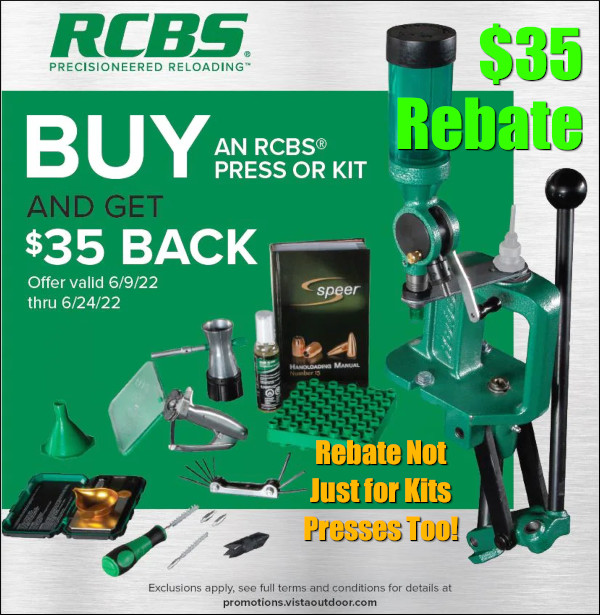
1. RCBS — $35 Factory Rebate on RCBS Press or Press Kit
⏺ $35 Rebate on RCBS Presses and Press Combo Kits
Here’s a great Father’s Day promotion, good through June 24, 2022. If you buy any qualifying RCBS Reloading Press or multi-product Press Kit, RCBS will give you a $35 Rebate. That $35 rebate represents a significant savings on a press. For example, a Rock Chucker Supreme Press is now $132.26 on Amazon. With the RCBS rebate, your net cost is just $97.26 for a Rock Chucker! Submit your Rebate Request ONLINE or with Mail-In Form. Here are the products that qualify for the RCBS Rebate:
2. Sportsman’s WH — Savage Precision Rifle & Vortex Sale
⏺ Save $250 on Savage Precision Rifles and Vortex scopes
Right now Sportsman’s Warehouse is running a big combo sale on Savage Precision Rifles and Vortex Optics. Some of the rifles and optics are discounted by as much as $250.00. This is a great opportunity if you want to get started in PRS/NRL factory class. You can see the deals together, or just Savage Deals or Vortex bargains. On sale for $799.99 ($200 off), the Vortex Razor HD Spotting Scope is a great value.
3. Urban Rifleman — Sierra .224/.308 MatchKing & BlitzKing SALE
⏺ Truly great prices on .22 Cal and .308 Cal Sierra bullets
Site sponsor UrbanRifleman.com is running a great close-out sale on Sierra MatchKing and Tipped MatchKing bullets. These prices are the best we’ve seen in a long time. Get .224 caliber 69gr MatchKings or 55gr BlitzKings for just $19.95 per 100ct box. Or, Palma and F-TR shooters can grab .308 caliber 168gr MatchKings or 168gr Tipped MatchKings for just $32.49 per hundred.
⏺ Save $250 on high-tech rimfire rifle with carbon-wrapped barrel
Save big with a $250.00 rebate on a very high-quality .22 LR rimfire rifle. The Christensen Arms Ranger 22 features an aluminum receiver, carbon fiber tension-wrapped barrel, carbon fiber composite rimfire stock, and a match grade Rem 700-style trigger. The Ranger 22 is backed by a Sub-MOA at 50 Yards guarantee. You can purchase from KYGUNCO for $570.37 after Rebate, or $599.99 (after rebate) direct from Christensen Arms.
5. Cabela’s — 15-45x65mm Spotting Scope, $349.97
⏺ Save $350 (50%) on good HD glass spotter, angled or straight
Here is a very good spotting scope with HD glass at a huge discount. Right now, as part of Cabela’s Father’s Day Sale, you can save $350 (50%) on the CX Pro HD 15-45X Spotting Scope with 65mm objective. Get the angled-body version (shown above) for $349.97 or the straight version for just $249.97! The CX Pro HD Spotter is also offered in a 20-60X version with 86mm objective for $549.88 (Straight) or $699.97 (Angled). We prefer the smaller 65mm version, which still has ample power and weighs 12 oz. less.
⏺ Get $100 Off on ultra-compact 9mm Beretta carry pistol
Here’s a great choice for concealed carry, at a very attractive price. The Beretta APX A1 Carry pistol retails for $399.00, and a $100 Factory Rebate lowers your net cost to just $299.00. The 9mm Luger APX A1 Carry has 4 frame color options: Black, Gray, Brown (FDE), and OD Green. This is an extremely compact pistol. OAL is just 5.63″, and it weighs a mere 19.8 oz. unloaded. The $100 Rebate is good through 8/15/2022. REBATE INFO HERE.
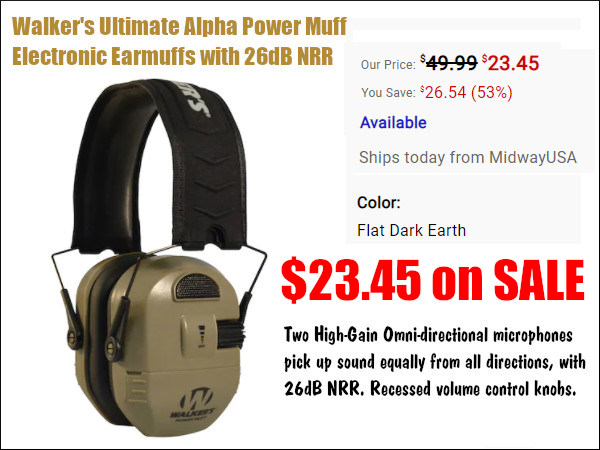
⏺ Save 53% on Good Quality Electronic Muffs 26dB NRR
We like Electronic Muffs when you need to hear range commands or get info from a team coach or your spotter. The Walker’s Ultimate Alpha Power Electronic Earmuffs are comfortable with good 26dB NRR. The two Hi-Gain omni-directional microphones pick up sound from all directions. These Walker’s Alpha Muffs are on sale now at MidwayUSA for $23.45 a 53% savings off normal retail. You could easily pay three times as much for other electronic muffs of comparable quality.
8. CDNN Sports — Savage Rascal .22 LR Patriotic Rifle, $199.99
⏺ Great patriotic choice as First Rifle for young shooter
July 4th is coming up soon. Here’s a patriotic rifle that’s a very good choice for a young family member’s first rifle. We like the patriotic American flag pattern red, white, and blue synthetic stock. And Savage calls this .22 LR Rascal rifle “the industry’s safest micro rimfire”. Shooters cock the rifle by lifting the bolt and unload without pulling the trigger. This eye-catching rimfire rifle features adjustable peep sights and user-adjustable AccuTrigger.
9. MidwayUSA — Tipton Best Gun Vise + Wheeler Gunsmithing Screwdriver Set, both for $79.99
⏺ Outstanding gun vise PLUS a 43-piece gunsmithing driver set
This is a great combo kit for working on rifles and shotguns. And right now you can save $60! The Tipton Best Gun Vise is stable, and offers plenty of storage for solvents, patches, small tools and parts. The vise can adapt to hold a variety of long guns, including ARs. Along with the Best Vise, you get a full 43-piece Wheeler screwdriver kit that has 40 bit options: standard (flat) (21), Phillips (4), Allen (10), and Torx (5). The adjustable driver handle is nicely designed and comfortable.
⏺ Versatile eye protection — 4 colors of lenses plus adjustable frame
Walker’s Adjustable Sport Glasses feature FOUR interchangeable lenses made of high-grade polycarbonate that exceeds ANSI 287.1-2003 High Impact Requirements. The interchangeable lenses come in four colors (Smoke Gray, Amber, Yellow, and Clear). The frames adjust for length and angle. These safety glasses ship with a soft carrying pouch that holds the extra lenses.
Ever wondered how factory ammunition is produced, from start to finish? How are brass cases made, how are bullets created, and how are finished cartridges produced on automated assembly lines? Today’s video showcase features six major factories that, collectively, produce bullets, powder, and finished ammo. We start with the Berger Bullet plant, follow by Vihtavuori powder production in Europe. Then we show the Remington (now Vista Outdoor) ammo plant in Utah, along with a Federal plant that produces rimfire ammunition. Last but not least, there’s an excellent, very informative video from the Norma ammo factory, plus a Hornady ammo plant video.
Bullets being seating at Hornady ammo factory.
Berger Bullets Factory Tour — Made in USA
In this video, Recoil TV takes a behind-the-scenes look at Berger Bullets, and how the outstanding, match-winning Berger bullets are created. The video covers the entire process — from raw materials, to the placement of bullet cores inside jackets, to the final ultra-consistent and uniform projectiles. To see the complete line of Berger Bullets, with full Ballistic data, visit BergerBullets.com
Vihtavuori Powder Production in Europe
Vihtavuori produces some of the most consistent, high-quality powder on the planet. Vihtavuori powders have been used to set world records and win countless championships in multiple disciplines. This excellent video goes inside Vihtavuori’s European production centers. It is really fascinating — you see how extruded powder starts with long spaghetti-like strings, before being finalized into the tiny sticks that we load.
Along with the powder production process, this video includes the entire VV production line, so you see how powder bottles are filled with powder and the tops of the bottles are secured by automated machines.
Remington Ammo Factory (Now Operated by Vista Outdoor)
This SHWATteam video visits the Remington ammunition plant in Arkansas. Vista Outdoor, the company that produces Federal, Speer and CCI ammo, purchased Remington’s ammunition business in Lonoke, Arkansas. Including the new high-tech plant in the back, this facility has the equivalent of 13+ football fields (1200 acres) under roof at its ammo plant, with over 1100 employees. Production capacity is impressive. When running at maximum output, this Remington ammo plant can crank out a staggering 7,000,000+ rounds every day. To produce that volume of ammunition, the facility needs a huge amount of resources: one million pounds of copper per month and 124,000 pounds of lead per day. Remington started manufacturing ammunition at this Lonoke facility in 1970, but some of the machines have been churning out ammo since long before.
Norma Factory Tour
Guys — honestly, if you do anything today on this site, watch this video. You won’t be disappointed. Guaranteed. This is a very informative (and surprisingly entertaining) video. Every serious hand-loader should watch this video to see how cartridge cases are made. The camera work and editing are excellent — there are many close-ups revealing key processes such as annealing and head-stamping.
VERY Informative Video Show Cartridge Brass and Ammunition Production:
Norma has released a fascinating video showing how bullets, brass, and ammunition are produced at the Norma Precision AB factory which opened in 1902. You can see how cartridges are made starting with brass disks, then formed into shape through a series of processes, including “hitting [the cup] with a 30-ton hammer”. After annealing (shown at 0:08″), samples from every batch of brass are analyzed to check metal grain structure and hardness. Before packing, each case is visually inspected by a human being (3:27″ time-mark).
Federal Rimfire Ammunition Production
Field & Stream Tours Federal Ammo Plant in Minnesota
A reporter for Field & Stream recently got a chance to tour the Federal ammunition production facility in Anoka, Minnesota. This large plant produces both rimfire and centerfire ammunition. While touring the plant, the reporter was allowed to capture video showing the creation of .22 LR rounds from start to finish. This is a fascinating video, well worth watching. Watch and learn how rimfire ammo is made.
Note to Viewers — After Starting Video, Click Speaker Icon to HEAR audio!
This revealing video shows all phases of .22 LR ammo production including cupping, drawing, annealing, washing, drying, head-stamping, priming, powder charging, bullet seating, crimping, waxing, inspection, and final packaging. We recommend you watch the video from start to finish. You’ll definitely learn some new things about rimfire ammo.
Hornady Ammunition Factory
If you wonder how ammo is made, starting with raw metal, check out this video from Hornady. It shows how bullet jackets are formed from copper, followed by insertion of a lead core. The jacket is then closed up over the core with the bullet taking its final shape in a die (a cannelure is applied on some bullet types). Next the video shows how cartridge brass is formed, starting with small cups of brass. The last part of the video shows how cases are primed and filled with powder, and how bullets are seated into the cases, using an automated process on a giant assembly-line.
Editor: Many new barrels will deliver higher velocities with the same load after 100-150 rounds through the bore. The exact reasons for this speed-up are not 100% certain, and velocity increases (if any) will vary from one barrel to the next. But this “speeding up” phenomenon is common, so be prepared if this happens with your next barrel. If you do experience a significant velocity increase you should probably re-tune your load AFTER the velocity stabilizes at the higher level.
From the Sierra Bullets Blog Article by Mark Walker, Sierra New Product Development Director
In a previous post, I discussed a couple of methods to tune a load to your barrel to help achieve the best accuracy possible. People most often work on load tuning if they get a new rifle or have a different barrel installed. In both instances, the barrel is new and has not been fired very much. According to most competitive shooters, this is the most accurate your barrel will ever be, so getting it tuned and shooting accurately is a priority.
The Speed Up Phenomenon After 100-150 Rounds
Even though after you work up a load and your new barrel is shooting great, a lot of shooters notice that at around 100 to 150 rounds their rifle may stop shooting as accurately. I had this happen to a rifle and I was confused as to why something that worked so well to begin with would all of a sudden quit shooting. I decided to break out the chronograph to do another load work up to see what was going on. To my surprise, the velocity had increased around 80 fps over the original velocity! After performing another ladder test and adjusting the seating depth, the rifle was once again shooting well.
There are several thoughts on why this may happen, however, you can rest assured that it does happen. One thought is that as the barrel breaks in, the tooling marks in the throat of the chamber smooth out and allow less resistance to the bullet as it exits the bore thereby increasing speed. Another idea is that the throat area starts to get a little rough which in turn causes more resistance which increases pressure and therefore more velocity. I’m sure there are some out there who have a better understanding as to why this happens, but it can definitely affect the accuracy of your rifle. So be aware and never be afraid to rework a load to keep your rifle in tune.
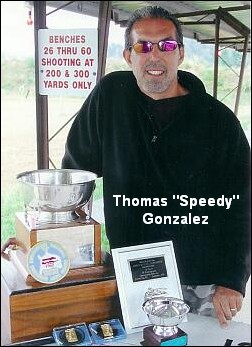
Experts Confirm That Barrel Speed-Up Is Common Two respected shooters have observed an increase in velocity with new barrels, typically after 100 rounds. Gunsmith and Hall-of-Fame benchrest shooter Thomas “Speedy” Gonzalez has documented barrel speed-up with testing. Moreover, Speedy’s bore-scope barrel inspections revealed a smoothing of the barrel lands. Jim See, a top PRS competitor, has encountered barrel speed-up many times. Accordingly, he re-tunes his load at 150 rounds.
“Alex Lipworth and I documented this phenomenon about four years ago and I have told all my customers about this. My son Mikee would shoot 100 rounds through all new barrels we planned on shooting before we would begin to do load development. We had a shooting snail that caught all the bullets set up in front of an indoor bench. We called it a wear-in process because upon careful examination of the bore when the ‘Speed Up’ takes place the cut-rifled bore resembles that more of a button-rifled barrels with the lands taking on more the softer look of a buttoned bore.” — Speedy Gonzalez
“Seen it [barrel velocity increase] too many times to count. All my match barrels get a ‘generic round’ loaded for them, which has worked well in barrels historically. After I hit 150 rounds I fine-tune the load and never look back, until the tube starts to slow down at it’s life end.” — Jim See
Get WAY Better Groups with New Criterion Pre-Fit Custom Barrel
In our Shooters’ Forum, you’ll find a lengthy thread about accuracy problems with a Savage LRPV, chambered in 6mmBR. The gun would repeatedly split groups at 100 yards, and at 300 yards, the “flyers” would open up the groups to 1.5 MOA or larger. Interestingly, the factory test target (at right) showed a split group — not a good sign.
The gun’s owner, forum member LR_Shooter, tried a variety of tweaks: “I did this, done that… [changed] torque, tang floated, bedded action, recut chamber, and [adjusted firing pin]”. But nothing really helped. Frustrated, LR_Shooter asked his fellow Forum members for help. Much advice was proffered, including the novel idea of removing the middle action screw in the Savage 3-screw target action. Some of the advice proved helpful, but none of the suggested remedies produced a major improvement. This rifle, out of the box, tossed flyers and no amount of tweaking (or changes in shooting technique) really cured the basic problem. That is, until, the factory barrel got replaced…
New Criterion Pre-Fit Barrel Works Wonders
LR_Shooter acquired a Criterion pre-fit barrel from Jim Briggs at Northland Shooters Supply (NSS). These pre-fits are designed for easy installation with the standard Savage barrel nut. Wouldn’t you know it, with a new 30″ heavy-contour barrel on the LRPV, the gun started shooting way better. No more crazy fliers, no more split groups, no more excessive vertical. And the improvement came without any other major modifications. LR_Shooter reports: “I got a replacement barrel from Jim at NSS. It is a 30″ bull Criterion barrel. So far, without playing with torque screws and having my old setup… I’m very satisfied with the barrel I got. Now I have no problem getting [groups] under 0.25 MOA. Finally this thing can shoot!” The targets below, shot with the new Criterion barrel, speak for themselves. The left target was shot at 100 yards, while the target on the right was shot at 300 yards (very impressive).
Targets Shot with Savage LRPV Fitted with Criterion Barrel
Moral of the Story — Sometimes A New Barrel Really Is the Right Solution
All of us have struggled at times with a rifle that won’t live up to expectations. This Editor personally struggled for over a year with a .260 Rem Savage with a factory tube. The gun tended to split groups and the POI walked as the barrel heated. I tried one powder/primer combination after another, working through a variety of seating depths over many months. I was persistent. Out of stubbornness, I just believed that sooner or later I’d find the magic load.
Well folks, sometimes there’s really nothing you can do about a sub-par barrel. It is what it is. To really improve a gun’s accuracy (particularly a gun with a factory tube), you may need to open your wallet and get a quality aftermarket barrel. Spending months trying one recipe after another may simply be an overwhelming waste of powder, bullets, and your precious time.
Albert Einstein supposedly said: “Insanity is defined as doing the same thing over and over again, and expecting different results.” Well that sort of describes my efforts with my .260 Rem. Once I had enough evidence that my barrel split groups no matter what load combo (and seating depth) I tried, it was time to pony up for a new barrel. When I did finally screw on a nice PacNor 3-groove SuperMatch, that Savage suddenly became a true tack-driver. As re-chambered in 6mmBR with the Pac-Nor, in calm conditions, my Savage will now consistently shoot in the twos with heavy bullets, and it can sometimes dip down into the ones with Berger 80gr flat-base bullets. The moral of the story here is simple — don’t waste weeks or months chasing your tail with a barrel that just won’t deliver (after a reasonable amount of testing). Save up for a custom barrel, get it chambered properly, and stop your cycle of frustration.
Are you in the market for your first handgun, for target use or for self-defense? The Winchester Blog has a good article for handgun buyers. This story, “Things You Should Know When Purchasing Your First Pistol”, provides many smart tips that can help you choose the right handgun, and save money in the process. In addition, the article explains how to train with your new pistol and handle it safely. READ Full Article.
If possible, you should test a variety of different pistols, to determine which works best for you. Check the feel, the ergonomics, the sight picture, and the controls. And, if possible, test the pistols with live-fire at a range which rents samples.
How do you know if your choice is right for you?
Once you’ve narrowed down choices, try to get time shooting the pistol(s) you are considering. You can usually rent guns at commercial ranges. This is an excellent way to “try before you buy.” NSSF has a list of places to shoot[.] When looking for a range that rents firearms, an online search and then a phone call to confirm what options are available is a solid plan. If you have friends and family who own a model you are interested in, ask if they will go to the range with you so that you can try it.
Take pistols for a test drive
First, dry-fire and manipulate the pistol. Can you easily lock the slide open? Are the sights suited to your vision? Then, fire a magazine or two of ammo [in a supervised range facility]. — Winchester Blog
The Winchester Blog article lists techniques that can help you get the “feel” for a particular firearm:
1. Practice the 4 Rules of Firearm Safety and make sure the gun is empty.
2. [After confirming the gun is empty] manipulate the slide, safety, magazine release, and dry-fire.
3. Perform a dry or empty magazine change — make sure you can hit the release and also reload a new magazine easily.
4. Perform a draw, or if you’re at a range where that is not allowed, simply pick the pistol up off the table and bring it up to your eye level and align the sights. Do this a few times. Can you acquire the sights quickly?
5. How does the backstrap fit your hand? Can you get both hands on the gun with enough “purchase” that you can really grip it well?
This Winchester Blog article is by Becky Yackley. Becky has competed in 3-Gun, Bianchi pistol, Service Rifle, NCAA air rifle, smallbore and air pistol events around the world since 1989.
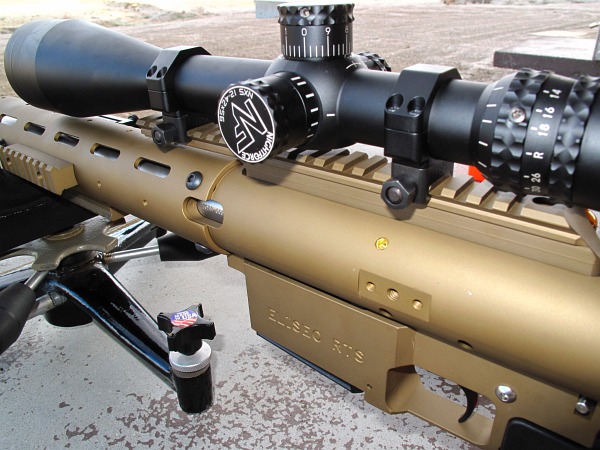
This article features an impressive .308 Winchester tubegun, crafted with an Eliseo (Competition Machine) RTS chassis, Borden action, and 30″ Krieger medium Palma Contour barrel. Owner Mark LaFevers chambered and fitted the barrel and assembled the rifle himself. What’s more, Mark even crafted his own muzzle brake, front/rear bag-riders, and his own, innovative “big-foot” bipod! Mark’s Do-It-Yourself (DIY) tubegun has proven as accurate as it is multi-faceted. Optimized to shoot the 155-grain-class match projectiles, this gun is a tack-driver. This Editor has witnessed the gun repeatedly put 3-round groups into one ragged hole at 100 yards. At 600 yards, the gun has held under 1″ of vertical in competition.
When it comes to versatility, it’s hard to beat a tubegun chambered in .308 Winchester. This rifle system can be used in High Power (Palma) competition, F-TR matches, Long Range Steel Matches, and Tactical Competitions. With the addition of a front sled, a modern tubegun can even be competitive in 600-yard benchrest matches, as demonstrated by Jerry Tierney, who, some years back, won the NBRSA 600-yard Nationals with an Eliseo (Competition Machine) tubegun.
Do-It-All Multi-Discipline .308 Win Tubegun for F-TR, Benchrest, Varmint Matches, Palma, and Tactical Competitions
by Mark LaFevers
The Concept — a ‘Do-It-All .308 Win’
This project began with a wish list developed after shooting in a precision tactical match in 2009. From that experience I knew I wanted a magazine-fed precision bolt gun sporting a high-quality, variable-power scope. I wanted a rifle that could be competitive in a broad range of gun games including tac comps and long-range prone events. If the gun could also double as a medium-range benchrest rig, that would satisfy the needs of the monthly club matches I shoot — a varmint steel silhouette match (shot from the bench), and an F-Class style prone event. I also wanted a gun that could shoot Palma matches someday (when I get around to learning to shoot with iron sights).
Because I like to build things, I’m always looking for projects that offer opportunities to customize and innovate to suit my needs. And because I’m interested in trying different shooting disciplines, I hoped to craft a rifle that could be reconfigured fairly easily to fit various needs. To maximize the gun’s potential, I chose to use only the highest-quality components for every aspect of this project. I planned on building as much of this rifle as I possibly could myself — and that would include chambering and fitting a barrel for the first time. Having much to learn, I would be relying heavily on the expert advice and goodwill of others for the gun’s success.
The Do-It-Yourself Approach — The Appeal of Building Your Own Rifle
Not everyone understands the DIY (do-it-yourself) approach to life. Why would anyone try to smith his own rifle, when he could have it done by competent professionals? There is the imagined prospect of cost savings. However, a home gunsmith may find that, at least initially, it costs more money to do it yourself when all the costs of tooling etc. are calculated. But doing it yourself is not just about saving money. There is a special satisfaction derived from building something with your own hands. For me the relationship between practiced hands, tools, materials, and knowledge of craft is important. The DIY approach surely means different things to different people. For me it’s about the quest for improvement, and an appreciation of the importance of craftmanship in history, and trying to do my part.
Whatever our craft, the fit and function of the things we care about ultimately define us. In this project I felt a responsibility to uphold certain standards. I also was motivated by the desire to give ‘homage’ to my distant relative Daniel M. LeFever, a gun-maker who left his mark on the firearms industry in the 1870s. “Uncle Dan” LeFever crafted high-grade double guns that rivaled the finest European doubles.*
Choosing Components for the .308 Win Tubegun
Looking over the range of suitable equipment, it did not take long to come across Gary Eliseo’s Competition Machine tubegun chassis kit. Initially intrigued by the beauty of the machine work in this aluminum stock, the more I looked the better this platform seemed. Gary’s RTS kit for Remington 700 and Rem clones accepts the proven AICS magazines and offers great stock adjustment flexibility. For more on that subject read German Salazar’s excellent article on Configuring the Eliseo Tubegun Stock.
When I learned that Jim Borden, BordenRifles.com, was building an action designed specifically for the Eliseo tubegun stock, the decision to go this route was made even easier. I had previously had the opportunity to admire close up the Borden action used by our top Club benchrest record holder, and I knew I couldn’t go wrong there. In selecting a trigger group, I knew I wanted a fully adjustable two-stage trigger that could be set for different pull weights for various shooting disciplines. At first glance Jewell seemed to be the obvious choices, but I asked if there were any products that might be better than the Jewell for my purposes. It was suggested that an American-made trigger by CG Jackson might do the trick, so I talked with Tom Myers of X-Treme Shooting Products. Tom’s company offered a fully-adjustable, 2-stage Mod 22 Tactical trigger that fits Remington 700 actions and their clones. It is offered with a fixed or moveable shoe, with or without a safety. I chose the fixed trigger shoe with no safety.
Choosing a Scope
Given my prior positive experiences with Nightforce products, a Nightforce scope was my first choice in optics. But I needed to select between the NXS (side-focus) and BR (front focus) models, and chose a magnification range. Because I wanted to play a variety of gun games from Tactical to Benchrest, it seemed to me that the NXS, with its faster side focus parallax adjustment, would be the more versatile choice. I went with the 12-42x56mm version so that I had plenty of magnification on tap for long-range precision work. I can still dial it back to 12 power for a wider field of view, as needed.
Mark bench-testing the gun during Load Development. The front rest is the superb SEB Neo Co-Axial.
Caliber Choice and Load Development
Choice of Caliber — .308 Win Offers Accuracy, Versatility, Long Barrel Life
Rather than agonize over the many caliber choices, I chose to step back and consider what I thought, in my experience, made winning shooters. Was it the caliber they were shooting or their training, skill and intelligence, that made them winners? While it is true that various calibers do have their specific merits, it is also true that an individual with five times as much training as you is likely to beat you with whatever caliber he or she is using. Case in point being the tactical match that got me started on this project, won by a young Marine shooting a .308 Win. While many other competitors had rifles with “faster, flatter, superior ballistics”, the Marine topped the field through his superior training, natural ability, and the keen edge of youth. With the right trigger puller, .308 Win was clearly still good enough to win this kind of match.
Among the arguments in favor of the .308 Win caliber for this project were:
I had positive previous experience with the .308 and was already set up to reload for it.
Very wide selection of performance-proven bullets.
Some popular disciplines, such as F-TR and International Fullbore, specify .308 Win (7.62×51) as one of the “permitted” chamberings.
Top shooters could provide guidance on .308 load development, and effective shooting techniques.
.308 Win offers long barrel life.
Weighing against the .308 Win were higher component costs and heavier recoil compared to many popular, smaller, mid-distance calibers, such as the 6mmBR, 6 Dasher, 6XC, and 6.5×47 Lapua.
Selecting the Optimal Barrel Configuration for my Bullet Selection
One way of narrowing the field of .308 bullet options is to choose a specific bullet that has performed well for winning shooters, and design the gun around the bullet. The weight of the bullet and its preference for a specific seating depth dictate the twist rate of the barrel and the depth of the chamber, which is also dependent upon whether you choose to single feed or magazine feed. Because I have had very positive experiences with Berger bullets, and becasue Berger Ballistician Bryan Litz was very positive about Berger’s 155.5gr Palma bullet, that was my starting bullet choice for this gun. Because Bryan had great 1000-yard success with a 1:13 twist barrel with the 155.5 bullet, but thought he might go with a 1:12 twist next time, I felt it would be interesting to try a 1:12.5″ twist. Krieger Barrels was able to privde this specific twist rate, and we hoped Krieger’s 5R rifling with a 30″ length would yield a fast barrel. Some extra velocity would help offset the velocity loss I might suffer by being limited to a mag-length COAL. (If I could load longer than mag length I could stuff in more powder and get more velocity.) The Krieger 5R proved a very good choice. From the start the barrel has cleaned up easily, it has delivered awesome accuracy, and it holds very tight elevation at long range. I’ve also been able to achieve very low ES/SD with this Krieger.
Gun Set-Up and Initial Testing
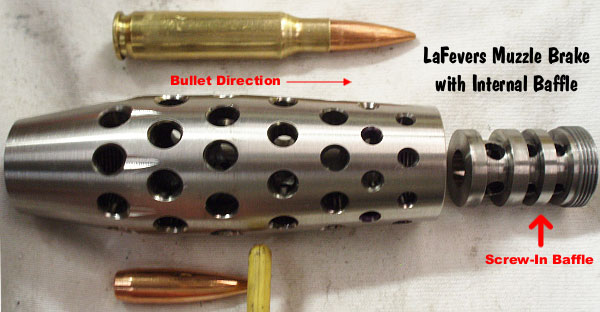
The first break-in of the rifle was done at 100 yards on home turf at the Ojai Valley Gun Club in California. Your Editor and I put 40 rounds through it using Krieger’s recommended break-in procedure. Our impression was that in less than 10 rounds the barrel was ready for competition. I shot the second 10 rounds looking at the performance of the variable muzzle brake I had built. Firing initially with only the one built-in baffle in place, a tremendous amount of gas was still blowing forward, made visually more pronounced by the frosty 29° air. Maximum recoil reduction was achieved adding the front baffle spool, so this is how the brake will be used. On disassembly after firing the forward faces of the baffle spool show descending amounts of powder residue from the gas entry to exit end, with almost no residue at the final baffle wall, showing most of the gas has exited to the side by that point. Attention to precision alignment shows the brake having no adverse effect on accuracy, as the last 20 rounds seated to various depths yielded a couple three-shot, one-hole groups at 100. At the end of the session I was pleased to find that the Krieger barrel cleaned extremely easily. Two wet patches cleared the powder residue and just a little copper showed up at the muzzle end by visual inspection.
The Jim Borden action has a really nice feel when single round loading, and good consistency feeding from the magazine with an authoritative hand. The ejector is very aggressive and will pitch the brass off the bench if it isn’t blocked from escaping. This action cycles very smoothly, and the beautiful workmanship shows even with the tubegun chassis mostly surrounding it.
Mark crafted two front sleds for the gun, one from metal, another from wood (which worked a bit better). Mark notes: “With the wood bag-rider in place the gun became quite stable, and you didn’t notice the high center of gravity so much.” Mark also made his own rear Bag-Rider.
Tubegun Wins First Fun Match
Shortly after breaking in the barrel, I took the gun down to a nearby range to compete in an informal 300- and 400-yard paper competition. I thought it would be fun to test loads while shooting in a club-level fun match. I was getting the best grouping at 44.5 grains of Varget, hotter loads were not doing so well, leading me to believe I needed to work up loads from 44.0 to 44.5 by tenths to find the sweet spot. In the 10-competitor match I squeaked out a win by 1 point. Still, a win is a win!
Load Development
I took the rifle up to the Ojai range at daybreak to run some load variations at 600 yards in still 26° air. I printed targets (sourced from AccurateShooter.com’s FREE Target Page) that had a 1″ red dot within a 5″ grid box. The dot made an excellent aim point at 600 yards. Here the capabilities of the Nightforce 12-42 NXS optic really became apparent. In the exceptionally clear, early morning conditions, I could see the dot AND the bullet holes — all at 600 yards downrange! I had set up my 72-power Meade spotting scope but didn’t use it as the Nightforce scope had more clarity and sharpness. There was no need to go downrange to check the targets, as bullet holes were clearly visible on the targets. This is great because I can make better use of the narrow window of perfect air in the morning, before the sun stirs thermals and mirage.
In this rifle, the Berger 155.5gr Fullbore bullet likes to be seated .010″ off what I’m calling “Max Jam”, using a Hornady OAL length gauge pressing the bullet softly into the lands, so the bullet just barely sticks there when the tool is removed. [Editor’s Note: At his optimal seating depth, Mark’s bullets are still in the lands, just .010″ shy of the max length he can load them without set-back.] The rounds are loaded to 2.850″ OAL to magazine feed. Even though I cut a “no-turn” chamber, I do lightly turn the outside of the case necks to uniform them. I like to look at bullet bearing surface length variations, using a Sinclair comparator body and two .30-cal inserts, one on the nose and the other on the tail of the bullet. With very uniform bullets like the Bergers this method is really only attempting to spot that random outlier bullet that varies in length enough to separate from the group. This is no knock on Berger, just a nod to the challenges of maintaining incredibly tight manufacturing tolerances.
Today’s five shot groups of Varget, jumping by tenths of a grain from 44.0 to 44.5 grains, showed the best grouping to be at 44.1 grains. The hotter loads were breaking the 2900 fps level, but the groups were not as tight as they were at the lower end. At 44.1 grains of Varget the five-shot group had a vertical dispersion of 1.9″ and a horizontal dispersion of 1.25″ at 600 yards, making that a keeper load.
Competition Load Selection and Performance
With a NBRSA 600-yard match fast approaching, I realized that with all the focus on testing I didn’t have enough Lapua brass to shoot the entire match. My solution was to fall back on once-fired Hornady Match brass, with which I have also had excellent luck. So, the day before the NBRSA match, I loaded up the best combinations of the Berger 155.5s with Hornady/Varget, Lapua/Varget, and Hornady/8208 for a final trial, and headed out to a 1000-yard range that’s a two-hour drive from home. Expecting to see the faster IMR 8208 edge out the Varget at this range, I was surprised to see the performance basically identical. With this last minute perspective I decided to shoot the six target NBRSA match using Berger/Hornady/Varget for the first three matches, then Berger/Hornady/8208 for the last three matches when the extra speed might help in a rising afternoon wind.
Match Results
Best results were in Match 1 using 44.0 grains of Varget to push the Berger 155.5 from the Hornady Match brass. Fortunately four bullets flew to a 1.44” group in the blue, unfortunately it was a five-shot match and one bullet flew high left. Excellent promise also showed in Match 6 with the IMR 8208 XBR powder yielding less than an inch of vertical at 600 yards. The lesson I learned from the event was that operator consistency was a much bigger factor than the technical limitations of the hardware or the ammunition. The gun can definitely shoot better than I can hold. I had the opportunity to shoot off a beautiful SEB NEO front rest in this competition. Although I am not a fan yet of joystick controls, this rest performed flawlessly and definitely had a positive effect on performance.
My Overall Impressions of the Project
For use as a benchrest rig, the tubegun provides an interesting challenge, because the pistol grip seems to make the gun much more sensitive to steering errors than a typical low-profile benchrest stock. You have to focus on consistency of grip. A light grip and firm cheek weld combination seems to work well at the bench, but the gun also responds well to a very firm grip and heavy shoulder pressure when fired in the prone position. Building an Eliseo tubegun is a great project and the finished product is a very versatile, fun-to-shoot gun! To encourage others with similar interests, let me just say that the products and components used in this project all get my five-star endorsement, without exception or hesitation.
The biggest challenge with this rifle lies in my own skill development — particularly for tactical matches. If you only have experience with known-distance shooting matches, you’ll need a whole new set of skills to be successful in unknown-distance (UKD) tactical competitions. These UKD matches require high levels of shooting intelligence and training. However, now that I have a rifle that instills confidence, I can work to improve my skills. Overall, I am very happy with the results of this project — the gun has certainly lived up to my expectations. It is rugged, accurate and very adept at “multi-tasking.”
DIY Machining — Chambering My First Barrel
One of my main objectives with this project was to do my own barrel chamber reaming and fit-up work. I had been studying and working from John Hinnants’s excellent book on Precision Rifle Barrel Making, building tools and working with the concepts, and felt myself to be ready to tackle the machining aspects of the project. Having local ace gunsmith Mac Tilton to talk to really helped me understand what would be needed. Greg Tannel’s excellent GreTan DVDs on how to set up a high pressure thru-the-barrel reamer flushing system and align the lathe tailstock properly for precision chamber reaming were invaluable. Greg’s off-the-shelf, hardware-store flow control layout makes the flushing system easy to regulate for other purposes as well. I built the reamer holder Greg describes in his DVD, and it too works well.
I began at everyone’s recommended starting point, which was to recheck the level of my lathe, a Jet 1340 gearhead belt-driven model. To accomplish this I used a precision 12” machinist level from Grizzly Tools. I can’t say the tool was easy to use because the leveling process is tedious as hell, but the level worked very well.
Dave Manson Shares His Reamer Knowledge
In researching which reamer maker to use to create the custom reamer for the Berger 155.5 fullbore bullet, which seems to like about .015″ jump to the lands, I was drawn by name recognition to Dave Manson’s products. In my years of thumbing through Brownells catalogs I was impressed with the thought Dave had put into the development of so many of his tools. During several phone conversations, I greatly benefited from Dave’s experience with chamber tolerances, cutting fluids and reamer modifications specific to thru-the-barrel flushing. To help spec the reamer, I sent Dave a couple dummy rounds built to magazine length so he could make a custom reamer to yield .015” jump and a no-turn neck. In no time I was using the Dave Manson reamer to practice with the flushing system on pieces cut from a take-off barrel, then checking dimensions using Cerrosafe castings. The dimensions were exactly as we had discussed, and I do mean EXACTLY! From the way Dave’s reamer worked in practice chambers, I knew this tool would produce a superior chamber.
Chambering Process with Tailstock DRO
For this project I set up a lathe tailstock digital readout from Grizzly, part # T10118, to help keep track of boring depth. Unlike relying on counting revolutions of the tailstock handwheel, with the DRO you are looking at the total travel measurement on a digital display, which is equally precise to the alternate dial indicator method. The chamber was cut in the stainless Krieger barrel at 60 RPM, using Mobilmet 744 heavy cutting oil diluted with mineral spirits, flushing chips from the reamer flutes at 100 PSI. For the last few thousandths of cut, lathe power was shut off and the cut completed by turning the reamer holder by hand while in-feeding with the lathe tailstock handwheel for precise depth and chamber dimension control.
To shorten this article up a bit and keep it on point for those interested in the rifle and not the process, let me just mention that details of some of the additional parts I made can be seen at my website: LaFeversFabricating.wordpress.com. Those parts include a muzzle brake of my design, my fast attach bipod design, a drop-leg level, wood grip, and wooden as well as metal front and rear bag riders for benchrest work.
Acknowledgements
For their participation and patience in supporting this project, and their tolerance of my myriad questions about parts and processes, I would like to thank, in alphabetical order:
Berger Bullets — Bergerbullets.com — Berger 155.5gr Fullbore Match bullets.
Jim Borden — BordenRifles.com — Stainless Rem. Clone action for Eliseo tubegun.
Gary Eliseo — CompetitionShootingStuff.com — RTS tubegun stock kit.
Grizzly Industrial — Grizzly.com
Krieger Barrels — KriegerBarrels.com — 30″ Medium Palma, 1:12.5″ twist 5R rifling, tight bore.
Dave Manson — MansonReamers.com — Custom .308 Win finish reamer for Berger 155.5 fullbore bullet.
Tom Myers — X-tremeShooting XTSP — CG Jackson Mod 22 Tactical 2-Stage Trigger.
Nightforce Optics — NightforceOptics.com — 12-42×56 NXS Scope with NP-R1 ranging reticle.
Greg Tannel — GreTanRifles.com — Lathe set-up and chambering DVDs.
*According to Chuck Hawks: “‘Uncle’ Dan Lefever was one of the greatest gun designers of his, or any, time. He founded several companies….The largest and best known of these, Lefever Arms Co., was eventually acquired by the Ithaca Gun Company around the time of the First World War. In the hey day of the classic American double there were guns galore and many different grades and price points, from plain field grade guns to masterpieces rivaling the best European guns. The Lefever Arms guns, for example, won medals at an International Arms Exhibition for ‘Best American’ and ‘World’s Best’ shotgun.”
I absolutely love using this press stand. I use it with my Forster Co-Ax as well as my Dillon 550. The stand mounts those presses at the right height to minimize fatigue and maximize torque. Some products I merely review and return but this one is a keeper and won’t be leaving my bench anytime soon. — F-Class John
Lyman Universal Press Stand REVIEW
Product Review by F-Class John
Positioning your press at the optimal height is one of the oldest problems in reloading. Most presses sit low off the edge leading to uncomfortable arm strain or inconsistent pressure being applied while using. Lyman has set out to fix that problem with a reasonably-priced ($69.46 at Midsouth) press riser that works with the vast majority of reloading presses. This unit will raise just about any press up off your bench securely, allowing you to working more comfortably from a standing position. This also frees up vital bench space UNDER the press. Unfortunately this press stand is so popular it is back-ordered at most vendors.
I have used a variety of presses over the years. At times I’ve run into issues mounting a press at a level that doesn’t promote arm or hand strain during normal operations. In the past I’ve used blocks of wood or even tried other brands’ proprietary stands. But I had very limited success with those options. Accordingly, I was very excited to give the Lyman Universal Press Stand a chance.
Lyman’s Universal Press Stand comes complete with side plates, two different top plates, and a large collection of mounting hardware. The two top plates are pre-drilled for numerous popular Single Stage or Progressive presses. Helpful diagrams and instructions show which side of the top plate you need to use. The pre-drilled holes accommodate a variety of presses from RCBS, Dillon, Lyman, Redding, and Hornady. But surprisingly, the plates are not pre-configured for the Forster Co-Ax Press.
CLICK to WATCH VIDEO Showing Lyman Universal Press Stand
Setting up the stand was very simple. The two sides bolt to the lower shelf unit at which point you attach the top plate. All the supplied bolts made this a breeze and once everything was snugged down, I was able to place it on my bench where I wanted it and mark the drill holes to mount it. After securing the stand to my bench it was time to mount my press.
Lyman Universal Press Stand with Dillon 550 Press
Adapting Lyman Universal Press Stand for Forster Co-Ax
At the time of testing I was primarily using a Forster Co-Ax press. With no pre-drilled Co-Ax configuration for either Lyman top plate, I decided to customize the blank side of one of the top plates. I opted to position the mounting holes so that the press could sit 100% on top of the mounting plate and not just off one edge. I found this process simple to execute. Mark your drill holes, then drill the plate. This can easily be done with regular drill bits although using a step-bit worked faster and cleaner to help enlarge the holes just a little when I needed some extra clearance.
Lyman Universal Press Stand Is Stable and Strong
Once set-up, I found the stand to be incredibly stable. The design allows for full force to be applied to the press no matter what the operation. Having used this Lyman Press stand regularly over the past few months with both my Co-Ax and a Dillon 550c, I still find myself loving it. The height is perfect and allows me to load as much as I like without straining my arm or getting fatigued. With an attractive price point (under $55.00 street price) and a simple design, I feel this is a great system for those looking for a secure and raised platform for their reloading presses.
The Universal Press Stand comes with two plates. If you have different presses that fit each plate you could easily swap presses just by changing plates while leaving the presses attached. It’s less functional if you have two presses that share one plate and would require removing one press before installing the next one.
Lyman Press Stand Unboxing and Set-Up (KFW Video Review):
At the NRA Annual Meetings in Houston, Colt’s Manufacturing introduced an impressive new rimfire revolver — the King Cobra Target 22 LR. Colt states: “From competition to plinking and small game hunting, this baby Cobra does it all and packs 10-rounds of .22 LR in its cylinder.” The King Cobra Target 22 LR is available with 4-inch and 6-inch barrel lengths, both with 1:16″ RH rifling twist. MSRP is $999.00.
The King Cobra Target 22 LR features USA-forged stainless steel construction. Designed and crafted for outstanding accuracy, new King Cobra Target 22 LR features a one-piece barrel/shroud with fiber optic front sight. The cylinder holds ten (10) rounds. The frame is fitted with an adjustable target rear sight and Hogue overmolded rubber grips.
This TFB Showtime episode examines the new .22 LR rimfire Colt King Cobra Target. The King Cobra Target 22 LR features a 10-shot cylinder, and the same adjustable target sights as the .357 Magnum version.
“We are very excited to debut this new Baby Snake to our customers at NRA Annual Meetings,” said Justin Baldini, VP of Product Strategy, Colt CZ-USA. “Shooting .22 LR is such an important part of shooting sports. It’s where we come to learn as a beginner; and where we return as seasoned shooters to cost-effectively enjoy more time at the range. We’re confident that new and old Colt fans will love what we’ve done with the new King Cobra 22 LR.”
All-American built, the King Cobra Target 22 LR was designed and made to be shot — a lot! It should deliver exceptional accuracy and good reliability. Expect to see these revolvers at formal and informal rimfire competitions at gun clubs around the nation.
Commentary: We applaud Colt for introducing this new .22 LR wheelgun. Rimfire revolvers are great. This Editor owns a Smith & Wesson Model 617 ten-shot rimfire revolver that has easily fired more rounds than all his other handguns combined. A .22 LR revolver is great for training and fun for plinking. Like the Model 617, this new Colt .22 LR wheelgun offers minimal recoil, great reliability, a nice sight radius, and affordable shooting. In addition, if you shoot single-action slow-fire, the trigger pull is light and crisp — better than the vast majority of semi-auto pistols. We think this new “Baby Snake” will be a great addition to any shooter’s collection.
At the request of our readers, we provide select “Deals of the Week”. Every Sunday afternoon or Monday morning we offer our Best Bargain selections. Here are some of the best deals on firearms, hardware, reloading components, optics, and shooting accessories. Be aware that sale prices are subject to change, and once clearance inventory is sold, it’s gone for good. You snooze you lose.
⏺ Superb Lapua cartridge brass — very uniform, long-lasting
As with bullets and powder, top-quality cartridge brass has been in high demand. But Creedmoor Sports has a large supply of long-lasting, high-quality Lapua cartridge brass. Many of the most popular types are available including .220 Russian (for PPC), .223 Rem, .243 Win, 6mmBR, 6mm Creedmoor, 6.5 Grendel, 6.5×47 Lapua, 6.5 Creedmoor, .260 Rem, 6.5-284, .284 Win, .308 Winchester, .30-06, 300 PRC, .338 Lapua Magnum and more. As an added incentive, during Memorial Day Weekend, you get FREE ground shipping on orders over $149.00 (some exclusions apply).
2. Precision Reloading — 10% Off Orders $49+ with Code MD22
⏺ Save on full range of products — store-wide 10% Savings
Here’s great opportunity. Right now you can Save 10% on nearly all products at Precision Reloading with CODE MD22. This 10% Off discount applies to all order over $49.00 total. Save on tools, dies, presses, bullets, powder, brass, optics, gun cases, and more. This offer applies to online purchases of in-stock items online. The 10% OFF Savings works through 11:59 pm CT on Monday 5/30/22.
3. Natchez — 10% Off Nearly All Products with $99+ Purchase
⏺ Save on nearly all products — site-wide 10% Savings
Now through Monday evening you can save 10% on all items at Natchez Shooters Supply. This includes ammo, bullets, brass, powder, primers, optics, reloading tools, gun cases, hunting supplies and more. For 10% site-wide savings, use Code P220528 during checkout. But don’t hesitate — the 10% OFF deal terminates at 11:59 pm CT on Monday, 5/30/22.
4. Primary Arms — Memorial Day Sale, Many Products
⏺ Major sale with all types of products discounted
Primary Arms is running a big Memorial Day Sale with dozens of products with big discounts. Save on AR parts, AR receivers, Optics, Slings, Shooting Mats, Carry packs, magazines and more. One of the best deals is a 3-Day Expandable Backpack for $19.99 (marked down from $54.99). Or get a complete AR15 bolt carrier group for $64.99 (marked down from $109.99). Other Memorial Day discounts include: 20% Off Expo Arms, Up to 20% Off Aero Precision, 25% Off North American Rescue, and 30% Off Vertx.
5. Pyramyd Air — Kral Arms Puncher Breaker Air Rifle, $429.99
⏺ Quality competitive field Air Rifle at 21% savings
Here’s a quality air rifle for Field Target and other airgun field sports. The Kral Arms Puncher Breaker Silent Sidelever Air Rifle is offered in .177, .22, and .25 calibers. This rig features a nice two-stage adjustable trigger and Weaver/Picatinny scope rail. There is adjustable power with 2900 psi fill pressure (200 BAR). The barrel is half-shrouded for extra-quiet shooting. Choose either the walnut-stocked version, or a synthetic-stocked model with nickel-finish barreled action. Both are priced at $429.99, a full $120.00 off the regular price.
6. Crimson Trace — Memorial Day Bundles, Save 13% to 30%
⏺ Crimson Trace makes excellent optics — bundles are big bargains
Crimson Trace makes very good optics for all types of firearms. Right now, through May 31, 2022, Crimson Trace is offering Six Combo Packages (“bundle deals”) with big discounts. The #5 Bundle includes the excellent 6-24x50mm FFP Hardline Pro scope PLUS a CT-RAD Max Red Dot optic. These two products would normally retail for $1,499.98 (combined price), but now you can get them BOTH for $1,249.90 — that’s a $250 savings. There are five other great bundle deals.
7. L.E. Wilson Tools — 10% Off and Free Shipping
⏺ L.E. Wilson makes outstanding tools and dies — now shipped for FREE
L.E. Wilson currently offers 10% OFF all online orders (prices reflected in cart). In addition, now through 11:59 pm on Monday 5/30/2022, L.E. Wilson offers FREE Shipping on all orders. Take advantage of these special Memorial Day Weekend savings on outstanding Wilson tools and dies. NOTE: The 10% Off discount is already reflected in the Wilson online shopping cart total.
8. Midsouth — Free Shipping over $49 + Accurate Powder Sale
⏺ Get FREE Shipping plus Accurate powders in stock at good prices
As a Memorial Day Promotion, Midsouth is offering FREE Shipping with purchases of $49 or more (HazMat charges are extra). And if you need reloading powder, definitely head over to Midsouth, which has a huge selection of Accurate brand powders IN STOCK at attractive prices, typically $31-$35 per pound.
9. Bruno’s — Memorial Day $9.95 Shipping and $19.95 Hazmat
⏺ Major savings on product shipping and Hazmat charges
Now through Memorial Day (5/30/22), Bruno Shooters Supply is running a special promotion. Shopper will get $9.95 Flat-Rate Shipping for most orders, including barrels, actions, stocks, scopes, bullets, brass, dies, presses and much more! And for HazMat (powder/primers) shipping, the HazMat charge has been slashed to $19.95, a major savings. Visit Brunoshooters.com.
10. CDNN Sports — Colt 1911 .22 LR by Walther, $429.99
⏺ Handsome, accurate .22 LR handgun with perfect 1911 ergonomics
The Colt 1911 A1 “Rail Gun” pistol is a full-size, .22 LR rimfire version of the legendary Colt 1911 handgun. It includes low-profile combat sights, beavertail safety, and frame accessory rail. This handsome, full-size rimfire 1911 pistol is manufactured by Walther under license from Colt. This blow-back operated pistol features a 5″ barrel and 12-rd magazine. For 1911 fans, this makes a great rimfire addition to your pistol collection. Get the Flat Dark Earth version for $429.99 or the Matte Black version for $419.99.
11. KYGUNC0 — Memorial Day Ammunition SALE
⏺ Great savings on pistol and rifle ammunition
Right now KYGUNCO is running a great AMMO SALE. You’ll find very attractive prices on name brand pistol and rifle ammunition. For example, Nosler .45 ACP ammo is just $26.99 per 50-round box, and 200 rounds of Winchester 9mm ammo is just $69.99 on sale. In addition, KYGUNCO has a super deal on the Citadel Warthog 12ga tactical shotgun — just $209.99.
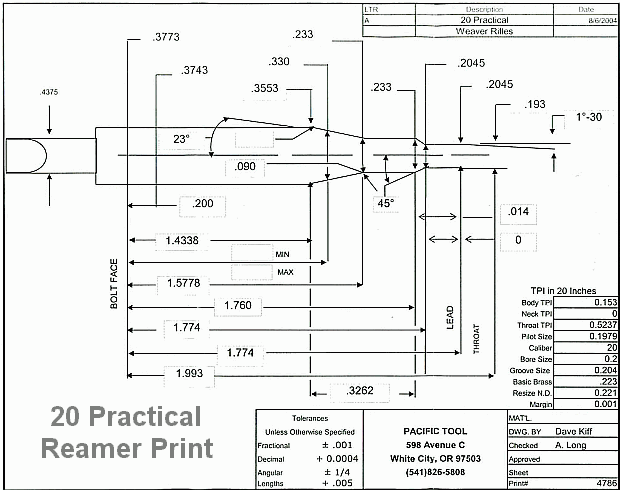
If you want to use an AR-platform rifle in the varmint fields, consider getting a 20-caliber barrel chambered for the efficient, low-recoil 20 Practical cartridge. The 20 Practical is simply a .223 Remington necked down to 20 caliber. The parent .223 Rem cartridge of course works great in an AR, but the 20 Practical offers some notable advantages for high-volume varmint shooters. The 20 Practical delivers very high velocity with very low recoil while still providing outstanding accuracy. The 20 Practical is great option for folks who favor “fast and light” — smaller, lower-mass bullets traveling at very high velocities. This little cartridge can launch 40-grainers at over 3900 fps, and 32-grainers even faster. This makes the 20 Practical a great choice for an AR-based varmint rifle.
20 Practical Ultimate Varminter
A decade ago, as a “proof-of-concept”, AccurateShooter.com created a 20 Practical AR15 Ultimate Varminter with a custom 20-caliber upper from Robert Whitley of AR-X Enterprises, LLC. That project rifle was ultra-accurate — every 5-shot group out of the gun was less than the size of a dime. That gun was auctioned off, but Robert Whitley continues to produce custom 20 Practical AR15 uppers. (The 20 Practical cartridge is simply the .223 Rem necked down to 20 caliber — you can use standard .223 brass and load with standard.223 Rem dies. Just swap in a smaller expander and use smaller neck bushings.)
Robert learned that the accuracy of the first 20 Practical AR15 was no fluke. After building six (6) more 20 Practical uppers, he tested them for accuracy and they all shot great. These uppers feature DPMS low-pro receivers with side-charging handles. They are fitted with PacNor 1:11″ twist, 3-groove stainless barrels.
Robert reports: “We have been making more 20 Practical AR15 uppers and I have to say I am astounded by the accuracy of these things. For shooting little tiny groups out of an AR15 with bullets going 3500+ fps, it’s hard to beat the 20 Practical. Today I test-fired six more uppers, all with 11-twist barrels. Three of the uppers had 24″ barrels, two had 20″ barrels, and one had an 18″ barrel (we call it ‘Stubby’).
In four of these uppers I shot re-sized Winchester brass using 25.3 grains of WC844 powder with Berger 40gr BTHP bullets loaded at 2.225″ OAL (about .015″ off the lands). WC844 is inexpensive military surplus powder that is nearly identical to H335. I tried three different primers and the choice did not seem to matter (CCI BR4, Rem 7 1/2s and Win Small Rifle — the old silver ones). All these four uppers shot great.”
Below is an animated GIF with targets from uppers #6, 10, and 11. All groups are mag-fed, 5-shot groups shot at 100 yards using a front rest and rear bag.
Targets Shot with Three Different 20 Practical AR Uppers
For more INFO visit www.6mmAR.com, or email: rcw3 [at] erols.com.
20 Practical Shooters Explain Why They Love this Little Cartridge
A current thread in our Shooters’ Forum focuses on favorite variants of the .223 Rem cartridge. The thread asks: “What is your favorite and most versatile round that you have made from a .223 Rem parent case?” Many cartridges were named, but the wildcat cartridge cited most often was the 20 Practical. Here are some comments by Forum members, who explain the appeal of this great little 20-caliber cartridge:
“The 20 Practical is just a hoot to shoot. Outstanding precision, minimal recoil, easy case forming and inexpensive to shoot. What’s not to like? It’s a great way to introduce kids to centerfire, too.” — JLT
“The 20 Practical for me. Never had as much fun shooting a rifle as I did with the 20 Practical. Also, [it is] the easiest wildcat to form. Just get cases, a couple of bushings to get the right neck tension, and you are shooting.” — NMKid
“Favorite .223 Rem Wildcat? The 20 Practical hands down for me. I have two of them built on Savage actions right now. One has a 20″ BHW barrel and the other has a 26″ Criterion. It is my go-to caliber for shooting up a Prairie Dog town and the ones I have are insanely accurate. Here are some typical 100- and 200-yard groups with my 20 Practicals.” — IA_Shooter
“My favorite was and is the 20 Practical. No fire-forming, no neck-turning, and with the increased BC of the 20 Cal bullets, it’s hard to wipe the smile off your face in a prairie dog town[.]” — Region Rat
“20 Practical and the [original] .223 Rem are my favorites. Accurate, cheap to shoot. The 20 Prac allows you to see your hits and it’s fast.” — Alguapo
“20 Tactical or 20 Practical. Both very easy to reload and/or form from .223 brass. And they are accurate, reach out on varmints at surprising ranges.” — Bill K
Smart Tips on Forming 20 Practical Cases
Varmint ace Warren B, aka “Fireball” in our Forum, explains how to form 20 Practical Cases. “Forming 20 Practical cases is very easy and no fire-forming is required. Start with any good quality .223 Rem brass. One can simply run the case into your bushing die with the appropriate bushing and call it done. I however like to make it a little more involved by doing the neck reduction in steps. I find that taking steps doesn’t overwork the brass as much as one step does. Also, if you resize the neck in too large of a step, sometimes, depending on the neck thickness, the neck will not be dimensionally what you would expect when finished. This is especially important towards the last step when one is getting close to the final required neck diameter.
For my cases the first thing I did was to run them into an old RCBS .223 Rem full length die with the decapping assembly removed. This will take care of any dented necks on the raw cases and bring the necks down to around 0.243″. Since all standard full-length dies oversize the necks way too much, starting with a .223 FL die actually reduces the neck diameter quite a bit–and obviates the need to buy an extra bushing for the first step. I then use my Redding Type-S die with two bushing sizes to get down to where I need to be. In other words, I start with the FL sizer, then move to a Type-S with a 0.233″ bushing and finish with a 0.228″ bushing. Notice how, as I get to the final step, I use progressively smaller increments in size between the reductions.” (Note: Depending on your brass your final bushing size may be different.)
20 Practical vs. 20 Tactical
Varminter Kevin Weaver, who shoots both the 20 Practical and 20 Tactical, states that: “Both the 20 Tactical and the 20 Practical are fine .20 caliber cartridges. However, my favorite would be the 20 Practical. The 20 Practical gives the SAME performance as the 20 Tactical without fire-forming, or having to buy expensive forming dies.
So with the 20 Practical you do less work, you shell out a lot less money, yet you give up nothing in performance. What’s not to like? To create 20 Practical cases, just buy a .223 Rem Redding Type “S” Bushing Die set with a .230 or .228 bushing and have fun with this great little cartridge.
The 20 Practical and the 20 Tactical are almost identical cartridges. There are only slight differences in case outside diameter, shoulder angle, and case body length. Neck length on the 20 Tactical is a bit longer, but there is still plenty of neck on the 20 Practical to grip the popular bullets, such as the 32gr V-Max.”






 Norma has released a fascinating video showing how bullets, brass, and ammunition are produced at the
  If you wonder how ammo is made, starting with raw metal, check out this video from
 Two respected shooters have observed an increase in velocity with new barrels, typically after 100 rounds. Gunsmith and Hall-of-Fame benchrest shooter Thomas “Speedy” Gonzalez has documented barrel speed-up with testing. Moreover, Speedy’s bore-scope barrel inspections revealed a smoothing of the barrel lands. Jim See, a top PRS competitor, has encountered barrel speed-up many times. Accordingly, he re-tunes his load at 150 rounds.


 In our


 The Concept — a ‘Do-It-All .308 Win’



 20 Practical Ultimate Varminter


 Varminter Kevin Weaver, who shoots both the 20 Practical and 20 Tactical, states that: “Both the 20 Tactical and the 20 Practical are fine .20 caliber cartridges. However, my favorite would be the 20 Practical. The 20 Practical gives the SAME performance as the 20 Tactical without fire-forming, or having to buy expensive forming dies.


