MagnetoSpeed’s technology has completely changed the market for firearms chronographs. With a MagnetoSpeed barrel-mounted chrono you can quickly and easily record muzzle velocity (MV) without having to set up tripods or walk down-range. The compact MagnetoSpeed chronos are easy to set up and transport. With the full-featured V3 model, everything you need comes in a small fitted case. In the top photo are the components used with the MagnetoSpeed V3 Kit:
1. V3 Bayonet sensor
2. Display and control unit
3. Bayonet spacers (plastic and rubber)
4. Cords and mounting hardware (left), suppressor heat shield (right)
5. Alignment rod (square cross-section)
6. Rail adapter (sold separately)
Our friend Gavin Gear of UltimateReloader.com reviewed the MagnetoSpeed V3 and came away impressed. Gavin explains that a good chrono is essential: “If you want to load and shoot precision ammunition, you need the tools that will produce and validate the precision of your loads. A good chronograph is one of those tools! In this post I’m going to introduce you to the MagnetoSpeed V3 chonograph, the high-end electromagnetic chronograph which fills out the top slot in MagnetoSpeed’s equipment portfolio.”
In this 11-minute video Gavin reviews MagnetoSpeed’s top-of-the-line V3 Chronograph. He shows what ships with the unit, how to set it up for both rifles and pistols, and then he puts it through its paces showing how it captures velocity data. Gavin says he will follow-up with future videos showing how to link the MagnetoSpeed V3 to your mobile phone and how to log velocity data for future reference. To learn more about this high-tech chrono, visit UltimateReloader.com.
We’ve done some bullet casting in the past, both for handgun bullets, and the large, heavy (400gr+) projectiles used with Black Powder Cartridge Rifles. We can say, unequivocally, that newbies should seek out the assistance of a skilled, experienced mentor, who is familiar with the important safety procedures that must be employed. Working with molten lead can be dangerous. And it also takes some skill to get good results (without visible casting flaws), particularly with very large bullets.
There are valuable resources that can help you get started with the casting process. Wolfe Publishing offers two DVDs that cover the bullet casting process from start to finish. Bullet Casting 101 takes you through the basics: showing you how to choose the correct alloy for your application, prep molds, maintain the optimal temperatures, and lube and size bullets. The important steps are laid out clearly. In addition, Bullet Casting 101 helps you select the right equipment and preferred molds for your particular application. (To create uniform rifle bullets that shoot accurately, you really do need high-quality molds.)
Wolfe Publishing offers a companion DVD, Casting Premium Bullets for Handguns, that covers more advanced techniques for high-volume pistol bullet production. This DVD covers both single-cavity molds and multiple-cavity “gang” molds. (Gang molds can be frustrating at first; it is harder to maintain perfect temp control and mold separation is more complex). The DVD also reveals the sources of most common casting flaws, and explains how to detect cracks, voids and other common problems.
You’ll save considerable time and effort if you really understand how to avoid common mistakes before you start pouring lead. And you’ll get the best results if you learn how to “blend” the optimal alloy for the job. Maintaining the right mold temperature is also critical for good results. These topics and more are covered in these two DVDs, priced at $20.00 each on Amazon.
Good Books about Bullet Casting
Along with these DVDs, there are some excellent print resources about bullet casting. Here are two good bullet casting books we recommend. Every serious bullet caster should own Lyman’s Cast Bullet Handbook, now in its 4th Edition. We also like Casting Premium Bullets for the Black Powder Cartridge Rifle by Paul Matthews (Wolfe Publishing).
We used the Matthews book to improve our cast bullets for a Pedersoli 45/70. Notably, with factory-made cast bullets, that rifle shot about 3″ groups at 100 yards. With custom cast bullets, accuracy was nearly twice as good. We were also able to choose a custom mold that produced bullets with a much higher BC, which helped with long-range matches.
Old “Number 2″ belonging to Ray Gross. Click Photo for full-screen Image.
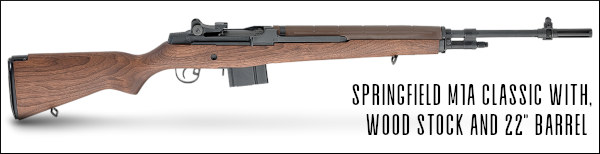
Ray Gross, one of America’s great rifle competitors, has served as captain of the United States F-TR Team. While Ray is best known for his F-Class shooting and leadership, Ray is also an experienced service rifle shooter, who secured his Distinguished Rifleman Badge 25 years ago. Ray has shot many rifles during his competitive shooting career, but the M1A rifle above held a special place in Ray’s heart. This old semi-auto earned Ray his Distinguished Badge, and he’ll never forget that, though he parted with the rifle in 2016.
Posting back in 2016, Ray told us:
“I said goodbye to an old friend… Affectionately known as ‘Number 2′, she is the rifle that I earned my Distinguished Rifleman Badge with in 1995 (#1159).
That rifle was also responsible for a fair amount of Venison in the ’90s, as well. But since then, she has spent a lot of time in the closet. Last time I got her out was to destroy a bunch of hard drives containing evidence collected during my Computer Forensics days. She deserved better than that.
I will miss the beautiful sound of all that American steel slamming into battery when I tripped her bolt.” – Ray Gross
Ray Gross was profiled in Shooting Sports USA last year. He explained how he started his competitive shooting career with an M1A rifle:
How did you begin in competitive shooting?
I began competing in 1991, at age 27. I bought an M1A and joined the Midland County Sportsman’s Club. One day I was at the club shooting the M1A when a member, Rich Koskela, came over and invited me to join them shooting competitions. Up until that point, I had no idea there was such a thing as NRA Competitive Shooting and I had been a member since 1986. Anyway, Rich and some of his friends showed me the basics and at my first match, I finished in the top half and first MU.
What are your major accomplishments in the shooting sports?
In 1995, I earned the Distinguished Rifleman Badge and a few years later switched to Palma rifle. On the way to making my first Palma team in 2003, I won the Army Cup, the Andrus trophy twice and the Sierra Trophy once. As a coach, I won the Herrick match, and seven F-TR National Championship team matches. Internationally, I’ve coached three gold medal America Match teams (The USA has only won four in Palma Rifle), and earned a Silver and Bronze coaching on the Palma Team in 2015 and 2019. In 2017, I led the U.S. F-TR Team to a World Championship. This year (2019), I also won the NRA ELR National Championship (25-lb max Division).”
“Descended from the M1 Garand, the M14 utilized multiple improvements that made it a far superior firearm for combat and a much better rifle for competition.” — Dick Jones, Shooting Sports USA.
In the April 2018 issue of Shooting Sports USA, you’ll find a good article on the civilian version of the M14, now sold commercially as the Springfield M1A. An evolution of the battle-proven M1 Garand, the M14 was designed to shoot the 7.62×51 (.308 Win) round instead of the larger .30-06 Springfield cartridge used in WWI, WWII and Korea. While the vast majority of today’s M1As are chambered for .308 Win/7.62×51, Springfield Armory also produces a 6.5 Creedmoor version.
Dick Jones reports that accurized M14/M1As could post remarkable scores: “The accuracy potential of the M14/M1A is unquestionable. During their reign as service rifles, they produced multiple perfect 200 scores at 600 and 1000 yards in the hands of top shooters. This is a difficult feat with a modern, scoped, magnum-caliber rifle and remarkable with an iron-sighted battle rifle. Good competition rifles can group 10 shots under one MOA, and the meticulously-massaged rifles used by the top shooters during my career would consistently put up 10 shots under an inch at 200 yards off a test cradle.”
For many years, the semi-auto version of the M14 was “top dog” in iron sights Service Rifle competition. Now that discipline is dominated by .223 Rem (5.56×45) AR-type rifles, but the bigger .308-caliber rifle, now sold as the M1A, remains popular. And in non-pandemic years, the CMP hosts a major M1A Match at Camp Perry, sponsored by Springfield Armory. This is a very popular event with 100+ competitors and significant cash prizes.
See how the modern M1A is built in this Springfield Armory Video:
As racing improves automobiles, competition improves firearms, and the current crop of Springfield M1As, from the Basic to the top-of-the-line Super Match and Loaded models, reflects the years of development. The M14 and its variants are … still considered by many to be the best battle rifle in the history of the U.S. Military. — Dick Jones, Shooting Sports USA
Military Version Operation Revealed — M14 Training Film
The original military version of the M1A was the select-fire M14. The 27-minute official U.S. Army video below demonstrates the operation of the M14. Field-stripping is shown from the 5:13 time-mark through 8:30. Cut-away drawings show the M14’s gas operation at 8:40.
Watch M14 Functioning Cycle Starting at 9:25 Mark:
The M14’s complete 8-step functioning cycle is demonstrated from the 9:25 time-mark through 22:41. These eight operations are: 1) Feeding; 2) Chambering; 3) Locking; 4) Firing; 5) Unlocking; 6) Extracting; 7) Ejecting; and 8) Cocking. This movie is fairly long, but fans of battle rifles will find it well worth their time. Every M1A owner should definitely watch this video start to finish.
Looking for a match-worthy PRS/NRL rig for under $1750.00? Check out Savage’s new Elite Precision Model 110. GunsAmerica Digest recently did a very thorough test of the 110 Elite Precision, declaring that this modern Savage is “Competition-Ready Out of the Box.”
The 110 Elite Precision has many notable features:
1. Modular Driven Technologies (MDT) Adjustable Core Competition (ACC) Chassis
2. Trigger adjusts from 1.5-4.0 pounds
3. Barrel comes with timed muzzle brake from factory
4. MDT Stocks easily accepts Weights and Accessories
5. Takes AICS-compatible Magazines
6. Titanium Nitride coated bolt body
This rifle boasts an excellent MDT ACC modular chassis. GunsAmerica stated: “Combined with the excellent trigger, an AR-compatible vertical grip, flared magazine well, and AICS mag system (along with a host of additional features), the 110 Elite Precision comes with everything you need [for PRS/NRL matches].” The stock has ARCA rails on the fore-end and M-LOK mounting points for accessories and/or weights. You can add an additional 9 pounds of steel to customize the balance/mass of the rifle to improve stability and minimize recoil.
The Cheekpiece and Buttpad are adjustable, along with Length of Pull (LOP).
Another reviewer noted that the 110 Elite Precision has important accurizing tweaks from the factory: “Key upgrades include a blueprinted action … Savage squared the receiver face and cleaned up the receiver threads to ensure they’re concentric with the barrel’s bore. This combination goes a long way in eliminating the occasional flyer that can ruin a good group or cause a miss in a match.” Source: GunsandAmmo.com.
Decent Accuracy with Factory Ammo
What kind of accuracy can you expect? Decent for a factory barrel and factory ammo. With Hornady 6.5 Creedmoor ammo, shooting off a sled, the test rifle delivered 1.1-MOA average groups. We would expect considerably better accuracy using a proper front rest with a bag-rider fitted to the fore-end. Likewise, the gun would almost certainly shoot better with handloads with Lapua brass and Berger bullets. Handling was good: “The Elite Precision is about as shootable as it gets. The 12.6-pound rifle produces very little recoil with the 6.5 Creedmoor cartridge, and … the ACC chassis can be weighted to control recoil even further.”
Actual owners have been impressed with the 110 Elite Precision. One buyer posted: “You couldn’t build a complete PRS rifle that is this good of a platform for even close to the price!” GunsAmerica tester Jordan Michaels concurred that this rig is a great choice for PRS/NRL factory-class: “If you’re in the market for a rifle to compete in a long-range competition, the Savage 110 Elite Precision is an excellent choice.”
Many of our readers are thinking of trying out PRS-type competition. Tactical matches are becoming more popular every season. Along with F-Class, tactical/practical disciplines are the fastest-growing forms of competitive rifle shooting. Rich Emmons, one of the founders of the Precision Rifle Series (PRS), has written an insightful article about getting started in the tactical game. This will help PRS novices pick the right equipment and understand the game. Here are highlights from Emmon’s “PRS — Intro to Competition” article, originally published on the PRS website. You may also want to read the current PRS FAQ Page.
Precision Rifle Series — Intro to Competition
by Rich Emmons, PRS President
Tactical Shooting with a precision rifle is not like other disciplines, there is no set course of fire or format. That is what makes it so fun!
First, you have to ask yourself what do you want to accomplish. When I was introduced to long range shooting, immediately a light turned on for me, once I saw how easy it was to hit 300–600 yard targets. What I quickly learned from my first competition and the many that followed was there is so much to learn and shooting in competition put everything you thought you knew to the test. So back to the question: “What do YOU want to accomplish?”. The reality is you may not know yet, you just think it is cool to have a bad ass rifle and scope that can make almost any shot. Now if you’ve got that rifle and scope, it’s time to take it to the next level.
Watch PRS 2016 Championship
Getting Started — What to Expect
If you’re reading this, you have probably already have been bitten by the long range shooting bug. It can seem quite intimidating to just jump in with a new bunch of shooters you don’t know and shooting lingo you don’t quite understand yet. But here is the key — show up and shoot! I guarantee you if you show up to a match as a new shooter, other experienced shooters will guide you along and give you help on anything you need.
AUDIO: Click Button to hear Rich Emmons Talk about the Precision Rifle Series.
Now, a couple things you should just expect. You’re not as good as you think you are. Don’t expect to come into your first match and beat all the veterans. That just doesn’t happen unless you have had some really good coaching or other shooting competition experience to get you ready for this type of competition. If possible, find a local rifle club that has monthly long range matches, or any type of match will help prepare you for a larger PRS event. Getting involved with a rifle club and starting out shooting monthly matches is definitely the way to jump into competition shooting.
The Gear You Need
The first question that many ask is: “What kind of rifle/caliber/scope do I need?” The easiest answer to this is, the best you can afford. It’s no secret the gear is expensive. It took me several years of buying sub-par gear and eventually trading up to figure this out. Now, a guy can get a real sense of pride of doing it on the cheap, or with a factory rifle. I’ve seen many old Savage 10FPs take down custom rigs that cost 10 times as much. And if that’s all you can afford, then eventually you will learn the limitations of yourself or your gear. As for choice of cartridge/caliber, the respected Precision Rifle Blog has analyzed five years worth of match results from the best tactical shooters in the nation. CLICK HERE to read a PRB article that reveals what cartridge types the “top guns” use.
Craig Arnzen of Area 419 has created a useful article reviewing the gear PRS shooters need, including support bags, hearing protection, and other key accessories such as muzzle brakes. This helpful article also covers factory ammunition options.
Making Good Ammo
Producing quality reloads is something you have to master. It’s not hard at all, you just have to pay attention to detail, and eventually you are going to do something stupid like mis-priming your brass, or skip a row of brass when dumping your powder. Everybody has their own horror story of some reloading failure that cost them a stage or even a match. So load to perfection, work with your rifle to find what load it likes the best, then start your practice.
Practice Makes Perfect
You want to become ONE with your rifle, learning everything you can about its functionality. Getting comfortable with the operation of your rifle is key. Learn the feel of your trigger, dry-firing until you wear the paint off your bolt handle. Learn how the rifle works best — pay attention to little things like the sound and feel of the bolt feeding a round from the mag (or when it doesn’t). Learn how to remove a jammed round quickly, learn how to reload a magazine quickly. Learn to scan across a field and find targets in a quick manner, seeing the targets with your eye and coming into the scope on target. These are some of the basic practices that separate the new shooters from the seasoned ones.
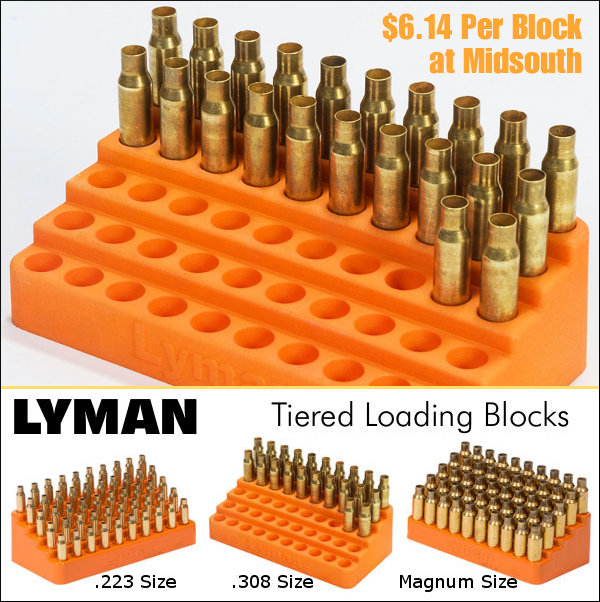
Here’s an inexpensive product that can make your case prep and loading tasks easier. We use and recommend the cleverly-designed Lyman Bleacher Blocks. These multi-level (stepped) cartridge holders save space on your bench AND make it easier to select a particular case/cartridge from a full block. Each row is a different height for convenience. With Bleacher Blocks it’s also easier to check for powder levels, or place bullets before the seating process.
Lyman’s Bleacher Block cartridge holders have many advantages over conventional, single-level blocks. Use the different levels for sorting brass. Or, migrate the brass from top to bottom as you proceed through case prep stages. If you are assembling loads with different bullets for load testing, you could arrange the loaded rounds on different levels for easy recognition. For example put V-Max loaded rounds on the top tier, and Berger Hybrid loaded rounds on the bottom tier. Or, if you are experimenting with neck tension, you can use different rows for cases processed with different bushings.
Made of durable orange polymer, Lyman Bleacher Blocks are molded in three sizes. The smallest size (with 0.388″-diam holes) fits .223 Rem-size case heads. The middle size (with 0.485″-diam holes) fits .308 Win-size case heads. That works for 6mmBR/Dasher sized cases perfectly. The biggest Bleacher Block has 0.565″-diameter recesses for magnum-size cases. All three cartridge block sizes hold fifty (50) rounds. Purchase any size for just $6.14 per Block at Midsouth.
Here’s what Lyman says about its innovative cartridge block design: “Our [stepped] loading blocks allow for easier handling of cases in and out of the loading block. Our stepped design allows you to easily grip a single case without jamming your fingers down into a group of cases like in traditional loading blocks, and allows for a smaller ‘footprint’ on your bench.”
Lyman Bleacher Blocks are among the Reloading Tools reviewed in this helpful video:
“Science tells us that exposure to continuous noise of 85 dB for eight hours is enough to cause permanent hearing loss, and worse, spikes of 130 dB and more can result in permanent hearing damage instantly.” Source: NRA Blog.
The Risk of Hearing Loss
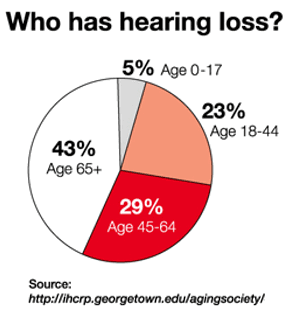
Hearing loss can be progressive and irreversible. If you are a shooter, this is serious business. As the NRA Blog cautions: “You may not even realize you’re harming your hearing. Hearing loss occurs gradually, and can go effectively unnoticed until symptoms become severe. By then, the damage is done.”Effective hearing protection is a must whenever you are shooting firearms or when you are in the vicinity of gun-shots. For ultimate protection, we recommend a good set of tapered foam earplugs, topped by ear-muffs. However, there are situations when you may prefer lighter-weight hearing protection that can be quickly removed. For example, if you are standing well behind the firing line as an observer, or if you are working as a rangemaster or waddie some distance away from the shooters.
Sound Levels for Common Noises:
9mm Luger pistol: 160 dB
Jet aircraft engine (near): 140 dB
.22 LR pistol: 134 dB
Normal human pain threshold: 120 dB
Noisy Nightclub: 110 db
Riding Motorcycle at 65 mph: 103 db
Power Lawnmower: 95 dB
Hearing damage possible: 85 dB (sustained for 8+ hours)
Hearing bands are inexpensive, lightweight, and are handy for special situations, such using hedgetrimmers and noisy power tools, when you may need to frequently remove the protection. These banded products are a also a very good form of hearing protection for hunters. You can keep them handy around the neck while spotting game, and then insert the plugs before shooting. We have tried two types of banded hearing protection, the Howard Leight Quiet Band (shown above) (25 dB NRR), and the Radians Rad-Band (23 dB NRR). The Leight Quiet Band is quite durable and the plugs can be replaced.
Radians Rad-bad is very light-weight, with Jelli™ Plugs that are comfortable, washable, and reusable. Peltor also offers Sport Banded Earplugs but we think those are a bit flimsy and the NRR seems exaggerated.
2. Ear Muffs — Max Protection and Compact Options
The highest current USA Noise Reduction Rating is 34 dB NRR. To get that kind of protection, you need pretty big muffs, but thankfully, you don’t have to spend big bucks. For under $15.00 you can buy quality ANSI-approved muffs with a 34dB Noise Reduction Rating. Chose the G&F Pro Muffs at $13.08 (Amazon’s Choice), or the dark green Walker EXT Range Muffs for $14.99. Both products have padded head-bands which retract.
Many hunters and competitive shooters prefer low-profile ear muffs. As these typically have a lower Noise Reduction Rating, perhaps NRR 22-24, we recommend running earplugs under muffs, particularly when you are at a busy range or shooting a match. If you use low-profile electronic muffs, such as Howard Leight Impact Sport Muffs, you should still be able to hear range commands even with plugs underneath.
3. Earplugs — Small, Inexpensive, but Essential
20 Pairs
50 Pairs
These Howard Leight NRR33 Max plugs are your Editor’s favorite foam earplugs. Between shooting, motorcycling and mowing lawns, I probably have Max plugs in my ears 3-4 days a week. These Leight Max plugs are very effective, easy to insert/remove (with the flared ends), and they seem to be less abrasive in the ear canal than some other brands. Right now you can get 50 pairs of these NRR33 Leight Max plugs for just $8.40 (with free shipping).
Note, if you prefer thin, light-weight earmuffs, we recommend running earplugs underneath for double protection while shooting firearms (or when you’re on the firing line). Sound experts tell us that running plugs and muffs together can effectively improve your effective noise reduction by 4-7 db NRR.
Believe it or not, here is a cartridge that makes a .338 Lapua Magnum look like a toy. The 14.5x114mm cartridge was designed as a MG and rifle-fired anti-materiel round. To translate from the metric system to caliber and inches, the round is a mammoth .57 caliber which measures 4.49 inches to the case mouth, and 6.13 inches overall. That jumbo-sized case holds a whopping 655 grains of powder. Commonly-loaded projectiles weigh 920-1030 grains. The 993gr armor-piercing projectile has a muzzle velocity of approximately 1006 meters per second (3300 fps) and can penetrate 30-32 millimeters of RHA steel at a range of 500 meters.
The top photo comes from Elardus De Lang, a Forum member who works at the Truvelo Manufacturers Armoury in South Africa. Elardus also provided an impressive video showing the massive 14.5x114mm being shot from prone with a Truvelo-built bolt-action rifle. Elardus tells us: “Here is a video, with a slow-motion ending, of our 14.5x114mm anti-materiel rifle being fired in our indoor testing facility. This caliber is a true beast! It propels a 993gr Armor-Piercing Incendiary bullet to 3300 fps, burning 480 grains of powder in the process. [This shows] that rifles of that power level can actually be shootable. The concussion indoors is something to experience……every shot feels like you are being punched in the face, and the heat from the muzzle flash actually hits you like a wave!”
14.5x114mm Cartridge Design and Dimensions
The 14.5×114mm has 42.53 ml (655 grains H2O) cartridge case capacity. The exterior shape of the case was designed to promote reliable case feeding and extraction in bolt action rifles and machine guns alike, under extreme conditions. Cartridges typically use lacquered steel cases, but some countries also use brass cases for the 14.5x115mm.
All dimensions are in millimeters (mm). Americans would define the shoulder angle at alpha/2, or 22.5 degrees. The common rifling twist rate for this cartridge is 455 mm (1:17.91″) with eight lands/grooves. According to official guidelines, the 14.5×114mm can handle up to 360 MPa (52,213 psi) piezo pressure.
14.5x114mm Cartridge History
The 14.5×114mm (.57 Cal) is a heavy machine gun and anti-materiel rifle cartridge used by the Soviet Union, the former Warsaw Pact, modern Russia, and other countries. It was originally developed for the PTRS and PTRD anti-tank rifles, but was later used as the basis for the KPV heavy machine gun that formed the basis of the ZPU series anti-aircraft guns that is also the main armament of the BTR series of armoured personnel carriers from the BTR-60 to the BTR-80 and for heavy anti-material sniper rifles. The cartridge was designed in 1939 and first issued in 1941.
Introducing the Hybrid-X Shooting Rest
The new, patent-pending Hybrid-X front rest from 21st Century Shooting is a true hybrid between a joystick and a traditional “wheel” rest. Windage (left/right point of aim) changes are made via a control stick that extends back to the shooter. This control stick travels on a horizontal plane. Elevation is controlled through a knob on the end of the control stick, OR a large, traditional wheel on the post. So you have TWO elevation control options — the Big Wheel or the smaller knob on the end of the control rod.
The entire central assembly of the rest is mounted on a circular plate that is mounted in the base plate. This central assembly and plate is called the Target Acquisition System or “T.A.S”. This allows the user to easily self-align the rifle and rear bag by simply loosening a few levers. Self-alignment will help minimize set-up time and improve repeatability by eliminating binding of the rifle in the shooting bags. In addition, this will allow for rapid windage adjustment if needed to acquire a target. This really is an important advancement — you can simply place the rest on bench or ground, and then use the T.A.S. function to get perfect target alignment. No more trial and error placing the rest multiple times to get the correct orientation to the target.
The Hybrid-X design team tells us: “Smooth operation and ease of control are what this rest represents. The utilization of a ball screw plus bearing block provides glass-smooth elevation adjustment. And the elevation is stable.” Guys, this is important. Unlike some joystick rests which move when you release the joystick, on the Hybrid-X, the cradle holding your rifle does not “droop” when you release the Hybrid-X control stick. Repeatability from shot to shot is provided by the rock-solid platform and the fact that elevation does NOT change when you let go of the control stick.
The entire center section of the rest rotates as one unit for fast, perfect alignment to target.
Key Features of New Hybrid-X Shooting Rest
1. Weight of rifle is not a factor in ease of controls due to the use of ball screws/bearing blocks in the post.
2. Windage range is more than you would ever need — more than other rests on the market.
3. Elevation is not lost from shot to shot even if you release control stick.
4. Total weight of Hybrid-X prototype is 28 pounds.
5. Designed, machined and built in the USA!
How does it work? Very well indeed! The folks at 21st Century report: “Everyone that has shot off this rest so far is blown away with the repeatability, smoothness, and the ease of the controls.” The innovative Hybrid-X rest is Patent Pending, and is 100% made in the USA. Priced at $1950.00, the Hybrid-X is in production now. You won’t see it (yet) on the 21st Century website, but you can email or call (260) 273-9909 to order. Currently, expect a 60-day wait from time of order to delivery. The rest includes a front bag.
Field Test of New 21st Century Rest in Competition
Report from F-Class Competitor Bret Solomon
I would like to first start out by saying “Thank You” to all the persons involved at 21st Century Shooting for getting me this new rest. I used the new rest for the first time on Friday, August 7, 2020 for a team match in The Michigan State Long Range Team Match Championship. My team took first in the F-Open Division and I had a very quick learning curve with the rest. Saturday, I again used the rest for the Michigan Long Range/F-Class Regional individual matches. We shot one match and called the rest of the day due to weather concerns. Sunday we came back for three matches.
As the day progressed, the winds came up and starting switching considerably more and I put the new rest to work. I was able to concentrate on wind switches, feeling very confident that the gun was staying where I put it in the rest and on target. Adjustments were very smooth and I was able to shoot multiple shots with no elevation changes. The controls are in a position where you can get behind the gun and not have to reach out for changes. Yes the rest performed great — I was able to come from behind to take a one-point win in the F-Open Division. I believe the new rest from 21st Century Shooting made a significant difference for me. In the future, I hope the Hybrid-X rest will help advance my shooting game.
Once again, thank you to 21st Century Shooting for a great addition of technology, innovation, craftsmanship, and customer service to the shooting community. — Bret Solomon
He who dies with the most toys wins — right? Well Sinclair has another interesting gadget you can add to your reloading bench. The Sinclair Case Neck Sorting Tool lets you quickly sort brass by neck-wall thickness. For those who shoot “no-turn” brass, this can improve neck-tension consistency. Large variances in neck-wall thickness can cause inconsistent neck “grip” on the bullet. Generally, we’ve found that more consistent neck tension will lower ES and (usually) improve accuracy. We know some guys who shoot no-turn 6mmBR brass in competition with considerable success — but their secret is pre-sorting their brass by neck-wall thickness. Cases that are out-of-spec are set aside for sighters (or are later skim-turned).
Watch Case Neck Sorting Tool Operation in Video
How the Case Neck Sorting Tool Works
Here’s how the Sinclair tool works. Cases are rotated under an indicator tip while they are supported on a case-neck pilot and a support pin through the flash hole. The unit has a nice, wide base and low profile so it is stable in use. The tool works for .22 through .45 caliber cases and can be used on .17- and .20-caliber cases with the optional carbide alignment rod. The MIC-4 pin fits both .060 (PPC size) and .080 (standard size) flash holes. Sinclair’s Case Neck Sorting Tool can be ordered with or without a dial indicator. The basic unit without dial indicator (item 749-006-612WB) is $59.99. The tool complete with dial indicator (item 749-007-129WB) for $89.99. IMPORTANT: This tool requires caliber-specific Sinclair Case Neck Pilots which must be ordered separately.
Editor’s Comment: The purpose of this Sinclair tool is rapid, high-quantity sorting of cartridge brass to ascertain significant case-neck-wall thickness variations. Consider this a rapid culling/sorting tool. If you are turning your necks, you will still need a quality ball micrometer tool to measure neck-wall thickness (to .0005) before and after neck-turning operations.


 Ray Gross was profiled in





 The Risk of Hearing Loss


 How the Case Neck Sorting Tool Works


