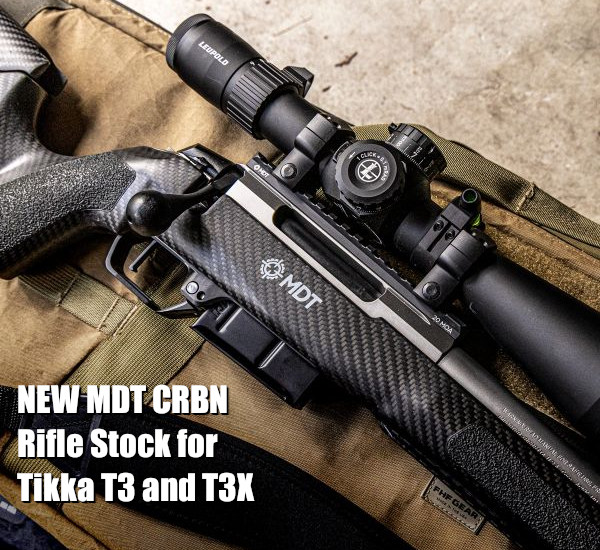
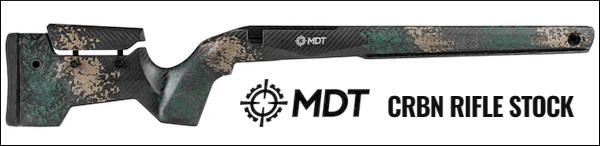
MDT produces excellent, ultra-light carbon fiber-based stocks, the “CRBN” series. And now MDT has added CRBN stocks for Tikka T3 and T3X rifles. The addition of a Tikka T3/T3x Short Action inlet CRBN stock provides a good option for Tikka T3 and T3x owners. Designed for precision hunters, the CRBN rifle stock combines carbon fiber construction with MDT’s proven ergonomics to deliver a platform optimized for weight without compromising capability. The new Tikka inlet allows shooters running T3 and T3x short action rifles to take advantage of the CRBN system without compromising fit or performance.
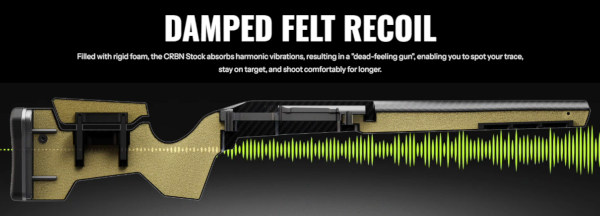
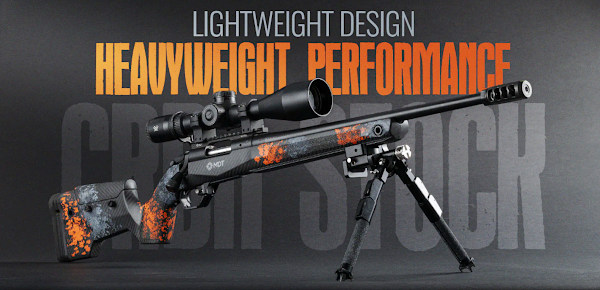
The CRBN rifle stock features a streamlined profile, adjustable ergonomics for improved fit and comfort, and compatibility with a wide range of accessories. This allows shooters to configure their rifle to suit different hunting styles, terrain, and conditions while maintaining a streamlined setup. Crafted from foam-filled carbon fiber, the MDT CRBN Rifle Stock is both lightweight and durable. This helps hunters maneuver through rough terrain on long hunts without feeling weighed down.
The CRBN rifle stock for Tikka T3/T3x Short Action (RH) will be available starting March 31, 2026 through MDT dealers and at MDTtac.com.
This video explains the features of MDT’s CRBN rifle stocks. This is a general review video, not only for Tikka-compatible CRBN stocks.
MDT manufactures high-quality precision shooting products for hunters and competitive shooters. Along with hunting stocks, MDT offers a wide variety of modular stocks and chassis systems for PRS/NRL and long range shooters. For more information, visit MDTtac.com.
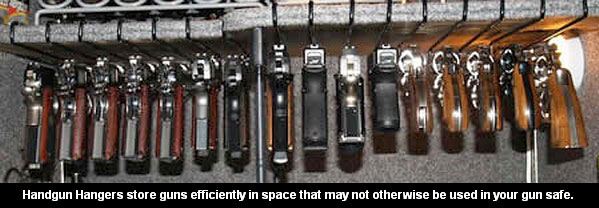
If you’re looking for a space-saving handgun storage system, consider the Easy Use Gun Hangers from USA GunClub, sold on Amazon. These vinyl-coated, wire hangers organize handguns below the shelves in your gunsafe, freeing up storage space above the shelves. To use the handgun hangers, simply slide each hanger on the shelf and then slip your pistol’s barrel over the lower rod. Handgun Hangers are intended for guns with an overall length of 10 inches or shorter. They will fit shelves that are at least 11 inches deep and 5/8-1 inch in thickness. Handgun Hangers will hold handguns .22 caliber and up, though the fit is a bit snug on .22s. A four-pack of Handgun Hangers costs $11.49 on Amazon. This product has been an Amazon Best Seller among handgun storage accessories.
WARNING — Always Make Sure Handgun is UNLOADED when using Handgun Hangers!!
USA GunClub also offers an Over-Under Hanger that holds two handguns — one above the shelf, and one below. A two-pack of Over-Under Hangers (capable of holding four handguns) costs $9.99 on Amazon. This may be a good solution for you. This Editor personally prefers the standard model, so I can use the upper surface of the shelf to hold odd-shaped items such as cameras, binoculars, and miscellaneous valuables.
Credit our buddy Joe Friedrich for this simple yet effective accessory for your benchrest rifle. Joe shoots a .22 LR benchrest rig with a barrel tuner. When he added weights to his tuner, he found his rifle no longer balanced well. He wanted to add some weight in the rear without drilling holes in the stock. He also wanted the weight to be removable, and easily placed on another rifle in his stable. He wanted a weight that could be moved from gun to gun as needed.
At a local sporting goods shop Joe found a 1.5-lb ankle weight that comes in a padded, tubular elastic cover. It’s like a 1.5-lb sausage in a soft, stretchy nylon cover. (Imagine a really fat, heavy bungee cord). Joe simply attached a plastic zip tie at the end to make a loop that fits perfectly over his buttstock. CLICK HERE for full-screen photo.
To “tune” the rifle’s balance, Joe just slides the ankle weight fore and aft on the stock. We have tried this moveable ankle weight on a variety of different BR stocks (including a McMillan Edge) and it worked perfectly. This is a great invention, and would work with sporter rifles and ARs just as well.
NOTE: Obviously, this ring will increase the measured weight of your rifle. So, if you are competing in a registered match with weight restrictions, you have to ensure that your rifle still makes class weight limits with the ankle weight ring in place.
Millions of Americans now exercise their Constitutional right to “keep and bear arms”, specifically to carry a pistol for personal protection and home defense. In response to the rapid growth of the CCW (Concealed Carry Weapon) market, numerous gun-makers have introduced compact handguns specifically designed for concealed carry. These “Carry Guns” tend to be smaller, lighter, with smoother, rounded edges on slide and frame. Today, many modern carry guns are also “Optics Ready”, meaning they have slides that can accept smaller red dot sights. And some companies are now selling handguns with the optics pre-installed.
Top Ten Best Carry Pistols for the Money
Here the Honest Outlaw Channel reviews ten semi-auto pistols. The host states these are the “10 best pistols for the money,” adding that “these handguns are reliable, accurate, durable, light weight, and cost less than most alternatives.” This video was released in December 2022, so it covers the latest generation of modern carry pistols.
Five Favorite Carry Pistols — Colion Noir’s Top Handguns
Colion Noir is a very popular gun reviewer and Second Amendment advocate. In this video, which has over 1.1 million views, Colion covers the five guns he personally carries. Why five? Colion states: “When it comes to my concealed carry guns, I practice tactical polyamory. Essentially, I don’t just carry one gun. I have a rotation of guns I carry based on what I’m wearing that day, where I’m going, and what I’m doing. I put a lot of thought into my carry rotation, which changes based on my needs. Sometimes a gun that’s better at handling the job comes out, and I’ll carry it once I’m comfortable with its reliability. That said, there are five guns I consistently carry[.]”
Five Top Choices among CCW & EDC (Everyday Carry) Handguns
The host notes: “We are going over the five best CCW firearms that I reviewed this year and ranking them from 1 to 5. We are going to save the best for the last. Some of the criteria for ranking these firearms isn’t only based on performance. We are ranking based on performance, price, reliability, and comfort.”
PMA Tool offers lightweight yet sturdy cleaning cradles that are handy, affordable, and easy to transport. PMA’s popular single-gun cradle, priced at $135.95, is ideal for benchrest and F-Class rigs. It measures about 17″ in length and weighs about one pound. You can choose among 2.25″, 3″, 4″, 5″, and 6″-wide saddles (U-shaped padded supports) to match your forearm width.
PMA also offers excellent double cradles for $189.95. These twin cradles have 2.5″, 3″, or 4″ saddles, or a combo of 3″ / 2.25″ front saddles. All these cradle types secure your rifle(s) in a muzzle-down position that allows easy cleaning and prevents solvents from running back into the action. The front saddles and all contact surfaces are covered by thick silicone rubber padding which grips the rifle securely yet protects the stock and components from scratches.
These cradles are most commonly sold with a 3″-wide front saddle for Benchrest and F-Open style stocks, or a 2.25″-wide front saddle for rifles with narrower fore-ends such as those found on F-TR, Hunter Class, and varmint stocks. In addition, you can get 4″-wide cradle for the big, long range benchrest rifles.
Double Rifle Cradle is a Smart, Versatile Design
PMA’s double rifle cleaning cradle was was designed from the ground up to work perfectly for two rifles side-by-side. Using the same tie bar and protective saddles found on the single cradel, PMA widened the base and created new uprights to support the saddles, making the cradle as narrow and light as possible, while retaining all the protective and non-slip features from our single unit.
This PMA Tool double cradle unit is available with twin 3″ front saddles, double 2.5″ front saddles or combination 3″ / 2.25″ front saddle configurations to accommodate different classes of benchrest rifles.
Here is Ernie Bishop’s pride and joy, a specialty pistol nicknamed “Batman” because the black carbon-fiber stock looks like the Batmobile. This is one sophisticated handgun. Complete with scope, the Batman pistol weighs under 7.5 pounds, thanks to the ultra-light stock. The carbon stock is 6 inches wide at the fore-end, yet weighs just one pound. Ernie tells us: “This gun shoots amazing and is easy to shoot especially with my SEB MAX Rest.” After these photos were taken, Ernie added a “field-usable rear-grip stock so [he could] shoot it prone from a bipod as well.”
The Batman pistol is chambered for the 6mm “Long Dasher”, a 6mm 40°-shouldered variant of the 6.5×47 Lapua. Ernie loads Berger 105gr Hybrid bullets pushed by Hodgdon H4350 powder.
Gun Specifications The gun, crafted by Eric Wallance of Nawaka Firearms, features an XP-100 action, Jewell trigger, and 15″-long, Brux 1:8″-twist barrel with aluminum muzzle brake. Interestingly, this gun does not have a traditional recoil lug. Instead, gunsmith Wallace milled out a lug from the bottom of the XP-100 action to save weight. On top of the action, the rig carries a Sightron Inc S-III 6-24X56mm scope in Kelbly rings on a custom +20 MOA rail.
Long Dasher Wildcat
Shown at right is a “Long Dasher” 40° wildcat created by Forum member Sunbuilder. This is very similar to Ernie Bishop’s chambering, though there may be small variations related to reamer design (such as freebore). Sunbuilder’s 6-6.5×47 Improved (aka “Long Dasher”) reamer was made by Dave Kiff of Pacific, Tool & Gauge. This wildcat cartridge adds about 2.0 grains capacity to the 6.5×47 necked down to 6mm. The case certainly is impressive with that 40° shoulder. We’re just waiting for the tactical guys to starting run this improved cartridge with its original 6.5mm bore.
Here are three FIVE-shot groups at 500 yards, shot by Ernie’s Batman pistol. The first 5-shot group is marked with pink dots, the second with green dots, and the third is measured with the calipers:
All shooters, even rimfire enthusiasts, should always wear ear protection when at the range. A typical rifle gunshot is very loud — in the region of 140 to 170 decibels (the pain threshold is 130-140 db). Without ear protection, you can permanently damage your hearing during a single shooting session. We all know older shooters who are partially deaf, or who suffer from Tinnitus, because they didn’t use earplugs or muffs when they were younger.
How Humans Hear Sounds — Amazing Video Reveals All
The human sense of hearing involves multiple delicate internal membranes, bones, organs, and nerves. Shooters understand the importance of protecting their hearing, but they may not understand the bio-mechanics of human hearing. We hear sounds through Auditory Transduction. Sound waves vibrate the ear drum (tympanic membrane), but that is only the beginning. These vibrations are passed along via tiny rocker-arm-like bones to be “processed” in a spiral chamber, the cochlea.
This remarkable VIDEO explains how humans hear sounds. We strongly recommend you take the time to watch and learn. The hearing you save may be your own!
Click Speaker Icon to turn on the video’s soundtrack.
Vibrations moving through the cochlea are separated into frequencies and then sent as neural messages to the brain. It is an astonishingly complex process, one that truly seems miraculous when you examine the bio-engineering involved. In the Video above, the process of human Auditory Transduction is explained and illustrated with 3D animation. You really should watch this amazing video. By the end you will have a new-found appreciation for your ability to hear.
⏺ Dual-function electronic muffs — great for range communications
Every shooter should own a pair of Electronic muffs, even if you prefer shooting with earplugs and/or standard muffs. Electronic muffs are great when you are spotting for other shooters or are working near the firing line. They let you hear ordinary conversations while still providing vital hearing protection. You can also wear ear-plugs under muffs for extra sound attenuation.
Plugs PLUS Ear-Muffs — The Benefits of “Doubling-Up” Your Hearing Protection
According to OHS Online: “The combined attenuation of an ear plug and an ear muff is not simply the algebraic sum of the performance of each individual protector. This is due to an acoustic and vibratory interaction between the ear muff and the ear plug that causes them to behave together as a system rather than as independent hearing protectors.
Generally speaking, when you combine two hearing protectors, ear muffs over ear plugs, you can expect an increase [in noise reduction] of between 3 and 10 dB over the higher-performing hearing protector. OSHA [now advises] 5 dB as the [typical] benefit offered by combining hearing protectors.” Source: OHSonline.com
Brian Williams is one of the top CMP match shooters in the nation. At the 2021 CMP Eastern Games, Brian won both the 3-Gun and 4-Gun Aggregates. He also won the 4-Gun at the CMP National Matches in Camp Perry three years in a row — the inaugural 2017 4-Gun Agg, plus 2018 and 2019. Due to COVID, there were no CMP Camp Perry National Matches in 2020, but Brian has been a leading competitor in subsequent seasons and he’ll be at Camp Perry this summer.
Given his remarkable, consecutive “three-peat” in the CMP 4-Gun Aggregate at Camp Perry, it cannot be questioned that Brian is the leading CMP 4-Gunner in the nation. In this article, Brian provides perspectives on the “Wood Gun” game, with suggestions on how to improve your performance with the M1 Garand, M1903 Springfield, M1917 Enfield, M1 Carbine, and other 20th Century military rifles. While Brian also shoots his AR15 for the 4-Gun, today’s article focuses on his favorite firearms — his classic “Wood Rifles”.
VIDEO Showcase — Brian Williams Shoots M1903A3 Prone
The Classic Wood Guns of CMP 4-Gun Competition
Perspectives on M1 Garand, M1903A3, M1917, and M1 Carbine
Q: What should one look for when acquiring older rifles for CMP 4-Gun Games — M1 Garand, M1903/1903A3, M1917, M1 Carbine? What are realistic budgets for these firearms? What kind of accuracy can one expect? What upgrades are important?
Brian: All of these military surplus rifles are out there, but they are getting harder to get your hands on. And, just like everything else, the prices continue to rise. Not that long ago you could get your hands on a M1 Garand for four or five hundred dollars. In today’s market they are usually about double that price. But understand that these rifles are all unique and all have a story to tell. No two are alike, or have the same story. Just like the guns themselves, there are fewer and fewer dedicated gunsmiths for these vintage rifles. But I promise if you look for a good smith, they are out there and they are some of the most interesting people you will ever meet.
M1 Garand — Of the four (4) centerfire guns I shoot in the CMP games, my favorite has to be the M1 Garand. There were over 6 million of them produced in a very short time period, and every single one has its own unique story, and that is just cool. M1 Garands are capable of good accuracy. I believe that a well-maintained M1 with at least a replacement barrel is capable of shooting between 1 and 1.5 MOA.
M1903A3 Springfield — I find that the sights on a M1903A3 are a little easier to see than the sights of the M1903, but both are very accurate rifles. Like most military rifles in the current climate the prices have risen dramatically, but there are some gems out there that can be had for far less than $1000. The nice thing about the Springfield rifle is that almost all of the accuracy than you would want can come from just replacing a worn out 80-year-old barrel. In terms of accuracy, I think a good M1903A3 can shoot 1 MOA most of the time.
M1917 Enfield — This rifle is the newest of my collection and it shoots very well, with just a new Criterion barrel — again about 1 MOA with iron sights. These rifles are very close in price to the M1903 Springfield. But if you do your homework and keep your eyes open, there are always great deals to be found. I actually prefer shooting the M1917 to my M1903A3, due primarily to the M1917’s cock-on-close bolt which allows smoother cycling.
M1 Carbine — By 1945 there had been more M1 Carbines built than Garands. Today the Carbine can be harder to find, and due to the scarcity the price has shot up and most military M1 Carbines are going for more than $1000 at this point. The great thing about the M1 Carbine is that as long as you have a good ammo supply this rifle can shoot. Honest. I have had countless numbers of people that tell me that there is not an M1 carbine that will shoot. I can tell you from experience that they will, but you are going to have to put in some time with one to learn how to get it to shoot where you want it.
The M1 Carbine shoots the .30 Carbine round, with 110gr bullet going about 1990 FPS. In comparison, the .30-06 Springfield round used in the M1 Garand is almost three times more powerful than the .30 Carbine.
Reloading for .30-06 Springfield Rifles
Tech Report by Brian Williams
Reloading for a military surplus gun as different than loading for a modern precision rifle in my opinion. There are a few tasks that care over from one to the other, but the main goal is slightly different. The Target that is being shot in the CMP games matches has a rather generous 10 ring, and with a little larger target you focus needs to change from a round with ultra accuracy to a round that is safe and functions well in your particular rifle.
Bullet Selection — With the .30-06 for my Garands and Springfields I stick mostly with 168gr bullets plus some 155-grainers. These bullet weights have just worked for me in the past.
Cartridge Brass (Milsurp vs. Commercial) — I use both military and commercial brass, having success with each. I do prefer commercial brass as it is easier to prep for the first reload. Military brass usually has a primer crimp of some kind that needs to be removed, and I have found that trimming these cases can sometimes leave you scratching your head as the OAL on military cases varies considerably.
Power Charge and Dispensing — I have always had good success with Hodgdon H4895 powder. My load has always been right around 47.0 grains, with both the 168gr and 155gr bullets. I also use the Auto-Trickler to drop all of my powder charges. This is a fantastic piece of equipment that not only gives super-consistent powder charges quickly, but it also makes one less thing that you have to worry about while on the firing line. With the Auto-Trickler, there is never a question about the powder charge in your ammo. As for primers, I have been shooting CCI 200 Large Rifle primers for many years and have never had an issue.
Case Care and Trimming — With most of the .30-06 brass that I use, I will only reload them 5 times maximum. I don’t push the brass too much, because the Garand’s semi-auto cycling can be tough on the cases. I also trim my cases for OAL each reload cycle. I use a Giraud power trimmer, so trimming is relatively quick and easy.
The chambers in some of the older rifles are not perfectly-machined like a modern high-end rifle. This can cause the brass to grow a little inconsistently, so I find trimming every load cycle helps to make sure that everything stays in a nice safe spec.
Case Annealing — A few years ago I started to anneal my .223 Rem service rifle brass. Now I have added that process for all my match ammunition. I anneal after every firing. It is a rather easy step as I can have my auto-feeding Annealeez machine running while doing something else, so annealing does not add a great deal of time or effort to the reloading process.
The .30-06 case was the father of the .308 Winchester, which was adopted as the 7.62×51 NATO cartridge. Brian has another Garand chambered in .308 Win which he shoots in Service Rifle Class in the President’s Match and NTI Match at Camp Perry.
Perspective on CMP 4-Gun (and 3-Gun) Aggregate Competition
Since the CMP’s introduction of the 4-Gun Aggregate in 2017, combining three classic wood rifles with the modern AR15-platform guns, Brian has lead the field, winning the 4-Gun at every National Match cycle held so far by the CMP at Camp Perry. Brian has also dominated in the 3-Gun Aggregate which includes the three older wood rifles.
Q. What’s the most fun/satisfying thing about shooting CMP 4-Gun Aggs?
Brian: The 4-Gun Agg takes place over several days, and is usually decided by a very thin margin of victory. Making sure that you are prepared for all four rifles and keeping focus through several days of competition is very difficult. There is a great sense of accomplishment when you are able to perform well for the entire aggregate.
Q. Do you like shooting the wood rifles more or the AR in Modern Military?
Brian: No question that the wood rifles are my favorite. A steel rifle, with a beautiful wood stock (see above), firing the .30-06 Springfield, is “where it is all at” in my opinion.
Q. What is the best approach to shooting these older Wood Guns?
Brian: One of the things that I struggled with shooting the “wood guns” is that it is so easy to tell yourself that its the rifle and not your bad habits or poor position. “The rifle is far older than I am it must just not be a shooter”. In order to be successful with these rifles you have to be honest with yourself. Only then will you improve.
Q. If you could change any CMP 4-Gun course of fire, or revise aspects of the CMP 4-Gun discipline, what would you modify/alter?
Brian: There is always conversation around changing the course of fire, target dimensions, or putting certain rifles into different classes. I like the fact that I have to adapt myself to fit the current discipline. I would surely not want to make it any easier. I feel like that would decrease some of the satisfaction that I get from competing well.
Q: What are your key gear items and shooting accessories?
Brian: A good shooting coat has been very important for me. I currently use a Creedmoor Hardback Cordura Leather Coat. I also think that a good rifle sling is very important. For the last couple of years I have been using a Eric Hollis National Match leather sling and love it. I own a ShotMarker e-Target system and I think it’s one of the best training tools that I own. It just makes it so easy to shoot, capture information, and then be able to recall that information later and use it to improve.
The Mental Game — How to Become a Better Marksman
Q. What is your pre-match routine (mental/physical match prep)?
Brian: I try not to do anything different on match day that I would do any other day. I am a coffee drinker and drink just as much on match day as I do on any work day. This game is very mental, and I find that treating match day just like any other day helps me to control stress and anxiety.
Q. If you could do it all over from the beginning, how would you change your training/practicing processes?
Brian: I have learned that practice makes me better, but just sending rounds down range is not that beneficial to me. Some of the biggest improvements I have made have come from practice sessions where I did not fire very many rounds. Working through the shot process, being honest with myself, and evaluating what needs to happen to get the desired outcome.
Q. Most guys will never achieve what you’ve done in Marksmanship, i.e. win multiple multi-gun titles. What are the other positive things people can get from the sport, beyond trophies and glory?
Brian: This is an easy one — this sport is full of the most genuine, thoughtful, and helpful people out there. I have friendships with people that I only see a couple times per year… yet when we see each other it’s like we had just gotten together last week. This does not just apply to fellow competitors, but also to the folks who run matches, to those who supply gear, even to spouses of competitors who’ve fed me more times than I can remember.
Brian “Carbine” Williams, King of Wood Guns
— Commentary by Dennis Santiago
When it comes to CMP Games competition, Brian Williams presently dominates the multi-gun field. I first met Brian at the so-called Michigan Embassy at Camp Perry, a makeshift compound of tables, pop ups and lawn chairs where competitors gather at the end of the shooting day to exchange stories. It’s a “who’s who” gathering of High Power personalities exchanging tall tales. In this prestigious crowd, Brian Williams is “King of Wood Guns”, his mastery of the GSMM (Garand, Springfield, Modern Military) Four-Gun Aggregate renown to all. Yet he is as humble a champion you can ever hope to spend time with.
I discovered that Brian and I share a mutual love of the U.S. .30 Caliber M1 Carbine, a rifle many other shooters don’t give a second thought. But we believe in the potential of the little gun. We know that when driven right, the joy of collecting gold achievement pins with it. I’ve enjoyed trading notes with Brian about how to make it shoot better to turn in scores in the high 360s to mid-370s out of a possible 400. In this regard, I assure you Brian is again the guy who will shoot the 400 possible on any given day. He truly deserves the moniker “Carbine” Williams.
BONUS: Rimfire Sporter — Brian’s Fifth Gun
Along with his centerfire rifles, Brian Williams likes to shoot in CMP Rimfire Sporter matches. In fact, he won the Rimfire Sporter Match “O” Class (Iron Sights) at the 2021 CMP Eastern Games. Shown below is his Czech-made .22 LR CZ 452 Ultra Lux bolt-action rifle.
Q: How do you like Rimfire Sporter? Do you have to adjust your technique for rimfire vs. centerfire?
Brian: Most of the fundamentals will transfer from centerfire guns to the rim fire guns, the biggest difference is in the course of fire for the match. The Rimfire course of fire includes a slow-fire seated stage, and a rapid-fire standing stage, both of these stages are unique to the Rimfire Sporter game. I enjoy this discipline, but due to the scheduling of the Rimfire Sporter match at Nationals I have not yet shot this event at Camp Perry. I did do well in this event at both the Eastern CMP Games and New England CMP Games.
Readers who have just recently discovered the Daily Bulletin may not realize that AccurateShooter.com has hundreds of reference articles in our archives. These authoritative articles are divided into multiple categories, so you can easily view stories by topic (such as competition, tactical, rimfire, optics, shooting skills etc.). One of the most popular categories is our Technical Articles Collection. On a handy index page (with thumbnails for every story), you’ll find over 120 articles covering technical and gunsmithing topics. These articles can help you with major projects (such as stock painting), and they can also help you build more accurate ammo. Here are six popular selections from our Technical Articles archive.
Stress-Free Pillar Bedding. Richard Franklin explains how to do a top-quality bedding job, start to finish.
Gun Safe Buyers Guide. Our comprehensive Safe Buyers Guide examines the key features to consider in a safe — Wall Thickness, Volume, Shelving, Fire Rating, Lighting, Weight and more. We also explain the Pros/Cons of Dial vs. Digital (Keypad) locking systems.
Savage Action Tuning. Top F-TR shooter Stan Pate explains how to enhance the performance of your Savage rifle by optimizing the torque settings of the action screws.
Complete Precision Case Prep. Jake Gottfredson covers the complete case prep process, including brass weight sorting, case trimming, primer pocket uniforming, neck-sizing, and, case-neck turning.
Stock Painting Instructions. Step-by-step guide for stock painting by expert Mike Ricklefs. Mike shows both simple coverage and fancy effects.
Ultrasonic Case Cleaning. This article reviews the recommended process for cleaning cartridge brass with ultrasonic cleaning machine. We cover the right liquid solutions, processing times, and case drying options.
This Armalite AR-50A1 .50 BMG rifle was modified by G.A. Precision.
If you’re a fan of big boomers, and love shooting steel, then definitely watch this Wide Open Magazine video. This covers a .50 BMG build by our friends at G.A. Precision (GAP). The rifle started as an Armalite AR-50A1 ($4750.00 MSRP). Then GAP fluted the barrel and swapped the factory muzzle brake with a more compact brake from American Precision Arms*. Then, as modified, the entire rig was given a rugged Cerakote finish.
The video has nice background music (pretty loud), great aerial drone footage, and of course some serious firepower. Using Hornady .50 BMG ammo, GA Precision’s George Gardner and his Wide Open friends shoot the big Fifty from the bench as well as prone. Enjoy!
About the .50 BMG Cartridge
The .50 Browning Machine Gun (.50 BMG, aka 12.7×99mm NATO or 50 Browning) is a cartridge developed for the Browning .50 caliber machine gun in the late 1910s, entering official service in 1921. Under STANAG 4383, it is a standard cartridge for NATO forces as well as many non-NATO countries.
John Browning had the idea for this round during World War I in response to a need for an anti-aircraft weapon, based on a scaled-up .30-06 Springfield design, used in a machine gun based on a scaled-up M1919/M1917 design that Browning had initially developed around 1900. According to the American Rifleman: “The Browning .50 originated in the Great War. American interest in an armor-piercing cartridge was influenced by the marginal French 11 mm design, prompting U.S. Army Ordnance officers to consult Browning. They wanted a heavy projectile at 2700 FPS, but the ammunition did not exist. Browning pondered the situation and, according to his son John, replied, ‘Well, the cartridge sounds pretty good to start. You make up some cartridges and we’ll do some shooting’.”
* In the video, George mistakenly says “American Patriot Arms”, but the brake is made by Georgia-based American Precision Arms.



 USA GunClub also offers an

 Credit our buddy Joe Friedrich for this simple yet effective accessory for your benchrest rifle. Joe shoots a .22 LR benchrest rig with a barrel tuner. When he added weights to his tuner, he found his rifle no longer balanced well. He wanted to add some weight in the rear without drilling holes in the stock. He also wanted the weight to be removable, and easily placed on another rifle in his stable. He wanted a weight that could be moved from gun to gun as needed.


 The gun, crafted by Eric Wallance of Nawaka Firearms, features an XP-100 action, Jewell trigger, and 15″-long, Brux 1:8″-twist barrel with aluminum muzzle brake. Interestingly, this gun does not have a traditional recoil lug. Instead, gunsmith Wallace milled out a lug from the bottom of the XP-100 action to save weight. On top of the action, the rig carries a Sightron Inc S-III 6-24X56mm scope in Kelbly rings on a custom +20 MOA rail.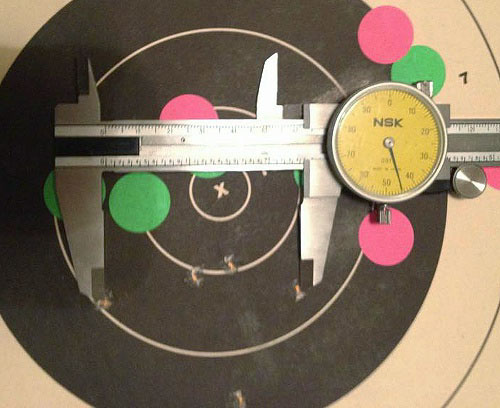

 All shooters, even rimfire enthusiasts, should always wear ear protection when at the range. A typical rifle gunshot is very loud — in the region of 140 to 170 decibels (the pain threshold is 130-140 db). Without ear protection, you can permanently damage your hearing during a single shooting session. We all know older shooters who are partially deaf, or who suffer from


 Bullet Selection — With the .30-06 for my Garands and Springfields I stick mostly with 168gr bullets plus some 155-grainers. These bullet weights have just worked for me in the past.
  Power Charge and Dispensing — I have always had good success with Hodgdon H4895 powder. My load has always been right around 47.0 grains, with both the 168gr and 155gr bullets. I also use the Auto-Trickler to drop all of my powder charges. This is a fantastic piece of equipment that not only gives super-consistent powder charges quickly, but it also makes one less thing that you have to worry about while on the firing line. With the Auto-Trickler, there is never a question about the powder charge in your ammo. As for primers, I have been shooting CCI 200 Large Rifle primers for many years and have never had an issue.

 Brian: I have learned that practice makes me better, but just sending rounds down range is not that beneficial to me. Some of the biggest improvements I have made have come from practice sessions where I did not fire very many rounds. Working through the shot process, being honest with myself, and evaluating what needs to happen to get the desired outcome.


