Here’s a cool new product from Hogue: Wrapter Adhesive Firearm Grips. Utilizing the same precision fit standards as Hogue’s OverMolded® rubber grips, Hogue has engineered a remarkably thin grip solution for polymer frame pistols. In order to improve the feel and “grippiness” of polymer frames, many shooters have resorted to custom stippling. That could work, but stippling can compromise the firearm’s factory frame and hurt resale value. The Hogue Wrapter Adhesive Grip System provides superior grip and hold while preserving the pistol’s original polymer surface integrity.
This video explains how to install Hogue Wrapter grips on your pistol frame:
Wrapters Are Precisely Cut, Comfortable, and Removable
Wrapter Adhesive Grips are made with a soft rubber material that emulates the renowned Hogue rubber feel. Wrapter grips, using multi-segment designs, conform to the exact contours and features of popular polymer frame pistols. These stick-on Wrapters provide optimal coverage with minimal added thickness. The Wrapters feel good in the hand and the rubber-type material is both sweat-resistant and skin-friendly. The adhesive is designed to create a long-lasting bond when activated by heat, but can also be removed without leaving a sticky residue behind.
Hogue Wrapter Grips sell for $14.95 MSRP. These grips are available now for nine Glock models plus SIG P320s. Wrapters for other pistol types will be available soon. There is also a $9.95 Do-It-Yourself Kit for installation on any firearm — pistols, rifles, and shotguns. Heavy grit options will also be available for those seeking a more aggressive grip texture.
With good factory rifle ammo costing $1.00 per round — a Laser BoreSighter could pay for itself in just a couple range sessions.
Laser BoreSighters — fitted to your chamber — help you get on target more quickly, particularly with factory firearms. Just activate the unit, slip it into the chamber and look for the red dot on the target. The laser dot is about 2″ in diameter at 100 yards, and is visible even in full sunlight. Right now you can get HQ Issue BoreSighters starting at $15.99 at Sportsman’s Guide (member price is $14.39). These units have a durable brass metal body and the battery will run an hour.
Boresighters are offered for many popular rifle cartridge types including: .223 Rem, .22-250, 6.5 Creedmoor, .308 Win family, and .30-06 (full list below). Sportsman’s Guide also offers Pistol Laser BoreSighters for $17.99 (member price): .38 SPL/.357 Mag, .40 SW, .44 Magnum, .45 ACP.
In-chamber BoreSighters are much safer than the kind that you insert in the end of the barrel (or attach to muzzle). If you forget your laser bore-sight placed in the end of the barrel, and then fire a round, you can blow up your barrel and/or suffer serious injury — it HAS happened.
This video shows how to use in-chamber Sightmark laser boresighters. The HQ Issue boresighters work the same way:
If you like PRS/NRL competition or just want to learn about this fast-growing practical shooting discipline, then definitely watch Shooting USA today (8/12/20). This week Shooting USA offers a special FULL-HOUR edition devoted to the inaugural Armageddon Gear AG Cup Invitational. The first-ever AG Cup showcased an all-star line-up of tactical talent. Twenty of the nation’s top PRS/NRL marksmen were invited to a two-day event at the Arena Training Facility in Georgia. $41,000 in prize money was up for grabs, with the overall match winner guaranteed twenty thousand ($20,000) in cash!
This AG CUP episode airs Wednesday 8/12/2020 on the Outdoor Channel at 9:00 PM Eastern and Pacific, 8:00 PM Central. After that it will be streamed on Vimeo for $0.99 per episode or $3.99 per month.
In this hour-long Shooting USA special, John Scoutten and Armageddon Gear’s Tom Fuller report the action and interview top precision rifle shooters. The Grand Prize of $20,000 was awarded for the best overall score, based on accuracy and time. In addition, the winner of each of the 20 stages received a $1000 cash prize. During the show, you can watch the competitors adapt to challenging stage set-ups and weather conditions. With $1000 at stake for each stage, a single miss can cost serious money!
Side Match with TN Twister Target
At the inaugural AG Cup, there was a side match with a $500 prize for the competitor who hit all five TN Twister Target plates in the shortest time. The side-match employed a modular target system from Innovative Target. This system can mount TN Twister or TN Revolver multi-plate rigs, which bolt on to the IRT Head. This provides interesting challenges quite different from a typical static PRS plate target.
Arena Training Facility — 2300 Acres
The 2300-acre Arena Training Facility is a premier shooting facility with multiple shooting ranges from 50m to 2100m. Arena’s 1000-yard covered Known Distance range offers multiple benches, steel and paper targets out to 1000 yards. On Arena’s UKD (unknown distance) range shooters can engage steel out to 2300 yards. This 2100m UKD range boasts a 3-Story Shooting Tower, Air-Conditioned Shoot House, and multiple Positional Challenges.space.
Armaggedon Gear — Tactical Accessories Armageddon Gear, founded by former U.S. Army Ranger Tom Fuller, sells support bags, gun cases, slings, suppressor covers, scope covers, and a wide variety of other accessories popular with the PRS/NRL crowd. Armageddon Gear now provides products to the U.S. Military, Law Enforcement, as well as PRS/NRL competitors.
Armageddon Gear Game-Changer Bag
Shooting USA is available On Demand via Vimeo.com. Watch a single episode for $0.99, or get a full-month subscription for $3.99 and watch as many shows as you like with limited commercial interruptions.
Main photo from NRAILA.org. The NRA supports Second Amendment rights.
Article by AccurateShooter.com Editor-in-Chief
In the last month, a half-dozen acquaintences have asked me about getting a handgun for self-defense at home and while traveling. What is notable is that all of these persons have never owned a handgun before. Moreover, two of the six are pretty staunch liberals who, prior to 2020, thought the Second Amendment was a “historical anachronism” that should be repealed. With the widespread riots and “defund the police” activism, that has all changed. These six people now realize that there are real threats in current society and they may find themselves in a situation where armed self-defense is the only option.
Try Before You Buy — Find a Gun with Good Reliability, Controls, and Ergonomics
These six persons asked for recommendations on handguns. I explained that there was no one “best gun” for every person. I also stressed the importance of training, and of trying various handguns to compare ergonomics, weight, balance, sight arrangement, controls, and trigger pull.
Folks, ergonomics and grip shape DO make a difference. I used to give pistol instruction at a local club. I provided four 9x19mm pistols: Beretta 92, HK USP, SIG P226, and Glock 19. Two-thirds of the students shot best with the SIG P226, and only 10% shot best with the Glock 19. The majority of the students kept “pulling shots” with the Glock, even with a lot of practice. Not so with the SIG P226. I attribute that to lower center of gravity and more ergonomic grip shape/angle.
Caliber Choice — Factors to Consider
We are not going into the long caliber debate today. I have owned semi-auto pistols in .380 ACP, 9x19mm Parabellum, .40 SW, .45 ACP. Each cartridge has its pros and cons. But for a first-time gun owner, looking for a self-defense round, I will recommend the 9mm. It will have noticeably less muzzle flip than the .40 SW, but still carries much more energy than a .380 ACP. I love the .45 ACP for target shooting, but it is more expensive for practice, and there are fewer pistol options. For revolvers, the .357 Magnum is a great defense round, but some of the smaller carry pistols are limited to .38 Special.
Semi-Auto 9mm Carry Gun Recommendation: S&W M&P9 Shield EZ
I have considered a wide range of 9mm carry pistols from Glock, Ruger, SIG Sauer, Smith & Wesson, Taurus, and Walther. There are many very good pistols out there. But what I recommended to my acquaintances was the new Smith & Wesson M&P9 Shield EZ 9mm. This gun features a back-strap grip safety and is offered with or without thumb safety. There is also a M&P9 EZ model with built-in Red Laser.
Here are the key reasons I recommended the M&P9 EZ 9mm pistol:
1. Good Accuracy and Balance
2. Integral Grip Safety and optional Thumb Safety
3. Good Ergonomics: 18-degree grip angle for natural point of aim
4. Reasonable 4.5-lb Trigger Pull (some other pistols are 7+ pounds*)
5. Easy-to-Rack Slide
6. Take-Down does NOT require trigger pull (unlike Glock)
7. Availability of built-in laser or accessory rail-mount lights/lasers
8. Good Price: $479.00 base MSRP with $399.99 street price
9. Outstanding Smith & Wesson reliability, warranty, and customer service
This detailed, authoritative M&P9 EZ video review also covers the M&P .380 Shield EZ:
Small Deep Concealment Carry Gun Recommendation — S&W Model 638
I am a big fan of revolvers. I have probably put more rounds through my S&W Model 617 .22 LR revolver than all my other handguns combined. Revolvers are accurate, solidly built, and the shorter-barrel models conceal easily. In addition, revolvers are inherently simple — they can be put into action without racking a slide or dealing with mag latches and the like. I’ve actually seen trainees drop magazines on the ground when they were drawing pistols from holsters — they hit the mag release by accident. If this can happen in a class, it can happen in a threat situation.
For concealed carry, I recommend the Smith & Wesson Model 638 revolver. IMPORTANT — the Model 638 has a hammer so it can be shot single-action OR double-action. Having the single-action option is great when a slower, more precisely-aimed shot is needed. Unique among S&W revolvers, the 638’s hammer is shielded — this way the hammer will not snag when the gun is carried in purse or pocket.
As for accuracy, you will be surprised with the Model 638 with good self-defense ammo. Despite the short site radius, the little 1.875″-barreled Model 638 will easily outshoot most self-loading .380 ACPs. With my 638 Airweight, slow-fire, I can put all five rounds inside 2″ at 20 feet with ease.
* Some folks may criticize this S&W Shield 9mm EZ because it lacks a heavy 7-9 pound trigger pull. The thinking is that a heavy DA pull is better for novices. We understand the argument. However, in the real world we found that novices shot much worse with very heavy trigger pulls, even after much training. We believe a 4.5-lb pull is moderate and will actually allow better accuracy for the average shooter. A typical Glock pull-weight is about 5.5-6 pounds.
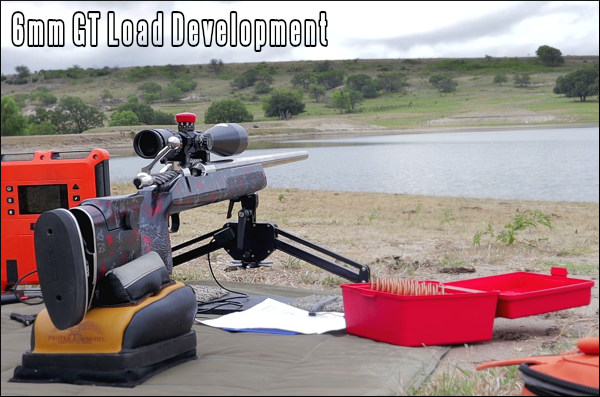
The 6mm GT (aka 6GT) cartridge was conceived as a “bigger Dasher” for PRS and NRL competition. The 6mm GT’s creators wanted 6mm Dasher accuracy and moderate recoil delivered via a cartridge with a slightly longer case body for better mag-feeding, longer neck for seating flexibility, and more moderate pressures. So far the 6GT has performed very well in PRS competition. Today’s story is a bit different — this is about an experiment — running a 6mm GT in an F-TR type rifle. Understand that, under current NRA rules, you may only shoot .223 Rem (5.56×45) or .308 Win (7.62×51), in official, sanctioned F-TR competition, but the 6GT is fine for F-Open. Mike McCasland wanted to see the potential of the cartridge for long-range target shooting, so he put a 6mm GT-chambered Bartlein barrel on a nice custom rifle with McMillan XIT stock and Kelbly F-Class Panda action. The results were impressive.
6mm GT — New Cartridge with Multi-Discipline Potential
Story by Mike McCasland, Texas Precision
The 6mm GT began garnering attention within PRS circles in early 2019. It promised to shoot 105-110gr 6mm bullets at 2950-3000 FPS, yet not suffer from mag-feed issues sometimes found with 6mmBR variants such as the 6 Dasher, 6BRX, and 6BRA. Moreover, since it burned less powder, the 6mm GT promised increased barrel life compared to the 6mm Creedmoor or 6XC. The 6mm GT case size should still work with the accurate powders in the Varget burn-range. I found the 6GT also worked great with H4350.
As someone who aspired to building a repeater and jumping into the PRS game, and had a spare F-TR rifle sitting around, I thought it would be fun to build up a 6mm GT to see if there was any merit to the hype. My smith, Wes Ripley of RIP Precision in Texas, builds a lot of PRS rigs, and already had the reamer on hand (a 0.120″ freebore variant).
Whidden Gunworks had some 6mm GT FL bushing die kits in stock, so I figured why not see what all the fuss was about? At the very least I could play around with the 6mm GT in F-Open Class at local club matches to see how it compared to the 6BRA, 6 Dasher, and other popular 6mm cartridges.
How the Project Got Started with Backup F-TR Rig
My 6mm GT build really started as a project spawned purely from COVID-19 Isolation boredom. This rifle primarily serves as a backup F-TR gun, and it had been relegated to performing some load development on .308 barrels, so I could spin new ones on my main match rifle. The only problem was, I had run out of .308 barrels that needed load development. So, I basically had an ideal test platform just collecting dust in the safe. All I needed was a 6mm GT-chambered barrel, since (like the 6mmBR) the 6mm GT works in a short action with a .308 Win-sized bolt-face.
6mm GT Rifle Specifications:
Action: Kelbly Panda F-Class SA RB/RP
Stock: McMillan XIT with RAD 2A
Barrel: 30″ 5R Bartlein 1:7.5″-Twist, HV Contour
Scope: Vortex Golden Eagle 15-60x52mm
Trigger: Jewell Benchrest, about 2 ounces
Bipod: Phoenix Precision
About the 6mm GT Cartridge
BRASS — The first thing you’ll find is cartridge brass choices for the 6mmGT are rather limited currently. At present, the only commercial options are Hornady and Alpha Munitions. For the die-hard Lapua fans, you can technically make 6mm GT brass from 6.5×47 Lapua, however that process is very labor-intensive.
I have used both Hornady and Alpha brass in this rifle and haven’t noticed much difference between the two. I will say that my batch of Alpha brass was slightly softer than Alpha brass I’ve used in other calibers; you could feel a difference when neck turning cases. I’m unsure if that’s a batch issue, or something specific to their 6mm GT brass as a whole. As far as performance, there was little discernable difference. Oddly enough, the Hornady brass seemed to have slightly less case capacity than the Alpha; with most other cartridges it’s the other way around.
POWDERS — The 6mm GT was designed with Hodgdon Varget in mind, and that popular powder works exceedingly well in this platform. That said, the 6mm GT can work with a wide variety of powders, some yielding better performance than Varget.
I’ve tried a multitude of powders during my initial 6mm GT load development: Varget, Shooters World Precision, RL16, VV N140, H4350, and RL-15 to name a few. In my barrel, Hodgdon H4350 seems to deliver the best velocity/accuracy combination. SD and ES also seemed to be the lowest with H4350.
Load Development for the 6mm GT — Many Powders Tested
BULLETS — The most common 0.120″ freebore chamber allows for the majority of high-BC 6mm projectiles found in both F-Class and PRS. I had good luck with the pointed 107gr Sierra Match Kings (SMK), as well as the 110gr Hornady A-Tips in my rifle. For those looking to run the heavier 112-115 grain 6mm offerings, I believe GAP designed a 0.160″ freebore reamer that gets those bullets out of the neck/shoulder junction. Shown below is the 0.120″ freebore JGS reamer print:
SUMMARY — Good Cartridge with Much Potential
Generally speaking, I think the 6mm GT is a good little round. Some may not subscribe to this theory, but I believe some cartridges are inherently easier to tune than others. I’m not sure the 6mm GT is as easy-to-tune as a 6mmBR, 6 Dasher, or 6 BRA, but I don’t think it lags that far behind.
With relatively little trouble, I was able to find loads with both Varget and H4350 that would consistently shoot very well — 0.2 to 0.3 MOA. Moreover, I found the 6GT cartridge lives up to the velocity claims made by G.A. Precision. I was easily able to push the 110gr A-Tips to 2950 FPS, and the 107gr SMKs to low 3000 FPS range without any pressure signs, or unnecessary wear and tear on the brass.
As a fun test, I ran my 6mm GT rifle in a local 1000-yard F-Class match with the 110gr A-Tips, just to see just how well they would perform. Although wind conditions of the day and some E-Target issues prevented my 6mm GT rig from getting the better of the larger 7mm and .30-Cal rifles, the 6mm GT proved itself an accurate little round at distance. Here is a 1000-yard ShotMarker target:
After putting several hundred rounds through my 6mm GT rifle, I anticipate building another 6GT on a repeater action to give PRS a try. I think if you are looking for a dual-purpose rifle that can run tactical matches (with 100% feeding reliability), and can also be used for mid-range, F-Open Class competition, the 6mm GT would be a very good option.
About the author, Mike McCasland:
Mike McCasland is an avid shooter who competes regularly in F-Class matches. Based in Texas, Mike is the creator of the Texas Precision YouTube Channel. There you’ll find many videos covering reloading, gun projects, and marksmanship. Mike has done some notable product reviews including a comparison test of Micrometer Competition Seating Dies. To access Mike’s YouTube Channel, CLICK HERE.
Review by F-Class John
Walk the line at any F-Class or Benchrest match and you’ll see plenty of SEB rests — for good reason. SEB produces some of the most popular competition shooting rests available today. With their ease of use and smart design, it is no wonder why SEB rests are so popular. But as good as they are, there are ways SEB rests can be made even better — such as making them easier to align precisely to the target during set-up. It was while shooting with his SEB NEO one day that inventor, fabricator, and competitive F-Class shooter Rod Brakhage decided to make a better mouse trap — to improve the SEB series of rests. He identified aspects of the NEO/MAX rests and SEB Mini tripod rest that could be enhanced and he then set out to improve their already great performance.
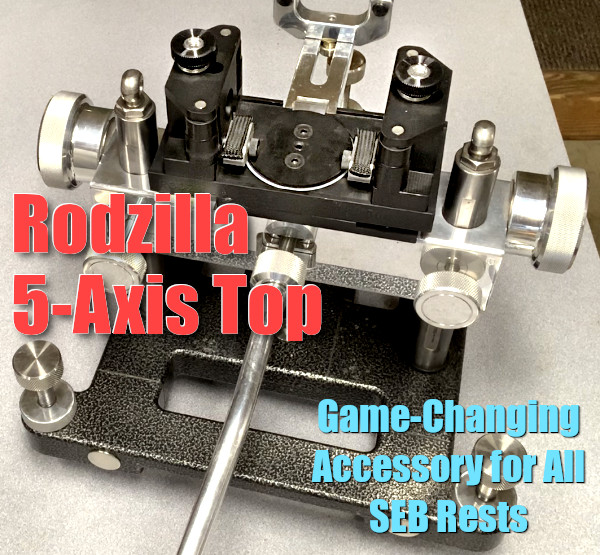
This photo shows the new Rodzilla 5-Axis top installed on a SEB Mini tripod rest. There are also Rodzilla tops for the SEB NEO and MAX two-column front rests.
Nearly a year and countless prototypes later, Rod unveiled his new Rodzilla 5-Axis Top to a select group of shooters to test and it’s been a wild ride ever since. Best of all, his top is drilled and tapped so that it can be fitted to a SEB NEO, MAX, or Mini front rest without altering the rest base in any way. To make things easy, if you don’t want to install it yourself, you can send just the bridge from your NEO/MAX or top from a Mini and Rod will install the 5-Axis unit. You pay for the Rodzilla top, and Rod will install it for free. The Rodzilla NE0/MAX tops currently sell for $549.00, while the Rodzilla Mini top is $584.00.
Watch Video to See All Features of Rodzilla 5-Axis Rest Top:
Rodzilla Top Swivels Independently of Rest Base
The first thing Rod did was allow the top to swivel independently of the base. On a NEO this makes a HUGE difference because you can now set your rest down in the general direction of your target and make final adjustments once you’re down behind the gun. This is a huge departure from the normal procedure where you find yourself moving your NEO repeatedly until it’s just right. You can do the same thing on a Mini which is actually a nice feature despite the head already swiveling because you can now lock down the Mini head and make your final adjustments behind the gun as well. This is probably the feature that stood out the most to me when I first set it up. Being able to lock the front end down and get comfortable immediately behind the gun without having to get up again was a time-saver. This also left me feeling very confident in my gun alignment to the target.
Delrin Rollers on Side Guide Stock during Recoil
The second major innovation is the addition of Delrin rollers along the side. The unit has two easily adjustable jaws that each contain a set of rollers. These rollers allow for as much or little contact as you want along the sides of your stock and provide a smooth if not near frictionless experience whether during recoil (breakaway) or when returning the gun to battery. the departure from traditional sandbags on the side quite revolutionary, and yes it is legal under NRA rules. Current NRA High Power F-Class rules have no limits on what material contacts the sides of the stock. As someone who has owned a number of front rests and filled countless small sandbags this comes as a welcome relief! The Rodzilla’s rollers give me confidence that I’ll have consistent contact with the stock without the side bags constantly shifting and needing my attention during a match.
Small, Separate Sandbags Provide Consistent Contact at Any Gun Angle
Another major Rodzilla advancement is the design of the left and right sandbags. Conventional sandbags are stationary and oriented to the rest itself meaning that if you’re shooting uphill or downhill then you may not have stock contact with the full bag surface or the stock may be at a weird angle to the sandbag. Plus, with time, conventional front sand bags can form crowns or lumps that require attention. Those problems are solved with the Rodzilla’s tilting mini-sandbags. Rod’s sandbags are very small yet still meet NRA High Power guidelines as they are filled with sand and can be visibly deformed when pushed. But otherwise, they are unlike anything you’ve seen before. Each bag is mounted on a pivoting arm allowing the gun to always keep consistent contact with each bag regardless of the angle of your rest. This provides confidence that your stock is always riding on the same amount of sandbag no matter how the rest has been placed, or the ground angle relative to target.
CONCLUSION: The Rodzilla 5-Axis Top is a Game-Changer If you have a SEB Rest you will definitely want this…
The innovative design features of the Rodzilla 5-Axis Top make SEB rests work even better. The Rodzilla Top delivers an incredibly smooth and repeatable shooting experience. Recoil seems smoother, and it is easier to align the rest on target during set-up. If you own a SEB rest and are looking to make your set-up on the line easier and faster, have near-zero breakaway force on each shot, and have consistent follow-up shots to your point of aim, then give the Rodzilla 5-Axis Top a try.
This Video shows how to install the Rodzilla 5-Axis Top on SEB Mini tripod rest:
This Video shows how to install the Rodzilla 5-Axis Top on SEB NEO or MAX Rest
Check out that bolt assembly. It features a fluted stainless bolt body, laser-engraved Titanium shroud, and Titanium dragon-scale bolt knob with polished stainless handle.
You haven’t seen a Ruger Precision Rifle (RPR) like this before. Forum member TerryH has customized his Second-Gen 6.5 Creedmoor RPR with a wicked purple finish, snazzy stainless/titanium bolt, and slick HDPE (polymer) bag-riders front and rear. The mods on this Hot Rod Ruger don’t stop there. Terry added a Seekins hand rail, Timney trigger, ergonomic grip, and more…
For his Hot Rod Ruger, Terry has the right skill set, learned on the job: “I work in a body shop and have pretty much custom-painted all my stuff for many years. For this 6.5 CM RPR, colors of choice are House of Kolor PBC-65 Passion Purple and black covered with Cerakote MC-161 matte clear.” Terry even painted his Bald Eagle rest purple to match his Hot Rod RPR.
Terry reports: “I’m shooting an RPR in 6.5 CM. It has a Patriot Valley Arms 26″ barrel. Josh at PVA is making a thread protector for me so I can remove the Mad Scientist brake. The butt stock has a V-Tab adjustable butt plate and Wiebad check rest pad. Glass is a currently a Vortex Gen I PST 6-24x50mm but I have a Golden Eagle on layaway”. To learn more about this rifle or ask TerryH questions about the build, visit this Shooters’ FORUM THREAD.
Ruger Precision Rifle Modifications: Chassis and Handguards Painted Passion Purple
Patriot Valley Arms 26″ Barrel with Brake
Timney Trigger with Ambi Safety
Custom HDPE (Polymer) Bag-Riders front and Rear
V-Tab adjustable butt plate and Wiebad cheek-pad
Seekins Rail
Good Accuracy with Factory Ammunition
Terry reports: “The RPR is shooting .3 MOA @ 100 with factory Fed American Eagle 140s.” Terry plans to start handloading for the rifle with the goal of shooting F-Class matches next year: “I’ve successfully shot steel out to 1140 yards on the range but [I don’t know] if that will actually translate well in a match. I’m committed to practicing as much as I can and starting to shoot some matches in 2018.”
Front and Rear Bag-Riders with Protektor Rear Bag and Upgraded Bald Eagle Rest
Terry has engineered a slick set-up for F-Open competition and load testing. Up front is a Bald Eagle rest upgraded with windage knob mod, stainless F-Class feet, and longer adjusters. Terry also “changed the hardware to all stainless and added a couple of levels”. In the rear, Terry runs a Protektor Doctor rear bag with 1″ ear spacing.
Impressive additions are the custom HDPE bag-riders Terry crafted himself: “I realized that the butt stock wasn’t going to cut it on the rear bag and even though I got the 2 1/4″ front bag and the Seekins rail is 2″ wide and flat that it wasn’t as stable or smooth as I’d like.” So Terry made his own front and rear bag-riders from HDPE, a material similar to Delrin. Currently the front unit is 2.25″ wide, but Terry will be changing that to a 3″-wide front sled: “I decided that I’d get a 3″-wide front bag and mill a new front bag-rider. I’m going to recess the center to fit around the hand guard and I’ll mill a recess on the bottom of that one.”
Shown below is the Hot Rod Ruger before Terry added the HPDE Bag-Riders front and rear. Terry says the rifle now handles much better with the bag riders, and he plans to upsize the front sled to 3″ width.
Bling’s the Thing. Below is the Hot Rod Ruger’s bolt assembly. It features a custom flat-fluted bolt shaft, laser-engraved Titanium shroud and Titanium dragon-scale knob with polished stainless handle. Terry confesses: “I simply can’t resist anything shiny!”
Brownells is a well-known retailer of guns, gun parts, tools, accessories, ammo, and pretty much everything gun related. What you may not know is that Brownells has a very active video production department that releases new “how-to” and product information videos every week. These videos offer helpful advice on gun cleaning/maintenance, reloading, as well as selecting/assembling components for various kinds of rifles. And every week Brownells serves up a new products video. There now over 1000 videos on the Brownells YouTube Channel, this really is a remarkable resource.
Here are six of our favorite recent videos from Brownells. AR owners will find some good advice on spare parts, new reloaders can learn how to use the OAL tool, and all gun owners should watch the video on ammunition storage.
Introduction to PRS Competition
In this video, Tom Beckstrand, former Special Forces Sniper Team Leader and Guns & Ammo magazine staffer, looks at the Precision Rifle Series (PRS). Tom covers the types of stages in a typical PRS match using unconventional, real-world shooting rests. He also discusses the equipment you’ll need including bag supports, bipods, tripods, and optics. As most ranges aren’t set up for PRS, Tom offers tips on how to train at your local range.
How to Use Hornady OAL Tool and Hornady Bullet Comparator
Gun Tech Steve Ostrem explains how to properly use Hornady’s Overall Length Gauge to determine length-to-land precisely. The OAL Gauge uses a “Modified Case” that theads onto the tool and holds a bullet. Push on the back of the gauge until you feel the bullet just touch the rifling. (We do this gently at first, tapping the rod a couple time to ensure the bullet is aligned correctly). Once you’ve got the length, then use the tool with a comparator on your calipers to get the lenght-to-lands. NOTE: We recommend taking the measurement 3-4 times in a row to get a reliable number. With a little practice your should be able to get repeatable measurements within .0015″.
New Bog Pod Tripod and Caldwell Electronic Muffs
Brownells staffer Paul Levy showcases the impressive new DeathGrip Tripod from Bog Gear. The DeathGrip’s adjustable jaws clamp firmly to the rifle’s forearm. This is a useful device for both PRS shooters and hunters. The head assembly has 25-deg front/rear tilt and 360-deg swivel. And the jaws’ non-slip, rubberized padding won’t scratch that stock. The legs snap open to three pre-set hard stops, and there’s plenty of length extension. Easily switch between rubber feet and steel spikes without removing a single part from the trippod. This video also features Caldwell’s E-Max™ Pro noise-cancelling electronic muffs. These affordable 23 dB NRR units boast dual microphones and digital volume controls, and two sizes are offered — Youth and Adult.
How to Store Ammunition Safely and Securely
Notably, this is the single most popular Brownells video this year, with 494,000 views since March 2020. Here’s the deal — ammunition WILL keep for a long time if you store it properaly. DO store ammunition in a cool, dry place that doesn’t have wide temperature swings. Temperature cycling will also degrade primers and powder. Put it in airtight ammo cans to keep out the moisture. Tupperware containers will work too. Brownells also recommends putting moisture-absorbing silica packs in your ammo containers. DON’T just keep ammo in factory cardboard factory boxes stacked in the basement, attic, or garage — especially not on the floor! The ammunition boxes will absorb moisture which will degrade primers and powder and corrode the brass cases. Yes, sealed military ammo will usually handle this kind of storage for quite a while, but it’s still not wise.
Must-Have Spare Parts for AR-Platform Rifles
This is one of Brownells most popular recent videos, with 154,000 views in just four months. Two gun technicians answer the question: “What spare parts should I keep on hand for my AR-15?” On the list are: Gas Rings, Buffer Spring, Extractor Spring and Pin. NOTE: You may want to try the one-piece spiral gas ring rather than the standard rings which require alignment. The cotter pin and cam pin can also easily get lost when the Bolt Carrier Group is disassembled for cleaning. On the lower receiver you’ll want spare springs and detents for the pivot/takedown pins. If you’re using lighter-power springs, keep standard-power spares on hand. If your rifle stops working, swap in the factory-spec springs to find out if the problem is the gun or your ammo. Also, if you have upgraded your trigger, always keep the original trigger as a backup.
Cleaning Advice for .22 LR Rimfire Rifles
Gun Techs Steve Ostrem and Caleb Savant debunk some myths about cleaning .22 LR barrels. One myth is that cleaning will harm the accuracy of a .22 LR barrel. Caleb thinks this myth is the result of people cleaning a barrel from the muzzle and damaging the muzzle crown, which CAN diminish accuracy. If it’s done right, cleaning won’t damage the bore. However, you certainly do NOT have to clean your 22 LR’s bore every time you go to the range. But DO clean the action every time you shoot the rifle, especially on a semi-auto. What about shooting a lot of lead bullets? Won’t that lead up the bore? The guys give us the straight skinny on lead fouling, too. When you see your .22 LR rifle’s groups opening up, you may want to consider cleaning.
Do you shoot long, pointy Hybrid Ogive bullets? If so, you may need to modify the Hornady L-N-L Bullet Comparator tool commonly used to measure the distance from bullet base to bullet ogive.
With modern, high-BC match bullets, so much of the bullet may extend forward of the ogive that the bullet tip actually contacts the inside of the red comparator body BEFORE the bullet’s ogive contacts the gray caliber-specific insert ring attached to the red body. When this happens you will NOT get an accurate Base-to-Ogive (BTO) measure. And likewise you will not get a proper Cartridge-Base-to-Ogive (CBTO) measurement with loaded rounds.
Watch this video — it shows exactly how this measurement “fail” can happen with a .338-caliber Berger Elite hunter bullet. The tester was getting a false bullet Base-to-Ogive reading of 1.175 (0:25 timemark) before modifying his tool. The true BTO measurement, with the bullet actually contacting the gray comparator ring, is 1.121 (1:25 timemark):
How to Fix the Problem
What’s the fix? With a drill, you must relieve the back “wall” inside the red comparator holder bore. This will provide more clearance for the bullet tip. With more clearance the bullet ogive will seat properly on the gray, caliber-specific insert. The tip will no longer bottom out on the red clamping half of the tool.
The maker of this helpful video, EuLRH explains: “As we all know the CBTO (Cartridge Base to Ogive) measurement is [more useful than] COAL (Cartridge Overall Length). There are lots of products that can do this. One of them is Hornady L-N-L bullet comparator. Attention! With modern long range bullets it is possible that the bullet tip is touching the comparator body instead of the bullet ogive touching the gauge.” In this example, EuLRH worked with the 300gr Berger elite hunter bullet in .338 Caliber.
Why You Need to Check with Your Own Loads
If your bullets have this “tip touching” issue, when you measure your loaded rounds you will be seeing COAL instead of the Cartridge Base to Ogive (CBTO) length. Take a moment, test with your own bullets and your comparator to determine if you have this measurement problem. If you do, try the drilling solution shown in the video.
Jeff Quinn, founder of GunBlast.com, was a good-hearted, southern country boy who loved firearms. Sadly he passed away on July 27, 2020. He will be missed. His reviews were always honest and thoughtful. Notably, Jeff was a true internet pioneer. With help from his brother Boge Quinn, Jeff created Gunblast.com back in 2000. He was one of the first independent writers publishing gun reviews on the internet. And he also was one of the very first to release gun test videos on YouTube. Over the past two decades the GunBlast YouTube channel has racked up over 64 million views. Jeff Quinn led the way for popular YouTube video hosts such as 22Plinkster and Hickok 45.
This Sunday Gunday, to mark Jeff’s passing and recognize his influence in the world of firearms videos, we are reprising six of his videos from the past decade. There are a wide selection here — both rifles and pistols, rimfire and centerfire. We’ve even included a special video where Jeff tests a pre-WWI era Maxim machine gun.
The Patriot — Accurate .22-250 AI Benchrest Rifle
While Jeff Quinn focused on factory handguns, hunting rifles, and defensive shotguns, he did occasionally sample accurate custom rifles. Here he tested a unique “Patriot” .22-250 AI rig built on a sleeved Remington 700 action. This handsome rifle boasts a custom-painted, thumbhole benchrest stock with a stars-and-stripes motif. One side says “In God We Trust”, while the other side carries the message “The Right to Keep and Bear Arms”. This “Patriot” rifle delivered three-shot ragged-hole groups at 100 yards.
Tales from the Vault — Winchester 1895 Lever Gun
Along with his regular field tests, Jeff hosted videos that focused on the historical heritage of some of his favorite firearms. In the “Tales from the Vault” episode, Jeff showcases a prized example from his personal gun collection. This is an original Winchester Model 1895 lever-action rifle chambered in 30 Army, also known as 30-40 Krag.
Smith & Wesson Performance Center M629 .44 Magnum
Smith & Wesson builds some of the best wheelguns on the planet, and Performance Center models are the top of the S&W lineup. This Editor owns two S&W Performance Center revolvers, and they are both outstanding, with great triggers and accuracy that puts most semi-auto handguns to shame. In this video, Jeff Quinn tests a Performance Center six-shot Model 629 Hunter Revolver with a 8 3/8″ fluted barrel. S&W includes a Weaver-type optics rail with this capable wheelgun.
Shooting the Savage A17 in 17 HMR
The Savage model A17 delayed-blowback semi-auto in .17 HMR is one of our favorite budget varmint rifles. It is affordable, reliable, and surprisingly accurate with good .17 HMR ammo. Here Jeff Quinn tests the basic A17. We like the upgraded version with a laminated thumbhole stock, shown below. But both versions utilize the same well-designed action. This is a good choice for small varmints, such as ground squirrels, out to 200 yards.
Ruger GP100 .22 LR 10-Shot Revolver
We believe every gun enthusiast should have a good rimfire revolver, and Jeff Quinn would concur. The small size of the .22 LR cartridge allows modern wheelguns to have 10-round cylinder capacity. That’s great for target shooting, fun plinking, and gun games. Here Jeff reviews the sturdy .22 LR GP100 from Ruger. Jeff says this pistol offers “a good tight barrel/cylinder gap” and “positive ejection that kicks spent cases out really well.” He noted that this pistol was “amazingly accurate”. He tested 9 different ammo types and got 1.5″ average TEN-shot groups at 25 yards. (See video at 2:40 for targets.)
BONUS Video — Maxim Machine Gun (1914 Vintage)
The Maxim machine gun was one of the earliest successful fully-automatic weapons. Many of its revolutionary design features are still used in modern machine guns. Here Jeff Quinn tests a belt-fed, wheeled-carriage Maxim with Joe Meaux of Aklys Defense from Aklys Defense.


 Wrapters Are Precisely Cut, Comfortable, and Removable


 As someone who aspired to building a repeater and jumping into the PRS game, and had a spare F-TR rifle sitting around, I thought it would be fun to build up a 6mm GT to see if there was any merit to the hype. My smith, Wes Ripley of

 BRASS — The first thing you’ll find is cartridge brass choices for the 6mmGT are rather limited currently. At present, the only commercial options are Hornady and


 SUMMARY — Good Cartridge with Much Potential




 Do you shoot long, pointy Hybrid Ogive bullets? If so, you may need to modify the Hornady L-N-L Bullet Comparator tool commonly used to measure the distance from bullet base to bullet ogive.


