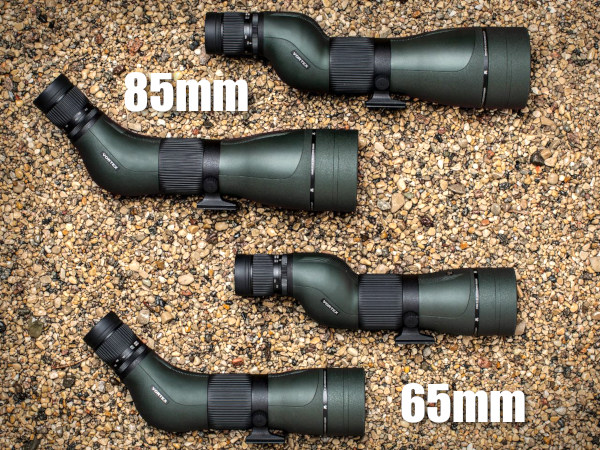
Vortex’s new Diamondback® HD series of spotting scopes offer impressive performance for the price. While you can spend $2500 or more for a premium Fluorite Glass spotter, Vortex’s new HD spotting scopes cost $500-$600 MSRP. These new Diamondback spotters could be affordable options for competitive shooters and hunters. The Diamondback HD line of spotting scopes include both angled and straight body types in 16-48x65mm and 20-60x85mm configurations.
The new Diamondback HD spotters employ an HD optical system with multi-coated lenses. Vortex claims these spotters offer greater light transmission, reduced chromatic aberration, better color fidelity, and enhanced sharpness. Vortex says the “crisp resolution, brighter images, and edge-to-edge sharpness [can reduce] eye strain during long glassing sessions.” We hope to test the 20-60x85mm model to confirm these claims. HD glass should deliver greater low-light performance and clarity.
These new Diamondback HD models boast design upgrades to make them more like Vortex’s higher-end Viper HD Spotting Scopes (which start at $1049.99 MSRP). The big change is the new full-diameter focus ring as you would see on a Swarovski spotter. Vortex says: “[We] took a fresh approach to the spotter’s exterior, introducing a streamlined, snag-free profile. The helical focus wheel provides fast, fine adjustments, and an Arca-Swiss compatible foot means the Diamondback® HD mounts quickly to compatible tripod heads without additional plates. Plus, a neoprene cover comes included, keeping your spotter protected in the field.” The video below reviews the main design features of the new spotters:
Which model should you choose? The 16-48x65mm ($499.99 MSRP) is smaller and lighter, making it easier to pack or move around the firing line. The angled 16-48X spotter OAL is 14.25″ and weight is 49.8 oz., making this a good choice for competition shooters looking for an affordable spotter to watch mirage and shot markers. For hunters and other shooters seeking enhanced low-light performance and magnification, the 20-60x85mm ($599.99 MSRP) offers more light-gathering for just $100.00 more. OAL is 16.0″ and weight is 60.9 oz., about 3/4 pound heavier than its smaller brother. You make the choice.
Looking for a very affordable first rifle? Here’s one of the best low-cost options you can find among .22 LR rimfire rigs. The Rossi RS22 is a reliable, semi-auto rifle that comes equipped with barrel-mounted iron/fiber optic sights. There are also dovetails on the receiver for mounting scope rings. The RS22 also takes most Mossberg 702 magazines.
The Rossi RS22 features an 18″ free-floating barrel, adjustable fiber optic sights and a synthetic Monte Carlo stock. For added accuracy, 3/8″ dovetail mounts allow the mounting of a scope or other optic.
Rossi RS22 Specifications:
Model: RS22 Semi-Auto, .22 LR
Barrel: 18″ Free-floating
Stock: Black Monte Carlo Synthetic Stock
Overall Length: 36.25″
Weight: 4.1 lbs.
NOTE: The Rossi RS22 on sale has a matte black stock.
Two Video Reviews of Rossi RS22
The above video review of the Rossi RS22 confirms its reliability and build quality. The reviewer praised the fiber-optic iron sights and liked the magazines. After fitting a scope to the rifle’s built-in dove-tail, the tester got excellent accuracy with CCI ammo at 25 yards. Ten shots basically formed one half-inch hole. (See video 8:24 – 8:50 and target at right.) That’s good enough for an NRL22 match. Pretty impressive for a $110 rifle!
Gunblast.com also tested the Rossi RS22. This “dandy little rifle” performed great, with flawless semi-auto feeding and cycling for hundreds of rounds. Accuracy was quite good. The tester praised the fit and feel of the stock and noted it has sling swivel studs and well-protected sights. The RS22 can also use 25-round Mossberg magazines.
Our friend Gavin Gear of UltimateReloader.com often gets to test the latest and greatest reloading tools before they hit the market. He does a good job showing the features of new products with informative videos. Today we present three interesting products that Gavin has reviewed. First off is the impressive new RCBS Rebel reloading press. Next is the versatile three-head Case Prep Trio machine from Hornady. Third, Gavin reviews new Die Lock Rings and Breech Lock Die Bushings from Lee Precision.
RCBS Rebel Single-Stage Reloading Press
Most hand-loaders have used an RCBS Rock Chucker press at one time or another. Recently RCBS unveiled its new Rebel single-stage press. Like the Rock Chucker, the Rebel has a Cast Iron frame, but with a bigger base and taller arch (for a larger opening). The most important change is that this new Rebel press ejects primers out the bottom of the ram. This a big deal — just put a bin under the press to collect spent primers. However — take note — the Rebel has no on-press priming. You need to prime your cases separately. That’s not really a major issue, as we know the majority of our readers prime separately using hand or bench priming tools.
In this video Gavin loads ammo on the new the Rebel single-stage press and explains its notable features, including the primer ejection through the ram.
Note, RCBS is currently running a Buy Green Get Green Rebate Program. The Rebel Press qualifies for a $50.00 Rebate. And right now, MidwayUSA has the Rebel Press on sale for $186.99. So your net cost, after RCBS Rebate, is just $136.99. That’s a great deal on an excellent press.
Hornady Lock-N-Load Case Prep Trio
Hornady’s compact Case Prep Trio machine (item 050160) packs a lot of functionality in a small package. This triple-threat tool has a small footprint, yet it can perform three tasks as well as much more expensive, tower-style case prep units.
Gavin Gear does a nice job explaining the features of the Case Prep trio. Watch this video to see how it can help you perform chamfering, deburring, and pimer pocket uniforming tasks more efficiently.
With three active stations, you can chamfer, deburr and clean primer pockets without having to change tools. The Case Prep Trio ships with inside chamfer, outside chamfer, and deburr tools. You can also use the machine with other optional 8/32 threaded accessories such as primer pocket reamers and case neck brushes. We’ve used this machine and it works well. The only negative is that you will get metal shavings on your bench (unlike some of the larger case prep centers). We’ve seen some guys put a small pan under the power head — then you can just dump the shavings out of the pan.
New Lee Die Lock Rings and Spline Drive Breech Lock Bushings
New basic lock ring in left hand. Older non-splined ring in right hand.
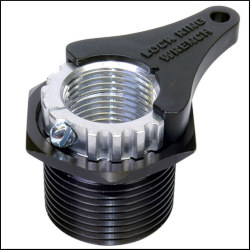
In this recent video Gavin Gear reviews three types of die accessories from LEE. These work for virtually all standard dies, not just LEE-brand reloading dies. The new LEE basic silver-finish die lock rings now feature splines for enhanced grip and compatibility with LEE’s new die lock ring wrench (photo right). They still boast a rubber 0-Ring that helps “float” the die for improved cartridge concentricity.
LEE’s new Ultimate Die Lock Rings have two major improvements — a colorful anodized finish, and a split-ring design with a tensioning screw, that allows these rings to be clamped securely to your dies. Available as a set, this package includes three ultimate die lock rings, and a plastic die lock ring wrench.
Gavin also reviews Lee’s new Spline Drive Breech Lock Bushings for use with presses fitted with LEE’s Breech Lock system. These new Breech Lock bushings allow rapid change-out of dies without modifying the setting. The colorful new bushings feature splines on top that work with the new Lee Lock ring wrench shown above. In addition, the Breech Lock Bushings have a clamp to preserve die depth setting.
Some top-flight components for a great-shooting rifle surely aren’t cheap — like a custom action ($1200 and up). And a premium, match-grade scope could set you back two grand or more. But there are still some great items that cost under $20.00 that can benefit any gun-owner. Here are our selection of six great shooting accessories under twenty bucks. Many of these are top-selling items on Amazon. The first item, a motion-sensitive light for your gun safe, has been a big hit with our readers.
1. Amazon — Motion-Sensor LED Interior Light, $15.99
Here’s a great accessory for your Gun Safe or closet. This rechargeable LED lamp turns itself on when you open the door, and off when you close the door. Select three brightness levels: 10LED, 20LED, 30LED. With the supplied 3M adhesive magnetic strip you can easily attach the light to the inner walls of your gun safe. And then quickly remove the unit for charging with a standard USB cord (no batteries to replace!). It works, it’s handy, and it’s inexpensive — just $15.99 on Amazon. These motion-sensor LED lamps can also be used in garages or stairwells. NOTE: this is Amazon’s choice for rechargeable LED Motion-Sensor lights.
If you shoot long range, you need a scope level. The best way to avoid inconsistent rifle canting is to use a bubble level fitted to rail or scope. One very affordable and versatile product is the Jialitte Scope Bubble Level. This features a 30mm milled inside diameter, plus an inner insert ring so it will also fit 1″-diameter main tubes. The Jiaalitte unit is nicely radiused, and has a low profile in the middle. User reviews have been very positive. This costs just $10.99. You could easily pay $35.00 or more for a 30mm scope level. Purchasers have praised this product: 89% of verified buyers rated this four or five stars.
3. Home Depot — Low-Profile Muffs + Shooting Glasses, $14.72
Every shooter should have an extra set of shooting muffs and protective earwear. These will provide vital protection for friends/guests you bring to the range. And let’s face it, sooner or later you’ll forget your own muffs, so it’s wise to keep an extra set in your vehicle at all times. Home Depot offers a great deal on Walker’s NRR 22 Muffs + ANSI Z87.1-rated Shooting Glasses. Get both as a Combo Set for just $14.72. Midsouth shooters also has this combo for $19.12.
4. Midsouth Shooters — Lee Universal Decapping Die, $10.95
Midsouth sells the Lee Universal Decapping Die for just $10.95 (item 006-90292), a very good deal. There are many situations when you may want to remove primers from fired brass as a separate operation (prior to case sizing). For example, if your rifle brass is dirty, you may want to de-cap before sizing. Or, if you load on a progressive press, things will run much more smoothly if you decap you brass first, in a separate operation. The Lee Universal Decapping Die will work with cartridges from 17 Fireball all the way up to 45-70. However, NOTE that the decapping pin supplied with this Lee die is TOO LARGE for LAPUA 6.5×47, 6BR, 220 Russian, and Norma 6 PPC flash holes. Because the pin diameter is too large for these brass types, you must either turn down the pin, or decap with a different tool for cases with .059″ flash-holes. Otherwise, the Lee Decapping Die works well and it’s a bargain.
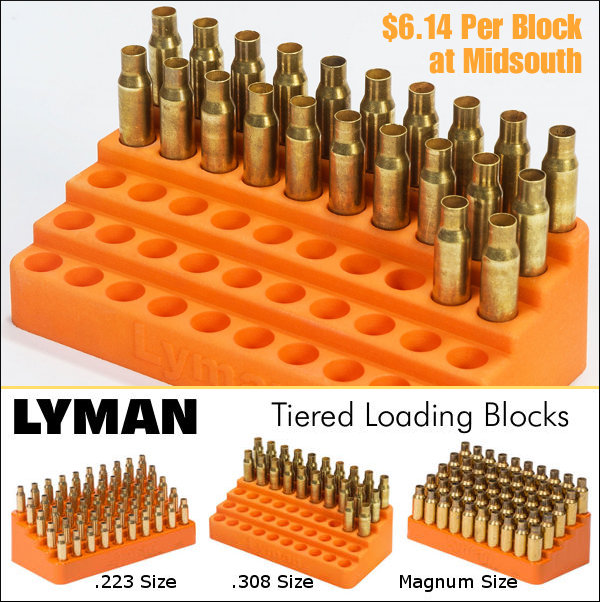
Lyman’s new Bleacher Block stepped cartridge holders are great. Use the different levels for sorting brass. Or, migrate the brass from top to bottom as you proceed through case prep stages. Made of durable polymer, Bleacher Blocks are molded in three sizes. The smallest size (with 0.388″-diam holes) fits .223 Rem-size case heads. The middle size (with 0.485″-diam holes) fits .308 Win-size case heads. The biggest Bleacher Block has 0.565″-diameter recesses for magnum-size cases. All three cartridge block sizes hold fifty (50) rounds. Purchase any size for just $6.14 per Block at Midsouth.
TEKMAT makes great products for cleaning long guns. This large 36″ x 12″ vulcanized rubber mat includes a full parts diagram for AR-platform rifles, available in gray, black, and green. Or choose a cool-looking cutaway AR15 illustration on black background. Get either type of 36″ x 12″ mat for just $9.99!. That’s 50% OFF the normal $19.99 price — a GREAT Deal. The oil- and water-resistant surface helps protect your firearm from scratches while the diagrams help with take-down and reassembly. This deal won’t last long.
In June 2020, Hornady introduced the 6mm ARC, a new SAAMI cartridge optimized for AR-platform rifles*. The new 6mm ARC is basically a 6.5 Grendel necked down to 6mm, with the shoulder moved back around .030″. That pushed-back shoulder does reduce case capacity (and velocity), but we assume Hornady did that to create a shorter, proprietary chamber so people could not simply neck-down Lapua 6.5 Grendel brass, as has been done for years with Robert Whitley’s outstanding 6mm AR wildcat.
What Is the 6mm ARC Cartridge? The 6mm ARC cartridge is a new SAAMI-spec cartridge based on the 6.5 Grendel case necked down for 6mm bullets, with the shoulder moved back 0.030. Yes it is designed to run in AR15-platform rifles. You’ll need a new barrel, bolt, and mags. If you already have an AR chambered in 6.5 Grendel, the ONLY thing you need to change is the barrel. Everything else — bolt, magazines, gas system – is compatible with 6mm ARC.
▶ Official SAAMI Cartridge (not wildcat)
▶ Fits standard AR15-platform rifles
▶ Fits Short/Mini action bolt rifles
▶ Efficient short, fat case design
▶ 30-degree case shoulder
What Do I Need To Shoot the 6mm ARC?
Faxon and Ballistic Advantage are already producing barrels, with more manufacturers sure to follow. All the other required components are already on the market for 6.5 Grendel rifles. Aero Precision already offers complete 6mm ARC uppers.
If you’re converting a standard 5.56×45 mm (.223 Rem) AR15 upper to shoot 6mm ARC, you’ll need a 6mm barrel, a Type II 6.5 Grendel bolt carrier group, and new magazines. Some folks have suggested standard AR mags will work, but trust us, you want the magazines that have been designed for 6.5 Grendel. All the hardware you need is currently available at Brownells. And Brownells also sells complete Aero Precision 6mm ARC Uppers, starting at $749.99.
* While 6-6.5 Grendel shooters are known to run stout pressures, the new 6mm ARC cartridge has a relatively moderate Maximum Average Pressure (MAP) rating of 52,000 psi according to the official SAAMI specifications. For a variety of reasons, is wise to keep pressures in a semi-auto rifle moderate. Don’t chase the velocities you might get in a bolt-action gun.
If you carry a handgun for self-defense after hours, you may want to equip your pistol with a laser beam aiming system. Pistol lasers can significantly improve your ability to get on target in low-light conditions. Watch this video to learn how to best use a laser-equipped pistol:
Viridian Weapon Technologies is one of the leading makers of laser aiming system, laser/light units, and compact gun-cameras. Right now Viridian is offering great savings on laser systems for Ruger pistols.
Viridian makes lasers for a wide variety of popular handguns, including compact revolvers. You can choose between red lasers and green lasers. Experts say the green lasers have some advantages. The light is stronger and the green beam itself is more visible. Veridian lasers are the choice of leading pistol-makers for factory-installed frame- or grip-mounted laser systems. And Viridian offers an industry-leading 7-Year Warranty plus a 30-day Money-Back Guarantee.
Instant-On Laser System
INSTANT-ON® is now part of most Viridian products, offering ultra-fast laser activation when desired. Just pre-set the Viridian mode, slide your gun into your INSTANT-ON equipped holster, and the INSTANT-ON system is armed and ready. The instant the gun leaves the holster, the Viridian laser is illuminating. Yes, you can also de-activate this feature, so that the laser only comes on when you push a button.
The Viridian C Series, X Series Gen 2 and Gen 3, and Reactor Series are equipped with INSTANT-ON technology and activate
Do you own an M1 Garand, or have you always wanted to acquire one of these legendary semi-auto battle rifles? Well then here is a valuable new resource: The Essential M1 Garand: A Practical and Historical Guide for Shooters and Collectors. This new book by Jim Thompson covers the history of the M1 Garand, and offers practical advice for Garand owners, along with complete parts lists. The book includes annotated military and National Match manuals, a troubleshooting chart, and a section on hand-loading for the Garand. The final Section addresses common questions about the rifle and offers detailed instructions for maintaining this wartime classic. First published in February, 2020, The Essential M1 Garand is available in Print Paperback and Kindle eBook versions. View Table of Contents.
Recommended M1 Garand Manual
Along with The Essential M1 Garand book by Jim Thompson, there are many other good M1 Garand print resources. Among the many M1 Garand manuals available, we recommend the CMP’s U.S. Rifle, Caliber .30, M1: ‘Read This First’ Manual. This booklet covers take-down, reassembly, cleaning, lubrication, and operation. The manual comes with CMP rifles or can be purchased for $3.25 from the CMP eStore. The CMP also offers many other M1 Garand print resources including:
Have a good look at the photos below — this may be one of the most noteworthy target strings we’ve ever published. What you can see is the effect of barrel tuner position on point of impact (POI). You can clearly see that the tuner position alters the up/down POI location in a predictable fashion.
This remarkable 15-shot sequence was shot by French benchrester Pascal Fischbach using his 6 PPC fitted with a CG (Carlito Gonzales) action and a Bukys barrel tuner.
Pascal reports: “After [bullet] seating and load validation, I put the Bukys tuner on, screwing it out 10 turns. According to Carlito, the CG’s super stiff action-to-barrel fit gives a faster vibration modulus that is detrimental below 10 turns [position of the tuner].” Pascal’s procedure was to screw out the tuner 1/4 turn progressively from one shot to the next. He shot one bullet at each tuner position, with a total of 15 shots.
Left Half of Target Strip (shots with 1/4 rotation change of tuner in sequence)
Right Half of Target Strip (shots with 1/4 rotation change of tuner in sequence)
Pascal observed: “Note the point of impact displacement [from shot to shot] tracks clearly along a sinusoide (sine wave curve).” This is indeed notable and significant! This shows how the tuner’s ability to change barrel harmonics can alter the position of the muzzle as each bullet exits, resulting in a higher or lower POI. Pascal sent his results to Carlito Gonzales in Argentina for analysis.
Pascal poses this question to readers: “Guess which three positions Carlito recommends to try?”
Editor’s Note: While this target sequence clearly shows how tuner position can alter bullet point of impact, this, by itself, does not tell us which tuner position(s) are best for accuracy. That will require further multi-shot group testing, involving careful experimentation with tuner position (and powder charge weights). But for those folks who doubt that a tuner can make a difference on a short, fat barrel, just take another look at the photos. The up/down changes are undeniable, and noteworthy in the wave pattern they follow.
Shooting Set-up and Test Conditions:
Pascal did this test at an outdoor range under very good conditions: “This was shot at my home range, outdoors, with four Smiley flags. The range is a narrow cut in high woods. Wind was consistent with readable flags. I started testing the tuner from 10 turns out and on to 15. I recently… found a sweet spot very close to the rearmost position of the tuner, so the rigidity provided by this super long tenon (just short of 70mm) was not a reason to overlook the recommended Bukys tuning procedure.”
Despite the COVID-19 Pandemic, we know that many readers will be traveling by air this summer to attend major matches. If you plan to fly commercially in the weeks ahead, you need to be careful when transporting firearms through airports both in the USA and in other countries. It is important that you comply with all Homeland Security, TSA, and Airline policies when transporting guns and ammunition. Following the rules will help ensure you (and your gear) make it to your destination without hassles, delays or (God forbid), confiscations.
You’ll want to visit the TSA Firearms and Ammunition webpage, and read it start to finish. In addition, before your trip, you should check the regulations of the airline(s) with which you will fly. Some airlines have special requirements, such as weight restrictions.
TSA Guidelines for Travel with Firearms
Firearms Guidelines
• When traveling, comply with the laws concerning possession of firearms as they vary by local, state and international governments.
• If you are traveling internationally with a firearm in checked baggage, please check the U.S. Customs and Border Protection website for information and requirements prior to travel.
• Declare each firearm each time you present it for transport as checked baggage. Ask your airline about limitations or fees that may apply.
• Firearms must be unloaded and locked in a hard-sided container and transported as checked baggage only. As defined by 49 CFR 1540.5 a loaded firearm has a live round of ammunition, or any component thereof, in the chamber or cylinder or in a magazine inserted in the firearm. Only the passenger should retain the key or combination to the lock unless TSA personnel request the key to open the firearm container to ensure compliance with TSA regulations. You may use any brand or type of lock to secure your firearm case, including TSA-recognized locks.
• Firearm parts, including magazines, clips, bolts and firing pins, are prohibited in carry-on baggage, but may be transported in checked baggage.
• Replica firearms, including firearm replicas that are toys, may be transported in checked baggage only.
• Rifle scopes are permitted in carry-on and checked baggage.
Ammunition Guidelines
• Ammunition is prohibited in carry-on baggage, but may be transported in checked baggage.
• Firearm magazines and ammunition clips, whether loaded or empty, must be securely boxed or included within a hard-sided case containing an unloaded firearm. Read the requirements governing the transport of ammunition in checked baggage as defined by 49 CFR 175.10 (a)(8).
• Small arms ammunition (up to .75 caliber and shotgun shells of any gauge) must be packaged in a fiber (such as cardboard), wood, plastic, or metal box specifically designed to carry ammunition and declared to your airline.
• Ammunition may be transported in the same hard-sided, locked case as a firearm if it has been packed as described above. You cannot use firearm magazines or clips for packing ammunition unless they completely enclose the ammunition.
• Firearm magazines and ammunition clips, whether loaded or empty, must be boxed or included within a hard-sided, locked case.
• Please check with your airline for quantity limits for ammunition.
To help our readers comply with rules and regulations for air travel, we offer these guidelines, courtesy “Ron D.”, a member of our Shooters’ Forum. Before he retired, Ron D. served as a Police Officer assigned to Chicago’s O’Hare airport. Here Ron offers some very important advice for shooters traveling with firearms and expensive optics.
First, Ron explains that airport thieves can spot bags containing firearms no matter how they are packaged: “Don’t think you’re safe if your guns are placed in cases designed for golf clubs or trade show items. Baggage is X-Rayed now and cases are tagged with a special bar code if they contain firearms. It doesn’t take long for bad guys to figure out the bar coding for firearms.”
Carry-On Your Scopes and Expensive Items
Ron advises travelers to avoid placing very expensive items in checked baggage: “When traveling by air, carry on your rangefinder, spotting scope, rifle scope, medications, camera, etc. You would be surprised at the amount of people that carry-on jeans and shirts, but put expensive items in checked baggage. Better to loose three pairs of jeans than some expensive glass.”
Mark Bags to Avoid Confusion
Ron notes that carry-on bags are often lost because so many carry-on cases look the same. Ron reports: “People do accidentally remove the wrong bag repeatedly. I frequently heard the comment, ‘But it looks just like my bag.’ When de-planing, keep an eye on what comes out of the overhead that your bag is in. It’s easy to get distracted by someone that has been sitting next to you the whole flight. I tie two streamers of red surveyors’ tape on my carry-on bag.” You can also use paint or decals to make your carry-on bag more distinctive.
General Advice for Air Travelers
Ron cautions: “Keep your hands on your items before boarding. One of the most often heard comments from theft victims was, ‘I just put my computer down for a minute while I was on the phone.’ Also, get to the baggage claim area quickly. If your family/friends can meet you there, so can the opportunists. Things do get lost in the claim area. Don’t be a Victim. Forewarned is forearmed.”
Choosing a Rifle Transport Case
Ron advises: “Buy the best [rifle case] that you can afford. Don’t cry when your $3,000+ Benchrest rifle has a cracked stock or broken scope. Think about what it would be like to travel across the country (e.g. to Montana or the Cactus Classic) and arrive with a damaged rifle. Remember the Samsonite commercial. (For you younger shooters, it shows a monkey throwing the suitcase around in his cage at the zoo.) Baggage handling is NOT a fine art. There is no guarantee that your rifle case will be on top of all the other baggage. Then there is shifting of baggage in the belly of the plane. Ponder that for a while. Rifle and pistol cases must be locked. It doesn’t take a Rocket Scientist to figure out that a simple pry tool will open most case locks. There is not much that you can do to disguise a rifle case. It is what it is, and opportunists know this. Among thieves, it doesn’t take long for the word to get around about a NEW type of case.”
Plano Two-Gun Tactical Case
This Plano AW2 two-gun Case offers the functionality and durability of an SKB-type hard case for HALF the money. This is now just $116.67, while the equivalent SKB is around $300.00.
This Plano AW2 two-gun case is Amazon’s #1 Best Seller in wheeled, heavy-duty firearms cases. This is offered in three sizes: 36″, 42″, and 52″. We like the biggest 52″ version, as it is long enough inside to fit most scoped match rifles. Alternatively, if you have a really long F-Class, ELR, or Palma rig, you can detach the barreled action from the stock, and run the two sections in the shorter 42″ case. This case is strong enough for airline travel, meeting FAA requirements for checked baggage. This Plano case offers a good balance between strength and weight, all for a reasonable cost — $116.67 on Amazon.
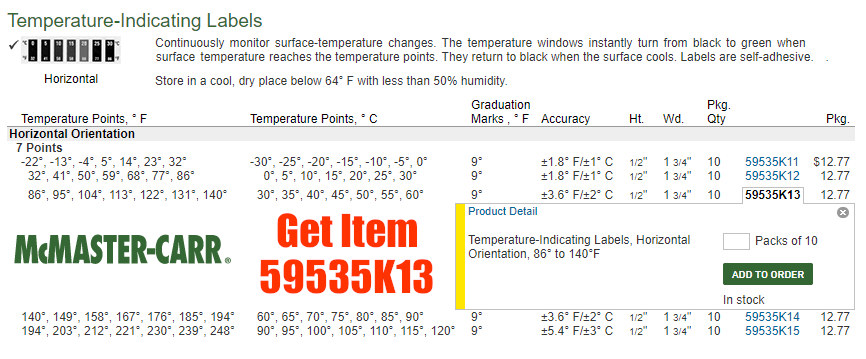
You never want your barrels to get too hot, which can happen more quickly in summertime. Accuracy suffers when barrels over-heat, and excessive heat is not good for barrel life. So how do you monitor your barrel’s temperature? You can check if the barrel is “warm to the touch” — but that method is not particularly precise. There is a better way — using temperature-sensitive strips. McMaster.com (an industrial supply house) offers stick-on temp strips with values from 86° F to 140° F. A pack of ten (10) of these strips (item 59535K13) costs $12.77. That’s a mere $1.28 per barrel for strips — cheap insurance for your precious barrels. For best barrel life, try to stay under 120 degrees F.
NOTE: On the McMaster.com website, you’ll need to scroll down to the multi-use “Temperature Indicating Labels”. Then click on the horizontal label and select item 59535K13, as shown below.
Click image for large view.
Forum member Nomad47 says: “I have temperature strips (bought at McMaster-Carr) on all my barrels. I try not to shoot when the barrel gets to 122 degrees or higher[.]” Here are photos of the McMaster-Carr temp strips on Nomad47’s customized Savage.
Bad things can happen if your barrel gets too hot. First, with some barrels, the point of impact (POI) will shift or “walk” as the barrel heats up excessively. Second, even if the POI doesn’t change, the groups can open up dramatically when the barrel gets too hot. Third, if the barrel is very hot, the chamber will transfer heat to your loaded cartridge, which can lead to pressure issues. Finally, there’s considerable evidence that hot barrels wear out faster. This is a very real concern, particularly for varmint shooters who may shoot hundreds of rounds in a day. For this reason, many varminters switch among various guns, never letting a particular barrel get too hot.
Neconos.com offers Bar-L Temp Strips that visually display heat readings from 86 to 140 degrees. Think of these strips as compact, unbreakable thermometers. With adhesive backing, they can also be used to monitor barrel heating.
Put a strip on the side of the barrel and the barrel’s temp will be indicated by a stripe that changes from black to green. There is also a “general purpose” strip that reads to 196 degrees (see bottom row). The Benchrest strip (86°F to 140°F) is in the middle. These Bar-L temp strips cost $9.00 each, or $25.00 for a 3-pack.





 In this recent video Gavin Gear reviews three types of die accessories from LEE. These work for virtually all standard dies, not just LEE-brand reloading dies. The new LEE basic silver-finish die lock rings now feature splines for enhanced grip and compatibility with LEE’s new die lock ring wrench (photo right). They still boast a rubber 0-Ring that helps “float” the die for improved cartridge concentricity.




 Have a good look at the photos below — this may be one of the most noteworthy target strings we’ve ever published. What you can see is the effect of barrel tuner position on point of impact (POI). You can clearly see that the tuner position alters the up/down POI location in a predictable fashion.


 First, Ron explains that airport thieves can spot bags containing firearms no matter how they are packaged: “Don’t think you’re safe if your guns are placed in cases designed for golf clubs or trade show items. Baggage is X-Rayed now and cases are tagged with a special bar code if they contain firearms. It doesn’t take long for bad guys to figure out the bar coding for firearms.”