With all the buzz about the 6.5 Creedmoor and its 6mm Creedmoor little brother, some folks forget that we’ve had an outstanding mid-sized, Across-the-Course cartridge for a long time — the 6XC. Pioneered by 11-time National High Power champion David Tubb, the 6XC has won national High Power championships, excelled in mid-range prone matches, and performed great in the varmint fields. It has also been used successfully by many Precision Rifle Series competitors. It’s no wonder — the 6XC has less recoil than a 6.5mm Creedmoor, there is a great selection of superb 6mm bullets, and Peterson 6XC brass is high-quality and reasonably priced ($69/100) from DavidTubb.com. Fine Norma 6XC brass is available from Grafs.com.
PRS Rifle with Modern 6XC II Chamber
Forum member Grimstod posted this new 6XC II rifle in our long-running Pride and Joy Rifle Thread. Grimstod notes: “These 6XC Gen IIs seam to be a hot commodity lately. This one is for PRS. It features a Premier Accuracy Atlas action made by Kelbly. The bolt and heavy-taper, fluted barrel are Cerakoted to match. I really like the ejectors on these Atlas actions. The stock is a KRG X-Ray painted in Premier Accuracy exclusive colors. The Kelbly Atlas action does not have any modifications. So far every Kelbly action we have tried has had perfect timing and trigger fall. We have been supper pleased with them. I look forward to using a lot more of these excellent actions.”
What is the 6XC II you may ask? That designates a 6XC with a chamber dimension optimized for Norma brass. It turns out that Norma brass is a bit bigger at the bottom than the 22-250 brass from which the 6XC originated. Robert Whitley of 6mmAR.com has created two new JGS reamer specs that fit the Norma brass perfectly, improving feeding and extraction. Here is Robert’s Report:
The 6XC II Chamber — Upgraded for Today’s Norma 6XC Brass
by Robert Whitley of 6mmAR.com
The 6XC II Chamber works perfectly with the Norma 6XC brass and resolves the “sticky bolt lift” issue. The original 6XC chambering was designed based off the usage of 22-250 brass which typically has a web diameter in the range of .461″-.463″. The area of the chamber just forward of the web on the original 6XC chambering was .4695″ which left plenty of clearance.
When Norma 6XC brass became available Norma appears to have developed the base of the case from the .308 Winchester line of cases which have a larger web diameter. The web diameter of the Norma brass typically measures right around .4685″ which leaves almost no diameter clearance.
As shooters would use Norma 6XC brass in an original 6XC chamber they typically would experience “sticky bolt lift” due to the lack of clearance and the fact that the large web diameter of the brass prohibited the re-size dies (no matter how small the base diameter was) from squeezing the brass down enough to create sufficient clearance. The 6XC II chamber resolves this issue. You can order 6XC II sizing dies from 6mmAR.com that work perfectly with this re-designed chambering. 6XC II die sets are in stock now — call (215) 348-8789 to order.
6XC II Long Range Reamer (Throated long for 105-115gr Bullets):
The 6XC II-LT reamer below is throated long to keep the full bearing surface of 110-115gr bullets forward of the neck/shoulder junction of the case. Note, 6mmAR.com has also developed a shorter-freebore version for 6mm bullets with shorter bearing surface. SEE shorter 6XC II Reamer Print.
6XC II Chamber and Sizing Die Combo:
- Resolves the “sticky bolt lift” problem shooters experienced using the Norma 6XC Brass in the original 6XC chambers.
– Chamber accepts all 6XC brass or ammo with no modification. Take your existing 6XC brass or ammo and use it without issues.
– Works well with existing Norma 6XC brass, or 6XC brass made from re-formed Winchester and Remington 22-250 brass.
– 6XC II Sizing dies and die sets are available from 6mmAR.com and in stock.
If you are looking for someone to chamber your rifle or re-barrel an existing rifle in the 6XC II chamber, Fred at Sabreco, Inc. in Skippack, PA, (610) 584-8228 can help you. He has the reamers for the cartridge as well as the head space gauges for the cartridge, and has had extensive experience chambering many barrels and rifles.
Looking for something really different for your next range visit — something fun to shoot with the kids or grand-kids? Then check out the colorful, innovative Game Series of paper targets from Action Target, a leading manufacturer of steel targets and shooting supplies.
Inspired by arcade games, tabletop gaming, circus themes, and team sports, the new Game Series paper targets are designed to be engaging — to involve the shooter in a fun process, rather than just aiming at dots on paper. The sports targets let you enjoy Baseball and Hockey. The nostalgic arcade target designs capture the fun of an amusement park. Some targets, such as ‘Alien Invasion’ (above), feature fluorescent colors that “glow” when used indoors with black lights. You can even enjoy darts and billiards targets.
The selection of games is impressive — there are currently 18 different Game Series targets — really something for everyone. NOTE: These Game Series targets are not inexpensive. A single Game Series target costs $1.19. However, with a 25-Pack, the cost per target goes down to $0.65, a 45% savings.
This video shows a variety of Game Series Targets being used at an indoor range. You can see they are large, brightly colored, and fun to shoot.
Bushnell has introduced an impressive new riflescope, the Match Pro. Designed for PRS, NRL, and NRL22 competition, this new 6-24x50mm FFP scope promises great performance for a very affordable, under-$500 price that fits within NRL22 “base rifle” price limits.
The new Match Pro series promises high-end features at entry-level price points: $499.99 (Illuminated) and $449.99 (Non-Illuminated). Standard features include: Parallax Down to 10 Yards, Etched Glass FFP MIL “Christmas Tree” Reticle, Locking Turrets, Tool-less Zero Reset,and Fully Multi-Coated Lenses.
“As more and more people enter into the world of precision matches, be it through the NRL22 or PRS, the need for a budget-minded scope… has never been greater,” said Greg Palkowitsh, Bushnell scope product manager. “The Match Pro riflescope [gives] shooters all of the features they need while still qualifying for base class and open class competition.” The Match Pro’s sub-$500 price point works with many of today’s top rimfire rifles to fall under the $1050 limitation for NRL22’s Base Class.
Bushnell Match Pro Standard Features:
First Focal Plane (FFP) Design
6-24 Power for 4X Zoom Ratio
30mm Main Tube
Locking Turrets with Tool-less Zero Reset
Side Parallax from 10 Yards to Infinity
10 MIL Locking Turrets with Tactile Clicks
18 MIL of Windage and Elevation Travel
Deploy MIL FFP Etched Glass Reticle
Fully-Multi Coated Optics
EXO Barrier™(weather protection)
Both the illuminated and non-illuminated Match Pro models will be available early May, 2020. CLICK HERE to visit the Match Pro product page which has detailed information and hi-rez photos. NOTE: First production will be limited, so Bushnell encourages consumers to sign up to be notified when the Match Pros are available.
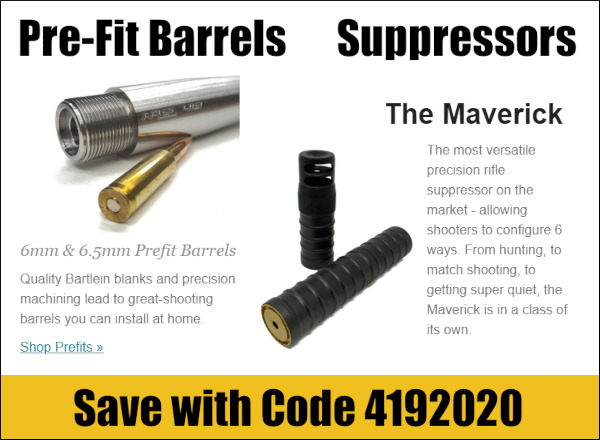
Area 419 is a top-tier manufacturer of reloading tools, shooting accessories, rails, suppressors, mag kits, and tactical/PRS rifle packages. To celebrate the 4/19 date which matches its company name, Area 419 is running a very compelling SPECIAL SALE. Right now you can save 10% on CZ tactical rifle builds, save 10% on suppressors, save 15% on select actions, save 20% on TriggerTech triggers, and save 50% on apparel.
In addition, during this special sale, pretty much everything else Area 419 sells is at least 10% Off. To take advantage of these big discounts, visit Area419.com and use CODE 4192020 during check-out. (NOTE: Some items, such as the TriggerTech triggers, are already discounted, so no check-out code is required). This sale runs through 11:59 pm ET on 4/20/20.
In these tough times, people are more concerned with home security than ever. Of course a gun owner should have the vast majority of his firearms collection secured in a heavy, thick-walled safe. However he may also want/need rapid access to a home defense weapon, and other important safety equipment.
This NRA Home Defense Cabinet allows instant access to your primary defense firearms. All an intruder will see is an innocent-looking wall mirror. But behind that artifice is a gun cabinet that will hold a rifle or shotgun, a pistol and more. For added security, the firearms in the cabinet are clamped by a rapid biometric locking system that releases the guns only for authorized users. The single long-gun version costs $795, while a double-gun cabinet costs $901.00.
The patent-pending NRA Home Defense Cabinet is a covert gun cabinet featuring a sliding mirrored front and proprietary biometric securing system. The Cabinet is offered in both dual-firearm and single-firearm configurations. Slide open the cabinet and you can see the guns, securely clamped in place. When an authorized user successfully engages the biometric system, your firearms are unlocked and ready for use. The simple-looking mirror offers nothing to attract the attention of intruders or children.
The interior of the NRA Home Defense Cabinet Features a proprietary biometric locking system.
The NRA Home Defense cabinet is offered in a one-gun version (rifle/shotgun) for $795.00, or a two-gun version for $901.00. Since this product is recessed into a wall, you also have to figure on installation costs. But if you are building a new house, this is an interesting new security option worth considering.
At the request of our readers, we provide select “Deals of the Week”. Every Sunday afternoon or Monday morning we offer our Best Bargain selections. Here are some of the best deals on firearms, hardware, reloading components, optics, and shooting accessories. Be aware that sale prices are subject to change, and once clearance inventory is sold, it’s gone for good. You snooze you lose.
1. Mc3 Stocks — 20% Off All Stocks and Accessories
Here’s a great oppotunity — get 20% Off all Mc3 products during the April Stay Healthy 2020 Sale. Do you have a rifle you’ve been wanting to upgrade? You can get 20% off EVERYTHING in the McMillan Mc3 store. Save on Hunting Stocks, Tactical Stocks, Bottom Metal, Magazines and other accessories IMPORTANT: To save 20% use Code STAYHEALTHY during checkout. Thanks to ELR Researcher for this tip.
2. Precision Reloading — HUGE Clearance Up to 50% Off
Precision Reloading is running a Big Clearance on a wide range of products including bullets, loaded ammo, reloading tools, dies, holsters, storage boxes, and more. You find some truly great deals, with many items up to 50% off. There are over 400 items on sale, including Berger, Barnes, and Nosler Bullet Sample Packs, cleaning kits, and more.
3. FREE FL Die Set with RCBS MatchMaster Dispenser
Have you been wanting to try the impressive new RCBS MatchMaster powder dispenser but you’ve been waiting for a special deal? RCBS is now offering a FREE Die Set Promo. Purchasers of a MatchMaster Scale/Dispenser qualify for a free set of MatchMaster Dies, with a $185.00 MSRP. This Promotion applies to MatchMaster machines purchased from any retailer including Amazon, Graf & Sons, and Midsouth Shooters. After completing your purchase, submit the RCBS Redemption Form to get your FREE set of MatchMaster FL dies. Die sets for 23 different cartridge types are available. MORE INFO HERE.
4. Midsouth — Aguila .22 LR Ammunition in-stock
Has the recent run on supplies got you thinking that you could use some more rimfire ammo? Well Midsouth Shooters has a full selection of reliable Aguila .22 LR ammunition at very affordable prices. A wide variety of Aguila .22 LR rimfire ammo is currently in-stock and ready to ship.
5. Bruno Shooters — McMillan Stock Sale
McMillan makes some of the best stocks available, with proven designs for just about any discipline or action type. If you’ve been in the market for a new stock, head over to Bruno Shooters Supply. Bruno’s has discounted a wide selection of McMillan stocks including popular tactical, hunting, and benchrest stock designs. Save money and avoid the manufacturer’s waiting period.
6. Sportsman’s Warehouse — Savage AXIS II w/scope, $399.99
If you’re in the market for a good basic rifle packaged with a 3-9x40mm scope, here’s a great deal. Sportsman’s Warehouse has the Savage Axis II with optic for just $399.99!. Currently this package deal is offered with 12 different chamberings including the popular .223 Rem, .243 Win, 6.5 Creedmoor, .308 Win, and .30-06 SPR. This is a great value for a basic hunting rig.
7. Natchez — Bushnell Gold Binoculars, $49.99
We love high-end binoculars, but it makes sense to have a lower-cost set of binoculars that you might keep as a spare, lend to a friend on request, or use on camping trips. Right now Natchez is selling Bushnell 8x42mm Custom Gold Binoculars for the crazy low price of only $49.99. Hard to beat that price (under fifty bucks) for a brand name optic.
8. Amazon — Tactical Survival Knife, $18.95
Good knives are vital tools, particularly during times of crisis. When we saw this cool tactical survival knife for only $18.95 we couldn’t resist sharing. With a G10 handle and full tang design this tactical chopper is equally at home around the shop as it is out in the field. The knife features a serious square-front 3.5″ blade, and ships with a rugged nylon carry sheath. Choose either Black or Silver, both with 3mm-thick stainless steel blades. A this price you could grab a pair — one in each color.
Are you sitting around in Coronavirus lockdown trying to figure out what to do? How about organizing your reloading area with these handy wall-mounted storage bins. At just $24.97 for 30 units — nearly 50% Off the regular price — this storage set is a great bargain. Use these for bullets, brass, ammo boxes, small tools — you name it. At this price you can get all those odds and ends put in their place and be ready for when the world gets back to normal.
NOTE: Barnes has just opened a new e-Commerce site where you can buy Barnes bullets direct from the manufacturer. To mark that development, we’re republishing an interesting article on how Barnes develops BC values and ballistic data for its match bullets and ammunition. Barnes employs advanced Doppler Radar to record bullet speeds at multiple distances out to 1500 yards.
Determining Bullet Ballistics with Doppler Radar Data
How do you build better (more precise) ammo drop tables? With radar, that’s how. Barnes Bullets is using Doppler Radar to develop the drop tables for its Precision Match line of factory ammunition. The Doppler radar allows Barnes to determine actual velocities at hundreds of points along a bullet’s flight path. This provides a more complete view of the ballistics “behavior” of the bullet, particularly at long range. Using Doppler radar, Barnes has learned that neither the G1 nor G7 BC models are perfect. Barnes essentially builds a custom drag curve for each bullet using Doppler radar findings.
Use of Doppler Radar to Generate Trajectory Solutions
by Barnes Bullets, LLC
Typical trajectory tables are generated by measuring only two values: muzzle velocity, and either time-of-flight to a downrange target, or a second downrange velocity. Depending on the test facility where this data is gathered, that downrange target or chronograph may only be 100 to 300 yards from the muzzle. These values are used to calculate the Ballistic Coefficient (BC value) of the bullet, and the BC value is then referenced to a standardized drag curve such as G1 or G7 to generate the trajectory table.
This approach works reasonably well for the distances encountered in most hunting and target shooting conditions, but breaks down rapidly for long range work. It’s really an archaic approach based on artillery firings conducted in the late 1800s and computational techniques developed before the advent of modern computers.
There is a better approach which has been utilized by modern militaries around the world for many years to generate very precise firing solutions. Due to the sizeable investment required, it has been slow to make its way into the commercial market. This modern approach is to use a Doppler radar system to gather thousands of data points as a bullet flies downrange. This radar data is used to generate a bullet specific drag curve, and then fed into a modern 6 Degree of Freedom (DOF) [ballistics software program] to generate precise firing solutions and greatly increase first-round hit probability. (The 6 DOF software accounts for x, y, and z position along with the bullet’s pitch, yaw, and roll rates.)
Bullet-Specific Drag Curves Derived from Radar Data
Barnes’ advanced Doppler radar system can track bullets out to 1500 meters, recording the velocity and time of flight of that bullet every few feet along the flight path. The noteworthy graph below shows a Doppler Radar-derived, bullet-specific drag curve alongside the more common G1 and G7 curves:
Neither of the standard curves is a particularly good match to our test bullet. In the legacy approach to generating a downrange trajectory table, the BC value is in effect a multiplier or a fudge factor that’s used to shift the drag curve of the test bullet to try and approximate one of the standard curves. This leads to heated arguments as to which of the standardized drag curves is a better fit, or if multiple BC values should be used to better approximate the standard curve (e.g., use one BC value when the velocity is between Mach 1 and Mach 2, and a different BC value when the velocity is between Mach 2 and Mach 3.) Barnes’ approach to creating trajectory tables is to generate bullet-specific drag curves, and use that data directly in a modern, state-of-the-art, 6 DOF ballistics program called Prodas to generate the firing solution.
Story tip from EdLongrange. We welcome reader submissions.
Specialty Pistols — Report from Ernie Bishop in Wyoming
For those who know of me in the shooting world, you would probably know me in one of two ways: Dealer for SEB Rests or someone who does most of his competing, varminting, and or hunting with specialty pistols. These are typically bolt-action, single-shot rigs that can be used with a bipod. They can seem very similar to a pistol-grip rifle, but without a conventional buttstock.
My interest in all things specialty pistols (Remington XP-100, TC Contender, MOA Maximum, Pachmayr Dominator, H-S Precision HSP, etc.) goes back to the early 1980s. Most of the specialty pistols listed are no longer made, so when I discovered that Kauger Arms was making two, I was excited. I have not had much time to shoot my new Kauger “Black Widow” chambered in 6.5×47 Lapua. But so far, the experience has been fun, even though I have not taken it prairie dog shooting yet or hunted big game with it. For this report, I went to my friend Dan’s place as one can load in the house, and simply shoot off his back porch.
When thinking of a precision shooting platform, most of you would not consider a wood back porch as ideal. But we managed a 0.179″ 3-shot group at 100 yards using a Harris bipod and a small leather bag. Yes the Black Widow can shoot! My load was Lapua brass, Federal 205M primers, Varget powder, and the Hornady 123gr A-Max, with a MV of 2514 fps. I selected the Hornady 123s with prairie dogs in mind. As shown in the top photo, the scope on the Black Widow is a Sightron S-III 6-24 with a Holland’s scope level. The Black Widow also sports a Holland’s Radial Baffle brake.
Here is the Black Widow with a different scope base and scope, ready to go on Dan’s porch.
The day we planned to shoot prairie dogs was windy, so we headed to public land nearby and set up steel to get ballistics drop info and simply to play at distance. We had 5″ steel at 220 yards, 10″ steel (diamond) at 510 yards, and 10″ steel (square) at 650 yards. Wind was from 8 mph to just over 20 mph, so the little 123 grainer was getting tossed about, while keeping us humble all at the same time. Regardless of the gusty winds, I considered the session a success!
Kauger Arms has been making parts for a number of companies in the firearm industry for over 20 years. In 2014 when things slowed down for them, they decided to start building rifles and decided to make their own actions. Good decision — these actions, which are machined in a single process to keep everything true to the bore, are great. Bolt manipulation with Kauger’s action is the smoothest I have ever experienced.
Tim Kauger explained features of his actions to me. The Kauger cock-on-opening action has a Rem 700 footprint for action holes and trigger shoe. The semi-coned bolt features a floating bolt head which is slightly smaller than the bolt body. The firing pin assembly is 1/4-turn removable. There are user-changeable bolt body and knob options. There is a side bolt release above the stock line. All moving surfaces are nitrided. This can be ordered single shot, feed rails or DBM cut. Also the long action will accept up to a .338 Lapua/.300 Norma Mag if ordered that way (with 1.25″ barrel cylinder).
Kauger Arms offers a right-hand or left-hand grip, which is very comfortable. I shot the Black Widow both right-handed and left-handed with no problems whatsoever. Kauger Arms can build the Black Widow in many more chamberings than the two that are listed on the KaugerArms.com website.
New left-bolt/left port action from Kauger Arms — To the specialty pistol shooters reading and to those considering entering the SP world, Kauger Arms has listened to your requests and is working on a left bolt/left port short action that will be offered either as a single-shot action or with bottom metal. You grip the pistol with your right hand, then run the bolt with your left-hand.
Specialty Pistol 2 — The Camo .223 Remington HSP
Here is another one of Ernie Bishop’s specialty pistols. This eye-catching camo-stocked rig was crafted by H-S Precision. Sadly, H-S Precision is not making these HSP pistols anymore. This .223 Remington features a 1:7″-twist, 15-inch-long H-S barrel fitted with the “H” Brake. On top is a Burris XTR-III 5.5-30x56mm scope with SCR 2 MIL reticle and Burris rings.
Great Results with Varget + 77gr Sierra TMKs
Ernie tells us: “For a load, I have been running Lapua brass, Rem 7.5 primers, Varget, and the 77 grain Sierra TMK. Muzzle Velocity is 2675 FPS. As you can see, it shoots pretty well. Shown at right is a measured 0.265″ 3-shot group at 100 yards, shot from Harris bipod and small field bag.
Previous to this, I was shooting Federal Match ammo with the 77 grain SMK (MV was 2500 fps), with prairie dog kills past 600 yards, and have played on steel out to 1000 yards. This H-S specialty pistol is great for young or old alike, for novice shooters or experienced shooters. Everyone needs a fast twist .223 Remington!”
Here is my friend Dan shooting the .223 Rem HSP with factory ammo during a prairie dog trip.
Given the Coronovirus Pandemic, many Americans are looking to acquire handguns for personal protection, both in the home and while away from the house. Thus, many folks are looking for slim, relatively lightweight pistols that can be carried comfortably and discretely. There are dozens of carry guns on the market currently. But our friends at GunsAmerica.com have recently reviewed three of the best “micro-compact” 9mm pistols: SIG Sauer P365, Smith & Wesson Shield, and the Glock 43.
Note: There seem to be some connection issues with GunsAmerica on 4/11/20.
After looking at a variety of factors, including accuracy, reliability, ergonomics, build quality, size/weight, and price, GunsAmerica’s tester Jeff Cramblit concluded that the SIG P365 was the best of the three: “Bottom Line — The SIG P365 wins this shootout in my humble opinion. The MSRP of $599 is a bit higher than the other guns but SIG brings a bit more to the game. The outstanding grip design, higher capacity, great sights, lighter trigger pull, smaller length, light weight and just a great overall feel make it a winning product. The other two guns are great, they have been the cornerstones of concealed carry for many years, and I have personally carried both of them, but SIG has changed the game.”
Choosing a Carry Pistol — Performance, Reliability, Value
This Editor owns two SIG Sauer pistols, a P226 and P232. Both are “old school” metal-framed handguns. I can attest to their quality and reliability over many years. So I’m not surprised to see that SIG’s new P365 took top honors in this recent test. But I also think the Smith & Wesson Shield also offers excellent value for the dollar. The S&W 9mm Shield is ON SALE now for $289.99 at Palmetto State Armory.
This YouTube Video Compares the SIG P365 and the S&W Shield
Accuracy with Various Ammo
In the GunsAmerica Test, the SIG P365 had the best accuracy, based on five (5) different types of 9x19mm ammo shot off-hand at 25 yards. The SIG’s average 5-shot, 25-yard group size was 1.45″, vs. 1.7″ for the Glock 43, and 2.1″ for the S&W Shield. The P365’s accuracy edge may be due in part to its lighter, 5.1-lb trigger pull compared to 6 lbs. for the S&W Shield, and 6.25 lbs. for the Glock 43.
Dimensions — Width and Weights
Size matters — particularly when it comes to a carry pistol. The S&W Shield is the narrowest of the three guns at 1.03″ wide vs. 1.11″ for the P365 and 1.36″ for the Glock 43. Though it has the highest round capacity, the SIG P365 actually has the smallest grip circumference and grip depth. Weight-wise, the Glock 43, at 18 oz. unloaded, is the lightest. The SIG P365 is 18.8 oz., while S&W Shield is the heaviest at 20.5 oz. weight.
Capacity — SIG P365 Has the Edge
The SIG P365, holding 10+1 rounds, has the highest ammo capacity. This is remarkable as the P365 has the smallest grip circumference of the three pistols. Kudos to SIG for clever design. The S&W Shield has an 8+1 capacity, while the Glock 43 only holds 6+1. Advantage SIG.
AR-platform rifles are fun and versatile, but the standard, mil-spec triggers leave much to be desired. They tend to be gritty, with creep and heavy pull weight. One of the easiest, most effective AR upgrades is a trigger group swap. An improved fire control group makes a huge difference. There are many aftermarket trigger options for the AR platform rifles. Choose single-stage or two-stage, either standard trigger assembly or unitized “drop-in” trigger, such as those made by Timney or Triggertech.
When upgraded with a precision trigger and match barrel, AR-platform rigs work great in NRA High Power competitions (Photo from NRA Blog, at Camp Perry).
Two-Stage vs. Single-Stage Triggers
Two-stage triggers have two separate movements. The first stage offers a light, spring-loaded pressure that works against the shooter’s pull until stopping at the second stage – this is called “take-up”. If there is no spring pressure, it is known as “slack”. Should the shooter continue to pull the trigger once he’s arrived at the second stage, the mechanism will operate like a single-stage trigger from there until engaging the sear and firing the gun. Some shooters prefer a two-stage trigger because it allows a mental preparation (first stage) before the final decision to “break the shot”.
Single-stage triggers feature no take-up or slack, as they begin engaging the sear as soon as the shooter begins pulling the trigger. Some competitive shooters prefer the two-stage trigger because of the feedback it provides during its first stage, while other shooters, including those using their rifle in tactical scenarios, may want the surety of a single-stage trigger, ready to engage and fire once their finger is inside the trigger guard. Regardless of preference, a good trigger will feature minimal creep and should be free of grittiness, providing a smooth, even break.
Drop-In Trigger Assembly vs. Standard Trigger Group
Once you decide between a single-stage or two-stage trigger, you can choose between standard and drop-in trigger groups. Standard trigger groups feature all the fire control group parts separated, and need to be pieced together and installed much like a mil-spec trigger, while drop-in trigger are pre-assembled and contained within a casing that simply drops in to the receiver and accepts the pins, hence the name.
After-Market Trigger Comparison
Some shooters prefer drop-in triggers due to the ease of installation, while others opt for standard groups so they can access the components individually for cleaning adjustment or replacement. If one piece of a drop-in trigger fails, you’ll need to either replace the entire unit or send it to the manufacturer for repair, whereas you may be able to simply replace the broken component of a standard trigger without needing a whole new trigger set.
Trigger Terminology — “Creep”, “Stacking”, “Overtravel”
“Creep” or “travel” is the distance the trigger moves between the end of take-up and when the trigger breaks to fire the fun. Too much creep can affect accuracy, but no creep can be unsafe, as the shooter may not be prepared to fire. “Stacking” occurs when the trigger weight actually increases during travel — this shouldn’t happen. Lastly, “overtravel” is the distance the trigger continues moving back after the gun fires.
This article is based on a longer story in the NRA Blog.




 This approach works reasonably well for the distances encountered in most hunting and target shooting conditions, but breaks down rapidly for long range work. It’s really an archaic approach based on artillery firings conducted in the late 1800s and computational techniques developed before the advent of modern computers.


 The day we planned to shoot prairie dogs was windy, so we headed to public land nearby and set up steel to get ballistics drop info and simply to play at distance. We had 5″ steel at 220 yards, 10″ steel (diamond) at 510 yards, and 10″ steel (square) at 650 yards. Wind was from 8 mph to just over 20 mph, so the little 123 grainer was getting tossed about, while keeping us humble all at the same time. Regardless of the gusty winds, I considered the session a success!
 Great Results with Varget + 77gr Sierra TMKs

 Dimensions — Width and Weights


