The CMP Eastern Games will run April 25 through May 4, 2025 at the Camp Butner Training Facility in North Carolina. This popular event, part of CMP’s Travel Games series, combines competitions and educational clinics open to adults and juniors of all experience levels. CLICK HERE to learn more about the CMP Eastern Games and to access the Eastern Games Registration Page.
There will be modern and vintage military rifle competitions, like the Springfield, Carbine, and John C. Garand Matches, as well as the .22 Rimfire Sporter Rifle Match and Vintage Sniper team event. Mid-Range 3×600 and 1,000-yard Long Range matches, added to Eastern Games in recent years, will also make a return in 2025, as well as CMP Cup Rifle Matches – comprised of 4-Man Team, 80 Shot and EIC Rifle competitions. All rifle matches will be fired on advanced CMP electronic targets, removing pit duty. That allows matches to be concluded more quickly.
Long Range Competition at CMP Eastern Games
The newest addition to the CMP Eastern Games is the Long Range program for Palma rifles, service rifles, and F-Class rifles. KTS (Kongsberg Target System) electronic targets were used for this match as well as all other rifle matches. Shown above is a Long Range competitor shooting with scoped Eliseo Tubegun. Note the viewing screen for electronic target. In addition to the Long Range Rifle matches, there will be a mid-range 3×600 match, EIC Rifle match, 80-shot HP match, Carbine Match, Vintage Sniper Match, 4-Man Team match, and other rifle competitions.
Garand, Springfield and Modern Military (GSMM) Matches
Like other Travel Games events, those competing in the John C. Garand Match with As-Issued M1 Rifles will have the chance to earn a GCA (Garand Collectors Association) Master Marksman medal.
Service Rifle Competition at CMP Eastern Games
There will be multiple matches for modern service rifles. Current rules allow ARs to be fitted with optics. In CMP and NRA service rifle competitions using AR-15 platform rifles, scopes are allowed with a maximum magnification of 4.5X and a maximum objective lens of 34mm, and the rifle, including the optic, must weigh no more than 11.5 pounds.
Rimfire Sporter Competition at CMP Eastern Games
The CMP expects a high turn-out of Rimfire Sporter class competitors. Rimfire Sporter competition is conducted with relatively inexpensive .22 LR production rifles and is a good way to enjoy a CMP match without a huge investment in rifle, fancy optics, and shooting gear.
Pistol Competition at the CMP Eastern Games
The Eastern Games will include multiple pistol competitions including Centerfire, .45 and .22 Pistol 900 Aggregates and a Service Revolver EIC Match. Those interested in learning more about the sport may also sign up for the Pistol Marksmanship 101 courses taught by certified CMP instructors.
For more information about the CMP and its programs, visit TheCMP.org.
One of our Forum members complained that he wasn’t able to set his primers flush to the rim. He tried a variety of primer tools, yet no matter what he used, the primers still didn’t seat deep enough. He measured his primers, and they were the right thickness, but it seemed like his primer pockets just weren’t deep enough. He was mystified as to the cause of the problem.
Well, our friend Boyd Allen diagnosed the problem. It was the decapping rod. If the rod is adjusted too low (screwed in too far), the base of the full-diameter rod shaft (just above the pin) will contact the inside of the case. That shaft is steel whereas your case is brass, a softer, weaker metal. So, when you run the case up into the die, the shaft can actually stretch the base of the primer pocket outward. Most presses have enough leverage to do this. If you bell the base of the primer pocket outwards, you’ve essentially ruined your case, and there is no way a primer can seat correctly.
The fix is simple. Just make sure to adjust the decapping rod so that the base of the rod shaft does NOT bottom out on the inside of the case. The pin only needs to extend through the flash hole far enough to knock the primer out. The photo shows a Lyman Universal decapping die. But the same thing can happen with any die that has a decapping rod, such as bushing neck-sizing dies, and full-length sizing dies.
Whenever you use a die with a decapping pin for the first time, OR when you move the die to a different press, make sure to check the decapping rod length. And it’s a good idea, with full-length sizing dies, to always re-check the height setting when changing presses.
There are a variety of decapping dies currently on the market, with models available from LEE, Lyman, Hornady, RCBS, Redding, and Sinclair Int’l.
LEE Universal Decapping Die Costs Just $11.49
Speaking of decapping tools, Midsouth Shooters Supply sells the LEE Universal Decapping Die for just $11.99 (item 006-90292), a very good deal. There are many situations when you may want to remove primers from fired brass as a separate operation (prior to case sizing). For example, if your rifle brass is dirty, you may want to de-cap before sizing. Or, if you load on a progressive press, things will run much more smoothly if you decap you brass first, in a separate operation.
Decapping Dies for Cases with Smaller Flashholes
TAKE NOTE: Some Euro Small Flash Holes are spec’d at 1.5mm or 0.059″, and max out at about .062″, so these need a smaller die pin.
The low-cost LEE Universal Decapping Die will work with cartridges from 17 Fireball all the way up to big Magnums. However, NOTE that the decapping pin supplied with this Lee die is TOO LARGE for LAPUA 220 Russian, 6mmBR, 6.5×47, 6.5 Creedmoor, .308 Win (Palma) and Norma 6 PPC flash holes. Because the pin diameter is too large for these brass types, you must either turn down the pin, or decap with a different tool for cases with .059-.062″ flash-holes.
Sinclair Int’l offers a Stainless Decapping Die that comes with BOTH .080 and .060 Pins. The $46.99 die ships with three decapping pins for standard .080″ flash holes, and two pins for .060″ flash holes.
Redding makes a Universal Decapping Die with an optional smaller-diameter decapping rod for the smaller .059-.062″ flash holes found on the BR and PPC cases. The use of this die is explained in the video below:
At the request of our readers, we provide select “Deals of the Week”. Every Sunday afternoon or Monday morning we offer our Best Bargain selections. Here are some of the best deals on firearms, hardware, reloading components, optics, and shooting accessories. Be aware that sale prices are subject to change, and once clearance inventory is sold, it’s gone for good. You snooze you lose.
NOTE: All listed products are for sale to persons 18 years of age or older. No products are intended for use by minors.
1. Palmetto SA — SIG Sauer Tango Optic Sale, SAVE Hundreds
⏺️ Major savings on wide variety of SIG Sauer Tango optics
If you need a tactical, PRS/NRL, or hunting rifle scope check out the SIG Sauer Tango optic sale at Palmetto State Armory. There are some great deals, with discounts up to $790. For an AR, grab a SIG Tango MSR 1-6x24mm for just $319.99, a $180 savings. Or if you want a high magnification 6X zoom scope for PRS/NRL consider the SIG Tango 4-14x44mm SPR scope for just $199.99, a $100 discount. CLICK HERE to view all SIG Sauer Tango optics on sale.
⏺️ Liquidation Sale on quality Sauer & Sohn rifles — save $350-$450
Right now you can get major savings (up to 47%) on Sauer & Sohn Model 100 Hunting Rifles in a wide selection of chamberings. With this liquidation sale, you can save $350 to $450 on excellent hunting rifles with good triggers and smooth actions. These Sauer 100 rifles have a 2.2-4.2 lb adjustable trigger, 22″ or 24″ hammer-forged barrel, and 4- or 5-rd detachable magazines. Chamberings include: 6.5 Creedmoor, 6.5 PRC, 7mm-08, 7mm Magnum, .308 Win, .30-06 Springfield, and .300 WinMag.
3. Midsouth — RCBS Buy Green Free Bullets Promotion
⏺️ FREE Sierra or Barnes bullets with $100 or more RCBS product purchases
If you’re looking to grab a new reloading tool from RCBS you can now also get FREE bullets with Midsouth’s BUY GREEN, Get Premium Bullets Sale. Spend $100 and choose from a selection of free Sierra and Barnes bullets (quantity of 40 to 100 bullets). If you spend $400 you can choose from variety of 200-ct to 500-ct bullet packs. Those 500 free Sierra bullets could be worth up to $295 (for .308 168gr MatchKings) — so this is a great deal! NOTE: To get the FREE bullets you’ll need to fill out a RCBS Rebate Form. CLICK HERE for full chart of BUY GREEN free bullets.
4. Amazon — Caldwell Stable Table Deluxe, $202.82
⏺️ Many positive user reviews — good set-up for varminting and home ranges
Spring is here so it’s time for fun shooting and varminting. If you want a good supported shooting option that can be transported in your vehicle, check out the Caldwell Stable Table Deluxe (#ad). This rotating range bench is stable and comfortable. The seat and tabletop pivot (rotate) around a center axis as a single unit so you can easily swing laterally from one target to the next. A bolt in the base allows position adjustment of a single leg, aligning the tabletop so that it is parallel with the horizon. This is great unit for varmint hunting. Owner reviews have been very positive.
⏺️ Nice double rifle case with shoulder straps and large outside pockets
Here’s a well-made, versatile double rifle case with multiple big outside pockets. This Feyachi TB-30 case is offered in Black for $69.99 (#ad), and Khaki (FDE) for $79.99 (#ad) on Amazon. Green is not in stock yet.
The TB30 double rifle case is 42″ long x 12″ wide with adjustable Velcro straps to secure the guns. This TB-30 case includes a large 20″ x 9.5″ outer pistol bag with internal straps, plus a MOLLE system and multiple D-rings to secure additional gear. And, notably, the case boasts nice padded shoulder straps for backpack-style carry.
7. Amazon — Caldwell AR-500 Steel Targets, starting at $19.89
⏺️ Great deals on durable AR500 steel targets — watch video below right
Caldwell’s bright, easy-to-see steel targets come in multiple shapes and sizes for competition, training, and recreational use. Made of AR-500 grade hardened steel, these bright yellow targets can withstand thousands of rounds. Rated up to a 3000 fps impact velocity and a 3500 ft-lb impact energy, these targets come in seven styles and sizes with three hanging solutions. These bright yellow Caldwell AR500 Steel Targets (#ad) are on sale now on Amazon, starting at just $19.89 for the 5″ Gong Target.
8. Amazon — Nightstand with Locking Gun Compartment
⏺️ Nightstand with locking compartment, charging station, and lamps
Here is a remarkably useful item of furniture for your house. This handsome black Gurexl Nightstand is just $123.99 at Amazon (#ad), with a $10 Coupon box that can lower net cost to just $113.99 — a total steal. There is a white version for $119.99 (#ad). This cool nightstand includes a side-mounted charging station with twin charging ports: USB and Type C. This nightstand also has a built-in LED light with adjustable brightness plus a motion sensor that can turn on the lights automatically when you approach (or get out of bed). NOTE: Some assembly is required — you’ll need to screw together the panels.
9. Amazon — TSA-Approved CVLIFE Five Handgun Case, $80.99
⏺️ Excellent, rugged pistol case with great owner reviews
If you take multiple handguns to the range or frequently fly with multiple pistols, consider this rugged CVLIFE Handgun Carry Case (#ad). It will hold 5 pistols (and magazines) securely, or you can carry a trio of pistols plus muffs, ammo, and other gear. Listed price is $89.99 on Amazon, but you can save 10% with Code CVLIFECASE, for a net cost of $80.99 (or try Code PHWUUX7R for possible 25% savings). Purchasers really like this case — it has 92% 5-star reviews. With shock-absorbing foam, precision-cut for a snug fit, this case protects gear for safe transport. This TSA-compliant 18″ hard case is a smart choice for gun guys who often travel with multiple pistols.
⏺️ Great price on versatile rapid access 2-gun security safe
If you want handy storage for two handguns or one pistol, watches, and other valuables, consider this SnapSafe 2-Gun Keypad Vault, now just $59.99 at Grafs.com (54% off). Along with the keypad, there is a backup rotary key lock. The spring-loaded door opens immediately with your programmable code. A protective foam liner safeguards contents, the interior shelf is removable, and the base is pre-drilled so the vault can be bolted in place. This is a great deal — the very same SnapSafe 2-gun vault costs $134.99 right now at MidwayUSA — nearly twice as much.
As an Amazon affiliate, this site can earn revenues through sales commissions.
We know that Competition Machine (Gary Eliseo) makes great chassis systems and Pierce Engineering (John Pierce) makes great actions. But sometimes a project comes together even better than one can imagine. The folks at Pierce Engineering crafted an Eliseo Tubegun that displayed some mind-blowing accuracy during initial testing. This was a special rifle built to a client’s spec in .22 PPC.
After his team completed the rifle, John Pierce took the Tubegun to the range to make sure everything was working right. The rifle was chambered for the .22 PPC, a known accuracy cartridge. Would this cartridge shoot in this gun? Heck yeah was the answer! The first two shots out of the gun were touching. That was promising enough. But then John drilled a five-shot group that was basically one hole! Here is that target. First two shots upper left, then the five-shot group below and to the right. Chassis-maker Gary Eliseo commented: “that’ll do just fine…”
Disclaimer: John shot some more groups with this Tubegun that were definitely NOT one-holers. That first five-shot masterpiece could not be duplicated. However, we’re told that the rifle shot other groups in the 2s, 3s, and 4s — impressive performance for a rifle designed for prone and position shooting. This shows how well the Pierce action mates to the Competition Machine chassis.
And if the owner ever wants to show off a “wallet group” for his new rifle — well he’s got that, thanks to John’s great trigger-pulling and rifle-building. Using On-Target software we measured that five-shot group at 0.189″ (see photo at right). That’s crazy small for a new gun with zero load development. That’s also a testimony to the quality of the Norma .22 PPC brass.
Why the .22 PPC Chambering?
The customer owns other Eliseo Tubeguns, but wanted something that combined extreme accuracy with very low recoil. He also wanted to be able to shoot factory brass without fire-forming. Norma makes very high-quality .22 PPC cartridge brass that is an easy load and shoot solution. In fact the folks at Pierce Engineering custom-loaded a quantity of .22 PPC ammo for this Tubegun and shipped it off to the customer along with the new rifle. NOTE: Loading ammo is not something that Pierce normally does, but this was a special client request.
Norma .22 PPC Cartridge Brass is available from Bullet Central for $75.99 for FIFTY (50) cases. That works out to $151.98 per 100. Yep that’s pricey considering that 6 years ago this same Norma brass was just $88.88 per 100 cases. But we have seen significant inflation in nearly all premium brass offerings.
For today’s Saturday at the Movies special, we provide a selection of videos showcasing rifle and pistol cartridge types — from tiny .17 caliber cases to huge 20mm cases. Two of the videos use advance computer animation to provide 3D views of dozens of cartridge types. Then there are some expert commentaries by Jerry Miculek and Ron Spomer discussing the characteristics and performance of various cartridge types. Finally, we provide two videos that discuss rimfire cartridges and show how .22 LR rounds are produced in a modern CCI factory.
90 Different Rifle Cartridge Types in Computer Animation
In this rifle ammunition comparison animation there are 90 different cartridge types, from very small (.22 Flobert) to very, very big (20mm Vulcan). This video employs sophisticated, 3D CAD animation to showcase 90 different rifle cartridges, one after the other, in sequence. It covers from .17 Caliber up to 20mm. Obviously a lot of time and effort went into this video, but it really is cool to see so many different cartridge types in one 3.5-minute video.
After the full line-up is complete at 1:41, the video then provides other smaller comparison, such as multiple large hunting cartridges (2:15) and .22 Caliber cartridges (2:45, see above). All the cartridge models are made using Autodesk Inventor software, and then the “line-up” animation was completed with Autodesk Showcase.
Cartridge Types Included (in Caliber Order, then Metric Order):
1) .17 HM2
2) .17 HMR
3) .204 Ruger
4) .218 Bee
5) .22 Flobert
6) .22 Hornet
7) .22 LR
8) .22 Magnum
9) .22 PPC
10) .22 Short
11) .220 Jaybird
12) .223 Rem/5.56x45mm
13) .223 WSSM
14) .224 Weatherby Magnum
15) .225 Winchester
16) .240 Weatherby Magnum
17) .243 Winchester
18) .25 Remington Auto
19) .250 Savage
20) .25-06 Remington
21) .256 Winchester Magnum
22) .257 Roberts
23) .260 Remington
24) .264 Winchester Magnum
25) .270 Weatherby Magnum
26) .270 Winchester
27) .280 British
28) .280 Remington
29) .284 Winchester
30) .30 Carbine
31) .300 H&H Magnum
32) .300 Rem Ultra Magnum
33) .300 Savage
34) .300 Winchester Magnum
35) .300 Win Short Mag (WSM)
36) .30-06 Springfield
37) .303 British
38) .30-30
39) .308 Norma Magnum
40) .308 Winchester
41) .32 Winchester Special
42) .325 WSM
43) .338 Lapua Magnum
44) .35 Whelen
45) .350 Remington Magnum
46) .375 H&H Magnum
47) .376 Steyr
48) .408 Cheyenne
49) .416 Remington Magnum
50) .416 Weatherby Magnum
51) .444 Marlin
52) .450 Marlin
53) .450 Nitro Express
54) .458 Win Magnum
55) .45×70
56) .460 Weatherby Magnum
57) .465 H&H Magnum
58) .470 Nitro Express
59) .50 BMG / 12.7×99 NATO
60) .500 jeffery
61) .505 Gibbs
62) .577 Nitro Express
63) .577 Tyrannosaur
64) .600 Nitro Express
65) .700 Nitro Express
66) .950 JDJ
67) 4.6×30 mm
68) 4.6x30mm
69) 5.6×50 Magnum
70) 5.7x28mm
71) 5mm/SMc
72) 6mm LEE
73) 6.5×55 Swedish
74) 6.5×6 mm Schuler
75) 6.8mm Remington SPC
76) 6mm PPC
77) 6×45 mm
78) 7mm Weatherby Magnum
79) 7mm Remington Magnum
80) 7mm Rem Ultra Magnum
81) 7.62×39 mm FMJ
82) 7.7×58 Arisaka
83) 7.95×57 Mauser
84) 8mm Remington Magnum
85) 9.3×62 mm
86) 9.3×64 Brenneke
87) 14.5×114 mm
88) 20mm Vulcan
89) 25mmx137mm
90) 30mmx173 mm
Ammunition Size Line-Up — from Tiny to Massive
This animation video shows the size comparison of ammunition from a 2.34mm rimfire caliber to the massive 800mm caliber shell of the Schwerer Gustav railway cannon used by German forces in World War II. This video includes many common rifle and pistol cartridges/calibers, but also includes large artillery ammunition. This video has very good CGI Graphics. Below is part of the line-up from the .17 Remington Fireball (far left) to the famed .50 BMG (far right):
Ammunition Types Showcased in this video:
2.34mm rimfire
2.7mm Kolibri
3mm Kolibri
4.25 mm Liliput
.17 Hornady Mach 2
.17 Remington Fireball
.17 Hornady Magnum Rimfire
.22 Long Rifle
.22 Winchester Magnum Rimfire
HK 4.6×30mm
4.6×36 Loffelspitz
5.45mmx18 MPTs
5.7×28mm SS190
.280 British 7×43
.297/230 Morris Short
.297/230 Morris Long
.30 Pedersen 7.65×20mm
7.92×33mm Kurz
.300 Winchester Short Magnum
8×50mmR Mannlicher
.499 LWR
.577/450 Martini–Henry
.600 Nitro Express
.470 Nitro Express
.50 Beowulf
.50 BMG
20×102 M55A3
25×137 M793
Popular Cartridges/Calibers for Self-Defense and Hunting
This video focuses on popular calibers/cartridges used for self-defense and hunting. It provides a quick but informative overview of the capabilities (and intended uses) of many types of pistol, rifle, and shotgun ammunition. The video discusses the pros/cons of various cartridge types and explains how you would select ammo for a particular purposes (e.g. skeet loads vs. defense shotshells). If you are considering buying a carry pistol and are undecided about caliber choice, this is a good video to watch.
Flattest-Shooting Cartridges by Caliber (Ron Spomer)
In this 15-minute video, hunting expert Ron Spomer examines a variety of standard and wildcat cartridges from .17 caliber all the way to .338 caliber. For each caliber, Ron picks a flat-shooting “winner” and provides some ballistics comparison tables. This video is quite popular, with over 550,000 views on YouTube.
Ammo Types and Calibers — Jerry Miculek Explains the Basics
In this video, legendary shooter Jerry Miculek talks about popular types of pistol and rifle ammunition and the various bullet options used for plinking, competition, and self-defense. Jerry, one of the greatest pistol shooters on the planet, provides useful insights on cartridge selection and bullet choices. Jerry notes: “There are a TON of different types of ammunition” so he explains the basics. And Jerry answers common questions such as: “What is the difference between ball and hollow-point bullets?” and “What type of gun takes rimmed cartridge versus rimless?”.
.22 Caliber Rimfire Cartridges — Some Key Facts Revealed
We recommend all .22 rimfire shooters watch this video from Old English Outfitters. It explains some important facts and clarifies some common misconceptions about to .22 caliber ammunition. To learn more about modern .22 LR rimfire ammo, we also recommend the video below, which shows how CCI .22 LR ammunition is manufactured, start to finish.
BONUS Video — How .22 LR Ammunition Is Made
YouTube host 22Plinkster toured the CCI/Speer production facility in Lewiston, Idaho. While touring the plant, 22Plinkster was allowed to capture video showing the creation of .22 LR rounds from start to finish. This is a fascinating video, well worth watching.
This revealing video shows all phases of .22 LR ammo production including cupping, drawing, annealing, washing, drying, head-stamping, priming, powder charging, bullet seating, crimping, waxing, inspection, and final packaging. If you’ve got ten minutes to spare, we really recommend you watch the video from start to finish. You’ll definitely learn some new things about rimfire ammo.
Ruger Super GP100 Revolver in 9mm Luger (9x19mm)
Wouldn’t it be cool if you could shoot your 9mm semi-auto pistol ammo in an ultra-accurate revolver? Well you can. Ruger adapted its existing Super Redhawk frame to create the Super GP100 9mm Luger (9x19mm) revolver. As you can see, the Super GP100 9mm features a stubby 8-round PVD-coated cylinder to better fit the 9x19mm round. According to Guns.com the 9mm GP100 “uses a cylinder and extractor cut for moon clips to speed up reloading [and] sports a 6-inch half-lug sleeved and shrouded barrel with an 11-degree target crown[.]”
Watch this GunBlast video review to see how this unique Ruger 9x19mm wheelgun performs. Reviewer Boge Quinn said this a “competition grade gun” with nice fit and finish. Out of the box the Super GP100 9mm had a 9.5-lb double-action pull and a 4.5-lb single action trigger pull. It took a while for the pull to smooth out Quinn noted. Also, he said that if you do NOT use the supplied moon-clips it is awkward to remove the spent cartridges: “You don’t have to use a moon clip, but I don’t know why you wouldn’t… it just works great that way.”
The 9×19mm Parabellum (aka 9mm Luger) cartridge was introduced in 1902 by German weapons manufacturer Deutsche Waffen und Munitionsfabriken (DWM) for the Luger semi-auto pistol. Now 120 years later, Ruger brings us a sturdy, 6″-barrel revolver for this popular cartridge. Ruger adapted its existing Super Redhawk frame for this Super GP100 9mm revolver. In this video, Ruger engineer Mark Gurney explains the features of the Super GP100 9mm revolver:
Super GP100 9x19mm Features
Triple-locking cylinder locked into the frame at front, rear and bottom for more positive alignment and dependable operation.
High-strength stainless steel cylinder is fluted and shortened to reduce overall mass and increase rotational speed. Cylinder has PVD finish for durability and ease of extraction.
Polished and optimized internals, a centering boss on the trigger, and centering shims on hammer deliver a smooth double-action trigger pull with crisp/consistent let-off.
Cylinder and extractor are cut for moon clips to speed reloading during intense competition. Ships with three full moon clips and moon clip tool. The ejector and chamber mouths have a light chamfer to aid loading with moon clips.
Hogue hardwood grip is hand-finished for a smooth, polished feel. Grip frame accommodates a wide variety of custom grips.
Transfer bar mechanism provides security against accidental discharge.
Cold hammer-forged barrel has precise rifling for accuracy and longevity.
Barrel features 11° target crown for competitive-level accuracy.
AR-platform rifles can be maintenance-intensive beasts. But some AR owners make the situation worse by not regularly cleaning important small parts, or by using too much oily/greasy lubricants in the wrong places. A properly maintained and lubricated AR15 can shoot hundreds of rounds (between cleanings) without a problem. If you learn where (and where not) to apply lubricant, you’ll find that your AR will run more reliably and the task of cleaning the bolt and bolt carrier will be less of a burden.
Here is a good video that explains AR-15 Cleaning and Maintenance. In this 30-minute NSSF video, Gunsite Academy instructor and gunsmith Cory Trapp discusses the proper way to clean and maintain the AR-15 carbine. Very knowledgeable, Trapp provides rock-solid advice for AR owners. Along with cleaning procedures, this video explains how to inspect key components and how to function-test your AR before each shooting session.
If you want to keep your black rifle running smoothly and reliably, you must clean it regularly and follow the correct maintenance procedures. Here’s another good video that explains how to properly disassemble and clean AR-platform rifles.
Take-Down and Full Cleaning of AR15 by Jerry Miculek
Here ace shooter Jerry Miculek takes down and cleans an AR-platform rifle belonging to his daughter Lena. This is a good video because Lena’s rifle was “run hard and packed up dirty” so you can see where carbon and grease build up. This 35-minute video is very thorough. Jerry is one of the nation’s top action carbine shooters, so listen carefully to his advice on cleaning and lubrication.
Wouldn’t it be nice to have a print resource that has hundreds of true-size cartridge illustrations, plus technical descriptions of thousands of popular cartridge types? That could be a real time-saver. It’s no wonder this Ammo Encyclopedia book is an Amazon category best-seller.
If you’re a serious shooter, the latest 7th Edition of the Ammo Encyclopedia belongs in your library. This 928-page book by Charles Priore Jr. and Lisa Buening is probably the most comprehensive and up-to-date book in print covering current and classic cartridges and shotshells. The Ammo Encyclopedia is a massive resource work. The 7th Edition, released in October 2022, now boasts 100+ chapters, covering thousands of handgun, rifle, and shotgun cartridges. This 928-page softcover book sells for $39.99 on Amazon (#ad). That’s a good deal — 20% off list price.
One of the best features is a full-color section depicting actual size drawings of over 300 current rimfire/centerfire cartridges and shotshells. You won’t find that many “life-size” cartridge drawings in one place even on the internet. Cartridge profiles and ballistic charts have been expanded to include many new factory cartridges. An expanded Trademark Index lists contact information for all current ammunition manufacturers.
For the 7th Edition, over 150 cartridge types have been added. And dozens of previously proprietary cartridges now have individual profiles. An expanded color section shows current centerfire, rimfire, and shotshell cartridges in full color. Plus updated Ballistic Tables provide muzzle velocity, dimensions, and page numbers for the corresponding cartridge profile pages.
Comments from guys who bought the book:
“[The Ammo Encyclopedia is] better than Cartridges of the World. Much better editing and more accurate.” — John Guibert
“The amount and depth of detail provided is beyond impressive. An enormous amount of time and thought went into this latest version of the Ammo Encyclopedia.” — BW Kreisler
“I have many books on firearms and ammunition acculmulated over a few decades. This is by far the best and most comprehensive book on ammunition that I have ever seen. It is a must have reference source for everthing ammunition whether for current or obsolete and the history behind them.” – Eric
Spring is just two days away (March 20, 2025). That means the shooting season in many areas will be starting soon. If you need ammo for your rifles and handguns it pays to comparison shop. Smart shooters can benefit by price-shopping to get the best deals on factory-loaded ammunition, particularly for popular cartridge types such as .22 LR, 9x19mm (9mm Luger), .357 Mag, .223 Rem (5.56×45), and 6.5 Creedmoor. It this article we list 15 reliable online sources for factory-loaded ammo. You may want to bookmark this page so you can quickly scan and price-check multiple vendors. In addition, you can use a service such as AmmoSeek.com.
Why Should You Shop for Ammo Online?
By shopping online for ammo, you can save money, get a wider selection, and get bulk discounts. GunDeals.com explains: “Online purchases [can] save you a lot of money [and can] also save your time… one of the most important advantages is definitively the huge selection.” With online retailers you can quickly compare prices, and you will often get a discount on a large order (300 rounds or more) that is not available in local stores. Note, with some large vendors such as Cabela’s and Sportsman’s Warehouse you can order online then pick up in a local store.
Are There Restrictions on Online Ammo Purchasing?
In most (but not all) U.S. states is it legal to order ammunition online to be shipped to your residence. However, you MUST check your State and local laws and regulations. In some states and/or cities, it is ILLEGAL to purchase ammunition online for shipment across state lines with direct delivery. For example, in California, all ammo must be purchased from a licensed ammo dealer/vendor with a state background check (so much for the Second Amendment)*. Likewise Washington DC, and Hawaii do not allow online ammunition purchases. And there are restrictions in New York City. In Alaska there are multiple shipping regulations that impact ammo deliveries from online sales so many vendors do not ship to Alaska.
*In some instances ammo can be purchased online from an out-of-state seller who will then ship to an authorized, in-state California vendor who may transfer the ammo for a fee with background checks as required by CA law.
This story, from our Gun of the Week Archives, offers a good intro to the 30 BR cartridge, which is still the leading chambering for short-range Score Benchrest.
What’s better than one custom-built 30 BR with gorgeous wood and top-shelf components? A matching pair of course. Just ask Australian shooter Greg Roche (“Caduceus” in our Forum). A decade ago, Greg spent two years living and working in the USA. While in America, he commissioned two matched custom rifles to bring back to Australia for Hunter Class BR matches. Though the look-alike rigs are both chambered in 30 BR, one is designed for the Australian “Traditional” centerfire Hunter Class (10-lb limit), while the other is purpose-built for the “Custom” centerfire Hunter Class (14-lb limit). The 10-lb Traditional rifle features a fully-functioning two-round magazine and a 6-power scope. In contrast the Custom Class rifle is a single-shot action, with a 45X Leupold scope. The Custom weighs 13.5 pounds so it can also be used in traditional Heavy Varmint Benchrest matches if desired.
Tale of Two Rifles Story and Photos by Greg Roche (“Caduceus”)
The USA boasts some of the finest precision rifle-builders and Benchrest parts suppliers in the world. Before returning to Australia after two years in the States, I decided to have two special BR rifles built using American components and skilled labor. I wanted a matched pair — twin guns that would be as handsome as they were accurate. The heavier gun of the pair, the 13.5-lb Custom Class rifle, features top-of-the-line (but well-proven) technologies and components. With the 10.5-lb Traditional Class rifle, we had to develop new solutions to allow the 30 BR cartridge to feed from a functional two-round magazine. Here is my saga of how my twin 30 BRs were conceived and built, and how they have performed in competition.
BACKGROUND — The 30 BR for Score Competition
The 30 BR is a wildcat cartridge based on a necked-up version of the 6mmBR Norma case. It originated in U.S. Benchrest circles where it found its niche in Varmint For Score (VFS) matches. Unlike traditional Benchrest, where group size determines the winner, VFS matches are shot on a target with multiple, concentric-ringed bullseyes. Point total is based on “best edge” shot location (one shot per bull). In score competition, the 30 BR’s “supersized” .308-diameter hole offers an advantage over the 6mm hole created by a 6 PPC, the dominant group BR chambering.
The starting point for loading the 30 BR wildcat is Lapua 6mmBR brass. These are necked up as a single-step operation using a .30 caliber tapered expander ball (or dedicated expander mandrel). This will leave a bulge in the neck, so the expanded case neck is normally turned to bring the thickness down to the correct dimension for the chamber. I turned these necks down to .010″ wall thickness using a Stiller neck-turning tool. It features an eccentric mandrel similar to the Nielson “Pumpkin”. Loaded rounds measure .328″ neck diameter. This gives minimum clearance in my .330″ neck chamber, so very little neck resizing is needed after firing. Cases are trimmed to 1.500″ prior to turning to ensure consistency since the Stiller tool indexes the length of cut off the case mouth. Other than that, cases are just chamfered, loaded and made ready to shoot. No special fire-forming is required.
17-Twist Barrels for Both Rifles
Texan gunsmith Mike Bryant chambered both barrels. Mike also polished both barrels to a high-gloss to match the receivers. In this game, barrels are consumables, much like powder and primers, so most owners wouldn’t bother to polish their barrels. However a 30 BR barrel can provide up to 5000 rounds of accurate life (unlike a 6PPC barrel which might be tossed after 800-1000 rounds.) So, these barrels are likely to be on the rifles for many seasons. Given the high-gloss finish of the Grizzly actions and the beauty of the Red Cedar stocks, it would have been an injustice to leave a dull finish on the barrels.
The chambers were both cut with the same reamer supplied by Dave Kiff of Pacific Tool and Gauge. Randy Robinett, one of the originators of the 30 BR wildcat, specified the reamer dimensions. Randy’s 118gr, 10-ogive custom BIB bullets and the 30 BR cartridge enjoy a winning track record in the USA. The 30 BR Robinette reamer has zero free-bore and a .330″ neck, and is optimized for the BIB 118s. The bullets perform best when seated far enough out to jam firmly into the rifling as the bolt is closed. The long ogive means the bullet’s bearing surface is very short.
Slow Twists for Maximum Accuracy
You may note the unusually slow twist rate of both barrels. In most .30-caliber chamberings, the barrel twist rate is 1:11 or 1:12 to stabilize 150gr to 200gr bullets. The 30 BR is optimized for 115gr to 118gr flat-base bullets and 1:17 provides sufficient stability at muzzle velocities around 2900-3000 fps. In competitive Benchrest, where every thousandth of an inch counts, over-stabilization of projectiles can hurt accuracy, so “just stable enough” is the goal; hence the 1:17 twist.
Case Forming, Case Prep, and Reloading Methods
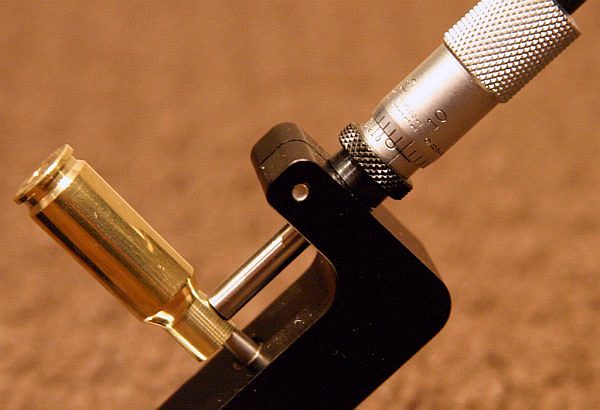
A Sinclair case neck micrometer indicates neck thickness of 0.010″ after neck turning.
30 BR dies are readily available from a number of manufacturers. I personally use Wilson neck and seating dies with a Sinclair Arbor press, but Redding and Forster both supply high-quality threaded dies for use in a conventional press. For under $100.00 US, custom full-length dies can be obtained from Hornady and CH Tool & Die by sending them reamer prints or a couple of fired cases. Harrell’s Precision offers “semi-custom” dies. Just send them some fired cases and they select a pre-made CNC-cut die that ideally fits your chamber. You can ask the Harrell brothers for a die that’s tighter at the shoulder or base, or otherwise customized to your preferences.
Load Development and Accuracy Testing
With cases formed and bullets selected, load development is simply a matter of choosing the right primer, powder and charge weight, and loading the most consistent ammunition possible. The Lapua BR cases use a small rifle primer. The choice here was Federal 205 Match primers vs. CCI BR4 Benchrest primers. Some shooters have also had success using CCI 450 Magnum primers but it is very unlikely the small case needs this much spark to light off regular extruded powders. In my case, I selected Federal primers because availability tends to be better in Australia.
The relatively large bore-to-capacity ratio of the 30 BR case means that fast burning powders are the order of the day. Once again, US experience suggests H4198 (the Hodgdon equivalent of ADI AR2207) is the choice of match winners. The fact that H4198/AR2207 is an Australian-made product is an added bonus. So, I loaded up test rounds with AR2207 from 32.5 grains to 35.0 grains in approximately 0.3 grain increments. All bullets were seated to jam +0.010″ into the lands. This places the bullet base about two-thirds of the way down the neck and well short of the neck-shoulder junction.
Action Choice — Stainless Grizzly II from Kelbly’s
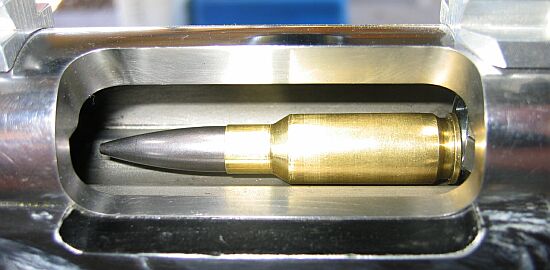
The heart of any rifle is the action. Both my two 30BRs have RBLP Grizzly II actions from Kelbly’s. Kelbly’s is perhaps most famous for the Stolle Panda flat-bottomed aluminum actions but the Grizzly II also has a match-winning pedigree and precise tolerances. The Grizzly II is a round-profile, stainless steel, Remington-style action. I chose Right-Bolt, Left-Port configuration for ease of loading at the bench. The Traditional Class action has a magazine cut out in the floor and a plunger-style ejector (both required to meet the class rules). By contrast, the Custom Class action has a solid floor and no ejector. Other minor differences are the shape of the loading/ejection port and the profile of the bolt noses. The bolt from the single-shot action has a conical face, which theoretically gives maximum accuracy when mated to a similarly profiled barrel. However, the bolt from the repeater is made square for reliable pickup of the next round in the magazine without jumping over the top. Both bolt face diameters are 0.473″ for .308 case heads and feature sliding-plate style extractors.
Both receivers have pinned recoil lugs. These are not always required in Benchrest actions since a square tang can perform the same role when the stock is inletted accordingly. Since the actions are pillar-bedded into their timber stocks rather than glued, and because the 30BR recoils more stoutly than the 6mmPPC, I decided to fit recoil lugs on both rifles. Jewell triggers are standard fare–both set at 2 ounces. Bolt stops are integral to the action as with most benchrest actions.
Scope Options — 6X for Traditional, 45X for Custom
Both rifles are fitted with Leupold scopes in Kelbly aluminum rings and bases. The Traditional rifle’s scope is a 6x42mm to comply with class restrictions. It has a front-adjustable objective for parallax correction and a target dot reticle. I like the target dot when “holding off” for wind correction on the Hunter Class targets. The other rig wears a 45-power scope since magnification is unrestricted in Custom Class. It has a side-parallax adjustment and target dot reticle. The greater magnification really helps with precision aiming, and is probably the main reason why Custom Class scores are higher.


 Disclaimer: John shot some more groups with this Tubegun that were definitely NOT one-holers. That first five-shot masterpiece could not be duplicated. However, we’re told that the rifle shot other groups in the 2s, 3s, and 4s — impressive performance for a rifle designed for prone and position shooting. This shows how well the Pierce action mates to the Competition Machine chassis.




 30 BR dies are readily available from a number of manufacturers. I personally use Wilson neck and seating dies with a Sinclair Arbor press, but Redding and Forster both supply high-quality threaded dies for use in a conventional press. For under $100.00 US, custom full-length dies can be obtained from


