Real Avid sells a unique multi-tool designed expressly for rifles and shotguns. The $29.99 Gun Tool™ combines 18 of the most commonly used long gun tools in a compact package. The Gun Tool boasts three Torx wrenches (T20; T15; T10), two Allen hex drives (3/32″; 5/32″), and four screwdriver blades (1/8″ flat; 3/16″ flat; Phillips 1 & 2). In addition, there is a magnetic 3/16″ driver, a pin punch, and a stainless claw blade useful for opening shipping boxes or trimming target backers.
The most unique feature of the Gun Tool is a stepped, multi-size choke-tube wrench that fits six shotgun bores from .410 all the way up to 10 gauge (see photo below right). For active shotgunners, that provides great versatility in a small package.
Praise from Respected Reviewers
In 2012, the NRA’s American Hunter magazine awarded The Gun Tool their Golden Bullseye award in the “Gear of the Year” category. The Gun Tool has also been awarded an outstanding 100% approval rating and a full endorsement by the North American Hunting Club.
Noted gun journalist Jim Shepard wrote: “I’ve been playing with ‘The Gun Tool’… and I’ve found it to be a pretty promising device that really should find a place in lots of range bags. If you’re a long gun shooter, it has something you’ll eventually need in the way of a tightening/loosening/adjusting tool.” Jim cautions that the claw blade does not lock into place.
High-contrast targets make aiming and seeing bullet impacts easier. EZ2C Targets, a family business in Pennsylvania, has developed a series of very bright, high-contrast targets printed with eye-popping fluorescent red/orange, bright green, and Deep Black Inks. These are available from the EZ2C online store. A set of 11″x17″ Hi-Viz targets printed on quality white paper costs $11.95 for either 25 or 40 sheets, depending on target design. A wide variety of designs are available — Bulleyes, Grids, Silhouettes, and Diamonds as well as many specialty targets, including mini self-adhesive targets.
EZ2C Fun Challenge Targets
EZ2C’s Battleship Target (Style 22) would be great for precision rifles at 100 or 200 yards. The red circles are about 3/4″ in diameter. That’s 0.36 MOA at 200 yards. That’s a good test for an accurate rifle (and for any shooting pals who boast that their guns can shoot “1/4 MOA all day long”.) The Dartboard target is great for a two-man shooting competition. You can shoot the numbers in order, or for more challenge, shoot the red rings (for each number), from the outer diameter to the middle. Just as in a real darts game, there are many variations.
Here are some other EZ2C Targets. The pistol diagnosis target (second from left) shows how to correct your aim and hold, based on where your errant shots fall. The decreasing dots target is a fun challenge for rimfire cross-training. Set it at 200 yards for centerfire.
EZ2C also offers 20 types of 3.5″ x 3.5″ Mini stick-on targets. These are printed with Black Ink on Fluorescent Red or Green Self-Adhesive Label Stock.
Get Customized Targets for Your Club or Business
EZ2C targets can be customized with the name/logo of your gun club or business. This is an excellent way to promote your organization or store. Here’s a suggestion — have your gun club print up customized targets to award as prizes at shooting matches.
At the request of our readers, we provide select “Deals of the Week”. Every Sunday afternoon or Monday morning we offer our Best Bargain selections. Here are some of the best deals on firearms, hardware, reloading components, optics, and shooting accessories. Be aware that sale prices are subject to change, and once clearance inventory is sold, it’s gone for good. You snooze you lose.
NOTE: All listed products are for sale to persons 18 years of age or older. No products are intended for use by minors.
Since its introduction, the Garmin Garmin Xero C1 Chronograph has been hugely popular with shooters. This radar chronograph is compact, accurate, reliable and easy to use. And right now you can save $50 off the regular $599.99 price. This excellent compact chrono is on sale now for $549.99 at Graf & Sons or Precision Reloading. Now’s your chance to save $50 on one of the best chronographs on the market. Take advantage of this discount this month.
2. Creedmoor Sports — Major Sightron Scope Sale
⏺️ Big savings on wide selection of zoom and fixed power scopes
Sightron makes good scopes that are popular with benchrest, F-Class, Silhouette and LR shooters. Right now you can save up to $750 on optics with the Sightron Scope Sale at Creedmoor Sports. There are scopes for a variety of disciplines, both zoom and fixed power. Chose from a 4.5X Service Rifle optic up to 10-50X F-Class and LR Benchrest scope. There are also 36X and 45X fixed power scopes popular with Benchresters. Sightron scopes are reliable, and customer services is very good.
3. Amazon — Frankford Arsenal Press and Reloading Kit, $396.07
⏺️ Great Combo Kit at major savings
New hand-loaders can save money with a combo kit that has all the key tools. A great choice is the Frankford Arsenal F-1 Single Stage Essentials Kit (#ad). This combo kit features the very good Frankford Arsenal F-1 Single Stage Press, plus Bench Top Powder Measure with bracket, Perfect Seat Hand Primer, Electronic Calipers, DS-750 Powder Scale, Powder Trickler, Aluminum Powder Funnel Set, and Universal Reloading Tray. This kit has pretty much all you need to start hand-loading except dies.
4. Primary Arms — Howa TRAKR Rimfire Rifle, $169.99
⏺️ Amazing low price on a versatile .22 LR rimfire rifle
Here’s a good .22 LR bolt-action rimfire rifle at an amazingly low price. The lightweight yet rugged Howa TRAKR .22 LR Bolt Action Rifle works for NRL22, target shooting, plinking, and small varmint shooting. The barrel is fitted with iron sights, and the action has scope ring mounts on top. The 1:16″-twist barrel measures 18″ long. The rugged synthetic stock has a Flat Dark Earth (FDE) weather-resistant exterior.
5. Natchez — Frankford Quick-N-Easy Case Tumbler Kit, $79.99
⏺️ We’ve used this Combo Kit for many seasons — very good value
Keeping your brass clean is important (and essential if you anneal). If you’re looking for a new, affordable setup to clean cartridge brass, consider the Frankford Arsenal Quick-N-EZ Case Tumbler Master Kit. You get everything needed to dry-tumble your brass and remove the media. This is all available now for a very low $79.99. You could pay that much for a good vibratory tumbler alone, yet this combo kit includes tumbler, media separator, bucket, brass polish, and media.
6. EuroOptic — Winchester Ammo Sale
⏺️ Attractive pricing on pistol, rifle, and shotgun ammo
Looking for factory rifle, pistol, or shotgun ammo at attractive prices? Then check out the Winchester Ammo Sale at EuroOptic. You find good, volume pricing on quality 9mm, .223 Rem, and .308 Win ammo. There are also major discounts on 12ga shotgun ammo. If you need 9mm ammo, check out this sale.
7. Amazon — SIRUI AM-324 Tripod, $299.00 plus 15% Off
⏺️ Good light yet strong shooting tripod, carbon fiber legs
Tripods are valuable for holding spotting scopes, cameras, and even rifles in PRS/NRL competitions. A good strong yet light-weight tripod is the SIRUI AM-324 Professional Tripod (#ad). This tripod has 32mm (max) carbon fiber tubes which keeps weight down to 4.2 pounds. Yet, this tripod boasts an impressive 39.8 lb/15 kg load capacity. The 40mm ball-head low gravity design provides stability and high load capacity. With damping knob friction control and smooth 360° panning base, you can adjust the shooting angle easily even with a heavy rifle or spotting scope. NOTE: Click the Amazon Coupon box to save an additional 15% for net cost of $216.03.
⏺️ Popular muffs offer good protection while allowing range commands
Protect your hearing with NRR 23 Walker’s Razor Ear Muffs (#ad). These muffs have a low-profile design featuring extra slim ear cups for better clearance on rifle cheek-pieces. These electronic muffs offer 23 dB NRR protection against loud noises and gunshot sounds but you can still hear conversations and range commands. These muffs have two hi-gain microphones providing clear omnidirectional hearing.
9. Amazon — Golden Rod Dehumidifier, $25.99
⏺️ Useful device for all gun safe owners
Here is a good, effective and low-cost tool to control gunsafe humidity and help prevent corrosion on your firearms. The Golden Rod Safe Dehumifier (#ad) is basically a small electric heating rod that helps maintain a proper humidity level in gun safes and storage cabinets. It controls humidity by slightly increasing the surrounding temperature to remove excessive moisture. On sale for $25.99, this is an inexpensive way to prevent corrosion of your valuable firearms and other metal items in storage.
As an Amazon affiliate, this site can earn revenues through sales commissions.
The IWA Outdoor Classics event in Germany is Europe’s leading outdoor, hunting, and target shooting trade show. The event, often called the “Euro Shot Show”, ran February 27th through March 2nd, 2025 in Nuremberg, Germany. The 2025 IWA Outdoor Classics event showcased a vast collection of products for hunting, target shooting, and the outdoor adventure market. The IWA Outdoor Classics trade show is a huge event, drawing over 1,080 exhibitors from 53 countries. CLICK HERE for descriptions/images of over 500 products on display at the IWA show this year.
Manufacturers and vendors from the hunting, shooting sports, and outdoor segments showcased a vast range of products this year. From hunting, sport shooting, and airsoft firearms to optics and technologies, ammunition, knives, hunting accessories, clothing and outdoor equipment, there was plenty to discover in the nine halls at IWA Outdoor Classics 2025. IWA Outdoor Classics allows buyers and retailers from around the world to see thousands of products from hundreds of manufacturers.
Along with the firearms, optics, stocks, and reloading products, there were many booths featuring outdoor clothing, hunting gear, and shooting accessories.
Many VIPs attended the 2025 IWA Outdoor Classics event. Here is Joachim Herrmann, Bavarian State Minister for the Interior (Bayerischer Staatsminister des Innern).
Here is a stunning, custom Walther pistol with engraved, fancy blued metal and deluxe grip.
For more than 50 years, outdoor and shooting industry companies have come together in Nuremberg to showcase the products and services for hunting and shooting sports. This past week Europe’s leading outdoor trade show hosted more than 1,080 German and international exhibitors in nine exhibit halls. In addition, there was a wide variety of seminars and interactive demonstrations.
The 2025 IWA Outdoor Classics show was a great success. We look forward to next year’s event which will be held February 26 through March 1, 2026. Auf wiedersehen for now — see you next year!
Three-Position Air Rifle (3PAR) shooting is the most popular and fastest-growing form of shooting sports competition for junior shooters (High School age and younger). The Civilian Marksmanship Program (CMP) conducts two primary Three-Position Air Rifle events. First, Precision Air Rifle is modeled after Olympic-style shooting and allows the use of specialized target rifles and equipment. Second, Sporter Air Rifle is designed for new competitors or those who desire to compete with a minimum of equipment and expense.
In both types of shooting, competitors fire at targets at a distance of 10 meters in three different positions, prone, standing and kneeling. Three-Position Air Rifle provides young competitors with competitive shooting sports opportunities that can be offered on a wide variety of easily accessible or easily constructed ranges, with equipment that is commonly available at affordable costs.
The CMP actively promotes Three-Position Air Rifle shooting as a premier youth marksmanship competition by providing low-cost equipment and pellets as well as training materials and competition activities. In addition, other air gun events for juniors and adults are hosted by CMP throughout the year. CMP facilities have Open Public Shooting evenings, and matches for air rifle and air pistol take place at the CMP Marksmanship Centers. CMP ranges are equipped with OpticScore Targets featuring technology by Kongsberg Target Systems.
The new-generation Crosman Challenger PCP (pre-charged pneumatic) Air Rifle is a preferred .177 Sporter Class air rifle for competitive marksmanship programs throughout the country, including the Marine Corps JROTC, Army JROTC, Air Force JROTC, Navy JROTC, American Legion, and 4-H. The $799.90 Challenger PCP is a three-position rifle with a fully adjustable stock, a two-stage, adjustable match grade trigger, a hooded front aperture sight, micro click adjustable diopter rear sight, patented ambidextrous pull bolt, and a floating Lothar Walther™ barrel. The Challenger PCP boasts a 3000 PSI reservoir for 200+ more shots per fill and good velocities. A pressure regulator aids shot-to-shot consistency. The Challenger PCP meets requirements of National Standard three-position air rifle competitions.
Young American Wins Gold Medal in Air Rifle at 2021 Olympics
William Shaner won a Gold Medal at the 2021 Tokyo Olympics. The University of Kentucky marksman, then age 20, captured Gold in the 10-meter (10m) Air Rifle, setting an Olympic record in the process. Shaner scored 251.6 points in the 10m final to set a new Olympic Record just 1.2 points shy of the world record. Will scored 10.5 or above on 13 of his 24 shots in the final. At the Tokyo Games, William was shooting a Walther air rifle.
Watch Will Shaner capture Gold with a stellar shooting performance, broadcast by NBC Sports:
William hails from Colorado Springs, Colorado. He started his shooting career at age nine in a 4H program in the appropriately named town of Rifle, Colorado.
CMP Records 500+ Entries During 2024 National Air Gun Events at Camp Perry
Air rifle shooting is a very popular activity throughout the nation. Air rifle matches can draw a huge number of competitors. Last summer, the 2024 National Air Gun events, held as part of the Civilian Marksmanship Program’s National Matches, welcomed over 500 air rifle and air pistol entries. The events were held at the Gary Anderson CMP Competition Center at Camp Perry, Ohio.
Gary Anderson CMP Competition Center at Camp Perry.
Special CMP Air Rifles from Anschutz
Back in 2009, the CMP ordered a special run of Anschutz Air rifles. These had laminated wood stocks and the CMP logos on the buttstock.
The CMP currently offers Precision Air Rifles and Sporter Air Rifles for sale via the CMP Website.
CMP Precision Air Rifles from Walther
The new Walther LG400 Bluetec was specifically designed for 3-position air rifle shooting. The barreled action and trigger are the same as the top-of-the-line LG400 models. It comes without an absorber but it can be retrofitted with one. The barreled action will fit into any of the higher end stocks if you wish to upgrade it. The accuracy is the same as the higher-priced LG400s. With a top-tier marksman, this rifle can put 10 shots through the same hole at 10 meters.
The LG400 Bluetec is sold by the CMP with the Walther Basic rear sight, Walther 22mm front sight and a 200/300 bar steel cylinder. The aluminum stock comes with an ambidextrous grip, trigger guard, and an adjustable cheekpiece and buttplate. This rifle is sold by the CMP but shipped via Walther Arms.
Video from the U.S. Army Junior Air Rifle Nat’l Championships at Fort Benning, Georgia. This invitation-only event features top 30 precision and sporter individuals, and top 30 teams in both disciplines.
Sporter Air Rifles
The largest and fastest-growing segment of junior shooting today, Three-Position Air Rifle Shooting, uses a class of target air rifles called Sporter Air Rifles. These Sporters now constitute a special class of junior shooting competition, and are used extensively in JROTC programs.
Sporter air rifles are characterized by their light weight (5-7 lbs.), low cost (from $180 to $600), basic target features (adjustable sights, adjustable length stocks, adjustable sling attachments) and good accuracy (rifles sold through this program must be capable of consistently shooting tens on the standard competition targets).
Shown above is the budget-priced Daisy Model 599 10-Meter Competition Air Rifle, a .177-caliber gun that allows competitors to shoot the entire match without having to recharge.
Story by Boyd Allen
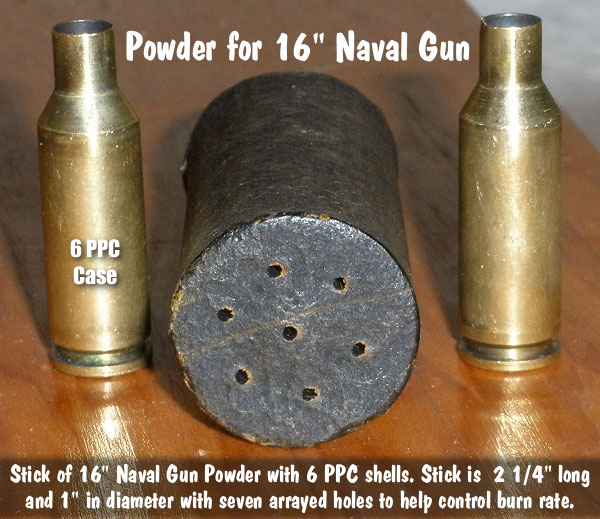
While many top competitive shooters trickle their stick powder charges to a kernel or two, that would be impractical when loading charges for giant naval guns. You may be surprised, but the shells fired by the U.S. Navy’s massive 14″ and 16″ naval guns were also propelled by stick-type extruded powders. You couldn’t trickle these ‘kernels’ though — a single stick or ‘grain’ can be over 2″ long.
The U.S.S. Iowa fires her massive 16″ main battery. The U.S. Navy’s Iowa-class battleships carried nine huge 16-inch Mark 7 cannons in three turrets. The big naval guns were 50 calibers long, i.e. 50 times bore diameter, making the barrels 66.7 feet long from chamber to muzzle.
In connection with a Benchrest Central discussion that drifted to the subject of powders used in large naval guns, I heard from Joe McNeil, whose father was involved in manufacturing those very propellants as a DuPont employee. Joe writes:
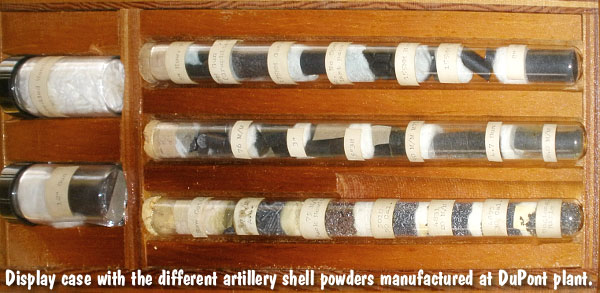
“My Dad worked for the DuPont company for over 40 years. Every time the nation went to war he was assigned to the gun powder plants which DuPont ran for the government for $1.00 per year! His last assignment was at the Indiana Ordnance Plant in Jefferson, Indiana from 1952 through 1958. He had a display case made of all of the different powders made at the plant and left it to me. That’s why I have a grain of 16″ gun powder. He took me out to the Jefferson proving grounds once when they tested the powder in a 16″ gun. We watched from a half-mile away but it left a lasting impression when they fired that gun. They actually had a set of rings they fired through to test the performance of the powder and shell. This was a truly fond memory of my Dad and his work.”
Here are some pictures of the gun powder “grains” made during the Korean War at the Indiana Ordnance Works where Joe McNeil’s father worked.
Above is the display case with the different powders manufactured at the DuPont plant. They include: 37 MM/AA, 75MM Pack Howitzer, 50 Cal. 5010, 20 MM 4831, 30 Cal. 4895, 76 MM, 3″, 5″, 90 MM, 4.7″, 240MM, 8″, 280 MM, 175 MM, 155 MM Howitzer, 155 MM Gun M.P., 8″ Gun M.P., 12″, 14, 16″. There are different-sized ‘grains’ for specific rounds.
16-inch/50-caliber gun projectile plus six propellant bags. Display mockup aboard U.S.S. Iowa (BB-61) in San Pedro, CA. Photo by James Madison per Creative Commons CC-BY-SA-4.0 license.
Rimfire .22 LR pistols are great training guns for both novice and seasoned shooters. The minimal recoil and reduced muzzle rise of .22 LR pistols makes them easy to handle, and fast to get back on target. This allows novices to build their basic pistol skills, and helps seasoned competitors upgrade their performance. Even experienced centerfire handgun shooters can improve their skills by cross-training with .22 LR pistols. We feature seven semi-auto pistol videos, with a bonus wheelgun video featuring the Colt King Cobra Target .22 LR Revolver.
Today’s Saturday Showcase features 7 videos covering a large selection of rimfire pistols. Along with these video reviews, serious shoppers should read some articles on the web. Pew Pew Tactical has a good online article that’s definitely worth reading: 9 Best .22 LR Handguns. As the author notes: “Every gun owner should own at least one .22 LR firearm. The ammo is ubiquitous, and affordable at around 5 cents a round.” And BackFire TV has published another good article covering eight popular .22 LR handguns.
Smith & Wesson Model 41 .22 LR Pistol Review
The S&W Model 41 is a classic American rimfire target pistol. Beautifully crafted, the Model 41 boasts a superb trigger, comfortable grip, and excellent accuracy. New or used, a Model 41 would be a fine addition to any firearms collection.
Browning Buck Mark Pistol Review
Taurus TX 22 Competition — Optics-Ready
The TaurusTX™ 22 Competition model is built on the same full-size polymer receiver as the Taurus TX 22 but has a newly engineered slide and barrel assembly designed to work with red dot optics. The Taurus TX 22 Competition features a “skeletonized” slide with a cutout between the ejection port to just behind the front sight. The mounting system allows the use of the following (but not limited to) sight models: Trijicon RMR, C-More STS 2, Vortex Venom, Doctor Noblex, Burris Fast Fire, Sightmark Mini, Holosun HS507C, Leupold Delta Point Pro.
Eight Popular .22 LR Pistols Reviewed
When initially shopping for a pistol, it’s wise to try a variety of guns from multiple manufacturers. You’ll want to try polymer vs. metal frame, iron sights vs. optics. And try to test-fire the pistols on the type of targets you’ll be using for competition and/or fun shooting. This helpful review video features eight (8) popular .22 LR pistols. In order of appearance these eight rimfire handguns are:
1. Browning Buck Mark Hunter (0:28)
2. Ruger SR22 (1:30)
3. Sig P322 (2:21)
4. Walther WMP (3:30)
5. Taurus TX22 Compact (4:36)
6. Smith & Wesson SW-22 Victory (5:48)
7. KelTec CP33 (6:56)
8. Ruger Mark IV (7:54)
Among the most popular .22 LR pistols are the Browning Buck Mark series. Buck Marks are very accurate and very reliable. This rimfire pistol is available in a variety of models starting at under $350.00. Reliable, accurate, and well-crafted, a good Buck Mark will serve you for a lifetime. The tester for the Sootch00 Channel says the “Browning Buck Mark UDX 22 [is] one of the highest quality production .22 LR pistols on the market.” This in-depth, 19-minute Sootch00 Channel review has been viewed over 560,000 times.
SIG P322 Comp Review by 22Plinkster
If you are looking for a well-crafted, .22 LR pistol for action pistol competitions, the SIG Sauer P322 Comp is an option you should definitely consider. The new .22 LR rimfire P322 Comp offers excellent ergonomics and 20+1 capacity, making it good for cross-training and fun rimfire shooting. Note how fast 22Plinkster can hit multiple targets with this new brake-equipped pistol. He observed: “The trigger is really nice and you just want to run it fast”. No question this rimfire pistol would be fun to shoot on steel targets.
Though it may look like a striker-fired pistol, the SIG P322 is a hammer-fired, single-action-only design (the hammer is enclosed by the rear of the slide). The P322 is blow-back operated with a fixed (non-tilting) 4″ barrel. This helps contribute to excellent accuracy and reliability.
S&W Victory Vs. Ruger Mark IV Pistol Shoot-Off
In this video, popular YouTube host 22Plinkster tests two rimfire pistols — the Smith & Wesson Victory and Ruger Mark IV. He favored the grips on the Ruger while preferring the S&W’s trigger. He felt the Ruger’s iron sights were best for precision work, but he noted that the green dot fiber optic sights on the S&W Victory worked better for speed work.
FN 502 .22 LR Tactical Pistol Review
The FN 502 is a modern, hammer-fired design with an optics-ready slide. The barrel is threaded for a suppressor. In this video, popular YouTube gun reviewer Colion Noir tests a FN 502 with suppressor. He was impressed, stating: “This is the best tactical .22 LR handgun I’ve ever shot.”
BONUS Wheelgun — Colt King Cobra Target .22 LR Revolver
In 2022 Colt introduced an impressive new rimfire revolver — the King Cobra Target 22 LR. Colt states: “From competition to plinking and small game hunting, this baby Cobra does it all and packs 10-rounds of .22 LR in its cylinder”. The King Cobra Target .22 LR is available with 4.25-inch and 6-inch barrel lengths, both with 1:16″ RH twist. Like the respected S&W Model 617, this Colt .22 LR wheelgun offers minimal recoil, great reliability, and a nice sight radius. In addition, if you shoot single-action slow-fire, the trigger pull is light and crisp — better than the vast majority of semi-auto pistols.
More and more folks are using Burris Signature Rings these days. These unique rings feature polymer inserts. That allows you to pre-load some elevation in your scope set-up, or you can center-up the windage. Additionally, the polymer inserts hold your scope securely without leaving marks on the tube. Lastly, some folks believe that Signature rings may offer advantages for benchrest competition. Rodney Wagner shot a world-record 600-yard group using Burris Signature Zee Rings (“Zee” denotes the Weaver-rail model). James O’Hara set multiple IBS 1000-yard records using Burris Signature Zee Rings. James will tell you he thinks “all his guns seem to shoot best with these rings”.
IBS World Record Set with Signature Zee Rings
Are Signature Zees good enough for competition? Absolutely. Some folks scoff at these Burris rings, given their modest price. A set of 1″-diameter Sig Zees cost $40.89 at Midsouth. But consider this, in 2013 Rodney Wagner shot the then-smallest 600-yard group in history, a 0.336″ 5-shot stunner, using Signature Zee Rings on his IBS Light Gun. It took five years for a smaller 600-yard group to be shot, a 0.311″ by bullet-maker Bart Sauter, using his IBS Heavy Gun. (See IBS 600-yard Records.) Here’s Rodney with his record-setting rifle, fitted with affordable Signature Zee 30mm rings.
Vendors Have Burris Signature Rings in Stock Now
Various models of Burris Signature Rings are available from many online vendors. NOTE: You may have to check with more than one seller to get the exact size, height, and model you prefer. But right now these vendors have pretty good selections of Signature Zees in stock now, including the popular 30mm High and 30mm Extra High models (each currently $56.36 at Midsouth). If you check all three sellers, you’ll probably find what you need.
The IWA Outdoor Classics, aka “Euro Shot Show”, is Europe’s leading outdoor, hunting, and target shooting trade show. The event opened today February 27th, and runs through Sunday, March 2nd, 2025 in Nuremberg, Germany. For the next four days, the Nuremberg metropolitan region will once again focus on hunting, target shooting, and the outdoor adventure market. The IWA Outdoor Classics is a huge event, drawing over 1,080 exhibitors from 53 countries. CLICK HERE for descriptions/images of over 500 products on display at the IWA show this year.
For more than 50 years, outdoor and shooting industry companies have come together in Nuremberg to present the latest products and services for hunting and shooting sports. For 2025, Europe’s leading outdoor trade show will host more than 1,080 German and international exhibitors in nine exhibition halls. In addition, there will be a wide variety of seminars, meetings, and interactive demonstrations.
Manufacturers and vendors from the hunting, shooting sports, and outdoor segments offer a vast range of products this year. From hunting, sport shooting, and airsoft firearms to optics and technologies, ammunition, knives, hunting accessories, clothing and outdoor equipment, there is plenty to discover in the nine halls at IWA Outdoor Classics 2025. IWA Outdoor Classics allows buyers and retailers from around the world to see thousands of new products from international manufacturers all in one convenient setting.
Rifles — Centerfire and Rimfire
Wheelgun Showcase at Korth Arms
Modern Scopes and Optics on Display
Suppressors and Ammunition
Along with the firearms, optics, stocks, and reloading products, there were many booths featuring outdoor clothing, hunting gear, and shooting accessories.
Official INTRO Video for IWA Outdoor Classics 2025
Headed to the 2025 IWA Outdoor Classics? Here’s an interactive map of Nuremburg, site of the event.
Forum member Jacob spotted this simple, but effective set of scope ring inserts on the Brownells Website. With these inserts, you can use a scope with 1″-diameter main tube in 30mm rings. Non-marring, matte black Delrin sleeves surround the scope tube so it can fit larger-diameter rings. Each sleeve comes in two parts for easy installation around your scope tube. This way you can use the same 30mm rings for all your scopes.
Ring Reducers are sold as front/rear kits. Cost is $16.99 for the Delrin 30mm to 1″ converters, item 084-000-091WB. There are also sets that reduce 30mm rings to 26mm, and 1″ rings to 3/4″ or 7/8″.
Note: These Brownells units simply function as plastic bushings. Unlike Burris Signature Ring inserts, they do not allow you to “pre-load” windage or elevation. If your rings are misaligned, the Brownells Ring Reducers won’t correct that problem.




 More and more folks are using Burris Signature Rings these days. These unique rings feature polymer inserts. That allows you to pre-load some elevation in your scope set-up, or you can center-up the windage. Additionally, the polymer inserts hold your scope securely without leaving marks on the tube. Lastly, some folks believe that Signature rings may offer advantages for benchrest competition. Rodney Wagner shot a world-record 600-yard group using Burris Signature Zee Rings (“Zee” denotes the Weaver-rail model). James O’Hara set multiple IBS 1000-yard records using Burris Signature Zee Rings. James will tell you he thinks “all his guns seem to shoot best with these rings”.


