Readers often ask us: “Is there an inexpensive way I can get started in position shooting?” The answer is “yes” — across the country CMP-affiliated clubs host Rimfire Sporter matches. You can use a wide variety of .22 LR rimfire rifles — manual actions (such as a Winchester model 52) or semi-automatics (such as a Ruger 10/22). There are prone, sitting/kneeling, and standing stages. CMP rules provide separate classifications for scoped rifles, open-sighted rifles, and aperature-sighted rifles. The matches are fun, the ammo is inexpensive, and everyone has a good time while improving their marksmanship.
The rapid-fire sitting or kneeling stage of a CMP-sanctioned .22 Sporter Match consists of two, 5-shot strings. A manually-operated or semi-automatic rifle may be used for this match.
This video shows the sitting/kneeling rapid-fire stage of a Rimfire Sporter match.
Our friend Dennis Santiago helps run CMP Rimfire Sporter Matches in Southern California. Dennis observes: “You want something challenging? Well that X-Ring 50 yards away is the diameter of a 50 cent piece, and there are people out there that can womp that thing with iron sights.”
Dennis notes: “There are six (6) stages of fire on a tough little target. Notice the rifles that can be used run the gamut from pump and bolt actions to variations on the semi-auto theme. All still require a good eye and a steady hold to earn one’s bragging rights for the day. A match takes about an hour and a half per relay. The slowest part of the match is initial sighting in. It’ll take longer than the allocated 5 minutes for the typical first timer coming to a club match.”
At Dennis’s Burbank Rifle & Revolver Club (BRRC), procedures are modified a little bit: “What we typically do at BRRC is run two relays. Experienced competitors shoot per the full rulebook. New shooters are afforded a bit more relaxed environment to make the experience more fun and inviting. We do the same thing in our M-1 Garand Clinic/Match series.”
Rimfire Sporter Match Basics
The CMP Rimfire Sporter Rifle Match is an inexpensive, fun-oriented competition using .22 caliber sporter rifles (plinking and small game rifles) commonly owned by most gun enthusiasts. To compete, all you need is a basic rifle, safety gear, and ammunition. No fancy, high-dollar rifles are required.
The event is shot with standard sporter-type, rimfire rifles weighing no more than 7 ½ lbs, with sights and sling. Rifles may be manually-operated or semi-automatic. Shooters with manually-operated actions are given extra time in the rapid-fire stage to compensate for the difference. (See Video).
There are three classes of competition — the standard “O Class” for open-sighted rifles, “T-Class” for telescope-sighted and rear aperture-sighted rifles and “Tactical Rimfire” class, which is a .22 caliber A4 or AR15 style rifle. Firing for all classes is done at 50 and 25 yards on a target with a 1.78″ ten-ring and an 18″ outer one-ring. Even new shooters can get hits on this target, but it’s still tough enough that no one yet has fired a perfect 600×600 score.
The Civilian Marksmanship Program (CMP) has a CMP Guide to Rimfire Sporter Shooting. This FREE, 50-page digital publication covers equipment, positions, course of fire, rules, scoring and much more. You’ll find helpful “how-to” sections on aiming, sight picture, hold control, and trigger control. Reading these instructional sections can benefit any prone or three-position competitive shooter.
The 2025 SHOT Show (Shooting, Hunting, and Outdoor Trade show) is just 17 days away. Thousands of new products will be on display at the SHOT Show, hosted at the Venetian Expo/Convention Center and Caesars Forum in Las Vegas. Gunmakers from around the world will be introducing hundreds of new (and updated) rifles, pistols, and shotguns. Along with the new guns, SHOT Show will feature many noteworthy new optics, electronics, reloading equipment, and accessories.
Here are six interesting videos that preview new (and updated) firearms expected to be on display at SHOT Show in Las Vegas later this month. There are hunting rifles, tactical rifles, rimfire rifles, plus a wide range of new pistols and some interesting shotguns.
This Survival Gear Video feature six interesting guns, starting with the Bear Creek Arsenal BC-15, a bolt-action AR-style rifle (note: this is incorrectly called the BCA-14 in a graphic). There is also an upper-only version that can be used with your existing AR Lower. Next the video reviews the Shadow System CR920X pistol, Wilson Combat Project 1 pistol, Ruger LC 10mm Carbine, CZ Bren 3 (3rd generation), and Atlas Gunworks Apollo V12 pistol. Other new guns are featured in a second Survival Gear Video with four rifles (Beretta 1301 Tactical, Cascade LRH, CMMG BR47, IWI Galil Ace Gen 2), one shotgun (Browning A520) and two pistols (Kimber KDS9C, Ruger RX XM).
This Gun Addicts video features a dozen new guns, many of which will be on display at SHOT Show for the first time. The host states: “The SHOT Show 2025 is here, and it’s packed with groundbreaking firearm announcements.” Featured new guns include: Bushmaster V-Radicator AR Rifle; Charter Arms Double Dog Revolver; EAA Girsan Witness Match Pistol; Fightlight Industries Lever-Action Bandito Pistol (AR style); Heritage Mfg. Coachwhip shotgun; Highpoint Firearms Large-Format Pistols; Jacob Grey TWC Black 2011 Pistol; Patriot Ordnance Factory P-15 Rifle; Shadow Systems CR920X/CR920XP Pistols; Taurus 608 Competition .357 Mag Revolver; and TriStar Arms APOC and Protege-X Pistols.
It’s that time of the year again with SHOT Show right around the corner. The PewPew Zone YouTube Channel offers a first look at some interesting new firearms. The PewPew editors were impressed, stating: “Gun makers are starting to roll out their latest and greatest for the upcoming year, pushing the boundaries of innovation and performance.” Over a dozen new rifles and pistols are featured in this 17-minute video.
This Line45 video features a large collection of new or updated guns. Featured firearms include: Shadow System CR920X pistol; Bushmaster V-Radicator AR-15; Hi-Point large format pistols; Patriot Ordnance P-15 Base Rifle; and Jacob Grey TWC Black 2011 Pistol.
Savage New Revel Rimfire Lever-Action Rifles
At SHOT Show 2025, Savage Arms will showcase its new Revel Classic and Revel DLX rimfire lever-action rifles in .22 LR, .22 WMR, and .17 HMR chamberings. These are take-down rifles with simple disassembly for cleaning and maintenance. The Revels feature a nice, satin-finish walnut wood stock plus a large lever loop for rapid cycling. These new rimfire lever guns start at $439.00 MSRP for the Revel Classic and $539.00 for the Revel DLX. The .22 LR Revel Classic is available now while the .22 WMR and .17 WMR versions will be available in early spring 2025, as will all Revel DLX models.
Here’s another Line45 channel video with five new guns on display at SHOT Show 2025. This 9-minute video is compiled mostly from marketing footage from the manufacturers. The featured new firearms include: EAA Gerson Witness 231 Pistol; Charter Arms Double Dog Revolver; Heritage Manufacturing Coach Whip Shotgun; Taurus 608 Revolver; Patriot Ordnance Factory (POF) P-15 Base Rifle (shown above).
BONUS: SHOT Show Floor Tour — Locations of Gun Companies
Will you be heading to SHOT Show this year? CLICK HERE for the handy official Interactive Floor Map. For each building and floor level this shows the location of exhibitors. This can help you efficiently organize visits to your favorite gun and optics manufacturers.
In this 54-minute video interview, Ken Clemens, co-owner of Brux Barrels, is interviewed by F-Class ace Erik Cortina for the Cortina Precision YouTube Channel. A lot of ground is covered, with many fascinating insights into barrel-making revealed. Watch and learn:
Interview with Ken Clemens, Co-owner of Brux Barrels
If you are involved in competitive shooting, and especially if you compete in F-Class or long-range benchrest, we recommend you take the time to watch this interview, perhaps in a couple of sessions because it runs for a lengthy 54 minutes. Ken Clemens explains the important procedures that go into making match-grade, cut-rifled barrels. Ken also explains some factors to consider when choosing a barrel-maker and specifying length, contour, land/groove configuration, and twist rates.
About BRUX Barrel-Making Methods
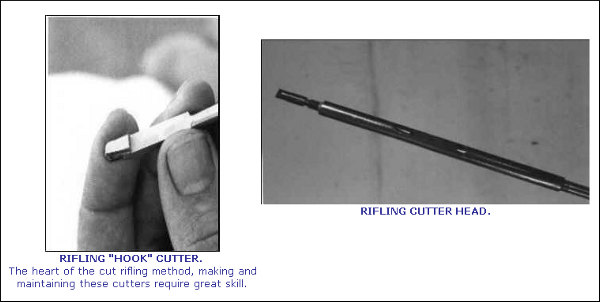
Brux starts with 4150 chrome-moly or 416R stainless steel double-stress-relieved bar stock — the best available. Barrels are bored with the Barnes gun drill, and reamed with an industry-standard Pratt & Whitney reamer. Brux uses solid carbide cutter hooks and employs special methods to achieve best results.
After the bore-cutting process is complete, each barrel is hand-lapped to high-precision standards. Multi-point inspections and meticulous hand processes (not possible in mass production) ensure extremely high quality. The Brux website says: “If there is the slightest deviation in surface finish or tolerance, the barrel is discarded.”
BRUX Specializes in Cut-Rifled Gun Barrels
Brux produces custom cut-rifled barrels, precision-crafted by professionals with extensive experience in both machine tools and competitive shooting. While Brux earned its reputation building great barrels for F-Class, benchrest, and long range competition, Brux also crafts hunting barrels. Brux states: “Hunters, big game and varmint, can benefit from the accuracy and dependability of a custom barrel made to your specifications.”
BRUX Barrels’ Owners Are Competitive Shooters
Brux owners and machinists are shooters themselves. So they understand how important a truly top-quality barrel can be. Everything else about a rifle can be great, but you need a superb barrel to win at the highest level. Owners Ken Clemens (pictured above) and Norm Brux are both seasoned shooters with years of experience using their own products.
Made in the USA — About the Home of Brux Barrels
The Wisconsin River Valley near Lodi has a storied history of hunting and shooting. The glacier spared many granite escarpments, leaving secluded glens and a topography rich in soil and wildlife habitat, which attracted families with old-world values and skills. Many of their descendants turned raw steel and iron into the tools necessary for farming – and some evolved to precision tooling and making gun barrels.
Wisconsin River Valley near Ferry Bluff State Natural Area.
At the request of our readers, we provide select “Deals of the Week”. Every Sunday afternoon or Monday morning we offer our Best Bargain selections. Here are some of the best deals on firearms, hardware, reloading components, optics, and shooting accessories. Be aware that sale prices are subject to change, and once clearance inventory is sold, it’s gone for good. You snooze you lose.
NOTE: All listed products are for sale to persons 18 years of age or older. No products are intended for use by minors.
1. Palmetto SA — SAR9 9mm Pistol, $219.99
⏺️ Save $330 off normal retail price on good full-size 9mm pistol
This is an incredible deal for a modern, reliable 9mm pistol with better ergonomics than a Glock (at less than half the price). The lightweight polymer-framed, striker-fired SAR9 points naturally and has three insertable back straps to customize fit. We like the 20-degree grip angle which points well for most users. This is a great gun for both self-defense and IDPA and other pistol matches. The listed $219.99 sale price is for the “platinum” gray version with 4.4″ barrel. A matte black version with 5.2″ barrel and ported slide is also on sale now for $299.99 from Palmetto SA.
⏺️ Massive savings up to $900 on quality PRS/NRL tactical scopes
EuroOptic is a top-flight vendor, with fast shipping and great customer service. Right now EuroOptic is running major sale on BurrisExtreme Tactical III and Extreme Tactical Pro scopes, which work great for PRS/NRL competition. With the current Burris XTR Scope Sale, you can save up to $900.00 on a rugged, reliable FFP scope with various zoom magnification options (e.g. 3.3-18x50mm, 5-25x56mm, 5.5-30x56mm), with both 0.1 Milrad and 1/4 MOA click options.
3. EuroOptic — Tikka T3x Rifle Blow-Out Sale — Save 35%
⏺️ Tikka makes great hunting rifles now offered at major savings
With this Blow-Out Sale at EuroOptic.com, you can save $120-$530 on quality Tikka T3x hunting rifles, starting at just $599.99. Multiple models are on sale including T3x Lite, T3x Lite Compact, T3x Lite Stainless, T3x Hunter, T3x Laminated, and T3x RoughTech. Both right-hand and Left-hand versions are offered. The Hunter models feature a handsome wood stock. These rifles can deliver sub-MOA accuracy with good hand-loads.
⏺️ Many positive user reviews — good set-up for varminting and home ranges
Need a good platform for shooting in areas other than organized ranges? Check out the Caldwell Stable Table Deluxe. A bolt in the base allows position adjustment of a single leg, aligning the tabletop so that it is parallel with the horizon. The central shaft, seat, and tabletop are able to pivot (rotate) around a center axis as a single unit while keeping the tabletop parallel to the horizon. This is great for varmint hunting. Owner reviews have been very positive. This item is sold via Walmart.com but ships from Optics Planet.
⏺️ Very rugged, full-featured TSA-approved roller case
Whether flying or just transporting your rifles to the range it’s important to protect them with a rugged, quality gun case. The solidly-built HQ Issue 41″ Tactical Rifle Case (#ad) meets all the TSA requirements and can withstand tough treatment. Offered in Flat Dark Earth (tan) or Dark Gray, this waterproof case has rollers to ease movement through the airport. Handy pick-n-pluck foam allows a secure custom fit for your firearms. NOTE: This case is 41″ overall so it will NOT fit long-barrel competition rifles unless the action is separated from the stock/chassis. For larger rifles, one good option is the Eylar 53″ Protective Roller Rifle Hard Case priced at $199.99.
6. Walmart — Fingerprint Access Gun Safe, $169.99
⏺️ $100 off price on Rapid Access Gun Safe (fingerprint, keypad, key)
Need to store a few rifles or shotguns with secure yet rapid access? Consider this 5-Gun Safe with Fingerprint Access. With a $269.99 MSRP, it is now just $169.99 on sale, $100 OFF. It has three locking bolts on the door sides plus an internal LED lights. Sized 11.0″ x 11.8″ x 54″, this 64-lb safe can hold multiple long guns and pistols, along with other valuables. The main door can be opened instantly with fingerprint recognition, or use the digital keypad. The interior has foam barrel holder and carpeted floor, plus three pistol pouches on the door. NOTE: We do NOT recommend this as a primary gun safe, but it can be a good secondary safe.
⏺️ High-quality soft case big enough for Palma and F-Class rifles
Typical soft rifle cases will not fit long-barreled match rifles. But this 52″-long quality case from Champion’s Choice is big enough for most F-Class and Palma rifles. Forum members highly recommend this $85.00 Deluxe Rifle Case which has a water-resistant heavy duty 600 denier PVC outer shell. It has large outside pockets for ammo and accessories, and is well-padded with over 1″ of thick high-density foam. This case boasts a carry handle, adjustable shoulder strap, and backpack straps. The case even has an interior tube for holding a cleaning rod.
8. Amazon — Birchwood Casey .22 LR Target Rack, $30.50
⏺️ Fun, self-resetting target rack for rimfire guns
Plinking reactive targets with a .22 LR can be a lot of fun. A great way to practice is with a dynamic target such as the Birchwood Casey Steel Resetting Target (#ad). Shoot the four lower plates then hit the upper plate to reset the group. NOTE — This target is designed for .22 LR Rimfire rifles and pistols only so don’t use this with any centerfire. This Rimfire target features a twist design with no welds to break.
9. Amazon — Waterproof 200rd Rifle Ammo Case, $49.99/$39.99
⏺️ Great high-capacity waterproof ammo transport case — three versions
Keep 200 rounds of ammo securely stored in this Waterproof Ammo Case (#ad), now $49.99 on sale. Made of high-strength ABS plastic, this 11.5″ x 9.5″ x 4.5″ ammo transport case can withstand harsh environments, resist impact, and protect against scratches. Shown above is the version that holds 200 .308 Win-sized rounds. If you are traveling long distances to a major match, this is a good option. The ammo is very secure with a foam base surrounding every round.
Another model holds 200 .223 Rem rounds in the same-size case. This .223 Rem version — great for varminters or service rifle shooters — is priced $39.99 on Amazon (#ad). There is also a $39.99 double-decker KingHardCase (#ad) that holds 350 rounds of pistol ammo.
10. Amazon — Walker’s Razor Slim Muffs, $38.50
⏺ Comfortable slim NRR23 muffs with high-gain microphones
Walker’s Razor Slim Electronic Shooting Earmuffs (#ad) provide good protection against gunshot noises, while allowing you to hear range commands and voices. These non-bulky Razor Slim muffs have a good 23 dB noise reduction rating (NRR). (For optimal protection run plugs under the muffs.) The Razor series muffs feature Walker’s comfort fit headband for all-day shooting. NOTE: These have been Amazon’s #1 Best Seller in Hunting & Shooting Earmuffs. This $38.50 price is a very good deal. Other colors/patterns (e.g. orange, camo, green, tan, gray etc.) are offered for a few bucks more.
As an Amazon affiliate, this site can earn revenues through sales commissions.
You’ve probably heard of cut-rifling, but did you know this process was invented in Germany nearly 500 years ago? Read on to learn more about how a cut-rifled barrel is made…
The cut-rifling process, used by leading barrel-makers such as Bartlein, Blake, Brux, and Krieger can yield a very high-quality barrel with a long useful life. Cut-rifled barrels have been at the top in short- and long-range benchrest competition in recent years, and cut-rifled barrels have long been popular with F-Class and High Power shooters.
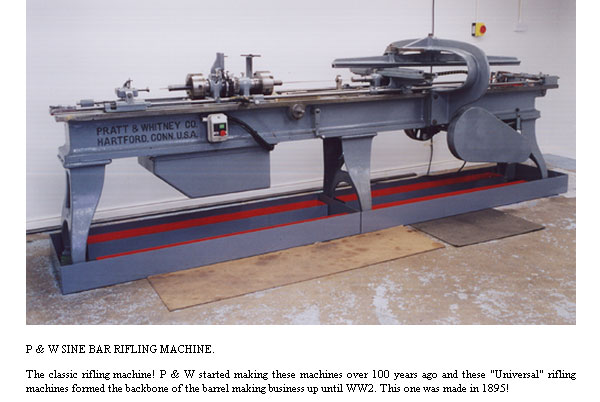
You may be surprised to learn that cut-rifling is probably the oldest method of rifling a barrel. Invented in Nuremberg around 1520, the cut-rifling technique creates spiral grooves in the barrel by removing steel using some form of cutter. In its traditional form, cut rifling may be described as a single-point cutting system using a “hook” cutter. The cutter rests in the cutter box, a hardened steel cylinder made so it will just fit the reamed barrel blank and which also contains the cutter raising mechanism.
Above is a computer animation of an older style, sine-bar cut-rifling machine. Some machine features have been simplified for the purposes of illustration, but the basic operation is correctly shown. No, the cut-rifling machines at Krieger don’t use a hand-crank, but the mechanical process shown in this video is very similar to the way cut-rifling is done with more modern machines.
Read About Cut-Rifling Process at FirearmsID.com
To learn more about the barrel-making process, and cut-rifling in particular, visit FirearmsID.com. There you’ll find a “must-read” article by Dr. Geoffrey Kolbe: The Making of a Rifled Barrel. This article describes in detail how barrels are crafted, using both cut-rifling and button-rifling methods. Kolbe (past owner of Border Barrels) covers all the important processes: steel selection, hole drilling, hole reaming, and rifling (by various means). You’ll find a very extensive discussion of how rifling machines work. Here’s a short sample:
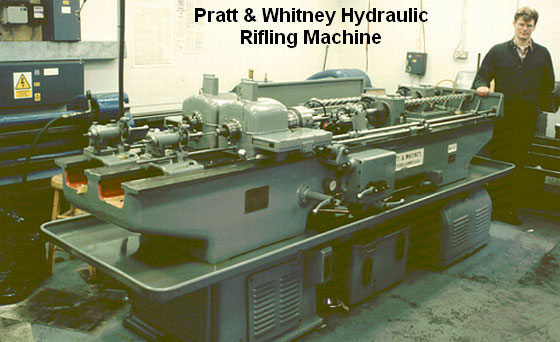
“At the start of World War Two, Pratt & Whitney developed a new, ‘B’ series of hydraulically-powered rifling machines, which were in fact two machines on the same bed. They weighed in at three tons and required the concrete floors now generally seen in workshops by this time. About two thousand were built to satisfy the new demand for rifle barrels, but many were broken up after the war or sold to emerging third world countries building up their own arms industry.
Very few of these hydraulic machines subsequently became available on the surplus market and now it is these machines which are sought after and used by barrel makers like John Krieger and ‘Boots’ Obermeyer. In fact, there are probably less of the ‘B’ series hydraulic riflers around today than of the older ‘Sine Bar’ universal riflers.
The techniques of cut rifling have not stood still since the end of the war though. Largely due to the efforts of Boots Obermeyer the design, manufacture and maintenance of the hook cutter and the cutter box have been refined and developed so that barrels of superb accuracy have come from his shop. Cut rifled barrel makers like John Krieger (Krieger Barrels), Mark Chanlyn (Rocky Mountain Rifle Works) and Cliff Labounty (Labounty Precision Reboring)… learned much of their art from Boots Obermeyer, as did I.” — Geoffrey Kolbe
Video find by Boyd Allen. Archive photos from Border Barrels in the UK.
SIG Sauer P365 in Rose Gold Plate with Jewells
There was a stunning SIG Sauer P365 pistol on display at SHOT Show 2022. This little carry pistol had a stunning 18-carat Rose Gold finish with dozens of diamonds embedded in the slide. This sets a new standard for Carry Pistol Bling. This one-of-a-kind handgun was created by the Seattle Engraving Center.
To learn more about this gold-plated pistol, watch SHOT Show TV video starting at 4:16 time-mark.
Review of the Standard SIG Sauer P365 Pistol
The P365 is a very popular carry gun that is very thin with good ergonomics. SIG Sauer claims the P365 series is now “America’s #1 Selling Handgun”. Multiple P365 models are currently offered including: P365X, P365 SAS with flush sights, the P365 Nitron Micro-Compact, the P365 Romeo Zero with integrated Red Dot, and the P365 XL with longer slide and barrel.
Here is a good video review of a standard production SIG P365 pistol, without the stunning gold-plating and engraving. The reviewer, Myles from Tactical Hyve, noted the pistol was accurate and reliable with a comfortable grip. This particular pistol has held up for 50,000 rounds! Very popular, this 2022 review has been watched over 500,000 times. Tactical Hyve also has an extensive 2700-word REVIEW of the SIG P365 with accuracy test results.
For some applications, we prefer a non-bushing FL die over a bushing die. Shown here are three Forster full-length sizing dies, with necks honed to three different dimensions: 0.265″, 0.266″, and 0.267″.
The Honed Full-Length Sizing Die Option
There are many good options in full-length (FL) sizing dies. Most precision hand-loaders prefer FL dies with neck bushings. These let you adjust the “grip” on your bullet by using larger or smaller bushings. FL bushing dies are available from Whidden Gunworks, Forster, Redding and other makers.
Conventional, non-bushing full-length sizing dies can create ultra-accurate ammo with very low run-out. But many conventional non-bushing FL dies have an undersized neck diameter so you end up with excess neck tension, and you work the brass excessively.
There is another effective option, one that promises extremely low run-out. The honed FL die is a full-length sizing die that has the necked honed to provide a precise fit to the case-neck. When done right, honed FL dies produce extremely straight ammo — as there are no issues with bushing alignment (or bushings that are not perfectly concentric). This Editor owns honed dies from Forster, Redding, and Whidden Gunworks. They all perform extremely well, delivering match ammunition with extremely low run-out measured with a 21st Century Concentricity Gauge.
In one of the most popular articles we’ve ever published, Bugholes from Bipod, California shooter “Froggy” explained why he prefers honed dies for his tactical ammo.
Q: Do you FL size every time? Do you use custom dies?
Absolutely, I full length resize all of my brass every time I reload. And guess what? I’ve never had a feeding problem.
I do use a modified sizing die, without bushings. My FL resizing die has been custom-honed in the neck area to give .0015″ press fit on the bullet. I also put a slightly larger radius at the neck shoulder junction. I feel that this helps to seal the chamber. With this die, I get consistent neck tension every time–without bushings. Bushings are useful when you’re fishing around for a good load. But once you find the right amount of sizing for ideal neck tension, you can do this better with a customized FL die.
6.5 Guys Review Forster Honed Full-length Dies
The 6.5 Guys have reviewed honed FL sizing dies from Forster, explaining the pros and cons of this type of reloading die. They explained that, if you load a wide variety of bullets from different manufacturers, you many want to stick with a Bushing FL die. However, if you have settled on a particular bullet and found the “ideal” neck tension, then a honed die may make sense.
In this Gear Update, the 6.5 Guys discuss a service offered by Forster Products to custom hone the neck diameter of its full-length sizing dies to the customer’s specifications (to the thousandth). Whidden Gunworks also offers custom-honed FL dies.
This article is Copyright 2023 AccurateShooter.com. Any publication on another website is unauthorized and obligates monetary compensation and statutory damages.
Cheaper Than Dirt (CTD), a Texas-based vendor of firearms, gun accessories, and ammo, has created a very complete web page on AR-15 assembly from start to finish. If you are thinking of building an AR, or upgrading your upper, trigger group, or buttstock, we recommend that you read CTD’s DIY ARs — Building Your Own AR-15 page. This illustrates all the components you will need for a complete AR build.
In addition, the page has a series of videos showing how to assemble each element of the AR-15. We’ve included five of those videos in today’s Saturday Movie Showcase. There a total of ten CTD AR-15 videos in the series. View them all on the CTD AR-15 Playlist on YouTube.
Then, as a closer, we offer another video — the Ten Mistakes to Avoid When Building an AR-15. Worth watching BEFORE you start an AR project, this useful video now has 2.6 million views!
Installing the Fire Control Group
Installing the Safety Selector and Pistol Grip
Installing the Take-Down Pin and Buffer Tube
Installing the Bolt Catch
Field-Stripping the Bolt-Carrier Group
Mistakes to Avoid When Assembling an AR-Platform Rifle
This popular Tactical Toolbox video (with 2.6 million views) is definitely worth watching BEFORE you start your own AR project. It explains the common mistakes that even careful builders can make when assembling an AR-type rifle.
Need some informative reading material for winter days? Here’s a vast resource available free from Sierra Bullets. Here are links to over 60 articles with information on bullets, ballistic coefficients, wind drift, up/down angles, temperature effects, tailwind effects and much more. Most of these resources come from the respected Sierra Reloading Manuals, 4th and 5th Editions. There are enough articles to read one per week for a year!
The U.S. Army Marksmanship Unit regularly publishes reloading “how-to” articles on the USAMU Facebook page. One very good article, part 5 of a 6-part series, focused on Progressive Presses. This article explains proper procedures for Auto-Indexing Progressives, which advance the shell-plate with every pull of the handle. Auto Progressives are very efficient, but they also require special attention and focus, because so many things are happening at once. You need to train yourself to watch every station. If you run a progressive press now, or are considering getting a progressive, we recommend you read this article. Visit the USAMU Facebook page for other helpful handloading guidance.
Progressive Loading Presses — Self-Advancing Shellplate Type
Recently, we addressed manually-operated progressive presses for the beginning handloader. This type press requires one to manually advance the shellplate after each handle stroke. An advantage for beginners is that nothing happens at any station until the loader wants it to. This helps users avoid problems from clearing malfunctions without noticing that the shellplate has advanced itself. (Read Previous USAMU Article on Manual Progressives.)
The next, more luxurious type progressive press advances the shellplate automatically whenever the handle is cycled. [Editor: This is also called an “Auto-Indexing” Progressive Press.] Typically, each stroke automatically sizes and primes a case, operates the powder measure (if used) and seats a bullet. Some also have case feeders that automatically put a new case in the shellplate with every cycle. Others require the loader to insert a case each cycle. With both types, the loader usually puts a bullet on each sized/primed/charged case.
[CAVEAT: While our Handloading Shop has several progressive presses, ALL of our powder charges are thrown/weighed by hand. We do not use powder measures on our presses. Our progressives are used for brass preparation, priming, seating, etc., but not for fully-progressive loading.]
The manually-advanced press can be a boon to beginners, but as one gains experience it can be a mixed blessing, depending on one’s style. If one pays close attention to every operation and loads without distractions, the manual press is very reliable and allows full scrutiny of each round as it is loaded. However, if one easily drifts into day-dreaming, or isn’t focused on paying careful attention at all times, the manual progressive can be a bit of a liability. The opportunity for forgetting a powder charge, leading to a squib load, is ever-present. [Editor: A lock-out die can help reduce the risk of a squib load, or a double-charge. See below.]
The automatically-advancing progressives help prevent this by ensuring a powder charge will be dropped each time the handle is operated. Experienced handloaders often appreciate this feature due to the savings of time and effort. Individual preferences between the two press styles are influenced by several factors. These include one’s comfort with more- vs. less-complicated mechanisms, how often one changes calibers (case feeders often must be converted, in addition to dies and shellplates), how many rounds one loads annually, relative ease of changing primer mechanisms from small to large, etc. Automatic progressives and their caliber conversion kits tend to be significantly more expensive than manual progressives and caliber conversions from the same maker.
One USAMU handloader, who likes simple, bullet-proof machines and maximum efficiency when converting presses, owns two manually-advanced progressives. One is set up for large primers, and the other for small primers. He can change calibers in the twinkling of an eye. As he loads for many different calibers, this fits his style. Another handloader here is just the opposite. He loads for a few calibers, but in larger quantities. He much prefers his self-advancing press with case-feeder for its speed. He makes large lots of ammo in a given caliber before switching, to improve overall efficiency. His caliber conversion kits are more expensive than those for the manually-advanced progressive, but he uses fewer of them.
Whichever type one chooses, it is VERY important to buy quality gear from a manufacturer with a long, well-established track record for quality, durability and good customer support. Avoid jumping on the “latest, greatest” model until it has a proven track record. For example, this writer knows a loader who got a brand-new, expensive, self-advancing model press some years back, shortly after its introduction. As is too often the case these days, the manufacturer released it before all the “bugs” were worked out.
Better Safe Than Sorry — the RCBS Lock-Out Die
RCBS Makes a “Lock-Out Die” that senses the powder charge. This will halt the Progressive press if you have a double charge, or an undercharge. Your Editor has the Lock-Out Die on his RCBS Pro 2000. It has “saved his bacon” a half-dozen times over the years. It can be used on Dillon and Hornady progressives as well as RCBS machines.
It would not fully seat primers to the correct depth. No amount of adjustment, extra force, or fiddling would do better than to seat primers barely flush with the case head. Any inattention could result in a slightly “high” primer, protruding above the case head. It created a risk for slam-fires, particularly in semi-autos without spring-retracted firing pins, such as the M1 or M1A. In desperation, he had a machinist buddy study the problem and machine a new part to correct it. No dice. Its engineering didn’t permit full primer seating, even with extended parts. He now wishes he’d heeded his shooting buddies’ advice to stick with the “tried and true,” reliable performer they all used.
Whichever press one selects, see if the maker has a kit or list of commonly-replaced parts. Having needed springs, pins, etc. on hand in the rare event that one breaks or “goes missing” can save the day when one is busy loading for a match! Another tip for improving one’s overall loading efficiency (rounds loaded with minimal set-up/tear-down time) is to plan one’s handloading by primer size. For example, if your machine is set to use small primers, load all the calibers that you intend to that take small primers, before converting the press to load large-primer calibers.
In our next chapter, we’ll discuss peculiarities of progressive loading for rifle cartridges, with remedies for problems such as excessive cartridge-case headspace variation when sizing, tips for ensuring best powder charge consistency, and so on. Until then, be safe, and good shooting!