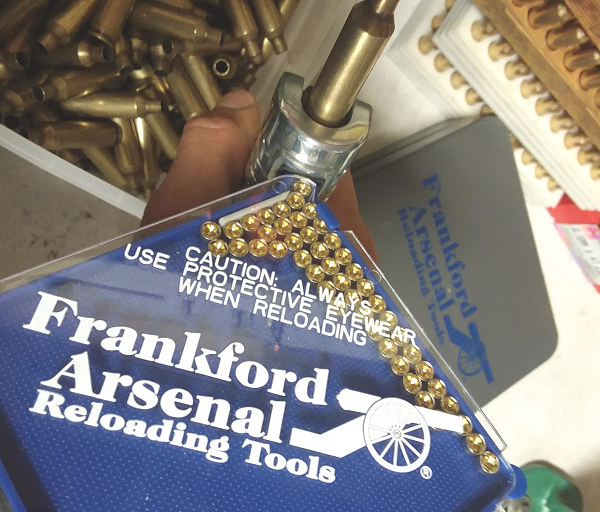
Our friend Jim See of Elite Accuracy LLC tested the depth-adjustable hand priming tool from Frankford Arsenal. This product, called the Platinum Series Perfect Seat Hand Primer has some unique features. Primer seating depth can be adjusted with a handy wheel in the tool’s center handgrip. Each “click” of the wheel moves the primer post .001″ (one one-thousandth of an inch). Additionally, the design of the case-holder allows quick and easy removal of a primed case. The unit ships with a full set of shell-holders to match all types of cases. Like many other hand priming units, the primers are loaded into a flip tray that attaches to the head of the tool.
Here is Jim See’s quick review of the Frankford priming tool:
“The Frankford Arsenal perfect hand-priming tool is legit. The tool is built heavy and strong. The only plastic parts in it are the tray and lid. The [primer] seating depth adjustment… is simple and accurate. Easy to operate. I primed 1000 cases, averaging 23 per minute. I adjusted the depth of seating between two different lots of brass in seconds. The system seats primers easily with one hand operation. The cases slide out on their own after seating. Insert, seat, reach for a new case at the same time as you are operating the lever, case slides out and you are inserting the next piece.”
Overall, Jim was “Super impressed with the quality and the results. This thing is super smooth — way less pressure needed than my Lee or RCBS. It’s a lot faster too.” Jim add that one can switch from small to large primer posts in 10-15 seconds.
This Video Shows the Frankford Priming Tool in Operation:
Even with premium brass you may want to adjust your primer seating depth: “Every thing has a tolerance that is acceptable in manufacturing. If primer pocket depth has a .005″ tolerance and the primers themselves have a .002″ tolerance you can see why adjustments would be needed. In this case the two lots were manufactured on year apart. Could you expect them to be identical?”
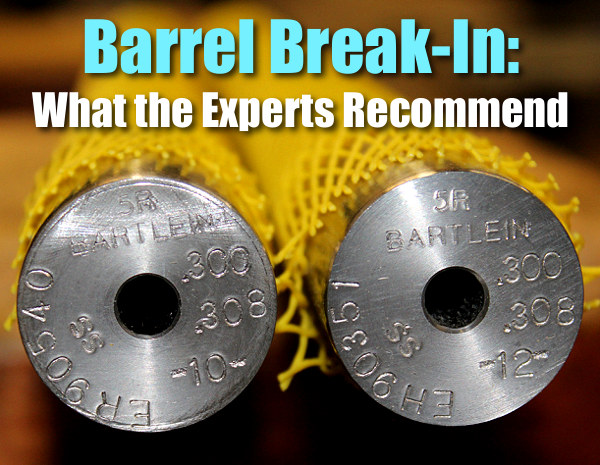
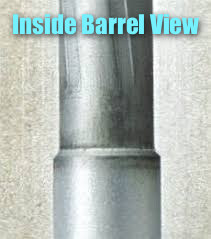
The question of barrel break-in is controversial. Some folks advocate an elaborate, lengthy cycle of shooting and brushing, repeated many times — one shot and clean, two shots and clean and so on. This, it is argued, helps barrels foul less and shoot more accurately. Others say minimal break-in, with patching and brushing after 10-15 rounds, is all you need. Still others contend that break-in procedures are a total waste of time and ammo — you should just load and shoot, and clean as you would normally.
We doubt if there will ever be real agreement among shooters concerning barrel break-in procedures. And one must remember that the appropriate break-in procedure might be quite different for a factory barrel vs. a custom hand-lapped barrel. This Editor has found that his very best custom barrels shot great right from the start, with no special break-in, other than wet patches at 5, 10, and 15 rounds. That said, I’ve seen some factory barrels that seemed to benefit from more elaborate break-in rituals.
What’s the best barrel break-in procedure? Eric Mayer of Varminter.com decided to ask the experts. Eric interviewed representatives of three leading barrel manufacturers: Krieger, Lothar-Walther, and Shilen. He recorded their responses on this video. In order of appearance, the three experts are:
Shilen, Krieger, and Walther Experts Talk about Barrel Break-in
Do I Need to Break-In a New Rifle Barrel?
Eric Mayer of Varminter.com says: “That is a simple question, [but it] does not necessarily have a simple answer. Instead of me repeating my own beliefs, and practices, on breaking-in a new rifle barrel, I decided to answer this one a bit differently. While we were at the 2016 SHOT Show, we tracked down three of the biggest, and most popular, custom barrel makers in the world, and asked them what they recommend to anyone buying their barrels, and why they recommend those procedures. We asked the question, and let the camera run!” Launch the video above to hear the answers — some of which may surprise you.
Barrel Break-in — Initial Inspection and Cleaning
This video explains that you should always inspect and clean the bore of your barrel before sending rounds through it. There may be remnants of the production process, such as lapping residues, that you’ll want to get out of the bore. We’ve even seen a few tiny metal pieces in some factory barrels. And it’s always wise to borescope a new barrel to see if there are visible defects in the rifling such as lands that have flawed edges — we’ve seen that on some cheaper barrels.
Barrel Break-In — Ian Klemm’s Surprising Observations
Here’s a 10-minute Vortex Nation interview with Ian Klemm. Ian, a 4-Time F-TR National Champion is one of America’s best long-range shooters. In this video, Ian explains his approach to barrel break-in, which may surprise you. Does barrel break-in even matter? Conventional wisdom says “Yes” and perhaps there’s some truth to that, but Ian argues that break-in is NOT nearly as important as the internet wants you to believe. Ian believes that you don’t need to waste a ton of time/ammo to get your barrel ready to shoot extremely accurately. This may be particularly true with premium hand-lapped custom barrels.
Barrel Break-In Procedures with Keith Glasscock
Keith Glasscock is also one of America’s greatest F-Class shooters who has finished second at the Nationals multiple times. Keith is also a highly-respected wind coach who has a popular YouTube video channel, Winning in the Wind. In this video, Keith explains his procedure for breaking-in his match barrels. He starts by bore-scoping the barrel and cleaning it. If he finds some burrs he may use some JB Bore Paste, a patch, and a worn brush and “give that throat a little scrub” (See 1:30 time-mark). He used different stroke lengths to avoid putting a “step” in the throat. When he’s satisfied he goes to the range. He fires the first five rounds, then cleans. He then fires quite a few rounds before cleaning the barrel again and beginning load development (See 8:25 time-mark).
General Barrel Break-in Procedures Recommended by Brownells
Brownells Gun Techs Steve Ostrem and Caleb Savant tackle a thorny topic: breaking in a new barrel. What IS breaking-in a barrel? And WHY do it? The rifling of a freshly machined barrel has microscopic burrs and sharp edges. “Breaking-in” is the process of putting bullets down the bore to smooth out those rough spots. The goal is to round down the sharp edges so they’re not stripping copper off a bullet as it travels the bore, which leads to fouling that leads to reduced accuracy and inconsistent groups. In a very minor way, you’re actually lapping the barrel. The breaking-in process works best on cut-rifled and button-rifled barrels. Cold hammer-forged, chrome-lined, or nitrided barrels — such as commonly found on AR-15s — may not benefit much from the process. Pistol barrels really don’t need to be broken in because larger-diameter bullets are not so much affected by tiny variations in the bore. Likewise, break-in is more helpful for a .17, .20, or .22 caliber rifle than a .45 caliber rifle.
George Gardner of G.A. Precision Talks About Barrel Break-In
G.A. Precision’s George Gardner is a leading figure in the PRS/NRL world. In this video, George makes the valid point that not all barrels require the same amount of break-in. George says some barrels require very little break-in, while others benefit from a more elaborate break-in process that helps reduce future copper and powder fouling. He calls this “seasoning” the barrel so it fouls less. For a typical barrel, George’s recommended process (4:25 time-mark) starts with one shot, then clean for three one-round cycles. This is followed by three shots then clean, with repeat 3-shot cycles if need. For cleaning George prefers nylon brushes (5:50 time-mark). NOTE: George also makes a very important point — you MUST swab the chamber and get it dry between cleaning cycles (5:30 time-mark).
Enjoy the Shooting Sports USA Archives
As we head into spring, many Americans will be spending more time at the range. And competitors will be shooting in rimfire and centerfire rifle matches throughout the country. Here’s an opportunity to learn competition skills, gun tuning methods, and reloading techniques from leading experts. A vast resource of great gun-related content available online for FREE. Check out the Shooting Sports USA Articles Archive. SSUSA maintains a vast digital library with hundreds of articles going back to June 2009.
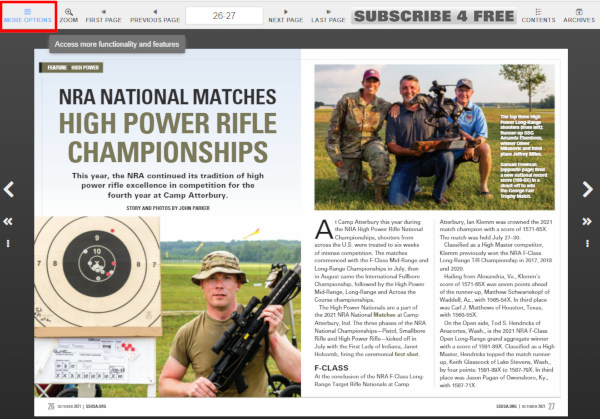
It’s easy to find back issues of Shooting Sports USA magazine. Here’s how: First, navigate to the latest SSUSA Online Issue (April 2025). Then click on the “ARCHIVES” icon in the upper right area (indicated with red arrow). When you click on “ARCHIVES”, a window will open with a selection of Shooting Sports USA magazine covers/dates in a vertical column. The most recent issue (April 2025) will appear at the top left. You can then scroll down — use the vertical scroll bar to go from April 2025 all the way back to June 2009. Click any issue cover to read.
How to Find and Save Articles
To search back issues, select “MORE OPTIONS” from the toolbar (top left). Then click the “SEARCH” button. When that opens, select either “Search Archives” for ALL back issues or “Search Only this Issue”. When you’ve made your choice, enter your search term(s). For example, you can search for “Camp Perry” or “Palma” or “F-Class Championship”. You can also save any archived issue as a PDF for viewing offline. Just click “SAVE” to download the article you’re currently viewing/reading.
Read Sample Articles
Here are a three of our favorite SSUSA feature stories from recent years. There are hundreds of other informative articles worth reading.
F-Class fans will enjoy the coverage of the 2023 F-Class World Championships in the June 2023 issue of Shooting Sports USA. On the cover is our friend and Forum member Erik Cortina.
First there was F-Class, and now there will be E-Class, the “E” standing for “Economy”. The NRA Competitive Shooting Division has just approved a new form of rifle competition starting in 2025: E-Class. Unlike F-Class, E-Class will have tight rifle and gear cost controls. This is a clear response to rising F-Class costs, which have spiraled out of control. The first major E-Class National event will be a preview match held this summer at Camp Atterbury in Indiana.
The NRA’s sanctioning of E-Class competition makes sense. Let’s face it, top-level F-Class competition, both F-TR and F-Open, has become just too expensive. A modern F-Open rifle capable of winning a championship can now cost $9000.00 or more, including rest, premium trigger, and optics. Under the NRA’s new E-Class Rules, rifles can cost no more than $2000.00 total, including optics and rest (E-Open) or bipod (E-TR). In addition, new E-Class rules will recognize a special division, called E-Factory, that is limited to factory rifles, such as the Savage Axis II and Howa rifles. The E-Factory Class will also be restricted to .223 Remington to keep ammo costs down.
COST COMPARISON — F-Open, E-Open, and E-TR Factory
E-TR Factory Division
Complete Rifle
Savage Axis II: $1079 MSRP
Barrel: Included
Stock: Included
Optics: $500
Trigger: Included
Bipod: $150
Rear Bag: $50 Total: $1779.00
Under the new E-Class rules, TOTAL Cost for an E-Open or E-TR Rifle is limited to $2000.00, including optics, front rest or bipod, and rear bag. There are specific gear limits. Scope maximum is $500.00. Front rest or bipod is limited to $300.00. In the chart above you see how an E-Open rifle could be built for $1900 with a $400 action and a $400 optic. In the third column we’ve priced out an E-Factory rifle, based on a Savage Axis II Rifle, at $1779.00.
A top-of-the-line F-Open set-up like this can cost more than $8000.00 with custom stock, high-end optic, and coax front rest. All new E-Class rifles must cost less than $2000 including rests and scope.
These E-Class rigs cost less than a quarter of the price of a Top-of-the-line $8750.00 F-Open Rig. That’s a huge savings, that will allow more shooters to enjoy competitive shooting. E-Class combines the fun challenge of the F-Class course of fire, with a vastly lower investment. With the rising costs of taxes, food, fuel, and everything else, it’s high time we get serious about the money we throw away on competition rifles. We know the wives will approve!
Keeping on Lid on Expenses
In the Wings — Controls on Ammo Costs as Well
Shooters know that the price of the rifle, optics, and rests is only part of the cost equation. The price of ammunition is also significant. Currently, in F-Open, competitors can easily pay $1.40 per round just for the expendables — bullets, powder, and primers. Add in the cost of premium cartridge brass and the cost per shot goes up significantly. One competitor lamented “Shooting a match these days really empties your wallet. I cringe every time I pull the trigger, knowing what it costs.”
Therefore, the NRA is considering E-Class ammo restrictions. Starting in 2026, E-Factory class competitors would be required to shoot recycled bulk brass and blem bullets. Bulk Lake City 5.56 brass will be offered by ARMorAlly.com, and blem bullets will be offered by Midsouth Shooters Supply. Purists may complain about using surplus brass, but it only costs $199.99 for 500 cases! That’s a huge savings.
The Final Step — Claiming Rules for E-Class
As in every competitive endeavor, there may be temptation to bend or even break the rules. Predictably, some E-Class competitors may try to substitute more expensive components, such as high-cost triggers, or modified actions. To prevent this, the NRA plans to impose claiming rules for E-Class matches. This means that any rifle that captures first or second place in a major match can be claimed by another competitor for the fee of $2000.00. This procedure may seem radical but it is used in other sports to ensure parity among the competitors. If a shooter wins with a “cheater” $5000.00 rifle, he can be forced to sell it to a competitor for $2000.00.
What’s a “Frankengun”? Well it’s a one-of-a-kind rifle that has been pieced together from a variety of different parts and components. It might be a little bit Bolt Gun mixed with a little bit AR-15. Or it might feature some home-made components unlike anything you’ve seen before. The end result is a unique rig you won’t find anywhere else.
We’ve selected these five Frankengun rifles from an older thread in our Shooters’ Forum.
Frankengun #1 — The EXO (as in Exo-Skeleton)
Forum member jm850 calls this tube-framed wonder the EXO (as in “exo-skeleton”). He says: “This is a prototype I designed around a few core concepts that stick out to me on a traditional configuration. Eliminating stresses, lowering recoil moment, and improved barrel cooling. I’m really happy with it so far.”
The EXO is a very unique rifle. We’ve never seen anything like this since the late Shelley Davidson’s famous Tinkertoy Rifle, a brilliantly innovative 30BR that actually won matches. (Sadly Shelley has passed away). The Tinkertoy, shown below, was truely radical, but it worked ! Could this have been an inspiration for jrm850’s EXO rifle?
Frankengun #2 — Mossberg MVG in LSS Stock with BipodeXt
Forum member BallisticXLR has created something very weird to say the least. It started out as a basic, bone-stock Mossberg MVP Varmint in .223 Rem. Then the transformation began: “I replaced everything except the receiver. It now has an LSS stock, PSG-1 grip from DPMS, XLR butt stock, PT&G lug and barrel nut, Columbia River Arms 26″ barrel with Sonoran coral snake Cerakote, A2 flash hider, Timney and Jard triggers (depending on what I’m doing), and a USO B17 which is now a USO 3.8-22×44.” That long extension tube under the chassis is a BipodeXt from Accuracy Solutions.
Frankengun #3 — A Chassis Rig in 25 Creedmoor
This Frankengun belongs to Forum member Geraldgee. This “black and blue” rig features a mag-fed Kelbly Atlas action in a McCree’s Precision G10 Chassis. The barrel is a Bartlein Rem Varmint Contour, 1:7.5″-twist 4 Groove, chambered for the 25 Creedmoor. There are some interesting .25-Cal bullets coming on the market now. You can make the brass by expanding 6mm Creedmoor, or necking down 6.5 Creedmoor.
Frankengun #4 — MDT Chassis, Fore-end Whittled by Spook
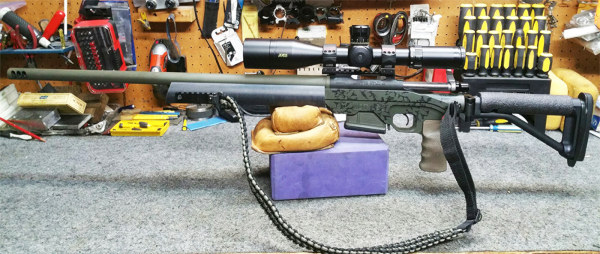
Here’s a real collection of odds and ends, but Forum member Spook says it shoots well, and is a great example of “Left-over parts made useful again”. This mix-n-match Frankengun features a Remington M7 action with PT&G bolt. The barrel is a stainless Pac-Nor chambered in 6mm SLR. The barreled action is carried in an MDT Chassis with rear folding buttstock. Up front is something unusual, a Delrin fore-end that owner Spook “whittled in the mill”.
Frankengun #5 — 6.5×47 in Accuracy Int’l Stock
CLICK photo for full-screen version.
Forum member CT10Ring kicked off the Forum Frankengun thread with this rifle. It’s actually not that shocking, but you rarely see a BAT action in an Accuracy International stock. The BAT VR action is mated to an AI Mag and set up in an AI folding stock. On top is an “old school” Nightforce Benchrest scope. The barrel is a very heavy Krieger chambered for the 6.5×47 Lapua. CT10Ring say the barrel alone weighs about 9 pounds, and the gun “shoots better than [he] can”.
Post Pictures of Your Frankenguns in our Forum
So do you have a favorite Frankengun resting in your gun safe? If you do, visit our Shooters’ Forum and post a description and some photos in the Frankengun thread.
If you are looking for a modern, extremely powerful semi-auto pistol, you may want to consider the impressive S&W Performance Center M&P 10mm M2.0 pistol. This boasts a long 5.6″ barrel for extra velocity. The barrel is also ported for reduced muzzle flip and less perceived recoil. The gun would be a very powerful defensive pistol and S&W says it can also serve for hunting.
Smith & Wesson states: “The new Performance Center 10mm was conceived with both the hunter and target shooter in mind. The goal was to build upon the M2.0 10mm series, with the intention of having reduced felt recoil and quicker follow-up shots. Popular features previously seen on other 5.6-inch PC pistols are present in this design and, when paired with the flat-shooting 10mm Auto cartridge, provide the end user a total package for hunting, self-defense, or at the range.”
Building off the success of the M&P 10mm M2.0, Smith & Wesson incorporated new features designed to increase the new Performance Center 10mm pistol’s performance. Chambered in 10mm Auto, this full-size polymer handgun boasts a ported 5.6-inch barrel to reduce muzzle rise, optic-height tritium night sights for a clear sight picture in low-light conditions, and a Performance Center-tuned flat M2.0 trigger with a crisp break and audible reset.
The Performance Center 10mm slide is cut for optics and ships with Smith & Wesson’s C.O.R.E. plate system, two 15-round magazines, and four interchangeable palmswell grip inserts. This 10mm pistol is made in the U.S.A. and has an MSRP of $749.00.
Do you know what the inside of a rifle chamber (and throat zone) really looks like? Do you understand the concept of headspace and why it’s important? If not, you should read the Brownells GunTech article Gauging Success — Minimum Headspace and Maximum COL. This article explains the basics of headspace and shows how to measure headspace (and length to lands) in your barrels with precision. The article also explains how to adjust your full-length sizing dies to “bump the shoulder” as needed.
Why is headspace important? The article explains: “Controlling headspace and setting proper C.O.L. also represent improved safety and reduced cost of handloading. Excessive headspace can cause case head separation and gases in excess of 60,000 PSI escaping from a rifle’s chamber. Too little headspace can result in a chamber forced bullet crimp and a bullet that becomes an obstruction more than a properly secured projectile. Excessive C.O.L. can result in a rifling-bound bullet, a condition that could result in spikes of excessive pressure.”
[Editor’s NOTE: It is common for competitive benchrest shooters to seat bullets into the rifling. This can be done safely if you reduce your loads accordingly. With some bullets we often see best accuracy .010″ (or more) into the lands. However, this can generate more pressure than the same bullet seated .010″ away from initial lands contact. As with all reloading, start low and work up gradually.]
Headspace is a measurement from the bolt-face to a point in the chamber. This point of measurement will vary based on the type of cartridge. Improper headspace, either excessive or (conversely) under SAAMI specifications, can cause a variety of problems, many serious.
How is headspace specified? Most cartridges used within the United States are defined within ANSI/SAAMI Z299.3-4. Brownells explains: “In the case of the .243 Winchester, as an example, there are pressure specifications, cartridge drawings and, as pictured above, chamber drawings. Armed with a chamber drawing, each manufacturer producing a firearm for the .243 Winchester knows the proper standard dimension to cut chambers and set headspace. Notice there are two headspace reference dimensions for the chamber. The upper is a place in the chamber where the shoulder is .400″ in diameter; the “datum” or “basic” line. The lower is the 1.630″~1.640″ minimum – maximum dimension from the breech face (bolt face) to that point in the chamber that measures .400″.”
The actual headspace of any firearm is the distance from the breech face to the point in the chamber that is intended to prevent forward motion of a cartridge.
Finding Cartridge Length to Lands with OAL Gauge
Using a comparator on a set of calipers, you can quickly determine cartridge base-to-ogive length. This is the measurement from the base of the case to the forward-most full diameter section of the bullet, which is for convenience called the ogive. (Technically, the “ogive” is the full curve from bullet tip back to full-diameter ring). Shown here, that ogive is 0.243″ diameter.
The next step is using a modified (threaded) case with a Hornady OAL tool to determine Length-to-Lands (LTL) in your rifle’s chamber. During this measurement process, the modified case, with a bullet in its neck, is inserted in the chamber. Go slow, take your time. Here are 5 tips that will help you get repeatable and reliable LTL measurements:
1. Start with a clean chamber and clean barrel throat.
2. Make sure the modified case is fully screwed down and seated on the OAL Gauge. It can sometimes unscrew a bit during repeated measurements.
3. Insert the modified case slowly and gently, but ensure the shoulder of the modified case is fully seated on the end of the chamber.
4. Push the gray plastic rod GENTLY. It is common for the bullet to be tilted a bit. You want to allow the bullet to self-center in the throat BEFORE you apply much pressure. Then tap a couple times and push until you feel resistance. Do NOT push too hard — that will jam the bullet in the lands.
5. Repeat the measurement at least 3 more times. If you follow our instructions, you should, typically, get a repeatable measurement, within 0.0015″ or so, 3 out of 4 times.
A while back your Editor was in New Mexico, on a prairie dog expedition. While in the field, my companions and I used two pairs of Steiner 8x30mm Military/Marine binoculars to spot the critters. Finding the Prairie Dogs (PDs) could be challenging in the high grass. Often, a PD would reveal only its head — a small target at distances approaching 400 yards. We really needed sharp optics with high contrast to spot the dogs hiding behind tufts of grass or dry brush.
The Steiner Military/Marine binoculars performed superbly. I came away very impressed with these armored 8x30mm binoculars (now called Model 2033). The glass is bright and super-sharp. And the rubber-armored body is truly rugged. These binoculars offer both right and left diopters — important for me as my right eye requires more correction than the left eye. One great feature of the Steiners is the focusing system which keeps everything you can see in focus. This really is a big deal. You don’t have to constantly fiddle with focus — everything past about 20 yards is in sharp focus all the time.
As one Steiner owner reports: “Focusing set-up is worth the price of admission. Set it and forget. Amazing. This single feature makes these worth owning.” And the sharpness is impressive. I compared the Steiners’ image with a 6.5-20×40 Leupold EFR riflescope set at 8X. Both 8×30 Steiners were brighter than the Leupold scope, and the Steiners resolved individual blades of grass and fine details better than the Leupold. Of course, comparing a binocular optic with a riflescope is like comparing apples and oranges. The advantages of binoculars (compared to a monocular scope) are well known — the brain combines the two images (left eye and right eye) to create a more vivid, 3D effect, with greater perceived contrast.
Steiner 8×30 Military/Marine Binocs are Just $211.15
At the end of our hunt, I told my host that I planned to purchase some Steiner 8×30 Military/Marine Binoculars similar to the units we used during our New Mexico varmint hunt.
When I arrived home I was amazed to see that the Steiner 2033 8×30 Military/Marine is available for just $211.15 on Amazon.com (#ad), with free shipping. That’s a great value, considering the ruggedness and optical quality of the unit.
The Steiner 210 10×50 Military/Marine (#ad) is also offered on Amazon.com. It has more magnification and better low-light performance. However, it currently runs $420.00, nearly twice the current price of 8×30 Military/Marine on Amazon! Unless you really need the 10×50’s extra low-light capability, the 8×30 M/M is the smart choice.
If you want to stay current with trends in the firearms industry, and see important new product releases before they hit dealers’ shelves, you should check out Shooting Industry magazine. While tailored for firearms/outdoor gear retailers and industry professionals, this monthly journal also provides valuable information for all gun owners. We read Shooting Industry to learn about sales trends, new products, and current gun laws issues.
READ for FREE — Shooting Industry Magazine is available in a digital format for FREE. The archives go back to January 2022 — giving you instant access to 40 FREE issues.
Get FREE Digital Shooting Industry Magazines for the Past 3+ Years
You can access, for free, three years of Shooting Industry back issues (2024, 2023, 2022), PLUS all the latest 2025 issues. CLICK HERE for the 2025 issues along with previous issues back through January 2022.
Below we’ve included quick links to the four most recent Shooting Industry editions — January 2025, February 2025, March 2025, and April 2025. These four monthly magazines can be read online for free. Also, as they are in PDF format you can easily print all or part of these monthly magazines. Simply click each cover to read full issue for FREE:
Along with the four 2025 issues, there are 36 more digital editions of Shooting Industry Magazine available for FREE on the web. Every monthly issue for years 2024, 2023, and 2022 is available online. Simply visit the Magazine Archive Page and scroll down top to bottom.
To access prior year monthly editions, CLICK HERE to access the Shooting Industry Digital Archives page with links for all 2024, 2023, and 2022 monthly issues.
In our Shooters’ Forum there is a popular photography thread. Along with some great nature and hunting images, you’ll find quality photos of handsome firearms. Among the many images were head-turning photos of some very impressive pistols belonging to Forum member Beiruty from Texas. He has some of the most handsome mag-fed handguns we’ve ever seen. Here are six of his favorite semi-auto pistols from his collection. Three of these handguns boast beautiful engraving.
FN Browning High Power Renaissance
This 9mm hand-engraved High Power with silver finish was made in Belgium in 1971:
NOTE: This is one of a near-matching pair of FN HP Renaissance pistols featured in the top photo.
Hämmerli .22 LR Model 208, Special Edition
This Special Edition, one of 500, marks 125 years of Hämmerli Sportwaffenfabrik (1863-1988):
The handsome grip is factory carved. This Model 208 pistol shipped in a fitted case, shown below.
Colt .45 ACP 1911 Commander
This 1975-vintage Colt Commander 1911 sports fully-engraved frame and slide:
Smith & Wesson .22 LR Model 41 Long Barrel
This target pistol features a 7-3/8″ barrel with factory compensator. Grip is custom:
Browning .22 LR Medalist Pistol
This handsome Browning Medalist, all factory standard, was made in Belgium in 1964:
The video below shows another Browning Medalist of the same design and relative vintage:
Stoeger Arms American Eagle Navy Model Luger
This stainless Stoeger Navy Model 6″ Luger Pistol is vintage 1978-1980:


 We doubt if there will ever be real agreement among shooters concerning barrel break-in procedures. And one must remember that the appropriate break-in procedure might be quite different for a factory barrel vs. a custom hand-lapped barrel. This Editor has found that his very best custom barrels shot great right from the start, with no special break-in, other than wet patches at 5, 10, and 15 rounds. That said, I’ve seen some factory barrels that seemed to benefit from more elaborate break-in rituals.






 Finding Cartridge Length to Lands with OAL Gauge

 A while back your Editor was in New Mexico, on a prairie dog expedition. While in the field, my companions and I used two pairs of