Forum member Martin Tardif (aka “Killick” in our Forum) competes with a very accurate .284 Win F-Open rig fitted with a Barnard action, Brux barrel, and Eliseo F1 chassis. Unlike some F-Class shooters, Martin has tried many disciplines over the years, including service rifle and Mid-Range and Long Range sling competition. But he told us, “After experiencing arthritis in my hands and wrists, I decided I would dabble with F-Class. And that has turned into a happy obsession.” Today’s story features the object of that happy obsession — Martin’s tack-driving .284 Win he calls the “Red Rocket”.
F-Open Match Rifle — .284 Winchester “Red Rocket”
by Martin Tardif
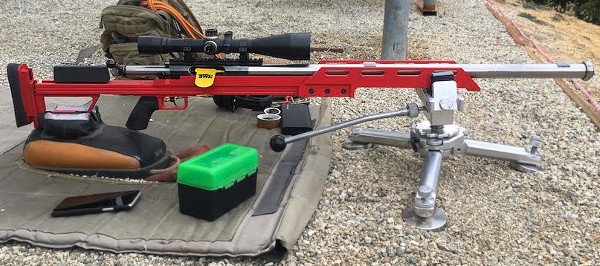
This is the story of the new “Red Rocket”, my new F-Open rifle. It’s chambered in .284 Winchester (.317″ neck, .220″ freebore). This rifle features Barnard P action, Barnard single-stage trigger (4 oz.), and Brux 30″ one-inch straight-taper, 1:8.5″-twist barrel fitted with Blake Tuner. The barreled action rides in a Gary Eliseo Competition Machine (CMI) F1 F-Open metal chassis with Marine Corps Red powder coat. On top is March 48x52mm fixed-power High Master scope. In a previous incarnation, this same Barnard action served in a wood-stocked F-Class rig, a Red Retromod built from a modified Anschutz stock. I still have the Barnard action (and trigger), but mostly everything else is new.
Here’s the .284 Win “Red Rocket” with CMI F1 Stock, Barnard action, Brux barrel, and Blake Tuner on my SEB Mini at Burbank Rifle and Revolver Club in SoCal.
My previous F-Class rifle started out as a Palma rifle back around 2008. With a modified Anschutz prone stock, that .308 Win Palma sling gun served me well, helping me earn the 2009 California State Palma Championship. Much later I grafted more wood on and whittled that same stock into an F-Open specimen (shown below). That did get me to Long Range High Master but it definitely had limitations. For one it had annoying flex in the fore-end and the buttstock was not aligned with the barrel channel.
I wanted to upgrade my stock to get a more consistent, better-shooting F-Open performer. So in April of 2020 I contacted Gary Eliseo of Competition Machine and ordered one of his streamlined, F1 “boom-stick” chassis units. These feature a very low Center of Gravity. I sent Gary my Barnard action and had Brux send him a barrel that I had won at the 2020 SWN raffle.
This video shows Martin shooting the “Red Rocket” in California
This rifle has been a success from the very start. At its first big match, the 2020 California State Championships, the Red Rocket tied for First Place on points but finished second overall on X-count.
Martin tells us: “The new red Eliseo stock is phenomenal and far surpasses the old red stock on my RetroMod project previously featured on the Daily Bulletin. The three things I like best about this Eliseo F1 chassis system are:
1. The lean, clean, efficient engineering and styling.
2. Easy manipulation of buttstock and cheek piece adjustments, ease of bolt removal.
3. Inherent confidence in its straightness and the durability of all the parts and finish.”
“I’m extremely impressed with the potential of this rig and I have still yet to fiddle with the tuner and test some of my Wolf/KVB primers. It’s all gravy now.” — Martin Tardif
I received the finished rifle in September and was impressed with its stark and consummate functionality and there is no doubt as to that function. The collinear aspect from any angle suggests a Red Rocket Car on the Bonneville Salt Flats, so that’s what I call this rig.
Reloading Methods and Load Development
My virgin brass prep starts with a .284 neck mandrel with the occasional squirt of WD-40, then to the drill press to turn the necks to 0.014″ wall thickness with my PMA Model B turner. After a quick dip in the media tumbler I run the whole batch through my DIY cake pan annealer and they’re ready for sizing. I like the Whidden Gunworks full length bushing dies. I use a .310″ bushing and a loaded round measures .312″. After sizing, I run the cases through the tumbler for 10-15 minutes to clean them up and then they are primed. I’m using my stash of S&B primers with an RCBS benchtop primer seater with a Holland Perfect Primer Seater add-on. I do point my 180-grain Berger Hybrid bullets with a Hoover die (see below).
Here is Martin’s reloading bench. From left to right: A&D FX-120i Force Restoration Scale with Auto-Trickler V3, Hoover Bullet-Tipping Die, Whidden .284 Win FL Sizing Die with PMA click-adjust lock ring, Hodgdon H4350 powder. Martin reports: “I’m also using some of F-Class John’s Auto Trickler Methods — using two powder cups to speed up the process, hash marks on Auto Trickler gear drive, and minimal openings on FX-120i wind guards. These all improve the powder measuring.
Load Development and Accuracy Testing in Competition
I started load testing in November 2020. I tried both H4831sc and H4350 at 100 yards. I usually have excellent results with H4831sc but the Brux tube stubbornly preferred H4350. So I took a preliminary recipe (52.2 grains) to the California Long Range Championship and tied for First Place on points but got beat on Xs. Having seen a little too much vertical at the state match, I went with a lighter load that looked good for vertical at 100 yards (51.8 grains — see photo below). That load got me an overall win at our 1000-yard club match.
I wanted to fine tune that load so I started a seating depth test. I did a final head to head test, comparing .015″ jump (away from first lands contact) and .018″ jump at 1000 yards. The .015″ jump load was the clear winner. This 15-round group was shot at 1000 yards with no flags on an overcast day with no mirage.
The ShotMarker screenshot above shows 15 shots at 1000 yards with bullets seated .015″ out, switching winds and no flags, just watching the mirage. I added .25 MOA up after the first round ‘9’ (me fighting a clean barrel on first shot) and went to town.
Advice for New F-Class Shooters — by Martin Tardif
1. Watch a Top Competitor — Find a good shooter that you respect and watch and take note of their equipment, how they set up to shoot, how they shoot, what conditions they shoot in or don’t. Ideally you should ask to be squadded with them (if possible) so you can score for them. That way you’re not dividing your attention from the shooter you’re supposed to be scoring for. Be mindful not to pester them while they are setting up. Best to wait until they have finished shooting and try to ask questions off the firing line, others still shooting need to concentrate.
2. Cartridge Selection for F-Open– Go to Accurate Shooter’s 7mm Cartridge Guide and scroll to the .284 Winchester section by Charles Ballard. You can read further about the 7mm WSM and 7mm SAUM but for a caliber that’s not fussy you should stick with the .284 Win.
3. Reloading Equipment — To win, you really need ammo as perfect as you can make it. You should be able to find out everything you need to know about reloading equipment via the Accurateshooter Forum’s Reloading and Competition areas. It’s a one-stop shopping brain trust for everything F-Class, Sling, and Benchrest. And the Forum Marketplace is literally a never ending ‘Gun Show’ of For Sale items. It’s a great place to buy quality used stuff for newbies.
As a final bit of advice — BELIEVE the wind — it’s smarter than you are!
Commentary on Metal Chassis vs Wood Stock
I previously had a wood F-Class stock so flexible you could easily pinch the barrel to the fore-end with one hand and hold it there. My Eliseo metal chassis is MUCH more rigid. I don’t think there is any argument that a metal stock is more rigid than wood. I also think a metal stock with its monolithic properties has a more consistent cross-sectional density along its length than a wood stock would have due to the vagaries of grain structure. However I have no experimental data to support that theory, or how that might positively affect shot to shot consistency. I CAN say that the gun shoots better, with smaller groups and higher scores, than the previous wood stock version.
The CMI F1 chassis has three main sections: rear assembly, main assembly, and fore-end. The main assembly is a 27″-long solid billet section with milled cavities for the rear assembly and trigger group. This also supports the action V-Block which cradles the full length of the action. The V-Block is mated to the top of the billet in a milled channel but doesn’t touch the sides to avoid uneven harmonics. The rear assembly hold the LOP-adjustable butt pad/bag rider and “easy off” cheek piece. The 3-piece fore-end is fitted to the main section with screws. The complete F1 chassis with grip and cheek piece weighs 6 pounds.
F1 Chassis Maker Gary Eliseo Talks about His Design
The F1 was designed to incorporate the most important features needed in an F-Open rifle system. Top priority was placed on how the rifle tracked. The chassis had to be perfectly straight, and immune to weather so it will stay straight. On the F1, the fore-end is designed to keep the centerline of the barreled action as low as possible. This super-low center of gravity, along with the tall vertical sides, keep torque to a minimum, so the gun doesn’t twist or hop, but instead comes straight back.
The F1 chassis can be fitted with bedding blocks to accommodate any action. These action bedding blocks are carefully epoxy-bedded to the chassis so the customer’s barreled action is perfectly in line with the central axis of the chassis. In addition to optimizing tracking, I also took a look at how the shooter interfaced with the rifle. I wanted the cheek piece to be narrow so that the shooter would not be forced into applying side pressure on the stock to get their eye behind the scope. The cheek piece is also easy to remove for those who shoot without one. This also facilitates bolt removal.
If you’re interested in an F1 F-Open Chassis, contact Gary via the Competition Machine eMail page. The current price for an F1 Chassis with Cerakote finish (any color) is $1295.00. Lead time is about 12 weeks.
Green Tools for Red Rocket — Martin uses an RCBS Rock Chucker single-stage press on an Inline Fabrication UltraMount. Primers are seated with an RCBS Bench Primer fitted with Holland’s Gunsmithing Perfect Primer Seater Adapter. This provides ultra-consistent primer seating.
F-Class Match Strategies for California Ranges
My strategy for a match clearly depends on the specific location. For instance, at my home range, the Burbank Rifle and Revolver Club, which has several cuts and gullies crossing the canyon, the wind comes primarily from NNE and since the range faces slightly NNE the predominant condition will be a head or right wind so I’m looking for R to L mirage and left angled flags.
By contrast, Coalinga CA is a much more open/exposed range which can make it much more challenging. When you see all the flags going against the mirage for the majority of the string (after you’ve gone for record of course) that can be tough. So I like to watch the wind while I’m scoring and for a few minutes during sighters and shoot them in a few ‘looks’ if I can get them. But sometimes you have to go with your gut if your sighters whisper “go-for-record-you-knucklehead” and so it’s off to the races. It often seems like I should have just chased the spotter when I’m waiting out a fishtail or let-up there.
You may have heard the phrase “blueprinting an action”, but do you know what that really means? Do you know what operations are done to an action during the blueprinting process? To help you understand, gunsmith Bill Marr of RifleShooter.com has created a helpful article showing a Rem 700 blueprinting job start to finish. This article spotlights how the procedures can be done with manual tools. Bill, who runs 782 Custom Gunworks Ltd., can also perform many of these operations with modern automated machinery. In fact, Bill has written a follow-up article on Truing a Rem 700 receiver with a Lathe.
Bill explains: “Blue-printing, or truing a rifle action, ensures the receiver face, threads, lugs, bolt lugs, and bolt face are square to the center line of the receiver.” In Bill’s informative article, Bill shows how he blueprints a Remington 700 short action receiver with .308 Win bolt face. He covers the following procedures step by step:
Action Disassembly
Ream Minor Diameter of Receiver Threads
Square the Receiver Lugs
Square the Face of the Receiver
Lap the Bolt Lugs
Square the Bolt Face
Bill employed a variety of tools from Brownells to complete the blueprinting job, including: Remington 700 Armorer’s Kit; Manson Receiver Accurizing Kit; Bolt Lapping Kit; Bolt Face Truing Tool; Manson Receiver Ring Facing Cutter; Multi-Vise with Jaw Pads; Silicone Carbide Abrasive; and Do-Drill Cutting Oil.
Highlights from the Rifleshooter.com article:
1. Chasing the Threads
We use the bushings to guide the receiver tap. This chases the threads and ensures they are square.
2. Truing the Receiver Face
Using the receiver facing tool, the front of the receiver is trued. The tool is placed over the tap and turned by hand. We used Do Drill to lubricate it.
3. Lapping the Lugs
The bolt lapping tool screws into the front of the action and applies rearward pressure on the bolt face. A little bit of lapping compound is placed on the front of the receiver lugs. The bolt handle is then raised and lowered repeatedly. Note — it is critical that we do not get any lapping compound on any other surfaces.
4. Truing the Bolt Face
On this bolt, the central part of the bolt face was low. After the truing operation, this Rem 700 bolt face is now completely square to the action.
IMPORTANT: Rifleshooter.com states: “This article highlights our project and is presented for information purposes only. This provides an overview of the process and should not be attempted without the guidance and supervision of an experienced gunsmith“.
Howa Model 1500 Mini Action rifles are popular with hunters and varminters. These rifles have smooth actions, very good 2-stage triggers, are lighter than most rifles, and are very affordable. And now Mini Action rifles are offered in the modern 22 ARC cartridge. Developed for the AR-15 and small actions, the 22 ARC is efficient and allows use of high-BC bullets in a very compact action. We think the 22 ARC is a great choice for a field-carried varmint rifle.
The Howa Mini Action series has been offered with a half-dozen chambering options and now the 22 ARC is available — a very good option for varmint shooting and small game. Hornady claims the 22 ARC outperforms all .22-caliber cartridges in its class. In the Mini Action, the 22 ARC rivals 22-250 performance, has dual-purpose match and varmint applications and is designed to take advantage of today’s long ogive, high-BC bullets with a variety of ammo offerings available from Hornady. Along with the 22 ARC, HOWA Mini Action rifles are offered in .223 Rem, 7.62×39, 6.5 Grendel, 6mm ARC, 350 Legend, 300 Blackout.
Howa 22 ARC Mini Action Features and Options:
Barrel Options: 22″ Steel, 20″ Light Varmint Steel, or 20″ Carbon Fiber Barrel (all 1:7″ twist). Threaded barrels are suppressor-ready.
Receiver (Action): Compact machined receiver with forged one-piece bolt and tool-less firing pin removal
Stock Options: Synthetic OD, Black & Yote dip, Walnut, Carbon Fiber, or APC Chassis
Trigger: Excellent two-stage trigger with 3-position safety
Magazine: Standard 5-round detachable magazine
HOWA Mini Action bolt is 09″ shorter than a short action, and 1.4″ shorter than a long action.
About the 22 ARC Cartridge
The 22 ARC (Advanced Rifle Cartridge) is a compact cartridge that fits into an AR-15 but is equally at home in a bolt action. The modern catridge shape is efficient and allows longer bullets to be fitted. The case capacity and sized offers performance, that rivals the 22-250. This makes the 22 ARC a good choice for varminters who want something with more punch than a .223 Remington case.
Hornady states: “The 22 ARC was engineered to use modern, high-BC bullets. Designing the cartridge and chamber in unison provides consistent accuracy, great velocity spreads and an outstanding shooting experience. This cartridge is the result of careful and meticulous design, following the same proven methodology as the highly acclaimed 6mm ARC.”
The 22 ARC is tailored to fit the AR-15 platform with a maximum overall length of 2.260″. In both ARs and bolt guns such as the Howa Mini, the cartridge should feed and function very well.
“The press is the heart of the handloading operation, also traditionally the most expensive single tool employed…” — Laurie Holland
British competitive shooter Laurie Holland has reviewed three popular, single-stage reloading presses for Target Shooter Magazine (targetshooter.co.uk). Laurie bolted up a Forster Co-Ax, RCBS Rock Chucker Supreme, and RCBS Summit to his reloading bench and put the three presses through their paces. These three machines are very different in design and operation. The venerable Rock Chucker is a classic heavy, cast-iron “O”- type press that offers lots of leverage for tough jobs. The smaller RCBS Summit press is an innovative “upside-down” design with a large center column and open front. It offers a small footprint and easy case access from the front. The Co-Ax is unique in many respects — dies slide in and out of the upper section which allows them to “float”. The cartridge case is held in the lower section by spring-loaded jaws rather than a conventional shell-holder.
If you are considering purchasing any one of these three presses, you should read Laurie’s article start to finish. He reviews the pros and cons of each press, after processing three different brands of brass on each machine. He discusses ergonomics, easy of use, press leverage, smoothness, priming function, and (most importantly), the ability to produce straight ammo with low run-out. The review includes interesting data on case-neck run-out (TIR) for RWS, Federal, and Norma 7x57mm brass.
Review Quick Highlights:
RCBS Rock Chucker Supreme
“My expectations of the antediluvian RCBS Rock Chucker Supreme’s performance weren’t over high to be honest as I mounted it in the place of the Summit. As soon as I sized the first of the stretched RWS cases though, I saw why this press has been such a long-running favorite. The workload was considerably reduced compared to the other two presses and doing 40-odd cases took no time at all with little sweat — it just eats hard-to-size brass.”
RCBS Summit Press
“Despite its massive build and long-stroke operating handle, [the Summit] took more sweat than I’d expected, even if it was somewhat less work than with the Co-Ax. Although the Summit is apparently massive, I noticed that the die platform would tilt fractionally under the heaviest strains[.] It is nevertheless a very pleasant press in use and bullet seating was a doddle — the few examples tried proving very concentric on checking them afterwards. The optional short handle would be valuable for this task.”
Forster Co-Ax
“[On the Co-Ax], the operating handle is above the machine, located centrally [with] twin steel links at the top end of the press dropping down to the moving parts. The Co-Ax incorporates [many] novel features, principally its automatic and multi-case compatible shell-holder assembly with spring-loaded sliding jaws, very neat spent primer arrangements that allow hardly any gritty residues to escape and foul the moving parts and, the snap-in/out die fitment that allows rapid changes and lets the die ‘float’ in relation to the case giving very concentric results. I own this press and it meets my handloading needs very well.”
The Taurus 327 T.O.R.O. Defender Revolver has earned an NRA Golden Bullseye Award as the Shooting Illustrated2025 Handgun of the Year. The 327 T.O.R.O. earned this honor for innovative design, dependable performance, and good value. Taurus says this is the first-ever small-frame revolver that’s optics-ready from the factory. This compact carry revolver is chambered for the .327 Federal Magnum cartridge, and is designed principally as a compact defensive pistol, though it can also be used for IDPA competitions.
The NRA Golden Bullseye Awards, now in their 23rd year, honor the shooting industry’s new and innovative products as selected by the editorial teams of Shooting Illustrated, American Rifleman, and American Hunter magazines. “These awards have become the most prestigious in the entire firearm industry,” said Michael J. Sanford, Deputy Executive Director of NRA Publications.
The Taurus 327 T.O.R.O. is part of the Taurus Optics Ready Option (TORO) platform for small-frame revolvers. This optics-ready capability is a notable upgrade for a small revolver — an important evolution for a defensive pistol. Red dot optics allow faster aiming, particularly in low-light situations. There are three main types of red dot sights – reflex, prismatic, and holographic. Although each works differently, they serve the same purpose: making target acquisition quick, easy, and accurate. Engineered for versatility, the Taurus 327 T.O.R.O. is chambered in .327 Federal Magnum, offering flexibility with compatibility for both .32 H&R Magnum and .32 S&W cartridges.
At the request of our readers, we provide select “Deals of the Week”. Every Sunday afternoon or Monday morning we offer our Best Bargain selections. Here are some of the best deals on firearms, hardware, reloading components, optics, and shooting accessories. Be aware that sale prices are subject to change, and once clearance inventory is sold, it’s gone for good. You snooze you lose.
NOTE: All listed products are for sale to persons 18 years of age or older. No products are intended for use by minors.
1. Brownells — Crimson Trace Optics Sale
⏺️ Quality Crimson Trace scopes now at very significant discounts
Brownells is running a major sale right now on quality Crimson Trace Optics. Along with rifle scopes (both FFP and SFP versions) with a wide range of magnification levels, there are red dots for pistols. With this notable Crimson Trace Optics Sale you can save up to 60% on quality optics with very positive user reviews. We would definitely consider a FFP Crimson Trace for a PRS rifle.
⏺️ High-quality match-winning 6BR brass, works for Dasher and 6BRA too
The original 6mmBR Norma cartridge and its wildcats such as the 6mm Dasher and 6BRA have been hugely popular for many disciplines — Benchrest, PRS/NRL, varminting. But with this popularity has come short supply. 6mmBR brass has been hard to find in recent months. But take heart — Whidden Gunworks has Lapua 6mmBR Brass in stock at $119.99 for 100 cases — a good price. If Whidden Gunworks sells out, Bruno Shooters also has Lapua 6mmBR brass in stock for $122.80 per 100, just a few bucks more.
3. Palmetto SA — SAR9 Sport 9mm Pistol, $299.99
⏺️ Save $300 off MSRP on good full-size 9mm pistol
This is a great deal for a modern, reliable 9mm pistol with better ergonomics than a Glock (at less than half the price). The lightweight polymer-framed, striker-fired SAR9 points naturally and has three insertable back straps to customize fit. We like the 20-degree grip angle which points well for most users. This ported slide version with 5.2″ barrel is a great gun for IDPA, USPSA, and other pistol matches. The listed $299.99 sale price is $300.00 off the original $699.99 MSRP. The slide has two threaded holes that allow an optic to be attached, but it does not have a removable plate like some newer pistols.
4. Graf & Sons — Unis Large Rifle Primers, 5000 for $399.00
⏺️ Get Large Rifle Primers — in stock now at Graf’s
Large rifle primers have been hard to source lately. But Graf & Sons now has ample inventories of Unis Large Rifle Primers. You can get a big 5000-count case of UNIX Large Rifle Primers for $399.00, a 15% discount. That price works out to just eight cents per primer. Manufactured in Bosnia and Herzegovina, Unis “Ginex” primers are used by major ammunition manufacturers world-wide. With consistent ignition and uniform size these will work for anything from plinking to competition.
5. Creedmoor Sports — $20 Off All Rifle Cases
⏺️ Creedmoor Sports makes some of the best soft cases — save $20 now
For decades Creedmoor Sports has offered some of the best fabric rifle cases you can buy. These cases are very popular with Palma, High Power, and Service Rifle competitors. They have quality zippers and handy outside pockets and are offered in a variety of sizes and colors. Right now these Creedmoor Sports gun cases are $20 OFF on Sale through 1/11/25. With a variety of size, pocket, and color options this is a great opportunity to pick up a new gun case for 2025.
6. Scheels — Forster Co-Ax Primer Seater, $119.99
⏺️ Great product, with significant savings over other sellers
If you load lots of cartridges, it’s wise to have a high-leverage, stack-loading bench-mounted primer tool that gives repeatable results. This allows you to prime hundreds of cases efficiently without the hand pain from repetitive gripping. A great choice is the Forster Co-Ax Primer Seater with E-Z-Just Shell Holder Jaws. This system has an adaptive rim holder so separate shell holders are not needed. The E-Z-Just jaws can grip rifle and pistol cases with a rim thickness of .045″ to .072″. Primers stack in vertically-oriented primer tubes (separate tubes for large primers and small primers are supplied). The primers stack sideways — outer diameter to outer diameter — for added safety.
7. Amazon — Frankford Arsenal Tumbler Combo Kit, $99.99
⏺️ Complete tumbling kit — tumbler, separator, bucket, and media
Cleaning your brass is a critical step in the reloading process and we found a great kit if you’re in the market for one. The Frankford Arsenal Quick-N-EZ Case Tumbler Kit (#ad) has everything you need to get started. With Quick-N-EZ Case Tumbler, Quick-N-EZ Rotary Media Separator, 4 oz. Brass Polish, 3 lb. Cleaning Media and a Plastic Bucket you’ll be up and running in no time.
8. Amazon — Wheeler Trigger Pull Gauge, $61.49
⏺️ Good very consistent and reliable trigger gauge
Competitive shooters as well as hunters need to accurately monitor trigger pull weights. Having optimal (and consistent) pull weights is key for shooting performance and safety. You may also need to verify pull weight to comply with match rules. One of the best trigger gauges out there is the Wheeler Professional Digital Trigger Pull Gauge (#ad). With digital display and 1 oz. increments this Pro Trigger Gauge is a great tool for target shooters and gunsmiths, allowing precise trigger settings. This digital gauge boasts accuracy to +/-0.5% over a range of 0 to 12 pounds.
9. Amazon — Lockdown Hidden Storage Shelf, $99.99
⏺️ Great design provides security in a living area
It can be challenging to keep firearms in your house in a manner where they are both secure yet readily accessible. One way to accomplish this is with the Lockdown Hidden Compartment Shelf (#ad). This has a hidden horizontal storage area where you can keep a pistol and other key items. The Lockdown Shelf mounts easily on your wall. With a simple swipe of the included magnetic key, you have instant access to firearms and other important items.
10. Amazon — Digital Microscope, $29.99
⏺️ Very low price on great tool for inspecting bullets, brass, primers
Do you wish you had a way to cheaply and easily inspect your primer pockets, trimmed brass, or pointed bullets? We like this 4.3″ 1080p HD 1000x Zoom Microscope (#ad) that allows you to go from 5X to 1000X with an easy-to-use focus. This advanced electronic magnifying system is priced at just $29.99, a very low price for such a sophisticated device. NOTE: This is a limited time deal that may expire very quickly.
11. TargetSports USA — Self-Inking Stamp for Targets, $5.99
⏺️ Handy tool to stamp your own 2″ bullseyes on target
Are you tired of buying targets or wasting expensive printer ink just to shoot holes in paper? Consider this handy, low-cost Self-Inking Target Stamp. With an easy-to-fill ink reservoir, you can stamp a grid of multiple targets or add 2″ red bullseyes to a printed target. NOTE: This target stamp is listed at 51mm, so it makes bulls 2 inches in diameter.
As an Amazon affiliate, this site can earn revenues through sales commissions.
The U.S. Army Marksmanship Unit regularly published a reloading “how-to” article on the USAMU Facebook page. One excellent “Handloading Hump Day” post covered preparation of once-fired 5.56x45mm brass. This article, the first in a 3-part series, has many useful tips. If you shoot a rifle chambered in .223 Rem or 5.56x45mm, this article is worth reading. You can obtain once-fired Lake City 5.56x45mm brass for less than half the cost of premium .223 Rem brass.
This week, Handloading Hump-Day will answer a special request from several competitive shooters who asked about procedures for morphing once-fired GI 5.56mm brass into accurate match brass for NRA High Power Rifle use. The USAMU has used virgin Lake City (LC) 5.56 brass to win National Championships and set National Records for many years. In this 3-part series, we’ll share techniques proven to wring match-winning accuracy from combat-grade brass.
GI brass has an excellent attribute, worth noting — it is virtually indestructible. Due to its NATO-spec hardness, the primer pockets last much longer than most commercial brass when using loads at appropriate pressures.
Preparing Once-Fired GI 5.56 Brass for Reloading (Part 1 of 3)
Assuming our readers will be getting brass once-fired as received from surplus dealers, the following steps can help process the low-cost raw material into reliably accurate components.
1. Clean the Brass
First, clean the brass of any dirt/mud/debris, if applicable. Depending on the brass’s condition, washing it in a soap solution followed by a thorough rinsing may help. [This step also extends the life of the tumbling media.] Approaches range from low-tech, using gallon jugs 1/2 full of water/dish soap plus brass and shaking vigorously, to more high-tech, expensive and time-consuming methods.
2. Wet-Tumbling Options (Be Sure to Dry the Brass)
When applying the final cleaning/polish, some use tumblers with liquid cleaning media and stainless steel pins for a brilliant shine inside and out, while others take the traditional vibratory tumbler/ground media approach. Degree of case shine is purely personal preference, but the key issue is simple cleanliness to avoid scratching ones’ dies.
If a liquid cleaner is used, be SURE to dry the cases thoroughly to preclude corrosion inside. One method is to dump the wet brass into an old pillow case, then tilt it left/right so the cases re-orient themselves while shifting from corner to corner. Several repetitions, pausing at each corner until water stops draining, will remove most water. They can then be left to air-dry on a towel, or can be dried in a warm (150° F-200° F max) oven for a few minutes to speed evaporation.
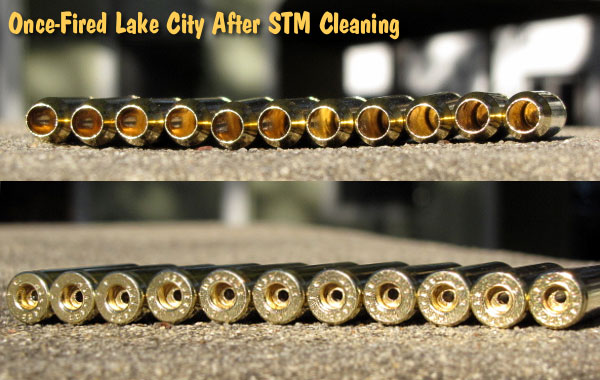
Shown below are Lake City cases after cleaning with Stainless Media (STM). Note: STM Case cleaning was done by a third party, not the USAMU, which does not endorse any particular cleaning method.
NOTE: The USAMU Handloading (HL) Shop does not RE-load fired 5.56 brass. We use virgin LC brass with our chosen primer already staked in place. However, our staff has extensive personal experience reloading GI brass for competition, which will supplement the Shop’s customary steps. In handloading, as in life, there are many ways to accomplish any given task. Our suggestions are note presented as the “only way,” by any means. Time for loading/practicing is always at a premium. Readers who have more efficient, alternative methods that maintain top accuracy are invited to share them here.
3. Inspect Every Case
Once dry, inspect each case for significant deformation (i.e., someone stepped on it), damaged mouths/necks and case head/rim damage. Some rifles’ ejectors actually dig small chunks of brass out of the case head — obviously, not ideal for precision shooting. Similarly, some extractors can bend the case rims so badly that distortion is visible when spinning them in one’s fingers. These can be used for plinking, but our match brass should have straight, undamaged rims.
Dented case mouths are common, and these can easily be rounded using a conical, tapered tool, [such as a .223 expander mandrel. A dummy 7.62 or .30-06 cartridge with a FMJ spitzer can also work.] If most of your brass is of one headstamp, this is a good time to cull out any odd cases.
4. Check the Primers Before Decapping
Your clean, dry and inspected brass is now ready for full-length sizing, decapping and re-priming. Historically, primer crimps on GI brass have caused some head-scratching (and vile language) among handloaders. Our next installment will detail efficient, easy and practical methods to remove primer crimp, plus other useful handloading tips. Until next week, Good Shooting!
Accuracy Potential of Mil-Surp 5.56×45 Brass
So, how accurate can previously-fired GI surplus brass be in a good National Match AR-15? Well, here’s a data point from many years ago that might be of interest. A High Power shooter who wrote for the late Precision Shooting magazine took a Bill Wylde-built AR match rifle to a registered Benchrest match. He had no difficulty obtaining consistent 0.5-0.6 MOA accuracy at 200 yards using LC brass and a generic “practice” load that was not tuned to his rifle.
Rimfire benchrest rifle of Forum member Peebles24.
With the variety of rimfire disciplines, from cowboy action to Olympic three-position smallbore, there are countless different rimfire designs on the market — bolt guns, lever guns, single-shots, toggle-links and more. These may shoot the same ammo, but they certainly vary in looks and ergonomics. This is testimony to human creativity.
In our Shooters’ Forum, you’ll find a long-running thread showcasing rimfire rifles for plinking, hunting, 3P Target Shooting, Silhouette, Benchrest, Rimfire F-Class, NRL22 and more. Here are some of the notable rifles in that Forum thread, with brief build/component details.
Rimfire F-Class Competition Rifle in Eliseo Stock
Here is a cool rimfire rifle featuring an Anschutz Model 1813 action in an Eliseo (Competition Machine) F-Class Chassis resting on a SEB Mini front joystick rest. This rig belongs to Forum member 10XShooter who won a Silver Medal at the Firecracker match at the NRA Whittington Range in Raton, NM. This rifle has a Maven 5-30X scope, Shilen Ratchet barrel smithed by Mark Penrod, plus a Harrell’s tuner. Gary Eliseo makes excellent metal stocks for centerfire and rimfire rifles with models for a variety of disciplines — Palma, F-Class, PRS/NRL and more. Check out all the Eliseo models at GotXRing.com.
IR 50/50 Sporter with 2500 XS Action and Muller 7R Barrel
Here is member doclu60’s Holeshot Arms (Stiller) 2500XS IR 50/50 Sporter. It features a polished action, barrel, rings/bases, trigger guard, and bolt knob. There are premium components: Bix ‘N Andy trigger, Peightal stock, and Muller 7R barrel. The optic is a Leupold Custom Shop VX3i 6.5-20x40mm wearing Rick Averill custom leather scope caps.
Anschutz BR-50 Benchrest Rifle with Upgrades
This is member BHarvey’s rare Anschutz 2013 BR50, with upgrades. This is actually a factory BR-50 stock, but the owner fitted a custom Benchmark barrel, along with a Fudd barrel tuner. That massive butt-plate is three POUNDS of custom-crafted copper, which helps with balance. This rifle was also featured in our popular Guns of the Week collection.
Rimfire F-Class Rig with Curly Maple Stock
This handsome, ultra-accurate Smallbore F-Class rig belongs to member RMist of Team Pro-Shot Products. It has a Holeshot (Stiller) 2500X, stunning Cerus Curly Maple wood stock, Nightforce scope. Up front is the joystick co-axial SEB Joy-Pod.
How does this impressive rimfire F-Classer shoot? Amazingly well. That target at right shows TEN (10) rounds fired at 100 yards. Most centerfire rifles would have trouble beating that level of accuracy.
Rimfire Tactical Rig with CZ Action and McRees Precision Chassis
Here’s a modern chassis rig built with a CZ 455 action. Forum member A-Rob upgraded the CZ 455 with a SCAR 2-stage trigger. This rifle features a Keystone Accuracy-fitted glue-in barrel, Athlon 10-40x scope and McRees Precision chassis. As you can see from the target, it shoots great. Note: CZ has replaced its 455s with the new CZ 457 series with available metal chassis precision model. CLICK HERE to see full target sheet with six 5-shot groups at 50 yards, averaging 0.270″.
Rampro .22 LR Pistol by Gre-Tan
This is a very rare .22 LR bolt-action silhouette pistol. It is a RamPro 22 LR single-shot crafted by Greg Tannel of Gre-Tan Rifles. Member Tonedaddy says this is the only .22 LR Rampro bolt-action pistol built by Gre-Tan in existence. Not the beautifully-figured wood stock.
Benchrest Rimfire with Turbo V3 Action and Owner-Crafted Stock
Member J.J. Coe reports: “Here is a little side project I recently finished. It features a
Turbo V3 action, Benchmark 3-groove barrel chambered by Mark Penrod, Jewell trigger, and Leupold 40X barrel in Harrell’s offset rings.” Notably, J.J. made the 5-piece laminate stock himself. Nice work! Yes this gun is very accurate as you can see from the match target. Below that is another one of J.J.’s rimfires, an Anschutz 54 in another handsome stock he made himself. This guy has talent!
SAKO P94S Rimfire Trio
This trio of SAKO P94S rimfire rifles belongs to Forum member “Thomasconnor”. He tells us: “The one in the middle is probably the most accurate .22 LR rifle I’ve owned. It was about 6 pounds (without the scope or rings) before I made a heavy buttplate for it. In its current configuration it’s under 8 pounds with a giant scope and steel rings. It now has a Jewell trigger, Benchmark barrel, oversized action screws, and Alex Sitman stock”.
Springfield Model 1922s
Member SnapDraw posted: “Here are my Springfield Model 1922s. One is an M1 I got from a shooting club back East. It has an NRA stock with upgraded M2 bolt and Lyman super target spot 15X scope. And the other (below) is an unmolested (except front sight) M2 with military stock. Both are amazing shooters!”
Benchrest Modified Anschutz 2013
Member Esk308 Picked up this pre-owned rifle in the summer of 2020. Along with the Anschutz 2013 action it features a 27″ Lilja barrel, laminated Shehane stock, and Nightforce 15-55x52mm scope in Kelbly rings. On the end of the barrel is a Harrels tuner with Don Blue tube. Esk308 now uses a John Loh front rest with SEB Bigfoot rear bag.
Anschutz 2013 in M. Werks Stock
Here is another Anschutz model 2013, but in a completely different configuration. This is a rimfire prone match rifle upgraded with a Bartlein gain-twist barrel and an M. Werks tuner stock. Note how the barreled action is secured. This handsome rig belongs to Forum member Jeffrey.
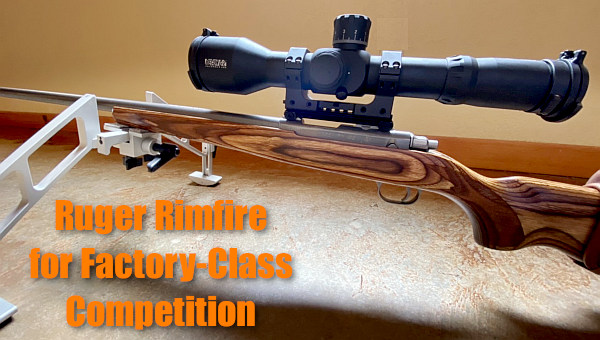
Factory-Class Ruger with Big Bipod
Forum member DavidJoe from Texas put together this rig for a local factory-class rimfire series. He reports: “There’s a discipline where a factory rifle under $1000.00 gets to shoot at a bigger-ringed target. I’m going to try out this new Ruger combination in those limited matches, weighed down with an enormous Valdada scope on a Sinclair bipod.”
Wood-Stocked Trio — Two Remingtons and a Kimber
Here are three .22 LR rigs belonging to member Alamo308. Note the competition iron sights on the middle rifle, a Remington M37 which features a Custom Birdseye Maple stock. The Kimber 82G was sold directly by the CMP as a training rifle. These CMP Kimbers were often extremely accurate.
Marlin 980S Custom with Owner-Crafted Stock
The rifle is based off a Marlin 980S action with a Green Mountain 20″ fluted barrel. The action was bedded with a one-piece aluminum bedding block and Devcon 10110. Owner Kakotoch tells us: “Trigger is a Rifle Basix I took down to just over 16 oz. by using a different pull weight screw. The scope is a Japanese-made Tasco 36x that I picked up NIB for $100 and is surprisingly clear. The stock was my winter project — it’s laminated carbon fiber and walnut, finished with Tru-Oil. I cut, shaped, and polished the buttplate by hand.”
Readers often ask us: “Is there an inexpensive way I can get started in position shooting?” The answer is “yes” — across the country CMP-affiliated clubs host Rimfire Sporter matches. You can use a wide variety of .22 LR rimfire rifles — manual actions (such as a Winchester model 52) or semi-automatics (such as a Ruger 10/22). There are prone, sitting/kneeling, and standing stages. CMP rules provide separate classifications for scoped rifles, open-sighted rifles, and aperature-sighted rifles. The matches are fun, the ammo is inexpensive, and everyone has a good time while improving their marksmanship.
The rapid-fire sitting or kneeling stage of a CMP-sanctioned .22 Sporter Match consists of two, 5-shot strings. A manually-operated or semi-automatic rifle may be used for this match.
This video shows the sitting/kneeling rapid-fire stage of a Rimfire Sporter match.
Our friend Dennis Santiago helps run CMP Rimfire Sporter Matches in Southern California. Dennis observes: “You want something challenging? Well that X-Ring 50 yards away is the diameter of a 50 cent piece, and there are people out there that can womp that thing with iron sights.”
Dennis notes: “There are six (6) stages of fire on a tough little target. Notice the rifles that can be used run the gamut from pump and bolt actions to variations on the semi-auto theme. All still require a good eye and a steady hold to earn one’s bragging rights for the day. A match takes about an hour and a half per relay. The slowest part of the match is initial sighting in. It’ll take longer than the allocated 5 minutes for the typical first timer coming to a club match.”
At Dennis’s Burbank Rifle & Revolver Club (BRRC), procedures are modified a little bit: “What we typically do at BRRC is run two relays. Experienced competitors shoot per the full rulebook. New shooters are afforded a bit more relaxed environment to make the experience more fun and inviting. We do the same thing in our M-1 Garand Clinic/Match series.”
Rimfire Sporter Match Basics
The CMP Rimfire Sporter Rifle Match is an inexpensive, fun-oriented competition using .22 caliber sporter rifles (plinking and small game rifles) commonly owned by most gun enthusiasts. To compete, all you need is a basic rifle, safety gear, and ammunition. No fancy, high-dollar rifles are required.
The event is shot with standard sporter-type, rimfire rifles weighing no more than 7 ½ lbs, with sights and sling. Rifles may be manually-operated or semi-automatic. Shooters with manually-operated actions are given extra time in the rapid-fire stage to compensate for the difference. (See Video).
There are three classes of competition — the standard “O Class” for open-sighted rifles, “T-Class” for telescope-sighted and rear aperture-sighted rifles and “Tactical Rimfire” class, which is a .22 caliber A4 or AR15 style rifle. Firing for all classes is done at 50 and 25 yards on a target with a 1.78″ ten-ring and an 18″ outer one-ring. Even new shooters can get hits on this target, but it’s still tough enough that no one yet has fired a perfect 600×600 score.
The Civilian Marksmanship Program (CMP) has a CMP Guide to Rimfire Sporter Shooting. This FREE, 50-page digital publication covers equipment, positions, course of fire, rules, scoring and much more. You’ll find helpful “how-to” sections on aiming, sight picture, hold control, and trigger control. Reading these instructional sections can benefit any prone or three-position competitive shooter.
The 2025 SHOT Show (Shooting, Hunting, and Outdoor Trade show) is just 17 days away. Thousands of new products will be on display at the SHOT Show, hosted at the Venetian Expo/Convention Center and Caesars Forum in Las Vegas. Gunmakers from around the world will be introducing hundreds of new (and updated) rifles, pistols, and shotguns. Along with the new guns, SHOT Show will feature many noteworthy new optics, electronics, reloading equipment, and accessories.
Here are six interesting videos that preview new (and updated) firearms expected to be on display at SHOT Show in Las Vegas later this month. There are hunting rifles, tactical rifles, rimfire rifles, plus a wide range of new pistols and some interesting shotguns.
This Survival Gear Video feature six interesting guns, starting with the Bear Creek Arsenal BC-15, a bolt-action AR-style rifle (note: this is incorrectly called the BCA-14 in a graphic). There is also an upper-only version that can be used with your existing AR Lower. Next the video reviews the Shadow System CR920X pistol, Wilson Combat Project 1 pistol, Ruger LC 10mm Carbine, CZ Bren 3 (3rd generation), and Atlas Gunworks Apollo V12 pistol. Other new guns are featured in a second Survival Gear Video with four rifles (Beretta 1301 Tactical, Cascade LRH, CMMG BR47, IWI Galil Ace Gen 2), one shotgun (Browning A520) and two pistols (Kimber KDS9C, Ruger RX XM).
This Gun Addicts video features a dozen new guns, many of which will be on display at SHOT Show for the first time. The host states: “The SHOT Show 2025 is here, and it’s packed with groundbreaking firearm announcements.” Featured new guns include: Bushmaster V-Radicator AR Rifle; Charter Arms Double Dog Revolver; EAA Girsan Witness Match Pistol; Fightlight Industries Lever-Action Bandito Pistol (AR style); Heritage Mfg. Coachwhip shotgun; Highpoint Firearms Large-Format Pistols; Jacob Grey TWC Black 2011 Pistol; Patriot Ordnance Factory P-15 Rifle; Shadow Systems CR920X/CR920XP Pistols; Taurus 608 Competition .357 Mag Revolver; and TriStar Arms APOC and Protege-X Pistols.
It’s that time of the year again with SHOT Show right around the corner. The PewPew Zone YouTube Channel offers a first look at some interesting new firearms. The PewPew editors were impressed, stating: “Gun makers are starting to roll out their latest and greatest for the upcoming year, pushing the boundaries of innovation and performance.” Over a dozen new rifles and pistols are featured in this 17-minute video.
This Line45 video features a large collection of new or updated guns. Featured firearms include: Shadow System CR920X pistol; Bushmaster V-Radicator AR-15; Hi-Point large format pistols; Patriot Ordnance P-15 Base Rifle; and Jacob Grey TWC Black 2011 Pistol.
Savage New Revel Rimfire Lever-Action Rifles
At SHOT Show 2025, Savage Arms will showcase its new Revel Classic and Revel DLX rimfire lever-action rifles in .22 LR, .22 WMR, and .17 HMR chamberings. These are take-down rifles with simple disassembly for cleaning and maintenance. The Revels feature a nice, satin-finish walnut wood stock plus a large lever loop for rapid cycling. These new rimfire lever guns start at $439.00 MSRP for the Revel Classic and $539.00 for the Revel DLX. The .22 LR Revel Classic is available now while the .22 WMR and .17 WMR versions will be available in early spring 2025, as will all Revel DLX models.
Here’s another Line45 channel video with five new guns on display at SHOT Show 2025. This 9-minute video is compiled mostly from marketing footage from the manufacturers. The featured new firearms include: EAA Gerson Witness 231 Pistol; Charter Arms Double Dog Revolver; Heritage Manufacturing Coach Whip Shotgun; Taurus 608 Revolver; Patriot Ordnance Factory (POF) P-15 Base Rifle (shown above).
BONUS: SHOT Show Floor Tour — Locations of Gun Companies
Will you be heading to SHOT Show this year? CLICK HERE for the handy official Interactive Floor Map. For each building and floor level this shows the location of exhibitors. This can help you efficiently organize visits to your favorite gun and optics manufacturers.




 Review Quick Highlights:






 This handsome, ultra-accurate Smallbore F-Class rig belongs to member RMist of Team Pro-Shot Products. It has a Holeshot (Stiller) 2500X, stunning Cerus Curly Maple wood stock, Nightforce scope. Up front is the joystick co-axial SEB Joy-Pod.