Doan Trevor is a master gunsmith and stock-maker who works in the old style. He still hand-crafts stocks from start to finish, and does all the metal-work on the custom rifles he builds. Starting with highly-figured woods, Doan carves and shapes his stocks largely by hand, with meticulous attention to detail. Each rifle he builds is optimized for its intended discipline, and custom-fitted for the customer.
With the help of his talented wife Sue (who does the photography and builds the web pages), Doan has created a wonderful website, DoanTrevor.com, that is a feast for the eyes. You can see beautiful wood-stocked rifles being hand-crafted. Doan also illustrates how he creates custom metal parts, and how he beds barreled actions into the finished stocks.
Set aside a few minutes and visit Doan’s website. Be sure to click on the site’s secondary pages: Rifle Building, Woodworking, and Metalworking. You’ll find dozens of high-quality photos and fascinating information on gun-building.
For more information, visit DoanTrevor.com, or call (505) 890-0368, 10am-5pm M-F.
Readers know Jim Borden as a Hall of Fame shooter and the owner of Borden Accuracy/Borden Rifles. Jim won 10 IBS National Championships, set 10 IBS world records, and was inducted into the Benchrest Hall of Fame in 1996. But Jim is not just a great shooter. This highly-trained engineer is very much a Renaissance man. He is as skilled with cameras as he is with benchrest rifles.
Jim is a talented outdoor photographer who has compiled an impressive portfolio of wildlife and landscape photographs. For our Thanksgiving-day edition of the Daily Bulletin we are featuring some of Jim’s favorite nature images. We hope readers enjoy them as much as shooters prize Borden’s Rimrock benchrest and Rimrock hunting actions.
Growing up in rural Pennsylvania, in a hunting household and hunting community, Jim learned about shooting at a very early age. He started hunting at the age of nine with his father and grandfather. His grandfather had an avid interest in photography while they were on hunts and Jim became interested as well. Jim began using SLR cameras in the 1970s, often carrying cameras on his hunts. As the years passed, Jim became more interested in “shooting” the animals with a camera versus a gun. Jim converted from film to digital in 2006 and in 2007 Jim’s wife Joan started accompanying Jim on the photo safaris. Jim has a particular passion for elk, moose, and eagles and Jim also enjoys scenic photography. Jim and Joan both shoot Nikon professional equipment. Their photographs can be viewed at www.BordenPhotography.com. You’ll also find Jim’s images (along with photography tips) on his JandJB Wildlife Photography Blog.
All in the Family
Jim’s grandfather was a gunsmith who taught Jim the trade when Jim was very young. Jim’s father and grandfather ran a country business that included an auto repair shop, welding, a small lathe, and a forge. Jim earned a degree in Mechanical engineering at Penn State University. For 23 years he worked for Procter and Gamble (P&G) as an engineer and as an engineering manager/project manager.
Borden Rifles — A Success Story
Borden Accuracy/Borden Rifles has been a source for precision benchrest and hunting rifles for many years. Jim started doing his own gunsmithing while competing in benchrest and high power silhouette matches. Jim launched his business in 1987, working nights and weekends while still employed at P&G. The business became full-time in 1995 with Jim and his wife Joan doing the work. The business was expanded in 1999 with the construction of the new Springville, PA facility and the addition of sons Jim Jr. and John to the staff. Son-in-law John Mecca came onboard in January 2000.
Jim and company began making Rimrock benchrest and Rimrock hunting actions in 2001. They added Borden Alpine and Timberline actions in 2006. These actions are made in an advanced manufacturing facility which has three CNC vertical Machining centers, three CNC lathes, three manual lathes, a manual knee mill, a surface grinder, a cylindrical grinder and wire EDM machine. To learn more, visit BordenRifles.com, call 570-965-2505, or send email to info [at] bordenrifles.com .
There are few master craftsmen who can create a truly “bespoke” wood stock customized for the owner. Ireland’s Enda Walsh is one such talent. Through Gun Stocks Ireland, Enda creates high-quality stocks for hunters, prone shooters, and F-class competitors. Enda first started building stocks in 2001 for himself and friends, and grew the business over a decade. Enda explains: “Demand gradually increased until in 2009 the decision was taken to make it my full-time occupation. In 2010 I obtained my RFD licence and haven’t looked back. My goal with Guns Stocks Ireland is to manufacture precise custom rifle stocks to the highest standard, tailored in every detail to best serve the shooters requirements.” Enda adds: “I started Gun Stocks Ireland to produce custom, individually-tailored gunstocks. I build from hand casts so your gun is genuinely an extension of your arm.”
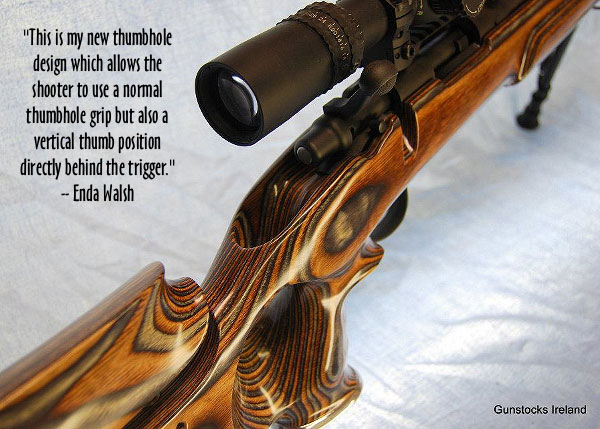
Walsh offers many stock designs, including a wide variety of thumb-hole and vertical grip stocks. Many of these feature hand-relieved grip areas customized for each guns’ owner. The hand-grip section literally fits the shooter “like a glove”. How does Enda create an ergonomically perfect grip for each customer? He actually makes a casting of the customer’s hand: “I send customers a hand cast kit so the shooter can make a plaster cast with his hand in shooting position. Done correctly there will be no tension in the shooter’s hand no matter how tight a hold is employed.” Enda’s stocks aren’t cheap, but they are a good value considering the amount of expert labor involved. Typical price for a fitted, bedded, and finished fully-adjustable F-Class stock is 1500 Euros.
Enda’s stocks, as you can see from the photos, are labors of love. Each stock may require up to 80 hours of work from start to finish. That includes fitting of special features, such as adjustable buttplate, adjustable cheek-piece, and a unique bag-rider that adjusts up and down for elevation control and rifle balance. We think the adjustable bag-rider is a great idea that American stock-makers should emulate.
Vertically Adjustable Bag Rider Permits Easy Elevation Adjustment
“For F-Open shooters the benefit of the [adjustable] bag runner is it allows precise elevation adjustments shot to shot without having to reach forward to adjust the front rest, taking the shooter out of his natural position. For ‘bag squeezers’ it eliminates the variable settlement during a shot causing vertical variances. The adjustable bag runner allows elevation changes to be dialed in easily and precisely with one hand.” — Enda Walsh
This is a .308 Win Savage in a fully adjustable F-TR stock. This rifle always performs well at the LRRAI shoots in Castlemaine Rifle & Pistol Range.
Enda Walsh Shoots What He Builds
Enda Walsh is a very talented shooter as well as a master stock-maker. He recently won a Silver Medal at 1000 yards at the 2012 European F-Class Championships at Bisley. He also shared a team Gold Medal at 1000 yards, shooting with an Irish F-TR team, and making wind calls as well.
Enda says: “I was very happy to take a silver at Bisley this year. This was my first trip to Bisley and first Euro Championships. The experience gave me some ideas on how to improve things for next year….”
Gun Stocks Ireland
Contact: Enda Walsh
Currabaha – Dungarvan
County Waterford
Ireland
E-mail: info [at] gunstocksireland.com
Phone in Ireland: 011-353-[0]87-661-1993
Want to invest in a gun-making milestone, with authentic “PPC Provenance”? Here is a rare opportunity to acquire a set of guns that forged new frontiers for rifle accuracy. Dave Kiff, founder of Pacific Tool & Gauge, is selling a consecutive built and numbered set of four (4) benchrest rifles which belonged to Ferris Pindell, one of the fathers of the PPC cartridge. These four game-changing guns were custom-crafted by Pindell with help from his friend and fellow PPC inventor Lou ‘Doc’ Palmisano.
Dave Kiff tells us: “These are the four rifles that June Pindell had sold me a while back. I have #1, #2, #3 and #4 of Ferris Pindell’s original custom-made Benchrest rifles. These are consecutive builds. I am selling all four at cost! Several collectors (and one museum) have offered a generous amount of money for only one or two of them, but I would hate to split them up. I would much rather sell all four of them complete for $6,900.00 and keep them all together. There are two PPCs and two BRs from what his wife told me. June told me these are the rifles that Ferris and ‘Doc’ Palmisano built when they created the PPC cartridge. This would be a great addition to any collection or a great start for anyone interested in shooting competition, as the rifles look very usable.”
For more information, call Yvette of PT&G at (541) 826-5808, or send email to yvette [at] pacifictoolandgauge.com .
Sale tip by Boyd Allen. We welcome reader submissions.
Report based on story by Lars Dalseide forNRAblog
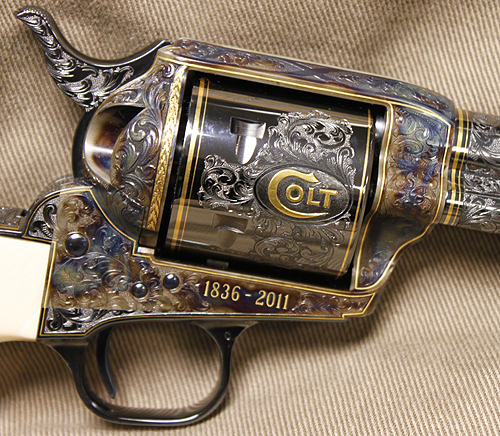
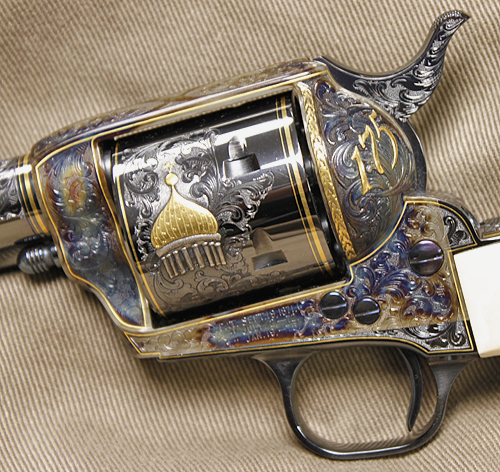
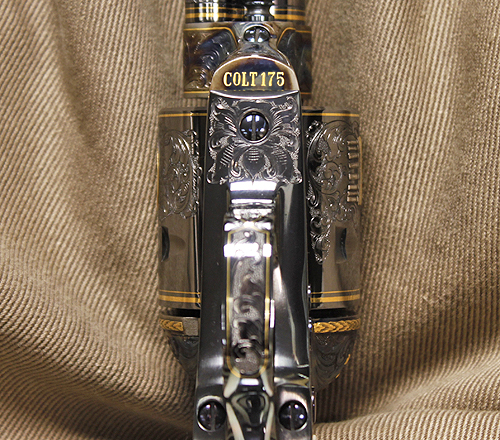
Colt Manufacturing’s 175th Anniversary Single Action Army revolver is now on loan at the NRA National Firearms Museum. The one-of-a-kind gun (serial number 175) was crafted by the Colt’s Custom Shop and engraved by Master Engravers Steve Kamyk and George Spring. It was created “to commemorate the 175th Anniversary of Colt Firearms”, notes Timothy Looney, Custom Shop Manager.
The firearm is based on the Colt Single Action Army with a black powder-style frame finished in color case hardening. The barrel, cylinder, trigger guard, and backstrap are finished in Carbonia Blue and the balance of small parts are fire-blued. The firearm has been scroll-engraved with C+ coverage and is accented by full gold frame borders including raised running leaf on both sides of the recoil shield. The left recoil shield exhibits “175” in high-relief gold over raised-relief scroll.
CLICK image squares to see larger photos.
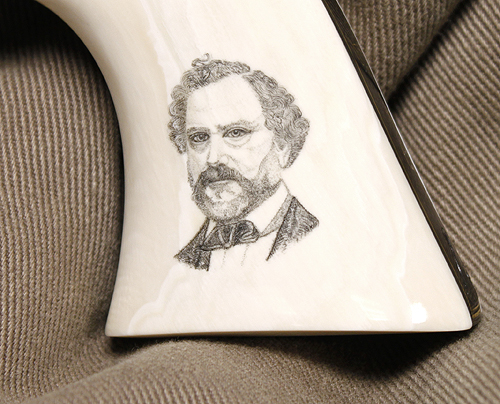
The non-fluted cylinder is highlighted by the Colt dome comprised of gold and silver raised relief and the the opposing side displays the serpentine Colt in raised gold. Hand inlaid gold bands accent the barrel and the cylinder. The backstrap has been engraved and gold inlaid with Sam Colt’s signature. The elephant ivory grips are scrimshawed with a portrait of Sam Colt on the left side and the Rampant Colt on the right side.
“The 150th Anniversary pistol was auctioned off and sold for $150,000,” explained Looney. “This one is valued at $175,000. We wanted it … where people could see it because we’re very proud of our master engravers and we like their work to be shown.” The Single Action Army Revolver will be on display at the NRA National Firearms Museum through October of 2013.
Put the same load in a variety of barrels (with the same length and chamberings) and you’ll see a wide variance in muzzle velocity. In fact, it’s not unusual to see up to 100 fps difference from one barrel to the next. We demonstrated this with a comparison test of Lapua factory ammo.
Chron Testing Lapua Factory Ammo
At our Southern California test range, we chronographed Lapua 105gr 6mmBR factory ammo in three different 8-twist barrels of similar length. The results were fascinating. Lapua specs this ammo at 2790 fps, based on Lapua’s testing with its own 26″ test barrel. We observed a speed variance of 67 fps based on tests with three aftermarket barrels.
Brand ‘S’ and Brand ‘PN’ were pre-fit barrels shot on Savage actions. Brand ‘K’ was fitted to a custom action. All test barrels were throated for the 100-108 grain bullets, though there may have been some slight variances in barrel freebore. With a COAL of 2.330″, the rounds were “jumping” to the rifling in all barrels. Among the four barrels, Brand ‘PN’ was the fastest at 2824 fps average — 67 fps faster than the slowest barrel. Roughly 10 fps can be attributed to the slightly longer length (27″ vs. 26″), but otherwise this particular barrel was simply faster than the rest. (Click Here for results of 6mmBR Barrel Length Velocity Test).
Results Are Barrel-Specific, Not Brand-Specific
These tests demonstrate that the exact same load can perform very differently in different barrels. We aren’t publishing the barrel-makers’ names, because it would be wrong to assume that ‘Brand X’ is always going to be faster than ‘Brand Y’ based on test results from a single barrel. In fact, velocities can vary up to 100 fps with two identical-spec barrels from the SAME manufacturer. That’s right, you can have two 8-twist, 26″ barrels, with the same land-groove configuration and contour, from the same manufacturer, and one can be much faster than another.
Don’t Demand More Than Your Barrel Can Deliver
We often hear guys lament, “I don’t get it… how can you guys get 2900 fps with your 6BRs and I can only get 2840?” The answer may simply be that the barrel is slower than average. If you have a slow barrel, you can try using more powder, but there is a good chance it may never run as fast as an inherently fast barrel. You shouldn’t knock yourself out (and over-stress your brass) trying to duplicate the velocities someone else may be getting. You need to work within the limits of your barrel.
Factory Ammo Provides a Benchmark If you have a .223 Rem, 6BR, .243 Win, 6.5×47 Lapua, 6.5×55, .308 Win, 30-06, or 300 WM Rifle, we recommend you buy a box of Lapua factory-loaded ammo. This stuff will shoot great (typically around half-MOA), and it can give you a baseline to determine how your barrel stacks up speedwise. When you complete a new 6BR rifle, it’s wise to get a box of the factory ammo and chronograph it. That will immediately give you a good idea whether you have a slow, average, or fast barrel. Then you can set your velocity goals accordingly. For example, if the factory 6BR ammo runs about 2780-2790 fps in your gun, it has an average barrel. If it runs 2820+ in a 26″ barrel (or 2835 fps in a 28″), you’ve got a fast tube.
The NRA Store’s Catalog has hundreds of interesting items for sale, ranging from belt-buckles to a ballistic calculator watch. There are plenty of unique gift items — how about a “Don’t Tread on Me” blanket, or a stag-handle NRA Tomahawk?
Among the many catalog items, two smart, utilitarian products caught our eye.
AR15 and m1911 Cleaning Mats
The NRA offers handy waterproof, stain-resistant Zorb-tech cleaning mats for black rifle shooters and 1911 fans. Printed on the 40″ x 14″ AR15 mat (item SA 21577, $16.95) are complete AR parts schematics, plus cleaning guide and AR assembly instructions. If you’ve ever fiddled with all the little parts on an AR15 bolt assembly, you’ll know how handy this Assembly/Cleaning mat can be. A smaller cleaning mat with 1911 pistol schematics sells for $13.95.
Magnetic Gun Clamp
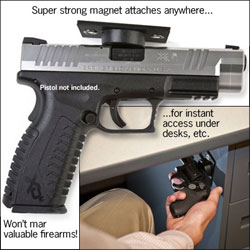
For years we’ve been wanting a product like this. This simple magnetic device allows a handgun to be stored out of sight, yet instantly retrieved in an emergency. The device is simplicity itself. No more fumbling with jury-rigged holsters or hard-to-access drawers.
A magnet strong enough to lift 10 pounds is sealed in durable, scratch-resistant plastic, and backed with a mounting bracket. You can easily place the magnet under countertops or on the side of a cabinet or desk. (On steel surfaces the magnet will grip without screws or through-bolts). The NRA Rapid Access Gun Magnet (item SA 24385) costs $27.95.
We often get requests from rimfire shooters who’ve acquired an older Anschütz that needs some repair work, or perhaps is missing a few small parts. Other readers have asked “who can help with tuning or upgrading an Anschütz trigger?” Listed below are two important resources. For repairs and factory replacement parts, contact Ten Ring Service. To purchase Anschütz smallbore and air rifles, (along with a selection of Anschütz accessories), you may want to try Champion Shooters Supply.
Anschütz Gunsmithing, Repairs, and Tuning
Looking for an knowledgeable shop that can help with Anschütz smallbore rifle repairs, trigger work, and tuning? Ten Ring Service in Jacksonville, Florida is highly recommended by many leading smallbore shooters. An authorized Anschütz factory repair center, Ten Ring can supply trigger upgrades, bolt replacements, and provide factory parts and accessories.
In 2010 we had an Anschütz 64R Biathlon rifle for testing and evaluation. We had some questions about tuning the 5103 two-stage trigger, and Ten Ring was very helpful. For other Anschütz rifles, Ten Ring can provide replacement springs, trigger parts, firing pins, and both factory and third-party accessories. For more info, contact Ten Ring Service at (904) 724-7419, and ask for Todd or Steven. Note: Ten Ring Service plans to launch a website (at long last) later this month (October, 2012).
Ten Ring Service, Inc.
2227 Lou Dr. West
Jacksonville, FL 32216-4456
Phone: (904) 724-7419 WEBSITE to be launched this month
Anschütz Rifles and Accessories Champion Shooters Supply in New Albany, Ohio carries a large selection of Anschütz target rifles and air rifles. If Champion Shooters doesn’t have a particular model in stock, they can often order the rifle from Germany on request.
Champion Shooters carries a full line of Anschütz shooting accessories, including front and rear sights, stocks, bolt knobs, shooting clothing, and miscellaneous small parts.
Download FREE Rifle Manuals
Looking for a manual or parts diagram for your Anschütz rifle or pistol? Champion Shooters offers FREE Rifle Manuals for 30+ different Anschütz firearms. These manuals are offered as Adobe .PDF files. Most of the manuals offer text in English, German and Spanish. In addition to the user manuals for dozens of Anschütz models, Champion Shooters offers a manual for the Anschütz 5065 trigger assembly.
Jerry Schmidt, an avid shooter and hunter from Montana, has created a tool designed to help install single-dovetail or double-dovetail rings on hunting rifles. Jerry’s invention, the Scope-Tru Alignment Bar (patent pending), is unique. Unlike most other alignment systems, this is a single, long precision machined rod with a pointed forward end. You work on one ring at a time, first setting the front ring in the dovetail and then setting the rear ring. The process is shown by Jerry in the video below.
Jerry explains: “The Scope-Tru Alignment Bar is a tool designed to install both standard ring/mount systems, and dual dovetail ring/mount systems. The tool provides significant leverage to turn the dovetail rings into their bases. By observing the pointer on the end of the bar, it is easy to align the ring with the center of the barrel, thereby assuring that the ring is installed at 90 degrees to the axis of the bore. Because the bar is a one-piece tool, it is possible to get the rings into nearly perfect alignment with each other, and near perfect alignment with the bore axis.”
The photos above show how the tool is used to install and align a set of standard hunting rings (with rear windage adjustment). You start with the front ring, rotating it 90 degrees in the dovetail, and then align with the center of the barrel. Next, slide the tool rearwards and loosely set the rear ring in place. With both rings adjusted correctly, the alignment tool will be perfectly centered and both rings with be subsequently squared at 90° to the bore axis. Schmidt says he can install conventional rings with this tool, tighten them to spec on a rifle scope, and there will be virtually no marks on the scope tube. (Of course this would require that the rings are extremely well made with no burrs or highspots on the trailing and leading edges.)
The Scope-Tru Alignment Bar is CNC-machined from TGP bar stock, and will be offered in both 1 inch, and 30mm diameters. The durable bar is designed for regular, long-term use by the professional gunsmith, the home gunsmith or “gun crank”, and retail or wholesale sporting goods store staff. The 1″-diameter, all-steel Scope-Tru is can be purchased for $135.00 plus shipping and handling. The version for 30mm rings AND a new combo 1″/30mm Scope-Tru tool are both in final development, and could be available in the near future. To place an order for a 1″-diameter Scope-Tru, CLICK this LINK.
For more info, visit Parabola-LLC.com, phone (406) 586-1687, or email info [at] parabola-llc.com. CLICK HERE for a shorter video that shows the entire mounting process in a compressed time format.
If you’re looking for the newest, hot tubegun set-up, check out BAT Machine’s new 3-Lug tubegun action. This new action, created with design input from Gary Eliseo of Competition Shooting Stuff (CSS), is designed to work perfectly in Eliseo’s modular tubegun chassis systems. The new BAT “tubegun special” action features a smooth, short-throw 3-lug bolt along with an integral, large-diameter recoil lug precision-machined as part of the action. The new BAT tubegun action will mate perfectly with an all-new tubegun chassis kit Gary Eliseo has “designed around the action”.
Gary Eliseo is excited about the BAT 3-Lug and he will be offering a new chassis for this “tubegun special” action. The new BAT 3-Lug action is shorter than Remington-style actions and Barnard actions, so it will NOT fit in existing Eliseo tubeguns. Accordingly, to use the new BAT 3-Lug action you will need a new chassis kit. Gary may, at some point in the future, offer a retrofit kit, but for now, you’ll need Gary’s new chassis if you want to run the BAT 3-Lug. Gary hopes to deliver BAT 3-Lug-capable chassis kits in about six (6) months time. That sounds like a long time, but remember that it will take you about six months to get your BAT 3-Lug action once you place an order with BAT Machine. The action is currently SINGLE SHOT only, and fits short-action-length cartridges (e.g. 6BR, .243, .308 Win). Price for the new action is roughly $1200.00. Both right-hand and left-hand versions will be offered in both stainless and chrome-moly. Extra-cost options will include fluted bolts and dual ports (as shown in photos). The new chassis kit will initially be available for standard RB/RP or LB/LP configurations.
Gary believes the new BAT 3-Lug action, when fitted to his new chassis, will be ideal for Palma, Long-Range Prone, and F-TR Shooters. Gary says: “This new action is stiff and smooth, with a fast 60° bolt lift. It offers many of the best features of a Barnard action, in a more compact, American-made design, available in stainless steel as well as chrome-moly.” (Barnards are chrome-moly only.) BAT Machine is currently accepting orders for the 3-Lug Tubegun action and you can order the new Eliseo Chassis designed around this action from CompetitionShootingStuff.com.


 Jim is a talented outdoor photographer who has compiled an impressive portfolio of wildlife and landscape photographs. For our Thanksgiving-day edition of the Daily Bulletin we are featuring some of Jim’s favorite nature images. We hope readers enjoy them as much as shooters prize Borden’s Rimrock benchrest and Rimrock hunting actions.


 Borden Rifles — A Success Story
 There are few master craftsmen who can create a truly “bespoke” wood stock customized for the owner. Ireland’s Enda Walsh is one such talent. Through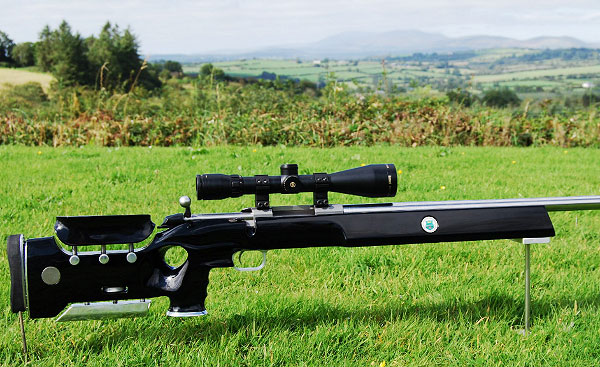




 Enda Walsh Shoots What He Builds
 Want to invest in a gun-making milestone, with authentic “PPC Provenance”? Here is a rare opportunity to acquire a set of guns that forged new frontiers for rifle accuracy. Dave Kiff, founder of



 If you have a .223 Rem, 6BR, .243 Win, 6.5×47 Lapua, 6.5×55, .308 Win, 30-06, or 300 WM Rifle, we recommend you buy a box of
 Among the many catalog items, two smart, utilitarian products caught our eye.
 Magnetic Gun Clamp
 Ten Ring Service, Inc.
 Anschütz Rifles and Accessories


