Editor’s Note: Sometimes proven old designs are just as good as the latest technology. In the capable hands of Robert Vadasz, the scratched and well-used 11-year-old Smith & Wesson revolver shown below has won three PPC National Championships and the 2011 National Police Shooting Championship (multiple guns used). Here’s a profile of a great shooter and his trusty old wheelgun.
Story by Lars Dalseide, for The NRA Blog
When I first approached U.S. Border Patrol Agent Robert Vadasz about profiling the guns he used to win the 2011 National Police Shooting Championship — his third in four years — he had just completed the final stage of the Revolver 1500 Match. A match that he won with a score of 1490-117X. A match in which he used his Bob Jones PPC revolver.
“It’s a .38 Special Smith & Wesson,” said Vadasz. “My Bob Jones PPC revolver. The very first competition gun that I ever had built … probably back in 2000″. Fitted with Hogue Monogrip, the .38 hasn’t been tinkered with since the day it arrived. “Exact same gun,” said Vadasz. “It’s never been worked on. It’s never been changed. I won all three of my PPC National Championships with this gun. It’s real special to me.”
In a 2001 NRA Law Enforcement Division Newsletter, gunsmith Bob Jones talked about his work on PPC pistols: “I started working on pistols in the Navy, and it kind of stuck — it was something I really enjoyed doing,” said Bob, thinking back to his days as a Naval armorer who tinkered with .45s.
Bob’s typical modifications to a Smith & Wesson revolver include fitting a Shilen barrel, bobbing the hammer (cutting off the cocking spur), adding an Aristocrat Sight Rib, tuning and smoothing the trigger, and installing a trigger stop. The Shilen barrel increases accuracy, adds some additional weight for stability, and its increased size (and surface area) helps with heat dissipation.
In the firearms business we are justifiably proud of the machining quality of high-end components. For example, a multi-flat BAT action with diamond fluted bolt is an impressive piece of machining. But if you want to see a truly amazing example of modern automated machining, watch the two videos below.
5-Axis Milling Magic
In the videos below, a modern, computer-controlled 5-axis milling machine produces a complete motorcycle helmet shell start to finish. Yes, the motorcycle helmet was milled out of one solid 120kg block of aluminum.
Every feature of the aluminum helmet was cut by machine — even the side vents and rear “50th Anniversary” logo and mesh grill”. The machines in use are 5-Axis hyperMILLs produced by Daishin Seiki Corp. of Japan.
At the gun industry writers round-table meeting earlier this month in Kansas City, KS, Alexander Arms made important announcements regarding the 6.5 Grendel Cartridge.
1. The “6.5 Grendel” has been officially approved as a SAAMI Cartridge. (This means that cartridge dimensions will be standardized for the purpose of manufacturing brass, loaded ammunition, pre-fit barrels, and 6.5 Grendel-chambered firearms.)
2. Alexander Arms has officially “relinquished” its trademark claim on the term/label “6.5 Grendel”. This opens the door to other companies offering products (such as ammo, barrels, magazines) which are identified by the 6.5 Grendel moniker.
Here is the text of Alexander Arms’ Official Press Release:
The 6.5 Grendel is an Official SAAMI Cartridge and Trademark is Relinquished.
The Sporting Arms and Ammunition Manufacturers’ Institute (SAAMI) has adopted the 6.5 Grendel as an official SAAMI cartridge. As a result of the cartridge’s official recognition, Alexander Arms will relinquish the trademark “6.5 Grendel”. Bill Alexander states: “One of the primary purposes of trademarking the name was to protect the integrity of the design. With the adoption of the 6.5 Grendel cartridge standard by SAAMI, the design is now protected, and any confusion in the marketplace as to the specification of the cartridge has been eliminated.”
SAAMI’s formal adoption of the design specifications for the cartridge has led Alexander Arms to announce that it will relinquish its federally-registered trademark and that “6.5 Grendel” to be the common commercial name for a cartridge that adheres to the specifications adopted by SAAMI.
Alexander Arms is proud that a cartridge of its design has received this important designation, and is pleased to take this important step in the continued market development of this breakthrough cartridge, which is perfectly matched to the AR-15 platform.
For additional information contact:
Alexander Arms
wayne@alexanderarms.com
540-639-8356
According to The Firearm Blog, “Hornady submitted the cartridge to SAAMI last year but the application was rejected because Alexander Arms refused to relinquish the trademark.” With the waiver of trademark objections by Alexander Arms, look for greater production of standardized 6.5 Grendel ammo and brass. We can also expect more factory and custom rifles to be chambered in the efficient 6.5 Grendel cartridge. Some gunsmiths had avoided working with this cartridge because of Alexander Arms’ trademark claims. In fact, the were even concerns about sales of “6.5 Grendel” chambering reamers, so some gun-builders developed slightly-different wildcats in order to get around Alexander Arms’ objections. But that is all “old history” now….
Stiller Precision Firearms is now offering hard-anodized, billet aluminum bottom metal systems that work with Accuracy International (AI) magazines in Rem-style actions. Currently a short-action version is offered (for both .223 Rem and .308 Win cartridge sizes) and a long-action unit is in the works. Bottom metal for the .223 Rem fits a 10-round magazine. For the .308 Win, there are three mag options: 5-round centerfeed, 10-round centerfeed, and a 10-round, .308 double-column mag. The double-column magazines won’t work in the standard Remington action, but are perfectly suited for dedicated actions such as Stiller’s new TAC30 A/W. Current MSRP for Stiller’s DBM Bottom Metal is $295.00 with one (1) 5-round magazine.
Jerry Stiller consulted many tactical shooters before finalized the design of his new bottom metal. It contains many smart features that enhance reliability/function and simplify the installation process:
Strong, billet aluminum construction with Mil-Spec Type 3 hard anodizing.
Flared magwell allows fast, positive insertion of Accuracy International magazines.
Computer-optimized truss pattern reduces weight while retaining strength and stiffness.
Works with all commonly-available triggers for Rem and Rem-clone actions.
“Exact-Fit” pillars and screws included to ensure a perfect fit and easy installation.
NO SPECIAL INLET is required on the tang ends. Stiller Bottom Metal will fit into a standard BDL bottom inlet in most stocks (must meet Remington specified depths). The only cutting needed is around the magazine box. Stiller has beefed up the material in this area so that a high-precision cut is not needed.
Story tip by EdLongrange. We welcome reader submissions.
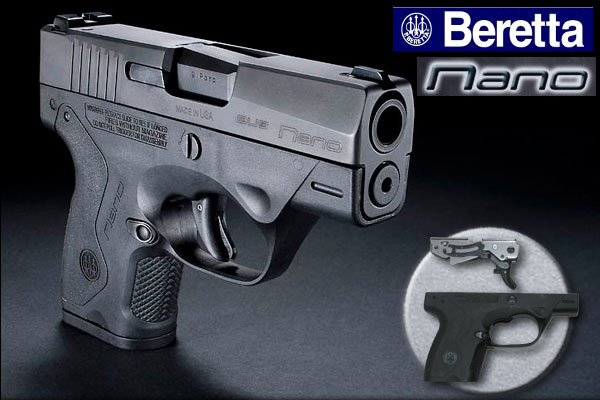
Put this in the “it’s about time” department. We’ve long wondered why makers of polymer-framed handguns don’t serialize the internal sub-chassis, so owners can swap frames (shells) easily without legal issues. Currently, for example, if you have a Glock and need to replace a damaged frame, you must return the frame to the manufacturer. Glock then destroys the frame and replaces it with a new frame with the same serial number. That’s necessary because the unitized Glock frame/chassis together constitute the serialized part. If you don’t want to relinquish your original frame, the only way to get a second Glock frame is to buy a new gun, and do a new DROS with background check.
Beretta has come up with a better solution. Beretta realized that pistol owners might want to upgrade their frames, or have multiple frames for the same serialized handgun — one frame could have a short grip and while another has a full-sized grip. With its new Beretta BU-9 Nano subcompact 9mm pistol (to be released in October), the serial number is stamped on a separate, removable internal chassis. The polymer frame bears no serial number. As a result, Nano pistol owners can purchase additional frames without legal restrictions. Acquiring a new Nano frame would be just like buying a new recoil spring or other accessory. CLICK HERE for Beretta Nano Spec Sheet (PDF).
We hope other manufacturers follow Beretta’s lead. Removing the serial number from a handgun’s external polymer shell allows aftermarket companies to develop a variety of frames with different features. Aftermarket frames could even be custom-molded to fit the owner’s hand. Additionally, the gun manufacturer could package multiple frames with one chassis for the original sale. That would appeal to folks who want a stubby grip for carry and a full-size grip for gun games.
Along with its novel serialized “modular chassis”, the new Nano has some other interesting features, including a push-button “striker de-activator”. This allows the gun to be disassembled without pulling the trigger. Also both front and rear sights are secured with set screws. This allows a user to easily adjust (or change out) the sights without expensive tools. These features are explained in the video below.
Forum Member Rod V (aka Nodak7mm) commissioned a full-bling “Extreme Make-Over” of his Bald Eagle Slingshot Front Rest. The visual change was dramatic — a benchrest version of “Pimp My Ride”. But Rod’s old Bald Eagle was also fitted out with new controls and new, large-diameter F-Class foot pads. Those hardware additions add more than flash — they improve function too.
Plain Jane Rest Becomes Black and Gold Beauty
The whole rest body was powder-coated black and the controls were finished in gold-tone. This has got to be the best-looking Bald Eagle in the galaxy. Rod says: “I had Bob Pastor of Viper Rests make me some F-Class feet for my Bald Eagle Slingshot rest. Since Bob does powder coating and such, I gave him the go ahead to make it look sweet. And he sure did!”
Rod adds: “Man do I have a ‘kick-butt’, hot looking rest for F-class now! Pastor did a great job and I really owe him a thanks for exceeding my expectations and for his craftsmanship. Bob is a great guy to work with. He is a top-shelf shooter too, so he knows what he wants in a rest and why.”
What’s involved in an “Extreme Make-Over” by Bob Pastor?
Here’s the description on Bob’s Website, www.ViperBench-rest.com:
Each rest is customized for the individual shooter. All the brass knobs and handles are melted down rifle cases from my foundry.
(Aluminum knobs and handles can be substituted of weight is a concern.)
Each knob and handle is individually knurled and turned on my lathe.
All threaded stainless steel rods, knob screws and knob extensions are used. These are all highly polished before installation.
The Viper Double-Edge F-Class Feet are 4″ wide, with a large tapered spike turned concentric to the center hole.
All corner stainless steel rods are ½ x 13 threads per inch for added stability.
All corner stainless steel rods have concentric points turned on the ends for use on a shooting bench.
All corner holes in base are drilled and tapped for ½ x 13 tpi., from 3/8 x 16 tpi. For better stability.
The base is stripped of any paint and all sharp edges and burrs are removed prior to powder coating.
The entire rest is either powder-coated or painted according to the material.
All threaded rods are burnished to remove any small burrs, before applying synthetic grease and assembly.
All brass is highly polished, unless a matte finish is desired.
Each rest is then packed in liquid hardening foam for safety during shipping.
To order an “Extreme-Makeover” visit www.ViperBench-rest.com, call Bob Pastor at (269) 521-3671, or email robpas [at] btc-bci.com . Bob says the Make-Over price “depends on the customer’s desires and is quoted before the rest is shipped to me.”
This past weekend we reported that the NBRSA approved the use of the Gonzales cartridge feeder in registered benchrest matches. This device, supported by an arm attached to the front rest, holds 6PPC cartridges close to the loading port on the left side of the action. Using a remote (red) cable activated by the left hand, the cartridge feeder drops one cartridge at a time directly into the action. Now, thanks to Rick Pollock of Benchrest.ca, we can show you close-up photos of the device, so you can see how it is positioned and supported. Note that the Gonzales device does not touch the gun.
Watch Video to See Speed-Feeder in Action
The cases are gravity-fed, but the shooter has positive control over feeding. A cable with a push-button control runs from the magazine down to the rear foot of the pedestal rest. You just push the button to drop one cartridge from the magazine. Watch the video below to see how it works:
Here’s a little known fact that may startle most readers, even experienced gunsmiths: your barrel wears out in a matter of seconds. The useful life of a typical match barrel, in terms of actual bullet-in-barrel time, is only a few seconds. How can that be, you ask? Well you need to look at the actual time that bullets spend traveling through the bore during the barrel’s useful life. (Hint: it’s not very long).
Bullet-Time-in-Barrel Calculations
If a bullet flies at 3000 fps, it will pass through a 24″ (two-foot) barrel in 1/1500th of a second. If you have a useful barrel life of 3000 rounds, that would translate to just two seconds of actual bullet-in-barrel operating time.
Ah, but it’s not that simple. Your bullet starts at zero velocity and then accelerates as it passes through the bore, so the projectile’s average velocity is not the same as the 3000 fps muzzle velocity. So how long does a centerfire bullet (with 3000 fps MV) typically stay in the bore? The answer is about .002 seconds. This number was calculated by Varmint Al, who is a really smart engineer dude who worked at the Lawrence Livermore Laboratory, a government think tank that develops neutron bombs, fusion reactors and other simple stuff.
On his Barrel Tuner page, Varmint Al figured out that the amount of time a bullet spends in a barrel during firing is under .002 seconds. Al writes: “The approximate time that it takes a 3300 fps muzzle velocity bullet to exit the barrel, assuming a constant acceleration, is 0.0011 seconds. Actual exit times would be longer since the bullet is not under constant acceleration.”
We’ll use the .002 number for our calculations here, knowing that the exact number depends on barrel length and muzzle velocity. But .002 is a good average that errs, if anything, on the side of more barrel operating life rather than less.
So, if a bullet spends .002 seconds in the barrel during each shot, and you get 3000 rounds of accurate barrel life, how much actual firing time does the barrel deliver before it loses accuracy? That’s simple math: 3000 x .002 seconds = 6 seconds.
Gone in Six Seconds. Want to Cry Now?
Six seconds. That’s how long your barrel actually functions (in terms of bullet-in-barrel shot time) before it “goes south.” Yes, we know some barrels last longer than 3000 rounds. On the other hand, plenty of .243 Win and 6.5-284 barrels lose accuracy in 1500 rounds or less. If your barrel loses accuracy at the 1500-round mark, then it only worked for three seconds! Of course, if you are shooting a “long-lived” .308 Win that goes 5000 rounds before losing accuracy, then you get a whopping TEN seconds of barrel life. Anyway you look at it, a rifle barrel has very little longevity, when you consider actual firing time.
People already lament the high cost of replacing barrels. Now that you know how short-lived barrels really are, you can complain even louder. Of course our analysis does give you even more of an excuse to buy a nice new Bartlein, Krieger, Shilen etc. barrel for that fine rifle of yours.
In our Shooters’ Forum, there’s a long-running thread entitled Pride & Joy Rifles. There you’ll find dozens of fine firearms — from hunting handguns to long-range benchrest rigs. A while back, Forum member John L. (GunDog64) posted this handsome Palma rifle, built by Chad Dixon.
John reports: “Here is my new ‘Pride and Joy’ Palma rifle. The action is a chrome-moly Barnard supplied by MT Guns. The gun is set up for switch-barrel use with two Medium Palma-contour Bartlein barrels, one chambered in 6CM, the other in .308 Winchester. Both barrels feature 5R rifling. Up front is a Riles 30mm front sight, while the rear sight is a Warner. The stock was crafted from a superb Turkish walnut blank supplied by Luxus Gunstocks in Mt. Orab, Ohio.
Gunsmithing by Chad Dixon — Stock Finish by Owner
All gunsmithing and assembly work was performed by Chad Dixon at Long Rifles Inc., Sturgis, South Dakota. Chad designed the trigger guard, handstop rail, recoil lug, and cheek-piece adjuster. John, the rifle’s proud new owner, completed the finish work on the stock. John reveals: “This project was a year in the making but well worth the wait”.
In our Shooters’ Forum, you’ll find a lengthy thread about accuracy problems with a Savage LRPV, chambered in 6mmBR. The gun would repeatedly split groups at 100 yards, and at 300 yards, the “flyers” would open up the groups to 1.5 MOA or larger. Interestingly, the factory test target (at right) showed a split group — not a good sign.
The gun’s owner, forum member LR_Shooter, tried a variety of tweaks: “I did this, done that… [changed] torque, tang floated, bedded action, recut chamber, and [adjusted firing pin]”. But nothing really helped. Frustrated, LR_Shooter asked his fellow Forum members for help. Much advice was proffered, including the novel idea of removing the middle action screw in the Savage 3-screw target action. Some of the advice proved helpful, but none of the suggested remedies produced a major improvement. This rifle, out of the box, tossed flyers and no amount of tweaking (or changes in shooting technique) really cured the basic problem. That is, until, the factory barrel got replaced…
New Criterion Pre-Fit Barrel Works Wonders
LR_Shooter acquired a Criterion pre-fit barrel from Jim Briggs at Northland Shooters Supply (NSS). These pre-fits are designed for easy installation with the standard Savage barrel nut. Wouldn’t you know it, with a new 30″ heavy-contour barrel on the LRPV, the gun started shooting way better. No more crazy fliers, no more split groups, no more excessive vertical. And the improvement came without any other major modifications. LR_Shooter reports: “I got a replacement barrel from Jim at NSS. It is a 30″ bull Criterion barrel. So far, without playing with torque screws and having my old setup… I’m very satisfied with the barrel I got. Now I have no problem getting [groups] under 0.25 MOA. Finally this thing can shoot!” The targets below, shot with the new Criterion barrel, speak for themselves. The left target was shot at 100 yards, while the target on the right was shot at 300 yards (very impressive).
Targets Shot with Savage LRPV Fitted with Criterion Barrel
Moral of the Story — Sometimes A New Barrel Really Is the Right Solution
All of us have struggled at times with a rifle that won’t live up to expectations. This Editor personally struggled for over a year with a .260 Rem Savage with a factory tube. The gun tended to split groups and the POI walked as the barrel heated. I tried one powder/primer combination after another, working through a variety of seating depths over many months. I was persistent. Out of stubbornness, I just believed that sooner or later I’d find the magic load.
Well folks, sometimes there’s really nothing you can do about a sub-par barrel. It is what it is. To really improve a gun’s accuracy (particularly a gun with a factory tube), you may need to open your wallet and get a quality aftermarket barrel. Spending months trying one recipe after another may simply be an overwhelming waste of powder, bullets, and your precious time.
Albert Einstein supposedly said: “Insanity is defined as doing the same thing over and over again, and expecting different results.” Well that sort of describes my efforts with my .260 Rem. Once I had enough evidence that my barrel split groups no matter what load combo (and seating depth) I tried, it was time to pony up for a new barrel. When I did finally screw on a nice PacNor 3-groove Supermatch, that Savage suddenly became a true tack-driver. As re-chambered in 6mmBR with the Pac-Nor, in calm conditions, my Savage will now consistently shoot in the twos with heavy bullets, and it can sometimes dip down into the ones with Berger 80gr flat-base bullets. The moral of the story here is simple — don’t waste weeks or months chasing your tail with a barrel that just won’t deliver (after a reasonable amount of testing). Save up for a custom barrel, get it chambered properly, and stop your cycle of frustration.
Contact Information for Northland Shooters Supply:
E-mail: briggs.j-b@q.com (that is Q.com not G.com)
Phone: (763) 682-4296
Fax: (763) 682-6098
Mailing address:
P.O. Box 333
Buffalo, MN 55313


 Story by Lars Dalseide, for The NRA Blog


 5-Axis Milling Magic




 Plain Jane Rest Becomes


 Gone in Six Seconds. Want to Cry Now?
 In our
  In our


