Henry Repeating Arms will offer two limited-edition models to mark company’s twenty-fifth anniversary. The two rifles, one rimfire and one 44-50 Centerfire, pay tribute to the beginnings of Henry Repeating Arms as a company and the origins of the lever action rifle’s enduring legacy in America.
25th Anniv. Edition .22 Rimfire
Twenty-five years ago, from a small factory in Brooklyn, New York, Henry Repeating Arms began shipping the now world-renown model H001 Classic Lever Action .22. Since then, the company has sold more than one million of the rifles.
Now, the company is introducing the 25th Anniversary Edition (model H001-25), which features semi-fancy genuine American walnut furniture and an engraved, nickel-plated receiver cover with 24-carat gold plated highlights. The handsome rifle comes with a fully adjustable semi-buckhorn rear sight, and a hooded blade front sight. The tube magazine holds 15 rounds of .22 Long Rifle, 17 rounds of .22 Long, or 21 rounds of .22 Short. The Classic Lever Action .22 25th Anniversary Edition is limited to 5,000 units with a $1,130 MSRP.
25th Anniversary .44-40 Henry Original Deluxe
The rifle is a faithful recreation of the original patent except for more robust materials and the concessions needed to accommodate the more modern .44-40 WCF cartridge, of which the rifle can carry 13 rounds. Other features include a folding ladder rear sight, a brass blade front sight, a hardened brass crescent buttplate with a period-correct storage compartment, and near full coverage engraving on the hardened brass receiver flats. The H011D-25 New Original Henry Deluxe Engraved 25th Anniversary Edition is limited to only 2,500 units with an MSRP of $3,990.
Above, Henry Repeating Arms CEO and Founder Anthony Imperato selects the rosewood blanks to be used for the buttstocks on the New Original Henry Deluxe Engraved 25th Anniversary Edition rifles. “It was love at first sight with this rosewood, and I immediately knew we needed to do something special with it,” said Imperato. “The richness and warmth of the wood is the perfect complement to our hardened brass and polished blued steel.”
About Henry Repeating Arms:
Henry Repeating Arms is one of the leading rifle and shotgun manufacturers in the USA and a world leader in the lever action category. The company currently employs over 550 people in its Wisconsin and New Jersey facilities. The company is named after Benjamin Tyler Henry, who invented and patented the Henry lever action rifle in 1860 – the first practical repeating rifle and America’s unique contribution to historic firearms design. Visit Henry Repeating Arms at henryusa.com.
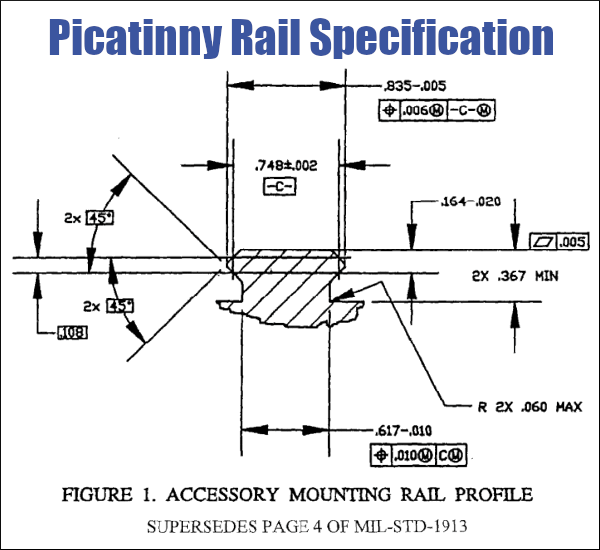
Readers often ask “What’s the difference between a Weaver scope rail and a Picatinny Rail?” The answer is not as simple as it seems. The dimensions of a Picatinny Rail should be consistent (from one rail-maker to another), since there IS a government spec. Conversely, there is some variance in “Weaver-style” rails. The width of the groove is the most important difference between Picatinny Rails and Weaver-type rails. “Mil-spec” Picatinny rails will have a grove width of 0.206″ while Weaver rails typically have a narrower, 0.180″ groove width.
Does your rifle have a Weaver Rail or Picatinny Rail? Check the dimensions to be sure.
Brownell’s has a helpful GunTech™ Article that discusses the Picatinny Rail vs. Weaver Rail. That article explains:
What are the differences between the ‘Picatinny’ and the ‘Weaver’ systems? The profile of the two systems is virtually identical. Depending on the quality of the machining done by the manufacturer, the two systems should be indistinguishable from the profile. The key difference lies in the placement of the recoil grooves and with width of the grooves. MIL-STD-1913 (Picatinny) grooves are .206″ wide and have a center-to-center width of .394”. The placement of these grooves has to be consistent in order for it to be a true Picatinny MIL-STD system. Weaver systems have a .180” width of recoil groove and are not necessarily consistent in a center-to-center measurement from one groove to the next.
In many instances, a Weaver system has a specific application that it is machined for, so interchangeability is not necessarily an issue. A MIL-STD-1913 system must adhere to the specifications listed above in order for it to be considered MIL-STD, since the military desires uniformity in the recoil grooves to allow for different systems to be mounted on the weapon with no concern for compatibility.
Now, what does this mean? Boiled down, it means that accessories designed for a Weaver system will, in most cases, fit on a Picatinny system. The reverse, however, is probably not the case. Due to the larger recoil groove, Picatinny accessories will not fit a Weaver system. There are, of course, exceptions to every rule, but for a good rule-of-thumb, [full-width] Picatinny won’t fit Weaver, but Weaver accessories WILL fit Picatinny.
As a Labor Day Weekend bonus, we thought we’d celebrate the beauty of highly-figured wood with a collection of custom rifles. In our Shooters’ Forum, there is a long-running Gun Glamour thread that showcases many beautiful wood-stocked rifles. Today we feature some very handsome rifles from that Forum Thread as well as other rifles we’ve featured in the Daily Bulletin.
Two F-Open Beauties with Walnut Laminates
Cerus-stocked Special from Cigarcop
Forum member Keith W. (aka “Cigarcop”) of KW Precision LLC is a talented riflesmith whose projects display outstanding finish work and attention to detail. Keith does some of the best bedding work we’ve ever seen. Back in 2018, Keith built a stunning .284 Win F-Class rig for a shooter in Delaware. It’s a beauty, that’s for sure.
Check out the stunning Cerus F-Open stock. This features multiple laminations with highly-figured Walnut on the sides. This certainly ain’t your “off-the-shelf” laminated stock. This just shows the beauty that can be achieved with carefully-chosen lamination layers (plus 12 coats of clear).
This beautiful F-Open rig features a laminated wood stock with stunning figured walnut on the outside.
A Beauty for the Boss (of Grizzly.com)
This F-Class rifle belongs to Shiraz Balolia, Chairman/CEO of Grizzly Industrial. Shiraz finished the stock himself: “I installed the bottom wider track for my rear bag and also carved out the finger grooves in the grip. The blank was quite long so I cut off approximately two inches from the front end of each stock and also deepened the large tracking cavity under the fore-end. I went ahead and inlaid my name in Mother-of-Pearl on the Walnut stock.” The stock was then sent to Sims Guitar Finishing for clear coating with “wet look” finish. This rifle is chambered for the .300 Shiraz wildcat, an improved .300 WSM.
F-0pen Stock made of highly-figured Walnut with Curly Maple inner laminations.
Beautiful Rifles from our Forum Gun Glamour Thread
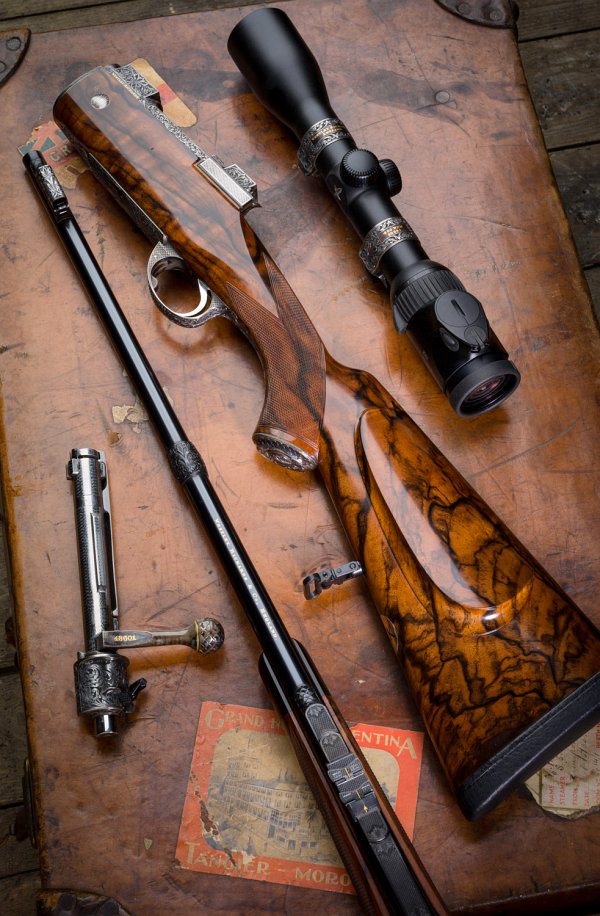
Here are a variety of handsome wood-stocked rifles from our Forum Gun Glamour thread. In that thread, member Kurz posted a dream gun owned by a friend in England. Kurz included a quote from a book created by the rifle’s owner: “There, with my father’s words ringing in my ears, I shall take that ‘step forward’ and order a perfect machine based on the Mauser ’98 action, built from metal and wood by master craftsmen who truly understand that ‘reliable’ and ‘mechanical integrity’ have as much relevance today as they did all those years ago.”
A gun can “shoot dots” and still be handsome. Here is a short-range benchrest rifle with a stunning, exhibition-grade Walnut stock. Forum member Josh B found this beauty.
Forum member JRS submitted a stunner from Europe. This beauty features a truly exquisite piece of wood with elaborately engraved receiver. It also has escutcheons and special metal work on the grip.
Lever-action Falling Block rifles can be beautiful too. This one features a color case-hardened receiver and handsome two-piece fancy wood stock. This was submitted by Forum member Kurz who notes: “Besides exhibition grade walnut, I like the variations available in spalted maple for rifle stocks.”
Here is member Oldduc’s Stevens 44 1/2, .38-55 Black Powder Cartridge Rifle, with an extra .218 Mashburn Bee barrel. Very nice blueing along with the figured wood stocks and fore-arms.
A competition rifle must be “performance first”. But that doesn’t mean they can’t be handsome too. Forum member XTR’s rifle, an F-TR rig, features Maple wood with Bubinga tips.
Here is “something completely different” — a classic lever-activated Martini Martini Cadet chambered in .20 Vartarg (rimmed). Look at the figure on that fore-end. Remarkable!
And wood can work for Benchrest rifles too, when cleverly fashioned in thin carbon-reinforced laminates. Photo from member mdman352.
“Wood is Good” — as demonstrated by all the rifles showcased above. In the photo below, master stock-builder Doan Trevor handcrafts a highly-figured wood stock.
372,000,000 views! Today’s five feature videos have, collectively, been viewed 372 million times on YouTube. Today’s Saturday special features five remarkable animated firearms videos from Matt Rittman, a very talented computer graphic artist. Matt employs multiple software programs to create these incredibly detailed animations. His software tools of the trade include Cinema 4D, Substance Painter, and Corona renderer. Don’t think this is easy. Some of these videos took over 500 man-hours to create. Enjoy!
AR-15 Full Animation — Components and Function
While there are other AR-15 animations on YouTube, we think this is the most accurate and creative, showing the function of a wide variety of components, including the bolt carrier, extractor, trigger, stock buffer, safety system, forward assist, and mag release. It also shows modes of a military M16, showing 3-round burst fire, and full-auto, employing disconnectors and auto sear. If you are planning to assemble/disassemble an AR, this is definitely worth watching start to finish. This video has recorded over 2 million views in just three weeks!
4:00 Auto Fire
4:58 Burst Fire
6:22 Bolt Catch
6:40 Sights
7:33 Adjustable Stock
7:50 Ejection Port Cover
Mauser Kar-98K Bolt Action Rifle video
This elaborate 3D animation shows how a Mauser-type Karabiner 98 Kurz (aka Kar-98K) bolt-action rifle works. Substance Painter was used to create the wood stock texture. Creator Matt Rittman states that this 3.7 minute video took over 500 man-hours to create. You have to admire the dedication involved in that kind of hard work.
This 3D animation video shows the popular Glock 19 (Gen 4) pistol. This modern, polymer-framed, striker-fired pistol has constant trigger pull for all shots. Some folks call this a DAO (double-action-only) trigger but that’s not really correct. Unlike the Model 1911, on a Glock there is no external safety on the frame or slide. The trigger “shoe” (the part that contacts finger) includes a central blade. This prevents the gun from firing unless the trigger is depresses normally. Glock calls this the “safe action”. The creator, Matt Rittman states: “Cinema 4D was used to create each individual part, as well as animating everything. Substance Painter was used to create the main textures. Corona renderer was used to render everything. This animation [with 84.6 million views] took me over 500 hours to create.”
Elements of Video:
0:11 Basic Function
0:39 Case Extraction
0:47 Cartridge Loading
1:02 Trigger Reset
1:28 Trigger Safety
Pump shotguns are essential firearms for hunting and home defense. The clever design of pump-action shotguns make them reliable even when feeding large diameter, blunt-ended 12 gauge shot-shells.
With 226 million views, this AK-47 video might just be the most-watched firearms tech video on YouTube. The video highlights the design features the account for the AK’s legendary reliability. For viewers with an eye to detail Matt adds this clarification: “The firing pin does NOT puncture the bullet primer. It just strikes it against the anvil, initiating the firing sequence.”
Laminated wood stocks offer an excellent combination of price and performance, and they can be obtained in a myriad of styles to suit your discipline — hunting, benchrest, tactical, silhouette, or high power. Laminated stocks can be a little trickier to finish compared to a hardwood such as walnut, as laminates are often delivered in bright or highly contrasting colors. Traditional wood finishes can alter the colors. Also, filling the pores in laminated stocks is an issue.
Automotive clear-coat products have become popular for finishing laminated wood stocks because they won’t alter the stock’s colors, and the clear-coat provides a durable weather-resistant finish. Clear-coat is also easy to “touch up” and it fills pores better than some other alternatives. Mike Ricklefs has written a comprehensive article on stock painting that includes a special section on clear-coating over laminated woods. If you want to clear-coat a stock, Mike’s article is a must-read!
1. When finishing laminated stocks with clear-coat, you need to prepare the wood carefully, and build up quite a few thin layers one at a time. Begin by sanding, with progressively finer paper, all the way to 400 grit. Certain laminated stocks are so rough when they come from the stock-maker, that you may have to be very aggressive at first. But be careful with angles and the edges of flats. You don’t want to round these off as you sand.
2. After sanding, use compressed air to blow out all dust from the pores of the wood. This is very important to avoid a “muddy” looking finish. If you don’t blow the dust out with air before spraying the clear it will migrate out as you apply the clear. Also, after each sanding session, clean your painting area to remove excess dust. I also wet down the floor of my spray booth to keep the dust down.
3. Some painters recommended using a filler to close the pores. That’s one technique, but the filler can detract from the clarity of the final finish. Rather than use a pore-filling sealer, I use a high solids or “build” clear for the initial applications. This is slightly thicker than “finish” clear and does a good job of sealing the pores. Three (3) fairly heavy coats of “build” clear are applied. If you get a thick spot or a run in the finish at this point, it is not the end of the world but this does create more sanding work.”
There is a helpful thread in our Shooters’ Forum that discusses the use of clear-coating on laminated stocks. Member BHoges offered this advice: “Stick with Diamont, Glassurit, and Spies. If anyone has questions, I painted cars for a long time.”
Forum member Preacher, whose bolt-action pistol is shown at right, states: “I buy my two-part clear-coat from the local NAPA dealer. They recommended Crossfire mixed 4:1. I really like the end results. There are six coats on that stock that were sanded down to bare wood for the first two, and then 600 wet-sanded for the other four coats. Two to three coats would be sufficient if the pores were filled first, but I would rather fill ‘em with the clear as it seems to make it appear deeper and I have the time to devote to it. I have PPG’s Deltron DC 3000 clear-coat on a few stocks of mine, but I like the NAPA better price wise, and it seems to hold up just as good as the Deltron.”
We know some guys who make their own stocks, and others who do their own chambering. But consider this, Robert Carnell of Australia built his own state-of-the-art, water-cooled, tension-barrel Rail Gun, even including the action. That’s right, Robert designed and crafted his own precision action. This has got to be the ultimate home gunsmithing, do-it-yourself (DIY) project.
Carnell is an accomplished benchrest shooter and past Australian Sporter Class Champion. In 1993 he won a Silver Medal at the World Championships. But Carnell is far more than an ace trigger-puller. Robert is a skilled and creative “home gunsmith” who has crafted his own custom action and built his own railguns from scratch. Robert also runs the Austrialian Benchrest Bulletin website.
Home-Built Rail Gun — Aussie Innovation
Below are photos of one of Rob Carnell’s most amazing builds. This liquid-cooled, tension-barrel rail gun is a great example of self-reliant Aussie engineering. The barrel runs inside a coolent-filled, large-diameter sleeve, much like an old water-cooled machine gun. This is the fourth rail gun that Rob built, and the second fitted with a tensioned barrel.
Robert explains: “My railgun design has a 1.75″ barrel under tension inside an aluminium tube filled with radiator coolant. There is nearly a gallon of coolant, and the barrel stays cool no matter how many shots I seem to fire, or how quickly they are shot. The brass nut on the front rides on a nylon bearing and can be tightened to get the best accuracy. I am a believer in the ‘tuner’ idea and this seems to work for me. The main tube is thick-walled aluminium 600mm (24″) long. There is a flange at both ends. The flange at the back fits onto the barrel before the action is screwed on. The front flange is a press-fit into the tube, then there is a brass nut that fits over the barrel and screws against a nylon washer on the front flange. The Railgun’s base is aluminium and has the standard adjustments — windage, elevation and a sighter cam. In addition, there is a 1/10 thou dial indicator for windage. This allows me to zero the indicator and shoot my group. If I need to add a bit of windage for a condition, I can quickly get back to the original position if my condition comes back.”
Home-Built Action Uses Rem Bolt
Rob’s rail gun uses his own home-made stainless action, which features Panda-spec threads and a modified Remington 700 aftermarket bolt. Not bad for a do-it-yourself project we’d say! CLICK HERE to read how Rob designed and built the action.
Kestros ZR Stock — Impressive Design for Competition
Review by F-Class John
Walk the line at just about any rifle competition and you’ll see your share of McMillan stocks. Known for crafting high-quality fiberglass/composite stocks, McMillan has long been at top choice for competitive shooters, hunters, and tactical marksmen. Now McMillan is out to dominate F-Open with the Kestros ZR stock. The Kestros line features several models, but the ZR represents the pinnacle of craftmanship. Each one is finished off by a single craftsman and takes roughly four times longer to create than any other Kestros. So when McMillan offered me a chance to test one out, I jumped at the opportunity.
The aluminum Z-Rail extends nicely from the front of the stock and has a nice contrast of metal against the matte finish of the stock. I inspected the rails and noticed that they are very cleanly machined — all the corners and rails were precise and sharp. As a result, I grabbed some 1000-grit sandpaper and just lightly knocked the edges and corners down just to keep from accidentally scratching myself or my gear.
Lead time for a ZR is currently 6-9 months. I was like a kid on Christmas when mine arrived after seven months. Holding a Kestros ZR is definitely a unique experience compared to a traditional wood stock and you can’t help but feel like you’re holding something special. I chose three shades of blue that transitioned dark from the butt stock to lighter on the fore-end in a spectacular flame pattern. With McMillan, there are thousands of possible color and pattern combinations. These color/pattern options are outlined on McMillan’s Gallery Page.
The Kestros ZR comes fully inletted with pillars. I was able to bolt my Defiance action right into the stock “as is” without a bedding job. (McMillan states bedding is not required, though this is certainly something most Kestros owners will do). I threw in my action, fit a couple action screws and tightened it all down. I was amazed at how nicely it all fit together with even the little details like the port cutout being perfectly smooth with my action port. I loaded up some .284 Win rounds and headed to the range to test the new stock at 100 yards.
Here are examples of targets shot with the Kestros ZR at 100 yards.
During initial range testing (see above) I shot nine groups for vertical and all of them were under 0.40″ with the smallest being .08″ of vertical. I topped off the testing by shooting a 200-11X the next week at my club match. The thing that really stood out was how smoothly the stock tracked with its lower center of gravity while shooting free recoil and ultimately this translated to success on target.
Low-Rider — You may find that because of how low the Kestros rides as well as its additional length due to the Z rail, you may require an extension for your front rest.
CONCLUSION — Great Modern Low-Profile F-Class Stock
Overall the Kestros ZR exceeded my expectations. After a small learning curve, it was a joy to shoot and it performed great. As someone who believes in the power of muscle memory, I found each time I transitioned between the Kestros and my traditional wood stocks there was a slight adjustment period but not enough to impair accuracy in any way. Something to consider is that because every Kestros is made to the same dimensions, it makes owning multiples an easy process of switching between guns without any need for readjustment.
For those willing to put in the practice, your patience will be rewarded, and I think most shooters will find the Kestros ZR could become their new favorite stock. If you’re in the market for a new F-Open stock, the Kestros ZR is definitely one to consider.
McMillan Kestros — Proven National Championship Winning Stock
Norm Harrold (above) won the 2018 USA F-Open National Championship shooting a .284 Shehane. Norm’s F-Open rig features a McMillan Kestros ZR stock and Bartlein barrel chambered for the .284 Shehane, which has a bit more case capacity than a standard .284 Winchester. Norm loaded Berger 184gr 7mm bullets in Lapua brass. Norm revealed his load in an Erik Cortina YouTube Video.
Tips for Ordering a Kestros ZR
Ordering the Kestros ZR is a simple process thanks to McMillan’s online order form. While there are a number of options available, McMillan has a helpful guide that walks you through each one to ensure you get exactly what you need. F-Class John notes: “While filling out my form I realized that because I have a custom-designed action, I needed some help, so I gave McMillan a call. The staffers were incredibly helpful and their knowledge of all the major actions out there made answering my questions a snap. I liked the fact that there is no set, fixed price on any of the stocks. The pricing system allows customers to get just what they want (within limits) and not have to pay for anything they do not want or need.”
If you have ever competed in NRA High Power, Silhouette, or Long Range disciplines, you know the name David Tubb. Arguably the greatest rifle marksman in American history, David has recorded 11 High Power Rifle Championships, 6 Long Range National Championships, and 7 High Power Silhouette National Championships. Over his career David has won 130 NRA trophies for various competitions. No one has even come close to that number of Championships and honors in rifle competition.
David Tubb Biography Video
Click the video above to view a great new documentary which covers David Tubb’s career in competitive shooting. Called America’s Rifleman, this fine documentary by filmmaker Sheldon Charron takes you inside the life and mind of legendary shooting champion David Tubb.
Learn how David evolved into the most successful rifleman in the history of competitive shooting, the challenges he faced, and how he overcame them on his road to success, both at the range and in his business, Superior Shooting Systems.
David Tubb Competition Shooting Accomplishments:
11 Time – NRA National High Power Rifle Champion – Camp Perry
6 Time – NRA Long Range Rifle (600-1000 yard) National Champion
7 Time (Consecutive) – NRA National High Power Rifle Silhouette Champion
6 Time – NRA National High Power Hunting Rifle Silhouette Champion
4 Time – NRA National Smallbore Hunting Rifle Silhouette
7 Sportsmen’s Team Challenge Championships
2 Time – Wimbledon Cup Winner
2019 ELR World Record Holder recognized by 50 Cal. Shooters Association
2019 NRA ELR Heavy Gun Winner
Over 130 NRA Championship Event Trophies (Individual Match Winner)
David Tubb with the ELR Adaptive Target Rifle (ATR) he designed which has set ELR records. You can see David shoot this rig in the video below:
David Tubb Shoots ELR Adaptive Target Rifle at KO2M
For the Extreme Long Range discipline, David Tubb developed a .375-caliber, long-barreled ELR version of his famous Tubb rifle, called the Adaptive Target Rifle (ATR). A version of this rifle, piloted by David’s son-in-law Nate Stallter, set the current ELR World Record in January 2018.
The TUBB 2000 — Innovative Modular Bolt Gun
David Tubb is arguably the greatest High-Power Across-the-Course rifle competitor in American history. He won many of his championships shooting a modular rifle of his own design — the Tubb 2000, aka T2K. In this video, David shows the features of the Tubb 2000 rifle which makes it adaptable to multiple shooting positions — prone, sitting/kneeling, and standing.
David Tubb Talks about KO2M and Extreme Long Range Shooting
David Tubb’s long-range rifles have performed well in Extreme Long Range shooting. AT the 2019 NRA Extreme Long Range Championship, David Tubb won the Heavy Gun Division. In this video, created during the King of 2 Miles (K02M) competition at the Whittington Center in New Mexico, David talks about the challenges of ELR shooting, and cartridge selection. Big, heavy, large-caliber bullets with ultra-high BCs are favored for the ELR game, but recoil and cost must also be considered.
David Tubb’s Approach to Load Development
In this 27-minute video, David talks about case prep and loading with both regular and progressive presses. David shares his methods. He recommends weighing your brass and segregating them in one grain increments. He then does an initial test with powder charge weights in half-grain increments (for smaller BR cases we recommend 0.3 grain increments). He then also experiments with seating depths.
“America’s Rifleman” Movie Credits:
Production Company: Enter360 Media
Producer/Director/Editor: Sheldon Charron
Production Assistant: Christie Tubb
The 6mm Creedmoor has become one of the most popular cartridges for PRS/NRL competition, and it also works great in the varmint fields. There are many 6mm Creedmoor factory rifle options now, such as the Savage Model 10 in GRS stock and the Ruger Precision Rifle (6mm Creedmoor).
Do-It-Yourself 6mm Creedmoor Rifle Project — UltimateReloader.com
Another cost-effective option for 6mm Creedmoor fans is to build your own rifle, starting with a Howa barreled action. The Howa 1500 is a mag-fed, flat-bottomed bolt action that ships with the excellent HACT 2-stage trigger. Howa barreled actions have been available with a variety of barrel lengths and contours, starting at about $440.00 at Brownells. (However, many are currently out-of-stock).
There are quite a few good stocks/chassis systems now offered for Howa 1500 actions, including the excellent KRG Bravo Chassis, which features an ergonomic composite outer shell over a precision-machined inner chassis.
Gavin Gear fitted a KRG enclosed fore-end and Mystic Precision MPOD to his 6mm Creedmoor rifle.
Our friend Gavin Gear of UltimateReloader.com has built a nice 6mm Creedmoor rifle using a Howa 1500 heavy-barreled action and KRG Bravo Chassis. This project has proven very successful. The rifle has shown impressive accuracy and outstanding reliability. Gavin hopes to use this rifle in practical/tactical competitions later this year.
In this video, Gavin fits KRG’s enclosed fore-end to the KRG Bravo chassis. This accessory fore-end features a top Picatinny rail and various attachment options on the sides and lower section. Here you can see the enclosed fore-end (upper right) next to the factory forend included with the KRG Bravo (lower left):
Gavin then fits a Mystic Precision MPod from EGW. This stable, wide-base bipod uses a T-Slot rail for rifle attachment, and has legs that adjust independently for height. The video shows the rifle coming together step-by-step. This is something the average guy can do with simple tools — no gunsmithing is required, because the Howa barreled action is pre-chambered for the 6mm Creedmoor cartridge.
In the video above Gavin unboxes his Howa 1500 barreled action from Brownells. He then mounts the barreled action to the KRG Bravo stock, checking the torque levels. Next Gavin borescopes the hammer-forged barrel (5:55) noting: “What I saw I liked — there are practically no tooling marks. The finish on the lands and grooves looks really good”. Lastly, Gavin tested the trigger with his TriggerScan TS-11 (6:24), confirming a two-stage pull weight of about 2.25 pounds out of the box.
Rimfire Benchrest can be fun and rewarding. It can also be frustrating because sourcing superior lots of ammo is a never-ending challenge. Still we like rimfire benchrest because you don’t need to load at the range. Plus rimfire barrels last a very long time (our friend Joe Friedrich set an ARA Benchrest record with a 100,000+ round-count barrel). Here’s a great video from the National Rimfire Benchrest Association of Ireland (NRBAI). Production quality is excellent! We highly recommend you watch this video, which does a great job illustrating both the fun and challenge of rimfire benchrest competition.
If you’ve never seen 50m Rimfire Benchrest competition, this video is well worth watching:
“If you need to get your mind away from everything… then look down a scope, concentrate, and be disciplined.”
“Comradery is one of our organization’s key traits… there are no barriers of gender, age or mobility. Just a very diverse, bunch of good people enjoying a sport together.”
“The skill, in brief, is having the ability to hit the equivalent of the top of a pinhead at 50 meters, in all conditions with a .22 round. Not easy, especially when you have to do it 50 times to get a maximum score of 500 [points], 250 per sheet.”
Back in the USA — The New National 50 Benchrest League
If this article has motivated you to try rimfire benchrest competition back here in the good ol’ USA, there is a new organization that can help. Launched just a couple seasons ago, the National 50 Benchrest League has easy-to-understand rules, and offers competition with a wide variety of rifles, even including air rifles. The whole idea was to make competition more affordable and get more shooters on the firing line. There are three classes — Pellet, Sportsman, and PRO. One can be very competitive in the Sportsman Class with a basic factory .22 LR rig or Air Rifle.
N50 competition is unique in allowing air rifle shooters to compete side-by-side with rimfire shooters. This allows folks to compete without the cost of expensive “top-dollar” rimfire ammo. Pellets are relatively inexpensive, and yes air is still free!
About N50 — The National 50 Benchrest League
Commentary by Joe Friedrich, Open Grove Benchrest
The new National 50 Benchrest League (N50) is a unique shooting experience. We shoot air rifles with pellets and slugs alongside .22 LR Rimfire shooters. We currently have sanctioned clubs throughout the USA offering competition and good fellowship.
N50 has three Classes: Pellet, Sportsman, and PRO. The first Pellet Class is strictly for pellet airguns ranging in calibers from .177-.30 using Diabolo-style pellets from various manufacturers.
The second class is the Sportsman Slug/Rimfire. This combined class allows any factory air rifle shooting commercially-made slugs in calibers from .177-.30 to compete against any factory rimfire that utilizes a factory-barreled action with no attachments to barrel. Pellet air rifles may also compete in this class.
The third class is the PRO Class, and no you do not have to have some magic card that says “Professional” to compete. This class allows purpose-built air rifles, and what we call “unlimited” rimfire rifles to compete. Three types of loads are allowed in PRO Class: .177 slug air-driven, .22 slug air-driven, and any .22 LR ammunition.
Another point — in N50, competitors are allowed to move up in class — you aren’t restricted to a “lower” division. For example, Pellet Class shooters can also move up to shoot in Sportsman and Pro. In addition, Factory rimfires are allowed in Pro Class. This way shooters with the less-expensive rifles can shoot more relays and also see how they compete with the unlimited rigs. It’s all about having fun.
We wanted to make N50 as simple as we could combining air rifles with rimfire so folks who have a factory rimfire can participate and have fun. We also did not want a lot of classes, so combining the two gun types would be simpler. To be honest we were worried that the rimfires will outpace the air rifles, but that was not the case at this year’s Nationals.
Air Rifle on beautifully crafted, plated Pappas Rest.
National 50 Benchrest League Rules and Course of Fire
The official N50 website, National50.net, lists N50 rules, classes, courses of fire, and membership requirements. There are currently 16 affiliated clubs nationwide, with more coming soon.
And the 2022 N50 National Championship is coming up soon. The event, for rimfire rifles and air rifles, will be held August 26-28, 2022 at the Whittington Center in Raton, New Mexico
General Rules — Here are some of the more notable N50 General Rules that apply to N50 matches:
Target Distance: 50 yards
Match Times: 20 minutes per target
Targets: Official targets produced and distributed by N50
Aggregate Score: Cumulative score of 3 targets shot in sequence on same day
Scoring: No competitor shall score their own target
As far as hardware, N50 is pretty open. For all 3 classes, any scope is allowed and any trigger is allowed. For all 3 classes, stocks are unrestricted, stocks may be bedded, and rifle weight is unlimited. However, the Sportsman Class must retain factory barrel and action. N50 competitors in all classes may use 1-piece rests, 2-piece rests, bags, or bipods — whatever they prefer.
CLICK HERE for a free, printable version of the N50 practice target shown above. After clicking, SCROLL DOWN the page and you will see the left and right target sections that will print on 8.5×11″ paper. You can also purchase the Official N50 11″ x 17″ printed Match Targets for $25 per 100 plus shipping.
Credit Boyd Allen for finding this NRBAI Benchrest Video


 25th Anniv. Edition .22 Rimfire







 Forum member Preacher, whose bolt-action pistol is shown at right, states: “I buy my two-part clear-coat from the local NAPA dealer. They recommended Crossfire mixed 4:1. I really like the end results. There are six coats on that stock that were sanded down to bare wood for the first two, and then 600 wet-sanded for the other four coats. Two to three coats would be sufficient if the pores were filled first, but I would rather fill ‘em with the clear as it seems to make it appear deeper and I have the time to devote to it. I have PPG’s Deltron DC 3000 clear-coat on a few stocks of mine, but I like the NAPA better price wise, and it seems to hold up just as good as the Deltron.”


 David Tubb Biography Video




 If this article has motivated you to try rimfire benchrest competition back here in the good ol’ USA, there is a new organization that can help. Launched just a couple seasons ago, the


