What’s better than a super-accurate 6BR rifle? Well, two super-accurate 6BRs. This week we feature a pair of tack-drivers owned Forum member Mark Schronce. These “Brothers in Arms” share similar stocks, but otherwise the components are different. Mark’s 17-lb gray laminate Light Gun features a Hall action, HV taper barrel, and muzzle brake. The 21-lb Heavy Gun, in “Desert Camo” laminate, boasts a trick dual-port BAT action, and full-contour 30″ barrel without brake. Both guns shoot tiny groups, track like they’re on rails, and give Mark a serious hardware advantage in club competition.
Mark provides this report: “The Light Gun started as my 22-250 AI varmint gun, with a Hall action and McMillan Hunter Benchrest stock. I wanted to build a proper Egg Shoot gun, so I had Richard Franklin (Richard’s Custom Rifles) chamber a Lilja 12-twist in 6mm BR Norma, with a .262″ neck. Using Fowler 80gr FB bullets, the gun shot great right out of the gate. (See my report, Egg Shoots and 600-yard 6 BR). I was curious about the heavier 6mm bullets, so I had Richard chamber and fit a 1:8″ Krieger in 6BR. But this time we went with a .271″ no-turn neck. The Krieger holds quarter-MOA with the heavy bullets, and, to my surprise, it shot the 80s as well as the 12-twist Lilja did. For the 2005 season, I ordered one of Richard’s latest 008 F-Class stocks. This new design is very comfortable to shoot and it’s much more stable in the bags than my old Hunter stock. That added stability will be a big plus for 600- and 1000-yard benchrest matches.
A Heavy Gun for 1000-yard BR and “Belly Benchrest” (F-Class)
I’ve been active in 1000-yard Benchrest for a few years, shooting my 6mm BS and 6mm BR Light gun in both Light and Heavy classes. I wanted to build a rifle for the Heavy Gun Class yet stay within the 22-lb F-Class limit. And I wanted it to have the best hardware I could buy. On a BAT ‘MB’ action (with Jewell trigger) we fitted a 30″ 8-twist 3-groove Lilja, 1.250″ diameter, no muzzle brake. Richard cut the chamber for 6mm BR Lapua Brass, .271″ no-turn neck, throated for Sierra 107gr MKs, matching my current Light Gun. The stock is a pillar-bedded Richard’s 008 1000-yd/F-Class model, with 10 coats of auto clearcoat, all work by Richard. Burris Zee rings hold a Leupold 8.5-25×50 LRT mounted on a BAT one-piece Weaver base. The Heavy Gun weighs in at 21 lbs, much lighter than most Heavy Guns (50 to 100 lbs). But with the 6BR’s light recoil, it’ll do just fine for long range, yet still make weight for F-Class.
Why a 6mm BR Chambering in a Heavy Gun?
I toyed with the idea of going with a 6BR Improved for Heavy Gun, but I’m not convinced the Improveds are worth the extra hassle of fire-forming, not to mention the added cost of custom dies. By way of background, I used to have a Rem-actioned rifle chambered in 6BR BS (Bill Shehane), which is very similar to the 6BR Dasher. I found the 6BR BS was only about 100 fps faster than a standard 6BR. For the shooting I do, that extra 100 fps is not critical. If, in the future, I feel I need more speed, I will go to a .243 AI or a 6.5-284. To be honest, I love the 6BR cartridge. Barrels last forever, and the accuracy can’t be beat. Yes a 6BR is a little light for everyday 1000-yard shooting, but on good days it can set world records. I may move up to a 6.5-284 some day, but for now I will stay with the standard 6mm BR. If I ever do want to go to a bigger caliber, the 8.5-inch BAT Machine MB action gives me this option.
Hall vs. BAT Light vs. Heavy
Comparing the two actions’ bolt lift, lock-up, fit, and finish, I feel they are equally good. However, the BAT can run stout loads with Federal 205 primers — loads that cratered Fed 205s with the Hall. I don’t know if this is a function of the actions’ engineering, or the barrels. I’ve got a Lilja on the BAT, while the Hall wears a Krieger. I do know the BAT has a tight-fitting firing pin, and that might make a difference.
Both my actions have a built-in recoil lug — a really nice feature when you are changing barrels, and one of the main reasons I favor custom actions over a Remington. I think anyone would be pleased with either the BAT or the Hall.
There is a big difference in shooting a Light Gun vs. a Heavy Gun, as you might expect. The Heavy Gun is more stable and recoils straight back. However, even at 21 pounds, the Heavy Gun actually recoils harder into your shoulder than the muzzle brake-equipped Light Gun. But if you take the Light Gun’s brake off, and put the action back in the old Hunter bench stock, the gun would jump, torque and roll. It’s much better with the 008 stock now, but still not as rock solid as the Heavy Gun. On recoil the 21-pounder just tracks straight back, no jumping, no yaw, no rolling–very impressive.
Load Development and Accuracy Results
Developed last year, my favorite Light Gun load is 30.5 grains Varget, CCI BR4 primers, and 106gr Clinch River VLDs, running 2825 fps. The Light Gun shoots other bullets very well, but the Clinch Rivers performed best, with groups in the 0.1s to the low 0.2s at 100 yds. I use Lapua brass of course.
I began my load development for the Heavy Gun with components I had from last year: Varget, N140, and N540 powders, plus Fed 205, CCI BR4, and CCI 450 primers. I also had a good selection of bullets: 95gr and 105gr Bergers, 105gr Lapua Scenars, 106gr Clinch Rivers, and 107gr Sierra MKs.
The Heavy Gun liked the Bergers right from the start. During break-in and fire-forming (with 95gr Bergers 0.20” into the lands, 30.0gr Varget and CCI 450s), the rifle shot in the low 0.2s at 100 yds, 0.3s at 200 yds, with a 0.182″ small group at 200 yards (see photo). I then moved up to the heavier bullets and again the Bergers stole the show. Best load for the Berger 105s (seated 0.15″ into the lands) was 30.5 grains Varget and Fed 205s at 2850 fps. At 100 yards, this recipe shot in the 0.1s to the low 0.2s with a small group of 0.089″. (By the way, this same load in my Hall Light Gun would crater the Fed 205 primers. I may have to change to CCI BR4 primers for the hot summer days.) After working with the 105s I wanted to see how the Heavy Gun performed with lighter bullets. I tried my favorite Egg Shoot and 600-yard load–80gr Fowlers pushed by 31.5 grains of Vihtavuori N135 with Fed 205 primers. The results were fantastic. The big BAT produced a 100-yard aggregate (five, 5-shot groups) in the 0.2s with an 0.129″ small group. Overall, at 200 yards, both guns could agg five 5-shot groups in the 0.3s and 0.4s. Eggs Beware!
Big, Strong, and Versatile ‘MB’ Action by BAT Machine
I looked at all the custom actions, and decided on a BAT model ‘MB’, configured Right Bolt, Left Port, Right Eject. The ‘MB’ action has some pretty unique features, including an integral recoil lug on the underside, and a recessed tenon (i.e. the threads start 1″ from the front of the receiver). The action is 8.5″ long, but with a 7.5″ bolt. The extra inch is added to the front. That provides extra bedding surface and room for a third pillar. The 8.5″ action length gives me the option to go up to a 6.5-284, while the dual ports should help give me the speed I need for the 10-round strings in Heavy Class. Also I can load from either side for F-Class.
Why did I choose a BAT? First, BAT quality is second to none. Moreover, BAT will custom-configure your port(s) and bolt for the same price, no added fees. Other action-makers charge extra for anything other than your basic Right Bolt, Right Port. This makes the BAT about the same price as a Stolle or Nesika, if you want a set-up like mine. The right-side ejection port is slightly smaller than the left feed port, but I can still feed 6BR cases from either side if I wish. The MB action is so big, the little BR case runs out of ejector as soon as the case leaves the chamber, so I push the case out to the right as I load the next round from the left. The BAT will eject a loaded 6BR round just fine, but a fired case only ejects sometimes. This action would work great with a longer round, such as a .243 AI or 6.5-284. If you want completely reliable 6BR ejection, you’ll need a smaller BAT action. But then, like my Hall standard action, the port would be too small for a 6.5-284.
Richard’s #008 Stock — How it Handles
The 008 stock is the best design I’ve ever shot off the bench. I like to hold my guns, and the 008’s grip profile gives me the control I like. The trigger is close enough for my short fingers. The underside of the buttstock is flat and completely straight (parallel to the barrel), so the gun tracks straight back. During recoil, the scope stays on target, making for quicker recovery time. In the picture at left, you can see that the underside of the fore-arm is relieved in the middle with raised strips on the left and right. These “rails” make for less surface area contacting the bags, less friction, and more consistent recoil. The high comb on the stock allows better prone shooting. For now, the stock is fine for what prone shooting I do. But if I do get seriously into into F-class I may want to add an adjustable comb or cheekpad. We’ll see.
Plans for Competition — The Lure of Hickory Groundhog Shoot Dollars
Some years ago, after building this pair of accurate 6mmBR rifles, Mark Schronce told us: “I can’t wait to see how this pair perform at long range. I will also take the Light Gun to the big Hickory GroundHog match in April, but I may put the barreled action back in the Hunter stock. This year you have to use bipods or sand bags, no front rest. [Editor: that is no longer the rule.] I don’t know if want to drill into my pretty new 008 stock for a bipod mount. I’ll let you know how it goes, and hopefully I’ll come back with some loot from the Shoot.” NOTE — that year Hickory offered about $8000 worth of prizes.
Today’s Sunday GunDay Story is a unique and beautiful F-Class rifle from France. This handsome rifle was first featured in our Gun of the Week Archives. This rifle was a gift from husband to wife. Because this is such a unique rifle, with a great back-story, we are reprising this “French Connection” rifle once again.
Europe has a number of capable custom arms makers, and in this article we feature one of them, Christian Salva of Toulouse, France. Here we spotlight an ultra-accurate and handsome 6-6.5×47 Lapua F-Class rifle. Built for a lady, the rifle exhibits flawless craftmanship to match its superior performance.
Alie Gets Her Gun — Thanks to Husband Aurélien
Photos and text by LONASSAC, translation by T.J.E., NRA UK
Aliénore, a charming young French lady, shares her passion for short- and long-range shooting with her husband, Aurélien. Aurélien already owns a 6mmBR PGM Ultima Ratio rifle and decided to have a rifle built for his wife so that they could shoot together. They therefore turned for help to the Christian Salva workshop, located in Toulouse in the south of France, close to their home.
SALVA Walnut Stock–Gorgeous Wood, and Great Ergonomics
Aliénore chose a superb, perfectly-grained French walnut blank for the stock. The stock is a single, solid piece of walnut, with a waxed finish to show off its fine figuring. The stock design is optimized for F-Class, prone and Bench Rest shooting. The fore-end is flat and 3.35″ (85mm) wide, slightly wider than the common 3″ used on most benchrest rifles. On the underside of the forearm is a rail to take a Parker-Hall or a Versa Pod-type bipod. The trigger guard is a custom, light alloy SALVA design. The butt plate is Anschütz-type. It adjusts vertically and can be rotated on its horizontal axis. The cheek piece is adjustable for height only — all that is needed.
Aliénore selected the F-Class Target Rifle from Christian Salva’s range of rifles, which is the one best suited to the type of shooting she wanted to do. Their club’s rifle range, near their home, goes out to 600 meters (See photos above). Unfortunately, as is usual in France, the range does not have a target pit. Members shoot prone using front benchrest-style rests, as in F-Class. The problem is that, without a proper target trench, it’s not possible have individual shots spotted and marked (as would be done in American High Power matches). However, with a good scope, in good light, shot-holes can be seen at 400m, and sometimes even at 600m — but this is rare.
When this rifle was crafted, Christian Salva was one of the few gunsmiths in France who manufactures complete rifles from front sight to butt-plate. With the sole exception of the barrel, he constructs the whole rifle, including action, bolt, trigger and stock. He also does all the bedding and chambering himself. Everything is done to his customer’s specification which, of course, can only be achieved in a small and highly specialized business.
General Rifle Specifications
The rifle was built on a SALVA hexagonal long range action with a flat base, which is set in a highly-figured French walnut stock using a bedding block. The gun is 49″ (125 cm) overall, and weighs 9 kg (about 20 lbs.), including scope. The barrel is 29″ (74cm) long, and a straight 1.22″ (31mm) in diameter. Given the weight and size of the barrel, the decision was made to secure the barreled action into the stock with a bedding block. On top of the action is an angled Picatinny rail with 20-MOA built-in to allow long-range shooting without using up the scope’s internal elevation. The rifle is currently fitted with a Nightforce 12-42x56mm BR scope held in alloy rings.
Details of SALVA Action
The rifle features a light Dural alloy right bolt, right port, single-shot action treated and coated with a champagne-color surface hardener. The action is hexagonal in shape (normal for a French action), with a flat base for improved bedding. On this particular gun, however, the action is floated, with the barreled action secured by the long barrel block. Take a good look at the photo below. Yes, the action on is fully-floated — the barrel block secures the barreled action into the wood stock. This is similar to some Benchreast heavy guns.
Christian Salva produces his actions from scratch, employing high-tech machinery, including CNC multi-axis mills. The advanced design allows the action to be very strong as well as light. The SALVA action is very thick and sturdy, in spite of its weight being reduced to a minimum. It can chamber cartridges from the 6mmBR size up to magnum calibers such as the 300 Win Mag. A treated steel insert is screwed into the front of the action. This is threaded to receive the barrel and machined to receive the locking lugs of the bolt. The threaded section is especially long (36mm with a 1.5mm thread) so as to ensure proper rigidity for the unit. Where the bolt lever closes, a steel insert, screwed into place with a BTR screw, prevents the steel bolt lever from wearing the softer Dural alloy of the action.
Tri-Lug Bolt with Extractor and Ejector in Lugs
The cylindrical all-steel bolt has a diameter of 0.906″ (23mm) and three (3) front locking lugs. The bolt design has BOTH extractor and ejector placed in locking lugs. Salva’s goal, in engineering the position and operation of both extractor and ejector, was to reduce side pressure on the cartridge. The extractor is designed to hold a cartridge case in place with minimal lateral displacement. The ejector is also built into one of the three lugs. [Editor’s Note: Many modern benchrest actions, such as the Stolle Panda, Stiller Viper, and some BATs employ an extractor in the lug. This is also a feature on Savage bolts and push-feed Model 70 Winchesters. However, these bolts do not have the ejector in a lug as well.]
Remarkably, the ejector has no spring, unlike most bolt designs. It should be noted that this springless ejector is designed to eliminate side pressure when chambering a round, thus keeping the round concentric in the chamber. The ejector is mechanical and will eject the case if the shooter pulls the bolt all the way back. If the shooter prefers to extract the case by hand, one simply pulls the bolt part way back. The 1.5″ (38mm) bolt lever is fairly short, but it has an oversize 30mm polymer knob to facilitate the opening and closing of the bolt.
French Gun, German Barrel — a 29″ Lothar Walther
On Aliénore’s rifle, the barrel is the only component not manufactured by SALVA in Toulouse. For the barrel, Christian Salva chose a stainless Lothar Walther, 6-groove barrel, with a 1:8″-twist for handling 105gr bullets. The muzzle is milled with an 11º slope so as to handle boat-tail VLD bullets. This German-made Walther tube has a 1.22″ (31mm) straight contour and is 29″ (74mm) in length. This long, non-tapered barrel is heavy enough that Salva decided to mount it with an alloy bedding block, about 8″ long (20 cm). Ten Allen-head screws clamp the block to the barrel, while the lower section of the bedding block is secured to the wood stock with eight screws and bedding compound.
Proprietary SALVA Trigger
The trigger is also manufactured by SALVA in its entirety, from Christian’s own design. Overall trigger pull weight adjusts from 50-250 grams (1.8 oz. – 8.8 oz.). The SALVA trigger can also adjust for: Longitudinal trigger position (Length of Pull); Over-travel; Main travel; Second-stage pressure; and Sear engagement.
Cartridge and Load Info
The rifle is chambered in 6-6.5×47 Lapua. Aurélien starts with Lapua 6.5×47 cases. These are then necked-down to 6mm and neck-sized with a .265″ bushing. The necks are turned very slightly, to ensure neckwall uniformity, and achieve a consistent grip on the bullet. Aurélien loads Berger 105gr VLD bullets, pushed by Vihtavuori N160 powder and small magnum primers. His preferred load is 38.2 grains of N160 with a cartridge overall length (COAL) of 2.732″ (69.40 mm). With this load, muzzle velocity is 2854 fps (870 meters per second) chronographed one meter from the muzzle. [Editor’s note–this is a very mild load. The 6-6.5×47 can drive 105-grainers over 3100 fps.]
How the Rifle Shoots
Smooth Function + Great Accuracy
When firing using a front rest, the recoil of a 9 kg, 6-6.5×47 Lapua rifle is minimal and ideal for a lady. The operation of the rifle is trouble-free, even if a few rounds were initially a bit stiff on loading for the first time. Thereafter everything sorted itself out very nicely. The action of the bolt is solid and one can feel that everything is very snug and that the tolerances are properly tight.
The versatile trigger rivals the best benchrest triggers, with the additional bonus of a single- or two-stage operation. That said, with a minimum pull-weight of 50 grams (1.8 oz.) perhaps the term “two-stage” is not the best description, since it is difficult to detect a let-off point at that weight. The trigger can be set to be a very light, single-stage let-off.
The rifle is fitted with a Nightforce 12-42x56mm BR model scope. This high-magnification optic enables the shooter to see his/her bullet holes at 400 meters in good light. This is very useful when it comes to adjusting for wind. The stock’s adjustability and ergonomics allow the shooter to feel comfortable using this rifle. The Anschütz butt-plate and easily-adjustable height of the cheek piece help in that regard.
This rifle has demonstrated some impressive accuracy. Below is a group shot by Aurélien at 400 meters (437.4 yards) on C200 targets. Using OnTarget group measuring software, we calculated this 5-shot group at 0.555″ or 0.121 MOA. That’s remarkable for a gun shooting long, VLD-style bullets. At 100 meters the rifle has yielded “one-ragged hole” groups.
The National Shooting Sports Foundation (NSSF) is challenging California’s firearm industry liability law, AB 1594, passed in 2022 and signed into law by Gov. Gavin Newsom. The law, which goes into effect on July 23, 2023, encourages civil suits against the firearm industry for the illegal actions of criminals with guns. This law is an affront to the U.S. Constitution and is an attempt to circumvent the will of the U.S. Congress when it passed the Protection of Lawful Commerce in Arms Act (PLCAA).
The litigation, NSSF v. Bonta, was filed in the U.S. District Court for the Southern District of California. The NSSF now seeks a preliminary injunction to halt enforcement of the unconstitutional law as challenges to AB 1594 progress through the courts.
“California’s General Assembly and Governor Newsom made a spectacle of defying the U.S. Supreme Court’s Bruen decision when this bill was passed and enacted,” said Lawrence G. Keane, NSSF Senior Vice President and General Counsel. “This law is openly hostile to the firearm industry and also defiant to Congress, the U.S. Supreme Court and the Constitution. Governor Newsom [seeks] to exert California’s radical gun control agenda across the United States. NSSF will defend our Constitutionally-protected industry against the broadsides of this extremist agenda.”
NSSF’s challenge explains that AB 1594, misleadingly titled the “Firearm Industry Responsibility Act,” is a law that was drafted prior to the Bruen decision and signed just weeks after the Supreme Court published the landmark ruling. Rather than re-examining the legislation to ensure it complied with Supreme Court precedent, Gov. Newsom forged ahead, challenging the ruling when he signed it.
The law bans the manufacture, sale and marketing of firearms the state deems “abnormally dangerous” regardless if they are commonly-owned. It also encourages civil lawsuits by a person who has suffered harm in California, the Attorney General, or city or county attorneys against a firearm industry member for the harm caused by the criminal misuse of a firearm by a remote third party. This is expressly prohibited by PLCAA. The law unconstitutionally invades the sovereignty of sister states by directly regulating lawful commerce occurring entirely and wholly outside the state of California in violation of the Commerce Clause and our system of federalism.
The NSSF argues that AB 1594 not only infringes on Second Amendment rights but chills First Amendment rights by restricting advertising of Constitutionally-protected products that are lawfully made and sold — even when that advertising takes place outside of California’s borders.
California’s AB 1594 is clearly unconstitutional on several fronts.
Readers who have just recently discovered the Daily Bulletin may not realize that AccurateShooter.com has hundreds of reference articles in our archives. These authoritative articles are divided into multiple categories, so you can easily view stories by topic (such as competition, tactical, rimfire, optics, shooting skills etc.). One of the most popular categories is our Technical Articles Collection. On a handy index page (with thumbnails for every story), you’ll find over 100 articles covering technical and gunsmithing topics. These articles can help you with major projects (such as stock painting), and they can also help you build more accurate ammo. Here are five popular selections from our Technical Articles archive.
Stress-Free Pillar Bedding. Richard Franklin explains how to do a top-quality bedding job, start to finish.
OnTarget Software Review. Our Editors test free software that measures shot groups with great precision. We explain how to use the program and configure advanced features.
Savage Action Tuning. Top F-TR shooter Stan Pate explains how to enhance the performance of your Savage rifle by optimizing the torque settings of the action screws.
Complete Precision Case Prep. Jake Gottfredson covers the complete case prep process, including brass weight sorting, case trimming, primer pocket uniforming, neck-sizing, and, case-neck turning.
Stock Painting Instructions. Step-by-step guide for stock painting by expert Mike Ricklefs. Mike shows both simple coverage and fancy effects.
Erik Cortina is one of the world’s top F-Class shooters. Erik won the 2023 Southwest Nationals in F-Open Division, and he was a member of Team USA which won the F-Open World Championship in South Africa. And Erik also won the individual F-Open title at the South African National Championship which preceded the 2023 F-Class Worlds. Erik also has competed successfully in Long-Range and Precision Rifle matches. Along with his shooting skills, Erik is a respected video host. His Erik Cortina Video Channel now boasts nearly 500 videos, covering a wide range of shooting disciplines, along with reloading, load tuning, and other gun tech topics.
This Saturday we are featuring nine of Erik’s informative videos. These cover reloading techniques, marksmanship tips, and more. We start with two vertical-format “shorts”, both worth watching. In the first video you can see Erik nail five straight targets at 500 yards, with the last one a tiny square.
Two “Shorts” — Precision Steel and Advanced Reloading
500-Yard “Know Your Limits”
Cortina with 6mmBR Nails ‘Em All
Loading Cartridge with
SuperTrickler and AMP Press
Barrel Break-in — Don’t Waste Barrel Life
A factory barrel can benefit from a break-in regimen. Some custom barrels shoot great from the get-go and don’t require elaborate break-in rituals. In this popular video, Erik explains how he determines the appropriate break-in procedure for his barrels: “Deciding if you need to break-in a barrel is not as easy as many think. In this video, I discuss the thought process I go through in deciding if I need to break in a barrel or not.”
Smallest 1000-yard Group Ever Caught on Camera
This 1000-yard group was NOT shot in a match, so it is not a record. But Erik shot a truly spectacular group during practice. This shows what modern F-class rifles can do with ideal conditions. Erik drilled five shots in 1.3″ inches, with 4 shots in under 1/2″ (see 1:15 – 2:20 time). And the first 3 shots landed right on top of each other (about 1/4″). Erik notes: “While shooting, I decided to set up my camera and record the screen on my phone so I could see the shots on my Electronic Target. To my surprise, the shots kept stacking up on top of each other. I had a 3-shot group under 1/4 inch! Most shooters would be happy with that at 100 yards, but this is at 1,000 yards!”
Common Sense Reloading
All novice reloaders should watch this video. Erik explains the three key items when reloading for accurate rifles. Erik explains: “We as humans have a tendency to complicate things, and reloading is no different. For some reason, we think that the more complicated it is, the better the end product will be. It doesn’t have to be that way, today I explain the three different things that must be in check to ensure you have a consistent and efficient load. Once you get these three things corrected, you’ll always have a good load.”
Team USA F-Open World Champions
The 2023 F-Class World Championships were recently held in South Africa. There were talented teams from many countries. With a strong, come-from-behind performance on the last day of the team match, The U.S.A. F-Open Team topped South Africa to win the F-Open Team Championship with a 3540-366V score (South Africa finished with 3535-374V — a “V” is like an “X” in the USA). Congratulations to the 2023 USA F-Open team, the new World Champions! Erik Cortina was a member of Team USA.
Stop Neck-Sizing Brass
With over 400,000 views, this is one of Erik’s most popular videos. Erik explains why it is NOT smart to neck-size only. For almost all rifle applications, you’ll get better case life and more consistent loads if you full-length size your cases. Full-length sizing also provides vital shoulder bumping, which is essential for proper case-feeding and smooth bolt closure. Proper full-length sizing will also help optimize ES and SD.
Precision Reloading Class at PRS Expo 2022
This 8-minute video records a seminar Erik conducted at the 2022 PRS Expo. In this segment, Erik explains the key elements of accuracy. He advises that the bullets are the most expensive element of each cartridge, and are critical to accuracy, so competitors should always buy the best — never attempt to cut costs on projectiles. CLICK HERE for PART TWO of Erik’s presentatiion.
About Erik Cortina Precision Products Cortina Precision makes some of the best barrel tuners on the market. The EC Tuner was developed over a decade ago and has many championships under its belt. The EC Tuner was recently revamped and released as the EC Tuner V2. The V2 model employs a spring to maintain load on the tuner at all times and eliminate backlash. That helps with consistency. The EC Tuner V2 works well for centerfire, rimfire, and even air rifles.
Cortina Precision also offers the EC Tuner Brake. The Tuner Brake combines a barrel tuner with a muzzle brake. The EC Tuner brake greatly reduces recoil and allows you to tune your rifle to your load. These Tuner Brakes are a good choice for hunters and PRS/NRL competitors, as they work equally well with handloads and factory loads. For more information, visit ShootSmallGroups.com. – Erik Cortina
To mark its 125th anniversary, German gun-maker Mauser produced a limited-edition, 25-count series of the original Mauser 98 bolt-action rifle. These Anniversary rifles are stunning to say the least. According to RifleShooter Magazine: “Built by Mauser’s master gunsmiths in the style of classic safari rifles from times past, the Mauser 98 125th Anniversary Rifles are a milestone of modern firearms technology. Only 25 of these masterpieces are available worldwide and each in the series is numbered.”
Free Range American explains: “[Mauser released] a small batch of Mauser 98 rifles to commemorate the model’s 125th anniversary. The manufacturer’s master gunsmiths built 25 rifles in the style of Mauser’s famous safari guns. Each uses wood-grade-8 walnut plus steel components decorated with engraving and gold inlay. They’re gorgeous rifles, but before you get too excited, you should know the MSRP for one of these exquisite rifles is an equally stunning $35,000.”
Mauser 98 125th Anniversary Specifications:
Price: $35,000
Stock: Wood-grade-8 walnut
Steel: Color case-hardened with engraving and gold inlay
Chamberings: .30-06 Springfield, 8×57 IS, .375 H&H, .416 Rigby
Special 125th Anniversary Model Features:
— Bolt handle ball with color case-hardening
— Fish scale checkering and gold inlay
— Color case-hardening with English scroll
— Engraved Original Mauser logo, inlaid in gold
— Color case-hardened trigger guard with 1 of 25 serial number
— Red recoil pad
The Number 1 in the series was offered for sale at the Safari Club International convention in February, 2023. Jason Evans, CEO, Blaser Group explained: “The Mauser 98 action is regarded as the forefather of all modern bolt-action rifles. Built in the millions, copied by the thousands, but never matched… We [had] the first 125th-anniversary rifle, marked #1 in the series, for sale at the SCI Convention in Nashville, and it is truly a work of art.” As quoted in American Hunter website.
Stunning Color Case-hardening with Gold Damascus Highlights
On these handsome 125th Anniversary Mauser 98s, the action, bolt handle ball, trigger guard, pistol grip cap, and magazine base are beautifully color case-hardened. The metal is also highlighted with English ornaments and gold damascening. [Editor: “Damascening is a decorative metalworking technique in which a soft metal, often gold or silver, is mechanically inlaid into a harder metal like iron or steel without heat or solder.” Damsascening is not just used for gunsmithing, but it also employed for a variety of decorative fine art applications. See: MetMuseum.org article.]
These unique rifles are available in both standard and magnum action versions. Details of the firearms and the caliber/chambering options are listed in the table below. Click to ZOOM TABLE.
Artistry in metal — Engraving has long been used to decorate fine firearms. The examples shown here prove that engraving is not a lost art. There still remain fine craftsman who can engrave beautiful designs into the metal components of pistols, rifles, and handguns. Above is a spectacular Dragon-engraved Korth revolver from Nighthawk Custom — an amazing example. Below are seven beautiful examples of engraved semi-auto pistols, from a tiny Colt .25 ACP to Chuck Yeager’s gold-plated Beretta.
Centennial 1911 from Colt — Marking 100 Years
In 2011, to celebrate the 100th birthday of the 1911 hangun, Colt created a spectacular, fully-engraved “Anniversary Edition” pistol. J.M. Browning’s 1911 pistol was officially adopted by the U.S. Army on March 29th, 1911. (The U.S. Marine Corps and U.S. Navy adopted the 1911 pistol roughly two years later). This Centennial 1911 is pimped to the max, complete with gold inlay and genuine ivory grips.
One-of-a-Kind Fully Engraved Walter Q5
On display at the 2019 IWA Outdoor Classics Show in Germany was this stunning fully-engraved Walther Q5 pistol. Note how even the magazine end plate is engraved. On the slide is an American Eagle and the quote “We the People”. Those rare wood grips are also very eye-catching and handsome. This may be the fanciest Walther pistol on the planet.
The Right Stuff — Chuck Yeager’s Gold-Plated Beretta
Here’s another pistol with a famous owner “The Right Stuff” Pilot, Chuck Yeager, the first human to break the sound barrier. This Beretta has extra value because it was owned by pilot Chuck Yeager. Photo NRA Museum.
Stunning Engraved Trio — Colt, Mauser, and Luger
Here is a matching set of three three beautifully engraved pistols by the late Indiana engraving wizard Ben Shostle — a Luger, a Mauser, and a diminutive Colt. By themselves, these three matching pistols would make a prized handgun collection. Photo courtesy Amoskeag Auction Company.
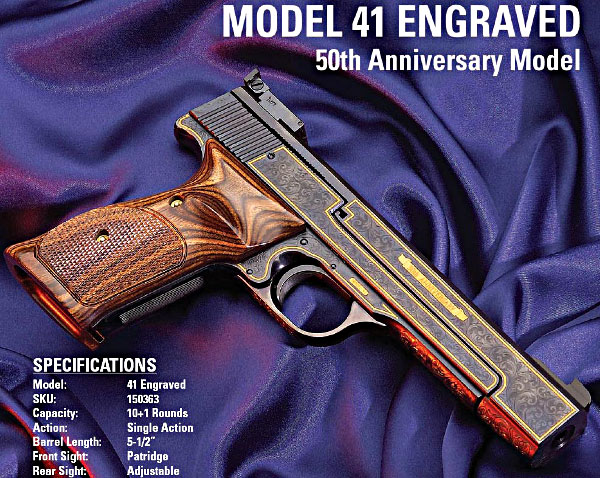
Smith & Wesson Model 41 — 50th Anniversary Edition
The .22 LR Smith & Wesson Model 41 is one of our favorite rimfire target pistol. First released in 2008, the engraved model 41 combines superior accuracy with stunning appearance.For $1700.00 to $2000.00 you can find the fully engraved, 50th Anniversary Model 41 in presentation case on Gunbroker.com.
A while back, RifleShooter Magazine released a list of the Ten Greatest Lever-Action Rifles of All Time. Writing for RifleShooter, Brad Fitzpatrick examined a wide selection of lever guns produced in the past 150 years, and came up with this short list of ten “all-star” lever action rifles:
Savage Model 99
Winchester Model 1873/73
Winchester Model 1888/88
Winchester Model 1892/92
Winchester Model 1894/94
As with all “Top 10″ lists, this will be controversial. Where is the Winchester model 1866 “Yellowboy”, the favorite of Native Americans? Where is the iconic Winchester model 1895, the beloved gun Teddy Roosevelt called “Big Medicine”? But other choices are hard to fault. The Henry Rifle, the first popular cartridge lever gun, surely belongs on the list. And, believe it or not, the Winchester Model 94 is the best-selling sporting rifle of all time in the USA, according to RifleShooter.
So what do you think of RifleShooter’s Top 10 list? Does it make sense, or did RifleShooter magazine get it wrong? NOTE, on the Rifleshooter Lever Gun Page, to see descriptions/photos of ALL the guns, you need to click the gray arrows that appear (barely) below each gun description (see below). That will scroll through the ten guns horizontally, back and forth.
Fitzpatrick writes: “The lever action played a very legitimate role in America’s westward expansion. It could bring meat to your table or protect your land and assets against rustlers. Nostalgia aside, the lever gun is an effective hunting tool for those willing to live within its limitations. While it can’t beat a bolt gun with a light trigger and free-floated barrel in a long-range shooting competition, a lever action in the right hands can be rather accurate, especially given new advancements in rifle design and bullet technology.”
Historic American Arms — Teddy Roosevelt’s Lever Guns
These two lever action rifles, owned by President Theodore Roosevelt, are part of the NRA Museum collection. First is a Winchester 1886 rifle known as the tennis match gun because Roosevelt used winnings from a tennis match to buy it. Below that is a suppressed Winchester model 1894 rifle. Roosevelt liked to shoot varmints around Oyster Bay (Long Island, NY) with this gun so he wouldn’t disturb his neighbors — the Tiffany and Du Pont families.
Barrel nut system allows “Pre-Fit” barrel installation on a Remington action. CLICK photo to zoom.
REMAGE Project Report by Bill, Rifleshooter.com Editor
Installing a new barrel on your Remington 700 (especially without a lathe) may seem like a daunting task, but thanks to companies like McGowen Precision Barrels and Criterion, there are easier alternatives. By adopting a Savage-style barrel nut on a 1 1/16″ thread for a Remington 700 receiver, pre-chambered (aka “pre-fit”) barrels can be easily swapped with just a few hand tools. This system is sometimes called a REMAGE conversion (for “REMington savAGE”). With simple tools a “Pre-fit” 6mmBR-chambered barrel was installed on the author’s Remington action — no machining or lathe-work required.
The existing barrel is simply removed from the action (normally the hardest part) and the new barrel is screwed on with the Go Gauge in place. After headspace is verified with the Go Gauge, the barrel nut is tightened against the action and you are off to the range. It takes all of the machine work out of the barreling process.
Note: Because barrel nut has a slightly larger diameter, some stocks may require minor inletting. Also, if you are shooting fired brass from another rifle with the same chambering, you should FL-size the brass before loading it for your new pre-fit barrel. And always check the set-up with a dummy round loaded to normal cartridge length BEFORE you head to the range. With Pre-Fits, the freebore should be adequate for your cartridge, but always check and adjust your seating depth as needed.
Bill has been a serious shooter for over 20 years. A former Marine Corps Sergeant, he’s competed and placed in High Power Rifle, ISPC, USPSA, IDPA, 3-Gun, F-Class, and precision rifle disciplines. In addition to being an NRA-certified firearms instructor and range officer, Bill has hunted big game in North America, South America, and Africa. Bill writes extensively about gunsmithing, precision rifles, and the shooting sports on his Rifleshooter.com website.
The question of barrel break-in is controversial. Some folks advocate an elaborate, lengthy cycle of shooting and brushing, repeated many times — one shot and clean, two shots and clean and so on. This, it is argued, helps barrels foul less and shoot more accurately. Others say minimal break-in, with patching and brushing after 10-15 rounds, is all you need. Still others contend that break-in procedures are a total waste of time and ammo — you should just load and shoot, and clean as you would normally.
We doubt if there will ever be real agreement among shooters concerning barrel break-in procedures. And one must remember that the appropriate break-in procedure might be quite different for a factory barrel vs. a custom hand-lapped barrel. This Editor has found that his very best custom barrels shot great right from the start, with no special break-in, other than wet patches at 5, 10, and 15 rounds. That said, I’ve seen some factory barrels that seemed to benefit from more elaborate break-in rituals.
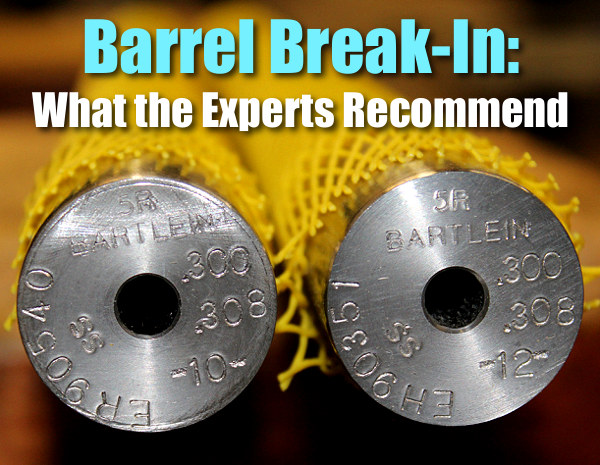
What’s the best barrel break-in procedure? Well our friend Eric Mayer of Varminter.com decided to ask the experts. A while back Eric interviewed representatives of three leading barrel manufacturers: Krieger, Lothar-Walther, and Shilen. He recorded their responses on video. In order of appearance in the video, the three experts are:
Do I Need to Break-In a New Rifle Barrel?
Eric Mayer of Varminter.com says: “That is a simple question, [but it] does not necessarily have a simple answer. Instead of me repeating my own beliefs, and practices, on breaking-in a new rifle barrel, I decided to answer this one a bit differently. While we were at the 2016 SHOT Show, we tracked down three of the biggest, and most popular, custom barrel makers in the world, and asked them what they recommend to anyone buying their barrels, and why they recommend those procedures. We asked the question, and let the camera run!” Launch the video above to hear the answers — some of which may surprise you.
Long-Term Barrel Care — More Experts Offer Opinions
Apart from the debate about barrel break-in, there is the bigger question of how should you clean and maintain a barrel during its useful life. Some folks like aggressive brushing, other shooters have had success with less invasive methods, using bore foam and wet patches for the most part. Different strokes for different folks, as they say. In reality, there may not be one solution for every barrel. Different fouling problems demand different solutions. For example, solvents that work well for copper may not be the best for hard carbon (and vice-versa).
“Why worry about a little barrel fouling when the throat is subjected to a brutal 5,600° F volcano at 55,000 PSI? To investigate these and other questions about taking care of a match barrel, we spoke with a dozen experts and share their knowledge in this first of a series of articles.
After listening to folks who shoot, build barrels or manufacture cleaning solvents for a living, we concluded that even the experts each have their own unique recommendations on how to care for a match barrel. But they all agree on one thing — the gun will tell you what it likes best. Because the life expectancy of a match barrel is about 1,500 to 2,500 rounds, the objectives of cleaning one should include: preserve accuracy, slow the erosion, and remove fouling — all without damaging the gun. This article doesn’t claim that one cleaning method is better than the next. Rather, we set out to interject a little science into the discussion and to share some lessons learned from experts in the field.” — Chip Lohman


 Hall vs. BAT
 Load Development and Accuracy Results
 Big, Strong, and Versatile


 Details of SALVA Action


 Proprietary SALVA Trigger






 Do I Need to Break-In a New Rifle Barrel?


