Readers know Jim Borden as a Hall of Fame shooter and the owner of Borden Accuracy/Borden Rifles. Jim won 10 IBS National Championships, set 10 IBS world records, and was inducted into the Benchrest Hall of Fame in 1996. But Jim is not just a great shooter. This highly-trained engineer is very much a Renaissance man. He is as skilled with cameras as he is with benchrest rifles.
Jim is a talented outdoor photographer who has compiled an impressive portfolio of wildlife and landscape photographs. For our Thanksgiving-day edition of the Daily Bulletin we are featuring some of Jim’s favorite nature images. We hope readers enjoy them as much as shooters prize Borden’s Rimrock benchrest and Rimrock hunting actions.
Growing up in rural Pennsylvania, in a hunting household and hunting community, Jim learned about shooting at a very early age. He started hunting at the age of nine with his father and grandfather. His grandfather had an avid interest in photography while they were on hunts and Jim became interested as well. Jim began using SLR cameras in the 1970s, often carrying cameras on his hunts. As the years passed, Jim became more interested in “shooting” the animals with a camera versus a gun. Jim converted from film to digital in 2006 and in 2007 Jim’s wife Joan started accompanying Jim on the photo safaris. Jim has a particular passion for elk, moose, and eagles and Jim also enjoys scenic photography. Jim and Joan both shoot Nikon professional equipment. Their photographs can be viewed at www.Borden-Photo.com. You’ll also find Jim’s images (along with photography tips) on his JandJB Wildlife Photography Blog.
All in the Family
Jim’s grandfather was a gunsmith who taught Jim the trade when Jim was very young. Jim’s father and grandfather ran a country business that included an auto repair shop, welding, a small lathe, and a forge. Jim earned a degree in Mechanical engineering at Penn State University. For 23 years he worked for Procter and Gamble (P&G) as an engineer and as an engineering manager/project manager.
Borden Rifles — A Success Story
Borden Accuracy/Borden Rifles has been a source for precision benchrest and hunting rifles for many years. Jim started doing his own gunsmithing while competing in benchrest and high power silhouette matches. Jim launched his business in 1987, working nights and weekends while still employed at P&G. The business became full-time in 1995 with Jim and his wife Joan doing the work. The business was expanded in 1999 with the construction of the new Springville, PA facility and the addition of sons Jim Jr. and John to the staff. Son-in-law John Mecca came onboard in January 2000. Now the Borden shop continues to make some of the finest rifles and actions in the world. Joan tells us that the company has seen a significant growth in ultra-high-quality precision hunting rifles in recent years.
Jim and company began making Rimrock benchrest and Rimrock hunting actions in 2001. They added Borden Alpine and Timberline actions in 2006. These actions are made in an advanced manufacturing facility which has three CNC vertical Machining centers, three CNC lathes, three manual lathes, a manual knee mill, a surface grinder, a cylindrical grinder and wire EDM machine. To learn more, visit BordenRifles.com, call 570-965-2505, or send email to info [at] bordenrifles.com.
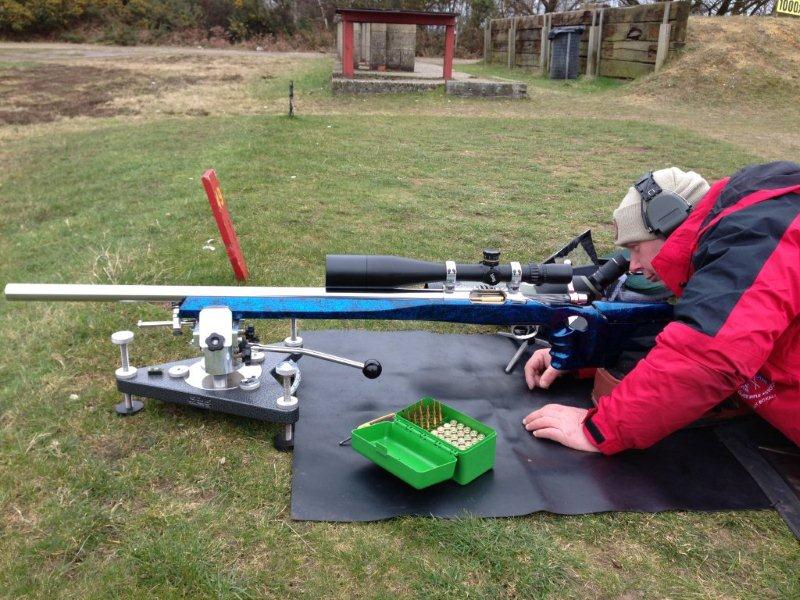
For today’s Sunday Gunday feature, we present a splash of color — the beautiful blue 7mm-270 WSM of Forum member Ian B. (aka “Elwood”) from Great Britain. A very knowledgeable guy, Ian has been one of the UK’s top F-Class shooters. And he’s the proud owner of a very “Flash” F-Class rig.
About the Shooter — Ian’s Background
Ian tells us: “I started shooting F-Class Open [many] years ago when a good friend invited me to Bisley to shoot with the Dorset Riflemen. I found it very enjoyable and a real challenge. The next year I attended the GB F-Class league’s Introduction to F-Class course, and soon afterwards started to compete in the GB F-Class league, while still shooting once a month with the Dorset Riflemen. In this short time frame, I’ve managed to finish 8th in the league last year, 12th in the Europeans, and I was a part of the GB squad that won the team event at the European Championship. I was then selected for the GB F-Open World Championship Team. Unfortunately, due to work commitments, I have had to withdraw.”
Ian’s Beautiful Blue 7mm-270 WSM F-Class Rifle
Report by Ian B. (aka “Elwood”)
Having spent my first year competing with a magazine-fed 7mm WSM tactical/sporting rifle (Surgeon action and AICS mag) and doing reasonably well with it, I then moved on to a .284 Shehane (.284 Winchester Improved). I love the Shehane and still use it but … I wanted something for those windy long-range days and so there was only one logical choice, the 7 WSM. This time I chose a 7mm-270 WSM as I quite enjoy case prep (just kidding). Actually, there’s not much to do really. The quality of Norma brass is well known and the Norma 270 WSM brass is quite easy to obtain in the UK.
The action is a Right Bolt, Left Port (RBLP) Stolle Panda F-Class action, with Jewell trigger. There wasn’t any particular reason behind the RBLP configuration — it was more of a case of that’s what I could get at the time. I had a 1.250″-diameter, straight-profile Bartlein barrel finished at 32 inches and chambered for the Berger 180gr VLD with a .313″ neck diameter. All my metal work and quite a bit of the wood work is done by the excellent Neil McKillop of McKillop Engineering. As with all top gunsmiths, Neil is meticulous to a point of obsessiveness and he’s the name behind quite a few winning rifles including several used by the GB Open and F-TR teams. Neil also inletted the stock from a blank and did the bedding for the action and the front bag runners.
Loading for the 7mm-270 WSM
I have one “tried and tested” load: 7mm Berger 180gr VLDs, seated .020″ into the lands, Vihtavuori N165 powder and CCI BR2 primers. This load is supremely accurate, but at 2990 FPS it’s a bit slow. To get more speed, I’m currently testing H1000 with good results, but it looks like I may have a slow barrel. I have another Bartlein barrel chambered and ready to screw on when the weather gets warmer. If that new barrel shoots well, the current barrel will probably be used as a practice barrel.
Loading Procedure
I do full case prep, neck-turning, uniforming primer pockets after the first firing, chamfering necks inside and out, and removing burrs around flash holes. Even the best brass sometimes suffers from imperfect quality control. I try to use Redding dies if possible, and will use bump dies, neck bushing dies, and competition seating dies.
I use an RCBS ChargeMaster 1500 to throw a charge just slightly under my desired weight and then trickle-up to final weight using the superb Dandy trickler and a Gem Pro 250 scale.
I anneal every other firing using a Bench-Source machine. Before this I used a Ken Light and also did them by spinning them in a drill. Never again will I do that after using the Bench-Source. After I have annealed, I always run a nylon brush wrapped in 0000 wire wool into the neck to remove any debris.
I keep to the same lot numbers of primers, powders, and bullets. Even the Bergers can vary from lot to lot — I have two different lots of 7mm 180gr VLDs that vary .020″ from bullet base to the ogive. I trim and point my bullets. Pointing may be a mental thing — I had a fantastic shoot while using trimmed and pointed bullets so I do it all the time now. ( A fellow GB team shot refers to them as “Pointless Dies” — I have witnessed him shoot a 99-14V at 1000 yards with bullets that weren’t trimmed or pointed). My next move will be to start measuring bearing surface…where does it all end?
Custom Wood Stock Was Modified by Ian and Treated to a Fancy Paint Job
The stock is a custom-made design crafted by Joe and Simon West of Joe West Rifle Stocks. I had several modifications done to one of their existing stock designs. Having done a lot of my shooting with the AICS, I was quite used to a thumbhole stock, so thought I would try one in F-Class. I told Simon what I wanted and he sent me down a prototype made from very inexpensive Tulip wood. We had a few discussions and then made some more mods..
I made two main changes to the stock. First, I removed the lip at the bottom of the pistol grip because I felt I might rest my hand on this and possibly disturb the rifle. Second, I had the protruding pistol grip base removed so that the bottom of the stock was completely flat like the Precision Rifle & Tool F-Class stock. Simon also made the finger grips to fit my hand and flattened them off to allow for a bit more movement. The stock was then sent to Hydro Graphics in the UK to have a custom exterior finish. The paint color is a Marbleized Candy Oriental Blue. As always, Hydro Graphics did a great job.
Optics and Rings
The scope is the excellent 5-50x56mm March with the MTR-2 reticle — far and away the best reticle I have used for F-Class. March makes great optics. During the 2012 European individual F-Class event, using another March (my 8-80x56mm), I could see my shooting partner’s impacts in the white V-Bull at 800 yards! And just recently at a club match I called two V-Bulls at 900 yards using the 8-80X (not at full power). Granted the light has to be perfect to be able to do this, but my highest praise for the Deon Optics glass is that it rivals that of Schmidt & Bender. Having owned both March and S&B scopes and compared them side-by-side, I feel that I can make this statement fairly.
UK-based Third Eye Tactical made the nice, 34mm rings. The UK is now producing some excellent products. We now have UK-made custom actions, rings, rails, stocks and more. It would be nice to think we could have a 100% British-made rifle, and not rely completely on USA-made products. I think all we need is the trigger? But I can’t see there ever being a UK-made scope!
In our Shooters’ Forum, there’s an interesting thread about a very light hunting rifle. Featuring a Defiance ultra-light all-steel action, this 6.5×57 Lapua lightweight tips the scales at just 4.93 pounds including scope and rings! For reference, a half-gallon of milk weighs 4.3 pounds, so this rifle is LIGHT! Here’s a report from the proud owner who built the rifle for a future Kodiak Island Alaska mountain goat hunt.
Ultralight Rifle Report by Forum Member Dave
I decided I wanted the challenge of a Mountain Goat hunt after I turn 60. It was the perfect excuse to put together an ultralight, something I had wanted to do for years. I wanted to see how light a bolt action rifle could actually be. My goal was to stay under 5 pounds, without going to a Titanium action, including rings and scope. I knew this would be difficult but I did manage to achieve the goal.
I started with a Defiance anTi model Rem Model 7 short action. This is an extremely smooth action that weighs just 19.2 ounces in this size. I had Carson Lilja of Lilja Barrels program a barrel taper to my dimensions for a 6.5mm 1:8″-twist stainless, 3-groove 22″ barrel. As fitted in the rifle, the barrel is free-floated except for the first inch or so forward of the action.
Other rifle components are: Bix n Andy Dakota trigger, aluminum trigger guard, blind magazine with an aluminum follower, titanium action screws, and a Leupold 3-9X lightweight optic in Talley rings. I also had an aluminum adapter installed in the for-end to accept a magnetic mount Javelin carbon fiber bipod.
The rifle was chambered up in 6.5×47 Lapua by my friends at Sportsman’s Outfitters in Knox, Pennsylvania. Then I sent the barreled action to Wayne at Oregunsmithing (Pendleton, OR) to have a Kevlar stock built. The stock weighs a whopping 14 ounces! When it came back I had everything Cerakoted (see bottom photo before coating). This stock was a full custom, built around my barreled action. Wayne’s work was reasonably priced with a 3-month turn around.
Excellent Accuracy — 5/8″ Three-Shot Groups at 100 Yards
Now it was time to shoot the rifle and I was not disappointed. It shoots both Barnes TTSX 100s or Swift Scirocco II 130s into 5/8″ at 100 yards. Off a bipod at 400 yards, three go into 3″ or so. This thing is crazy light even though it wears a 22″ barrel.
Without scope and rings, before Cerakoting the action and barrel, this 6.5×47 rifle tipped the scales at a mere 4.20 pounds (67.2 ounces). Check it out:
Remington Firearms (RemArms), America’s oldest firearms manufacturer, will locate its global headquarters and open a new advanced manufacturing operation as well as a world-class research and development center in LaGrange, Georgia. Through these projects, RemArms will invest $100 million and create 856 jobs over a five-year period in Troup County, Georgia. In making the move, Remington will leave New York for good. RemArms is turning its back on the state of New York, with its governmental bias against the firearms industry, high taxes, and executive incompetence.
Report from Georgia Governor Brian Kemp:
“Georgia’s firearms industry is responsible for thousands of jobs and millions of dollars of investment in our communities,” said Governor Kemp. “I am a proud owner of some of Remington’s first-class product, and now, I am excited to welcome them to their new home in the Peach State. As yet another big manufacturing win for our state, I look forward to seeing the oldest firearms manufacturer in America thrive in Georgia’s pro-business environment.”
Founded in 1816, Remington Firearms is one of the United States’ largest domestic producers of shotguns and rifles. Several of the company’s strategic products will be manufactured in Georgia. The new headquarters will also become home to an innovative research and development center.
“We are very excited to come to Georgia, a state that not only welcomes business but enthusiastically supports and welcomes companies in the firearms industry,” said Ken D’Arcy, RemArms CEO. “… Everyone involved in this process has shown how important business is to the state and how welcoming they are to all business, including the firearms industry.”
The company will be hiring for positions in production, operations, engineering, and management, as well as careers in HR, finance, and administration in Remington’s onsite executive offices. For more information, please visit www.Remarms.com.
“For more than two centuries, Remington Arms has been a part of the fabric of our country, and for many of us who grew up with a strong connection to the outdoors and a love of outdoor sports, a trusted brand like Remington has been interwoven into our lives,” said Georgia Department of Economic Development Commissioner Pat Wilson.
“I am thrilled to welcome Remington Firearms to the growing list of manufacturers who call LaGrange home,” added Mayor of LaGrange Jim Thornton. “The Remington name has long been associated with great products, and I know they will continue that tradition and be very successful here.”
Remington Has a Storied History
Founded in 1816 by Eliphalet Remington in New York, Remington is the oldest continuously-operating gun manufacturer in the United States. Prior to the re-organization, Remington sold more sporting rifles and shotguns than any other American company. Remington has developed more cartridges than any other U.S. company. And for decades Remington was the only American company that sells firearms AND ammunition under its own name. Now Remington ammo is produced in Arkansas, as a separate business. Remington’s ammunition business was acquired by Vista Outdoor, parent of CCI, Federal, RCBS and other major shooting/outdoor industry brands.
In the face of growing online censorship across many popular social media sites (such as YouTube), Brownells has launched a new online resource to help customers build their own AR-15 rifles at home. Hosted at Brownells.com/HowToBuild, the new web page features step-by-step, interactive videos. Featuring Brownells Gun Tech Caleb Savant, the videos show the AR-15 build process with easy-to-follow directions and expert advice. There are currently four AR Build videos: Introduction, How to Build Your Lower, How to Build Your Upper, and Troubleshooting Guide. See all videos at: Brownells.com/HowToBuild.
Each of the videos have an easy search button on the upper left-hand corner, allowing viewers to navigate to specific parts of the video. This will help viewers access key parts of each video and find the information they need. For example, the Lower Video has specific sections on trigger and buttstock installation. There is also a video on how to properly test fire and troubleshoot an AR-15 once it’s built.
In addition to the instructional videos, Brownells’ AR Builder Site also provides links to all the parts, tools, and accessories required to build an AR-15 rifle. There are specific links to uppers, lowers, triggers, grips, buttstocks, bolt carrier groups, handguards, barrels, gas blocks, muzzle brakes and more.
“Several social media platforms have banned videos and other content showing how to build firearms,” said Brownells V.P. of Marketing Ryan Repp. “Because of Brownells’ long-time support of the Second Amendment and individual freedom, it made sense for us to create a professionally-produced video and resource center to assist rifle builders of all skill levels make the rifle of their dreams in the comfort of their own home or workshop.”
Colt has issued a Recall for certain Colt AR-type rifles made in 2021. Here is the official Recall Notice:
COLT’S Manufacturing LLC (“Colt”) has recently discovered a potential safety issue with certain Modern Sporting Rifles (“MSRs”). Colt is voluntarily initiating a recall to protect the safety of its customers because, under certain conditions, it is possible that some of these MSRs may discharge a second round when the trigger is released when there is a live round in the chamber.
Colt is committed to the highest standards of quality and customer satisfaction. In keeping with that commitment, during routine quality testing, Colt discovered that hammers that do not meet Colt’s specifications were installed in certain MSRs that were manufactured beginning on March 5, 2021. The issue will be corrected by replacing the hammers in affected MSRs.
The recall only covers a portion of MSRs manufactured beginning on March 5, 2021, and includes the following models: AR15A4, CR6700A4, CR6920, CR6920-EPR, CR6920MPS-B, CR6921, CR6921-EPR, CR6933, CR6933-EPR, CR6960, LE6920-EPR, LE6920MPS-B, LE6920-OEM1, LE6920-OEM2, LE6920-R, LE6933-EPR, SP633784, LE6920SOCOM.
Chart lists all the serial numbers for those models that may potentially be subject to the recall:
To prevent the possibility of death or serious personal injury, Colt advises anyone who has purchased a Colt MSR since March 5, 2021 to stop using it immediately and visit ColtRepairMSR.com or call Customer Service at 1-800-971-3216 to see if your specific MSR is affected. Please note: Not all MSRs within the serial number range in the above chart are subject to this recall and this website offers easy, step-by-step instructions to determine if a particular MSR is affected.
Customer service agents will assist anyone who needs additional help. Our expert craftsmen are ready to upgrade all affected MSRs at our West Hartford, CT headquarters.
4140, 4150, 316, 17-4, 6061, 7075-T6 — What is the significance of these numbers? No, they’re not winning lottery numbers. These are all designations for metals commonly used in firearm and barrel construction. 4140 and 4150 are carbon steels, with 4150 often used in mil-spec AR15 barrels. 316 and 17-4 are grades of stainless steel. 316 is “marine grade” stainless, while 17-4 has 17% chromium and 4% nickel. 17-4 is a harder steel used in barrels and receivers. 6061 and 7075-T6 are aluminum alloys. 6061 is “aircraft grade” aluminum, often used for rings and trigger guards, while 7075-T6 is a much stronger, heat-treated aluminum commonly used in AR15 uppers.
You can learn about all these metals (and more) in the online archives of RifleShooter magazine.
Written by Patrick Sweeney, RifleShooter’s Guide to Gun Metal summarizes the primary types of steel and aluminum used in gun and barrel construction. Sweeney explains the nomenclature used to define metal types, and he outlines the salient properties of various steel and aluminum alloys. This is a useful resource for anyone selecting components or building rifles. We recommend you print out the page, or at least bookmark it.
Metals by the Number
The number system for steel classification came from the auto industry. Sweeney explains: “The Society of Automotive Engineers uses a simple designating system, the four numbers you see bandied about in gun articles. Numbers such as 1060, 4140 or 5150 all designate how much of what [elements are] in them. The first number is what class—carbon, nickel, chromium, and so forth. The next three numbers [list other elements in the alloy]. 4140, also known as ordnance steel, was one of the early high-alloy steels. It has about 1 percent chromium, 0.25 percent molybdenum, 0.4 percent carbon, 1 percent manganese, around 0.2 percent silicon and no more than 0.035 percent phosphorus and no more than 0.04 percent sulphur. That leaves most of it, 94.25 percent, iron.”
Aluminum Alloys
Numbers are also used to differentiate different types of aluminum alloys. Sweeny writes: “Aluminum is used in firearms in two alloys: 7075 and 6061. 6061 is commonly referred to as ‘aircraft aluminum’ and has trace amounts of silicon, copper, manganese, molybdenum and zinc. 7075 is a much stronger alloy and has markedly larger amounts of copper, manganese, chromium and zinc.” 7075 Aluminum has significantly better corrosion resistance, and that’s why it is used for AR receivers. The “T6″ you often see appended to 7075 refers to a heat-treating process.
Aluminum (or “Aluminium” in the UK) is a chemical element in the boron group with symbol Al and atomic number 13. It is a silvery-white, soft, nonmagnetic, ductile metal. Aluminum is the third most abundant element, and the most abundant metal, in the Earth’s crust. (Wikipedia)
To learn more about the metals used in your firearms’ barrels, rings, receivers, and internal parts, read Sweeney’s article in RifleShooterMag.com. Taking the time to read the article from start to finish will expand your knowledge of metal properties and how metals are chosen by manufacturers and gunsmiths. CLICK to Read Guide to Gun Metal.
Story Tip by EdLongrange. We welcome reader submissions. Aluminum Alloy chart courtesy AluminiumDesign.net.
Let’s face it, AR-platform rifles run dirty, at least compared to typical bolt-action rifles. The AR-15 works by piping gas from the barrel back into the bolt carrier, causing the bolt to unlock and the carrier to move the bolt backward. The “exhaust gas” from the barrel contains soot and carbon. The carbon will form hard deposits on the bolt. In addition, the carbon can combine with lube on the bolt carrier to make a nasty, paste-like sludge. This can be particularly problematic when the black paste pollutes the ejector and extractor recess.
This Editor has inspected dozens of ARs over the years. Other than mag-related malfunctions, the most common cause of AR cycling problems I found was oily gunk in the extractor and ejector areas. Many AR owners overlook these critical areas. Look at an AR that hasn’t been cleaned properly and you’ll probably find black gunk (and small brass shavings) in the ejector and extractor recesses.
If you want to keep your black rifle running smoothly and reliably, you must clean it regularly and follow the correct maintenance procedures. Here are three videos that explain how to properly disassemble and clean AR-platform rifles. And then they cover the essential lubrication ARs need to run reliably.
Take-Down and Full Cleaning of AR15 by Jerry Miculek
Here ace shooter Jerry Miculek takes down and cleans an AR-platform rifle belonging to his daughter Lena. This is a good video because Lena’s rifle was “run hard and packed up dirty” so you can see where carbon and grease build up. This 35-minute video is very thorough. Jerry is one of the nation’s top action carbine shooters, so listen carefully to his advice on cleaning and lubrication.
General AR-15 Maintenance and Lubrication
There are various schools of thought on AR lubrication. Some guys like to run “wet” with lots of CLP, while others choose to focus lubrication on the key spots that receive the most friction and wear, such as the contact point for the bolt carrier. We do advice check the ejector recess and extractor spring recess frequently as gunk can get in there, causing malfunctions. Here is a good video from Pew Pew Tactical — a 7-minute guide to cleaning and lubricating AR-platform rifles. This shows important details for both the upper and the lower.
How to Clean Your AR-15 Bolt Carrier Assembly
This video offers very specific advice on the bolt carrier group, which receives the dirty gas directly from the barrel. Be sure to check the extractor and ejector recesses. That’s where old lube, brass shavings, and carbon accumulate. Follow the directions in this video for lubrication, and don’t over-lubricate the bolt carrier — that will only capture more carbon.
If you are looking to acquire a reliable, accurate rifle for a late fall hunt, Howa can be a good choice. Howas feature smooth-running actions with fine two-stage HACT triggers. A Howa barreled action can also be a good basis for a DIY project. But some folks have heard that it may be difficult to find stocks, or to fit an after-market barrel. That’s not true. There are many stock options available, and in this article, Bill of RifleShooter.com shows that it is easy to remove the factory-installed barrel with the right tools. We think a Howa makes a fine basis for a varmint rig or field rifle. Or you can build a tactical rifle as Bill did. You can start with the factory barrel and when you want/need more accuracy, then have a gunsmith install a custom barrel from Krieger Barrels, Lilja Barrels or other quality brand.
The Carbon Stalker is an excellent ultralight factory option, weighing just 4.6 lbs. with Mini Action (before optics). All Howa Carbon Fiber Stalker rifles come with a Sub-MOA Guarantee and Lifetime Warranty.
What You Need to Know About Howa 1500-series Rifles
Tech Feature by Bill, editor of RifleShooter.com
Consider this article the “Howa 1500 Overview”. There has been a lot of interest in Howa rifles and barreled actions imported by Legacy Sports International. In addition to being able to buy a complete rifle from a dealer, Brownells sells barreled actions in a wide variety of calibers and configurations. In this post we are going to take a look at the Howa 1500 series.
Howa Rifles — General Background
Howa is a Japanese heavy machinery company. One of its product lines are firearms, which, are imported into the United States of America by two different companies, Legacy Sports International and Weatherby. Legacy sells the 1500 under the manufacturers name while Weatherby re-brands the guns as the Weatherby Vanguard. In general, the finishes on the Weatherby rifles are more refined than the LSI-imported 1500s.
General Evaluation of Howa 1500 Rifles
I’ve found Howa 1500s to be solid, entry-level rifles that are capable of sub-MOA accuracy out of the box. I’ve actually purchased two Howa rifles I’ve tested because I like them so much. The gun below, a Howa Mini-Action in 7.62×39 Russian, is one of my favorite factory guns to shoot.
Check out this three-shot group I drilled at 100 yards with the rifle above and 125-grain Sierras. It took a lot of work and load development to get there, but when it did, it worked well.
Howa 1500 HACT 2-Stage Trigger
Howa 1500s feature the very nice Howa HACT trigger. This is an adjustable, two-stage trigger, set for about 3 pounds (combined stages). Crisp and repeatable, this is an excellent trigger for a factory gun. There is no annoying Glock-style safety lever in the middle of the trigger blade. The 2-stage design and pull weight range works well for a hunting rifle or a rig for PRS competition. Rifleshooter.com says the Howa trigger is “one of the best factory triggers, along with Tikka. I’ve found the Howa trigger superior to a Remington 700 — the Howas doesn’t need to be replaced.”
Writing for the Western Outdoor News, WONews.com, Steve Comus has field-tested the HACT Trigger. Steve writes: “I always liked two-stage triggers, because of the way I could take-up the slack and then actually know when the rifle was going to go off. The take-up on the [HACT] trigger was fast and easy. The crisp, positive release when pressure was put on during the second stage [reminded me] of some of the target rifles I shot through the years.”
Howa Actions — Three Options
Howa offers three action lengths: Mini, Short, and Long. You can see the bolts for the three action lengths in the image below. The Mini-Action has similar external dimensions to the Remington Model Seven, however, the Mini-Action’s bolt does not travel as far to the rear. This is a mixed bag. The upside is you have a quicker action (shorter bolt throw). The downside is you are limited to shorter rounds such as the .223 Remington, 7.62×39mm Russian, and 6.5 Grendel. But if you need a bigger cartridge, just choose the standard or long action Howa variant.
Howa 1500 vs. Remington 700 — Important Differences
Is the Howa 1500 a Remington 700 clone, or some kind of improved Remington 700? No, not really. While the top radius of the Howa 1500 does match the Model 700, and they can both use the same two-piece scope bases, there are a number of differences.
If you look at the Howa 1500 alongside the Remington 700 you’ll note the M700 is a round action, while the Howa is a flat-bottom action. In many ways the Howa’s bottom half reminds me of a push-feed Winchester. This means the chassis and stocks that support a Howa 1500 are not V-block based like you’ll find on a 700, instead they have a flat bottom. While the bolt of the Howa is similar in external appearance to the Model 700, it does offer some improvements, notably an M16-style extractor and a firing pin assembly that can be easily removed without tools.
Howa 1500 action screws are metric and are in a different location from the 700. The Howa 1500 has an integral recoil lug that accepts the front action screw, this means you have more of the front action screw engaging the action. WARNING: If you install it into a poorly-fitted stock or action you may bind it.
Can a Howa Action Be Used for a Custom Rifle Project?
Absolutely! You can either buy a barreled action from Brownells and throw it in a chassis system/stock of your choice or you can use a stripped action to build a custom rifle. If you are in the chassis market, MDT offers a wide variety of chassis in different price ranges. All have worked well for me.
How to Remove Howa Factory Barrel from Action
You may have heard internet grumblings about removing Howa barrels. Some keyboard commandos say they are extremely difficult to remove without a relief cut. Well Bill at Rifleshooter.com demonstrates that Howa barrels can be removed without trouble, provided you have the right tools. Watch this video:
Watch Howa Barrel Removal Video — Quick and Easy (Click Speaker Icon for Audio)
Q: Is it difficult to remove a barrel from a Howa 1500?
A: Not very. I’ve heard from some smiths that worked on Howas (years ago) that the factory barrels are difficult to remove. However of the half dozen or so Howa barrels that I’ve pulled, they’ve been very easy. I use a Brownells action wrench with the top piece for a Rem Model 700 and the flat bottom resting against the flat on the wrench.
Howa Actions Require Metric Barrel Threads
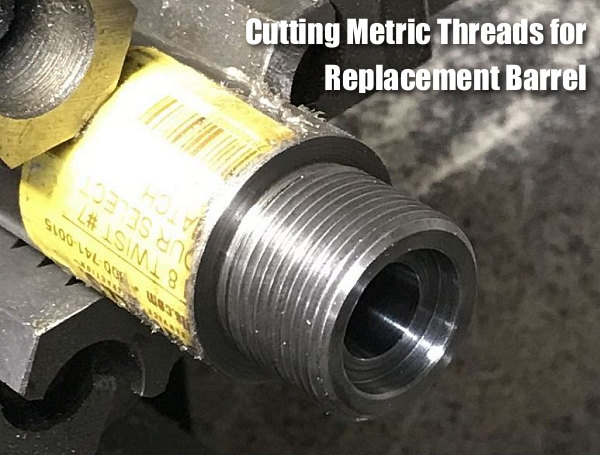
It’s easy to thread a barrel for a Howa Action. You just have to cut metric threads — most lathes out there can cut them. I cut the threads below on a manual lathe using change gears. [Editor: John Whidden cuts metric tenon threads with a CNC lathe. “It’s easy,” John tells us, “No issue whatsoever.”]
Savage Arms just won a major award for its innovative straight-pull hunting rifle, the Savage Impulse. This is the only straight-pull centerfire rifle currently produced by a major U.S. manufacturer. Guns & Ammo magazine named Savage’s Impulse the 2021 Rifle of the Year.
“The Savage Impulse pushed Savage rifles to a new level in 2021″, wrote Guns & Ammo editors. “Creating a unique, reliable rifle is never easy, but the Impulse combines the innovative features of other Savage rifles along with Hexlock bolt technology that provided a fast, safe, and accurate shot. This rifle was designed to attract hunters of all types through versatile features and load compatibilities. Each model delivers on their promise of speed and range.”
Beth Shimanski, Savage’s Marketing Director, says the design is a game-changer for hunters: “The speed of Impulse’s straight-pull action has changed the way Americans think about hunting rifles. This design combines everything Savage has learned about accuracy and reliability with innovation that provides marksmen and women with new capabilities with new capabilities.”
Savage’s Impulse series of straight-pull bolt rifles is the first American-designed and crafted straight-pull centerfire rifle. The new Impulse features an innovative Hexlock bolt-locking mechanism with six spherical bearings that move radially outward into a ring in the barrel extension, thereby locking the bolt in place. That barrel extension is held in the receiver assembly by four cross-bolts on the lower front section. Ahead of the barrel extension is a conventional recoil lug and a familiar Savage barrel nut.
Savage Impulse Straight-Pull Rifle — Overview
Savage claims the new system offers the cycling speed of a semi-auto, with the accuracy of a bolt-action. However, based on the videos that Savage has posted, the cycling of the Impulse’s straight-pull bolt does not seem to be as smooth as some European straight-pulls, such as the Blaser R8, Merkel RX Helix, and Strasser RS 14. We’ve tried those Austrian/German rifles and you really can cycle them very smoothly. From the video the Savage Impulse appears to require somewhat more muscle and effort. Watch below. The video will launch at the 15-second mark for a comparison between the Impulse and a conventional Savage bolt-action:
Savage Speed Comparison — Impulse vs. Regular Bolt Action
Savage says: “Conventional bolt-actions require four steps to cycle the bolt. Impulse simplifies the process with a simple back-and-forth motion.”
Advantages of Straight-Pull Cycling System
What is the advantage of a straight-pull system? You should be able to cycle faster, and (ideally) maintain your cheek-weld and target view. Savage says: “The smooth bolt throw allows a shooter to cycle rounds intuitively, without the need for the standard four changes-of-direction common to a conventional bolt’s path-of-travel. Impulse reduces split times and allows a shooter to manipulate the bolt without losing [his] cheek weld. The bolt travels out and back and shooters don’t have to take their eyes off the target.” Sounds good, but if you watch the above videos, it’s not as wonderful as claimed. That said, if one slows down a bit, a straight pull should allow the shooter to maintain his cheek weld.
Savage’s Impulse “will redefine the way you think about straight-pull rifles”, said Al Kasper, President/CEO of Savage Arms. These new Impulse rifles are built for speed — faster bolt cycling while maintaining ones cheek-weld. This increase in speed can help a hunter make effective follow-up shots.
When the bolt is closed, the Hexlock system holds it in place instead of conventional lugs. With the Hexlock, six (6) hardened steel bearings lock the bolt in place inside the receiver’s barrel extension. Savage says “As pressure increases, Hexlock’s hold tightens, ensuring that there can be no rearward movement of the bolt. Once the round has left the barrel, the pressure subsides, and the action can safely open again with the straight pull of the bolt handle.”
Savage Impulse — Hexlock System (Bolt Locks in Barrel Extension)
The cleverly-designed, modular Impulse bolt can be disassembled without tools. And the bolt-handle can be moved to either side easily. NOTE: In this diagram it may appear that the barrel does not have threads on the chamber end. Actually, Impulse barrels DO have threads on that end, which are used by the barrel nut. However, these threads are covered by a barrel extension which is held in the action/receiver by a lower-side four-bolt barrel clamp.
Savage Impulse Models: Predator, Big Game, Hog Hunter
Savage currently offers three Impulse models, all equipped with Savage AccuStock, Accufit, and AccuTrigger. All Impulse actions feature a Picatinny rail on top along with a central safety. Because the bolt handle can be placed on either side, all Impulse rifles are essentially ambidextrous — good for lefties as well as righties. There are both short-action and long-action versions of the Impulse rifle. Seven different chamberings are offered, from .22-250 to .300 Win Magnum.


 Jim is a talented outdoor photographer who has compiled an impressive portfolio of wildlife and landscape photographs. For our Thanksgiving-day edition of the Daily Bulletin we are featuring some of Jim’s favorite nature images. We hope readers enjoy them as much as shooters prize Borden’s Rimrock benchrest and Rimrock hunting actions.


Borden Rifles — A Success Story





 Optics and Rings


 Howa 1500 HACT 2-Stage Trigger




 Savage Arms just won a major award for its innovative straight-pull hunting rifle, the


