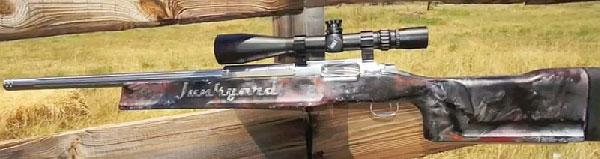
Benchrest shooter Ronnie Smith had the folks at S&S Precision craft a barrel block benchrest gun with a McMillan 50 LBR stock. While the metal work (and block installation) is impressive, the rig’s jaw-dropping feature is an amazing paint job applied by artist David Tidwell of Dallas Airbrush.
Ronnie wanted a stock that didn’t look like anything else you’ve ever seen. Working from Ronnie’s concept of a junkyard-sourced rifle, Tidwell created a masterpiece of airbrushing. The finished stock looks like it was hammered from old beat-up metal, complete with dents, grind marks, hollows, Bondo, and wire-mesh patches. Watch the video below to see how this amazing paint job was applied, from start to finish. (Definitely worth watching!)
If you have a stock you’d like painted by David Tidwell, visit DallasAirbrush.com, call 214-529-4410 or email: david [at] dallasairbrush.com. Dallas Airbrush currently sprays out of Texas Body Works, 2415 Midway Rd Suite 111, Plano, TX 75025.
This story first ran ten years ago. But to mark our long-standing friendships with shooter Joe Friedrich and chassis builder Gary Eliseo, we wanted to reprise the article for a new decade. Joe’s Eliseo-chassis 6BR rifle delivered some of the most stunning factory ammo accuracy we’ve ever seen, in any rifle, in any caliber.
Amazing Accuracy from 6mmBR Tubegun
What kind of accuracy do you think a tubegun can deliver with factory ammo — during barrel break-in? Perhaps 0.6″ at 100 yards, half-MOA if the conditions are perfect? Well you may want to change your preconceptions about tubeguns — and factory ammo. This Eliseo R5 repeater, smithed by John Pierce with a Pierce CM action and Broughton 5C barrel, shot the Lapua 90gr factory ammo into flat ONEs during the break-in session. A day later, in tricky 8-14 mph winds, the gun nailed a witnessed and software-measured 0.174″ 5-shot group using the 105gr factory ammo. That would be impressive for a “full-race” benchgun with precision handloads. For an across-the-course rifle shooting factory ammo, it’s pretty amazing.
Eliseo Tubegun Shoots in the Ones
This accurate rifle belongs to our friend (and designated expert trigger-puller) Joe Friedrich. During the initial break-in session, since his reloading dies had not yet arrived, Joe decided to start with some Lapua factory-loaded 6BR ammo he had on hand. After doing a few two-shot-and-clean cycles (with patches and nylon brush), Joe decided to try a 3-round group just to see if the Broughton barrel had some potential. To his astonishment, the Eliseo R5 put three rounds in 0.100″ (photo below left). Joe then cleaned the barrel again, shot a couple foulers and tried a 4-shot group. The results were just as stunning — 4 shots in a mere 0.104″ but three in virtually one hole (photo below right).
You Can’t Believe How This Gun Shoots
Joe called your Editor and said “You can’t believe how this gun shoots with factory ammo!”. So we arranged a photo session for the next afternoon, where I could verify the rifle’s accuracy. Well it turned out the conditions were way more challenging than when Joe broke in the barrel the day before. Winds were running 8-14 mph and were swinging through 180 degrees half-way down the range. Joe fired a few 90s through the Oehler chronograph at my request, then opened a box of Lapua 105gr factory ammo. It took about four rounds for the barrel to settle in after being cleaned the night before. Then Joe got serious, and with your Editor looking over his shoulder, he drilled a 0.174″ five-shot group in switching winds, doping every shot. Joe felt the gun could have shot tighter but he missed one wind call.
Serious Accuracy with a Multi-Purpose Rifle
So there you have it — a tubegun that shoots in the ones with factory ammo. Joe says that, at least with the 90s, the Elesio R5 shoots as well as his 6 PPC. Joe stressed that “steering the tubegun is hard work. You really have to concentrate compared to a purpose-built bench gun like my PPC. With the tubegun, everything has to be perfect on every shot — hand position, cheek position, stock position in the bag. If you’re off just a little bit, it’s easy to steer the gun the wrong way and send a shot out of the group.”
Accuracy Great But Fouling Heavy and ES Could Be Better
Have there been any negatives to Joe’s 6BR tubegun experiment so far? Well, the Broughton 5C barrel, while phenomenally accurate, shows signs of being a bad fouler. Copper built up pretty quickly over the first 25 rounds or so. We saw best accuracy with a recently-cleaned barrel. Hopefully the fouling will lessen as the barrel polishes in with use. And the canted land barrel is slower than average with the factory ammo. Lapua rates its 90gr naked-bullet ammo at 2950 fps with a 26″ tube. In Joe’s 27.5″ barrel we only averaged 2901 fps. With the 105gr factory ammo, which is rated at 2790 fps, we averaged just 2694 fps. That’s quite disappointing. Also the ES on the factory ammo, slightly over 50 fps for both bullet types, wasn’t particularly good. Still, the overall results were stunning. This gun shoots better than many long-range benchrest rifles running carefully-developed handloads — and it does that with factory ammo, right out of the box.
Joe Friedrich is a superb benchrest shooter, who has won many matches and set National Records in ARA rimfire benchrest competition. Here is Joe with “Sweet Pea”, his favorite .22 LR rimfire rig. With over 100,000 rounds through the Benchmark barrel, this well-worn rifle set an ARA 4-target Aggregate record! READ about Sweat Pea Record HERE.
Look for a lighter barrel for your latest hunting or PRS/NRL rifle? Well there’s a new option on the market. Bartlein Barrels, makers of premium benchrest, F-Class, tactical, ELR and hunting barrels, is now offering carbon fiber-wrapped barrels. These will be available in a variety of lengths/contours, and multiple carbon colors. Bartlein posted on Facebook: “We are thrilled to announce that Bartlein Barrels is now offering carbon fiber-wrapped barrels! With the help of Mission Specific Worldwide LLC, another Wisconsin-based company, we will be offering these barrels in limited contours and calibers.
Bartlein’s Matt Buettgen told our Forum: “Bartlein Barrels is proud to introduce its new line of Carbon Fiber-wrapped barrels. We will start off with three (3) contours, the #4 Bull Sporter, #13 Rem Varmint, and the #14 M24/M40. Lengths will be 20″, 22″, 24″, and 26″ finished lengths in any twist you like including Gain Twist and Left-Hand Twists. And just to make it a little more interesting, there are four colors: Black, Red, Green, and white/black marble. For more information give us a call at the shop or check out our Facebook Page.”
Here is more information from George Gardner of GA Precision:
It’s been a hard thing to keep under wraps, no pun intended. But Bartlein Barrels is now offering carbon-wrapped barrels! We have been helping test these for a few months now and all I can say is they are very impressive. Same Bartlein accuracy and no point of impact shift at all as the barrel warms. Plus as a bonus, GA Precision will be offering colors: Red/Brown, Green and White. These colors really pop against the sunlight and accent various colors offered by composite and painted chassis stocks (see below). These color-wrap barrels are special order for 4-month delivery.
GA Precision already has good inventory of Standard Black Carbon barrels in all four contours in popular calibers and twists. See GA Precision website for details. These are available for immediate delivery.
NOTE: GA Precision currently offers FOUR (4) contours:
Bartlein #4 B Sporter | Bartlein #13 Remington Varmint
Bartlein #14 M/24-M40 | Bartlein 1.200″ Straight
Price is $700 + shipping for standard black carbon wrap, or $750 + shipping for colored carbon wraps.
Many short-range Benchresters have thought about converting their 6 PPC to shoot a 30BR for score matches, or a Dasher for mid-range (or even 1000-yard) games. That way you have a rifle that does double duty, giving you the most bang for your buck. Though an action with a PPC bolt won’t normally work with 30BR/6BR/Dasher cases with their larger .308-class rim (0.4728″ diameter), there is a pretty easy solution that allows you to cycle these bigger cartridges with a 6PPC-style bolt (designed to fit .220 Russian rims).
“Rebating case rims … lets you shoot a 30BR in score matches using your PPC action. All you need is a new barrel. This saves buying another bolt, receiver, or rifle.” — Butch Lambert
Butch Lambert of ShadeTree Engineering provided this tip. Butch notes that many 6 PPC benchrest group shooters also enjoy shooting in score matches. But to be really competitive in the BR for score game, that means shooting a 30BR, which has a wider, .308-class rim (0.4728″ diameter). Likewise, if you want to compete in 600-yard registered BR events or in varmint matches, you probably want to run a bigger case, such as the 6BR, 6mm Dasher, or 6-6.5×47. Those cartridges also have the larger 0.4728″ rims.
Cutting Head for Rebating Rims
To convert a PPC-boltface action to shoot the bigger cases you can spend a ton of money and buy a new bolt. That can cost hundreds of dollars. The simpler solution is to turn down the diameter of the larger cases on a lathe. Butch explains: “We’ve seen plenty of interest in rebating case rims. This lets you shoot a 30BR in score matches using your PPC action. All you need is a new barrel. This saves buying another bolt, receiver, or rifle if you have a PPC boltface. Anyone who has access to a lathe can do this job pretty easily. Yesterday I turned 150 case in about an hour.” At right is the lathe form tool Butch uses to rebate the case rims.
Kelbly makes outstanding actions, including the Stolle Pandas. In the past 20 years, Pandas have probably won more benchrest matches than any other action (though BATs and Bordens are increasingly in the winning circle). Recently gunsmith Alex Wheeler of Wheeler Accuracy worked his magic on an aluminum Panda, optimizing the “ignition timing” of the action. This involves many small mods to bolt, camming surfaces, trigger, and firing pin: “The whole cam helix and detent shelf is re-cut. The firing pin and cocking piece are modified as well.” When executed properly, Ignition Timing has a number of benefits, including a smoother bolt opening/closing, improved firing pin fall, and enhanced accuracy (though the accuracy improvements can be subtle).
BEFORE Action Timing — Stiff and Clunky
Alex reports: “Normally Panda actions have plenty of firing pin fall. For one reason or another this one was very low. Before timing, firing pin fall was .210 with a Bix’N Andy (BNA) trigger. After trigger timing firing pin fall is .244 with zero cock on close.” Here is how the action functioned before timing work:
CLICK Photo to start VIDEO
Alex notes: “As you can see, after the cocking piece rides out of the detent notch it thenfalls to the trigger and is then re-cocked. This is normal on most un-timed actions.”
AFTER Action Timing — Smooth and Refined
Alex explains the modifications he made for this Panda action: “Moving the trigger back adds cock on close. The whole cam helix and detent shelf is re-cut. The firing pin and cocking piece are modified as well. I do love a timed Panda. In fact, I like aluminum actions, I think there is something to them. But yes, I also recommend Borden as my first choice.’
CLICK Photo to start VIDEO
Fix for Right-Bolt Actions Only
After seeing these videos on Facebook, one poster asked: “I do like my Panda but this is exactly why I bought a Borden action and I love it. It’s good to know you can make a Panda better. Alex, can you time a left bolt Panda?”
Alex replied: “No, the tooling I built is all for right hand actions sorry….”
With all the buzz about the 6.5 Creedmoor and its 6mm Creedmoor little brother, some folks forget that we’ve had an outstanding mid-sized, Across-the-Course cartridge for a long time — the 6XC. Pioneered by 11-time National High Power champion David Tubb, the 6XC has won national High Power championships, excelled in mid-range prone matches, and performed great in the varmint fields. It has also been used successfully by many Precision Rifle Series competitors. It’s no wonder — the 6XC has less recoil than a 6.5mm Creedmoor, there is a great selection of superb 6mm bullets, and Peterson 6XC brass is high-quality and reasonably priced ($69/100) from DavidTubb.com. Fine Norma 6XC brass is available from Grafs.com.
PRS Rifle with Modern 6XC II Chamber
Forum member Grimstod posted this new 6XC II rifle in our long-running Pride and Joy Rifle Thread. Grimstod notes: “These 6XC Gen IIs seam to be a hot commodity lately. This one is for PRS. It features a Premier Accuracy Atlas action made by Kelbly. The bolt and heavy-taper, fluted barrel are Cerakoted to match. I really like the ejectors on these Atlas actions. The stock is a KRG X-Ray painted in Premier Accuracy exclusive colors. The Kelbly Atlas action does not have any modifications. So far every Kelbly action we have tried has had perfect timing and trigger fall. We have been supper pleased with them. I look forward to using a lot more of these excellent actions.”
What is the 6XC II you may ask? That designates a 6XC with a chamber dimension optimized for Norma brass. It turns out that Norma brass is a bit bigger at the bottom than the 22-250 brass from which the 6XC originated. Robert Whitley of 6mmAR.com has created two new JGS reamer specs that fit the Norma brass perfectly, improving feeding and extraction. Here is Robert’s Report:
The 6XC II Chamber — Upgraded for Today’s Norma 6XC Brass
by Robert Whitley of 6mmAR.com
The 6XC II Chamber works perfectly with the Norma 6XC brass and resolves the “sticky bolt lift” issue. The original 6XC chambering was designed based off the usage of 22-250 brass which typically has a web diameter in the range of .461″-.463″. The area of the chamber just forward of the web on the original 6XC chambering was .4695″ which left plenty of clearance.
When Norma 6XC brass became available Norma appears to have developed the base of the case from the .308 Winchester line of cases which have a larger web diameter. The web diameter of the Norma brass typically measures right around .4685″ which leaves almost no diameter clearance.
As shooters would use Norma 6XC brass in an original 6XC chamber they typically would experience “sticky bolt lift” due to the lack of clearance and the fact that the large web diameter of the brass prohibited the re-size dies (no matter how small the base diameter was) from squeezing the brass down enough to create sufficient clearance. The 6XC II chamber resolves this issue. You can order 6XC II sizing dies from 6mmAR.com that work perfectly with this re-designed chambering. 6XC II die sets are in stock now — call (215) 348-8789 to order.
6XC II Long Range Reamer (Throated long for 105-115gr Bullets):
The 6XC II-LT reamer below is throated long to keep the full bearing surface of 110-115gr bullets forward of the neck/shoulder junction of the case. Note, 6mmAR.com has also developed a shorter-freebore version for 6mm bullets with shorter bearing surface. SEE shorter 6XC II Reamer Print.
6XC II Chamber and Sizing Die Combo:
- Resolves the “sticky bolt lift” problem shooters experienced using the Norma 6XC Brass in the original 6XC chambers.
– Chamber accepts all 6XC brass or ammo with no modification. Take your existing 6XC brass or ammo and use it without issues.
– Works well with existing Norma 6XC brass, or 6XC brass made from re-formed Winchester and Remington 22-250 brass.
– 6XC II Sizing dies and die sets are available from 6mmAR.com and in stock.
If you are looking for someone to chamber your rifle or re-barrel an existing rifle in the 6XC II chamber, Fred at Sabreco, Inc. in Skippack, PA, (610) 584-8228 can help you. He has the reamers for the cartridge as well as the head space gauges for the cartridge, and has had extensive experience chambering many barrels and rifles.
Area 419 is a top-tier manufacturer of reloading tools, shooting accessories, rails, suppressors, mag kits, and tactical/PRS rifle packages. To celebrate the 4/19 date which matches its company name, Area 419 is running a very compelling SPECIAL SALE. Right now you can save 10% on CZ tactical rifle builds, save 10% on suppressors, save 15% on select actions, save 20% on TriggerTech triggers, and save 50% on apparel.
In addition, during this special sale, pretty much everything else Area 419 sells is at least 10% Off. To take advantage of these big discounts, visit Area419.com and use CODE 4192020 during check-out. (NOTE: Some items, such as the TriggerTech triggers, are already discounted, so no check-out code is required). This sale runs through 11:59 pm ET on 4/20/20.
Specialty Pistols — Report from Ernie Bishop in Wyoming
For those who know of me in the shooting world, you would probably know me in one of two ways: Dealer for SEB Rests or someone who does most of his competing, varminting, and or hunting with specialty pistols. These are typically bolt-action, single-shot rigs that can be used with a bipod. They can seem very similar to a pistol-grip rifle, but without a conventional buttstock.
My interest in all things specialty pistols (Remington XP-100, TC Contender, MOA Maximum, Pachmayr Dominator, H-S Precision HSP, etc.) goes back to the early 1980s. Most of the specialty pistols listed are no longer made, so when I discovered that Kauger Arms was making two, I was excited. I have not had much time to shoot my new Kauger “Black Widow” chambered in 6.5×47 Lapua. But so far, the experience has been fun, even though I have not taken it prairie dog shooting yet or hunted big game with it. For this report, I went to my friend Dan’s place as one can load in the house, and simply shoot off his back porch.
When thinking of a precision shooting platform, most of you would not consider a wood back porch as ideal. But we managed a 0.179″ 3-shot group at 100 yards using a Harris bipod and a small leather bag. Yes the Black Widow can shoot! My load was Lapua brass, Federal 205M primers, Varget powder, and the Hornady 123gr A-Max, with a MV of 2514 fps. I selected the Hornady 123s with prairie dogs in mind. As shown in the top photo, the scope on the Black Widow is a Sightron S-III 6-24 with a Holland’s scope level. The Black Widow also sports a Holland’s Radial Baffle brake.
Here is the Black Widow with a different scope base and scope, ready to go on Dan’s porch.
The day we planned to shoot prairie dogs was windy, so we headed to public land nearby and set up steel to get ballistics drop info and simply to play at distance. We had 5″ steel at 220 yards, 10″ steel (diamond) at 510 yards, and 10″ steel (square) at 650 yards. Wind was from 8 mph to just over 20 mph, so the little 123 grainer was getting tossed about, while keeping us humble all at the same time. Regardless of the gusty winds, I considered the session a success!
Kauger Arms has been making parts for a number of companies in the firearm industry for over 20 years. In 2014 when things slowed down for them, they decided to start building rifles and decided to make their own actions. Good decision — these actions, which are machined in a single process to keep everything true to the bore, are great. Bolt manipulation with Kauger’s action is the smoothest I have ever experienced.
Tim Kauger explained features of his actions to me. The Kauger cock-on-opening action has a Rem 700 footprint for action holes and trigger shoe. The semi-coned bolt features a floating bolt head which is slightly smaller than the bolt body. The firing pin assembly is 1/4-turn removable. There are user-changeable bolt body and knob options. There is a side bolt release above the stock line. All moving surfaces are nitrided. This can be ordered single shot, feed rails or DBM cut. Also the long action will accept up to a .338 Lapua/.300 Norma Mag if ordered that way (with 1.25″ barrel cylinder).
Kauger Arms offers a right-hand or left-hand grip, which is very comfortable. I shot the Black Widow both right-handed and left-handed with no problems whatsoever. Kauger Arms can build the Black Widow in many more chamberings than the two that are listed on the KaugerArms.com website.
New left-bolt/left port action from Kauger Arms — To the specialty pistol shooters reading and to those considering entering the SP world, Kauger Arms has listened to your requests and is working on a left bolt/left port short action that will be offered either as a single-shot action or with bottom metal. You grip the pistol with your right hand, then run the bolt with your left-hand.
Specialty Pistol 2 — The Camo .223 Remington HSP
Here is another one of Ernie Bishop’s specialty pistols. This eye-catching camo-stocked rig was crafted by H-S Precision. Sadly, H-S Precision is not making these HSP pistols anymore. This .223 Remington features a 1:7″-twist, 15-inch-long H-S barrel fitted with the “H” Brake. On top is a Burris XTR-III 5.5-30x56mm scope with SCR 2 MIL reticle and Burris rings.
Great Results with Varget + 77gr Sierra TMKs
Ernie tells us: “For a load, I have been running Lapua brass, Rem 7.5 primers, Varget, and the 77 grain Sierra TMK. Muzzle Velocity is 2675 FPS. As you can see, it shoots pretty well. Shown at right is a measured 0.265″ 3-shot group at 100 yards, shot from Harris bipod and small field bag.
Previous to this, I was shooting Federal Match ammo with the 77 grain SMK (MV was 2500 fps), with prairie dog kills past 600 yards, and have played on steel out to 1000 yards. This H-S specialty pistol is great for young or old alike, for novice shooters or experienced shooters. Everyone needs a fast twist .223 Remington!”
Here is my friend Dan shooting the .223 Rem HSP with factory ammo during a prairie dog trip.
AR-platform rifles are fun and versatile, but the standard, mil-spec triggers leave much to be desired. They tend to be gritty, with creep and heavy pull weight. One of the easiest, most effective AR upgrades is a trigger group swap. An improved fire control group makes a huge difference. There are many aftermarket trigger options for the AR platform rifles. Choose single-stage or two-stage, either standard trigger assembly or unitized “drop-in” trigger, such as those made by Timney or Triggertech.
When upgraded with a precision trigger and match barrel, AR-platform rigs work great in NRA High Power competitions (Photo from NRA Blog, at Camp Perry).
Two-Stage vs. Single-Stage Triggers
Two-stage triggers have two separate movements. The first stage offers a light, spring-loaded pressure that works against the shooter’s pull until stopping at the second stage – this is called “take-up”. If there is no spring pressure, it is known as “slack”. Should the shooter continue to pull the trigger once he’s arrived at the second stage, the mechanism will operate like a single-stage trigger from there until engaging the sear and firing the gun. Some shooters prefer a two-stage trigger because it allows a mental preparation (first stage) before the final decision to “break the shot”.
Single-stage triggers feature no take-up or slack, as they begin engaging the sear as soon as the shooter begins pulling the trigger. Some competitive shooters prefer the two-stage trigger because of the feedback it provides during its first stage, while other shooters, including those using their rifle in tactical scenarios, may want the surety of a single-stage trigger, ready to engage and fire once their finger is inside the trigger guard. Regardless of preference, a good trigger will feature minimal creep and should be free of grittiness, providing a smooth, even break.
Drop-In Trigger Assembly vs. Standard Trigger Group
Once you decide between a single-stage or two-stage trigger, you can choose between standard and drop-in trigger groups. Standard trigger groups feature all the fire control group parts separated, and need to be pieced together and installed much like a mil-spec trigger, while drop-in trigger are pre-assembled and contained within a casing that simply drops in to the receiver and accepts the pins, hence the name.
After-Market Trigger Comparison
Some shooters prefer drop-in triggers due to the ease of installation, while others opt for standard groups so they can access the components individually for cleaning adjustment or replacement. If one piece of a drop-in trigger fails, you’ll need to either replace the entire unit or send it to the manufacturer for repair, whereas you may be able to simply replace the broken component of a standard trigger without needing a whole new trigger set.
Trigger Terminology — “Creep”, “Stacking”, “Overtravel”
“Creep” or “travel” is the distance the trigger moves between the end of take-up and when the trigger breaks to fire the fun. Too much creep can affect accuracy, but no creep can be unsafe, as the shooter may not be prepared to fire. “Stacking” occurs when the trigger weight actually increases during travel — this shouldn’t happen. Lastly, “overtravel” is the distance the trigger continues moving back after the gun fires.
This article is based on a longer story in the NRA Blog.
Want to see new-born Pandas? No, not the furry kind — rather Stolle Panda actions produced with state-of-the-art CNC machinery. If you’ve ever wondered how precision benchrest, long-range, and tactical rifles are built, check out video from Kelbly’s. You’ll see actions finished, barrels chambered and crowned, pillars installed in stocks, barreled actions bedded, plus a host of other services performed by Kelbly’s gunsmiths and machinists.
If you’re a fan of fine machine-work, this video should be both informative and entertaining. You can see how precision gun work is done with 21st-Century technology. Tip of the hat to Ian Kelbly and crew for producing this excellent video visit to the Kelbly’s production center.
Click Volume Control to Activate Sound for Kelbly’s Video:




 Amazing Accuracy from 6mmBR Tubegun


 You Can’t Believe How This Gun Shoots




 The day we planned to shoot prairie dogs was windy, so we headed to public land nearby and set up steel to get ballistics drop info and simply to play at distance. We had 5″ steel at 220 yards, 10″ steel (diamond) at 510 yards, and 10″ steel (square) at 650 yards. Wind was from 8 mph to just over 20 mph, so the little 123 grainer was getting tossed about, while keeping us humble all at the same time. Regardless of the gusty winds, I considered the session a success!
 Great Results with Varget + 77gr Sierra TMKs


