Here is an interesting project by one of our Forum members. Martin C. (aka “Killick”) modified an Anschutz 1411 Match 54 rimfire prone stock to become a comfortable, great-tracking F-Class Open Division Stock. No Killick didn’t sacrifice a perfectly good rimfire rifle for this project — he bought the Anschutz stock by itself on eBay, then transformed it…
Killick explains: “This project started about seven years ago. I bought the Anschutz prone stock on eBay and whittled it a bit into a Palma rifle with a Barnard action and block and a Doan Trevor cheek piece and scope rail. Then about two years ago I decided to re-task the stock/action assembly into an F-Open rig. With more whittling, gluing, sanding, body fillering, sanding, filling, sanding, more sanding…and sanding, forming, priming, sanding, painting, waiting, painting, painting…painting and before you know it, Bob’s your uncle.”
Here is the eBay-sourced Anschutz 1411 stock, with new high-gloss blue finish, as initially modified for use in Killick’s centerfire Palma rifle. Looks nice!
Next step was the addition of a 3″-wide wood fore-end for F-Open duties with front rest:
Almost done here… just needs priming and final painting:
Here is Killick’s completed F-Open rifle with its much-modified Anschutz stock now finished in fire-engine red lacquer. This image shows the detail of the grip and customized cheekpiece.
One recent trend in F-TR competition is the use of low-profile, benchrest-type stocks shot with a light hand-hold and little or no face contact. For this method of F-TR shooting to work, you need the right equipment, and practice a “minimalist” shooting technique. One of the pioneers in this style of F-TR shooting is action-maker John Pierce of Pierce Engineering. Above you can see John shooting one of his F-TR rifles at the 2015 Canadian F-Class Championships. Note the straight-line stock and see how the adjustable bipod is set quite low to the ground (in fact the bipod’s arms are almost straight out).
Members of the Michigan F-TR Team, including Bryan Litz, have used similar rigs with success. Bryan said it took a while to adapt his shooting technique to this kind of rig, but there is a pay-off. Armed with a Pierce-built F-TR rifle, Bryan won his first-ever F-TR Match. Bryan explains the technique he uses when shooting this kind of rifle:
“Coming over from sling shooting, I knew there would be unique challenges to F-TR which I wanted to learn prior to (not during) a major tournament. I learned a new shooting position which doesn’t involve drawing the right knee up. For F-TR I get more straight behind the gun rather than at an angle. I found that the rifle shoots best with very light cheek, shoulder and grip pressure, approaching free recoil. This is how Eric Stecker shot his similar rifle into second place in the SW Nationals [with high X-Count by a large margin]. I learned the rifle’s sensitivity to different bipod and rear bag supports, and found the best buttplate position to allow the rifle to track and stay on target after recoil. This set-up shot best with a mostly free-recoil approach, that means ‘hovering’ over the comb, rather than resting your head on the stock. This took some ‘getting used to’ in terms of neck and back muscle tone. These are the kind of details I think it’s important to focus on when entering a new discipline.”
Bryan’s Pierce-built F-TR rig is a tack-driver: “I can certainly vouch for this set-up! In [a 2015] mid-range State Championship in Midland, MI, I shot my Pierce rifle into first place with a 598-44X (20 shots at 300, 500 and 600). Once you get used to the positioning and way of shooting these rifles, they just pour shots through the center of the target.”
Pierce F-TR Rifles with Scoville Stocks
Shown below are three complete Pierce F-TR rifles, along with a barreled action for comparison. The carbon-fiber/composite stocks are built by Bob Scoville. These Scoville stocks are very light, yet very strong and very stiff.
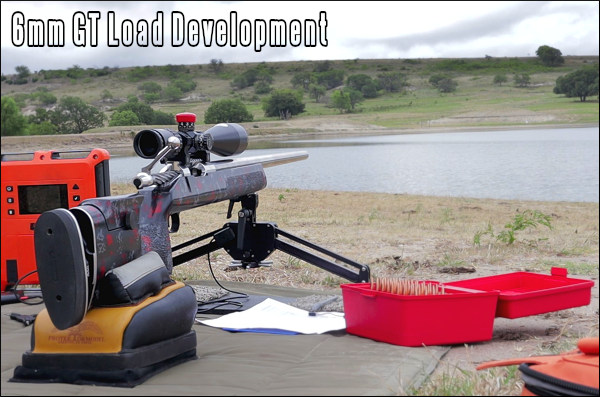
The 6mm GT (aka 6GT) cartridge was conceived as a “bigger Dasher” for PRS and NRL competition. The 6mm GT’s creators wanted 6mm Dasher accuracy and moderate recoil delivered via a cartridge with a slightly longer case body for better mag-feeding, longer neck for seating flexibility, and more moderate pressures. So far the 6GT has performed very well in PRS competition. Today’s story is a bit different — this is about an experiment — running a 6mm GT in an F-TR type rifle. Understand that, under current NRA rules, you may only shoot .223 Rem (5.56×45) or .308 Win (7.62×51), in official, sanctioned F-TR competition, but the 6GT is fine for F-Open. Mike McCasland wanted to see the potential of the cartridge for long-range target shooting, so he put a 6mm GT-chambered Bartlein barrel on a nice custom rifle with McMillan XIT stock and Kelbly F-Class Panda action. The results were impressive.
6mm GT — New Cartridge with Multi-Discipline Potential
Story by Mike McCasland, Texas Precision
The 6mm GT began garnering attention within PRS circles in early 2019. It promised to shoot 105-110gr 6mm bullets at 2950-3000 FPS, yet not suffer from mag-feed issues sometimes found with 6mmBR variants such as the 6 Dasher, 6BRX, and 6BRA. Moreover, since it burned less powder, the 6mm GT promised increased barrel life compared to the 6mm Creedmoor or 6XC. The 6mm GT case size should still work with the accurate powders in the Varget burn-range. I found the 6GT also worked great with H4350.
As someone who aspired to building a repeater and jumping into the PRS game, and had a spare F-TR rifle sitting around, I thought it would be fun to build up a 6mm GT to see if there was any merit to the hype. My smith, Wes Ripley of RIP Precision in Texas, builds a lot of PRS rigs, and already had the reamer on hand (a 0.120″ freebore variant).
Whidden Gunworks had some 6mm GT FL bushing die kits in stock, so I figured why not see what all the fuss was about? At the very least I could play around with the 6mm GT in F-Open Class at local club matches to see how it compared to the 6BRA, 6 Dasher, and other popular 6mm cartridges.
How the Project Got Started with Backup F-TR Rig
My 6mm GT build really started as a project spawned purely from COVID-19 Isolation boredom. This rifle primarily serves as a backup F-TR gun, and it had been relegated to performing some load development on .308 barrels, so I could spin new ones on my main match rifle. The only problem was, I had run out of .308 barrels that needed load development. So, I basically had an ideal test platform just collecting dust in the safe. All I needed was a 6mm GT-chambered barrel, since (like the 6mmBR) the 6mm GT works in a short action with a .308 Win-sized bolt-face.
6mm GT Rifle Specifications:
Action: Kelbly Panda F-Class SA RB/RP
Stock: McMillan XIT with RAD 2A
Barrel: 30″ 5R Bartlein 1:7.5″-Twist, HV Contour
Scope: Vortex Golden Eagle 15-60x52mm
Trigger: Jewell Benchrest, about 2 ounces
Bipod: Phoenix Precision
About the 6mm GT Cartridge
BRASS — The first thing you’ll find is cartridge brass choices for the 6mmGT are rather limited currently. At present, the only commercial options are Hornady and Alpha Munitions. For the die-hard Lapua fans, you can technically make 6mm GT brass from 6.5×47 Lapua, however that process is very labor-intensive.
I have used both Hornady and Alpha brass in this rifle and haven’t noticed much difference between the two. I will say that my batch of Alpha brass was slightly softer than Alpha brass I’ve used in other calibers; you could feel a difference when neck turning cases. I’m unsure if that’s a batch issue, or something specific to their 6mm GT brass as a whole. As far as performance, there was little discernable difference. Oddly enough, the Hornady brass seemed to have slightly less case capacity than the Alpha; with most other cartridges it’s the other way around.
POWDERS — The 6mm GT was designed with Hodgdon Varget in mind, and that popular powder works exceedingly well in this platform. That said, the 6mm GT can work with a wide variety of powders, some yielding better performance than Varget.
I’ve tried a multitude of powders during my initial 6mm GT load development: Varget, Shooters World Precision, RL16, VV N140, H4350, and RL-15 to name a few. In my barrel, Hodgdon H4350 seems to deliver the best velocity/accuracy combination. SD and ES also seemed to be the lowest with H4350.
Load Development for the 6mm GT — Many Powders Tested
BULLETS — The most common 0.120″ freebore chamber allows for the majority of high-BC 6mm projectiles found in both F-Class and PRS. I had good luck with the pointed 107gr Sierra Match Kings (SMK), as well as the 110gr Hornady A-Tips in my rifle. For those looking to run the heavier 112-115 grain 6mm offerings, I believe GAP designed a 0.160″ freebore reamer that gets those bullets out of the neck/shoulder junction. Shown below is the 0.120″ freebore JGS reamer print:
SUMMARY — Good Cartridge with Much Potential
Generally speaking, I think the 6mm GT is a good little round. Some may not subscribe to this theory, but I believe some cartridges are inherently easier to tune than others. I’m not sure the 6mm GT is as easy-to-tune as a 6mmBR, 6 Dasher, or 6 BRA, but I don’t think it lags that far behind.
With relatively little trouble, I was able to find loads with both Varget and H4350 that would consistently shoot very well — 0.2 to 0.3 MOA. Moreover, I found the 6GT cartridge lives up to the velocity claims made by G.A. Precision. I was easily able to push the 110gr A-Tips to 2950 FPS, and the 107gr SMKs to low 3000 FPS range without any pressure signs, or unnecessary wear and tear on the brass.
As a fun test, I ran my 6mm GT rifle in a local 1000-yard F-Class match with the 110gr A-Tips, just to see just how well they would perform. Although wind conditions of the day and some E-Target issues prevented my 6mm GT rig from getting the better of the larger 7mm and .30-Cal rifles, the 6mm GT proved itself an accurate little round at distance. Here is a 1000-yard ShotMarker target:
After putting several hundred rounds through my 6mm GT rifle, I anticipate building another 6GT on a repeater action to give PRS a try. I think if you are looking for a dual-purpose rifle that can run tactical matches (with 100% feeding reliability), and can also be used for mid-range, F-Open Class competition, the 6mm GT would be a very good option.
About the author, Mike McCasland:
Mike McCasland is an avid shooter who competes regularly in F-Class matches. Based in Texas, Mike is the creator of the Texas Precision YouTube Channel. There you’ll find many videos covering reloading, gun projects, and marksmanship. Mike has done some notable product reviews including a comparison test of Micrometer Competition Seating Dies. To access Mike’s YouTube Channel, CLICK HERE.
Brownells is a well-known retailer of guns, gun parts, tools, accessories, ammo, and pretty much everything gun related. What you may not know is that Brownells has a very active video production department that releases new “how-to” and product information videos every week. These videos offer helpful advice on gun cleaning/maintenance, reloading, as well as selecting/assembling components for various kinds of rifles. And every week Brownells serves up a new products video. There now over 1000 videos on the Brownells YouTube Channel, this really is a remarkable resource.
Here are six of our favorite recent videos from Brownells. AR owners will find some good advice on spare parts, new reloaders can learn how to use the OAL tool, and all gun owners should watch the video on ammunition storage.
Introduction to PRS Competition
In this video, Tom Beckstrand, former Special Forces Sniper Team Leader and Guns & Ammo magazine staffer, looks at the Precision Rifle Series (PRS). Tom covers the types of stages in a typical PRS match using unconventional, real-world shooting rests. He also discusses the equipment you’ll need including bag supports, bipods, tripods, and optics. As most ranges aren’t set up for PRS, Tom offers tips on how to train at your local range.
How to Use Hornady OAL Tool and Hornady Bullet Comparator
Gun Tech Steve Ostrem explains how to properly use Hornady’s Overall Length Gauge to determine length-to-land precisely. The OAL Gauge uses a “Modified Case” that theads onto the tool and holds a bullet. Push on the back of the gauge until you feel the bullet just touch the rifling. (We do this gently at first, tapping the rod a couple time to ensure the bullet is aligned correctly). Once you’ve got the length, then use the tool with a comparator on your calipers to get the lenght-to-lands. NOTE: We recommend taking the measurement 3-4 times in a row to get a reliable number. With a little practice your should be able to get repeatable measurements within .0015″.
New Bog Pod Tripod and Caldwell Electronic Muffs
Brownells staffer Paul Levy showcases the impressive new DeathGrip Tripod from Bog Gear. The DeathGrip’s adjustable jaws clamp firmly to the rifle’s forearm. This is a useful device for both PRS shooters and hunters. The head assembly has 25-deg front/rear tilt and 360-deg swivel. And the jaws’ non-slip, rubberized padding won’t scratch that stock. The legs snap open to three pre-set hard stops, and there’s plenty of length extension. Easily switch between rubber feet and steel spikes without removing a single part from the trippod. This video also features Caldwell’s E-Max™ Pro noise-cancelling electronic muffs. These affordable 23 dB NRR units boast dual microphones and digital volume controls, and two sizes are offered — Youth and Adult.
How to Store Ammunition Safely and Securely
Notably, this is the single most popular Brownells video this year, with 494,000 views since March 2020. Here’s the deal — ammunition WILL keep for a long time if you store it properaly. DO store ammunition in a cool, dry place that doesn’t have wide temperature swings. Temperature cycling will also degrade primers and powder. Put it in airtight ammo cans to keep out the moisture. Tupperware containers will work too. Brownells also recommends putting moisture-absorbing silica packs in your ammo containers. DON’T just keep ammo in factory cardboard factory boxes stacked in the basement, attic, or garage — especially not on the floor! The ammunition boxes will absorb moisture which will degrade primers and powder and corrode the brass cases. Yes, sealed military ammo will usually handle this kind of storage for quite a while, but it’s still not wise.
Must-Have Spare Parts for AR-Platform Rifles
This is one of Brownells most popular recent videos, with 154,000 views in just four months. Two gun technicians answer the question: “What spare parts should I keep on hand for my AR-15?” On the list are: Gas Rings, Buffer Spring, Extractor Spring and Pin. NOTE: You may want to try the one-piece spiral gas ring rather than the standard rings which require alignment. The cotter pin and cam pin can also easily get lost when the Bolt Carrier Group is disassembled for cleaning. On the lower receiver you’ll want spare springs and detents for the pivot/takedown pins. If you’re using lighter-power springs, keep standard-power spares on hand. If your rifle stops working, swap in the factory-spec springs to find out if the problem is the gun or your ammo. Also, if you have upgraded your trigger, always keep the original trigger as a backup.
Cleaning Advice for .22 LR Rimfire Rifles
Gun Techs Steve Ostrem and Caleb Savant debunk some myths about cleaning .22 LR barrels. One myth is that cleaning will harm the accuracy of a .22 LR barrel. Caleb thinks this myth is the result of people cleaning a barrel from the muzzle and damaging the muzzle crown, which CAN diminish accuracy. If it’s done right, cleaning won’t damage the bore. However, you certainly do NOT have to clean your 22 LR’s bore every time you go to the range. But DO clean the action every time you shoot the rifle, especially on a semi-auto. What about shooting a lot of lead bullets? Won’t that lead up the bore? The guys give us the straight skinny on lead fouling, too. When you see your .22 LR rifle’s groups opening up, you may want to consider cleaning.
Above is a 26-year-old hand-loaded .300 Winchester Magnum case that failed to fire. After the misfire, the shooter used an inertial (impact) bullet puller to pull the bullet. In the process the case-neck sheared off.
Here’s a cautionary tale from the Tactical Rifle Shooters Facebook group. This real-world example explains why you should be cautious of old ammunition. Here serious internal corrosion was discovered.
Old Ammunition — Why You Should Be Careful
Commentary byTactical Rifle Shooters
The subject often comes up as to whether it is safe to shoot old ammunition. Historically my answer has always been yes, since over the years I have shot military surplus ammo dating back to World War II (1939-1945) and never had a problem. With over 40 years in competitive shooting, I’ve also had boxes of factory ammo that were 30+ years old and all worked flawlessly.
But I had an interesting experience this week shooting some .300 Winchester Magnum (WinMag) that I had loaded for competition with Reloder 22 back in 1993. I was breaking in a new barrel so just shooting any old ammo that I had. Of the 20 rounds, 15 shot perfectly, three had a fraction of a second hang-fire, and two didn’t shoot at all.
SMART TIP: If you have old ammunition, pull one bullet to see what’s going on inside.
So I pulled the bullets using a hammer-type impact (inertial) bullet puller. What I found was verdigris-like corrosion inside the necks, with one neck completely separating. One reason for this could be that dissimilar metals (copper and brass) can set up a reaction resulting in corrosion. Like I said, this is the first time I’ve seen this, but will definitely be more aware when shooting old hand-loads in the future.
Above is one of the 26-year-old reloaded .300 WinMag cartridges which had failed to fire. To check the internal condition, the bullet was removed using an impact (inertial) bullet puller. Note the verdigris-like corrosion and crack in neck.
Here’s a close-up of the same .300 Winchester Magnum hand-load from 1993 showing serious corrosion inside the neck. (This was a fail-to-fire.) The powder was Alliant Reloder 22. If you have old ammo, it wouldn’t hurt to pull one bullet to see what’s going on inside.
Even with surging firearms sales in 2020, Remington Arms Company (Remington) found itself in financial trouble — with overwhelming obligations to creditors and investors. Accordingly, on July 27, 2020, Remington filed for Chapter 11 Bankruptcy — the second time in recent years.
Remington, based in Madison, North Carolina, filed for Chapter 11 in March 2018. With major loan reorganizations, Remington “emerged nearly two months later, having converted more than $775 million in debt into equity for its lenders.” (Source: Syracuse.com.) However, despite this debt-restructuring, the company has struggled with high interest costs and litigation related to the 2012 Sandy Hook Elementary School shooting. The perpetrator had a Bushmaster XM15-E2S rifle sold by Remington.
This time, there are more challenges — and it’s unclear how the company’s operations will fare in the months and years ahead. According to the Wall Street Journal, the debt-burdened firearms maker will seek buyers for its assets:
Remington Arms Declares Bankruptcy Despite Surging Gun Demand
Firearms maker Remington Arms Co. filed for bankruptcy protection for the second time since 2018, weighed down by more debt than it can repay even as fearful Americans buy more guns than ever.
Remington … sought chapter 11 protection and will try to sell its business at a time when civil unrest and worries about personal safety have driven firearm sales to record highs.
The chapter 11 petition in the U.S. Bankruptcy Court in Decatur, Alabama, marks Remington’s second restructuring since 2018, when it filed for chapter 11 and transferred ownership to investors including Franklin Resources Inc. and JPMorgan Chase & Co.
Remington has been searching for potential buyers and was in talks to sell itself out of bankruptcy to the Navajo Nation before negotiations collapsed in recent weeks, leaving the company without a lead bidder, or stalking horse, in place.
The manufacturer’s firearms and ammunition businesses could be sold off separately, according to a person familiar with the matter.
Remington Has a Storied History
Founded in 1816 by Eliphalet Remington in New York, Remington is the oldest continuously-operating gun manufacturer in the United States. Even with its present difficulties, Remington still sells more sporting rifles and shotguns than any other American company. Remington has developed more cartridges than any other U.S. company. And it is the only American company that sells firearms AND ammunition under its own name.
In June 2020, Hornady introduced the 6mm ARC, a new SAAMI cartridge optimized for AR-platform rifles*. The new 6mm ARC is basically a 6.5 Grendel necked down to 6mm, with the shoulder moved back around .030″. That pushed-back shoulder does reduce case capacity (and velocity), but we assume Hornady did that to create a shorter, proprietary chamber so people could not simply neck-down Lapua 6.5 Grendel brass, as has been done for years with Robert Whitley’s outstanding 6mm AR wildcat.
What Is the 6mm ARC Cartridge? The 6mm ARC cartridge is a new SAAMI-spec cartridge based on the 6.5 Grendel case necked down for 6mm bullets, with the shoulder moved back 0.030. Yes it is designed to run in AR15-platform rifles. You’ll need a new barrel, bolt, and mags. If you already have an AR chambered in 6.5 Grendel, the ONLY thing you need to change is the barrel. Everything else — bolt, magazines, gas system – is compatible with 6mm ARC.
▶ Official SAAMI Cartridge (not wildcat)
▶ Fits standard AR15-platform rifles
▶ Fits Short/Mini action bolt rifles
▶ Efficient short, fat case design
▶ 30-degree case shoulder
What Do I Need To Shoot the 6mm ARC?
Faxon and Ballistic Advantage are already producing barrels, with more manufacturers sure to follow. All the other required components are already on the market for 6.5 Grendel rifles. Aero Precision already offers complete 6mm ARC uppers.
If you’re converting a standard 5.56×45 mm (.223 Rem) AR15 upper to shoot 6mm ARC, you’ll need a 6mm barrel, a Type II 6.5 Grendel bolt carrier group, and new magazines. Some folks have suggested standard AR mags will work, but trust us, you want the magazines that have been designed for 6.5 Grendel. All the hardware you need is currently available at Brownells. And Brownells also sells complete Aero Precision 6mm ARC Uppers, starting at $749.99.
* While 6-6.5 Grendel shooters are known to run stout pressures, the new 6mm ARC cartridge has a relatively moderate Maximum Average Pressure (MAP) rating of 52,000 psi according to the official SAAMI specifications. For a variety of reasons, is wise to keep pressures in a semi-auto rifle moderate. Don’t chase the velocities you might get in a bolt-action gun.
Do you own an M1 Garand, or have you always wanted to acquire one of these legendary semi-auto battle rifles? Well then here is a valuable new resource: The Essential M1 Garand: A Practical and Historical Guide for Shooters and Collectors. This new book by Jim Thompson covers the history of the M1 Garand, and offers practical advice for Garand owners, along with complete parts lists. The book includes annotated military and National Match manuals, a troubleshooting chart, and a section on hand-loading for the Garand. The final Section addresses common questions about the rifle and offers detailed instructions for maintaining this wartime classic. First published in February, 2020, The Essential M1 Garand is available in Print Paperback and Kindle eBook versions. View Table of Contents.
Recommended M1 Garand Manual
Along with The Essential M1 Garand book by Jim Thompson, there are many other good M1 Garand print resources. Among the many M1 Garand manuals available, we recommend the CMP’s U.S. Rifle, Caliber .30, M1: ‘Read This First’ Manual. This booklet covers take-down, reassembly, cleaning, lubrication, and operation. The manual comes with CMP rifles or can be purchased for $3.25 from the CMP eStore. The CMP also offers many other M1 Garand print resources including:
We’re saddened to announce that noted gunsmith Donald “Stick” Starks passed away last Wednesday. He succumbed to COPD, a disease he’d struggled with for many years. Stick Starks was respected as a knowledgeable gunsmith who built very successful competition rifles, and help popularize many innovative smithing techniques. As proprietor of S&S Precision Rifle in Texas, Stick built great rifles, and helped many folks get their start in competitive rifle shooting. In this Forum Thread, many folks recounted memories of Stick and expressed their sadness at his passing…
“Stick was a great friend and gunsmith. He will be missed.” — Chris Covell
Online Memorial for Donald “Stick” Starks
There will be an online memorial service for Stick Starks on Wednesday, July 15, 2020. This will work via the Zoom video meeting service. This may require you to install some software.
This video shows Stick Starks at his very best, building a rifle with great attention to detail. He did superb chambering and metal work and his bedding jobs were as good as it gets.
Remembering Donald “Stick” Starks…
Eric Kennard posted: “I learned my good friend Don “Stick” Starks died … after a several year battle with COPD. Stick was an amazing and innovative gunsmith. He was a Master Machinist who built engines for dragsters and race boats in his past years. Stick was ornery as all get out. I will truly miss him. He built all of Kenny Adams’ rifles that led Kenny to becoming the 2013 World F-Class Champion. God Speed Stick.”
Forum member Thud added: “My best recollections of Stick is his helping both new and seasoned shooters. They would see him at the range or a match and make a bee line to talk to him. He would listen to their problems or ideas and comment on them. There were customers that would call several times a day just to talk, He always made a few minutes available to them so they flounder. For anyone who had a problem with their rifle — he was always will to help both at the range or in the shop. He was a easy-going guy yet a serious guy who would help anyone if you needed it.”
Forum member Bill (Boiler_House 7) praised Starks’ skills: “Don was such a nice guy and a super good friend. Some may not know this but he was a super talented automotive machinist back in the day as well. He turned out a lot of quality work on race motors at ABC performance in Odessa, Texas. Don is going to be missed by a lot of people he influenced with his knowledge through the years. RIP my friend.”
“Stick was the one who shoved me off the bank into the deep water of accurate rifles, and competitive shooting. The stainless steel Stiller Viper and red Robertson-stocked gun he built [for me] is truly a prized possession. I am really sad to see him go. May his breathing be easy now.” — D. Martin
We have always liked Tikka actions, and now there is a great re-barreling option for Tikka T3 owners. Criterion Barrels Inc. (CBI), makers of “pre-fit” barrels for Savage, Remington, and Rem-clone actions, also produces Tikka pre-fits. These pre-chambered barrels for Tikka T3 actions will be headspaced with a barrel nut, just like a Savage.
Click image for full-screen version
Criterion’s Tikka T3 pre-fit barrels are currently sold through Solid Accuracy, a respected Texas-based outfit that sells high-end scopes, stocks, barrels and other rifle components. Solid Accuracy states: “Each Solid Accuracy/Criterion pre-fit barrel features a hand-lapped bore and meets extreme quality control standards. Utilizing a proven barrel nut design, these barrels can be swapped in just a few minutes using only a barrel nut wrench and the appropriate headspace gauge set. Solid Accuracy offers finished lengths up to 30″ with multiple contour options.”
These Tikka pre-fits were introduced in 2017, and the accuracy results were impressive. Solid Accuracy’s initial test rifle featured a Tikka T3 action mounted in a KRG X-Ray chassis, with Criterion barrel chambered in 6.5 Creedmoor. The group below was shot with a stout load of H4350 and Sierra 140 grain MatchKings seated .009″ in the lands.
Criterion is proud of how well the Tikka pre-fit project turned out. These barrels work great in the Tikka platform. One of Criterion’s staffers was so impressed with the initial test results that he is built his own Tikka T3 rifle, with a Criterion pre-fit of course…


 As someone who aspired to building a repeater and jumping into the PRS game, and had a spare F-TR rifle sitting around, I thought it would be fun to build up a 6mm GT to see if there was any merit to the hype. My smith, Wes Ripley of
 BRASS — The first thing you’ll find is cartridge brass choices for the 6mmGT are rather limited currently. At present, the only commercial options are Hornady and

 SUMMARY — Good Cartridge with Much Potential




 Online Memorial for Donald “Stick” Starks


