|
|
November 15th, 2019

Can you really make a silk purse from a sow’s ear? Would you believe a winning benchrest rifle could be constructed with a stock fashioned from a cast-off log-splitter? Well it can.
Anyone who has attended an IBS benchrest match knows that this brotherhood of shooters includes some “backyard engineers” who can build amazing things with low-cost components. Consider Steve Jordan. He has built a winning Heavy Gun with a gunstock made out of a wood splitter. Check out the photo. The butt section is in the shape of a “V” like an ax. The “V” sits on an adjustable, flat rear sandbag. The flat shaft of the wood-splitter, running horizontally, serves as the main chassis and fore-end. The barrel block sits on top (with the action floated), while the flat, forward section of the shaft rides the front bag. Not only does this “log-splitter” stock work, but Jordan has won IBS matches with it! Sometimes simple and cheap beats expensive and fancy.
Sam Hall Says the Log-Splitter Has Been “Kicking Our Tails”
Sam Hall (multi-time IBS 600-yard champion) reports: “I was not at the first match (years ago) where Steve Jordan debuted his barrel-blocked, Heavy Gun stock made out of a wood splitter. From what I heard he cleaned house with it that day. When I first heard about this log-splitter rig, I thought guys were pulling my leg. But the log-splitter Heavy Gun really exists. In fact, over the past two years at Piedmont, Steve’s home-built log-splitter HG has won numerous Heavy Gun matches, out-performing nearly all the other Heavy Guns on the line, even those that cost thousands more to build.
Steve made the rifle as economical as possible. Steve’s entire stock is made from a metal wood splitter. From what I understand, Ray Lowman gave him the barrel block. This rides on the shaft of the wood splitter. With this inexpensive, simple rig Steve has kicked our tails at times! By the way, Steve’s Heavy Gun is chambered as a 6mm Dasher.”

November 10th, 2019


One of the most popular features of our Shooters’ Forum is the Official ‘Pride & Joy’ Rifle thread. There you’ll find dozens of interesting rifles, with photos and descriptions supplied by proud owners. Today we’re spotlighting one of the more interesting ‘Pride & Joy’ rifles unveiled this year, a Mosin Nagant “senior citizen”. This 72-year-old Russian bolt gun is not like any Mosin Nagant you’ve ever seen before. It has been brought into the 21st Century with a handsome target stock and some first-class upgrades, including Lothar Walther barrel and Timney trigger. Here’s a look at a very nice Russian rifle, belonging to Forum member Ben C. (aka “Grimstod”):
Video Shows Rifle Shooting Sub-Half-MOA from Bipod (in the Snow):
Name of rifle: Smyert Mk3 (Modified Mosin Nagant)
Make: Izhmekh/Izhevsk (“Izzy”) High Wall
Model: 91/30 | Year: 1942

Components and Specifications:
Barrel: Lothar Walther 26″
Contour: 1.18″ straight
Chambering: 7.62x54R, .310 bore
Stock: Bluegrass Tactical (Gen 1 & 2)
Trigger: Timney with Bluegrass trigger shoe
Magazine: Finnish No-Jam magazine |
Scope mount: Rock Solid (looks like an action sleeve)
Scope: SWFA 20x42mm MRAD
Gunsmith: Sheppard
Bolt handle: Rock Solid with Surgeon tactical handle
Bipod: Versa Pod
Total Weight: 18.6 lbs |


Grimstod’s Mosin Nagant Custom Shoots Under 0.5 MOA From Bipod
Even in harsh winter conditions, the rifle shot well. (I guess we should expect that for a Russian gun). The photo below shows a group shot from bipod. (The video shows Grimstod’s snow-bound range session). Grimstod calculated the group at 0.394 MOA measuring from outside edge to edge. Using our On-Target software, which measures center to center of most distant shots, we came up with 0.428 MOA. Still that’s impressive for an ancient action being shot in the dead of winter with snow falling. To learn more about this rifle (and view photos of the build process), visit the SurplusRifleForum.com.

November 3rd, 2019

High-Tech Hunter in .300 WSM
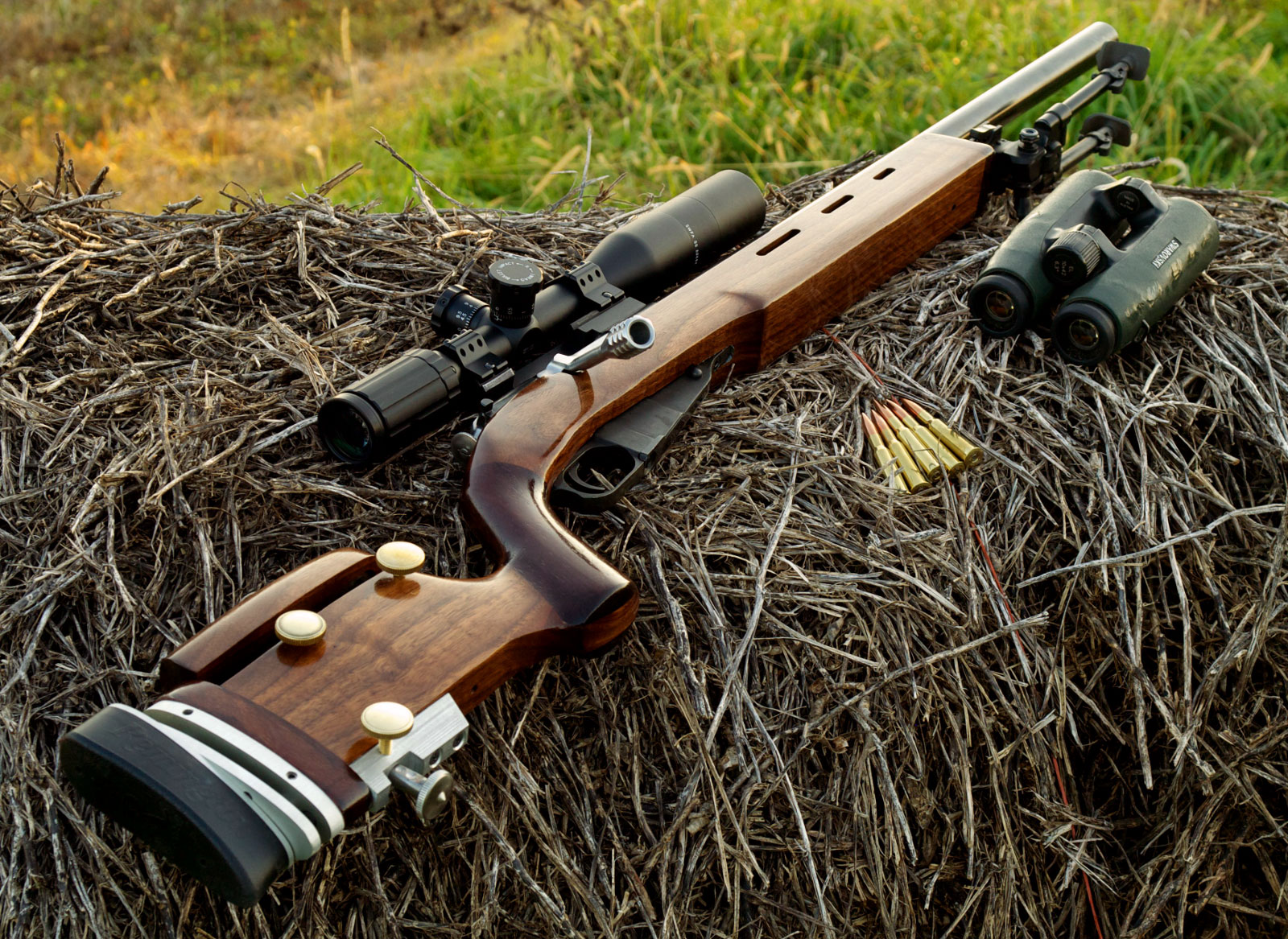
Since its introduction in 2001, the .300 Winchester Short Magnum (.300 WSM), has proven very popular for hunting and long-range competition. The case has ample capacity to drive the heavy .30-caliber bullets, and with proper case prep and annealing, the WSM is capable of outstanding accuracy. When Nebraskan Greg Anderson decided to build his “ultimate long-range hunter”, he selected the .300 WSM for its accuracy and its ability to drop large game at long distances. Teaming up with Chris Matthews of LongShot Rifles, Greg developed an impressive long-range hunting rig, with high-tech components to reduce weight. The 26″ barrel is a carbon-wrapped composite over a Rock Creek stainless blank. The carbon technology saved about 3 pounds over an all-steel barrel of similar length/contour.

The Manners Composite stock also features carbon fiber construction for stiffness and reduced weight. Greg’s carbon/carbon rifle tips the scales at just 10.8 pounds, including scope and bipod. A conventional rig could easily weigh 15 pounds or more. Greg’s carbon hunter has proven accurate as well as innovative. With 175gr Sierra MKs, the gun shoots well under 1/2-MOA out to 600 yards and beyond.
The Ideal Spot and Stalk Rifle
by Greg Anderson
The purpose of this project was to create a hunting rifle that would be inherently accurate at long range and have an acceptable weight for hunting in rough country. I researched the question of overall weight with several gunsmiths. The smiths confirmed that while fat-contour barrels could deliver improved accuracy, there was a price to pay and a lot more weight. With a heavy barrel, the finished rifle would be most likely weigh about 15 pounds. That’s more than I wanted to haul around in the field. To reduce barrel weight, the suggested “traditional” solutions were fluting, which would reduce barrel weight by at least one-half pound, or going with a smaller diameter barrel.
The Quest for Reduced Weight without Accuracy Loss
Fluting didn’t promise enough weight savings, and a slim, sporter barrel probably wasn’t going to deliver the kind of consistent accuracy I wanted (particularly as the barrel heated up). Accordingly, I decided to “think outside the box”. My research on lightweight barrel options lead me to Advanced Barrel Systems, (ABS) a company in Lincoln, Nebraska that once produced custom carbon-wrapped barrels. ABS President Mike Degerness could wrap a barrel to virtually any shape and diameter, allowing great stiffness even with a huge reduction in barrel weight. As the “core” for his carbon-wrapped barrels, Mike recommends a cut-rifled blank made by any of the quality cut-barrel makers. [NOTE: ABS is not taking orders at this time. You cannow get excellent carbon-wrapped barrels from Proof Research].

Significant Weight Saving with Carbon
How much weight can you save with a carbon-wrapped barrel? Well a 24-inch, #7 contour ABS carbon-wrapped barrel will weigh about 2.5 pounds compared to about 5.5 pounds for a steel barrel of the same length and contour. So, this means that you can put a fat, stiff competition-contour barrel on your hunting rifle and save over half the barrel weight compared to an all-steel barrel. Saving three pounds is a blessing when you’re carrying the rifle all day long in the field. I placed an order for a 30-caliber Rock Creek barrel blank with an 1:11.25″ twist and a finished length of 26″. Mike wrapped the barrel and finished it to an M24 contour.
Carbon Can Also Improve Barrel Vibration Damping
One interesting benefit of carbon barrel-wrapping is that the carbon components have a vibration-dampening effect. According to ABS, the extreme rigidity of the finished composite barrel dampens the vibration nodes of the barrel making it shoot like a plain steel barrel of much greater mass. Carbon fiber has a high modulus of elasticity that has the effect of lowering the amplitude of the vibration of the barrel when fired. This is what makes the ABS barrels perform so well, according to Mike.

Impressive Accuracy For a Hunting Rifle
Looking at the targets below, one may ask, “Does the rifle always shoot this well?” The answer, not surprisingly, is: “it depends on the trigger-puller”. The rifle is capable of outstanding accuracy. But it took some time and effort for me to develop the skills required to shoot up to the rifle’s inherent accuracy. I nearly always practice prone from bipod. Initially, I was getting horizontal stringing until I changed my grip and learned to be more consistent from shot to shot. Shooting a heavy-recoiling .30-caliber rifle from the ground is not the same as shooting a .223 Rem from the bench.
| 3-Shot Group at 200 yards | 6-Shot Group at 500 Yards |
  |

Completing the Project Build
To smith the rifle, I selected Chris Matthews of LongShot Rifles, LLC because of his expertise with the WSM cartridges and long-range shooting equipment. Because cost was a factor, we decided to use a donor Remington long action that had been used on a Remington 7mm magnum. Chris trued the action and we had Dave Kiff from Pacific Tool & Gauge grind us a bolt to fit the action more perfectly. Chris chambered the Rock barrel and installed a .300 Badger recoil lug.
Carbon-reinforced Hunting Stock from Tom Manners
Being a fan of carbon fiber technology, I selected an MCS-T stock from Manners Composite Stocks. These stocks have an extremely high strength-to-weight ratio and the high comb of the MCS-T gave an almost perfect alignment with the scope. The finished rifle was topped off with a Leupold 4.5-14x40mm LR scope equipped with M1 windage and elevation turrets. A Harris bipod completed the package. All up, including scope, steel rings, and bipod, my .300 WSM rifle with 26″ barrel weighs 10.8 pounds.

Load Development for Accuracy
I developed a load using 63.0 grains of H4350, 175gr Sierra Match Kings with Federal 210M primers in Winchester-brand brass. This load gives 2960 FPS out of my rifle. The load would shoot sub-MOA from bipod from 100 yards to 600 yards and was adopted as the “go to” load. I have also tried the 208gr Hornady A-Max in this gun. The A-Maxs shot well but the Sierras work well for everything (paper punching and hunting) so the 175gr SMK is my bullet of choice.

Brass Prep and Annealing Are Very Important
The Winchester-brand brass is good, but you have to prep it thoroughly if you want good results. My brass prep consisted of turning the necks, de-burring the flash holes (inside and out), and chamfering the case necks. Using a Sinclair neck-turning tool, I turn the necks to .0135″ per side. That provides a complete clean-up of the necks, which run about .015″ neck-wall thickness out of the box.
 One thing I’ve learned to do is anneal the brass every 3-4 firings. I started to do that after I noticed that the force required to seat bullets became inconsistent after just a few loading cycles. I also experienced flyers that were going out of the group for no apparent reason. Annealing the cases every 3-4 firings has eliminated most of the unexplained flyers and annealing has also made bullet seating much, much more consistent. I’ve also noticed a significant improvement in my groups at 500 and 600 yards now that I anneal regularly. Group sizes at 600 yards can be as much as 2″ smaller with annealed brass than with un-annealed, work-hardened brass. One thing I’ve learned to do is anneal the brass every 3-4 firings. I started to do that after I noticed that the force required to seat bullets became inconsistent after just a few loading cycles. I also experienced flyers that were going out of the group for no apparent reason. Annealing the cases every 3-4 firings has eliminated most of the unexplained flyers and annealing has also made bullet seating much, much more consistent. I’ve also noticed a significant improvement in my groups at 500 and 600 yards now that I anneal regularly. Group sizes at 600 yards can be as much as 2″ smaller with annealed brass than with un-annealed, work-hardened brass.
Greg Anderson was successful with his .300 WSM on his very first hunt, dropping a nice buck at 364 yards. Chris reports: This was on some private land in Nebraska. As daylight faded… there were a couple of bucks, but one looked to be the best of the lot. The buck gave me a broadside shot ranged at 364 yards. I settled behind the scope and took one shot. It hit right where I aimed and the buck just folded.”

October 31st, 2019

Most of us own a .223 Rem rifle. Now, thanks to our friends at Rifleshooter.com we can assess exactly how velocity changes with barrel length for this popular cartridge.
Rifleshooter.com performed an interesting test, cutting the barrel of a .223 Rem rifle from 26″ all the way down to 16.5″. The cuts were made in one-inch intervals with a rotary saw. At each cut length, velocity was measured with a Magnetospeed chronograph. To make the test even more interesting, four different types of .223 Rem/5.56 ammo were chron’d at each barrel length. The Rifleshooter.com team that conducts these tests has a full-service gun shop, 782 Custom Gunworks — visit 782guns.com.
READ RifleShooter.com 5.56/.223 Barrel Cut-Down Test Article.
Test Barrel Lost 25.34 FPS Per Inch (.223 Rem Chambering)
How much velocity do you think was lost, on average, for each 1″ reduction in barrel length? The answer may surprise you. The average speed loss of the four types of .223/5.56 ammo, with a 9.5″ shortening of barrel length, was 240.75 fps total (from start to finish). That works out to an average loss of 25.34 fps per inch.
| 5.56/.223 Barrel Cut-Down Speed Test 26″ to 16.5″ |
Start FPS at 26″ |
End FPS at 16.5″ |
Total Loss |
Average Loss Per Inch |
| UMC .223 55gr |
3182* |
2968 |
214 |
22.5 FPS |
| Federal M193 55gr |
3431 |
3187 |
244 |
25.7 FPS |
| Win m855 62gr |
3280 |
2992 |
288 |
30.3 FPS |
| Blk Hills .223 68gr |
2849 |
2632 |
217 |
22.8 FPS |
*There may have been an error. The 25″ velocity was higher at 3221 fps.
Rifleshooter.com observed: “Cutting the barrel from 26″ to 16.5″ resulted in a velocity reduction of 214 ft/sec with the UMC 223 55-grain cartridge, 244 ft/sec with the Federal M-193 cartridge, 288 ft/sec with the Winchester M855 cartridge and 217 ft/sec with the Back Hills 223 68-grain match cartridge.”
How the Test Was Done
The testers described their procedure as follows: “Ballistic data was gathered using a Magnetospeed barrel-mounted ballistic chronograph. At each barrel length, the rifle was fired from a front rest with rear bags, with five rounds of each type of ammunition. Average velocity and standard deviation were logged for each round. Once data was gathered for each cartridge at a given barrel length, the rifle was cleared and the bolt was removed. The barrel was cut off using a cold saw. The test protocol was repeated for the next length. Temperature was 45.7° F.”
CLICK HERE to Read the Rifleshooter.com Test. This includes detailed charts with inch-by-inch velocity numbers.
See More Barrel Cut-Down Tests on Rifleshooter.com
Rifleshooter.com has performed barrel cut-down tests for many other calibers/chamberings including 6mm Creedmoor, .308 Winchester, and .338 Lapua Magnum. See these test results at Rifleshooter.com.

Much Different Results with 6mmBR and a Longer Barrel
The results from Rifleshooter.com’s .223/5.56 test are quite different than the results we recorded some years ago with a barrel chambered for the 6mmBR cartridge. When we cut our 6mmBR barrel down from 33″ to 28″ we only lost about 8 FPS per inch. Obviously this is a different cartridge type, but also our 6mmBR barrel end length was longer than Rifleshooter.com’s .223 Rem start length. Velocity loss may be more extreme with shorter barrel lengths. And, of course, different cartridge types and powder/bullet combinations will yield different results.
October 29th, 2019
 This one-of-a-kind .50-caliber rifle was crafted by the late J.T. Smith. Along with the lever-actuated falling block, it has a massive swing-out breech block — like an artillery piece. This one-of-a-kind .50-caliber rifle was crafted by the late J.T. Smith. Along with the lever-actuated falling block, it has a massive swing-out breech block — like an artillery piece.
Beautiful and Historic Firearms
We’ve collected some of the most eye-catching firearms featured on AccurateShooter.com over the past decade. There are famous pistols, a shotgun owned by a princess, the fanciest Savage ever made, and some beautiful examples of engraving and stock-making. Enjoy this collection of firearms eye candy.
Centennial 1911 from Colt — Marking 100 Years
In 2011, to celebrate the 100th birthday of the 1911 hangun, Colt created a spectacular, fully-engraved “Anniversary Edition” pistol. J.M. Browning’s 1911 pistol was officially adopted by the U.S. Army on March 29th, 1911. {The U.S. Marine Corps and U.S. Navy adopted the 1911 pistol roughly two years later). This Centennial 1911 is pimped to the max, complete with gold inlay and genuine ivory grips.

Savage President’s Engraved Savage 99 Rifle
When you run the company, you get some pretty nice stuff — in this case you get what may be the most elegant Savage ever made. This rifle was created for Joseph V. Falcon, who served as President of Savage Arms. This highly embellished Savage 99 lever-action rifle is chambered for the .300 Savage. It features deluxe checkering and gold inlays.

World’s Most Perfect Colt Paterson — Worth Nearly $1 Million
This 1836 Colt Paterson Revolver sold in 2011 for $977,500 at auction. That set a world record (at the time) for the sale of an American firearm. The very rare, ivory-gripped Texas Paterson Revolver, with a 9-inch barrel and attached loading lever, is the finest known surviving example of Samuel Colt’s first revolver, produced in Paterson, New Jersey.

Stunning Engraved Trio — Colt, Mauser, and Luger
Here is a matching set of three three beautifully engraved pistols by the late Indiana engraving wizard Ben Shostle — a Luger, a Mauser, and a diminutive Colt. By themselves, these three matching pistols would make a prized handgun collection. Photo courtesy Amoskeag Auction Company.

Princess Diana’s Westley Richards Shotgun
This stunning Westley Richards & Co. shotgun was made for the 1981 nuptials of Lady Diana Spencer and HRH Prince Charles. It is rare, has a unique history of ownership, and is also elaborately decorated.

Butch Cassidy’s Colt Wheelgun
This revolver isn’t so pretty, but it has an impressive heritage — it belonged to Butch Cassidy. Butch Cassidy’s famous “Amnesty Colt” Revolver sold to a foreign museum for $175,000. The handgun was offered as part of a collection of Western guns and memorabilia auctioned in Casitas Springs, California.

The Right Stuff — Chuck Yeager’s Gold-Plated Beretta
Here’s another pistol with a famous owner “The Right Stuff” Pilot, Chuck Yeager, the first human to break the sound barrier. This Beretta has extra value because it was owned by pilot Chuck Yeager. Photo NRA Museum.

Stunning Mauser Custom — Master-grade Wood and Steel
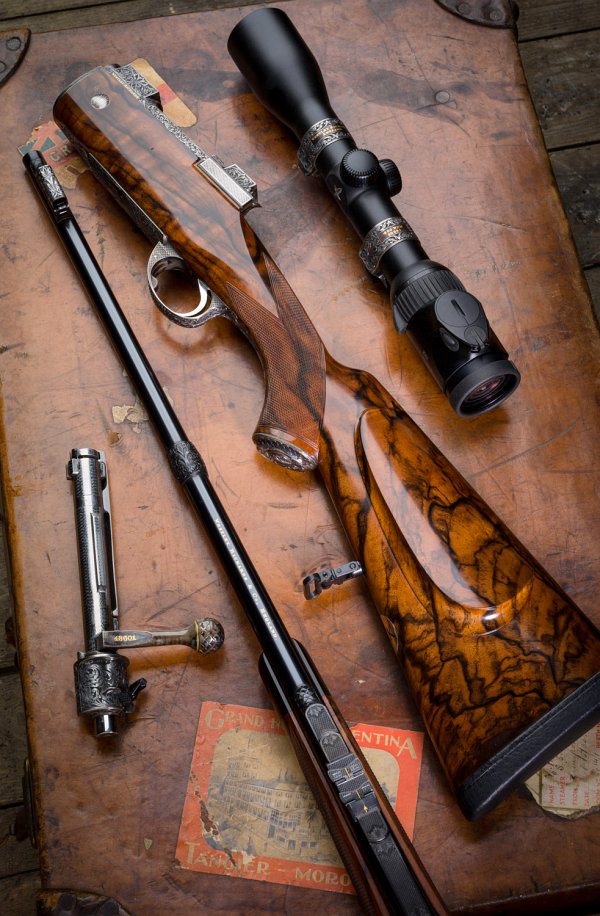
Forum member Kurz posted a dream gun owned by a friend in England. Kurz included a quote from a book created by the rifle’s owner: “There, with my father’s words ringing in my ears, I shall take that ‘step forward’ and order a perfect machine based on the Mauser ’98 action, built from metal and wood by master craftsmen who truly understand that ‘reliable’ and ‘mechanical integrity’ have as much relevance today as they did all those years ago.”
October 27th, 2019

Shoot Rimfire Ammo from your Centerfire Rifle
Wouldn’t it be cool if you could shoot .22 LR rimfire ammo from your regular hunting or tactical rifle? That would be ideal for low-cost training right? Well, this IS possible, provided you have a rifle that was designed with a .22 LR conversion in mind. One such firearm is the remarkable Sauer 202 from Germany. This impressive centerfire rifle is available with a factory-engineered .22 LR rimfire conversion. Read on to learn how Sauer’s cool .22 LR conversion works.
Sauer 202 Rifle: .308 Win/6.5×55 with .22 LR Conversion
Forum member “Tooms” sent us a report on his very special Sauer 202 with a .22 LR conversion kit. Sauer 202 rifles feature a “Quick-change barrel system”. The barrel is clamped into the receiver with crossbolts providing tension. This allows barrels to be swapped in a few minutes with simple tools. NOTE: This conversion kit was originally designed for the Sauer 200 STR, but because the Sauer 202 shares virtually the same design for the action/bolt/magazine, the system works for the 202 as well.
Tooms, from Denmark, explains: “The rifle began as a Sauer 202 Avantgarde Gold in .308 Win. I have added a 6.5×55 match barrel, plus a wide flat-bottom match fore-arm with rail for handstop and bipod. The .22 LR system [originally] cost $1000.00 [including] barrel, bolt, magazine well assembly, and magazine. The barrel is attached by three cross-bolts and the magazine well assembly is attached by one screw that fits into the barrel.”


Using this “Quick-change system”, Tooms can easily remove his centerfire barrel and swap in a .22 LR barrel. Then he places the factory conversion kit into the magazine well. This kit provides a rimfire bolt, a fitted sleeve for the rimfire bolt, and a magazine housing. This is a full Sauer factory-designed system so it works flawlessly. With the bolt closed, you can see the “new” .22 LR chamber in the front section of the loading port. On the silver section of the bolt you can see the rimfire extractor on the side.

 The .22 LR Conversion Really Works The .22 LR Conversion Really Works
The Sauer 202 Varmint rifle shoots very well with the .22 LR conversion, as the 50m target at right shows. Though quite expensive, the conversion kit essentially transforms your centerfire rifle into fully functional, mag-fed precision rimfire rifle. That makes the Sauer 202 much more versatile as a hunting platform. It also allows you to cross-train with inexpensive ammo. You don’t have to purchase another scope, trigger, or stock. And you enjoy the exact same stock fit and ergonomics whether you’re shooting centerfire or rimfire. In some countries where gun ownership is severely restricted, it may be easier, from a legal standpoint, to purchase a .22 LR conversion kit than to obtain a permit for a second rifle.
Comments from Readers about .22 LR Conversions:
“I had a Sauer 200 STR with the .22 LR conversion and a .308 Win barrel kit. I can attest to the accuracy of both systems. The .22 LR would easily hold 1/2 MOA or better out to 100 yards. I now have the .22 LR conversion in my Sig SSG 3000 (same action as the Sauer 200TR and the Sauer 202 listed here). The action and trigger are as good as any I have ever used to include custom actions, AIAW, AIAT, TRG22. I never had 1 malfunction from the .22 LR over many thousands of rounds. They are truly top shelf systems!” — Jesse Bell
“Blaser made a .22 LR conversion kit for the R93 for a few years. It was available in 17 HMR, .22 LR, and .22 Magnum. My 17 HMR version has fired well over 17,000 rounds at prairie dogs and has scored kills in excess of 250 yards on many occasions. Possibly the best thing ever for practicing with your big game/match rifles.” — Captain Dave Funk
The Sauer 202 rifle line-up has been replaced by the Sauer 404 series which has much in common. To learn more about the complete line of Sauer rifles visit the J.P. Sauer USA website. You’ll also find more information on the primary J.P. Sauer & Sohn German website, www.Sauer.de. Though out of production, some Sauer 202s are still for sale at EuroOptic.com.
October 24th, 2019

A fire consuming the Pac-Nor Barreling Oregon factory was the lead story for the Curry Coastal Pilot.
The Pac-Nor Barreling production center in Oregon burned to the ground yesterday morning, October 23rd. The 7000-square-foot barrel-making facility located near Brookings, Oregon, was destroyed in a massive fire that apparently started with an electrical fault. There were nine workers in the facility at the time the fire broke out. All exited the building safely.
Millions of dollars of production machinery and barrels were lost in the fire. The Pac-Nor facility is insured, but Pac-Nor owner Chris Dichter said he was not sure if the plant would be re-built: “Thirty-five years of my life went up in this fire. I am 66 years-old and I don’t know if I have the time left. It took my lifetime to find all the machinery in this plant.”
UPDATE 10/26/19: Our Forum members contacted Pac-Nor and learned that the Dichters plan to rebuild the facility: “I got an e-mail from Kathy Dichter and she said six months to a year to rebuild, hopefully. She also said you could follow their progress on Facebook. That’s great news for the shooting community.”
The building and machinery inside were worth between four and six million dollars, Dichter estimated. There is insurance, but it is not clear whether Pac-Nor will resume production in the future.
How did the fire start? Chris Dichter said there were sparks when an electical conduit for a lathe was removed from a wall socket. Then when power was shut off from the main breaker, there was a blast of flame from the wall, almost like an explosion. Dichter declared: “I’d never seen anything go like that. It blew up with smoke and fire. It sounded like a tree fell on the plant.”
We recommend you read this story — it provides the most information on how the fire started. Pac-Nor owner Chris Dichter is quoted extensively.
This story has the most complete collection of Pac-Nor fire photos.
Early report with six Pac-Nor Fire photos.

Pac-Nor Barreling Inc., founded in 1985, was a major producer of precision rifle barrels in North America. Pac-Nor offered a huge variety of barrel lengths and contours, and had a vast selection of reamers for chamberings from .17 to .50 caliber. Pac-Nor was also well-known for its popular pre-chambered, “pre-fit” barrels. These provided affordable accuracy upgrades for factory rifles. This Editor has a Pac-Nor 3-groove 6mmBR pre-fit barrel that proved superbly accurate. That barrel, and the Savage rifle to which it was fitted, helped inspire this website, which started as 6mmBR.com.
October 17th, 2019

Here is the BEMIS-SC (Small Caliber) Barrel Inspection Machine. This laser system captures thousands of precise data points over the full length of a .22-.50 caliber bore
Do you think your digital borescope is a state-of-the-art bore inspection device? Well think again. There is now something way more advanced than any optical or electro-optical borescope. A new laser-equipped scanning device can map the entire interior surface of a barrel bore. With this new technology you can now examine every land and every groove, millimeter by millimeter, from the chamber to the tip of the muzzle. The most minute flaw in a barrel can now be revealed.
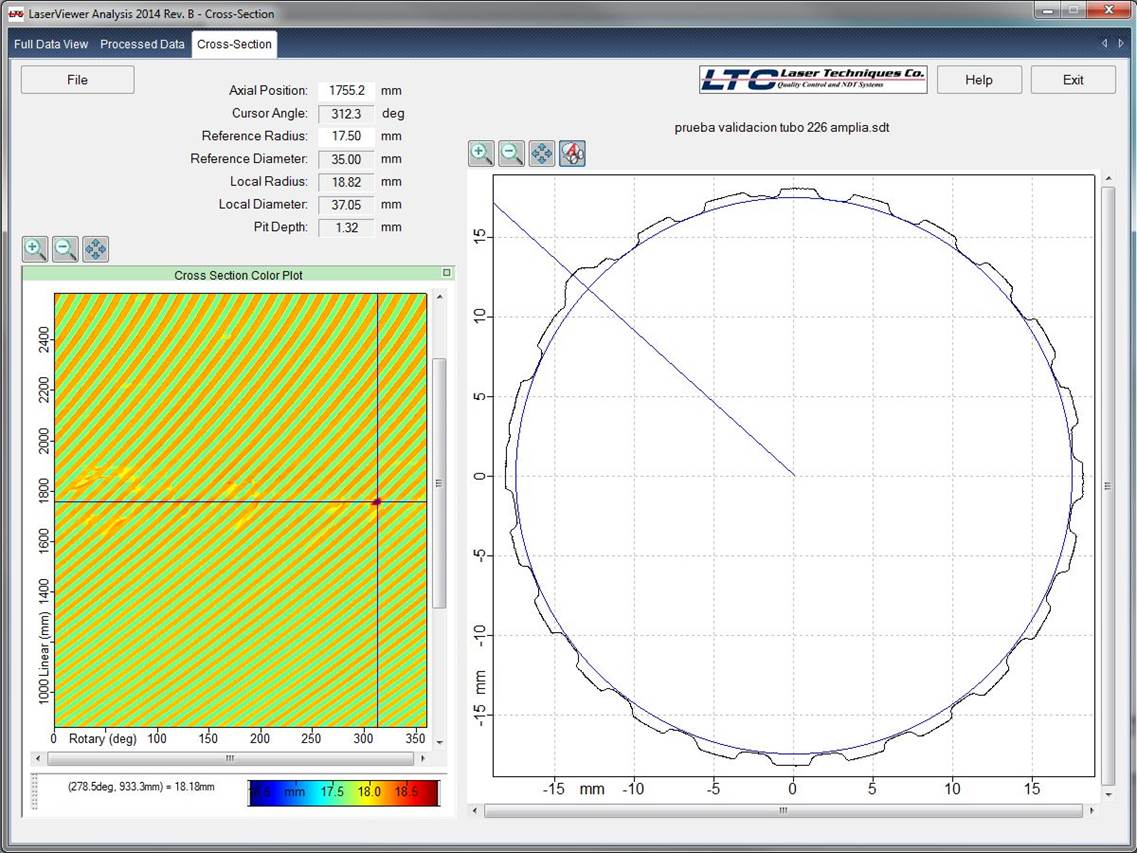
 The new device is called the BEMIS-SC™ (for Barrel Inspection Machine Small Caliber). Operated by NTS Chesapeake Testing, BEMIS-SC performs non-destructive laser-based mapping of gun bores. The BEMIS-SC currently works with .22 caliber to .50 caliber (5.56 – 12.7 mm) barrels. The BEMIS captures thousands of highly accurate data points over the full length of a barrel. The inspection can be completed in mere minutes, with scan results displayed in graphical, tabular, and 3D visual formats. Here is a barrel cross-section, as scanned by the BEMIS-SC: The new device is called the BEMIS-SC™ (for Barrel Inspection Machine Small Caliber). Operated by NTS Chesapeake Testing, BEMIS-SC performs non-destructive laser-based mapping of gun bores. The BEMIS-SC currently works with .22 caliber to .50 caliber (5.56 – 12.7 mm) barrels. The BEMIS captures thousands of highly accurate data points over the full length of a barrel. The inspection can be completed in mere minutes, with scan results displayed in graphical, tabular, and 3D visual formats. Here is a barrel cross-section, as scanned by the BEMIS-SC:
Click for Full-Screen Version

Until the 1980s, gun tube inspection had to be conducted by hand using a manual “star” gauge, a process that would take hours and provide minimal data. Electronic gauges were eventually developed along with the video bore scope, but these systems were still limited to very few, low-resolution data points. That has all changed with the BEMIS™, a huge leap forward in technology that is capable of rapidly capturing thousands of precise data points.
Chesapeake Testing commenced BEMIS-SC barrel inspection services in September 2014. Testing is performed in Chesapeake’s commercial barrel inspection laboratory, located in Belcamp, MD, minutes from the U.S. Army Aberdeen Proving Ground. While testing is currently limited to .22 to .50 caliber barrels, Chesapeake Testing will accommodate both smaller and larger calibers in the future.
“We have always focused on building our company around very unique technologies. BEMIS™ has changed the industry in regards to the inspection of weapon systems. We are excited to be an exclusive partner with LTC in this industry and look forward to contributing to the future of this technology,” says Jim Foulk, founder and president of Chesapeake Testing.
October 14th, 2019

How Krieger Builds Barrels
This video shows the process of cut-rifled barrel-making by Krieger Barrels, one of the world’s best barrel manufacturers. Krieger cut-rifled barrels have set numerous world records and are favored by many top shooters. The video show the huge, complex machines used — bore-drilling equipment and hydraulic riflers. You can also see how barrels are contoured, polished, and inspected.
For anyone interested in accurate rifles, this is absolutely a “must-watch” video. Watch blanks being cryogenically treated, then drilled and lathe-turned. Next comes the big stuff — the massive rifling machines that single-point-cut the rifling in a precise, time-consuming process. Following that you can see barrels being contoured, polished, and inspected (with air gauge and bore-scope). There is even a sequence showing chambers being cut.
Click Arrow to Watch Krieger Barrels Video:
Here is a time-line of the important barrel-making processes shown in the video. You may want to use the “Pause” button, or repeat some segments to get a better look at particular operations. The numbers on the left represent playback minutes and seconds.
Krieger Barrel-Making Processes Shown in Video:
00:24 – Cryogenic treatment of steel blanks
00:38 – Pre-contour Barrels on CNC lathe
01:14 – Drilling Barrels
01:28 – Finish Turning on CNC lathe
01:40 – Reaming
01:50 – Cut Rifling
02:12 – Hand Lapping
02:25 – Cut Rifling |
02:40 – Finish Lapping
02:55 – Outside Contour Inspection
03:10 – Engraving
03:22 – Polish
03:50 – Fluting
03:56 – Chambering
04:16 – Final Inspection |

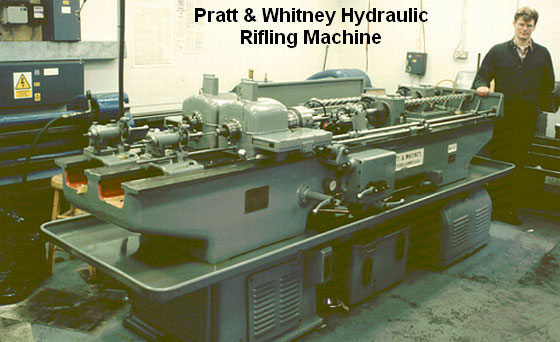
“At the start of World War Two, Pratt & Whitney developed a new, ‘B’ series of hydraulically-powered rifling machines, which were in fact two machines on the same bed. They weighed in at three tons and required the concrete floors now generally seen in workshops by this time. Very few of these hydraulic machines subsequently became available on the surplus market and now it is these machines which are sought after and used by barrel makers like John Krieger and ‘Boots’ Obermeyer. In fact, there are probably less of the ‘B’ series hydraulic riflers around today than of the older ‘Sine Bar’ universal riflers.” — Geoffrey Kolbe, Border Barrels.
October 8th, 2019

Can sustained rapid-fire shooting with no cool-down period wear out a quality barrel more quickly? The answer is “Yes” according to Forum member LCazador, who did an interesting comparison test with two .243 Winchester barrels. He started off with two, identical, match-grade HV taper stainless barrels. Both were NEW at the start of testing, and LCazador shot the same load through each: 95gr match bullets with 38 grains of Hodgdon Varget. After giving both barrels the same, gentle 20-round break-in, 300 rounds were then fired through each barrel — in very different ways. Barrel condition and wear were monitored with a borescope.
Barrel One — Slow Fire, Cool Down Periods, Cleaning Every 50 Rounds
At the end of the 300-round test, Barrel One looked brand new. There was none of the severe fire cracking found in Barrel Two. This barrel was shot no more than 10 times without a cool down and firing was done at a much slower pace. Cleaning for this barrel was done every 50 shots.
Barrel Two — Fast Firing, No Waiting, Cleaning Every 100 Rounds
The second barrel, which received hard use and minimal cleaning, was severely damaged with severe fire cracking at the leade and throat. As a result, the barrel had to be re-chambered. This barrel was shot 100 rounds at time without cleaning and was shot up to 20 times in succession without a cool down.
LESSON LEARNED — Heat Kills Barrel Life
Don’t let your barrel get too hot, and keep it clean. One afternoon can ruin a barrel!
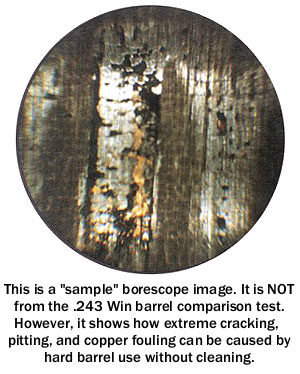 Monitoring Barrel Wear with Borescope Monitoring Barrel Wear with Borescope
Some folks worry too much about what their borescopes reveal — many barrels do not have to be “squeaky clean” to perform well. In fact some barrels run better after ten or more fouling shots. However, a borescope can be very helpful when your barrel starts losing accuracy for no apparent reason. Forum member FdShuster writes:
“A borescope is a positive way of backing up your suspicions when the rifle starts to throw an occasional (soon followed by more frequent) wild shot. Using the scope is also an excellent way to determine that the cause is barrel wear and not simply a need for a concentrated cleaning session to remove built up copper and more importantly, carbon fouling.
I’ve had a few barrels that gave every indication of being shot out. But I ‘scoped them out and found the cause to be nothing more than requiring a good cleaning. They then returned to their usual performance. There’s no guessing involved when you are able to get ‘up close and personal’ using the scope. The borescope also provides an excellent view of the all-important condition of the crown. My borescope is one of the most valuable investments I’ve ever made.”
|