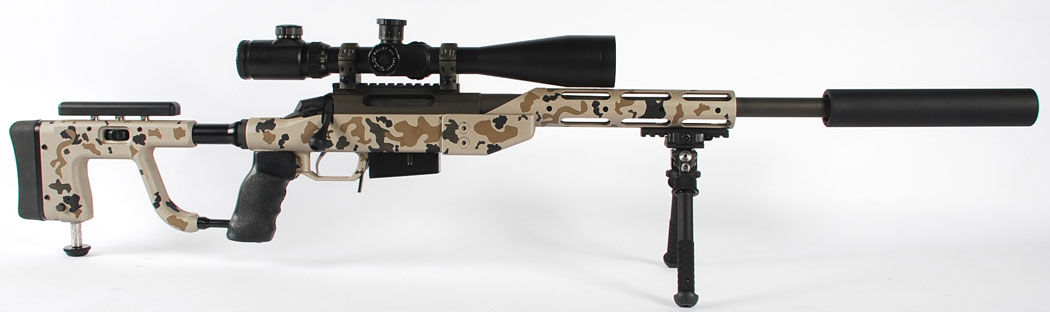
Need a new barrel for your Rem-actioned hunting or tactical rifle? Here’s a great DIY option for riflemen. McRee’s Precision offers complete, no-gunsmithing re-barreling kits for Remington and Rem-clone actions. These feature a high-quality, pre-chambered “PRE-FIT” stainless barrel from Criterion, a Savage-style barrel nut, a recoil lug, and a special barrel-nut wrench. Most of the Pre-Fit barrels are 24″ long and threaded at the muzzle. CLICK Here for all Pre-Fit barrel specs.
With this system you can easily re-barrel your favorite Remington rifle yourself in less than an hour. You don’t need to pay gunsmithing fees, or wait weeks (or months) for a busy smith to do the job. And the price is under $500.00. Kits are currently available for these chamberings: 6.5 Creedmoor, 6mm Creedmoor, .243 Win, .308 Win, .308 Winchester Magnum. You can buy with confidence — McRee’s Precision offers a Half-MOA Accuracy Guarantee with its pre-fitted barrel kits.
The stainless steel Barrel Nut is set up for 1 1/16 x 16 barrel threads, while the stainless steel recoil lug has a 1/8 inch removable locator pin and is set up for 1.0625 dia barrel threads.
McRee’s Precision sells Rem-action Pre-Fit barrel packages (complete with barrel nut, recoil lug, and wrench) starting at $489.52. Choose from five chamberings: 6.5 Creedmoor, 6mm Creedmoor, .243 Win, .308 Win, and .300 Win Mag. These Pre-Fit barrel kits come ready-to-install. All you need to do is remove your current barrel, place the recoil lug, spin on the new tube, follow the instructions for setting head-space with standard go/no-go gauges, then torque the barrel nut against the lug. NOTE: You may require a barrel vise and action wrench to remove the original barrel. Chambering-specific headspace gauges required. Minor inletting changes may be needed forward of the action.
The folks at McRee’s Precision say their Pre-Fit system offers many advantages: “Remington Pre-Fitted Barrel Kits have become popular over the years. If Savage can do it, why not for our Remingtons? Our [Criterion-supplied] barrels are spec’d to the McRee standard of performance. There are several places to get the tools required to remove your factory barrel correctly. Once you have your barrel removed all you have to do is follow the normal Savage procedure to install your new barrel. We recommend that you contact your local gunsmith for the install. Feel free to call us with any questions.”
Product Tip from Ed LongRange. We welcome readers’ submissions.
Kestros ZR Stock — Impressive Design for Competition
Review by F-Class John
Walk the line at just about any rifle competition and you’ll see your share of McMillan stocks. Known for crafting high-quality fiberglass/composite stocks, McMillan has long been at top choice for competitive shooters, hunters, and tactical marksmen. Now McMillan is out to dominate F-Open with the Kestros ZR stock. The Kestros line features several models, but the ZR represents the pinnacle of craftmanship. Each one is finished off by a single craftsman and takes roughly four times longer to create than any other Kestros. So when McMillan offered me a chance to test one out, I jumped at the opportunity.
The aluminum Z-Rail extends nicely from the front of the stock and has a nice contrast of metal against the matte finish of the stock. I inspected the rails and noticed that they are very cleanly machined — all the corners and rails were precise and sharp. As a result, I grabbed some 1000-grit sandpaper and just lightly knocked the edges and corners down just to keep from accidentally scratching myself or my gear.
Lead time for a ZR is currently 6-9 months. I was like a kid on Christmas when mine arrived after seven months. Holding a Kestros ZR is definitely a unique experience compared to a traditional wood stock and you can’t help but feel like you’re holding something special. I chose three shades of blue that transitioned dark from the butt stock to lighter on the fore-end in a spectacular flame pattern. With McMillan, there are thousands of possible color and pattern combinations. These color/pattern options are outlined on McMillan’s Gallery Page.
The Kestros ZR comes fully inletted with pillars. I was able to bolt my Defiance action right into the stock “as is” without a bedding job. (McMillan states bedding is not required, though this is certainly something most Kestros owners will do). I threw in my action, fit a couple action screws and tightened it all down. I was amazed at how nicely it all fit together with even the little details like the port cutout being perfectly smooth with my action port. I loaded up some .284 Win rounds and headed to the range to test the new stock at 100 yards.
Here are examples of targets shot with the Kestros ZR at 100 yards.
During initial range testing (see above) I shot nine groups for vertical and all of them were under 0.40″ with the smallest being .08″ of vertical. I topped off the testing by shooting a 200-11X the next week at my club match. The thing that really stood out was how smoothly the stock tracked with its lower center of gravity while shooting free recoil and ultimately this translated to success on target.
Low-Rider — You may find that because of how low the Kestros rides as well as its additional length due to the Z rail, you may require an extension for your front rest.
CONCLUSION — Great Modern Low-Profile F-Class Stock
Overall the Kestros ZR exceeded my expectations. After a small learning curve, it was a joy to shoot and it performed great. As someone who believes in the power of muscle memory, I found each time I transitioned between the Kestros and my traditional wood stocks there was a slight adjustment period but not enough to impair accuracy in any way. Something to consider is that because every Kestros is made to the same dimensions, it makes owning multiples an easy process of switching between guns without any need for readjustment.
For those willing to put in the practice, your patience will be rewarded, and I think most shooters will find the Kestros ZR could become their new favorite stock. If you’re in the market for a new F-Open stock, the Kestros ZR is definitely one to consider.
Tips for Ordering a Kestros ZR
Ordering the Kestros ZR is a simple process thanks to McMillan’s online order form. While there are a number of options available, McMillan has a helpful guide that walks you through each one to ensure you get exactly what you need. While filling out my form I realized that because I have a custom-designed action, I needed some help, so I gave McMillan a call. The staffers were incredibly helpful and their knowledge of all the major actions out there made answering my questions a snap. I liked the fact that there is no set, fixed price on any of the stocks. The pricing system allows customers to get just what they want (within limits) and not have to pay for anything they do not want or need.
A few seasons back, our Editor and his friend Joe Friedrich flew to Texas to visit Gene Beggs and test rifles in Gene’s 100-yard indoor tunnel. That was a once-in-a-lifetime opportunity to shoot centerfire rifles in such a test facility. Here’s our report…
The South Texas Tunnel
Gene Beggs operates his own 100-yard indoor tunnel and rifle testing facility just outside of Odessa, Texas. Surrounded by tall fencing, this place really looks like a “Area 51″ secret military facility.
In his South Texas tunnel, Gene provides instruction and “tunnel time” for serious benchresters looking to improve their skills and optimize the accuracy of their rifles. Along with teaching the fine points of short-range benchrest, Gene employed his tunnel to develop a pair of radical rifles, one chambered in 220 Beggs, a slightly modified 220 Russian, and a second chambered in 6mm Beggs, a necked-up version of the 220 Russian that retains the original body taper and shoulder angle.
Radical Skeleton Stocks with Aluminum Sled mounted to Barrel
Both rifles shared a skeleton design which uses the Stiller Cobra or Viper action as a central load-bearing member. Remarkably, there is no conventional fore-arm at all. Gene has bolted, directly to the barrel, a 3″-wide bag-riding aluminum sled. The sled was not designed as a mid-barrel tuner, but it might have some beneficial effects in that regard. However, the tuning functions are handled by two concentric rings threaded to the muzzle. Gene believes that with minor rotations of his front tuning rings, he can dial the gun into tune and the tune can be easily adjusted as conditions warrant.
Do Mr. Beggs’ guns shoot? Absolutely. We had the chance to visit Gene in Odessa. We shot both the 220 Beggs-chambered rifle, and its 6mm Beggs-chambered cousin. Both rifles are nearly identical, though the Heavy Varmint-weight 220 has a longer, 27″ barrel compared to 22″ for the Light Varmint 6mm.
In the tunnel, the 220 HV, with a no-turn-neck 220 Beggs chamber, produced three-shot groups in the low ones and zeros right out of the gate, even before the tuner was optimized. With a barrel with over 1000 rounds through it, after firing 40 rounds without cleaning, Gene produced a tiny 5-shot group in the low ones. The first shot was slightly high (a common occurrence in the tunnel according to Beggs). The last 4 shots, rounds 42-45 since the barrel had been cleaned, went into 0.084″. This rig, though radical in the extreme, certainly appears fully competitive with more conventional BR rigs, and it tracked superbly, with no hopping or rocking on the bags.
220 Beggs — Simple, Accurate, Efficient
We were also very impressed with the 220 Beggs cartridge. It’s basically a plain 220 Russian with a sharper radius at the neck-shoulder junction. Gene has commissioned a 220 Beggs reamer with matching seating and full-length sizing dies. The little cartridge achieves 3600+ fps with a 52gr bullet, pushed by Benchmark powder.
Less Recoil Than 6PPC — From what we could tell during our short visit, the 220 Beggs is easy to load for, and performs exceptionally well with either turned (.250″) or no-turn necks. The recoil was noticeably less than a 6mm PPC, making the gun a joy to shoot. This round, we felt, could also be an outstanding varmint cartridge. The velocity is there, and we don’t think any other 22-caliber varmint cartridge is going to beat it for inherent accuracy.
As for the 6mm version, Gene told us: “The 6mm version of the cartridge performs best with Hodgdon’s H4198 Extreme, but the 220 has proven it will shoot well with just about anything you put in it including N133, H322, Benchmark, 8208, Norma 200 etc. It is the most trouble-free, user friendly cartridge I have ever worked with and will compete heads-up with anything. It’s also very easy on the shoulder.”
Gene Beggs sells components (reamers, dies etc.) for the 220 and 6mm Beggs, and also, under special circumstances, offers training/testing sessions in his West Texas Tunnel on an appointment basis.
Readers who have just recently discovered the Daily Bulletin may not realize that AccurateShooter.com has hundreds of reference articles in our archives. These authoritative articles are divided into multiple categories, so you can easily view stories by topic (such as competition, tactical, rimfire, optics, shooting skills etc.). One of the most popular categories is our Technical Articles Collection. On a handy index page (with thumbnails for every story), you’ll find over 120 articles covering technical and gunsmithing topics. These articles can help you with major projects (such as stock painting), and they can also help you build more accurate ammo. Here are six popular selections from our Technical Articles archive.
Stress-Free Pillar Bedding. Richard Franklin explains how to do a top-quality bedding job, start to finish.
Gun Safe Buyers Guide. Our comprehensive Safe Buyers Guide examines the key features to consider in a safe — Wall Thickness, Volume, Shelving, Fire Rating, Lighting, Weight and more. We also explain the Pros/Cons of Dial vs. Digital (Keypad) locking systems.
Savage Action Tuning. Top F-TR shooter Stan Pate explains how to enhance the performance of your Savage rifle by optimizing the torque settings of the action screws.
Complete Precision Case Prep. Jake Gottfredson covers the complete case prep process, including brass weight sorting, case trimming, primer pocket uniforming, neck-sizing, and, case-neck turning.
Stock Painting Instructions. Step-by-step guide for stock painting by expert Mike Ricklefs. Mike shows both simple coverage and fancy effects.
Ultrasonic Case Cleaning. This article reviews the recommended process for cleaning cartridge brass with ultrasonic cleaning machine. We cover the right liquid solutions, processing times, and case drying options.
Velocity vs. barrel length — How much speed will I sacrifice with a shorter barrel? Hunters and competition shooters often ask that. Today we DO have solid answers to that question for many cartridge types thanks to Rifleshooter.com.
Bill, Rifleshooter.com’s Editor, explained his test procedure:
“I gathered four different types of factory Federal 224 Valkyrie ammunition, the 90gr Sierra MatchKing (SMK), 90gr Fusion soft point (SP) (referred to a Fusion MSR), 75gr Total Metal Jacket (TMJ) and 60gr Nosler Ballistic Tip Varmint (NBT). After a brief barrel break in and zero, I fired 5 rounds of each cartridge at each barrel length (except the 75 TMJ, I fired 4 rounds at each barrel length due to limited resources). I recorded the average muzzle velocity and standard deviation for each ammunition and barrel length combination and cut the barrel back 1 inch and repeated the process. I recorded barrel lengths from 28″ to 16.5″ (I try to save these barrels as finished 16″ tubes so they don’t go to waste).”
The Heavy Bullet 90gr Ammo Lost about 21 FPS per Inch
How did the test turn out? You’ll find all the results summarized in helpful tables with inch-by-inch velocity and SD numbers. For the two, 90gr ammo samples, results were similar. The 90gr SMK ammo started at 2782 fps (28″), finishing at 2541 fps (16.5″). That’s a loss of 241 fps, or 20.96 fps average per inch of length. The ammo loaded with 90gr Fusion SPs started at 2797 fps (28″) and ended at 2561 fps (16.5″), a drop of 236 fps. That’s 20.5 fps loss per inch. NOTE: Ambient temperature during the test was 45° F. You could expect the overall velocities to be a bit higher during hotter summer months.
With a the smaller bullets, the effect was even more dramatic. As you’d expect they started out faster. The ammo with 60gr Nosler Ballistic Tips (NBT), a good choice for varminters, started at 3395 fps (28″), and declined to 3065 fps (16.5), a total velocity drop of 330 fps. Average velocity loss was 28.7 fps per inch of barrel length. Rifleshooter.com also tested Federal 75gr TMJ ammo.
About the .224 Valkyrie Cartridge
The new .224 Valkyrie was introduced late last year as a Hot Rod cartridge that will work in AR15s. Designed to rival the .22 Nosler while still running well in ARs, the new .224 Valkyrie offers excellent long-range performance when loaded with modern, high-BC bullets. We expect some bolt-action PRS shooters might adopt the .224 Valkyrie. Why? Reduced recoil. With the 90gr SMK, the .224 Valkyrie offers ballistics similar to the 6.5 Creedmoor but with significantly less felt recoil. Check out this chart from Federal showing comparative recoil levels:
.224 Valkyrie vs. .22-250 Remington
The Social Regressive explains: “There are two key reasons why the .224 Valkyrie is unique and desirable. First, it is specifically designed to fit the limitations of the AR-15 platform. It does so even when loaded with gigantic bullets, like the 90-grain SMK that Federal announced. The .22-250 Rem is too long and too fat to work in the AR-15 platform; it needs an AR-10 bolt and magazine.”
The new .224 Valkyrie is basically a 6.8 SPC case necked down to .22-caliber. You can use your existing AR15 lower, but you will need a dedicated .224-Valkyrie upper, or at the minimum a new barrel, modified bolt with proper bolt face, and 6.8-compliant mags.
This barrel’s shoulder was 0.025″ off the action because Red Locktite had been used on the threads.
Gunsmith Thomas ‘Speedy’ Gonzales offered this interesting report about how NOT to headspace a barrel. Hopefully you never discover something like this…
“A good friend and customer sent this rig in for repair after FedEx damaged the rifle during inbound transport from another smith. After repairing the stock and rebedding it, I decided to re-polish the barrel to make the repair perfect. Well this just added insult to injury as the barrel did not want to come off. After a few choice words, the barrel finally broke free only to reveal something very disturbing. It seems the barrel had been ‘headspaced’ by using RED Loctite to hold it in place.” [Editor: That’s definitely NOT how barrels should be fitted.]
Speedy was not happy: “I hope the smith that did this sees the photos and realized what jeopardy he put my customer in or anyone who shot the rifle for that matter. When cleaned up, the shoulder on the barrel was over 0.0250″ (25 thousandths) away from the face of the receiver.” [Editor: That’s a lot in this business]. Check out the images below to see how much the barrel rotated further inward when cleaned up. The barrel spun in nearly another eighth-turn or more. Not good.
Many of our readers use AR-type rifles for Service Rifle matches, varmint hunting, 3-Gun competition, or defensive use. AR-platform rifles can be configured in a multitude of ways to suit the application. But if you plan to put together your own purpose-built AR rifle, how do you get started?
For AR Do-It-Yourselfers, we suggest reading Glen Zedicker’s book, the Competitive AR-15 Builders Guide. Following on Zedicker’s The Competitive AR15: Ultimate Technical Guide, the Builders Guide provides step-by-step instructions that will help non-professional “home builders” assemble a competitive match or varmint rifle. This book isn’t for everyone — you need some basic gun assembly experience and an aptitude for tools. But the AR-15 Builders’ Guide provides a complete list of the tools you’ll need for the job, and Zedicker outlines all the procedures to build an AR-15 from start to finish.
One of our Forum members who purchased the AR-15 Builders Guide confirms it is a great resource: “Much like any of the books Mr. Zediker puts out this one is well thought-out and is a no nonsense approach to AR building. I can not stress how helpful this book is from beginner to expert level.”
Along with assembly methods, this book covers parts selection and preparation, not just hammers and pins. Creedmoor Sports explains: “Knowing how to get what you want, and be happy with the result, is truly the focus of this book. Doing it yourself gives you a huge advantage. The build will honestly have been done right, and you’ll know it! Little problems will have been fixed, function and performance enhancements will have been made, and the result is you’ll have a custom-grade rifle without paying custom-builder prices.” Other good resources for AR projects is Gunsmithing the AR: The Bench Manual, and the Building Your AR from Scratch DVD.
Whidden Gunworks has the long-awaited Barnard SMS action. This impressive new 3-lug Rem-footprint action is NOT just another Remington 700 clone, though it fits Rem-inletted stocks and chassis systems. The Barnard SMS is a high-quality, custom-grade action. With the 3-lug design, bolt handle lift is shorter and quicker than its top competitors. And the excellent trigger timing of the SMS provides a smooth, glass-like operation.
New Zealand-crafted Barnard actions, such as the venerable Model P, have been highly coveted in the competitive long range community based on their high quality, ease of maintenance, and superb performance. Here in the USA, customers have asked for the same Barnard quality in a format that allows the use of Rem 700-configured stocks, triggers, magazines, and other accessories. This new SMS action can be used for long-range competition, PRS, benchrest, silhouette, hunting — any application where Rem 700-type actions are popular.
This new SMS action works with the Rem 700-family accessories which are readily available on the market. No adapters or conversion blocks are necessary for this action. The Barnard SMS is a true drop-in fit with Rem 700-inletted stocks and chassis systems. Likewise magazines and triggers for the Remington 700 footprint fit and work 100% with the new Barnard SMS.
Whidden Gunworks states: “Sportsmen all over the world will agree to the unequaled and superb quality of Barnard actions. The internal parts are simple and robust. Disassembly and maintenance can be easily done in the field if needed quickly, returning your firearm back into service. Quality material and proper heat-treating methods ensure strength and longevity for a lifetime of use. The new Barnard SMS is a great new offering. For MORE INFO or to place your order today visit WhiddenGunworks.com. SMS Actions list at $1150.00.
In a recent Forum thread, one member asked for recommendations for a factory rifle with a good action and trigger, under $600.00. Many respondents recommended a Tikka T3 (or newer T3X), and we concur. These won’t run with a $2500 custom, but for a hunting or varminting rig, they offer good bang for the buck with a very nice action. The last Tikka T3 we tried, a .308 Win with 24″ barrel, easily shot sub-MOA groups with factory ammo.
The original Tikka T3 and newer T3x actions are rigid, robust, and well-crafted. They cycle smoothly and have a short 75° bolt lift. The bolt features a Sako-style extractor, with angled-leading-edge bolt lugs for smooth lock-up. These T3/T3x rifles offer smooth-running actions, easy sub-MOA accuracy with good ammo, crisp triggers, and ultra-reliable detachable box magazines. The Tupperware stocks aren’t super-rigid, but they are comfortable and easy to handle.
If you are looking for a hunting rifle, the Tikka T3/T3x is a smart choice, offering good performance for the price (which starts at $569.00 for the T3X Lite version). The current T3x series is offered in a wide selection of chamberings, from .204 Ruger up to the large magnums.
We were impressed with the new Tikka T3x UPR rifle we saw at SHOT Show 2020 We liked the stock very much, and thought this was a very versatile gun that could be used for target shooting off bipod, hunting, even PRS, given its detachable magazine. The stock is very ergonomic and feels good. Tikka states the UPR’s stock “features an extra layer of carbon fiber mixed with fiberglass for increased rigidity and accuracy.”
Video Owner’s Review of standard model T3X with polymer stock:
Tikka T3 Upgrades — Barrels, Stocks, and Chassis Systems
Once you acquire a Tikka T3 there are many interesting upgrades available. First, you can improve accuracy and consistency with a pre-fit barrel from Criterion. There are also many chassis systems that fit Tikkas. In fact you can even get an Eliseo Chassis so you can shoot Palma matches F-TR competitions, or tactical/practical matches.
Criterion Pre-Fit Barrels for Tikka T3/T3x
We have always liked Tikka actions, and now there is a great re-barreling option for Tikka T3/T3x owners. Criterion Barrels Inc. (CBI), makers of “pre-fit” barrels for Savage, Remington, and Rem-clone actions, also crafts Tikka pre-fits. These pre-chambered barrels for Tikka T3 actions will be headspaced with a barrel nut, just like a Savage.
Click image for full-screen version
Tikka T3/T3x pre-fit barrels are sold through Solid Accuracy, a respected Texas-based outfit that sells high-end scopes, stocks, barrels and other rifle components. Price is $461-$485 with various contours and lengths available. Order HERE.
Competition Machine Chassis for Tikka T3
At SHOT Show, we saw some tactical shooters admiring the smooth Tikka T3 action and crisp trigger. They liked the action but they told us they wished they could get the T3 action in a configuration similar to the Ruger Precision Rifle. Well folks, there is a way to build a Tikka T3-based tactical/practical rig.
Gary Eliseo of Competition Machine offers a tubegun chassis for Tikka T3 actions in both Target and Tactical versions. The T3 kit is set up for AICS short action magazines. This is a “no gunsmithing” installation — no modifications to the action are required and the chassis kit works with the factory T3 trigger and safety. Along with the new Target and Tactical versions, a lower-cost Light-Weight Hunter T3 Chassis is also offered which accepts most AR-type buttstock assemblies.
Full Tactical Upgrade for Tikka T3
Tikkas are boring, nondescript hunting rifles right? Wrong. Check out this Tikka T3 tactical with “attitude”. For the British Shooting Show a while back, the folks at Osprey Rifles placed a Tikka T3 action into a modern modular chassis: “A standard factory Tikka T3 was fully Cerakoted and dropped into a Third Eye Tactical chassis stock which also had the Cerakote treatment.”
Click Photos to see full-screen version.
This T3 Chassis can be ordered through Osprey Rifles in the UK. The latest chassis stock system from Third Eye Tactical is currently available for both the Rem 700 short action and the Tikka T3.
Here’s some eye candy for your Monday morning. We’re presenting some stunning Royal shotguns from Holland & Holland, a legendary British gun maker. These amazing arms, which cost as much as a luxury automobile, demonstrate that the “art of engraving” still thrives among a few elite gun-makers.
What goes into a £77,500.00 ‘Royal’ model hand-crafted shotgun? Watch this remarkable video from Holland & Holland to find out. Filmed in the Holland & Holland factory, this nine-minute video shows all the key stages in the creation of H&H’s prized shotguns and rifles. The video shows barrel-making, stock checkering, metal engraving and more…


 Gene Beggs operates his own 100-yard indoor tunnel and rifle testing facility just outside of Odessa, Texas. Surrounded by tall fencing, this place really looks like a “Area 51″ secret military facility.

 Do Mr. Beggs’ guns shoot? Absolutely. We had the chance to visit Gene in Odessa. We shot both the 220 Beggs-chambered rifle, and its 6mm Beggs-chambered cousin. Both rifles are nearly identical, though the Heavy Varmint-weight 220 has a longer, 27″ barrel compared to 22″ for the Light Varmint 6mm.


 Velocity vs. barrel length — How much speed will I sacrifice with a shorter barrel? Hunters and competition shooters often ask that. Today we DO have solid answers to that question for many cartridge types thanks to


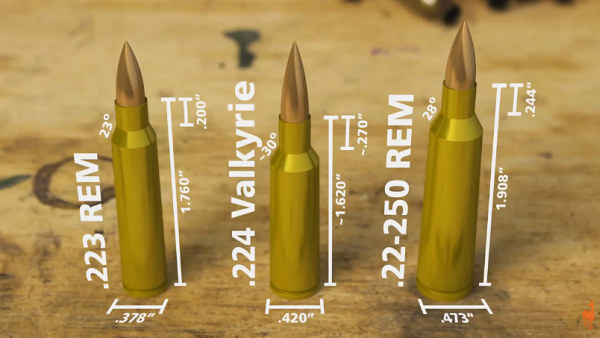 Image from Social Regressive


 Many of our readers use AR-type rifles for Service Rifle matches, varmint hunting, 3-Gun competition, or defensive use. AR-platform rifles can be configured in a multitude of ways to suit the application. But if you plan to put together your own purpose-built AR rifle, how do you get started?