Here’s one of the most popular videos from the Daily Bulletin archives. If you’ve ever wondered how a top-flight, custom rifle is built, watch carefully….
This video, produced for the folks at S&S Precision in Denton, Texas, shows a full custom 6.5×47 bench rifle being crafted from start to finish. It is a fantastic video, one of the best precision rifles video you’ll find on YouTube. It shows every aspect of the job — action bedding, chambering, barrel-fitting, muzzle crowning, and stock finishing.
You’ll be amazed at the paint job on this rig — complete with flames and four playing cards: the 6, 5, 4, and 7 of spades. Everyone should take the time to watch this 13-minute video from start to finish, particularly if you are interested in stock painting or precision gunsmithing. And the video has a “happy ending”. This custom 6.5×47 proves to be a real tack-driver, shooting a 0.274″ three-shot group at 400 yards to win “small group” in its first fun match. NOTE: If you have a fast internet connection, we recommend you watch this video in 720p HD.
We’re told that the founder of S&S Precision, the inimitable “Stick” Starks, is retiring from full-time gunsmithing duties. This video is a nice tribute to Stick’s dedication to his craft for so many decades.
First there were books, then Videos/DVDs, then Ballistic Apps, then Seminars, and now Applied Ballistics is moving into the gun-building business. Founded by Ballistics guru Bryan Litz, Applied Ballistics LLC has been a world leader in the science of ballistics for the shooting sports. Now Applied Ballistics is using its expertise to produce complete rifle systems capable of world-beating Extreme Long Range performance.
Applied Ballistics Weapons Division Will Offer Complete Tactical ELR System
Applied Ballistics Weapons Division (ABWD) states: “We have the capability to build you a custom rifle, with ammo matched for that system. We can test the ammo and rifle combination over Radar in the lab. ABWD [will be] offering a complete system, with a CDM specific to that rifle. The first rifles are purpose built for 2500+ yard engagements.”
Based on the “teaser” video above, ABWD will offer a complete rifle system featuring Nightforce riflescope, ELR optical prism, laser rangefinder, Kestrel wind meter, and ammo that has been tuned for the rifle and trajectory-verified with Doppler Radar. This promises a “turn-key” system with sub-MOA 1000-yard accuracy plus hit capability at ranges out to 2500+ yards.
One Facebook reader asked: “Will you focus your rifle builds to just Extreme Long Range or will you be doing PRS-style type rifles as well?
AB states: “We are starting out with this ELR system, but will be offering more systems in the near future, as well as custom rifle builds. Stay tuned as the ABWD website should be up soon!”
Many Questions about ABWD’s New Products:
Of course, like our readers, we have many questions about this new project:
1. What cartridge types will be available in ABWD Rifles?
2. What companies will supply the rifle actions and chassis systems?
3. Who will supply the barrels and what are length/chambering options?
4. Will ABWD rifle systems be offered to the general public (vs. military/LEO)?
5. When will the first ABWD rifle systems be available?
And last but not least…
6. What will these ABWD ELR Rifles cost, both by themselves and as a complete package (with solvers, LRFs, optics etc.)?
News Tip from EdLongrange. We welcome reader submissions.
Craters may look interesting on the moon, but you don’t want to see them on your primers. Certain mechanical issues that cause primer craters can also cause primer piercing — a serious safety problem that needs to be addressed. If you have a gun that is cratering primers (even at moderate pressure levels), there is a solution that works with many rifles — send your bolt to Greg Tannel to have the firing pin hole bushed. CLICK HERE.
Shooters who convert factory actions to run 6BRs, 6PPCs or other high-pressure cartridges should consider having the firing pin bushed. These modern cartridges like to run at high pressures. When running stout loads, you can get cratering caused by primer flow around the firing pin hole in the bolt face. The reason is a little complicated, but basically the larger the hole, the less hydraulic pressure is required to crater the primer. A limited amount of cratering is normally not a big issue, but you can reduce the problem significantly by having a smith fit a bushing in the firing pin hole. In addition to reduced cratering, bushing the firing pin often produces more consistent ignition.
This is a highly recommended procedure that our editors have had done to their own rifles. Greg Tannel (Gre-Tan Rifles) is an expert at this procedure, and he does excellent work on a wide variety of bolts. Current price for a bushing job, which includes turning the firing pin to .062″, is $80.00, or $88.00 with USPS Priority Mail return shipping.
If you have a factory rifle, a bushed firing pin is the way to go if you are shooting the high-pressure cartridges such as 6PPC, 6BR, 6-6.5×47 and 6.5×47. This is one of the most cost-effective and beneficial upgrades you can do to your factory rifle. For more info on the Firing Pin Bushing process, visit GreTanRifles.com, or email greg [at] gretanrifles.com. (After clicking the link for GreTanRifles.com, Click on “Services” > “Shop Services” > “Bolt Work”, and you’ll see, in the lower left, a listing for “Bush Firing Pin Hole & Turn Pin”. Click on that box.)
Firing Pin Hole Bushing by Greg Tannel
Work Done: Bush firing pin hole and turn pin.
Functions: Fixes your cratering and piercing problems.
Price: $80.00 + $8.00 return shipping Total Price: $88.00
Actions for which Bushing is Offered: Remington, Winchester, Savage multi-piece pin, Sako, Kimber, Nesika, Stiller, BAT Machine, Kelbly, Lawton, Surgeon, Borden, Wichita, Hall, Ruger, Howa, Weatherby, Dakota, Pacific Tool, Phoenix, and Defiant bolt action rifle or pistol.
Actions for which Bushing is NOT Available: Case hardened receivers, ARs, Accuracy International (AI), Barnard, Big Horn, Cooper, Desert Tactical Arms, Kimber, Rosenthal, New Savage single piece pin, Rim fires, Falling block, Break open, Lever, Pump rifles, 1903-A3, CZ, Mauser.
How to send your bolt in to be bushed:
You can send your bolt snail mail, priority mail, or UPS (Please do not use FEDEX as it sometimes has delivery delays). Pack your bolt carefully and ship to: Gre’-Tan Rifles, 24005 Hwy. 13, Rifle CO 81650. Please include your name, phone number, and return shipping address.
Due to the high volume of work, turn around is 5 to 8 weeks on bushing a bolt. Three or more bolts will be sent back to you UPS and we will have to calculate shipping. We can overnight them at your expense. You can pay by check, money order, or credit card. For more information visit GretanRifles.com.
Here’s an interesting project — using a second-hand barrel to upgrade an AR15. Our friend Erik Cortina decided to make his AR15, originally chambered in 6.8 SPC, into a 6.5 Grendel. Erik acquired a “pre-owned” 6.5-06 match barrel through our Shooters’ Forum. Erik inspected the barrel with a bore-scope and confirmed it was in good shape after the first few inches (past the chamber).
The 6.5-06 barrel had more than enough length, so he trimmed off the chamber end, then contoured the barrel to fit his AR15. This is a smart way to upgrade a gun without spending $350 or more on a brand new barrel.
In the first video, Erik explains the process of converting his 6.8 SPC AR15 into a 6.5 Grendel: “I take the upper completely apart and pull barrel off which will be used to take dimensions for new barrel. The new barrel will be turned from an old competition heavy barrel. All the barrel reaming will be done using JGS reamers. I will also use JGS reamers to make a seating and F/L sizing die.”
In the second video, Erik contours the “pre-owned” barrel to fit his AR. He uses an old bolt-action 6.5-06 competition barrel and cuts it to 17″ long and contours it to fit his AR-15. The barrel is turned down on a manual lathe to .750″ outside diameter for the majority of its length in order to fit the gas system barrel block that is made for a .750″ barrel. After contouring, the barrel will be threaded and chambered.
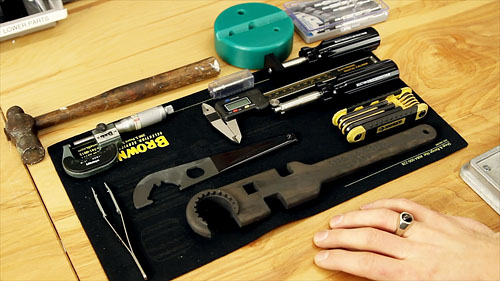
Here are the main tools you’ll need to assemble an AR-platform rifle
Planning to put together an AR-platform rifle? Or are you looking to upgrade your AR with a new barrel, stock, or trigger group? Then you should check out the AR-15 Rifle Build DVD from our friends at UltimateReloader.com. This DVD covers all the details of a custom build, using high-resolution video sequences, and helpful supporting graphics.
In this DVD, Gavin Gear guides you through the entire process including selecting components, acquiring and using the necessary tools, assembly steps and details for each component, and even mounting a scope. Building an AR-15 can be overwhelming, but with the right guidance and help it’s not difficult and can be very rewarding. With this DVD you’ll be able to build your AR-15 with confidence.
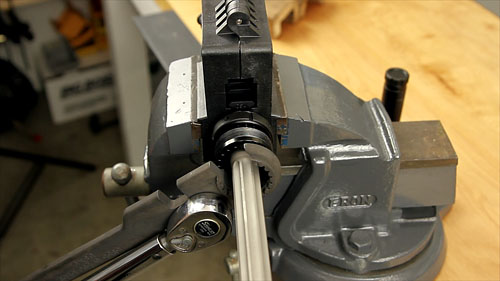
Upper: Barrel / Gas Block / Gas Tube
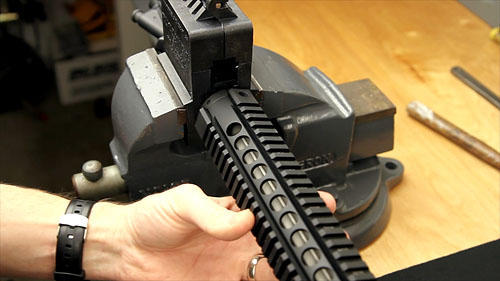
Upper: Handguard Installation
UltimateReloader.com’s AR-15 Build DVD is available just $9.90 (plus $3.80 shipping/handling). This DVD can pay for itself many times over by showing you how to do your own gunsmithing (and get quality AR components at attractive prices).
See Parts Installed in See-Through AR-15 Lower
This isn’t part of UltimateReloader.com DVD, but this YouTube video shows how to install the AR trigger group and other parts in an AR-15 lower. A transparent, see-through Tennessee Arms Company lower receiver was chosen to make it easier to see how the parts are installed.
You’ll want to tune in to Kelly McMillan’s Taking Stock Radio Show tomorrow, Friday, October 27, 2017. This week’s Episode 42 features respected action-maker and gunsmith Jim Borden of Borden Accuracy. The Radio Show, which streams on the internet, runs 8/27/2017 at 11:00 AM Pacific Time on VoiceAmerica Sports Channel.
Jim and Kelly will discuss a variety of topics, including gunsmithing, action design/manufacture, the past/present/future of Benchrest and F-Class competition, and how Benchrest technology have influenced other disciplines. Jim Borden is a “benchrest icon” who has been in the business maybe as long as McMillan. Kelly notes: “I remember the Borden name dating way back to when it was just my mother, father, and I working in the garage. Jim Borden will share the story of his legacy with our listeners”. CLICK HERE to LISTEN.
The Radio Show will also feature Kelly’s friend Kevin Finley, a professional bass fisherman. Access this and other “Taking Stock” episodes by clicking the Radio link on McMillanUSA.com, then select “Listen Live” or select Episode on Demand to hear previous shows. In past weeks, Taking Stock Radio has featured K02M and World F-TR Champ Derek Rodgers, Team USA F-TR Captain Ray Gross, Ballistics Guru Bryan Litz, Long-Range Champ Nancy Tompkins, High Power Champ Carl Bernosky, Legendary Olympic Shooter Lones Wigger, Sniper’s Hide Founder Frank Galli, and many other notables.
Borden and McMillan Collaborate on F-Open Rifle for Juniors
It’s great to see two important businessmen give back to the shooting sports. Kelly McMillan and Jim Borden are working together on a project — creating an F-Class Open rifle that can be loaned out to young shooters to help them get started with the sport. Great idea — we need to get more young folks involved in precision shooting. In F-Class (as well as benchrest) we have an “aging population”. Engaging the next generation of shooters is vitally important.
Borden Accuracy — A Success Story
Borden Accuracy/Borden Rifles has been a source for precision benchrest and hunting rifles for many years. Jim started doing his own gunsmithing while competing in benchrest and High Power silhouette matches. Jim launched his business in 1987, working nights and weekends while still employed at P&G. The business became full-time in 1995 with Jim and his wife Joan doing the work. The business was expanded in 1999 with the construction of the new Springville, PA facility and the addition of sons Jim Jr. and John to the staff. Son-in-law John Mecca came onboard in January 2000.
Jim and company began making Rimrock benchrest and Rimrock hunting actions in 2001. They added Borden Alpine and Timberline actions in 2006. These actions are made in an advanced manufacturing facility which has three CNC vertical Machining centers, three CNC lathes, three manual lathes, a manual knee mill, a surface grinder, a cylindrical grinder and wire EDM machine. To learn more, visit BordenRifles.com, call 570-965-2505, or send email to info [at] bordenrifles.com.
In the wake of the tragic events in Las Vegas, politicians have drawn up new anti-gun legislation in Congress and in State Legislatures. As expected, there are bills to ban “bump-fire” stocks and rotary triggers, but there is more… much more. Anti-gun politicians have used the Las Vegas tragedy as an impetus to draft much more far-reaching restrictions on guns, magazine, and ammunition.
Here is a summary of new Federal legislation released in the past month. Note that none of these new bills specifically targets rapid-fire technology. Instead they seek to restrict conventional firearms, or impose new restrictions on purchasing shooting supplies. For example, H.R.3962 will ban online ammunition sales by requiring face-to-face purchases of ammo.
Here is a list of anti-gun measures that have recently been proposed in Congress. This list was prepared by the Cheaper Than Dirt Shooter’s Log. The list provides a representative sample, but it is not comprehensive — readers should note that other legislation has been introduced in various states. And expect more anti-gun legislation to come….
H.R.3984 – Rep. Schiff, Adam B. [D-CA-28] (Introduced 10/05/2017)
Summary: This would repeal the Protection of Lawful Commerce in Arms Act, and provide for the discoverability and admissibility of gun trace information in civil proceedings.
Comment: The Protection of Lawful Commerce in Arms Act (PLCAA) protects firearms manufacturers and dealers from being held liable when crimes have been committed with their products.
Summary: To require face-to-face purchases of ammunition, to require licensing of ammunition dealers, and to require reporting regarding bulk purchases of ammunition.
Comment: This measure is designed to eliminate online sales of ammunition.
H.R.3986 – Rep. Velazquez, Nydia M. [D-NY-7] (Introduced 10/05/2017)
Summary: To provide for the establishment of a national standard for incorporating a passive identification ability into all firearms sold in the United States.
Comment: This essentially would require all firearms to have smart gun technology.
H.R.3987 – Rep. Velazquez, Nydia M. [D-NY-7] (Introduced 10/05/2017)
Summary: To reduce gun violence, fund gun violence research and victim assistance, and enhance the tracking of lost and stolen firearms, and for other purposes. Any transaction involving at least on firearm, would have a $1 fee added.
S.1945 – Sen. Menendez, Robert [D-NJ] (Introduced 10/05/2017)
Summary: To regulate large capacity ammunition feeding devices.
Comment: In truth, there is not much new here, but the threat is as serious as it ever was.
CLICK HERE to subscribe to Cheaper Than Dirt Newsletter.
Trigger images from PrimaryArms.com, which sells all the triggers reviewed here: Geissele, Elftmann, Timney, and ALG Defense.
Are you thinking of upgrading the trigger system for your AR-platform rifle? There are dozens of options available, from $45 up to $300. Thankfully, Brownells has created video reviews of some of the more popular AR trigger options from Timney, Geissele, and ALG Defense. And we included a video review of the highly-regarded Elftmann Match Trigger. If you want the best solution for Service Rifle competition, you might favor the Geisselle. For ease of installation, it’s hard to beat the Timney, a “drop-in” module. Like the Timney, the super-smooth Elftman is a drop-in module. At $249.00 it’s pricey, but it is one of the best AR triggers out there. If you’re on a tight budget, the best “bang for your buck” may be the “Perfected Mil-Spec” ALG which starts at around $45.00.
Geissele Enhanced Two-Stage Trigger
Geissele makes a variety of quality AR trigger sets both single-stage and two-stage. Many High Power competitors like the two-stage Geissele trigger. This delivers a repeatable, controlled pull through the first stage with a very clean break in the second stage. The Super Dynamic Enhanced Trigger, shown above, features a distinctive, trigger blade. Reviewer Thomas Conroy says: “The flat surface is very easy to press against. Both stages are light and very distinct.”
Elftmann Drop-In Match Trigger
Though pricey ($249.00 at PrimaryArms.com), we really like the Elftmann AR trigger. It combines the best of both worlds — the precision and smoothness of the Geissele with the Timney’s ease of installation. This single stage trigger is user-adjustable from 2.75 to 4 pounds pull weight. It is offered with either straight or curved trigger blade. Primary Arms says: “The amazingly short take-up, glass-rod crisp break and [near-zero] over-travel can be compared to the finest custom 1911 triggers.”
Timney Drop-In Trigger Module
This trigger module is available for both the AR15 and the AR10 platform (as covered in the above video). Timney triggers are easy to install and come with multiple pin size and pull-weight options. Reviewer Thomas Conroy confirms that the single-stage Timney “breaks cleanly and crisply. This trigger is modular, meaning that the trigger, sear, hammer, and spring are all encased in a bright, shiny yellow aluminum housing.”
ALG Defense Trigger — Higher-Quality Basic AR Trigger
According to Thomas Conroy, ALG triggers “are the perfected version of the standard, non-adjustable mil-spec original trigger. They have the same geometry, but are made to higher quality standards, and come with … hardened and smoothed-out sear contact surface to eliminate all grittiness.” These are also offered in a nickle-boron coated version. Available for under $45.00, the ALG is a well-made, low-cost option for shooters who want a better factory-type trigger system.
For More Information about These Triggers
Learn more about Geissele, Timney and ALG triggers, plus two more AR trigger options (CMMG and Rock River Arms) in a Trigger Comparison Review by Thomas Conroy on Ammoland.com.
We were pleased to see our friend John Whidden featured in the October 2017 issue of Shooting Sports USA. John captured the 2017 NRA Long Range Championship this summer, his second LR title in a row, and fifth overall. This year was a bit different, as the competition was held in Indiana at Camp Atterbury. All John’s previous Long Range HP titles were earned at Camp Perry.
Whidden’s Perfect Palma Match
Whidden secured the 2017 LR Title by shooting “clean” (not dropping a point) in the tough Palma competition. In the NRA Palma match, rifles must be .223 Rem or .308 Winchester, with metallic sights (no scopes). The match is conducted at three yardages, 15 shots at each distance of 800/900/1000 yards, with unlimited sighters at 800 and two sighters at 900 and 1000.
SSUSA’s Editor John Parker writes: “On another note, this month’s cover feature highlights the very first NRA High Power Rifle Championships conducted at the match’s new home—Indiana’s Camp Atterbury. Located about 50 miles south of Indianapolis, this active Indiana National Guard base boasts over 60 ranges, making it the ideal new venue to continue the legacy of NRA High Power. Hundreds of competitors made the trek to continue the historic tradition of rifle competition at the National Matches.”
Another friend, Anette Wachter, is featured in this issue as well. That’s the 30CalGal herself in the upper right after winning the Andrus Trophy Match.
Sling Rifle Evolved: The Ultra-Accurate Hybrid Palma Rifle
Since John captured his fifth Long Range crown with a superb performance in the Palma match, we thought we’d give readers a look at John’s very special Palma rifle. This unique .308 Win prone rifle features a Barnard “P” action in a converted aluminum Anschutz “Precise” smallbore (rimfire) stock. The combo of Barnard action and Anschutz ergonomics is hard to beat, says John, who told us: “this is easily the best Palma rifle I’ve ever had.” John told us this gun handles like no other: “After recoil, with this Anschutz stock, the sights fall right back on target — better than any other prone rifle I’ve shot”.
As a bonus, the Barnard “drop-in” required no modification of the Anschutz Precise stock. This means John can actually swap in his rimfire barreled action and shoot smallbore with the same stock.
Whidden Palma Rifle
Action: Barnard “P” (three lugs, 60° bolt lift)
Barrel: Bartlein 32″, Light Palma contour, cryo-treated by 300 Below.
Stock: Anschutz Precise aluminum smallbore stock, set up for centerfire barreled action.
Trigger: Barnard Two-Stage adjustable
Whidden’s Wonder-Gun: German Stock, New Zealand Action, American Barrel
John built this Palma rifle in early 2016. With it, John won back-to-back long-range Championships in 2016 (Camp Perry) and 2017 (Camp Atterbury). The major components are: Barnard ‘P’ action, Anschutz Precise smallbore stock, and Bartlein barrel. The caliber is .308 Win, as dictated by the Palma rules. Palma matches are fired from 800, 900, and 1000 yards utilizing iron sights only. No optical sights are allowed.
Here is an interesting project by one of our Forum members. Martin C. (aka “Killick”) modified an Anschutz 1411 Match 54 rimfire prone stock to become a comfortable, great-tracking F-Class Open Division Stock. No Killick didn’t sacrifice a perfectly good rimfire rifle for this project — he bought the Anschutz stock by itself on eBay, then transformed it…
Killick explains: “This project started about seven years ago. I bought the Anschutz prone stock on eBay and whittled it a bit into a Palma rifle with a Barnard action and block and a Doan Trevor cheek piece and scope rail. Then about two years ago I decided to re-task the stock/action assembly into an F-Open rig. With more whittling, gluing, sanding, body fillering, sanding, filling, sanding, more sanding…and sanding, forming, priming, sanding, painting, waiting, painting, painting…painting and before you know it, Bob’s your uncle.”
Here is the eBay-sourced Anschutz 1411 stock, with new high-gloss blue finish, as initially modified for use in Killick’s centerfire Palma rifle. Looks nice!
Next step was the addition of a 3″-wide wood fore-end for F-Open duties with front rest:
Almost done here… just needs priming and final painting:
Here is Killick’s completed F-Open rifle with its much-modified Anschutz stock now finished in fire-engine red lacquer. This image shows the detail of the grip and customized cheekpiece.


 This video, produced for the folks at S&S Precision in Denton, Texas, shows a full custom 6.5×47 bench rifle being crafted from start to finish. It is a fantastic video, one of the best precision rifles video you’ll find on YouTube. It shows every aspect of the job — action bedding, chambering, barrel-fitting, muzzle crowning, and stock finishing.


 Craters may look interesting on the moon, but you don’t want to see them on your primers. Certain mechanical issues that cause primer craters can also cause primer piercing — a serious safety problem that needs to be addressed. If you have a gun that is cratering primers (even at moderate pressure levels), there is a solution that works with many rifles — send your bolt to
  Firing Pin Hole Bushing by Greg Tannel




 Borden Accuracy — A Success Story


 Trigger images from


