Savage Arms has issued a RECALL notice on B.MAG (17 WSM) rifles after discovering that the bolt on some B.MAG rifles may catch the safety button and slide it forward into the “fire” position. This condition is primarily present if downward pressure is applied to the bolt too early while pushing it forward. While Savage has received no reports of accidents related to issue, the company will offer free retrofits of all B.MAG rifle bolts. Savage 17 WSM B.MAG rifles with a serial number below J800928 are included in this recall. No other Savage firearms are affected.
The bolt retrofit includes the replacement of the existing bolt handle and bolt cap with a revised bolt handle and bolt cap. The correct, revised parts are easily identified. The old bolt cap is conical. The new, corrected bolt cap is short and stubby. See illustration:
To avoid possible unintentional discharge or injury, do not use your B.MAG rifle until your bolt has been retrofitted with a new bolt handle and cap.
Savage has a dedicated B.MAG Recall webpage (http://www.savagearms.com/recall/bmagbolt/) and hotline (844-784-3301, Mon through Fri 8 am to 10 pm EDT). Use those resources to check your serial number, file a claim, and receive a free retrofit kit with simple, step-by-step instructions.
Intro: Ron Dague wanted a new gun that was similar to his trusty .223 Rem rifle, but which fired 6mm bullets. There is a superb choice of bullets in this caliber, and Ron found that the 95gr Berger VLD could be driven to a healthy 2,604 fps by the small .223 Rem case. This 6mm wildcat based on the common .223 Rem offers excellent accuracy and very low recoil — something very important in the cross-the-course discipline. In addition, Ron’s 95gr load with Reloder 15 delivered an ES of just 4 fps over ten shots. That exceptionally low ES helps achieve minimal vertical dispersion at 600 yards.
I already had a .223 Remington match rifle, and I wanted the 6mm-223 to be as close to the same as I could make it. I installed the barreled action in a wood 40X stock to work up load data and work out any magazine feeding issues. While I was working on that, I looked for a McMillan Baker Special stock and finally found one to finish this project. I bedded the action and stock, then took the rifle to the range to check zeros on the sights and scope. I was surprised that I didn’t have to change anything on the sights. I thought changing the stock would cause sight changes. The thought went through my head, “Maybe the 40X stock isn’t all that bad”.
Here’s line-up of 6mm bullets. The Berger 95gr VLD is in the middle.
I took the new rifle to the first match of the year, a National Match Course match, and my off-hand score was 83, rapid sitting 95, rapid prone 95, and slow fire prone 197 — for total aggregate 470. This may not be my best work, but on match day the wind was blowing about 15 mph and the temp was around 40° F, with rain threatening. This was a reduced course of fire — we shot at 200 and 300 yards on reduced targets.
I used 70gr Berger bullets for this match, loaded in Remington brass with 25 grains of VihtaVuori N540 and Federal 205M primers. When I worked up loads for this rifle, N540 gave the best accuracy with the best extreme spread — 2,950 fps with an extreme spread of 20 fps on a 10-shot string. The load for 600 yards was with a 95gr Berger VLD bullet, with 23.0 grains of Reloder 15, Lapua cases, and the same Federal 205M primers. This load is 2,604 fps, with an extreme spread of 4 fps over a 10-shot string. I’ve shot this load at several 3×600 yard matches, and the accuracy has proven to be very good. At the last 3×600 match, my scores were as follows: 199-10x and 198-11X with scope, and 193-10X with iron sights. Best 600-yard score so far with iron sights was 198-12X.
6mm-223 Rem Rifle Specifications: 700 BDL action and floor plate, Bartlein 6mm 1:8″ twist, McMillan Baker Special stock in Desert Camo, Centra front and rear sights, Ken Farrell bases with stripper clip guide, Sinclair hand stop, and Jewell trigger. Gunsmith Neil Keller helped me with the metal work and instructed me on the action work and rebarreling.
There has been a huge growth in the number of registered suppressors in the USA. From 2014 to 2015, the number of NFA-registered suppressors rose from 571,150 to 792,282. That’s a 39% increase in just one year! It’s remarkable that there are nearly 800,000 suppressors now registered in the USA. These stats are based on data published in the latest Bureau of Alcohol, Tobacco, Firearms, and Explosives (BATFE) Firearms Commerce Report.
According to Knox Williams, president of the American Suppressor Association, “The suppressor market grew more [from 2014-2015] than it did in the previous two years combined. This unprecedented growth is in large part due to educational initiatives, and the passage of 11 pro-suppressor laws and regulations last year.” (Source: Guns.com.)
We expect suppressors (also known as “cans”, “silencers” or “sound moderators”) to become even more popular in the years to come. This trend will continue: “As more target shooters and hunters realize the many benefits suppressors provide, their popularity across the United States will continue to increase,” said NSSF Senior Vice president and General Counsel Larry Keane.
Texas Leads the Way in Suppressor Ownership
Currently, 41 states permit ownership of Federally-registered suppressors. While suppressor ownership rates are increasing in all those 41 states, forty percent (40%) of all registered suppressors are found in five key states: Texas (130,769), Georgia (59,942), Florida (50,422), Utah (50,291) and Oklahoma (27,874).
Jay Christopherson, our Forum admin and dedicated F-Open shooter, recently ventured to the “dark side”, crossing disciplines and trying his hand at F-TR, shooting off a bipod. Jay wasn’t using just any old F-TR rig. He used a purpose-built rifle, designed to mimic the handling of his Open rifle. With this rig, Jay won two of the three matches he’s shot in, including the F-TR division at the Washington State Long Range Championships. Jay’s last 600-yard match featured two clean scores with excellent X-Counts, including a 200-13X and a 200-15X (one off the national record) for a total score of 599-36X.
The 2015 Washington State Long Range Championships was held at the infamous “Rattlesnake” range in Richland, WA, which has some of the most challenging wind conditions in the USA. At the LR Championships, shooting his .308 Win F-TR rig, Jay was right up there with the F-Open shooters. Until the final relay, Jay was within three points of the overall F-Open leader, and still finished second overall in X-Count and score. This demonstrates the capability of a state-of-the-art F-TR rig.
In this story, Jay describes his F-TR rifle and set-up. Knowledgeable readers will recognize that Jay’s gun is similar to John Pierce-built rigs successfully fielded by Michigan F-TR Team shooters.
JOINING THE “DARK SIDE”
by Jay Christopherson
I originally decided to build a F-TR rifle to shoot at local mid-range club matches. I keep burning through F-Open barrels (and components) because I shoot a lot more local club matches than “big” matches – maybe 2:1 or 3:1. The end result is that I’d be endlessly tweaking loads and burning up barrels and I just got tired of it. The endless tweaking also caused me some trouble at large matches and I thought shooting a .308 Win would be more “relaxing” from a technical point of view. It’s a very well understood round at this point.
I’d been kicking around the idea of shooting F-TR for a couple of years, but I didn’t want an F-TR rig that handled completely different than my Open gun. I didn’t want to learn different habits from a different stock or position that would cause issues on race day. I use a Terry Leonard/Speedy Gonzales designed F-Class Open stock that is designed more along benchrest lines than the traditional prone stocks you see most F-Class shooters using. I don’t like to use any hand grip at all and my preferred position is very light pressure into the shoulder and just enough cheek touch to index. So, when I saw Eric Stecker at the 2014 Berger SWN (and later Bryan Litz) shooting an F-TR rig that was designed along the same lines, I decided to get serious about it.
The Stock is the Secret
The stock is a Scoville carbon-fiber-over-balsa model set up for a Panda action (which I had on hand). This stock is extremely stiff and stable. I purpose-built the rifle to shoot 215gr Berger bullets and I knew that I would keep my velocity relatively low-ish – in the 2500+ fps range. If I ran those 215s much faster, the recoil would become an issue for me. I bought and chambered a Benchmark 1:9″-twist barrel, in a heavier-than-normal contour. This was finished at 28″. I custom-throated the chamber with a PTG .30 Cal Uni-Throater to accommodate the longer-than-normal OAL I wanted.
I modified my Phoenix bipod based on some of the pictures I’ve seen of John Pierce’s modifications and after talking to John at the 2015 Berger SWN. I sure do appreciate how open he is with the modifications he’s done. I doubt I would have thought of putting together a rifle like this without his example.
Proofing at Mid-Range
From the get-go, this F-TR rifle has been a shooter. It handles extremely well, and recoil is not a problem at my velocities. The 215s still maintain a significant wind advantage over the more usual 155gr and 185gr bullets at long distances. Ballistics Performance is not quite in the same class as the 7MM 180gr bullets I shoot in my F-Open rifle, but not that far off either.
Below is a 300-yard target shot while proofing my load in preparation for 600-yard matches. I decided to shoot a “match” string (2 “sighters” + 20 “record” shots). Looking at this target, I’m thinking that if I had clicked left one or two clicks, this might have been a 200-20X.
On Race Day
I’ve shot three matches with my F-TR rifle now, two 600-yard club matches and the WA State Long Range Championships at the infamous “Rattlesnake” range in Richland, WA. The LR Championship was the first time I’ve shot the rifle at long range. At the 600-yard club matches, I’ve had several “cleans”, including a 200-13X and a 200-15X (finishing 599-36X at the last one, which is just within my normal Open scoring range). At the WA State Long Range Championship, I managed to win the F-TR division in extremely hot conditions (100+ degrees over two days of shooting) and managed to post the second highest X-count and finish second overall among all F-Class shooters (F-Open and F-TR combined). I was “in the running” for the overall win until the last relay.
Seduced by the “Dark Side” — The Lure of F-TR
I still plan to shoot my Open rifle at “big” matches, but I doubt I’ll be able to leave the F-TR rifle in the safe for all of them. My reference to the “dark side” is an inside joke between myself and another shooter. I kept saying that shooting F-TR was just for fun… that I wasn’t taking it too seriously. However, the more I shoot F-TR, the deeper into the “Dark Side” I seem to fall. F-TR is a different animal than F-Open (I use a Nascar vs. Formula 1 analogy), but it’s addicting. And not having to carry 30 pounds of front rest doesn’t make me sad when I’m traveling!
Top Three F-TR shooters at WA State Championships: Jay Christopherson (Winner), Monte Milanuk (second), and Laton Crawford (third).
USA F-TR Team Captain has a new competition rifle, which features the brand new McMillan F-TR stock. Ray is very pleased… “It’s like Christmas”, he says. The reduced mass of the new McMillan stock helps F-TR shooters “make weight” more easily. Ray tells us:
“This McMillan stock really changes the weight budget. Kelly McMillan updated his three-way buttplate design to make it substantially lighter and the stock itself has a very light fill. Fully assembled, with a 29″ HV-contour barrel (.900″ at muzzle), Duplin bipod, and Nightforce NXS scope, the rig is about 10 ounces under weight. Switch to a Nightforce Competition scope and it will be 14-15 ounces under.” Ray says he could run a slightly longer barrel and still make weight.
Initially, Ray will install a Jewell trigger in the rifle, but he hopes to try out a Bix ‘N Andy trigger in the future. Made in Austria, the advanced Bix ‘N Andy trigger (shown below), features ball bearing internals for an ultra-smooth, creep-free pull and very short lock time.
Garand matches are among the most popular and well-attended of the CMP competition disciplines. When obtained directly from the CMP, Garands are fun to shoot and affordable. However, with these classic battle rifles, you need to ensure that the headspace is set properly to ensure safe function and good brass life.
In the archives of The FIRST SHOT, the CMP’s online magazine, CMP Armorer John McLean has written an excellent article entitled: “Everything You Ever Wanted to Know about Checking M1 Garand Head Space.” We recommend all Garand shooters read the article.
McClean explains: “Excessive headspace will cause the brass to stretch more than it should and increases the likelihood of a case failure. Insufficient headspace may contribute to slam fires, light strikes on primers, misfires and more wear on parts due to the additional force needed to chamber the rounds.”
Garand Head Space Gauges
McClean writes: “Both Forster and Clymer make fine gauges but we have found that there are differences between the two companies’ gauges that make the Clymer gauges best for use with the M1. The headspace that the original manufacturers of the M1 considered correct can be determined by checking new or nearly new rifles that we have here at CMP. With that information we have determined that Springfield Armory and the other manufacturers of the M1 used gauges that were very close to the Clymer dimensions… and therefore we use, and recommend using only the Clymer gauges.”
How to Check for Proper Headspace
In the article, McClean goes on to show how to properly use the “GO”, “NO GO”, and “FIELD” gauges. You’ll want to read the Complete Article. One of the important points McClean makes is that the ejector can affect headspace reading. Accordingly, “the bolt must be disassembled and the ejector removed, or clearance notches must be made on the headspace gauges so there will be no contact between the headspace gauges and the ejector.”
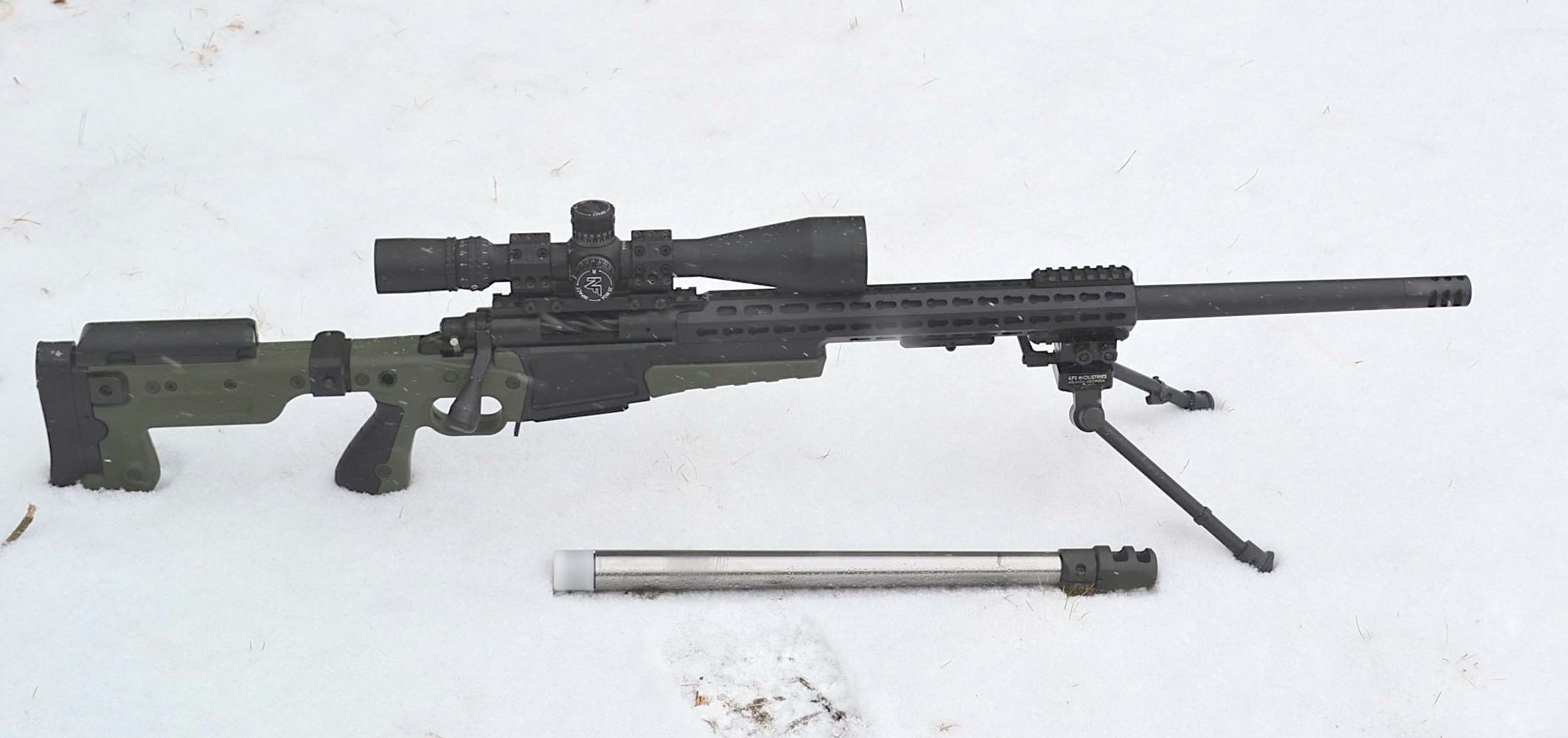
Initially drawn to the 6mmBR and 6mm Dasher, I realized these cartridges wouldn’t feed from an AICS magazine system without extensive modification. I took a look at the 6mm Creedmoor, 6XC, and 6mm-6.5×47 Lapua (aka 6×47 Lapua), all of which feed well from a detachable magazine. At right you can see the 6×47 Lapua in an AICS magazine. It has the “Goldilocks factor” — not too long, not too short.
The ability to simply convert 6.5×47 Lapua brass to 6×47 brass by running the parent 6.5mm brass through a full-length Forster sizing die in a single step was what made me choose the 6×47 Lapua over the 6mm Creedmoor and 6XC (both excellent cartridges in their own right). I also own a 6.5×47 Lapua rifle, so I had a supply of 6.5×47 brass ready to neck-down. Being able to create 6×47 brass easily (one pass and done) was very appealing.
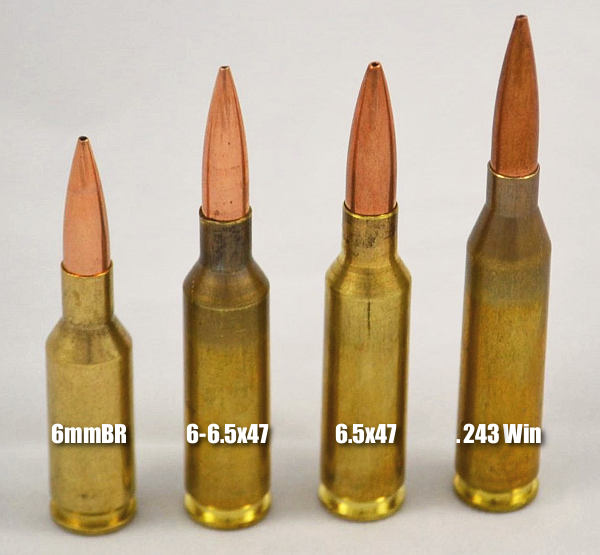
Left to right, below: 6mmBR, 6-6.5×47 Lapua, 6.5×47 Lapua, and .243 Winchester.
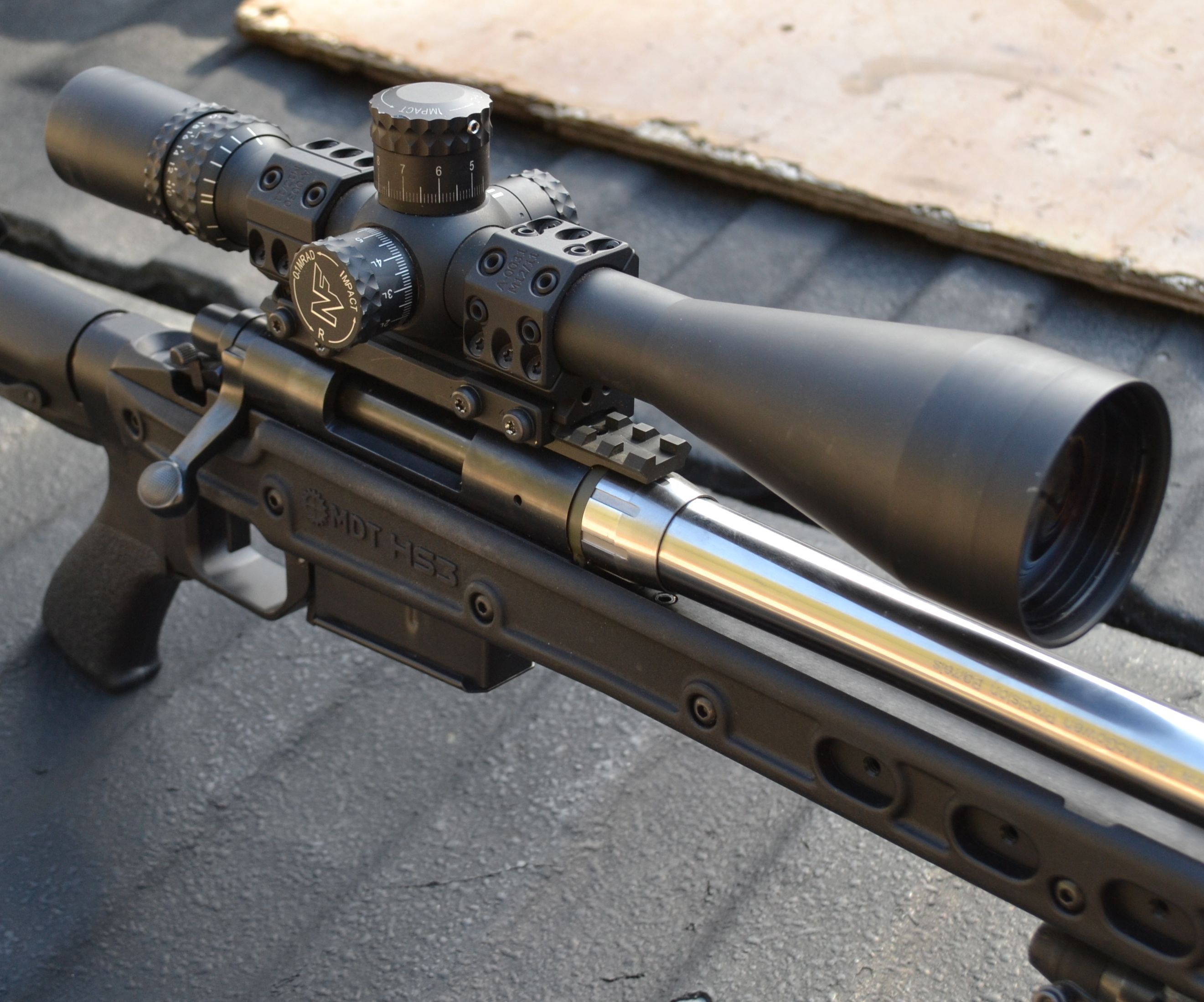
I cut the chamber end off my .243 Win barrel, threaded and chambered my rifle for the 6×47 Lapua cartridge. I have written a lengthy article on this cutting and re-chambering process. Home gunsmiths interested in this process can READ MORE HERE.
When the re-chambering was complete, I headed to the range and worked up a set of eight loads using Berger 108 BTHPs, H4350, Lapua brass, and CCI 450 primers.
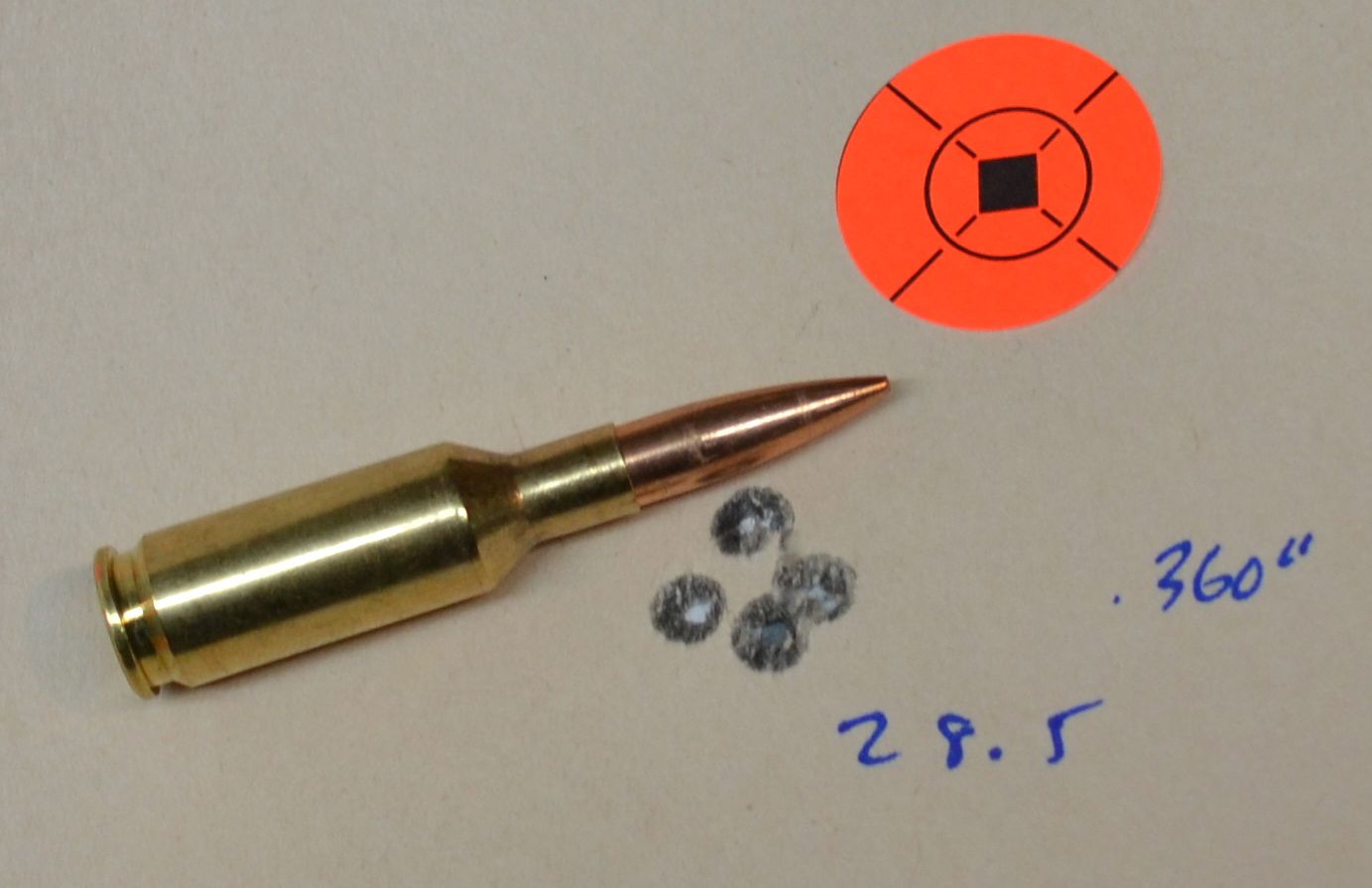
Load development was a little trickier than with the 6.5×47 Lapua parent cartridge. The accuracy nodes were smaller. However, once I dialed in a load with Hodgdon H4350 and the 108-grain Berger BTHP, the rest was history. The 6×47 rig is now one of the most consistent rifles I own, holding just above 0.3 MOA for 5-round groups. Below is a 100-yard test target with 108-grain Berger BT in the 6×47 Lapua. Five-shot group sizes are (L to R): .369″, .289″, and .405″. The average size was .354″ or .338 MOA. [Editor: We think that is excellent accuracy for a tactical-type rifle shot from bipod.]
Learn More about this 6×47 Lapua Project
I’ve written more about this 6×47 rifle on my Rifleshooter.com website. To learn more about my experience with the 6×47 Lapua, click this link: 6-6.5X47 Lapua Review.
About the author: Bill has been a serious shooter for over 20 years. A former Marine Corps Sergeant, he’s competed and placed in High Power Rifle, ISPC, USPSA, IDPA, 3-Gun, F-Class, and precision rifle disciplines. In addition to being an NRA-certified firearms instructor and range officer, Bill has hunted big game in North America, South America, and Africa. Bill writes extensively about gunsmithing, precision rifles, and the shooting sports on his blog, Rifleshooter.com.
Barrel nut system allows “Pre-Fit” barrel installation on a Remington action. CLICK photo to zoom.
REMAGE Project Report by Bill, Rifleshooter.com Editor
Installing a new barrel on your Remington 700 (especially without a lathe) may seem like a daunting task, but thanks to companies like McGowen Precision Barrels, there are easier alternatives. By adopting a Savage-style barrel nut on a 1 1/16″ thread for a Remington 700 receiver, pre-chambered (aka “pre-fit”) barrels can be easily swapped with just a few hand tools. This system is sometimes called a REMAGE conversion (for “REMington savAGE”).
The existing barrel is simply removed from the action (normally the hardest part) and the new barrel is screwed on with the Go Gauge in place. The barrel nut is tightened against the action, headspace verified with the Go Gauge, and you are off to the range. It takes all of the machine work out of the barreling process. Note: the barrel nut has a slightly larger diameter and some stocks may require minor inletting. Also if you are shooting fired brass from another rifle with the same chambering, you should FL-size the brass before loading it for your new pre-fit barrel.
Bill has been a serious shooter for over 20 years. A former Marine Corps Sergeant, he’s competed and placed in High Power Rifle, ISPC, USPSA, IDPA, 3-Gun, F-Class, and precision rifle disciplines. In addition to being an NRA-certified firearms instructor and range officer, Bill has hunted big game in North America, South America, and Africa. Bill writes extensively about gunsmithing, precision rifles, and the shooting sports on his blog, Rifleshooter.com.
The July 8th (Wednesday night) episode of Shooting USA features the 1874 Sharps rifle, a lever-action breech-loader favored by plains buffalo hunters. Christian Sharps patented his signature rifle design in 1848. The Sharps Model 1874 was an updated version, chambered for metallic cartridges. According to firearms historian/author Garry James, the Sharps rifle “came in all sorts of different calibers from .40 all the way up to .50, and jillions of different case lengths and styles and configurations”.
Sharps rifles have enjoyed a new-found notoriety, thanks to Hollywood. Tom Selleck starred as Matthew Quigley in the hit movie Quigley Down-Under. In a famous scene (watch below), Quigley used his 1874 Sharps to hit a wooden bucket at very long range*. In this movie clip, Selleck explains the 45-110 cartridge, the rifle’s double-set trigger, and the Vernier rear sight. (45-110 refers to .45 caliber and case capacity of 110 grains of black powder).
The Sharps rifles used in the movie were made by Shiloh Rifle company (Powder River Rifle Company). There were actually three (3) Sharps rifles made for the movie. One went to the NRA’s National Firearms Museum while another was raffled off to support NRA shooting programs. The headline photo shows the third rifle, Selleck’s favorite, which the actor retained for some years until deciding to sell it. This third rifle (with spare barrel and associated items) were sold at auction in 2008.
* Based on the way the movie is edited, we figure the bucket is placed at about 800 yards. A typical speed for a horse galloping is 35 mph, and the horse ran (with rider holding bucket) for 46.5 seconds (0.775 minutes). To calculate yardage, divide 35 by 60 to get miles per minute, times 0.775 for distance traveled over time. Then multiply by 1760, the number of yards in a mile. That gives us 795.66 yards.
In our Forum recently, there was a discussion about “improved” cartridges based on the .243 Winchester parent case. One popular such cartridge is the Super LR, a 30° long-necked wildcat. The 6mm Super LR was developed by Robert Whitley, who wanted something similar to the 6XC, but with “more boiler room” to push the 115-grain bullets comfortably at 2950-3050 fps.
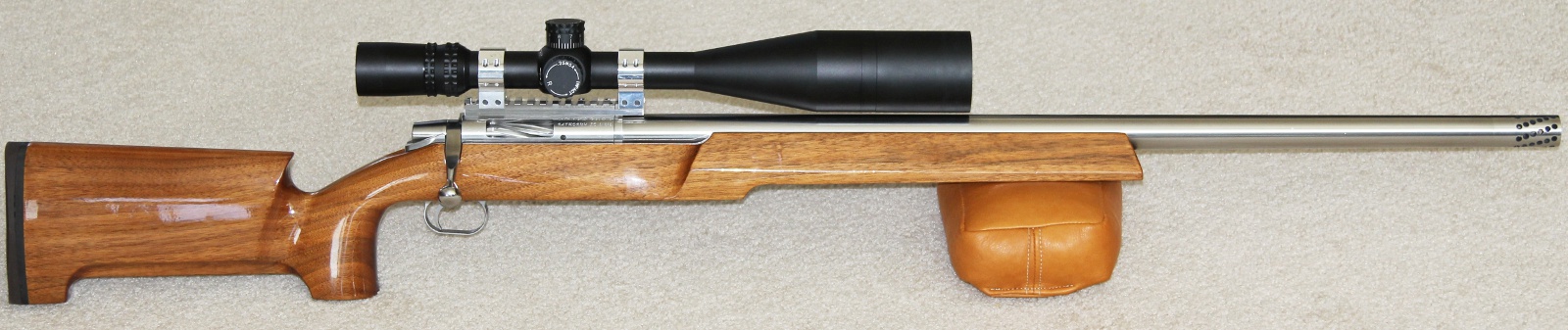
To illustrate the Super LR for interested readers, we dug into our archives and found a report on a 6mm Super LR varmint rifle belonging to Barry O. (aka “TheBlueEyedBear”), a long-time AccurateShooter Forum member. A few years back, Barry put together an impressive 6mm Super LR long-range varminter on a BAT SV action. Barry actually sourced many of the components for this rifle through our AccurateShooter Forum Free Classifieds. CLICK HERE to read all about Barry’s Super LR BAT-Actioned varmint rifle, featured in our popular Gun of the Week Series.
CLICK Photo to Read Full Story
The Richard Franklin walnut LowRider stock (above) for Barry’s rifle came from fellow Forum member “Preacher”, who also did most of the metal work. The gun is chambered as a 6mm Super LR.
6mm Super LR Cartridge Design and Loading Advice by Robert Whitley, AR-X Enterprises
Conceptually, the 6mm Super LR is like a long-bodied 6XC (case body about .120″ longer). The Super LR has a long neck (.321″ vs. the .263″ long neck of the parent .243 Winchester case). The Super LR also has a 30° shoulder angle vs. the 20° shoulder angle of the .243 Winchester parent case. The Super LR has about 54 grains of H20 capacity, compared to 55 grains for the .243 Win and 49 grains H20 for the 6XC.
The Super LR has sufficient case capacity to shoot the 115gr 6mm bullets in the 2950 – 3000 fps range without being “on the edge” of maximum pressure. If you do not need to run sustained fire in long strings, you can “hot rod” things more. Testing has shown that the Super LR can run the 115s up around 3100 fps without issues. With the 105-108 grain 6mm bullets, the 6mm Super LR can push them up in the 3150-3200 fps range with the right powders. In addition, if you like to shoot the 105-108 grain bullets close to the lands, or engaging the lands, the Super LR cartridge case neck is long enough to give most of them a good bearing surface purchase, even if the chamber is throated for the 115gr bullets. That gives the 6mm Super LR cartridge great versatility.
The 30° shoulder angle of the 6mm Super LR is another good feature of the Super LR. Not only does it help to avoid the throat-torching effect that people associate with the .243 Winchester (because of the .243’s short neck and 20° shoulder angle), but the 30° shoulder angle has also been a hallmark of some very accurate cartridges such as the 6 PPC, 6mm BR, 6XC, and 6.5 x 47, to name a few.
The 6mm Super LR wildcat is easy to make. Robert Whitley figured out how to reform domestic .243 Win brass with one simple pass through a Redding 6mm Super LR full-length sizing die. Robert has commissioned these dies from Redding. Call Robert at (215) 348-8789 to order.Learn more about the 6mm Super LR on Whitley’s www.6mmAR.com website.


 By Ron Dague, Sinclair Reloading Tech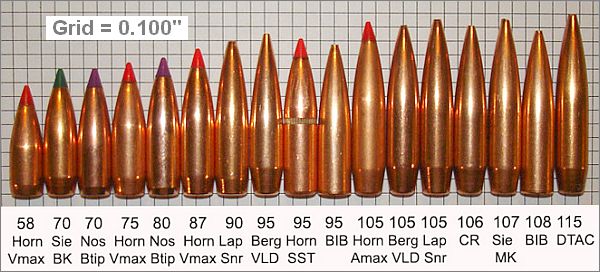


 In the archives of