|
|
January 30th, 2016
 Craters may look interesting on the moon, but you don’t want to see them on your primers. Certain mechanical issues that cause primer craters can also cause primer piercing — a serious safety problem that needs to be addressed. If you have a gun that is cratering primers (even at moderate pressure levels), there is a solution that works with many rifles — send your bolt to Greg Tannel to have the firing pin hole bushed. Craters may look interesting on the moon, but you don’t want to see them on your primers. Certain mechanical issues that cause primer craters can also cause primer piercing — a serious safety problem that needs to be addressed. If you have a gun that is cratering primers (even at moderate pressure levels), there is a solution that works with many rifles — send your bolt to Greg Tannel to have the firing pin hole bushed.
Shooters who convert factory actions to run 6BRs, 6PPCs or other high-pressure cartridges should consider having the firing pin bushed. These modern cartridges like to run at high pressures. When running stout loads, you can get cratering caused by primer flow around the firing pin hole in the bolt face. The reason is a little complicated, but basically the larger the hole, the less hydraulic pressure is required to crater the primer. A limited amount of cratering is normally not a big issue, but you can reduce the problem significantly by having a smith fit a bushing in the firing pin hole. In addition to reduced cratering, bushing the firing pin often produces more consistent ignition.
This is a highly recommended procedure that our editors have had done to their own rifles. Greg Tannel (Gre-Tan Rifles) is an expert at this procedure, and he does excellent work on a wide variety of bolts. Current price for a bushing job, which includes turning the firing pin to .062″, is $80.00, or $88.00 with USPS Priority Mail return shipping.
If you have a factory rifle, a bushed firing pin is the way to go if you are shooting the high-pressure cartridges such as 6PPC, 6BR, 6-6.5×47 and 6.5×47. This is one of the most cost-effective and beneficial upgrades you can do to your factory rifle. For more info on the Firing Pin Bushing process, visit GreTanRifles.com, or email greg [at] gretanrifles.com. (After clicking the link for GreTanRifles.com, Click on “Services” > “Shop Services” > “Bolt Work”, and you’ll see a listing for “Bush Firing Pin Hole & Turn Pin”. Select “View Details”.)
 Firing Pin Hole Bushing by Greg Tannel Firing Pin Hole Bushing by Greg Tannel
Work Done: Bush firing pin hole and turn pin.
Functions: Fixes your cratering and piercing problems.
Price: $80.00 + $8.00 return shipping
Total Price: $88.00
Actions for which Bushing is Offered: Remington, Winchester, Savage multi-piece pin, Sako, Kimber, Nesika, Stiller, BAT Machine, Kelbly, Lawton, Surgeon, Borden, Wichita, Hall, Ruger, Howa, Weatherby, Dakota, Pacific Tool, Phoenix, and Defiant bolt action rifle or pistol.
Actions for which Bushing is NOT Available: Case hardened receivers, ARs, Accuracy International (AI), Barnard, Big Horn, Cooper, Desert Tactical Arms, Kimber, Rosenthal, New Savage single piece pin, Rim fires, Falling block, Break open, Lever, Pump rifles, 1903-A3, CZ, Mauser.
How to send your bolt in to be bushed:
You can send your bolt snail mail, priority mail, or UPS (Please do not use FEDEX as it sometimes has delivery delays). Pack your bolt carefully and ship to: Gre’-Tan Rifles, 24005 Hwy. 13, Rifle CO 81650. Please include your name, phone number, and return shipping address.
Due to the high volume of work, turn around is 5 to 8 weeks on bushing a bolt. Three or more bolts will be sent back to you UPS and we will have to calculate shipping. We can overnight them at your expense. You can pay by check, money order, or credit card. For more information visit GretanRifles.com.
January 29th, 2016

 Guess what American gun-maker has been building guns for two centuries? That’s right, Remington Arms Company celebrates its 200th year in business in 2016. The Remington enterprise was founded in 1816 by Eliphalet Remington in Ilion, New York, as E. Remington and Sons. Remington is America’s oldest gun maker and is still the largest U.S. producer of shotguns and rifles. CLICK HERE for 200 facts about the 200-year-old company. Guess what American gun-maker has been building guns for two centuries? That’s right, Remington Arms Company celebrates its 200th year in business in 2016. The Remington enterprise was founded in 1816 by Eliphalet Remington in Ilion, New York, as E. Remington and Sons. Remington is America’s oldest gun maker and is still the largest U.S. producer of shotguns and rifles. CLICK HERE for 200 facts about the 200-year-old company.
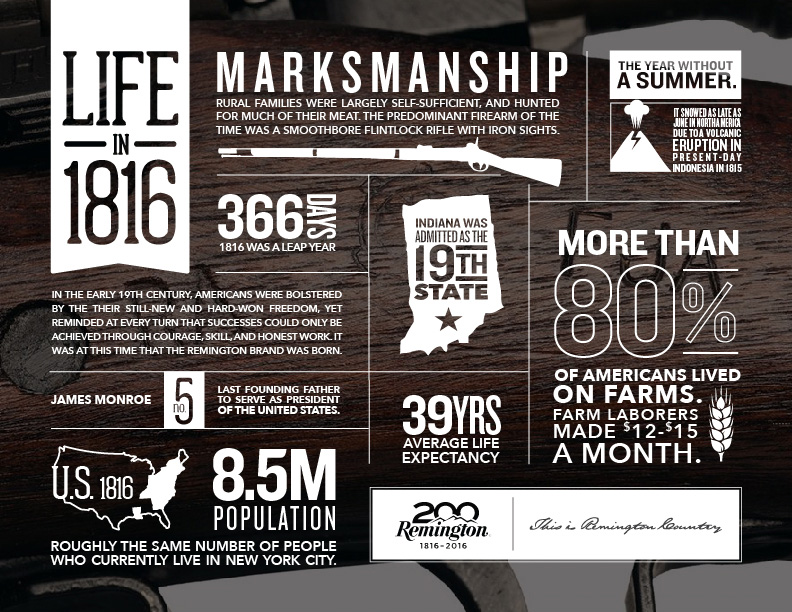
American Life in 1816
What was life like in America in 1816, two hundred years ago? This infographic offers some interesting facts. For example, average life expectancy was only 39 years, and a farm laborer earned just $12-$15 per month. Still want to go back to the “good old days”?
Click to Zoom Infographic:

Since 2007, Remington Arms has been part of the Remington Outdoors Group, which is owned by Cerberus Capital Management. Remington recently opened a new plant in Huntsville, Alabama which produces Modern Sporting Rifles (MSR) and Remington 1911 R1 pistols. Interestingly, Remington also operates America’s oldest factory that still makes its original product (guns). Remington has also developed or adopted more cartridges than any other gun-maker or ammunition manufacturer in the world. Here are some interesting facts about the Remington 700 rifle. Did you know that over 5,000,000 Rem 700s have been produced, in 56 different chamberings? Laid end to end, the five million Rem 700s could span the Atlantic ocean.
Remington 700 Fun Facts

200th Anniversary Remington 700 (Engraved, High-Grade $2399.00)
To celebrate its 200th Anniversary, Remington is releasing a special Bicentennial Series of “limited edition” rifles, shotguns, and pistols. Here is the 200th Year Anniversary Limited Edition Model 700, which features a high-grade stock with Fleur de Lis checkering, American-style engraving with gold inlay, and grip medallion. Remington will make no more than 2016 of these rifles, priced at $2399.00.

January 20th, 2016
Some folks feel that they don’t have to worry about rust and corrosion on stainless steel barrels, actions, and other components. That’s not really true. “Stainless” is a bit of a misnomer. First, there are different types of stainless steel alloys, with different degrees of rust resistance. 300 series stainless is more corrosion resistant than the 416 stainless commonly used in barrels. The composition (by percentage weight) of 416 stainless is 0.15% carbon, 12-14% chromium and the rest iron. 416 stainless steel lacks the roughly 10% nickel content that makes the 300 series more corrosion resistant in atmospheric conditions. But because 416 handles pressure better and is easier to machine (than 300 series steel), 416 stainless remains the better choice for barrels.

Though some grades of stainless are more corrosion-resistent, ALL varieties of stainless steel can rust if they are not handled and stored properly. Forum reader Kells81 observed: “Wanna see some rusted stainless? Go to the big “C” brand store in Ft. Worth. Every stainless gun they have on the used gun rack is rusted.” Tom Easly of TRE Custom explains: “Sweat is very corrosive. Sweat and blood will rust many stainless steels. I hate to handle my guns or drip on them when I sweat. It really helps to just wipe them good with a wet rag, dry and wipe on a light coating of gun oil. I think most stainless barrels are made from type 416 stainless, and it is generally pretty corrosion resistant, but not when exposed to sweat, blood, or chlorates (corrosive priming), and some other electrolytes.”
Forum member Jacob, who is studying materials science at LSU, provides this technical information: “The basic resistance of stainless steel occurs because of its ability to form a protective coating on the metal surface. This coating is a ‘passive’ film which resists further ‘oxidation’ or rusting. The formation of this film is instantaneous in an oxidizing atmosphere such as air, water, or other fluids that contain oxygen. Once the layer has formed, we say that the metal has become ‘passivated’ and the oxidation or ‘rusting’ rate will slow down to less than 0.002″ per year (0.05 mm per year).
Unlike aluminum or silver, this passive film is invisible in stainless steel. It’s created when oxygen combines with the chrome in the stainless to form chrome oxide which is more commonly called ‘ceramic’. This protective oxide or ceramic coating is common to most corrosion resistant materials.
Halogen salts, especially chlorides, easily penetrate this passive film and will allow corrosive attack to occur. The halogens are easy to recognize because they end in the letters ‘ine’. Listed in order of their activity they are: fluorine, chlorine, bromine, iodine, astatine.
These are the same chemicals that will penetrate Teflon and cause trouble with Teflon coated or encapsulated o-rings and/ or similar coated materials. Chlorides are one of the most common elements in nature and if that isn’t bad enough, they’re also soluble, active ions. These provide the basis for electrolytes. The presence of electrolytic solutions can accelerate corrosion or chemical attack.”
 CONCLUSION: Stainless steel barrels and components won’t rust nearly as fast as blued steel, but you still have to take precautions — particularly removing sweat and corrosive salts from the barrel. Also, don’t let moisture build up inside or outside of the barrel. We recommend wiping your barrels and actions with Eezox, or Corrosion-X after each use. These are both extremely effective rust-fighters that go on thin, without leaving a greasy residue. (Eezox leaves a clear finish, while Corrosion-X has a slightly waxy finish.) Also store your guns in Bore-Store bags when the guns go in the safe. Bore-Stores wick away moisture, and the synthetic fleece inner surface is treated with rust-fighting chemicals. Bore-Stores also protect your guns against dings and scratches. CONCLUSION: Stainless steel barrels and components won’t rust nearly as fast as blued steel, but you still have to take precautions — particularly removing sweat and corrosive salts from the barrel. Also, don’t let moisture build up inside or outside of the barrel. We recommend wiping your barrels and actions with Eezox, or Corrosion-X after each use. These are both extremely effective rust-fighters that go on thin, without leaving a greasy residue. (Eezox leaves a clear finish, while Corrosion-X has a slightly waxy finish.) Also store your guns in Bore-Store bags when the guns go in the safe. Bore-Stores wick away moisture, and the synthetic fleece inner surface is treated with rust-fighting chemicals. Bore-Stores also protect your guns against dings and scratches.
January 16th, 2016

As a visual treat for our Daily Bulletin readers, we went back to our Gun of the Week archives to showcase a very special rifle. This humdinger could be the prettiest prone rifle we’ve ever seen. Commissioned for Forum member Corbin S., this is one handsome rifle, built with all-premium components and a stunning Curly Maple thumbhole stock with adjustable cheekpiece. The rifle is chambered in .243 Winchester. It features a custom stainless RBRP action Nesika R action, with keycuts in the bottom instead of recoil lug. A Grünig & Elmiger trigger has been specially modified (milled and pinned) to work with the Nesika action. The barrel is a 30″ Broughton 5R Palma-contour tube, and there is another 30″ Broughton 6BR barrel that Corbin uses at shorter ranges. The trigger guard, fore-arm rail, cheek adjuster, and 4-way adjustable butt assembly are all custom metal, designed by Dan Gleason. The stock is cut from exhibition-grade fiddleback maple (from Cecil Fredi Gunstocks in Las Vegas) with a Gaboon Ebony tip wood and butt-plate spacer.

Very Accurate with Fast-Flyin’ Berger 105s
Corbin tells us the gun will put five shots into the size of a quarter at 300 yards “when he does his part.” Corbin shoots pointed Berger 105gr VLDs and 45.5 grains of H4831SC. That load runs 3180 fps. He can push it faster, but “that’s where the node was and where it shoots best”, according to Corbin.
Forum member Jim Hardy has seen (and shot against) this beautiful rifle. He reports:
“A casual observer might think that the trigger guard, cheek plate and butt plate hardware are Anschutz — as the stock takes on the Anschutz prone pattern. However, this is ALL custom metal. The G&E trigger breaks like a glass rod and will makes my BR triggers feel inferior at best. I had the pleasure of holding, shouldering, and lusting over this gun at Camp Perry last year, and it is even more impressive in person. The killer is that there is yet ANOTHER one in a beautiful, dark figured walnut owned by Corbin’s shooting partner. BTW, both guns will hammer at 1000 yards prone.”


January 13th, 2016

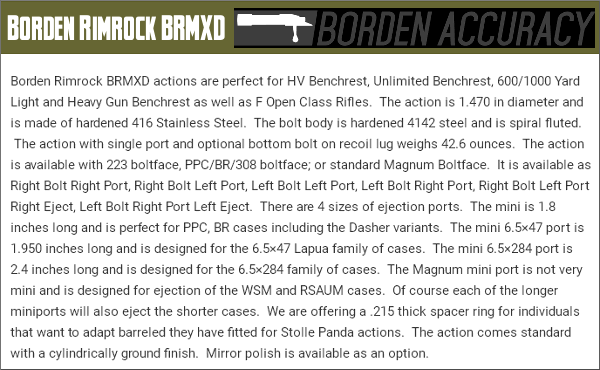
Our friend Erik Cortina told us that Jim Borden of Borden Accuracy has developed a new “wide-body” action, the Borden BRMXD. Erik is building a rifle around this action to shoot at the 2016 Berger SW Nationals. The new BRMXD is Borden’s first venture into action bodies larger than 1.350″ in diameter. The round BRMXD action measures a stout 1.470″ in diameter and comes standard with bottom recoil lug. If the customer prefers, Border can deliver the action with a conventional recoil lug on the front. We like the looks of Borden’s new BRMXD, and we bet this new stainless action will be a smooth runner.

Borden BRM-XD Action Specifications:
• Action: BRM-XD
• Length: 8-1/8″
• Outside Diameter: 1.470″
• Port Length: Single Port: 2.750″
— Dual Port w/ Mini Port for BR / PPC: 2.750″ Loading & 1.8″ Eject Port
— Dual Port w/ x47 Family Port: 2.750″ Loading & 1.9″ Eject Port
— Dual Port w/ .284 Family Port: 2.750″ Loading & 2.4″ Eject Port
• Weight: 42.6 oz for Single Port
• Price: $1325.00 with bottom lug for a single port – $1400.00 for a dual port + shipping
• Price: $1250.00 for no lug (Glue-In Only)
Borden Accuracy will also offer a 0.215″ spacer for shooters who wish to use their current PANDA barrels with a new BRMXD action. This hardened steel spacer will cost $50.00 (introductory price).

January 5th, 2016

The creators of the Firearms Guide DVDs have launched a huge online database for firearms. This new, subscription-based web resource, Firearmsguide.com, includes over 61,000 firearm types from 902 manufacturers. It’s easy to find just about any gun — search by manufacturer or other variables such as caliber, action type, country of origin, and vintage. In addition, the gun entries are cross-linked to a large ammunition database so you can find factory ammo for any type of firearm.
You Can Search for 61,000+ Guns Using 14 Variables:

Think of this as a digital encyclopedia of guns — the mother of all gun reference guides. The sheer amount of information (text, photos, and schematics) is mind-boggling. Firearmsguide.com currently covers 61,000 models of rifles, pistols, shotguns, air rifles, and air pistols from 50 different countries. Subscription plans start at $49.95 per year.

This new database is a gold mine for gun collectors and gunsmiths. For most of the firearm entries, there are full specifications and up to 12 high-rez color photos. In addition, the database features 5500 printable schematics along with parts lists. Collectors will appreciate the inclusion of gun values for both modern and vintage firearms.
December 26th, 2015

Here’s important news for owners of Accuracy International (AI) rifles. There is now an approved AI service facility in the United States: Mile High Shooting Center (Erie, Colorado). After Mile High’s tech team received extensive training at the AI production center in England, Mile High Shooting Center has been appointed the USA’s first Accuracy International Factory Authorized Service Center.
Mile High, owned by Randy and Diann Pennington, has been an AI distributor for many years and the Service Center will be run by professional gunsmith Adam Rehor. To contact the new Service Center, email AIservice@milehighshooting.com or call (303) 255-9999.


|
Mile High Shooting Center is located in the Denver metropolitan area. The company has fully-equipped facilities to provide LEO and civilian users with factory standard spares, service, and repair for all Accuracy International rifles and equipment. |
Mile High Shooting Accessories
3731 Monarch Street
Erie, CO 80516
Toll Free: 1.877.871.9990
Phone: 1.303.255.9999
Fax: 1.303.254.6572 |
December 23rd, 2015

PMA Tool now offers a unique “adjustable” Stock Weight System with variable weighting from 2 to 8 ounces (including internal sleeve). This $65.95 system allows the shooter to add or remove weight (in the buttstock) to balance the gun, or adjust the weight to meet class weight limits. Say, for example you were running at max weight but then changed your scope for a new optic that weighed 4 ounces less. With this system, you can easily get back up to the “legal limit”. You can also use the weight to adjust balance when running barrels of different lengths or contours.
The PMA Stock Weight system is made up of a sleeve, a nut and three interchangeable weights. The sleeve and nut weigh 2 ounces (combined) and weight inserts of 2, 4 and 6 ounces are included in the system. The sleeve is machined from aluminum, while the nut and weights are machined from stainless steel. All weights are roll-stamped with their weights and “coin-slotted” so they can be easily installed using a screwdriver or coin. The nut utilizes a 1/4″ hex wrench for removal from the sleeve and installation of weights.
While installation of these Stock Weight Systems is fairly simple, PMA states that: “The sleeve should be installed into the buttstock by someone with some mechanical aptitude and an understanding of stock construction, preferably a trained gunsmith or stock-fitter.”
Product tip from EdLongrange. We welcome reader submissions.
December 19th, 2015

Doan Trevor is a master gunsmith and stock-maker who works in the old style. He still hand-crafts stocks from start to finish, and does all the metal-work on the custom rifles he builds. Starting with highly-figured woods, Doan carves and shapes his stocks largely by hand, with meticulous attention to detail. Each rifle he builds is optimized for its intended discipline, and custom-fitted for the customer.

With the help of his talented wife Sue (who does the photography and builds the web pages), Doan has created a wonderful website, DoanTrevor.com, that is a feast for the eyes. You can see beautiful wood-stocked rifles being hand-crafted. Doan also illustrates how he creates custom metal parts, and how he beds barreled actions into the finished stocks.


Set aside a few minutes and visit Doan’s website. Be sure to click on the site’s secondary pages: Rifle Building, Woodworking, and Metalworking. You’ll find dozens of high-quality photos and fascinating information on gun-building.

For more information, visit DoanTrevor.com, or call (505) 890-0368, 10am-5pm M-F.
Doan Trevor RifleBuilding
4119 Lanceleaf Ct NW
Albuquerque, NM 87114
505-890-0368
December 17th, 2015
Butch Lambert of ShadeTree Engineering provided this tip. Butch notes that many 6 PPC benchrest group shooters also enjoy shooting in score matches. But to be really competitive in the BR for score game, that means shooting a 30BR, which has a wider, .308-class rim (0.4728″ diameter). Likewise, if you want to compete in 600-yard registered BR events or in varmint matches, you probably want to run a bigger case, such as the 6BR, 6mm Dasher, or 6-6.5×47. Those cartridges also have the larger 0.4728″ rims.
To convert a PPC-boltface action to shoot the bigger cases you can spend a ton of money and buy a new bolt. That can cost hundreds of dollars. The simpler solution is to turn down the diameter of the larger cases on a lathe. Butch explains: “We’ve seen plenty of interest in rebating case rims. This lets you shoot a 30BR in score matches using your PPC action. All you need is a new barrel. This saves buying another bolt, receiver, or rifle if you have a PPC boltface. Anyone who has access to a lathe can do this job pretty easily. Yesterday I turned 150 case in about an hour.” Below are photos of a rebated 6BR case, along with the lathe form tool Butch uses to rebate the case rims.
Cutting Head for Rebating Rims

|