There’s a chap in Poland named Łukasz Pietruszka, who is a bonafide “Wizard of Wood”. Lukasz handcrafts unique custom stocks, selling them through his LP Gunstocks company. Many of his most eye-catching stocks are for airguns (particularly Field Target rifles), but he also produces fine stocks for rimfire and centerfire hunting rifles. Lukasz is a master carver who includes exquisite details on many of his stocks. Some of these designs, crafted from exotic hardwoods, raise stock-crafting to an art form.
Check out the figure on this Turkish Walnut stock by Łukasz Pietruszka.
You can see a variety of Lukasz’s stocks in a video sampler. If you’re a fan of fine wood, you’ll love this video. So pull up a chair, grab your favorite beverage, and enjoy this 16-minute video interlude.
Watch Video in High Definition
NOTE: We recommend you view this video in high definition, in wide screen format. To do this, start the video, then click on the gear-shaped icon at the lower right-hand corner of the video frame (it’s located just to the right of the clock icon). If you have a fast internet connection, select 720P or 1080P from the pop-up menu. (1080P is the highest resolution.) Now select theater mode or full-screen mode using the small icons on the lower right of the frame.
Radical ‘Shockwave’ from LP Gunstocks
Here is a truly amazing bit of craftmanship. The images below show a one-of-a-kind Shockwave stock created by Łukasz for a Steyr Field Target air rifle. Over the top? Perhaps… but you have to admire the imaginative design and exquisite worksmanship.
Video find by Boyd Allen. We welcome reader submissions.
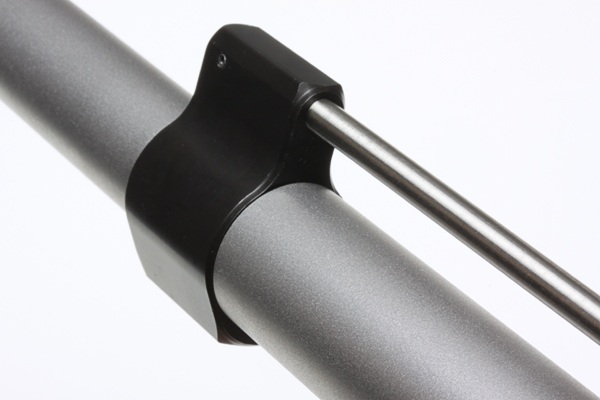
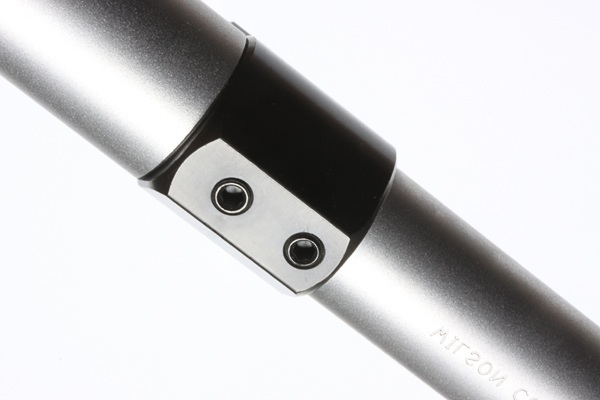
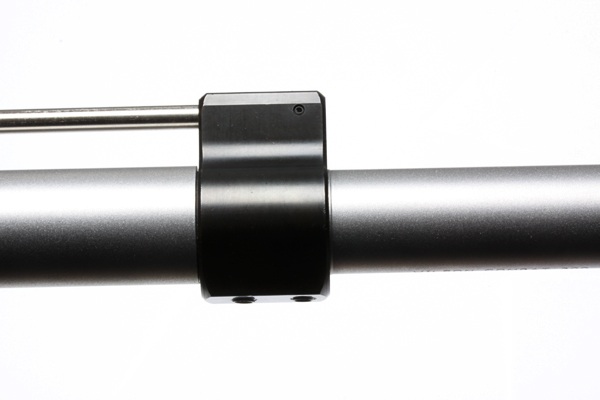
Here’s an interesting $75 product that can help you “tune” the cycling force of your AR-platform rifle. Wilson Combat offers an Adjustable Lo-Profile AR Gas Block for direct gas impingement AR-type rifles. Wilson Combat’s adjustable gas block replaces a standard AR gas block and allows you to tune your AR’s gas system for smoother cycling and enhanced reliability. Wilson Combat explains: “Adjusting your rifle’s gas port will lower or increase your bolt’s cyclic rate. This tailors your rifle’s performance to your unique needs.” When varmint hunting with an AR, we like a less-energetic ejection so the brass lands close to the gun (and doesn’t tag fellow shooters).
A simple adjustment of the hex screw at the front of the block modulates the gas volume allowing you to tune your rifle’s function to your favorite loads. This is very handy when shooting non-standard AR calibers, unusual hand-loads, or suppressed rifles. Adjustable Gas Block systems are sold as complete kits starting at $74.95. Wilson Combat offers two diameters (.750″, .937″) and three lengths (Carbine Length, Mid-Length, & Rifle Length), so you can select the right dimensions for your rifle configuration and barrel diameter. The blocks are Chromoly steel with a Melonited finish.
Package Includes:
Adjustable Gas Block (Melonite Finish)
Adjustment Set Screw (Installed)
Straight Gas Tube (Installed, Gas Tube Pin Installed)
Ed Shilen at a rimfire benchrest match. Photo courtesy Frederick Jamison.
Ed Shilen, founder of Shilen Rifles Inc. and legendary barrel-maker, has passed away. This is sad news — we are all diminished. Ed was a great innovator who was always willing to help other shooters. Ed’s good friend Butch Lambert reported the news: “Mikel Shilen called a little while ago and told me that Ed has passed away. No services will be held. Ed was a great friend and very helpful to me. He was one of the true icons of our sport. Keep the family in your prayers.”
A member of the Benchrest Hall of Fame, Ed Shilen set many records during his long shooting career. Thomas “Speedy” Gonzalez, wrote: “Ed was always in your corner always wanting to see you succeed. He was one of our sport’s great gentlemen, innovators, and promoters of accuracy to the end. Thank you Ed for building me the barrels that allowed me to complete a dream and life’s work. Your family and friends are in my prayers. God bless them all!”
Speedy, who earned all but one of his Hall of Fame points with Shilen barrels, added: “Ed was one of my mentors. I have owned almost every type of Shilen action Ed ever made — from the early Ross Sherman/Shilens, to the SS&D (Shooters Service and Dewey), to the 2″ round unlimited actions of which only 10 were made, to the round big bolt Shilens and DGA & DGA-S.” Here is one of Speedy’s older Shilen actions, beautifully engraved.
Posting on Facebook, B. Moreno wrote: “Very sad indeed…I dare say that not only did [Ed Shilen] make great barrels, actions and triggers, but his business model allowed custom performance at a reasonable price. I believe more bullet holes are touching across America due to his name than any other single family. R.I.P. Ed, you will be missed.”
Did you know that Shilen Rifles Inc. offers barreled actions and complete rifles? And that Shilen offers a Savage-style, barrel-nut system for its Rem-clone actions? Starting in 2010, after a hiatus of nearly twenty years, Shilen returned to the rifle manufacturing market. After several years of development, Shilen now offers custom actions ($950.00), barreled custom actions with triggers ($1500.00), and complete rifles ($3200.00 and up). Call (972) 875-5318 or email comments [@] shilen.com for more information. NOTE: An 11% Federal Excise Tax is due on complete rifles.
The new Shilen custom actions are CNC-milled from high-grade stainless steel. Two types are offered — the multi-shot DGR (Repeater) or the single-shot DGV (Varminter) action. Both actions are offered in most common bolt faces and both right-hand and left-hand actions are immediately available. The DGR and DGV actions have a 1.350″ diameter with 8-40 scope base mounting screw holes, and an 0.300″ pinned recoil lug. The spiral-fluted bolts feature a floating bolt head with an interchangeable bolt handle knob. These actions feature a footprint similar to the Remington Model 700. Both DGR and DGV actions will accept many aftermarket components crafted for Rem-700 style actions, including triggers and bottom metal.
Barreled Actions with Barrel-Nut System for Easy Barrel Exchanges
Along with the stand-alone DGR and DGV actions, Shilen is offering barreled action assemblies, chambered and ready to drop into Rem 700-inletted stocks. The actions are fitted with Shilen match-grade barrels and Shilen triggers. The barrels feature a 1-1/16″x20 barrel thread and are attached to the action by a barrel nut. This Savage-style barrel nut system simplifies headspacing, allowing easy swapping from one barrel to another. With the simple barrel-exchange procedure, you can shoot multiple chamberings with a single action/rifle. For example, shooters can change from a .223 Remington to a .204 Ruger or a .22-250 to a 6mm BR in a matter of minutes.
Complete Rifles with McMillan Stocks
With Shilen’s complete rifles, buyers can choose their chambering, and select barrel and stock configuration. Shooters can choose between a sporter weight wood stock or a variety of McMillan fiberglass stocks. With all complete rifles, the entire package is delivered in a quality gun case and Shilen even includes table mat, cleaning rod, bore guide, jag, bore brush, and cleaning patches.
Here’s an early Christmas present to our readers from Beretta — a really great video about gun-making. This movie, entitled “Human Technology”, is one of the best videos we’ve ever featured on this site. It’s that good. You’ll see an amazing blend of ultra-modern manufacturing technology along with old-world artisanship — “a mesmerizing meld of the high-tech and the traditional”. (Daniel Xu, Outdoor Hub.)
“Human Technology is a singular and symbolic movie, its cast entirely made up of Beretta workmen, thus illustrating the perfect synthesis between craftsmanship and technology,” Beretta writes. This artistic movie by Ancarani Studio illustrates all the aspects of the manufacturing of a high-end Beretta shotgun. This video is a study in contrast. The movements of robotic assembly machines are juxtaposed with the centuries-old craftsmanship of stock carvers. Beautifully filmed and edited, this video should amaze and entertain anyone who loves fine firearms. (Full-screen HD Recommended.)
Here’s an interesting project — using a second-hand barrel to upgrade an AR15. Our friend Erik Cortina decided to make his AR15, originally chambered in 6.8 SPC, into a 6.5 Grendel. Erik acquired a “pre-owned” 6.5-06 match barrel through our Shooters’ Forum. Erik inspected the barrel with a bore-scope and confirmed it was in good shape after the first few inches (past the chamber). The 6.5-06 barrel had more than enough length, so he trimmed off the chamber end, then contoured the barrel to fit his AR15. This is a smart way to upgrade a gun without spending $350 or more on a brand new barrel.
In the first video, Erik explains the process of converting his 6.8 SPC AR15 into a 6.5 Grendel: “I take the upper completely apart and pull barrel off which will be used to take dimensions for new barrel. The new barrel will be turned from an old competition heavy barrel. All the barrel reaming will be done using JGS reamers. I will also use JGS reamers to make a seating and F/L sizing die.”
In the second video, Erik contours the “pre-owned” barrel to fit his AR. He uses an old bolt-action 6.5-06 competition barrel and cuts it to 17″ long and contours it to fit his AR-15. The barrel is turned down on a manual lathe to .750″ outside diameter for the majority of its length in order to fit the gas system barrel block that is made for a .750″ barrel. After contouring, the barrel will be threaded and chambered.
A while back, Roy Bertalotto acquired a budget-priced Kimber 82G rimfire target rifle from the CMP. The Kimber comes with an oiled-wood stock that works fine for three-position training, but Roy wanted to shoot the gun for the bench. The original Kimber stock, with its narrow, radiused forearm, was not ideal for this purpose. Roy wanted a wide, flat fore-end, which is much more stable in the bags. Rather that spend hundreds on a new benchrest stock, Roy modified his Kimber’s original stock by slicing a section off the bottom of the stock and then replacing this with a 3/4″ X 2 3/4″ X 15″ piece of walnut.
WATCH Project Stages in Slide-Show Below:
Roy explains: “The modification I did on my Kimber 82G stock was done using a milling machine, hand planes, files, die grinder and sand paper. It can also be done with simple hand tools — it will just take longer. The first step is removing the wood on the bottom of the fore-end. This was accomplished in the milling machine. A scrap piece of 2X8 was mounted to the milling machine’s table and the surface milled to be perfectly flat. The Kimber stock was screwed to this 2X8 with two large screws and the bottom of the stock was milled flat. Once this was done, a piece of 3/4″ X 2 3/4″ X 15″ walnut was glued using West System epoxy to the cut out area. I use West System epoxy in boat building, but any good wood glue will work.”
After gluing the new bottom piece in place, Roy milled the sides to provide side flats with a radius to transition from the wider lower section to the narrower upper part of the fore-end. As a added enhancement, Roy contoured the rear of the fore-end to blend with the rear of the stock, adding what he calls “1965 Ford Mustang side scoops”. Roy then used a Die Grinder with a 1.5″ sanding wheel to modify the wrist area to provide more thumb relief.
Following the cutting, milling, gluing, and shaping, Roy sanded with 150 grit and 300 grit sandpaper before applying multiple coats of Tung Oil. Once the main stock was completed, Roy completed the project by crafting an extended buttplate from a couple pieces of 1/8″ aluminum and two 1.5″ aluminum tubes, “all polished to a slightly less than mirror finish”. NOTE: This metal buttplate assembly was made from scratch (other than the pad). This is not an aftermarket extension kit.
Overall the gun turned out very nicely. Log on to Roy’s RVB Precision webpage to learn more about this Kimber stock modification project, and view more photos of the building process.
If you own a Ruger Precision Rifle (RPR), or are considering purchasing one, you should watch this short video from Sniper’s Hide. The Hide’s head honcho, Frank Galli (aka “LowLight”), added some upgrades to his RPR, to enhance looks and ergonomics. Frankly we think the RPR is pretty good right out of the box. Our friend Gavin Gear of UltimateReloader.com is seeing near-half-MOA accuracy with his “box-stock” RPR in .243 Winchester. Nonetheless we know some RPR owners will want to swap barrels or otherwise “hot rod” their rifle. Here’s how it’s done…
Video Shows New Barrel, Stock, Grip and Handguards Installed on Ruger Precision Rifle:
Galli unbolted quite a few factory parts, replacing them with proven aftermarket components. That’s one of the advantages of the RPR — it’s modular nature allows the owner to make changes with simple tools. Off came the handguards, stock, and grip. While we’ve been fairly impressed with the accuracy of some RPR factory barrels, Galli decided to fit a custom barrel, courtesy Chad Dixon of LongRifles Inc. (LRI). All totaled, the new components cost more than the original rifle. Galli figures he now has about $2400 in the gun. A new RPR (if you can find one) will run you about $1100-$1200.00.
The new barrel was a good investment, but the other items could be considered indulgences. But we like the fact that Galli demonstrated how easily the RPR can be modified by anyone with basic mechanical skills. (The Ruger’s barrel-mounting system allows you to run a “Pre-fit” barrel with headspace set by clamping nuts.) CLICK HERE for details of the build.
New Components for LowLight’s Ruger Precision Rifle
Magpul MOE Grip
Magpul PRS Stock
Seekins Precision “Triangle” Handguards
LongRifles Inc. (LRI) Aluminum Bolt Shroud
Custom K&P “Pre-Fit” Barrel from LRI (chambered in 6.5 Creedmoor)
As a lead-up to Black Friday, Brownells.com is running three full weeks of special sales. You can get some very good deals during this 3-week “Back to Black” event. Above are three featured items for Week Two of this promotion. There are some nice Geissele and Timney triggers at good prices. In addition to these top deals, hundreds of other products are on sale at Brownells.com this week. Here are three products that caught our eye. You can’t go wrong with an RCBS Rock Chucker for $129.99 or a stripped AR15 Lower Receiver for $59.99 (or $99.99 with Tan or Sniper Gray Cerakote finish). Brownells offers a 100% satisfaction guarantee on these Aero Precision Lowers.
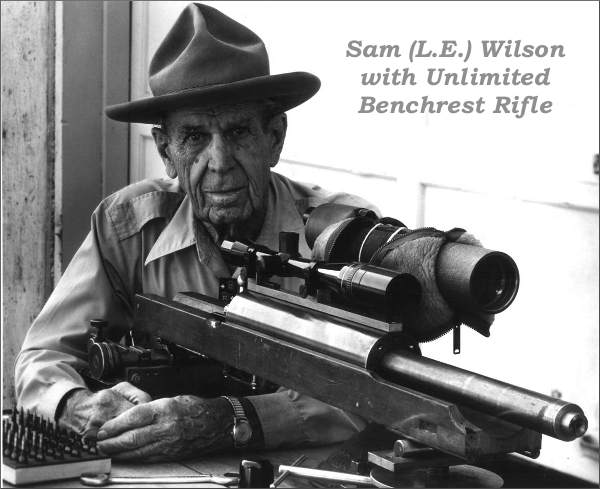
Sam (L.E.) Wilson actively competed in benchrest matches until he passed. He’s shown here with an Unlimited benchrest rifle of his own design.
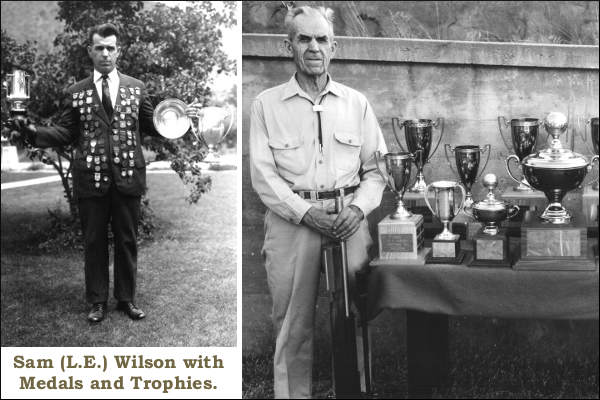
If you’ve used hand dies with an arbor press, chances are you’ve seen the L.E. Wilson company name. You may not know that the founder of L.E. Wilson Inc. was an avid benchrest competitor who pioneered many of the precision reloading methods we used today. Known as “Sam” to his friends, L.E. Wilson was one of the great accuracy pioneers who collected many trophies for match victories during his long shooting career.
The photo above shows Sam (foreground) with all of his children at a shoot. Behind Sam are Jim, Jack and Mary, shooting in the Unlimited Class. What do they say — “the family that plays together stays together”? Note the long, externally-adjusted scopes being used. Learn more about Sam (L.E.) Wilson and his company on the L.E. Wilson Inc. Facebook Page.
Unlimited Class was Sam’s favorite discipline, because in the “good old days” top competitors normally would craft both the rifle and the front/rear rests. This rewarded Sam’s ingenuity and machining/fabrication skills. In the “build-it-yourself” era, one couldn’t just order up an unlimited rail gun on the internet. How times have changed…


 Watch Video in High Definition



 A member of the Benchrest Hall of Fame, Ed Shilen set many records during his long shooting career. Thomas “Speedy” Gonzalez, wrote: “Ed was always in your corner always wanting to see you succeed. He was one of our sport’s great gentlemen, innovators, and promoters of accuracy to the end. Thank you Ed for building me the barrels that allowed me to complete a dream and life’s work. Your family and friends are in my prayers. God bless them all!”