Brownells recently reviewed some interesting new products including Howa Barreled Actions and a low-profile titanium gas block for AR-platform rifles. We really like the Howa Barreled Actions as the basis of a varmint or hunting rifle build. The actions are smooth and the Howa-supplied, adjustable HACT 2-stage trigger is excellent. Brownells will stock these barreled actions in a wide range of calibers and barrel profiles (including some with threaded muzzles for brakes or suppressors).
Watch Brownells NEW PRODUCT Review 3/11/2016:
Starting at $407.00, Howa Barreled Actions include hammer-forged barrel, bottom metal, magazine (internal or DBM), and the HACT 2-stage trigger. The three-position safety allows you to manipulate the bolt with the trigger blocked. These Howa barreled actions, which are drilled and tapped for scope mounts, come in Blue or Cerakote Gray finish in Short, Long, and Mini-Action sizes. The Howa Mini-Action is a great basis for a light, compact small-caliber varminter.
Low-Profile Titanium Gas Block for AR-Platform Rifles
The Battle Arms AR-15 Titanium Gas Block (#100-800-003) provides a very trick, low-profile set-up for an AR “space gun” or 3-Gun rig. Light and strong, the Battle Arms Ti gas block fits underneath almost any handguard. This slim, ultra-lightweight Titanium block helps keep an AR-15 rifle/carbine fast and maneuverable by reducing front-end mass. Brownells price is $99.95.
Planning to put together an AR-platform rifle? Or are you looking to upgrade your AR with a new barrel, stock, or trigger group? Then you should check out the AR-15 Rifle Build DVD from our friends at UltimateReloader.com. This DVD covers all the details of a custom build, using high-resolution video sequences, and helpful supporting graphics.
In this DVD, Gavin Gear guides you through the entire process including selecting components, acquiring and using the necessary tools, assembly steps and details for each component, and even mounting a scope. Building an AR-15 can be overwhelming, but with the right guidance and help it’s not difficult and is a lot of fun. With this DVD you’ll be able to build your AR-15 with confidence.
Right now, as a New Year’s promotion, the AR-15 Build DVD is on sale for just $9.90 (plus $3.80 shipping/handling). This DVD can pay for itself many times over by showing you how to do your own gunsmithing (and get quality AR components at attractive prices).
At the IWA Trade Show in Germany a few years ago, a correspondent for The Firearm Blog interviewed Woody Woodall, who runs Lothar Walther’s USA operation. While many shooters assume that Walther hammer-forges most of its barrels like some other European barrel-makers, in fact Lothar Walther USA uses the button rifling technique for most of its US-made barrels.
In the video below, created for The Firearm Blog, Woodall explains that button rifling involves some extra steps to ensure a good result: “The extra work that goes into it is that you’ve got to make rifling, stress relieve it, and have it come out the right size. And it takes a lot of skill to do that. Lothar Walther invented button rifling in 1925, if a better way of making rifling came out, we’d be glad to go to it.”
Woodall explains that hammer forging is a good method for mass production, but it is costly to set up: “Hammer forging is relatively new, it came out in 1934, but did not come into prominence until the 1950s…. But the cost of [hammer forging] in the world today is getting above what the market will bear for barrels. [Hammer forging] is more complicated. As the hammers hit the barrel the barrel gets longer, but the hammers have to hit uniformly so the barrel [stays] straight. There’s a higher failure rate in that. There’s also some surface delamination that can occur, and some other issues. So if you’re hammer forging, you really have to pay attention to the details. So, it’s like button rifling, only ten times more complicated. It’s for super-high-volume production… The large companies tend to use the hammer forging, intermediate size companies tend to use the buttoning, and craft companies tend to use the cut rifling. All three [methods] can make an equally accurate barrel.”
How well can factory .308 Win ammo perform? Amazingly well it seems. Our friends at Criterion Barrels recently tested some .308 ammo from Creedmoor Sports. This was loaded with Lapua’s 175gr Scenar HPBT bullet. The results speak for themselves. Any time factory ammo can shoot inside quarter-MOA, that’s impressive. This ammo was used in a “Rem/Age” project rifle. That term refers to a Remington action rifle that has been re-barreled with a pre-fit Criterion barrel. The new barrel is secured with a Savage-style barrel nut. Hence the term “Rem/Age” or “Rem-Age”.
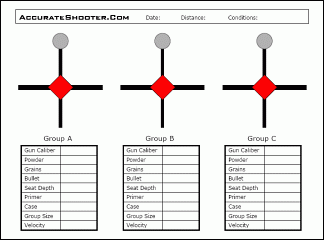
Criterion posted: “I think we may have a new favorite factory match load for the nitrided Rem/Age build.” Another reader added: “[Creedmoor’s] 175 Scenar .308 ammunition is top notch.” FYI, this group was shot on our load development target, which you can download for free from our Targets Page.
Why do Criterion barrels shoot so well? One reason is that Criterion’s barrel steel is carefully stress-relieved. In the photo below, Criterion Rack 1A (aka the “Coffin”) has been loaded with barrel blanks — made ready for the stress-relieving process.
Report by Vince Bottomley Victrix Armaments, an Italian company, has developed new technology that could be a major “game-changer” in the world of precision rifles in general, and F-Class in particular. Victrix’s leadership group knows all about excellence — and winning. Giuseppe Valtorta, CEO of Victrix Armaments, is a top competitive shooter who won Gold with his F-TR rifle at the 2015 European F-Class Championships.
A New Breed of F-Class Rifle
Turn back the clock half a century — George Farquharson is happily shooting a modified military rifle with iron sights and sling. He hasn’t even dreamt of F Class…
Benchrest however is beginning to gather momentum. Accuracy seekers are demanding the ultimate in precision engineering. They will go to their favorite gunsmith and, if they’re very lucky, procure one of the new custom actions from Hart or Shilen.
In the last 50 years, what’s changed? Benchrest is still with us but F-Class has emerged as a world discipline and, to some extent, brought new challenges to our accuracy rifle builders. But, whilst the rest of the planet has reveled in the speed and precision of CNC machining, we still love to place our faith in the gunsmith and his trusty old lathe!
But, of course, there is a reason for this. CNC equipment is expensive and geared towards the rapid multiple production of precision parts, whereas the custom gunsmith is dedicated to the ‘one-off’ build.
Also, even with a limited run, CNC does not readily lend itself to chambering our cut- or button-rifled barrels. Good as our barrels are, there are issues that have made CNC machine problematic. Each barrel demands loving care at the hands of our chosen gunsmith – if it is to perform to our expectations.
5-Axis CNC vs Manual Barrel Chambering
What if — What if the whole barrel-fitting and chambering process could be made “CNC compliant” and produce a rifle which would equal (or even exceed) the accepted standard. And do it every time, time after time! Cost could be reduced and also waiting times.
Good as our custom barrels are, they still need to be scrupulously checked — for uniformity of the bore, the lands, the grooves — for straightness, consistency of diameter, and concentricity. This could be achieved, using some pretty sophisticated measuring equipment — but that would be outside the realms of the custom gunsmith.
Even then, how could the barrel be easily accommodated in a CNC five-axis machining center to ensure a set-up for the best possible chamber and threading? Remember, bores are rarely concentric to the outside diameter and seldom straight, so the set-up would need to ensure that any deviation would be in the vertical plane when the barrel is screwed in the action and the chamber-section would need to be exactly aligned.
These are of course the issues faced every day by the custom gunsmith but currently, there are few CNC machines which could easily accommodate this requirement. But yes, there are a few….
Let me introduce you to Victrix, an Italian engineering company with an impressive multi-million euro factory crammed with the very latest in CNC machinery and a state of the art measuring laboratory. They already have a well-established background in the firearms manufacturing industry, at both military and sporting level. Never heard of Victrix? You soon will, for Victrix has chosen the prestigious 2016 IWA Show (Hall 9 – 423) to launch its new range of high-end rifles.
Victrix manufacturing facility in Italy is ‘crammed with the very latest in CNC machinery':
Whilst Victrix initially developed a range of tactical/military firearms — some of which will also be of interest to the sport shooter — the company has now turned its attention to the F-Class discipline. By working with those competing at the highest level of F-Class competition, Victrix has developed a range of “off the shelf” F-Class rifles that are “competition-ready” right out of the box. Incidentally, Victrix have chosen American barrel-maker Benchmark as its exclusive barrel supplier. Victrix has already perfected a way of accurately assessing barrels to adapt them to CNC working, and this is the key to the new project.
Victrix Target Trigger — Adjustable down to an Ounce
Victrix F-Class rifles will feature an advanced, new target trigger engineered by Victrix. This four-lever target trigger boasts an adjustment range of 1 to 2.5 ounces (30 – 70 grams). Another trigger (8 to 21 ounces pull weight), is used for the Victrix tactical rifles.
Victrix Action
For its new line of rifles, Victrix have developed its own proprietary actions. These actions employ some interesting ideas. The bolt is three-lug with a 60-degree lift and 105/105/150 degree lug-geometry. Testing verified that this arrangement provided a greater resistance to flexing in the locked position over the more traditional 120/120/120 geometry. This geometry also aids the pick-up and feeding of rounds from a magazine when used in a tactical configuration.
Above is Victrix’s new action. It’s impressive. Multiple configurations are offered: Right Bolt/Left Port, Right Bolt/Right Port and other variations. The action can be fitted with Victrix Target or Tactical trigger.
The action and bolt are machined from 17.4PH stainless steel and then hardened (body 48 Rockwell, bolt 45 Rockwell) and treated with PVD (physical vapor deposition). Finally the actions are coated with chromium nitride and nobium for wear-resistance and smooth operation. Tenon thread is M27x1.5 and of course, tolerances are ‘benchrest’ standard. Picatinny rails are screwed and pinned to the action.
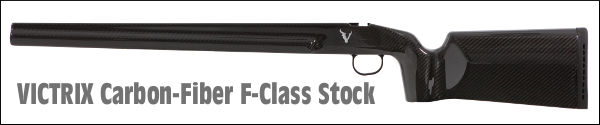
Victrix has certainly done its homework. The company will offer rifles for both F-Open and F-TR classes. Stocks will be offered in a variety of materials: wood, wood-laminate, aluminum, and carbon-fiber. The stocks share a no-nonsense, straight-forward design, specifically for shooting a rested rifle.
Whilst we are focusing on their F-Class rifles, we shouldn’t forget the Victrix tactical range. Although designed with military and police use, they will appeal to anyone who enjoys tactical-style shooting. There is no compromise on quality or accuracy so, expect the same build standard but with stocks CNC’d from 7075 mil-spec aluminum with a hard-anodized coating. The Victrix three-lever tactical trigger adjusts from 8 to 21 ounces (250 – 600 grams).
Victrix has chosen March Scopes UK (IWA Hall 3A – 110) as its business partner in launching the new Victrix F-Class rifles. This was a wise choice, as March Scopes UK proprietor Gary Costello is a former World F-Class Champion. Gary, well-known to F-Class competitors, continues to shoot with the Great Britain Team.
We look forward to taking a closer look at the Victrix F-Class rifles and hope to provide an in-depth range report in the not-too-distant future. Check out the Victrix website at www.Victrixarmaments.com.
An impressive new rifle action was just announced by BAT Machine and Bullet Central. This new action, dubbed the “Neuvo”, has many impressive features, and it certainly looks like nothing else on the market. Hall of Fame Shooter Dwight Scott provided design input for the Neuvo action.
Bullet Central says much careful design and engineering went into this new action: “The Neuvo … action is the result of more than half a century of experience in rifle building, gunsmithing, target shooting and high-end machining. Bullet Central, Dwight Scott, and BAT Machine teamed up to develop this receiver. The Neuvo encompasses time-proven functionality with a host of brand-new features. The new action includes a wide-body, two-lug bolt, horizontal locking lugs and a totally redesigned fire control system. The Neuvo is manufactured by BAT Machine in the U.S.A. and available at Bullet Central.”
After reviewing early photos of the BAT Neuvo action, Forum member Alex Wheeler liked what he saw: “This action has some features that do set it apart. A full-diameter two-lug will open very nice due to the shallower cocking ramp angle allowed by the large-diameter bolt. There is no lug raceway, so it [could be safer] in an over-pressure situation. I also think that full-diameter bolts run smoother due to not having lugs to bind. I hope to get to handle one of these to really look it over. The big thing will be the fire control — that will make or break it in my opinion.”
Most long-range benchrest stocks are three inches wide because that used to be the max width under the rules for Light Gun Class. Many folks may not realize that the IBS, the NBRSA, and the Williamsport organizations have all modified their Light Gun rules to allow wider forearm widths in registered 600-yard and 1000-yard competition. A wider stock provides increased stability and resists rotation (torquing) as the gun is fired. If you’re building a new Light Gun, you may want to consider a 4″-wide or 5″-wide forearm. Do check the rules of your local club or regional organization to ensure the wider width is allowed in the matches you attend. And if you plan to shoot F-Class as well, stick to 3″. Under F-Class (Open) rules, “the width of the rifle’s forend shall not exceed 76mm (approximately 3 inches)”.
Wider Forearm Stock Options
Most stock-makers still only offer a 3″-wide forearm width with their Light Gun long-range benchrest stocks. However, there are some other options. On request, Joel Russo, Russo Rifle Stocks, can cut a stock with 4″-wide forearm, but that’s not a standard pattern.
If you want a 4″-5″ wide version of the popular MBR Tooley-style long-range stock, Bill Shehane offers a ‘Big Dawg’ version of his MBR Tracker stock. This features a longer, deeper, and wider fore-end for added stability and more resistance to torque with the heavy calibers. Along with having a wider forearm, the Big Dawg stock is cut 4″ longer than a standard Shehane ST-1000 Tracker. This provides a “longer wheelbase” for better balance with very long (30″+) barrels. (The ST-1000 itself is 3″ longer than most benchrest stocks.) The Big Dawg is available with a 4″-wide or 5″-wide forearm, and will handle barrels up to 40″ in length and 1.5″ in diameter. In the top photo, taken by Forum member Preacher, you see a 4″-wide Big Dawg next to a normal ST-1000 Tracker. (Both stocks are symmetrical; there is distortion caused by wide-angle lens.)
This color pattern is what Bill calls “Prairie Dog Camo”, a Rutland laminate in orange and dark gray, with olive ‘accent’ layers. The price for a ‘Big Dawg’ in Rutland laminate is $625. In African Obeche wood (any color choice), the price is $855.00. For more info, contact Bill Shehane at (704) 824-7511, or visit his website, www.ScopeUsOut.com.
Wide Stocks for Rimfire Benchrest
Ultra-wide stocks are also legal in many rimfire benchrest disciplines. Shown below is a rimfire rifle built with a 4″-wide Shehane Big Dawg stock. This gun is used in ARA Unlimited competition. Extra-wide stocks like this can also be used in the IR 50/50 Unlimited Class and RBA Unlimited Class.
Why use a wide stock for rimfire where recoil is not an issue? The extra width definitely provides more stability in the bags. This is noticeable when cycling the action during the loading process — the gun shows less “wiggle” when opening and closing the bolt. The larger mass of wood also, potentially, provides additional vibration damping. A wider stock design carries more weight (per inch of length) and more mass is distributed outboard. Initial testing shows that the wide stocks work well for rimfire shooters who like to grip their gun — the gun feels “planted” with less wobble when the stock is gripped or cheeked by the shooter.
Here are some of the fine rifles Mike Bryant has smithed. You’ll find dozens more on BryantCustom.com.
Texas-based gunsmith Mike Bryant has decided to start taking work again. It seems that retired life was just a bit too sedate for Mike. This is great news for fans of precision rifles. Mike is an superb smith who has produced many match-winning competition rigs along with fine hunting and varmint rifles.
The services Mike can provide are listed on his “re-activated” website at BryantCustom.com. Mike will still continue to specialize in Rem Action-based and Custom Action-based rifles with customer-supplied parts. He explains his decision to return to the business he does so well: “Retirement was short with what the economy has done in the oil and gas business. I am back at least part time. I am Looking forward to serving my customer’s needs as I have done in the past.”
Welcome back Mike — we wish you success in your “return to the fold”. As before Mike will offer complete custom rifles as well as a full range of gunsmithing services including chambering, barrel-fitting, stocking, and action truing.
Here’s a tale that should make you chuckle. This is the kind of boo-boo any shooter can make (but hopefully only once). Our friend Vu Pham from Sacramento was out testing his .260 Rem tactical rifle. Now Vu, an ace NorCal Tactical marksman, is a darn good shooter — but his first three-shot, 200-yard group looked like a shotgun pattern. Vu was puzzled to say the least. (His actual reaction, as noted on the target, was “WTF?!”)
But there was a simple explanation for the rifle’s miserable accuracy — Vu forgot to tighten the crossbolts attaching the rings to his scope rail. Consequently, his scope was moving after each shot. According to Vu, stunned disbelief followed by embarrassment happens “the moment you realized you forgot to torque your scope rings to the base after moving [the scope] the night before. [I felt like a] Freaking nooooob.”
Here’s a bit of Britain in blue — a 270-7mm WSM F-Classer belonging to Elwood in the UK.
One of the most popular items in our Shooters’ Forum is the ongoing “Pride and Joy” thread. Since 2009, Forum members have posted photos and descriptions of their most prized rifles. Here are some of the most recent “Pride and Joy” rifles showcased in our Forum. Do you have a gun you’d like to see featured there? Just Register for the Forum and you can add your gun to the list.
1. Dasher LowBoy. CigarCop just completed a lovely 6mm Dasher in a yellow/gray laminated PR&T LowBoy stock. CigarCop did the stock inletting and finish work himself. Very nice work indeed.
2. Varmint Special. Here’s a handsome varminter with a beautifully-figured walnut stock. This is one of three rifles Forum Member Dan Hall posted this month.
3. 6mm Trifecta. DixiePPC served up not one but THREE pretty rifles, all with pearlescent paint jobs. Details of the three rigs are provided below. Click the image to see a full-screen version.
Top: 6 PPC for 10.5-lb NBRSA LV Class, 1:14″, .262″-necked SS Hart Barrel chambered and fitted by Doug Pascal, Pearl Black Kelbly Stock, RB/RP Blueprint & Trued 40X Short Action (Glued) with a Doug Pascal Bolt Release. This gun is a 1994 build by Doug Pascal of Craftsmith.
Middle: 6 PPC 13.5lb NBRSA HV Class, 1:14″, .262″-necked SS straight-countour Hart Barrel, Pearl White Kelbly Stock/Aluminum Butt Plate, RB/RP Stolle Panda Action (Glued). Kelbly Double Screw Rings. 1994 Vintage Leupold/Premier BR 36X. This gun is a 1992-vintage Kelbly build for NBRSA Unlimited Class.
Bottom: 6mmBR 17-lb IBS Light Gun Class, 28″, 1:8″, .268″-necked SS Bartlein 5R Barrel tipped with a SS Harrell Spiral Muzzle Brake, Pearl Rust Orange 90s-vintage Lee Six Stock with home made Aluminum Butt Plate, RB/RP Blueprinted and Trued 1995-Vintage 700 Short Action.
4. Simple Elegance. This is Chopper Duke’s handsome 6mm PPC. It features a Remington action in a classic older-style benchrest stock. We like the flawless pale-green finish. Subtle but nice.
5. (Nearly) Identical Duo. Here are a matching pair of customs from Forum member NHM16. He tells us: “I sold my two Savages I was using for F-Open, and had these two built in their place. One reason I upgraded was so I could have two (nearly) identical rifles. The nice thing about these rifles is that most everything interchanges, including the barrels.”
Here Are Specs for Both Guns:
— Panda F-Class action (LRBP, no ejector, 20 MOA dovetail scope base, one action is polished, the other unpolished so I could easily tell them apart).
— PR&T LowBoy stocks with adjustable buttplates, with vents on the side and the bottom.
— Both have Bartlein 32″ 7mm, 1:8″-twist, 5R barrels, chambered in 7mm Walker (basically a .284 Shehane with the addition of a 40 degree shoulder).
— Rifles were built by Richard King (“Kings X” in Forum) in Arlington, Texas, though I did the clear coating myself.
6. First Custom. Here is Forum member Barrys’s very first custom rifle, and it’s a nice one. It features a BAT Machine VR action, Krieger #17 heavy varmint contour, chambered for the 6mmBR Norma with 0.272″ neck. The stock is a Shehane Varmint Tracker with a Walnut-color laminated Obeche stock. On top is a Sightron SIII 8-32x56mm scope in BAT Machine rings.
7. Basic Black. David P. offered this F-TR rig: “A buddy of mine just finished up new rifle for NRA F-TR competition. This rifle is built on a Kelbly action, chambered in .308 Win with a custom, tight-neck match chamber. It’s sitting in a PR&T stock, with a Broughton 32″, 1:11″-twist 5C barrel. The rifle was chambered and built by Brian at Plainfield Precision in Shelby, NC.



 At the




 Texas-based gunsmith Mike Bryant has decided to start taking work again. It seems that retired life was just a bit too sedate for Mike. This is great news for fans of precision rifles. Mike is an superb smith who has produced many match-winning competition rigs along with fine hunting and varmint rifles.
 Here’s a tale that should make you chuckle. This is the kind of boo-boo any shooter can make (but hopefully only once). Our friend


