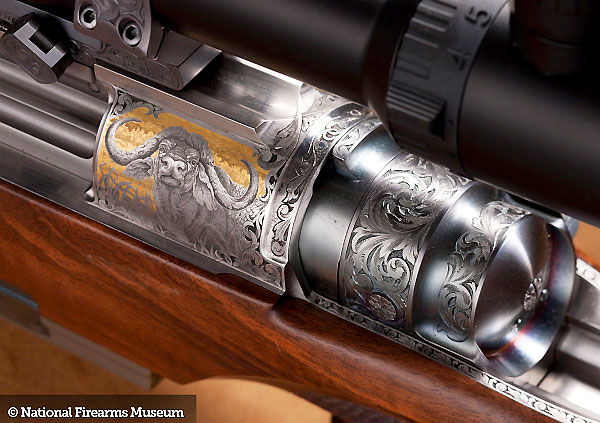
One of the most unique and exotic rifles in the NRA Museum is the Szecsei & Fuchs Double Barrel Bolt Action Rifle. “This is the … most substantial bolt action rifle ever made,” said NRA Museums Senior Curator Philip Schreier. This unique double-barrel bolt-action rifle loads two cartridges at the same time. It is the world’s only repeating double rifle design. Incorporating titanium components to reduce weight, this .416 Remington Magnum rifle has an eight-shot capacity, feeding from a beautifully engraved massive magazine assembly mounted under the receiver. Hungarian inventor Joseph Szecsei developed this innovative design after being charged simultaneously by three elephants in 1989.
An engineering tour de force, this elaborately engraved rifle is also a work of art. On the action, and bottom metal are engraved images of the “Big Five” African game species: elephant, cape buffalo, rhino, lion, and leopard. This rifle was recently featured on Curator’s Corner on the Outdoor Channel, and it now resides behind glass in the Robert E. Peterson Collection at the NRA Museum.
This amazing twin-barreled bolt-gun has a closing mechanism that locks two separate bolt bodies into the chambers of the right and left barrels. Yes there are two firing pins, two ejectors, two extractors, and two triggers. We’re not sure how one jumbo camming system closes two bolts — Perhaps one of our gunsmith readers can explain how this system works.
This Rifle Has TWO Barrels and TWO Bolts
Just $78,000 at “Half-off Pricing”
Shown here (above and below) is another Szecsei & Fuchs double bolt rifle chambered in .416 Remington. This example, without the “Big Five” animal engravings, sold a few years back on Gunbroker.com for $78,000. That astronomical sum is just half the original cost, according to the seller. This amazing double safari rifle has 22″ barrels and weighs 11.5 pounds.
Do-It-Yourself Joystick Rest — Jeff’s Labor of Love
Quite a few competitors chamber their own barrels, and a few construct their own stocks. But Jeff Godfrey takes the prize for do-it-yourself audacity — he built his own co-axial front rest from scratch. Sam Hall provides this report:
“Jeff, one of Piedmont Gun Club’s regulars, is a talented fabricator. He made one of the smoothest joystick rests that I have ever laid my hands on. Jeff’s home-built coaxial rest rivals the Farley and Seb Max. It will also handle a wide fore-end Heavy Gun. Constructing virtually every part of this rest from scratch, Jeff made his own co-axial to save money. You have to admire his ingenuity and his dedication. Jeff says it took him over 100 hours to make. He said there would be no way he could make another one for profit!”
Stiller’s Precision Firearms is now offering its new line of rear lug, benchrest-grade rimfire actions, the 2500X (single-shot) and the 2500XS (sporter class mag-fed). These actions have already performed superbly in competition (see below). These actions represent the state-of-the-art in rimfire receivers. Top rimfire benchrest shooters are building rifles around the new Stiller actions and the results have been very promising. These actions offer true benchrest-grade manufacturing tolerances plus a superior firing pin system that should allow greater shot-to-shot consistency. Expect fewer unexplained fliers with these Stiller actions compared with older, factory-based actions (such as the Rem 40X).
Stiller 2500X Rimfire Action
The 2500X is Stiller’s new rear lug rimfire benchrest action. This features an Anschutz-style loading ramp, center recoil slot, side bolt release, and a unique shroud/firing pin system for perfect alignment (and more consistent ignition). Unlike many rimfire actions, the 2500X has a trigger hanger for easy trigger maintenance. The 2500X’s body and bolt are crafted from 416R stainless steel with a nitride finish for smooth and trouble-free operation. The outside is OD ground after nitriding for precise tolerances and a distinctive two-tone look.
Stiller 2500SX Rimfire Sporter Action
The 2500XS is a rear lug rimfire benchrest action for the Sporter Class. The “XS” model features a Sako magazine and easy-to-use loading ramp. Like the 2500X, the “XS” has an advanced shroud/firing pin system, plus a trigger hanger for easy trigger maintenance. The bolt and body are nitrided, 416R stainless OD ground for a dimensionally precise, two-tone finish. This lightweight action is specifically designed for IR50/50 sporter class benchrest. It comes with one (1) magazine.
Proof of Performance — 2500X Action Shoots 250-25X
Mike Kuklis’s new rimfire BR rifle built on a Stiller 2500X action delivered an impressive 250-25X in competition last week. Mike drilled this superb 250-25X card at the Tuckertown BR Barn on the way to a 1000-86X match win. Credit J. Miller for the photos from Benchrest Central.
Product Tip from EdLongrange. We welcome reader submissions.
Many of our readers use AR-type rifles for Service Rifle matches, varmint hunting, 3-Gun competition, or defensive use. AR-platform rifles can be configured in a multitude of ways to suit the application. But if you plan to put together your own purpose-built AR rifle, how do you get started?
For AR Do-It-Yourselfers, we suggest reading Glen Zedicker’s book, the Competitive AR15 Builders Guide. Following Zedicker’s New AR-15 Competitive Rifle (2008), the Builders Guide provides step-by-step instructions that will help non-professional, “home builders” assemble a competitive match or varmint rifle. This book isn’t for everyone — you need some basic gun assembly experience and an aptitude for tools. But the AR-15 Builders’ Guide provides a complete list of the tools you’ll need for the job, and Zedicker outlines all the procedures to build an AR-15 from start to finish.
Along with assembly methods, this book covers parts selection and preparation, not just hammers and pins. Creedmoor Sports explains: “Knowing how to get what you want, and be happy with the result, is truly the focus of this book. Doing it yourself gives you a huge advantage. The build will honestly have been done right, and you’ll know it! Little problems will have been fixed, function and performance enhancements will have been made, and the result is you’ll have a custom-grade rifle without paying custom-builder prices.”
The Competitive AR-15 Builders Guide is not available from most large book vendors. However, Amazon still has a few copies in stock. CLICK HERE to order.
Brownells is offering more than month of deals on AR-15 hardware. Brownells’s “Back In Black Rifle Event” features six weeks of special, discount pricing on AR-15 upper receiver parts kits and accessories. The event culminates with blowout specials on the official Black Rifle Friday Weekend (from Friday, November 28 through Cyber Monday, December 1st).
Each Monday, leading up to Black Rifle Friday, Brownells will unveil a new package that includes all the required parts (except for lower receiver) to build a different version of the AR-15. Every package will give customers significant savings compared to buying all the parts separately(and eliminate the chance of overlooking important items).
In addition to the main sale on AR-15 components and tools, some weeks will feature specials on 1911 magazines and parts, as well as accessories for Remington 870 shotguns.
Got fifty bucks? Well that’ll buy you an AR Lower this week. Quite simply, this is the best AR deal we’ve seen this year, and one of the best values on a firearm receiver we can remember. Right now, while supplies last, Brownells.com is offering Bushmaster-brand AR-15 stripped lower receivers for just $49.99. You read that right — you can get a major manufacturer AR lower for under fifty bucks. That’s a savings of $120.00 off the normal price. Get them while you can.
NOTE: Stripped lowers are considered the firearm, so this must be delivered to an FFL-holder. It is fairly easy to complete the lower with readily available parts and the trigger group of your choice.
Bushmaster Stripped Lower Receiver Product Description
Receiver is a rigid 7075 T6 aluminum forging with extra metal in the right places for added strength without unnecessary bulk. Features a beefy, M16A2-pattern reinforced area around the front pivot pin, a strengthening ridge over the receiver extension threads, and a ridge around the mag release button to guard against accidental magazine drop by preventing unintentional button activation. Bead blasted after machining to ensure a uniform, non-reflective surface before application of lusterless black military hardcoat A8625, Type III, Class 2 anodized finish that adds surface strength and resists abrasion. A final, nickel acetate seal coat provides extra protection against corrosion. Stripped lower is the perfect companion for Bushmaster Lower Receiver Parts Kit, available separately
Accuracy International (AI) is perhaps the most noted manufacturer of bolt-action sniper rifles in the Western world. AI was founded in the 1980s by Dave Caig, Malcolm Cooper, and Dave Walls, three competitive rifle shooters. The company took its name from Cooper’s shop: Accuracy International Shooting Sports. The first project was a smallbore target rifle for civilians. Then the trio decided to build a 7.62×51 sniper rifle, inspired by a UK Ministry of Defense (MoD) competition to replace the venerable L42A1. (That old, wood-stocked design had proven unsatisfactory in the 1982 Falkland Islands conflict.)
Working in a garage workshop, Walls and his partners combined their knowledge of target shooting with input from active military personnel to create the first AI sniper rifle, the L96A1. This ground-breaking design won the MoD contract and immediately proved successful in the field. In an interview with The Telegraph, Walls explained: “The company’s early success was based on not just the what the founders knew from target shooting but also what they learnt from the users, the military users. They went out and they sought inputs from those users, and based on that they designed their very first sniper rifle, and it was very successful.”
Today, “At a discreet location on the outskirts of Portsmouth”, Accuracy International continues to make rugged, versatile, and ultra-accurate sniper rifles for military, law enforcement, and private use. A team from The Telegraph visited the Accuracy International facility in England earlier this year. The video below shows AI’s facilities and the products AI produces:
Watch Accuracy International Video:
Profile of Accuracy International in The Firearm Blog
If you want to learn more about Accuracy International, you’ll find an excellent company history in The Firearm Blog (TFB). Writer Miles Vining visited AI’s Portsmouth facility and toured the factory. His in-depth TFB article provides some fascinating insights. For example, Vining recounts that struggles AI went through before reaching its current success:
“The company wasn’t an immediate success in the beginning. After winning the British Army contract and the MoD realizing the gun was constructed in a garage, Accuracy International had to subcontract many of its parts out to various companies around the UK. In 2000, after over 15 years of production, the company only had two CNC machines, one of which didn’t even work and the other one was making front sight posts…. During the 1990s Accuracy International was surviving on contract to contract, barely making ends meet.”
A major turn-around came with the creation of AI’s Arctic Warfare rifle for the 1993 Swedish trials. As chambered in .338 Lapua Magnum, this AW rifle proved to be a game-changer that “carried the company through the 1990s”. In 2005 the enterprise did go through a re-organization with Tom Irwin and Dave Walls taking over as sole Directors. Since then, AI has been going strong for the past decade. It now produces almost all components in-house, with 30 CNC machines, 70 employees in the UK, and two large-scale manufacturing plants.
When we recently ran a story about Dennis Santiago’s new snakeskin Eliseo Tubegun, folks asked us if this kind of rifle can be competitive in F-Class competition. Here’s a detailed answer to that question by G. Salazar, who runs the Riflemans Journal Website.
A while back, G. Salazar published a three-part article on Shooting The Tubegun in F-Class. Links for all three segments are found below. The article covers some of the hardware German engineered to adapt his tubegun for long-range F-Class shooting with scope. If you’re an F-Classer, or just a fan of tubeguns, you should read German’s article, in all its parts.
In the intro to his multi-part F-Class Tubegun article, German explains:
Salazar: The tubegun has truly changed the face of High Power shooting over the past five years or so. Specifically, the CSS (Gary Eliseo) tubeguns, which are made for a broad variety of actions and configurable to single-shot or repeater, have truly helped the sport to grow. That’s not just idle talk, the two principal factors that made the tubegun so important to our growth are the ease of transition for AR15 shooters moving into a bolt-action rifle and the absolutely ridiculous length of time it currently takes to get a stock from the conventional stock makers. My last conventional stock took well over two years from order to delivery (plain fiberglass). One of my friends has now been waiting four years for a simple wood stock for a smallbore rifle. By contrast, tubeguns, which are largely CNC machined, are delivered in a reasonably short time — weeks or a couple of months at most.
Notwithstanding the foregoing, the tubegun would never have attained its present success if it weren’t for one simple fact — they are brutally accurate. I have three CSS tubeguns, one chambered in .308 and two in .30-06 and they are my favorite prone rifles due to their accuracy and great ergonomics. Those factors are just as appealing to an F-Class competitor as to a prone shooter, and indeed, the tubegun is making solid inroads into F-Class. READ MORE…
Frank Galli, aka “Lowlight”, runs the popular SnipersHide.com website. A while back, Frank completed a gunsmithing course with Robert Gradous. Frank recounts the learning process in an informative, nicely-illustrated article on the ‘Hide. Frank explains how he put together a new 6.5 Creedmoor tactical rifle using a Bartlein barrel, Bighorn Action (Rem clone with floating bolt-head), and a “lightly used” Accuracy International 1.5 chassis. The HD video below shows the process start-to-finish. READ Full Article.
During Frank’s “hands-on” training sessions with Gradous, Frank learned to thread and chamber a barrel, fit a recoil lug, and install the barreled action in the AI chassis. Chambering was done with great care: “We spent the better part of the day working the barrel. I feel this is a critical component and seeing the attention to detail in Robert’s approach confirmed it for me. When it came time to chamber Robert had a custom tight chamber reamer there for a 6.5CM but I’m shooting a tactical rifle, tight chambers aren’t for me, and this was clear, as out came the standard SAAMI reamer.”
Frank also learned how to modify an aluminum chassis: “the AI chassis had the recoil lug opened up, but it was opened in the wrong direction. This was going to require milling increasing the gap to at least a 1/2″ in size. Robert was really leery of this, but my attitude was, ‘it’s just a chassis and nothing a little Marine Tex can’t handle’.” Thankfully the chassis mod came out OK.
Once the barreled action was complete and the AI chassis was successfully milled, Frank applied a tan Cerakote finish to the barreled action. This would give a proper tactical look to the rifle, while providing superior corrosion resistance for the metal parts. To learn more about Cerakote finishing, check out the Cerakote Application Video, published last week in the Daily Bulletin.
When the rifle was complete, Frank took it out for testing with a variety of ammo, both factory fodder and handloads. There were some initial worries about accuracy as it took a while for the barrel to break in. A few sessions of bore cleaning were required before the barrel stopped fouling and then — like magic — the rifle started printing really small groups.
By the end of his load testing session, Frank was getting good groups with Hornady 120gr GMX factory 6.5 Creedmoor ammo, and really superb groups with handloads. The 120gr GMX ammo “was going 3100 fps with no ill effects”. The best handloads were approaching 1/4 MOA for three shots, and Frank’s load with Berger 130 VLDs shot even smaller than that: “In my opinion the load development we did was worth its weight in gold. Where else can you build in a rifle in two days, then go out and develop a baseline load using everything from 120gr ammo to 140gr ammo with a few in between? My favorite load and clearly the rifle’s too, was the [Berger] 130gr VLD. This gave us great velocity, awesome groups [with some one-holers] and really nice results at distance.”
Lowlight’s Gunsmithing Story is a ‘Must-Read’
We recommend you read Frank’s story. It shows that, with the right tools, and the supervision of a master smith, even a novice can produce an ultra-accurate rifle. For those of you who have considered taking a gunsmithing class, Frank’s successful experience with gunsmith Robert Gradous should give you plenty of motivation.
Forum member Erick C. (aka cncmill) has produced a very nice laminated stock featuring wood inlays. A tool and die maker from Pennsylvania, Erick is justifiably proud of his handiwork. Erick tells us: “Here is my latest build — just finished. The rifle features a Kelbly’s Atlas action, with Hawk Hill custom barrel chambered for the .284 Winchester. The stock is made from three types of wood: Birdseye Maple, African Padauk wood, and Wenge wood (for the dark stripes).” Erick explained that the Wenge inlays served a useful (as well as aesthetic) purpose: “I put the Wenge stripes in to fix two cracks in the Birdseye Maple. I was not sure about it at the time but it turned out well.”
Home-built Laminated Stock features three different woods.
Stock before final finishing.
Detail of Fore-End.
If you like this example of rifle-building, check out the ‘Pride and Joy’ thread in the AccurateShooter Forum to see other “home-built” project guns.


 This amazing twin-barreled bolt-gun has a closing mechanism that locks two separate bolt bodies into the chambers of the right and left barrels. Yes there are two firing pins, two ejectors, two extractors, and two triggers. We’re not sure how one jumbo camming system closes two bolts — Perhaps one of our gunsmith readers can explain how this system works.

 Do-It-Yourself Joystick Rest — Jeff’s Labor of Love


 Many of our readers use AR-type rifles for Service Rifle matches, varmint hunting, 3-Gun competition, or defensive use. AR-platform rifles can be configured in a multitude of ways to suit the application. But if you plan to put together your own purpose-built AR rifle, how do you get started?


 Once the barreled action was complete and the AI chassis was successfully milled, Frank applied a tan Cerakote finish to the barreled action. This would give a proper tactical look to the rifle, while providing superior corrosion resistance for the metal parts. To learn more about Cerakote finishing, check out the
  By the end of his load testing session, Frank was getting good groups with Hornady 120gr GMX factory 6.5 Creedmoor ammo, and really superb groups with handloads. The 120gr GMX ammo “was going 3100 fps with no ill effects”. The best handloads were approaching 1/4 MOA for three shots, and Frank’s load with Berger 130 VLDs shot even smaller than that: “In my opinion the load development we did was worth its weight in gold. Where else can you build in a rifle in two days, then go out and develop a baseline load using everything from 120gr ammo to 140gr ammo with a few in between? My favorite load and clearly the rifle’s too, was the [Berger] 130gr VLD. This gave us great velocity, awesome groups [with some one-holers] and really nice results at distance.”


