|
|
December 22nd, 2014
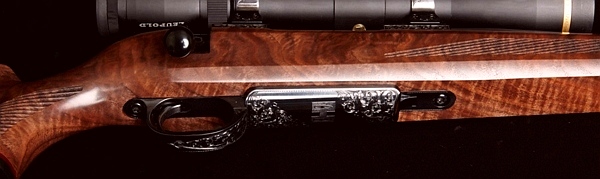
Hornady Manufacturing has created its first-ever rifle. Well, kind of, sort of, maybe…. In actuality, Hornady hired Bill Wiseman & Company to craft the barrel and action and Hornady commissioned Lucid Solutions (Clem Boyd) to build the stock. But the Hornady name IS now engraved on the side of a rifle receiver and that does represent a genuine first. This one-of-a-kind rifle, serial number “H-001″, is a bolt-action hunter, chambered for the .300 RCM cartridge. The historic “Hornady Number One” rifle has two (2) stocks — a highly figured walnut stock plus a second camo-pattern Hogue synthetic stock. So this rifle is not just a safe queen — it was designed to work in the field as well.


This “Hornady Number One” rifle was commissioned as the featured 2015 SHOT Show Gun. It will be displayed in Las Vegas and auctioned on Gunbroker.com. As of December 22, the bid price was already over $14,525 with 45 bidders. The action and bottom metal is elaborately engraved by Baron Engraving of Trumbull, Connecticut. “We’ve had the privilege of designing and engraving more than a dozen SHOT Show rifles, shotguns, handguns and knives but it’s a unique privilege to be asked to help craft the Hornady Number One”, said David Baron.

Not Just a Beauty Queen, This Rifle Can Shoot
Bill Wiseman & Company, of College Station, Texas crafted the barrel and action for this special rifle. This outfit is the leading producer of test receivers/barrels for the firearms industry. About the Hornady project gun, Bill Wiseman commented: “Our Wiseman barrels have earned a bit of a reputation for accuracy. Now I guess there will be at least one other rifle out there as accurate as our Texas Safari rifles.” The 24-inch blued barrel is fluted and fitted with a muzzle brake. Thus far, the gun has shown impressive accuracy. Three test-firings of the “Hornady Number One” using 180-grain SST, 165-grain GMX and 150-grain SST Hornady cartridges produced groups between ¼” and ½” at 100 meters.
About the Stocks
“Hornady Number One” is equipped with two separate custom-fitted stocks, one for shooting and one for display. A very special select American Walnut stock was selected, fitted and checkered by Clem Boyd of Lucid Mfg. Systems & Solutions (Mitchell, SD). Boyd’s challenge was to design a functional walnut wooden stock that would frame the beauty of the Wiseman barreled-action. Several weeks of design went into a Solidworks 3-D CAD model before the group made any CNC machine cuts. The stock was produced from a XXX walnut blank grown in the Great American Heartland and selected for the vertical-line color pattern. The stock shape incorporates the natural hex design of the receiver.
The trademark Hornady name was inlaid into the stock using African Padauk wood wafers. Padauk was also used for red-tone grip cap and butt pad spacers.

Oops. Someone mounted the Leupold scope incorrectly. The diopter marks should be TDC, meaning the scope should be rotated 90° clockwise.
The Lucid stock design repeats the hexagon features in the forearm, allowing a wide forearm floor to aid in bench rest practice. The stock features a distinctive 13.5° linear checkering pattern on the grip and side panels. A custom aluminum bedding block supports the barreled action. Recoil is absorbed through a 1″ black recoil pad. Three swivel studs provide multiple options for carry and tripod use.

Auction Details and Extras
The GunBroker.com auction will conclude at 5:00 pm Eastern Time on Friday, January 23, 2015, the last day of the 2015 SHOT Show. During the Show, the rifle will be displayed at the GunBroker.com booth in a custom glass and walnut display case. In keeping with SHOT Show tradition, this 2015 SHOT Show rifle will be auctioned on GunBroker.com. At its current $14.5K bid price, “Hornady Number One” has a ways to go before it sets a record. The all-time record SHOT Show auction price was $136,014.00 set in 2013. To complement the Hornady package, the gun will be delivered with a case of Hornady .300 RCM ammo, with each box signed by Hornady President, Steve Hornady. In addition, the high bidder will receive a signed Letter of Authenticity from Hornady Manufacturing.
December 22nd, 2014
 Sometimes you’ll get a barrel that doesn’t stabilize bullets the way you’d anticipate, based on the stated (or presumed) twist rate. A barrel might have 1:10″ stamped on the side but it is, in truth, a 1:10.5″ twist or even a 1:9.5″. Cut-rifled barrels, such as Kriegers and Bartleins, normally hold very true to the specified twist rate. With buttoned barrels, due to the nature of the rifling process, there’s a greater chance of a small variation in twist rate. And yes, factory barrels can be slightly out of spec as well. Sometimes you’ll get a barrel that doesn’t stabilize bullets the way you’d anticipate, based on the stated (or presumed) twist rate. A barrel might have 1:10″ stamped on the side but it is, in truth, a 1:10.5″ twist or even a 1:9.5″. Cut-rifled barrels, such as Kriegers and Bartleins, normally hold very true to the specified twist rate. With buttoned barrels, due to the nature of the rifling process, there’s a greater chance of a small variation in twist rate. And yes, factory barrels can be slightly out of spec as well.
Before you purchase a bunch of bullets and set off to develop loads it’s wise to determine the true twist rate of your new barrel. Sinclair International, in its Reloading Press Blog provides a simple procedure for determining the actual twist rate of your barrel. Read on to learn how….
How Twist Rate Affects Bullet Stability
Most of you know that the twist of the rifling in the barrel is what puts spin on the bullet. As a bullet is pushed down the barrel and compressed into the rifling, the bullet follows the path or twist of the rifling. The combination of velocity and bullet spin is what stabilizes the bullet. Finding the twist rate for your barrel will help you in selecting appropriate weight bullets for your firearm. Remember, the general rule is that the faster the twist rate for a given caliber, the longer the bullet (of that caliber) you will be able to stabilize. (Generally speaking, a longer bullet will also be a heavier bullet, but the bullet geometry dictates the needed twist rather than the weight per se.)
Determining Barrel Twist Rate Empirically
Twist rate is defined as the distance in inches of barrel that the rifling takes to make one complete revolution. An example would be a 1:10″ twist rate. A 1:10″ barrel has rifling that makes one complete revolution in 10 inches of barrel length. Rifle manufacturers usually publish twist rates for their standard rifle offerings and custom barrels are always ordered by caliber, contour, and twist rate. If you are having a custom barrel chambered you can ask the gunsmith to mark the barrel with the twist rate.

Erik Dahlberg illustration courtesy FireArmsID.com.
Sinclair’s Simple Twist Rate Measurement Method
If are unsure of the twist rate of the barrel, you can measure it yourself in a couple of minutes. You need a good cleaning rod with a rotating handle and a jag with a fairly tight fitting patch. Utilize a rod guide if you are accessing the barrel through the breech or a muzzle guide if you are going to come in from the muzzle end. Make sure the rod rotates freely in the handle under load. Start the patch into the barrel for a few inches and then stop. Put a piece of tape at the back of the rod by the handle (like a flag) or mark the rod in some way. Measure how much of the rod is still protruding from the rod guide. You can either measure from the rod guide or muzzle guide back to the flag or to a spot on the handle. Next, continue to push the rod in until the mark or tape flag has made one complete revolution. Re-measure the amount of rod that is left sticking out of the barrel. Use the same reference marks as you did on the first measurement. Next, subtract this measurement from the first measurement. This number is the twist rate. For example, if the rod has 24 inches remaining at the start and 16 inches remain after making one revolution, you have 8 inches of travel, thus a 1:8 twist barrel.
This rifling illustration was created by Danish graphic artist Erik Dahlberg. It is published here courtesy FireArmsID.com, an excellent website for forensic firearms examiners.
December 17th, 2014
If you do anything on our site today, watch this movie from Beretta, start to finish. Among the scores of videos we have featured in 2014, this movie, entitled “Human Technology”, is certainly a candidate for “Video of the Year”. It’s that good. You’ll see an amazing blend of ultra-modern manufacturing technology along with old-world artisanship — “a mesmerizing meld of the high-tech and the traditional”. (Quoting Daniel Xu, Outdoor Hub.)
“Human Technology is a singular and symbolic movie, its cast entirely made up of Beretta workmen, thus illustrating the perfect synthesis between craftsmanship and technology,” Beretta writes. This artistic movie by Ancarani Studio illustrates all the aspects of the manufacturing of a high-end Beretta shotgun. This video is a study in contrast. The movements of robotic assembly machines are juxtaposed with the centuries-old craftsmanship of stock carvers. Beautifully filmed and edited, this video will amaze and entertain anyone who loves fine firearms. (Full-screen HD Recommended.)


 Zoom for Best Viewing Zoom for Best Viewing
We strongly suggest you watch this excellent video in 720p or 1080p High-Definition, Full-Screen Mode. To do this, after starting the video, click the gear icon and select 1080p (or 720p if you have a slower connection). After setting the resolution, click the four-corner box to enter Full-Screen Mode. When you’ve finished watching the movie, click the “Esc” key to return to your normal browser screen. |
December 16th, 2014
Ruger 10/22 fans rejoice. Ruger has just released a $89.95 drop-in trigger upgrade that should fit all 10/22 rifles as well as 22 Charger pistols. The affordable trigger upgrade completely transforms the 10/22. Pull weight is reduced from a hefty 6.5 pounds to 2.5-3.0 pounds, and Ruger claims the new trigger offers a “light, crisp” break with “minimal overtravel and a positive reset.” Packaged as a self-contained module, the new BX Trigger is easy to install (no gunsmithing required).

“We have made continuous improvements to the 10/22 over the years, but the BX-Trigger is an exciting performance advancement,” said Ruger President and COO, Chris Killoy. “The BX-Trigger was designed for easy installation, superior performance, and legendary Ruger reliability.” Rugger will sell the BX-Trigger as a complete “en bloc” unit that will replace the existing trigger assembly. No additional fitting should be required. Simply install the BX-Trigger into your rifle and go shooting.

December 16th, 2014
 Ernie Paull from California was an active competition shooter for many years. However, his eyesight has declined so he has turned his attention to providing components for shooters and gunsmiths. Through his Ernie the Gunsmith website, Paull sells a variety of useful products including gun trigger springs, pillar-bedding kits, Accu-Risers, and pillar installation tools. This Bulletin post focuses on Ernie’s trigger springs. Ernie offers springs for a wide variety of rifles: Browning (A-Bolt, A-Bolt 22), CZ (m452), Kimber, Remington (XR100, XCR, 7, 700, 722, 788, 7600 and more), Ruger (77, 77-22, LC6), Tikka (T-3), Weatherby (MK-V), and Winchester (M-70). Ernie Paull from California was an active competition shooter for many years. However, his eyesight has declined so he has turned his attention to providing components for shooters and gunsmiths. Through his Ernie the Gunsmith website, Paull sells a variety of useful products including gun trigger springs, pillar-bedding kits, Accu-Risers, and pillar installation tools. This Bulletin post focuses on Ernie’s trigger springs. Ernie offers springs for a wide variety of rifles: Browning (A-Bolt, A-Bolt 22), CZ (m452), Kimber, Remington (XR100, XCR, 7, 700, 722, 788, 7600 and more), Ruger (77, 77-22, LC6), Tikka (T-3), Weatherby (MK-V), and Winchester (M-70).
Springs start at just $6.95. Ernie also sells springs for the Rem-compatible Shilen Benchrest trigger, as well as Rem 700 ejector springs and trigger alignment springs. For Rem 700 rifles, Paull makes a spring that fits all Remington M-7 and M-700 triggers including the 2007-vintage X Mark-PRO trigger (but not the newer X Mark-PRO trigger introduced in 2009). Ernie says: “on average, installation of his Model-700 spring will reduce factory triggers’ weight of pull by 1½ to 2½ lbs with no other changes. The exact amount of creep, over-travel, and weight of pull are dependent upon the type and amount of tuning accomplished by your gunsmith.”
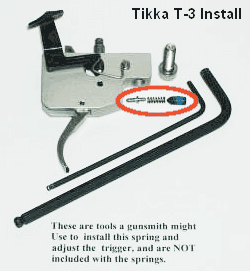 We often hear requests from Tikka T-3 owners asking how they can reduce their trigger pull weight. Paull offers a Tikka T-3 varmint trigger spring which can reduce the pull weight significantly. The photo at left shows the Tikka T-3 trigger assembly. We often hear requests from Tikka T-3 owners asking how they can reduce their trigger pull weight. Paull offers a Tikka T-3 varmint trigger spring which can reduce the pull weight significantly. The photo at left shows the Tikka T-3 trigger assembly.
While there is more to a good trigger job (in most cases) than just a spring swap, you need to have the proper rate spring when adjusting trigger pull weight downwards. NOTE: For safety reasons, we recommend you consult a competent gunsmith before modifying factory triggers. We stress the word competent…
Ernie has observed that some gunsmiths try to lighten trigger pulls by modifying factory springs in questionable ways: “I have worked with gunsmiths in the past who, when the subject turned to trigger springs, preferred to clip them, grind them, heat them, bend them, smash them, or simply back out the weight of pull screw until there was no or almost no pressure on the spring. With any of these methods, you get a spring whose rate is rapidly rising as the trigger is pulled. As the trigger is released, the spring rate rapidly decreases as it approaches full or near-full extension. A more uniform weight of pull will be achieved when the trigger spring is compressed within its normal working range throughout the entire movement of the trigger. In the long run, the benefits of saved time, plus more uniform and reliable results, will more than offset the cost of these [replacement] springs. If you want a lighter trigger pull, you need a lighter trigger spring.”
December 13th, 2014
 Here’s one of the latest F-Class projects from Enda Walsh of Custom & Precision Rifles in Ireland. This rifle features a free-floated BAT Machines ‘M’ action with a Benchmark barrel chambered in .300 Blaser Magnum (300 BM). The barreled action is secured with a large barrel block. This handsome, long-wheelbase F-Class rig is “new-born”, but it has already demonstrated some stunning accuracy at 1000 yards. Enda tells us: “I couldn’t wait until the rifle was fully polished before testing. I went to MNSCI (Midlands National Shooting Centre of Ireland) to shoot my new barrel block rifle. I came home with a huge smile on my face after shooting a five-shot group with 1.5″ vertical and 3″ horizontal at 1000 yards in an 8 mph wind.” Here’s one of the latest F-Class projects from Enda Walsh of Custom & Precision Rifles in Ireland. This rifle features a free-floated BAT Machines ‘M’ action with a Benchmark barrel chambered in .300 Blaser Magnum (300 BM). The barreled action is secured with a large barrel block. This handsome, long-wheelbase F-Class rig is “new-born”, but it has already demonstrated some stunning accuracy at 1000 yards. Enda tells us: “I couldn’t wait until the rifle was fully polished before testing. I went to MNSCI (Midlands National Shooting Centre of Ireland) to shoot my new barrel block rifle. I came home with a huge smile on my face after shooting a five-shot group with 1.5″ vertical and 3″ horizontal at 1000 yards in an 8 mph wind.”
Click Photo for full-screen version

|
AUDIO FILE: Enda Walsh Talks about his New .300 BM Barrel Block F-Open Rifle. |
Below you can see the barrel block in the handsome Padouk wood and carbon fiber stock. Enda uses high-spec epoxy layered between the barrel and the aluminum barrel block. Yes, those three “super-sized” cartridges are .300 Blaser Magnums loaded with with 230gr Berger Hybrids. The smaller cartridge is a .308 Win (with 150gr bullet), provided for comparison. This .300 BM drives the 230s at 3140 FPS.

CLICK HERE for Horizontal Version of above photo.
 .300 BM Runs 230-grainers at 3140 FPS! .300 BM Runs 230-grainers at 3140 FPS!
Enda tells us: “I wanted something to beat the 300 WSM. After studying the .300 Blaser Magnum, I decided this was the [chambering] that could deliver high accuracy consistently and be able to shoot the 230gr Bergers at 3140 FPS. Using H1000 powder, they do very well but the case life is short at these speeds. We have backed them off a little and retained the accuracy and extended case life considerably.”
Enda says the 230gr Hybrids at 3140 fps drift much less in the wind than do 7mm 180gr Hybrids launched from a 7mm WSM. A quick run through JBM Ballistics for a 10 mph, full-value crosswind at 1000 yards (sea-level) tells the tale. JBM predicts 4.2 MOA horizontal deflection for the .30-caliber 230s at 3140 fps vs. 5.0 MOA for the 7mm 180s at 3050 fps. That 0.8 MOA difference represents more than 8 inches at 1000 yards. When you consider the small size of the F-Open X-Ring, you can see how the enhanced ballistics could be a game-changer in the wind.
Barrel Block Acts as Heat Sink
Enda needed a way to beat the heat, with this big case. He explains: “Because of the large case volume (roughly 82 grains of usable capacity) there are two issues. Firstly, throat wear, and secondly heat. To combat this I have a new reamer on order with slight alterations which will help the throat wear. To combat the heat affecting a 34″ barrel I decided to build a barrel block rifle. It was previously mounted in a standard stock, and when the barrel got too hot accuracy was an issue. The barrel block acts as a heat sink and also shortens the overhanging barrel considerably, which has greatly improved accuracy over a complete string. The block is made from aircraft grade aluminium.” As a final note, Enda wanted to thank Pacific Tool & Gauge for the special-order reamers.
Note the metal bag-rider “keel” on the underside of the buttstock.

December 8th, 2014
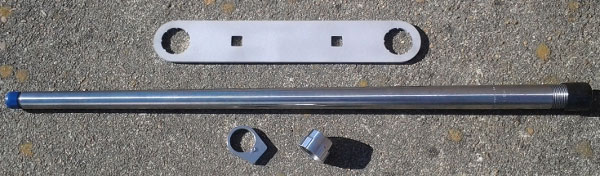
Need a new barrel for your Remington-actioned hunting or tactical rifle? McRee’s Precision has you covered. McRee’s is now offering complete, no-gunsmithing re-barreling kits for Remington and Rem-clone actions. These feature a high-quality, pre-chambered “PRE-FIT” stainless barrel from Criterion, a Savage-style barrel nut, a recoil lug, and a special barrel-nut wrench. With this system you can easily re-barrel your favorite Remington rifle yourself in less than an hour. You don’t need to pay gunsmithing fees, or wait weeks (or months) for a busy smith to do the job.
McRee’s Precision Remington DIY Barrel Kit includes Criterion Pre-Fit Stainless Barrel, Barrel Nut, Recoil Lug, and Barrel Nut Wrench:
CLICK HERE for Barrel Specifications PDF Sheet
Right now McRee’s Precision is offering Rem-action Pre-Fit barrel packages (complete with barrel nut, recoil lug, and wrench) starting at just $412.50 (On Sale). Choose from four chamberings: .243 Win, .260 Rem, .308 Win, and .300 Win Mag. These Pre-Fit barrel kits are “100% complete and ready-to-install”. All you need to do is remove your current barrel, place the recoil lug, spin on the new tube, follow the instructions for setting head-space, then torque the barrel nut against the lug. NOTE: You may require a barrel vise and action wrench to remove the original barrel. Minor inletting changes may be needed forward of the action.

The folks at McRee’s Precision say their Pre-Fit system offers many advantages: “Remington Pre-Fitted Barrel Kits have become popular over the years. If Savage can do it, why not for our Remingtons? Our [Criterion-supplied] barrels are spec’d to the McRee standard of performance. We require a minimum of 0.5 MOA with good factory ammo and 0.2 MOA with quality handloads. There are several places to get the tools required to remove your factory barrel correctly. Once you have your barrel removed all you have to do is follow the normal Savage procedure to install your new barrel. We recommend that you contact your local gunsmith for the install. Feel free to call us with any questions.”
Product Tip from Ed LongRange. We welcome readers’ submissions.
December 6th, 2014
 According to a CNBC report, Remington has agreed to replace (or upgrade) the triggers on 7.85 million Remington rifles including ALL Remington 700s, and a dozen other models including the Model Seven, Sportsman 78, 673, 710, 715, 770, 600, 660, XP-100, 721, 722, and 725. CNBC reported that, as part of the settlement of a class action lawsuit, Remington has agreed to provide trigger replacements (or other solutions) to all owners of the affected rifle models. While Remington is not specifically recalling all the affected firearms, Big Green has committed to offering trigger upgrades (or other compensation) on millions of firearms produced over many decades. In a released statement, Remington insisted it was not “recalling” the affected rifles, but Remington did offer to replace the triggers on request. This corrective program could, potentially, involve millions of rifles (though we doubt that most Rem 700 and Model Seven owners will actually request trigger modifications.) According to a CNBC report, Remington has agreed to replace (or upgrade) the triggers on 7.85 million Remington rifles including ALL Remington 700s, and a dozen other models including the Model Seven, Sportsman 78, 673, 710, 715, 770, 600, 660, XP-100, 721, 722, and 725. CNBC reported that, as part of the settlement of a class action lawsuit, Remington has agreed to provide trigger replacements (or other solutions) to all owners of the affected rifle models. While Remington is not specifically recalling all the affected firearms, Big Green has committed to offering trigger upgrades (or other compensation) on millions of firearms produced over many decades. In a released statement, Remington insisted it was not “recalling” the affected rifles, but Remington did offer to replace the triggers on request. This corrective program could, potentially, involve millions of rifles (though we doubt that most Rem 700 and Model Seven owners will actually request trigger modifications.)
Affected Remington Products: Model 700, Seven, Sportsman 78, 673, 710, 715, 770, 600, 660, XP-100, 721, 722 and 725.
According to CNBC: “America’s oldest gun manufacturer, Remington, has agreed to replace millions of triggers in its most popular product — the Model 700 rifle. While insisting its action is not a recall of the iconic gun, Remington says in a statement that it is agreeing to make the changes ‘to avoid the uncertainties and expense of protracted litigation.’ The settlement involves a class action suit brought in 2013 by Ian Pollard of Concordia, Missouri, who claimed his Remington 700 rifle fired on multiple occasions without the trigger being pulled.”
According to the Montana Standard, the proposed Remington class action settlement will include model-by-model solutions:
— For Models 700, Seven, Sportsman 78 and 673 rifles, Remington will remove the original Walker trigger mechanism and replace it with a new X-Mark Pro mechanism.
— For Models 710, 715 and 770, Remington will remove the original trigger mechanism and replace it with a Model 770 connector-less mechanism.
— For Models 600, 660, XP-100, 721, 722 and 725, Remington will provide vouchers of $12.50 or $10, depending on the model, redeemable for Remington products.
— For Models 700 and Seven rifles made between May 2006 and April 9, 2014 with an X-Mark Pro trigger mechanism, Remington will retro-fit a new, improved assembly.

Under the terms of the settlement (which must ultimately receive Court approval), Remington will pay for the parts and labor involved to replace or fix trigger mechanisms, at no cost to the owner. The scope of the settlement may include rifles which previously had trigger upgrades done by owners. According to CNBC, “For guns that cannot be retrofitted, the company plans to offer vouchers for Remington products”. LINK: Related Story with Mis-Fire Demo Video.
CLICK HERE to view Remington Proposed Settlement Document (PDF file)
Will This be a Thirty Million-Dollar Fix?
How much will the trigger fix program cost Remington? That is hard to predict. However, Remington Outdoors (previously known as “The Freedom Group”) told its investors last month that it had allocated $29.7 million for a “Model 700 settlement reserve”.
December 6th, 2014
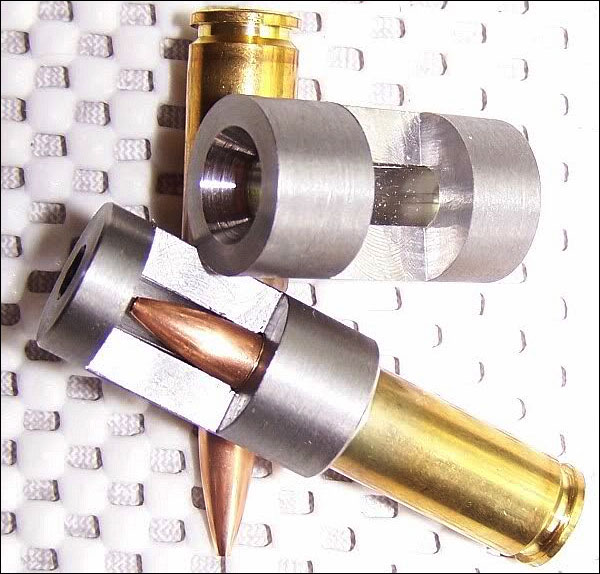
Next time you have a barrel fitted, consider having your gunsmith create a “stub gauge” from a left-over piece of barrel steel (ideally taken from your new barrel blank). The outside diameter isn’t important — the key thing is that the stub gauge is created with the same reamer used to chamber your current barrel, and the stub must have the same bore diameter, with the same land/groove configuration, as the barrel on your rifle. When properly made, a stub gauge gives you an accurate three-dimensional model of the upper section of your chamber and throat. This comes in handy when you need to bump your case shoulders. Just slide a fired case (with spent primer removed) in the stub gauge and measure from base of case to the end of the gauge. Then, after bumping, re-measure to confirm how much you’ve moved the shoulder.
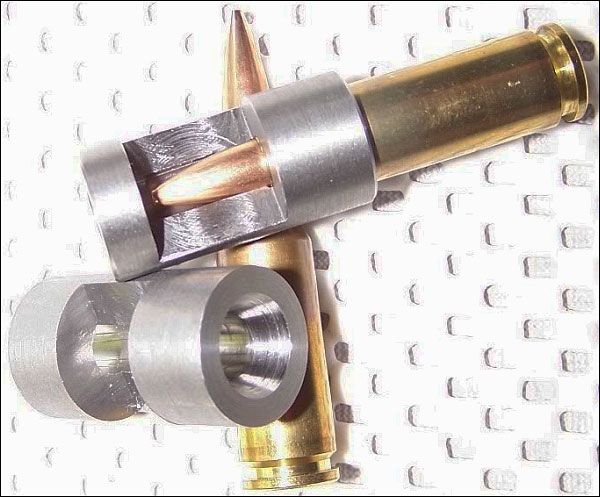
In addition, the stub gauge lets you measure the original length to lands and freebore when your barrel was new. This gives you a baseline to accurately assess how far your throat erodes with use. Of course, as the throat wears, to get true length-to-lands dimension, you need take your measurement using your actual barrel. The barrel stub gauge helps you set the initial bullet seating depth. Seating depth is then adjusted accordingly, based on observed throat erosion, or your preferred seating depth.
Forum member RussT explains: “My gunsmith [makes a stub gauge] for me on every barrel now. I order a barrel an inch longer and that gives him enough material when he cuts off the end to give me a nice case gauge. Though I don’t have him cut that nice-looking window in the side (as shown in photos). That’s a neat option. You can tell how much throat erosion you are getting from when it was new as well. For measuring initial seating depths, this is the most useful item on my loading bench next to calipers. Everyone should have a case gauge made by there smith if you have a new barrel put on.”
Forum member Lawrence H. has stub gauges made with his chamber reamers for each new barrel. He has his smith cut a port in the stub steel so Lawrence can actually see how the bullet engages the rifling in a newly-cut chamber. With this “view port”, one can also see how the case-neck fits in the chamber. Lawrence tells us: “My stub gauges are made from my barrels and cut with my chamber reamers. With them I can measure where my bullets are ‘touching the lands’ and shoulder bump dimensions. This is a very simple tool that provides accurate information.” To learn more about stub gauges, read this Forum Thread. The photos above and below show Lawrence’s stub gauges:
November 18th, 2014
Tubegun Guru Gary Eliseo of Competition Machine will be offering a new finish option on his Eliseo chassis kits. Remarkably, this will be a true “custom camo” option, with hand-applied graphics. No two rifles will be exactly alike. Gary tells us: “My Daughter Tamira has joined us at the new shop in Arizona. She’s a gifted artist and has been doing great work on our custom paint jobs. I challenged her to come up with something original. She thought we could do something a little more unique than the cut stencil technique normally used with our Cerakote camo finishes. Needless to say, I was impressed with the outcome. We call her handiwork ‘Tamifleck’.” This combines a unique look with the rock hard durability of Cerakote. Each chassis finished with this special “Tamifleck” camo finish is truly one-of-a-kind.

“Tamifleck” camo is Competition Machine’s newest Cerakote finishing technique for its rifles and chassis kits. Each “Tamifleck” chassis is hand-painted by Tamira Eliseo.

|


