|
|
January 24th, 2014
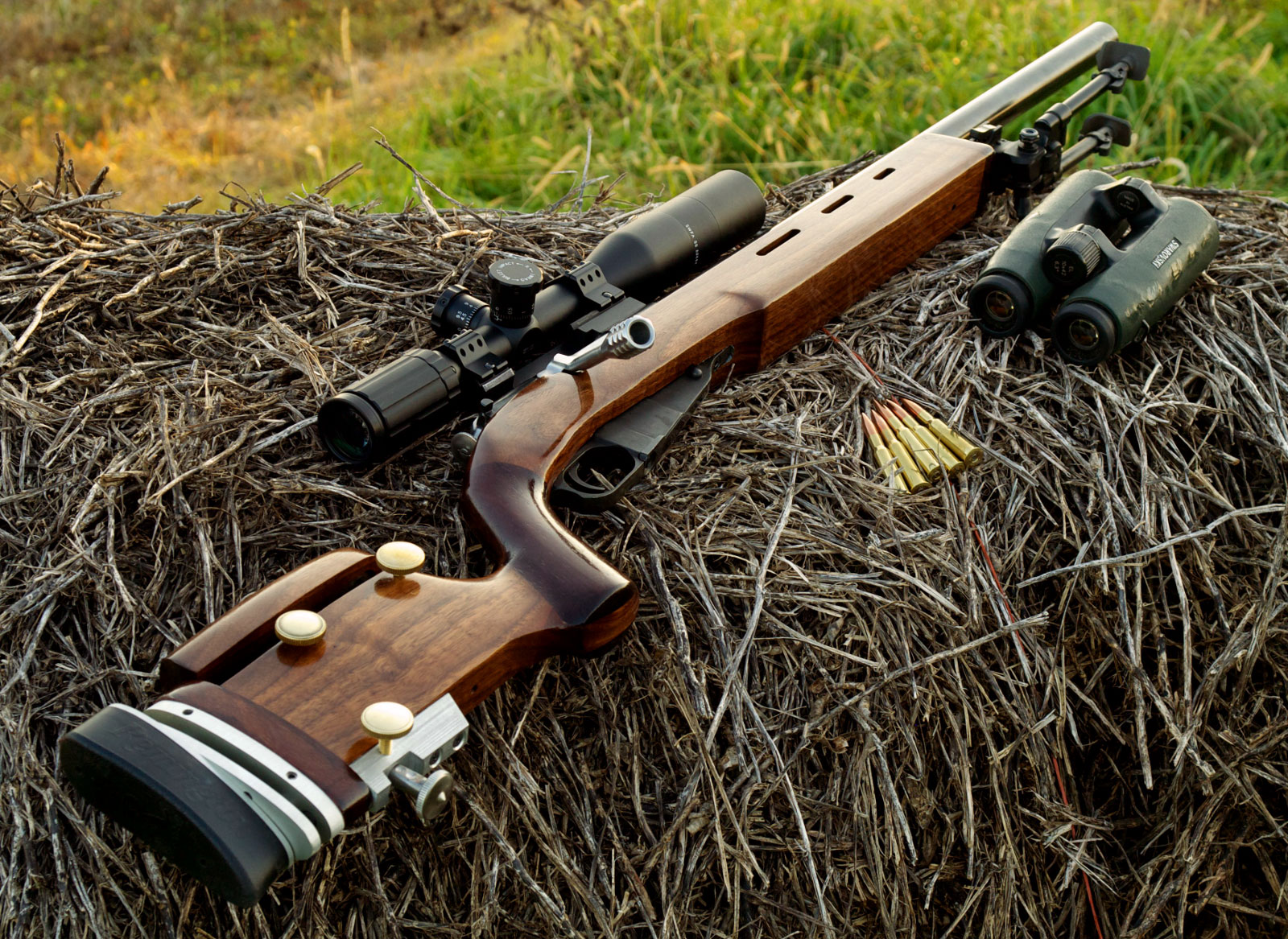
One of the most popular features of our Shooters’ Forum is the Official ‘Pride & Joy’ Rifle thread. There you’ll find dozens of interesting rifles, with photos and descriptions supplied by proud owners. Yesterday, one of the more interesting ‘Pride & Joy’ rifles appeared. This was a “senior citizen” — a 72-year-old Russian Mosin-Nagant bolt gun. But this is not like any Mosin Nagant you’ve ever seen before. It has been brought into the 21st Century with a handsome target stock and some first-class upgrades, including Lothar Walther barrel and Timney trigger. Here’s a look at a very nice Russian rifle, belonging to Forum member Ben C. (aka “Grimstod”):
CLICK TO See Full-Screen Photo:


Video Shows Rifle Shooting Sub-Half-MOA from Bipod (in the Snow):
Name of rifle: Smyert Mk3 (Modified Mosin Nagant)
Make: Izhmekh/Izhevsk (“Izzy”) High Wall
Model: 91/30 | Year: 1942

Components and Specifications:
Barrel: Lothar Walther 26″
Contour: 1.18″ straight
Chambering: 7.62x54R, .310 bore
Stock: Bluegrass Tactical (Gen 1 & 2)
Trigger: Timney with Bluegrass trigger shoe
Magazine: Finnish No-Jam magazine |
Scope mount: Rock Solid (looks like an action sleeve)
Scope: SWFA 20x42mm MRAD
Gunsmith: Sheppard
Bolt handle: Rock Solid with Surgeon tactical handle
Bipod: Versa Pod
Total Weight: 18.6 lbs |


Grimstod’s Moisin Nagant Custom Shoots Under 0.5 MOA From Bipod
Even in harsh winter conditions, the rifle shot well. (I guess we should expect that for a Russian gun). The photo below shows a group shot from bipod. (The video shows Grimstod’s snow-bound range session). Grimstod calculated the group at 0.394 MOA measuring from outside edge to edge. Using our On-Target software, which measures center to center of most distant shots, we came up with 0.428 MOA. Still that’s impressive for an ancient action being shot in the dead of winter with snow falling. To learn more about this rifle (and view photos of the build process), visit the SurplusRifleForum.com.

January 18th, 2014
Ashbury Precision Ordnance (APO) has introduced a new line of modular SABRE chassis systems for Savage model 10 and 110 rifles. These chassis systems are completely modular, upgradeable, and reconfigurable. Sporter models start at $995.00. APO President Morris Petersen explains: “Our customers said ‘Hey, you need to build a line for Savages’. So we built a series of SABREs for Savage [short action and long action rifles]. We have a composite version (Sporter), the Super-Sport Alloy, and the Carbon Fiber version. They are all fully adjustable (as all of the SABRE Platforms are) so they can fit any type of shooter.” New model calibers include .308 Win, .300 Win Mag, .338 Lapua Mag in Sporter Composite and Quattro Alloy series with 5-round and 10-round AICS-type magazines.
New Savage SABRE Chassis System (SVS-A3, MOD-1 Alloy Series SuperSport)
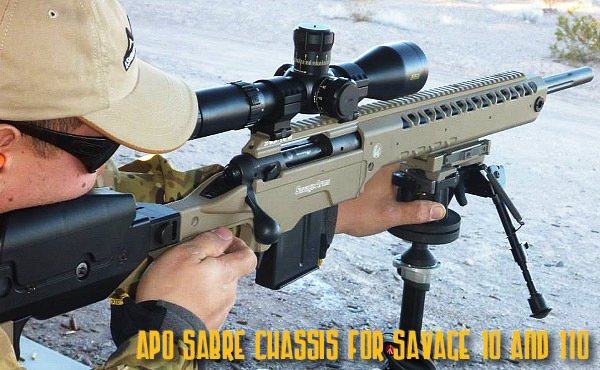

APO has been selling the Savage SVL-A2 MOD-1 for the 110 BA for nearly 2 years. The new Savage 10 and 110 models will begin deliveries to APO dealers in the Spring of 2014. Sporter models will come first, followed by the Alloy Series.
APO Showcases the New SABRE Chassis Line for Savage 10 and 110 Rifles


Shooting with APO During Media Day at the Range
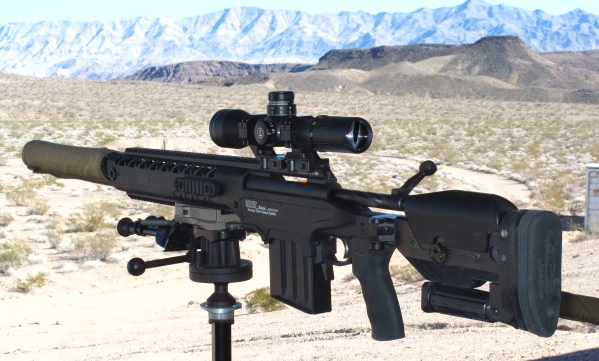
Media Day at the Boulder Pistol and Rifle Club was busy all day long. The APO crew let reporters test drive three precision rifles: an ASW .338 Lapua Magnum, a custom M700 .300 Win Mag, and the new Savage 10 FCP/SVS-A3. The winds kicked up quickly and reached 25 mph at times. But everyone still had fun.

January 16th, 2014
 Evolution is relentless. It seems that tactical rifles are becoming more accurate ever year. Five years ago tactical competitors might have been satisfied with 0.8 MOA rifles. Now the best tactical rigs approach quarter-MOA accuracy. One reason for the increased precision is the application of benchrest build techniques — with ultra-precise barrel-fitting, chambering, and stock bedding. Evolution is relentless. It seems that tactical rifles are becoming more accurate ever year. Five years ago tactical competitors might have been satisfied with 0.8 MOA rifles. Now the best tactical rigs approach quarter-MOA accuracy. One reason for the increased precision is the application of benchrest build techniques — with ultra-precise barrel-fitting, chambering, and stock bedding.
That’s nothing new to Kelbly’s, which has been building tack-driving competition rifles for decades. The new Arcas series of Tactical rifles comes with a half-MOA guarantee. And in some particularly accurate chamberings, these rifles can shoot well inside that.

One reason for the great performance of Kelbly’s tactical rifles are the outstanding components. There are no compromises. Kelbly’s tactical rifles feature Atlas actions, Brux barrels, premium bottom metal and a choice of Kelbly’s carbon-reinforced stock, McMillan A5, or GRS Laminated Stock (from Europe). If you haven’t heard of Brux, you should know these cut-rifled barrels are as good as anything out there. Brux barrels have set records and won many matches in recent years. You can learn more about Kelbly’s tactical rifles in the video below. Ian Kelbly explains all the features, the multiple stock choices, as well as the options (such as a butt-hook on the stock),
Kelbly’s Arcas Line of Tactical Rifles at SHOT Show 2014

January 14th, 2014
There were many big tactical rifles on display at Media Day, none bigger than the .50 BMG Barrett m107a1. This beast also sported the largest suppressor we’ve ever seen, a “can” the size of a motorcycle exhaust. Called the “QDL” for “Quick Detach Large”, this suppressor fits over the regular muzzle brake. It is capable of reducing the m107a1’s report from 175 db to 158 db. We learned that the m107a1 has been made “leaner and meaner” for 2014, with a six-pound weight savings. That’s important to soldiers charged with carrying the big rig in the field. Watch the last half of the video below to learn about the upgraded m107a1 and the big new QDL suppressor.


Along with the m107a1, Barrett showed us the new MRAD (Multi-Role Adaptive Design), a modular rifle that can shoot .308 Win (7.62×51), .300 Win Magnum, and .338 Lapua Magnum. The MRAD’s design allows the operator to swap barrels and change bolt-heads quickly and easily with simple tools. In fact, you can even remove the trigger group in less than a minute, just by flipping up the MRAD’s hinged upper and pushing out the safety cross-pin (3:00 minute mark in video). The MRAD dis-assembly procedure is shown in the video below. The MRAD is a very well-thought-out design, and it shot very well when Jason tested it. At least in .308 Win configuration, the braked MRAD has good manners on bipod. It doesn’t hop or roll, but recoils straight back, making it very easy to get back on target.


January 13th, 2014
 On January 10, the National Shooting Sports Foundation (NSSF) and the Sporting Arms and Ammunition Manufacturers’ Institute (SAAMI) filed a lawsuit on behalf of their members against the State of California in Fresno Superior Court challenging the state’s microstamping law. NSSF and SAAMI seek to invalidate and enjoin enforcement of provisions of California state law enacted in 2007, but not made effective until May 2013. These newly “activated” provisions of California law will effectively require that ALL future models of semi-auto pistols be microstamp-capable. Note — semi-auto handguns that are currently on California’s “approved” handgun roster will not be banned from sale. But guns introduced in the future cannot be sold in California unless they have microstamping technology. If gun makers cannot include such features in their future designs, the next generation of handguns will effectively be banned from sale in California. On January 10, the National Shooting Sports Foundation (NSSF) and the Sporting Arms and Ammunition Manufacturers’ Institute (SAAMI) filed a lawsuit on behalf of their members against the State of California in Fresno Superior Court challenging the state’s microstamping law. NSSF and SAAMI seek to invalidate and enjoin enforcement of provisions of California state law enacted in 2007, but not made effective until May 2013. These newly “activated” provisions of California law will effectively require that ALL future models of semi-auto pistols be microstamp-capable. Note — semi-auto handguns that are currently on California’s “approved” handgun roster will not be banned from sale. But guns introduced in the future cannot be sold in California unless they have microstamping technology. If gun makers cannot include such features in their future designs, the next generation of handguns will effectively be banned from sale in California.
Under California law, firearms manufacturers would have to micro laser-engrave a gun’s make, model and serial number on two distinct parts of each gun, including the firing pin so that, in theory, this information would be imprinted on the cartridge casing when the pistol is fired. “There is no existing microstamping technology that will reliably, consistently and legibly imprint the required identifying information by a semiautomatic handgun on the ammunition it fires. The holder of the patent for this technology himself has written that there are problems with it and that further study is warranted before it is mandated. A National Academy of Science review, forensic firearms examiners and a University of California at Davis study reached the same conclusion and the technical experts in the firearms industry agree,” said Lawrence G. Keane, NSSF senior vice president and general counsel. “Manufacturers can not comply with a law the provisions of which are invalid, that cannot be enforced and that will not contribute to improving public safety. As a result, we are seeking both declaratory and injunctive relief against this back-door attempt to prevent the sale of new semiautomatic handguns to law-abiding citizens in California.”
In 2007, California Assembly Bill 1471 was passed and signed into law requiring microstamping on internal parts of new semiautomatic pistols. The legislation provided that this requirement would only became effective if the California Department of Justice certified that the microstamping technology is available to more than one manufacturer unencumbered by patent restrictions. On May 17, 2013, Attorney General Kamala D. Harris provided such certification. The DOJ’s certification notice has been attacked on the grounds that it is scientifically unsound, founded on little more than “wishful thinking”.
January 12th, 2014
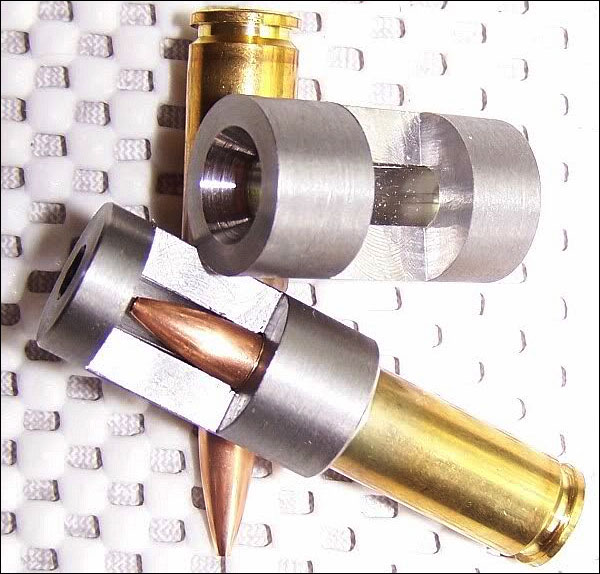
Next time you have a barrel fitted, consider having your gunsmith create a “stub gauge” from a left-over piece of barrel steel (ideally taken from your new barrel blank). The outside diameter isn’t important — the key thing is that the stub gauge is created with the same reamer used to chamber your current barrel, and the stub must have the same bore diameter, with the same land/groove configuration, as the barrel on your rifle. When properly made, a stub gauge gives you an accurate three-dimensional model of the upper section of your chamber and throat. This comes in handy when you need to bump your case shoulders. Just slide a fired case (with spent primer removed) in the stub gauge and measure from base of case to the end of the gauge. Then, after bumping, re-measure to confirm how much you’ve moved the shoulder.
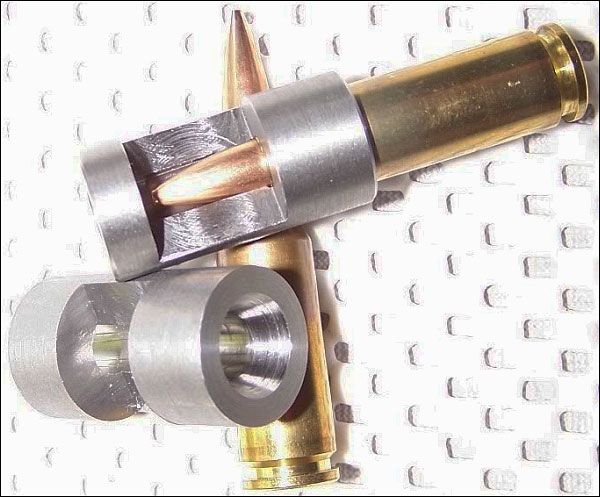
In addition, the stub gauge lets you measure the original length to lands and freebore when your barrel was new. This gives you a baseline to accurately assess how far your throat erodes with use. Of course, as the throat wears, to get true length-to-lands dimension, you need take your measurement using your actual barrel. The barrel stub gauge helps you set the initial bullet seating depth. Seating depth is then adjusted accordingly, based on observed throat erosion, or your preferred seating depth.
Forum member RussT explains: “My gunsmith [makes a stub gauge] for me on every barrel now. I order a barrel an inch longer and that gives him enough material when he cuts off the end to give me a nice case gauge. Though I don’t have him cut that nice-looking window in the side (as shown in photos). That’s a neat option. You can tell how much throat erosion you are getting from when it was new as well. For measuring initial seating depths, this is the most useful item on my loading bench next to calipers. Everyone should have a case gauge made by there smith if you have a new barrel put on.”
Forum member Lawrence H. has stub gauges made with his chamber reamers for each new barrel. He has his smith cut a port in the stub steel so Lawrence can actually see how the bullet engages the rifling in a newly-cut chamber. With this “view port”, one can also see how the case-neck fits in the chamber. Lawrence tells us: “My stub gauges are made from my barrels and cut with my chamber reamers. With them I can measure where my bullets are ‘touching the lands’ and shoulder bump dimensions. This is a very simple tool that provides accurate information.” To learn more about stub gauges, read this Forum Thread. The photos above and below show Lawrence’s stub gauges:
January 11th, 2014
 In our Shooters’ Forum, you’ll find a lengthy thread about accuracy problems with a Savage LRPV, chambered in 6mmBR. The gun would repeatedly split groups at 100 yards, and at 300 yards, the “flyers” would open up the groups to 1.5 MOA or larger. Interestingly, the factory test target (at right) showed a split group — not a good sign. In our Shooters’ Forum, you’ll find a lengthy thread about accuracy problems with a Savage LRPV, chambered in 6mmBR. The gun would repeatedly split groups at 100 yards, and at 300 yards, the “flyers” would open up the groups to 1.5 MOA or larger. Interestingly, the factory test target (at right) showed a split group — not a good sign.
The gun’s owner, forum member LR_Shooter, tried a variety of tweaks: “I did this, done that… [changed] torque, tang floated, bedded action, recut chamber, and [adjusted firing pin]”. But nothing really helped. Frustrated, LR_Shooter asked his fellow Forum members for help. Much advice was proffered, including the novel idea of removing the middle action screw in the Savage 3-screw target action. Some of the advice proved helpful, but none of the suggested remedies produced a major improvement. This rifle, out of the box, tossed flyers and no amount of tweaking (or changes in shooting technique) really cured the basic problem. That is, until, the factory barrel got replaced…

New Criterion Pre-Fit Barrel Works Wonders
LR_Shooter acquired a Criterion pre-fit barrel from Jim Briggs at Northland Shooters Supply (NSS). These pre-fits are designed for easy installation with the standard Savage barrel nut. Wouldn’t you know it, with a new 30″ heavy-contour barrel on the LRPV, the gun started shooting way better. No more crazy fliers, no more split groups, no more excessive vertical. And the improvement came without any other major modifications. LR_Shooter reports: “I got a replacement barrel from Jim at NSS. It is a 30″ bull Criterion barrel. So far, without playing with torque screws and having my old setup… I’m very satisfied with the barrel I got. Now I have no problem getting [groups] under 0.25 MOA. Finally this thing can shoot!” The targets below, shot with the new Criterion barrel, speak for themselves. The left target was shot at 100 yards, while the target on the right was shot at 300 yards (very impressive).
Targets Shot with Savage LRPV Fitted with Criterion Barrel

Read Thread on Savage Accuracy Issues Fixed By Criterion Barrel
Moral of the Story — Sometimes A New Barrel Really Is the Right Solution
All of us have struggled at times with a rifle that won’t live up to expectations. This Editor personally struggled for over a year with a .260 Rem Savage with a factory tube. The gun tended to split groups and the POI walked as the barrel heated. I tried one powder/primer combination after another, working through a variety of seating depths over many months. I was persistent. Out of stubbornness, I just believed that sooner or later I’d find the magic load.
Well folks, sometimes there’s really nothing you can do about a sub-par barrel. It is what it is. To really improve a gun’s accuracy (particularly a gun with a factory tube), you may need to open your wallet and get a quality aftermarket barrel. Spending months trying one recipe after another may simply be an overwhelming waste of powder, bullets, and your precious time.
Albert Einstein supposedly said: “Insanity is defined as doing the same thing over and over again, and expecting different results.” Well that sort of describes my efforts with my .260 Rem. Once I had enough evidence that my barrel split groups no matter what load combo (and seating depth) I tried, it was time to pony up for a new barrel. When I did finally screw on a nice PacNor 3-groove Supermatch, that Savage suddenly became a true tack-driver. As re-chambered in 6mmBR with the Pac-Nor, in calm conditions, my Savage will now consistently shoot in the twos with heavy bullets, and it can sometimes dip down into the ones with Berger 80gr flat-base bullets. The moral of the story here is simple — don’t waste weeks or months chasing your tail with a barrel that just won’t deliver (after a reasonable amount of testing). Save up for a custom barrel, get it chambered properly, and stop your cycle of frustration.
Contact Information for Northland Shooters Supply:
E-mail: briggs.j-b@q.com (that is Q.com not G.com)
Phone: (763) 682-4296
Fax: (763) 682-6098
Mailing address:
P.O. Box 333
Buffalo, MN 55313
January 11th, 2014
For 2014, Kelbly’s is introducing a new series of rifles for competition, tactical disciplines and hunting. The Arcas™ Series rifles are complete packages designed with Kelbly’s recommended specifications and top-grade components. Pick your application (Benchrest, F-Open, F-TR, Hunting, Tactical) and Kelbly’s can provide a complete build with all the bells and whistles.
Shown below are the four Arcas competition rifles currently offered. In addition to these four comp guns, the Arcas series includes two tactical-style rifles and two hunting rifles (starting at $2799.00). All these Arcas series rifles will be on display at SHOT Show next week. Let us know (via comments) which Arcas models interest you the most, so we’ll be sure to feature those in our SHOT Show reports.

Every Arcas Series rifle comes with premium components and a wide choice of stock colors. In addition you can have an Arcas rifle customized. For example, the Arcas F-Open rifle shown below can be customized with an extra long barrel ($20 per inch), fluted barrel ($199.00 extra), polished metal (all parts, $249), a GRS Laminated Stock with ergonomic grip (no charge), or a PRT Lowboy stock with high gloss finish ($799 extra).

January 6th, 2014
 Looking for a nice, half-pound trigger for your Rem-actioned varmint or tactical rifle? Well Timney has introduced a new series of triggers with pull weights adjustable from 8 ounces (half a pound) up to 40 ounces (2.5 pounds). These new 8-to-40 oz. triggers are also adjustable for sear engagement and over-travel. They will be offered in blued steel ($209.95 MSRP, $199.00 street price) or nickel-plated versions ($10 more). The new 8 oz. to 40 oz. Calvin Elite triggers are named for Timney designer Calvin Motley, who designed Timney’s AR drop-in trigger, Timney’s Rem 700 trigger with blocking safety, and other critically-acclaimed replacement triggers. Looking for a nice, half-pound trigger for your Rem-actioned varmint or tactical rifle? Well Timney has introduced a new series of triggers with pull weights adjustable from 8 ounces (half a pound) up to 40 ounces (2.5 pounds). These new 8-to-40 oz. triggers are also adjustable for sear engagement and over-travel. They will be offered in blued steel ($209.95 MSRP, $199.00 street price) or nickel-plated versions ($10 more). The new 8 oz. to 40 oz. Calvin Elite triggers are named for Timney designer Calvin Motley, who designed Timney’s AR drop-in trigger, Timney’s Rem 700 trigger with blocking safety, and other critically-acclaimed replacement triggers.
New for 2014, the Calvin Elite series will initially be offered for Remington Model 700 and Model Seven rifles, with other action types to follow. These Timney triggers are proudly made in the USA and are covered by Timney’s lifetime product warranty.
Timney’s new Calvin Elite series triggers are precision-made with top-quality components. Sears are wire-EDM-cut and triggers are CNC-machined. Parts that receive heavy wear are made from A2 tool steel (heat-treated to Rockwell 58 hardness), with Teflon-nickel coatings. The lightweight 6061-T6 aluminum housings are CNC-machined and anodized Timney Elite Gold. To learn more about the new Calvin Elite triggers, call 1-866-4TIMNEY (toll-free), or visit TimneyTriggers.com.
Calvin Elite Remington Model 700
Fully adjustable for sear engagement, over-travel, and pull weights from 8 ounces – 2.5 pounds. Trigger-Blocking Safety. MSRP $209.95 or $219.95 (nickel plated).
Calvin Elite Remington Model Seven
Fully adjustable for sear engagement, over-travel, and pull weights from 8 ounces – 2.5 pounds. Trigger-Blocking Safety. MSRP $209.95 or $219.95 (nickel plated).
December 30th, 2013
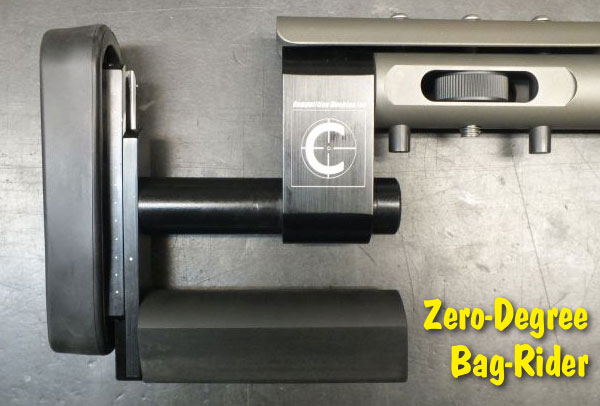
Tube-gunners take note. Gary Eliseo has just introduced a new wider, V-profile rear bag rider for his Competition Machine modular chassis systems. The new bag-rider is a wide V-shape that conforms to the shape and angle of popular rear sandbags. Gary tells us that “The new F-class rear bag rider will be available as an option in 2014. Constructed of Delrin, the new bag-rider is reversible with 0 degree and 5 degree mounting ends. The bottom of the bag-rider is sized to fit 3/4″-wide ear spacing.”


Editor’s Comment — This Kind of Bag Rider Really Works
We have tested a prototype, V-shaped bag-rider on an Eliseo 6mmBR Tubegun. The profile on our wooden prototype is very similar to Gary’s final design crafted from Delrin. We were really surprised at how much better the gun behaved with the wide, V-shaped bag rider, compared to a standard slab-sided skid. With the “V-Rider” the gun felt more “locked-in” with less side-to-side play. There also seemed to be less vertical bounce when shooting F-TR style with a bipod. But mostly the gun felt much more stable, with less tendency to roll. There was noticeably less side to side wobble, and the gun did track better.
The most important thing, is that the V-shaped bag-rider definitely made the gun easier to shoot — at least in the opinion of our three trigger-pullers. When we switched to our wide, V-shaped bag-rider, three different shooters were able to hold smaller groups with tighter horizontal. We saw fewer left/right shot impacts (away from the group center) that may have been attributable to little, last-micro-second movements of the rifle. The gun seemed to settle in the rear bag better, and after each shot, it seemed we could get back on target more quickly. The gun “locks in” to the rear bag faster and more solidly, so you spend less time fiddling with horizontal. With less wobble, the TubeGun feels less top-heavy. Understand that a V-shaped bag rider will not make your rifle more inherently accurate. However, it may help you steer the gun more consistently, and it make help the rifle track more consistently.
Product find by EdLongRange. We welcome reader submissions.
|