|
|
February 5th, 2014
 A while back, while in Arizona, we headed out to the Ben Avery Shooting Facility, located about 27 miles north of downtown Phoenix on I-17. We were impressed by Ben Avery’s vast range complex, which includes a Clay Target (shotgun) center, 1000-yard High Power range, 100-300 yard Benchrest range, rifle and pistol silhouette ranges, handgun ranges, smallbore range, Running Boar range, and a large, 53-bay, 200-yard main range. A while back, while in Arizona, we headed out to the Ben Avery Shooting Facility, located about 27 miles north of downtown Phoenix on I-17. We were impressed by Ben Avery’s vast range complex, which includes a Clay Target (shotgun) center, 1000-yard High Power range, 100-300 yard Benchrest range, rifle and pistol silhouette ranges, handgun ranges, smallbore range, Running Boar range, and a large, 53-bay, 200-yard main range.
At the main range we ran into Forum Member Troy D., who had a brand-spanking new 6mmBR rifle built by Lester Bruno of Bruno Shooters Supply. While breaking-in his new 28″ Krieger barrel, Troy was using Sierra 70gr Blitz-Kings. Accuracy was impressive — the 70 grainers ripped tight, little knots in the high 2s, low 3s. Though his rifle has an 8-twist barrel, Troy was testing the 70s in preparation for a prairie dog trip next week. From what we saw, those p-dogs should be worried. Troy’s gun was a tack-driver with the Sierra Blitz-Kings.


Troy’s Compact Storage Box (Just $1.50!)
While Troy was cleaning between groups, we noticed he was using a compact little box to hold his jags, brushes and patches. The box was the perfect size for these items. Troy explained: “If you’re just taking one rifle to the range, you don’t need to take a big gear box with stuff for all your guns. Apart from solvent, bore guide, and cleaning rod, this little box holds all I really need to clean my rifle.” Troy sourced the box at Cabela’s for $1.50.

January 30th, 2014

 A 7mm Snake for Santiago A 7mm Snake for Santiago
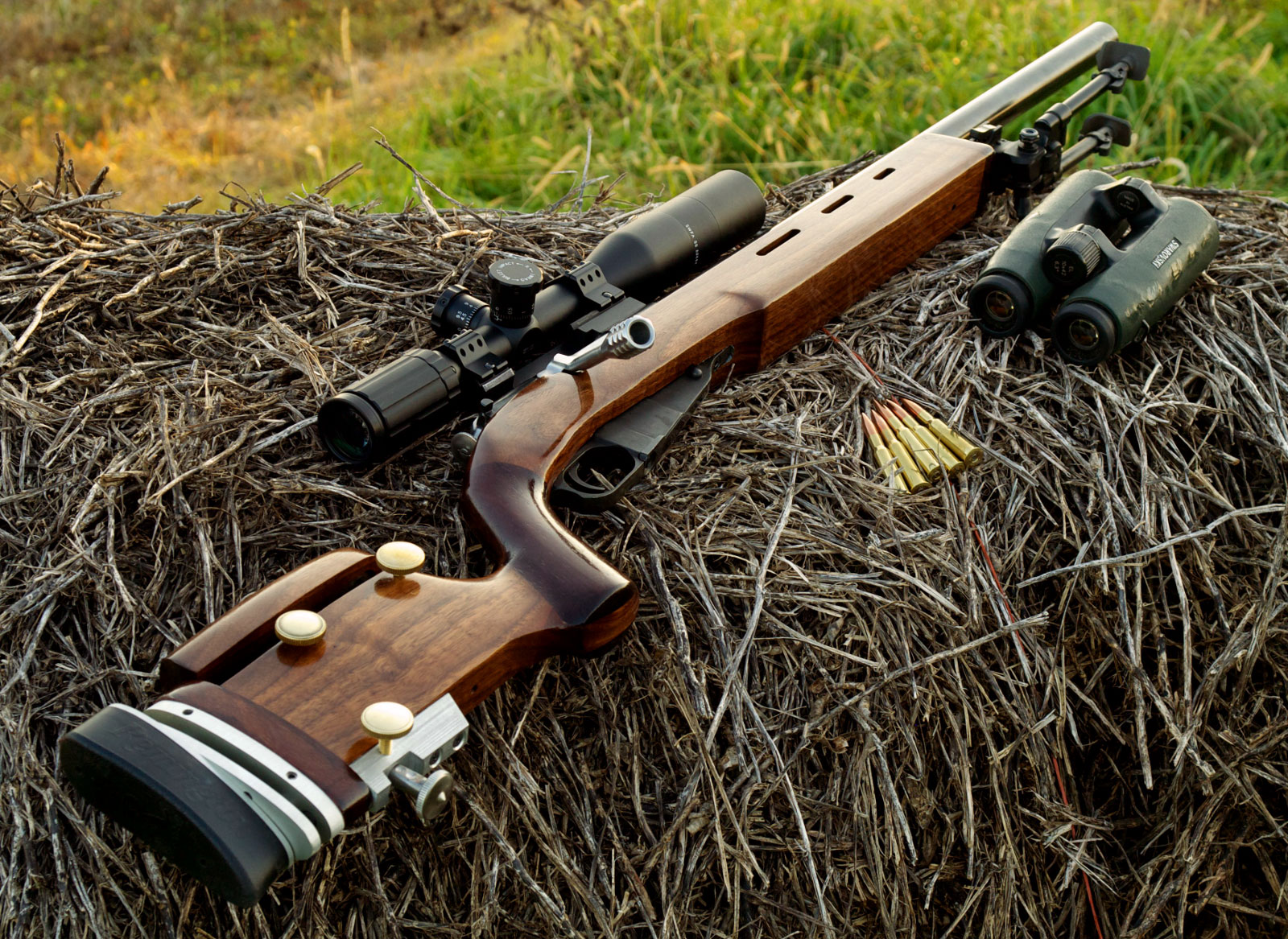
Our friend Dennis Santiago has a new reptile in his arsenal. It’s actually an Eliseo R1 single-shot tubegun chambered in .284 Winchester. The eye-catching aspect of Santiago’s new toy is the snakeskin dip job on the exterior. This really creates a distinctive look. Dennis tells us: “It was Gary Eliseo’s idea to try a water-transfer printing finish for this rifle. There are many patterns to choose from — this is the WTP-260 Snakeskin Illusion-Fall Copper from WaterTransferPrinting.com. For a single shot LR gun, I figured something on the bright side would be interesting and pick up less heat from the sun in the summer.”
Dennis will use his new rifle in prone and tactical matches. He says: “I can’t wait to start breaking it in. Underneath the hood, it’s a Rem 700 Long Action, chambered in .284 Win. Yes it’s a single shot! I don’t need anything else for a prone gun. Nothing to get in the way of building the perfect position.”

Dennis says: “Length of pull, offset and cast initially set the same as my similar RTS .308. My gun, my body dimensions.”

A FFP Sightron Rides on Top
The optic is a Sightron 6-24x50mm, FFP MOA-2. Dennis reports: “I looked at many scopes (within my determined price range), and this is the one that had the best combination of features for for this gun’s particular application. The sight line sits about 3 inches above bore line on these guns. It’s been leveled, bore-sighted and pre-dialed for a 200-yard estimated zero for the ammo I plan to use during break-in. If I did everything right, the first round will be on paper — theoretically. Those are Gen II A.R.M.S. rings. Super easy to tailor to different rail widths. Same rock-steady steel performance.”


January 29th, 2014
Beretta USA announced today that it will open a new firearms manufacturing plant in Sumner County, Tennessee. Beretta, a global manufacturer of sporting and military firearms, will invest $45 million in a state-of-the-art manufacturing and R&D facility in the Gallatin Industrial Park. Tennessee Gov. Bill Haslam stated that this new facility will create 300 new Tennessee jobs. Beretta hopes to complete construction on the facility this year. Moving production and R&D functions to Tennessee will allow Beretta to scale down its operations in the state of Maryland. In recent years, Maryland has become less attractive to firearms-related businesses.

Beretta supplies sporting and self-defense firearms to consumers worldwide. The company manufactures the U.S. Armed Forces M-9 pistol, the standard sidearm of U.S. soldiers since 1985. Beretta will make firearms at the new Gallatin plant from both their sporting and tactical product lines.
Established in 1526, Beretta is one of the oldest industrial companies in the world. The company has enjoyed 16 generations of continuous family ownership. Firearms bearing the Beretta name have been sold for almost 500 years. Beretta also owns and markets other leading firearms brands, including Benelli, Franchi, SAKO, Stoeger, Tikka, and Uberti. For more information, visit www.beretta.com.
“From the moment when we started to consider a location outside of the State of Maryland for our manufacturing expansion, Governor Haslam and his economic development team did an excellent job demonstrating the benefits of doing business in Tennessee. We are convinced we could find no better place than Tennessee to establish our new manufacturing enterprise.”
— Franco Gussalli Beretta, Vice President and Managing Director of Fabbrica D Armi S.p.A and Executive Vice President of Beretta USA.
January 25th, 2014
While at SHOT Show, I visited nearly all the major pistol manufacturers, and tried out their latest polymer-framed, striker-fired pistols. To my dismay, these pistols (from a half-dozen different makers), all had one thing in common — really unpleasant triggers. The triggers were mushy, “sproingy” (my term), with a heavy (and sometimes rough) “stagey” pull that was not consistent through the pull cycle. Trying one gun after another, my reaction was always: “Yep, another awful trigger”. Most of the striker-fired guns also had a sloppy slide to frame fit, so they clanked around as they cycled. I’m sure they would function reliably, but I felt I was sampling staple guns, not fine firearms.

 In Search of A Better Trigger In Search of A Better Trigger
Disheartened, I left the main exhibit hall and descended to level one. There, like a beacon, I saw the STI logo, and ranks of metal-framed, hammer-fired pistols. I picked one up. I worked the slide — it operated oh-so-smoothly, like it was on ball bearings. The grip safety functioned perfectly when I wrapped my hand on the grip — no conscious pressure was required and I didn’t feel an uncomfortable bump in the web of my hand. The safety just did its job effortlessly.
I asked an STI rep if I could dry-fire the pistol. “Go right ahead” he said. The first thing I noticed was that the take-up was smooth — butter smooth. There was no grittiness, and the take-up pull was constant. When you got to the break point, resistance increased, and at just about 3 pounds of pressure, the hammer fell with a precise release. No staginess (rising/falling pull weight), no “sproingy” feel (like a cheap coil spring compressing and then snapping), just even pressure and “click” the hammer falls. This was trigger heaven, compared to striker-fired trigger hell.
As I was at the STI booth, a young fellow came up next to me. I noticed, from his name badge, that he was from Austria, home of the Glock. He said “You know I have had Glocks for years. Then one day I said ‘Why am I doing this to myself, why am I putting up with this?’. The triggers are scheiße — I can’t stand them, and the grip shape is wrong. So I sold my Glocks and bought one of these [an STI] and now I am very happy.” He held up an STI and said “Now this is how a pistol should be made!” I smiled and said, “Isn’t it ironic that it has been more than 100 years since John Moses Browning invented the 1911, and his design still works so well?”
Here are two of the STI Pistols on display at SHOT Show. They are both built to very high quality standards, and they both have smooth-running slides and crisp, near-perfect triggers.


STI Target Master
The Target Master is built on STI’s 1911 Government-length frame with 30 lpi checkering on the front strap. The safety controls are STI ambidextrous thumb safeties and STI high rise, knuckle-relief beavertail grip safety. The 6″ slide features a lowered and flared ejection port, tri-level adjustable sights, and STI front and rear cocking serrations. The barrel is a 6.0″, fully-supported and ramped bull barrel. The Target Master comes standard with a STI two-piece steel guide rod, Commander-style hammer and patented STI Int’l trigger system. The STI Target Master ships with one 1911 Magazine.

STI International Edge
Integrating patented 2011 technology with classic 1911 design, the STI International Edge is a high capacity pistol that carries John Browning’s design into the 21st Century. Since its introduction in late 1997, the STI Edge has become the standard for USPSA/IPSC Limited Division competition. Built on the STI Modular Steel 2011® frame with polymer grip, the Edge delivers the traditional features of a 1911 with the benefit of high capacity magazines. The Edge frame preserves the 17° grip angle (like the original 1911). The design allows for double stack magazines without over-sizing the circumference of the grip.
Along with its distinctive full-length dust-cover frame, the STI Edge features traditional front and rear cocking serrations. The Edge comes standard with a stainless, high-rise, knuckle-relief grip safety, stainless ambi-thumb safeties, and a stainless, fully-supported and ramped bull barrel. The Edge ships with one 126mm magazine.
January 24th, 2014
One of the most popular features of our Shooters’ Forum is the Official ‘Pride & Joy’ Rifle thread. There you’ll find dozens of interesting rifles, with photos and descriptions supplied by proud owners. Yesterday, one of the more interesting ‘Pride & Joy’ rifles appeared. This was a “senior citizen” — a 72-year-old Russian Mosin-Nagant bolt gun. But this is not like any Mosin Nagant you’ve ever seen before. It has been brought into the 21st Century with a handsome target stock and some first-class upgrades, including Lothar Walther barrel and Timney trigger. Here’s a look at a very nice Russian rifle, belonging to Forum member Ben C. (aka “Grimstod”):
CLICK TO See Full-Screen Photo:

Video Shows Rifle Shooting Sub-Half-MOA from Bipod (in the Snow):
Name of rifle: Smyert Mk3 (Modified Mosin Nagant)
Make: Izhmekh/Izhevsk (“Izzy”) High Wall
Model: 91/30 | Year: 1942

Components and Specifications:
Barrel: Lothar Walther 26″
Contour: 1.18″ straight
Chambering: 7.62x54R, .310 bore
Stock: Bluegrass Tactical (Gen 1 & 2)
Trigger: Timney with Bluegrass trigger shoe
Magazine: Finnish No-Jam magazine |
Scope mount: Rock Solid (looks like an action sleeve)
Scope: SWFA 20x42mm MRAD
Gunsmith: Sheppard
Bolt handle: Rock Solid with Surgeon tactical handle
Bipod: Versa Pod
Total Weight: 18.6 lbs |


Grimstod’s Moisin Nagant Custom Shoots Under 0.5 MOA From Bipod
Even in harsh winter conditions, the rifle shot well. (I guess we should expect that for a Russian gun). The photo below shows a group shot from bipod. (The video shows Grimstod’s snow-bound range session). Grimstod calculated the group at 0.394 MOA measuring from outside edge to edge. Using our On-Target software, which measures center to center of most distant shots, we came up with 0.428 MOA. Still that’s impressive for an ancient action being shot in the dead of winter with snow falling. To learn more about this rifle (and view photos of the build process), visit the SurplusRifleForum.com.

January 18th, 2014
Ashbury Precision Ordnance (APO) has introduced a new line of modular SABRE chassis systems for Savage model 10 and 110 rifles. These chassis systems are completely modular, upgradeable, and reconfigurable. Sporter models start at $995.00. APO President Morris Petersen explains: “Our customers said ‘Hey, you need to build a line for Savages’. So we built a series of SABREs for Savage [short action and long action rifles]. We have a composite version (Sporter), the Super-Sport Alloy, and the Carbon Fiber version. They are all fully adjustable (as all of the SABRE Platforms are) so they can fit any type of shooter.” New model calibers include .308 Win, .300 Win Mag, .338 Lapua Mag in Sporter Composite and Quattro Alloy series with 5-round and 10-round AICS-type magazines.
New Savage SABRE Chassis System (SVS-A3, MOD-1 Alloy Series SuperSport)
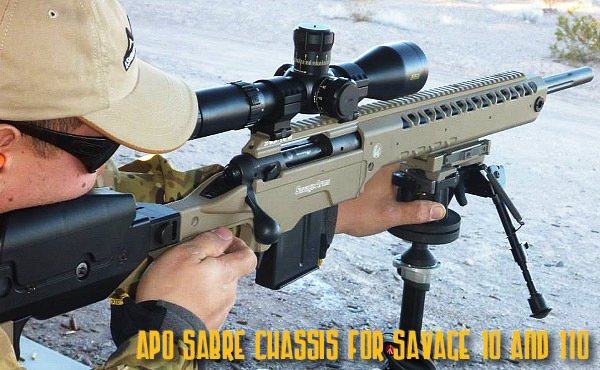

APO has been selling the Savage SVL-A2 MOD-1 for the 110 BA for nearly 2 years. The new Savage 10 and 110 models will begin deliveries to APO dealers in the Spring of 2014. Sporter models will come first, followed by the Alloy Series.
APO Showcases the New SABRE Chassis Line for Savage 10 and 110 Rifles


Shooting with APO During Media Day at the Range
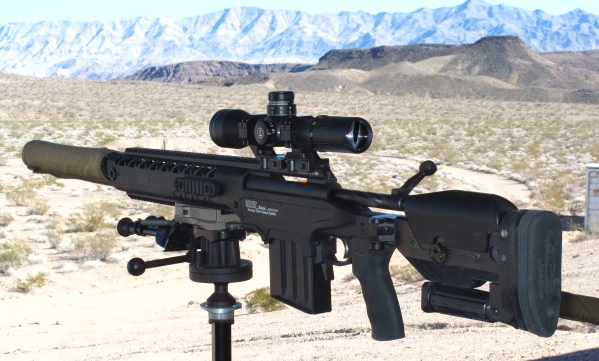
Media Day at the Boulder Pistol and Rifle Club was busy all day long. The APO crew let reporters test drive three precision rifles: an ASW .338 Lapua Magnum, a custom M700 .300 Win Mag, and the new Savage 10 FCP/SVS-A3. The winds kicked up quickly and reached 25 mph at times. But everyone still had fun.

January 16th, 2014
 Evolution is relentless. It seems that tactical rifles are becoming more accurate ever year. Five years ago tactical competitors might have been satisfied with 0.8 MOA rifles. Now the best tactical rigs approach quarter-MOA accuracy. One reason for the increased precision is the application of benchrest build techniques — with ultra-precise barrel-fitting, chambering, and stock bedding. Evolution is relentless. It seems that tactical rifles are becoming more accurate ever year. Five years ago tactical competitors might have been satisfied with 0.8 MOA rifles. Now the best tactical rigs approach quarter-MOA accuracy. One reason for the increased precision is the application of benchrest build techniques — with ultra-precise barrel-fitting, chambering, and stock bedding.
That’s nothing new to Kelbly’s, which has been building tack-driving competition rifles for decades. The new Arcas series of Tactical rifles comes with a half-MOA guarantee. And in some particularly accurate chamberings, these rifles can shoot well inside that.

One reason for the great performance of Kelbly’s tactical rifles are the outstanding components. There are no compromises. Kelbly’s tactical rifles feature Atlas actions, Brux barrels, premium bottom metal and a choice of Kelbly’s carbon-reinforced stock, McMillan A5, or GRS Laminated Stock (from Europe). If you haven’t heard of Brux, you should know these cut-rifled barrels are as good as anything out there. Brux barrels have set records and won many matches in recent years. You can learn more about Kelbly’s tactical rifles in the video below. Ian Kelbly explains all the features, the multiple stock choices, as well as the options (such as a butt-hook on the stock),
Kelbly’s Arcas Line of Tactical Rifles at SHOT Show 2014

January 14th, 2014
There were many big tactical rifles on display at Media Day, none bigger than the .50 BMG Barrett m107a1. This beast also sported the largest suppressor we’ve ever seen, a “can” the size of a motorcycle exhaust. Called the “QDL” for “Quick Detach Large”, this suppressor fits over the regular muzzle brake. It is capable of reducing the m107a1’s report from 175 db to 158 db. We learned that the m107a1 has been made “leaner and meaner” for 2014, with a six-pound weight savings. That’s important to soldiers charged with carrying the big rig in the field. Watch the last half of the video below to learn about the upgraded m107a1 and the big new QDL suppressor.


Along with the m107a1, Barrett showed us the new MRAD (Multi-Role Adaptive Design), a modular rifle that can shoot .308 Win (7.62×51), .300 Win Magnum, and .338 Lapua Magnum. The MRAD’s design allows the operator to swap barrels and change bolt-heads quickly and easily with simple tools. In fact, you can even remove the trigger group in less than a minute, just by flipping up the MRAD’s hinged upper and pushing out the safety cross-pin (3:00 minute mark in video). The MRAD dis-assembly procedure is shown in the video below. The MRAD is a very well-thought-out design, and it shot very well when Jason tested it. At least in .308 Win configuration, the braked MRAD has good manners on bipod. It doesn’t hop or roll, but recoils straight back, making it very easy to get back on target.


January 13th, 2014
 On January 10, the National Shooting Sports Foundation (NSSF) and the Sporting Arms and Ammunition Manufacturers’ Institute (SAAMI) filed a lawsuit on behalf of their members against the State of California in Fresno Superior Court challenging the state’s microstamping law. NSSF and SAAMI seek to invalidate and enjoin enforcement of provisions of California state law enacted in 2007, but not made effective until May 2013. These newly “activated” provisions of California law will effectively require that ALL future models of semi-auto pistols be microstamp-capable. Note — semi-auto handguns that are currently on California’s “approved” handgun roster will not be banned from sale. But guns introduced in the future cannot be sold in California unless they have microstamping technology. If gun makers cannot include such features in their future designs, the next generation of handguns will effectively be banned from sale in California. On January 10, the National Shooting Sports Foundation (NSSF) and the Sporting Arms and Ammunition Manufacturers’ Institute (SAAMI) filed a lawsuit on behalf of their members against the State of California in Fresno Superior Court challenging the state’s microstamping law. NSSF and SAAMI seek to invalidate and enjoin enforcement of provisions of California state law enacted in 2007, but not made effective until May 2013. These newly “activated” provisions of California law will effectively require that ALL future models of semi-auto pistols be microstamp-capable. Note — semi-auto handguns that are currently on California’s “approved” handgun roster will not be banned from sale. But guns introduced in the future cannot be sold in California unless they have microstamping technology. If gun makers cannot include such features in their future designs, the next generation of handguns will effectively be banned from sale in California.
Under California law, firearms manufacturers would have to micro laser-engrave a gun’s make, model and serial number on two distinct parts of each gun, including the firing pin so that, in theory, this information would be imprinted on the cartridge casing when the pistol is fired. “There is no existing microstamping technology that will reliably, consistently and legibly imprint the required identifying information by a semiautomatic handgun on the ammunition it fires. The holder of the patent for this technology himself has written that there are problems with it and that further study is warranted before it is mandated. A National Academy of Science review, forensic firearms examiners and a University of California at Davis study reached the same conclusion and the technical experts in the firearms industry agree,” said Lawrence G. Keane, NSSF senior vice president and general counsel. “Manufacturers can not comply with a law the provisions of which are invalid, that cannot be enforced and that will not contribute to improving public safety. As a result, we are seeking both declaratory and injunctive relief against this back-door attempt to prevent the sale of new semiautomatic handguns to law-abiding citizens in California.”
In 2007, California Assembly Bill 1471 was passed and signed into law requiring microstamping on internal parts of new semiautomatic pistols. The legislation provided that this requirement would only became effective if the California Department of Justice certified that the microstamping technology is available to more than one manufacturer unencumbered by patent restrictions. On May 17, 2013, Attorney General Kamala D. Harris provided such certification. The DOJ’s certification notice has been attacked on the grounds that it is scientifically unsound, founded on little more than “wishful thinking”.
January 12th, 2014
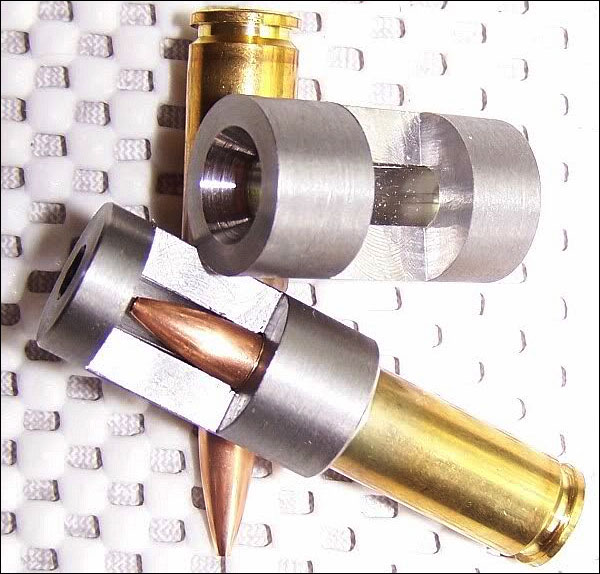
Next time you have a barrel fitted, consider having your gunsmith create a “stub gauge” from a left-over piece of barrel steel (ideally taken from your new barrel blank). The outside diameter isn’t important — the key thing is that the stub gauge is created with the same reamer used to chamber your current barrel, and the stub must have the same bore diameter, with the same land/groove configuration, as the barrel on your rifle. When properly made, a stub gauge gives you an accurate three-dimensional model of the upper section of your chamber and throat. This comes in handy when you need to bump your case shoulders. Just slide a fired case (with spent primer removed) in the stub gauge and measure from base of case to the end of the gauge. Then, after bumping, re-measure to confirm how much you’ve moved the shoulder.
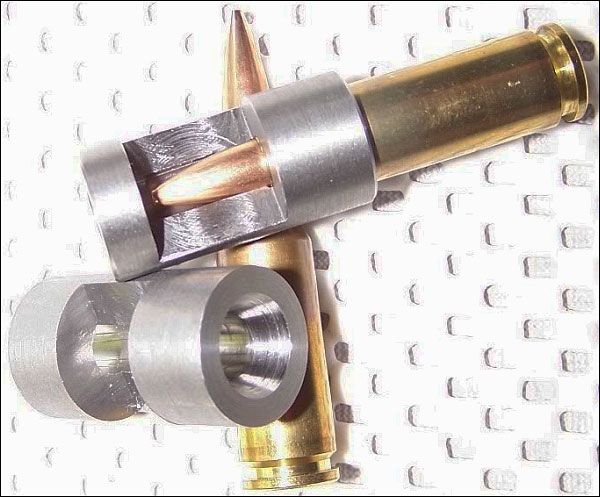
In addition, the stub gauge lets you measure the original length to lands and freebore when your barrel was new. This gives you a baseline to accurately assess how far your throat erodes with use. Of course, as the throat wears, to get true length-to-lands dimension, you need take your measurement using your actual barrel. The barrel stub gauge helps you set the initial bullet seating depth. Seating depth is then adjusted accordingly, based on observed throat erosion, or your preferred seating depth.
Forum member RussT explains: “My gunsmith [makes a stub gauge] for me on every barrel now. I order a barrel an inch longer and that gives him enough material when he cuts off the end to give me a nice case gauge. Though I don’t have him cut that nice-looking window in the side (as shown in photos). That’s a neat option. You can tell how much throat erosion you are getting from when it was new as well. For measuring initial seating depths, this is the most useful item on my loading bench next to calipers. Everyone should have a case gauge made by there smith if you have a new barrel put on.”
Forum member Lawrence H. has stub gauges made with his chamber reamers for each new barrel. He has his smith cut a port in the stub steel so Lawrence can actually see how the bullet engages the rifling in a newly-cut chamber. With this “view port”, one can also see how the case-neck fits in the chamber. Lawrence tells us: “My stub gauges are made from my barrels and cut with my chamber reamers. With them I can measure where my bullets are ‘touching the lands’ and shoulder bump dimensions. This is a very simple tool that provides accurate information.” To learn more about stub gauges, read this Forum Thread. The photos above and below show Lawrence’s stub gauges:
|