|
|
November 28th, 2010
If you’re wondering what to ask Santa to deliver this holiday season, how about a Quilted Maple 300 WSM Varminter? That’s what Santa brought Barry O. (aka TheBlueEyedBear) last December. Barry, a respected long-time member of our Shooters Forum, ordered a new 300 WSM Varminter in 2009 and it arrived just in time for Christmas. The beautiful rifle, smithed by Richard Franklin, features a BAT Action, Bartlein 30″ barrel, and a stunning Quilted Maple wood stock. Barry’s new 300 WSM is capable of delivering 125gr Ballistic Tips at over 4000 fps, with great accuracy.


Barry reports: “Here is my 300WSM Varminter built by Richard Franklin of Richards Custom Rifles. This is one awesome piece of work — And YES, it shoots! I expected a lot when I asked Richard to build this gun, and believe me; I got more than I expected. I am not a machinist, nor am I an engineer, but I can tell you for certain that this is the finest quality work you can expect from a gun builder.

As you can imagine, my reason for building this gun was for long range varminting. I had read articles about the flat-shooting 300 WSM Varminter on AccurateShooter.com, and how it could launch a projectile at over 4000 fps with great accuracy. I also read some of the brutal articles on other sites from the nay-sayers. So, I had to have one. Simply put: THE NAY-SAYERS ARE WRONG! You CAN launch a 125gr Ballistic Tip bullet over 4000 fps and terrorize those little fury creatures way far away. I love this thing… I think I’ll ask Richard to build me another!” [Editor’s Note: Anyone wanting Richard Franklin to build a custom rifle had better act quickly. Richard is retiring and he will not work on any orders submitted after January 1, 2011.]

Franklin 300 WSM Vaminter Specifications:
BAT Machine SS Model ‘B’ action, RB/RP, Diamond fluted bolt
BARTLEIN 30″ SS str. 1.25″-diam. barrel (polished) 1:16″ tw, .337 neck
BAT Machine polished aluminum trigger guard
HOLLAND recoil lug
JEWELL BR trigger set at 1.5 oz.
HARRELL’s muzzle brake
UNDERTAKER stock in Quilted Maple, clearcoated
RCR polished SS pillar bedding
LIMBSAVER recoil pad (I hate recoil)
BAT Machine SS 20moa scope base
NIGHTFORCE 30mm scope rings
NIGHTFORCE 8x32x56 NSX with NP-2DD reeticle
NIGHTFORCE angle meter
U.S OPTICS cant indicator
Richard Franklin To Retire — Final Order Deadline Announced
Richard Franklin, builder of the beautiful rifle shown above, has announced his retirement. He will be taking orders for custom rifles through January 1, 2011, but that’s it — he’s giving up the business. Orders received after January 1st will be built by Richard’s protégé Tommy Shurley. Read on…
| Richard Franklin Will Retire. Order Cut-Off Date is 1/1/2011
 I will be taking orders for custom rifles and muzzle loaders until the 1st of January, 2011. When these orders are completed by me in 2011 I will be officially retired from building rifles as a business. After Jan. 1st, 2011 Tommy Shurley of Shurley Bros. Custom Rifles will be taking over my business known as Richards Custom Rifles. I will retain my website and answer questions as usual. Any rifle orders coming in after Jan. 1st will be directed to Tommy Shurley. Tommy has been working with me for some time now here in my shop and I will continue to work with Tommy in his shop in Heber Springs, Arkansas until I am satisfied that Tommy can build rifles as I have been building them. Tommy will have a full service shop and be able to meet all your shooting needs. — Richard Franklin I will be taking orders for custom rifles and muzzle loaders until the 1st of January, 2011. When these orders are completed by me in 2011 I will be officially retired from building rifles as a business. After Jan. 1st, 2011 Tommy Shurley of Shurley Bros. Custom Rifles will be taking over my business known as Richards Custom Rifles. I will retain my website and answer questions as usual. Any rifle orders coming in after Jan. 1st will be directed to Tommy Shurley. Tommy has been working with me for some time now here in my shop and I will continue to work with Tommy in his shop in Heber Springs, Arkansas until I am satisfied that Tommy can build rifles as I have been building them. Tommy will have a full service shop and be able to meet all your shooting needs. — Richard Franklin
|
November 25th, 2010
 Forum member Jerry S. posted this story yesterday in our Shooters’ Forum. It shows that, with the right bullet and good shot placement, the diminutive 6BR is more than enough cartridge for deer. Forum member Jerry S. posted this story yesterday in our Shooters’ Forum. It shows that, with the right bullet and good shot placement, the diminutive 6BR is more than enough cartridge for deer.
I decided to try something different this year. Instead of dragging out my trusty .44 Smith or the 6.5×55 Remington 700, I took my 6mmBR Norma Prairie Dog rifle deer hunting. We got a lot of wet sloppy snow the week before the opener and had a freezing drizzle on the first morning. I decided to hunt close to the house since my old bones couldn’t handle the trip to my normal hunting stand.
I set the 6mmBR P-dog rifle up on my shooting bench and began the long, cold wait. The deer trail I was watching is about 180 – 230 yards from where I was sitting.
Buck Lined up in Cross-hairs
At about 2:30 this afternoon, I was watching some does feeding along the trail and looked away for a minute then looked back and saw a third deer moving up behind them. A quick check in the spotting scope showed horns and I got behind the rifle. There is no safety on my P-dog gun so it wasn’t loaded and I quickly chambered a round. The does stepped into the woods and the buck stopped for a minute and looked right at me. I centered the cross hairs on his chest and touched the trigger. I could hear the impact as he leaped straight in the air and hit the ground running into the woods.

I figured it was a good hit, so I poured a cup of coffee and relaxed for a bit to let him tire out and drop. After my coffee, I picked up my 6.5×55 and went out to where he was shot. I was 190 yards from my bench and there was no blood. He was headed toward a swamp south of me so I figured I’d cut him off and see if I could cut his trail farther into the bush. I hadn’t gone ten yards when I came across a good blood trail.

I followed it for a few more yards and found him crumpled up. He had only gone 25 yards from where he was shot. While I was looking at him and taking photos, two more deer showed up. You can see one standing on the other side of my rifle.

My buddy brought his 4-wheeler over and helped me drag it to the house where we skinned it out. The bullet had taken the top off the heart and he was totally bled out. All in all, it was a successful hunt, and the 6mmBR did its job.
November 23rd, 2010
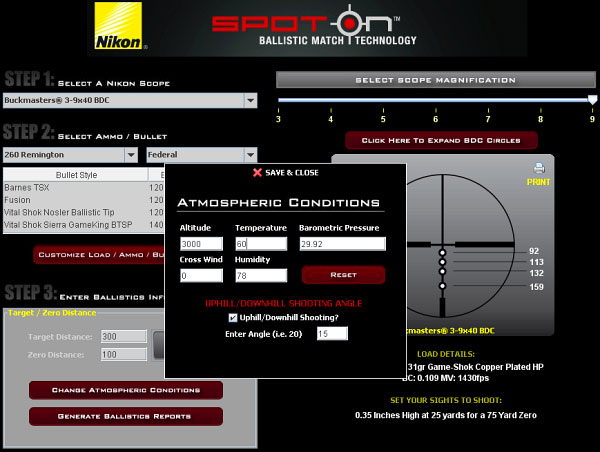
Nikon has adapted its popular Spot On Ballistics software to run on iPhones and iPods. The Spot On iPhone App contains a vast database of factory ammo (both rimfire and centerfire), so you can quickly plot ballistics for your chosen load. If you have a Nikon scope with a Ballistic Drop Compensating Reticle (BDC), you can input the ammo type, zero distance, and atmospheric conditions, and the software will automatically calculate exact target distances corresponding to the hold-over circles on your reticle. Match Technology provides precise aiming points for any Nikon BDC reticle riflescope and precise reference for sighting in other Nikon riflescopes with plex, MilDot or standard crosshair reticles. Nikon’s Spot On App costs $4.99 from the iTunes App store.

Free Web Version of Nikon’s Ballistics App
If you don’t own an iPhone, you can still use the full-featured Spot On program for free on the web. Just log on to NikonHunting.com/spoton and register. Pick a caliber/cartridge and a bullet, then input temp, altitude, and shooting angle. This will give you a ballistics solution and will show the actual yardages corresponding to your BDC reticle hold-over circles. Shown below is the user interface for the FREE web-based version of Spot On.
November 22nd, 2010
 We recently had a chance to chat with Dave Emary, Hornady’s Chief Ballistics Scientist. Dave told us that varmint hunters should definitely check out two new .224-caliber bullets from Hornady, the 35gr NTX and the 53gr V-Max. Both bullets offer high-BCs for their weight class, along with excellent terminal performance. We recently had a chance to chat with Dave Emary, Hornady’s Chief Ballistics Scientist. Dave told us that varmint hunters should definitely check out two new .224-caliber bullets from Hornady, the 35gr NTX and the 53gr V-Max. Both bullets offer high-BCs for their weight class, along with excellent terminal performance.
New Lead-Free NTX “California-Legal” Bullet
First is the new 35gr NTX® BT plastic-tipped bullet. This is a lead-free California-compliant design. Designed with a boat-tail and extended ogive, the new 35gr NTX has better ballistics than most other bullets in its weight class. This bullet can be pushed to very high velocities by a standard .223 Remington cartridge. As you can see from the factory illustrations below, the new 35gr NTX bullet is far more streamlined that the previous 35gr flat-base V-MAX, and the NTX’s BC is much higher. So the NTX gives you a lead-free alternative, that has better ballistics to boot.

New High-BC, 53gr V-Max May Be a “Game-Changer” for .223 Rem Shooters
The second recently-released bullet is a new, High-BC, 53gr V-Max with a field-tested 0.290 G1 Ballistic Coefficient. That’s a very high BC for a .224-caliber bullet in this weight class. To demonstrate that point, the Berger 55gr BTHP Varmint bullet has a .210 G1 BC, while the Sierra 53gr FB MatchKing has a .224 G1 BC (above 2800 fps). How did Hornady achieve the higher BC? Emary tells us that this new bullet was designed with an extended ogive (nose section) to provide significantly better ballistics than other bullets in its weight class. Emary added: “With this .290 BC bullet and the higher velocities we get with the SuperFormance powder blends, the .223 Remington runs pretty darn close to a .22-250 with standard loads — you can run the ballistics numbers yourself.”

Taking Up Emary’s Challenge — Running the Balllistics
Given Dave’s challenge to “run the numbers” — we did just that. Hornady claims 3465 fps from its new SuperFormance .223 Rem factory ammo loaded with the 53gr V-Max. At 400 yards, this load will drop 20.8 inches from a 100-yard zero, and drift 15.6 inches in a 10 mph crosswind. (Figures calculated with JBM Ballistics, for 500′ altitude, 70° F.) To compare, Hodgdon’s Reloading Data Center says a .22-250 can deliver 3713 fps with a 55-grainer pushed by a max load of IMR 4064. So, for the .22-250, assuming a .220 BC for the 55gr bullet, the drop at 400 yards (from 100-yard zero) is 20.4 inches, while the 10 mph wind drift is 20.2 inches (again according to JBM). So, it looks like Emary is right, assuming his .223 Rem velocities are real. At 400 yards, the .223 Rem with the 53-grainer has nearly identical drop and much less wind drift than a .22-250 shooting a conventional 55-grainer. Here are the numbers:
| Cartridge |
Muzzle Vel |
Bullet BC |
Drop at 400 yds |
Drift at 400 yds |
| .223 Rem |
3465 fps |
0.290 BC (53gr) |
20.8 inches |
15.6 inches |
| .22-250 |
3713 fps |
0.220 BC (55gr) |
20.4 inches |
20.2 inches |
We asked Emary how the new 53-grainers hold up when driven at high velocities. Emary replied: “The 53-grainer has the tough V-Max jacket. You should be able to push it up to 4000 fps with no problems”.
November 17th, 2010
Russian arms-maker Baikal has a new mag-fed rimfire repeater chambered in .22 LR, .22 WMR, and .17 HMR. The new Baikal MP-161K “Small-bore Magazine Carbine” combines Russian reliability/simplicity of operation with modern styling and ergonomics. The fiberglass-reinforced polymer outer shell copies the design of recent Beretta carbines — that’s not a bad thing. The MP-161K features a modern thumbhole stock configuration with a comfortable hand grip and adjustable cheekpiece.

The MP-161K comes with standard iron sights or you can attach a Weaver-type rail to the top of the receiver for mounting telescopic optics. Standard magazine capacity is 10 rounds, and the curved magazine “disappears” completely into the receiver housing. That’s a nice feature for someone carrying the gun in the field — one less projection to snag. The gun is light-weight. Without scope the MP-161K weighs just 5.72 lbs. (2.6 kg).

The Baikal MP-161K will be sold in the USA by European American Armory (EAA Corp.), which has recently resumed importation of the Baikal line of firearms. EAA does not expect to have MK-161Ks in stock before mid-December, if then. Price has not yet been set. We’ll try to give you a hands-on report from SHOT Show 2011 in January.

Specs and More Info
November 10th, 2010
Elcan ushers in the age of digitally-enhanced scopes with its amazing Digital Hunter. It’s about time digital features were added to consumer rifle scopes. In many respects a $150.00 point and shoot camera is much more sophisticated than a $2600.00 Schmidt & Bender. Adding a digital image sensor and digital “crosshairs” to a telescopic lens system unlocks an amazing realm of possibilities. First, you can eliminate moving parts, including the reticle itself, avoiding the possibility of reticle movement that could alter your zero. With digital crosshairs “informed” by a ballistics calculator, the reticle’s aimpoint can automatically display the correct hold-over at any target distance. For low-light shooting, you can boost the brightness and contrast of the image. You can even hook up the scope to a remote monitor so an instructor or spotter can see exactly what the shooter is seeing. Last but not least, everything viewed through the scope can be digitally recorded for later playback and analysis. This way a hunter can record, for posterity, the moment he bagged a trophy buck. Or, a military sniper can record a complete target engagement, for later review by his commander and fellow marksmen.
The $1199.00 Elcan Digital Hunter offers a 2.5-16.5X digital zoom, four field-selectable reticles, and built-in video capture. Reticles can be changed ‘on the fly’ and you can output the video to an external monitor, or simply pop out the SD flash memory card to play back video files on your computer.

Electronic Zoom with No Moving Parts
There are no moving parts in the Digital Hunter except for the diopter adjustment. Magnification is accomplished electronically, and the aiming point does not change at all during magnification. The electronic magnification is parallax-free and the exit pupil remains constant, allowing easy target acquisition, even at high power. Elcan claims that resolution does not change significantly from wide field of view to narrow field of view.
Electronic Ballistic Compensation
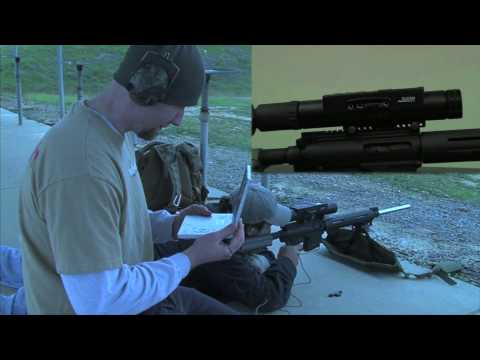
One of the most useful features of the Digital Hunter is electronic ballistic compensation. Here’s how that works. The scope has a USB port to connect with a computer. Using Elcan-provided PC ballistics software, you input Bullet BC, Muzzle Velocity, and even wind speed and angle. The scope’s processor automatically calculates drift and drop for various distances and then positions the digital aim point for the correct holdover, based on the target distance you select. All the critical calculations are handled automatically. Watch the video below to see how this all works.
Day-Night Digital Hunter
 In addition to the standard Elcan Digital Hunter, Elcan offers a version for low-light shooting. The Day/Night Digital Hunter, priced at $1399.00, can be combined with IR (infrared) “flash-lights” to provide full night-hunting capability. Low Light mode displays all the available visible light and the near infrared light (that can be “seen” by the scope’s image sensor, but not by the human eye). Utilizing the near infrared means more light energy is available to the scope for better, brighter imaging. After dark, active night vision enables covert surveillance and varmint hunting (where legal). The effective range of the active night vision depends on the power of the IR Flashlight(s). In addition to the standard Elcan Digital Hunter, Elcan offers a version for low-light shooting. The Day/Night Digital Hunter, priced at $1399.00, can be combined with IR (infrared) “flash-lights” to provide full night-hunting capability. Low Light mode displays all the available visible light and the near infrared light (that can be “seen” by the scope’s image sensor, but not by the human eye). Utilizing the near infrared means more light energy is available to the scope for better, brighter imaging. After dark, active night vision enables covert surveillance and varmint hunting (where legal). The effective range of the active night vision depends on the power of the IR Flashlight(s).
Remote Viewing Capability Helps Disabled Shooters
When the Elcan Digital Hunter was first introduced a couple years ago, Outdoors writer Ray Sasser of the Dallas Morning News field-tested it with Ray Mauldin, Elcan Products Manager. Sasser wrote: “There’s a new rifle scope technology on the horizon, a spin-off from military developments made by the Raytheon Company [parent company of Elcan]. The software calculated bullet drop… and the information was stored in a computer chip inside the scope. The only two drawbacks I could find were price and weight. The digital scope weighs 26 ounces, nearly seven ounces heavier than Leupold’s LPS 3.5-14x50mm, my personal favorite traditional scope. Mauldin said physically challenged hunters are particularly excited about the Digital Hunter. It can be used with a video monitoring screen so the rifle can be sighted without your eye to the scope. That’s a huge advantage for a quadriplegic, one-armed or no-armed shooter.”
Digital Enhancements for Target Scopes?
Traditionalists may scoff at digital scope technology, thinking that something like the digital Elcan could never be used in a match because it is too big and heavy. But consider this — all you really need on top of the rifle is the lens system with light sensor. All the other controls and the display could be moved off the rifle and built into a benchtop display/control/processing unit (which could be wireless). In fact, the control functions and display could even performed by an iPod or smartphone. With the iPod you could select the reticle, input ballistics data (Velocity, Bullet BC, Wind direction), and select the magnification level. (Fitting longer focal-length lenses would allow higher magnification than the Digital Hunters’ 2.5-16.5X.) And with a finger-tap on the screen you can record the entire match you are shooting. When mass-produced, such a unit could be sold for considerably less than the $1199.00 price of the Elcan Digital Hunter, as the iPod does the processing and replaces most of the hardware.
November 5th, 2010
 Berger Bullets has released a brand new bullet designed to work in 6mm rifles with a 1:10″ or faster twist. This new bullet borrows its basic design from the very accurate 95gr VLD, but it is shorter so it can fully stabilize in a 10-twist barrel. Berger Bullets has released a brand new bullet designed to work in 6mm rifles with a 1:10″ or faster twist. This new bullet borrows its basic design from the very accurate 95gr VLD, but it is shorter so it can fully stabilize in a 10-twist barrel.
This thin-jacket hunting bullet has been confirmed in testing to work in a 1:10” twist or faster barrel, and was specifically designed for those who want to hunt with factory rifles. Berger Ballistician Bryan Litz field-tested the new 87gr bullet. Here is his report:
For the new 87gr VLD, the G1 BC is .412, and the G7 BC is .211. Prior to this bullet, our lightest Hunting VLD was the 95 grainer, which requires a 1:9″ twist. This left many shooters with no option from Berger for a 6mm hunting bullet because the fastest common twist for many 6mm factory barrels is 1:10″. The 87 grain VLD was designed specifically to fill the gap, and it squeezes the most performance possible out of the common 1:10″ twist barrel. As with all Berger Hunting VLDs, this is the standard J4 (thin) jacket. There is not a Target (thick-jacket) version planned for this design.


L to R – Berger 6mm 87 gr, 95 gr, 105 gr, and 115 gr Match Grade Hunting VLD.
87gr VLDs are In Stock and Ready to Ship
Eric Stecker tells us: “We are excited to announce that our 6mm 87gr Hunting VLD bullets are now available. They are on the shelves now and ready to ship. We have made several shipments to dealers and have more bullets in stock at our shop now. We also have enough jackets ready to make more if we run out quickly. Currently the 87gr VLD is only available in 100-ct boxes.”
October 22nd, 2010
Many gun industry insiders report that sales are soft this year. However, a recent poll by HunterSurvey.com indicates that most hunters and shooters have not cut back significantly on their gun-related expenditures over the last year. When asked by HunterSurvey.com if they were buying more, less, or about the same amount of gun gear this year (compared to 2009), 40.0 percent of hunters said they were spending “about the same” amount of money this year. That is consistent with 2009, when 40.1% of shooters said their spending levels would stay the same.
No Big Change in Actual Spending Habits
The number of hunters expecting to spend more in 2010 dropped only slightly to 19.8 percent from 21.6 percent in 2009. Of those anticipating fewer purchases, 35.7 percent said they would be spending less compared to 33.5 percent in 2009. Considering the natural variation common to any poll, the differences are not considered significant.
 Pollster Rob Southwick, president of Southwick Associates, says: “This is decent news for sporting goods manufacturers and retailers who have been uncertain about the effects of the soft economy. While it appears a slow economic recovery is preventing some sportsmen from rushing out and spending at levels seen in 2007, it appears sales in 2010 will fair rather well, given the softness seen in other retail sectors.” Southwick Associates conducts the surveys at HunterSurvey.com and AnglerSurvey.com. Pollster Rob Southwick, president of Southwick Associates, says: “This is decent news for sporting goods manufacturers and retailers who have been uncertain about the effects of the soft economy. While it appears a slow economic recovery is preventing some sportsmen from rushing out and spending at levels seen in 2007, it appears sales in 2010 will fair rather well, given the softness seen in other retail sectors.” Southwick Associates conducts the surveys at HunterSurvey.com and AnglerSurvey.com.
Big Sale on Hunting Gear Now at Cabela’s
If you’re looking for some excellent deals on hunting gear and accessories, Cabela’s is running a big Fall Hunting Sale right now. You’ll find savings of up to 50% on hunting apparel, knives, boots, ammunition, optics and more…

October 17th, 2010
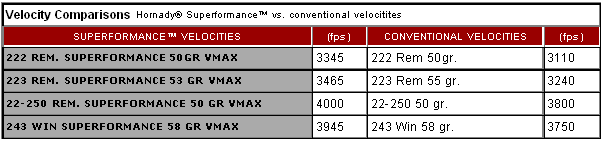
In early 2011, Hornady will start shipping its new, “enhanced velocity” Superformance™ Varmint ammunition for four chamberings: 222 Remington, .223 Remington, 22-250, and .243 Winchester. This ammo uses proprietary, blended powder formulations to achieve faster velocities that most other factory-loaded ammo (for these cartridge types). In addition, the propellant burns more completely in the barrel, reducing the amount of ejecta (i.e. powder residue that exits the muzzle). By burning the powder more completely in the barrel, Hornady claims the Superformance ammo delivers higher velocities without increased recoil.

New 53gr V-Max for .223 Rem Ammo
All four types of Superformance Varmint ammo are loaded with polymer-tipped V-Max bullets. The .223 Rem ammo features a new 53-grain V-Max bullet with a decent 0.290 G1 Ballistic Coefficient. Hornady claims that: “This new bullet… enables this load to produce trajectory and wind drift equaling that of a conventional 22-250″. Well, it may come close to factory loaded 22-250 rounds from other manufacturers, but any competent hand-loader can produce 22-250 or 22-6XC loads that easily outrun Hornady’s 53gr V-Max load. As with any advertising claims, run the numbers yourself. The chart below shows Hornady’s claimed velocities for its Superformance Varmint ammo:
Hot-Rod Ammo?
Hornady released a somewhat “over the top” video touting its Superformance Varmint Ammo. We chuckled at the drag-racing animation, but you will find some useful info in the second half of the video:
October 1st, 2010
 The 4R Rifle Club’s Team Hunting Challenge is one of the only matches in the country to mimic a long range hunting scenario. The match is held in central Oklahoma and has evolved over the last thee years to challenge not only the competitors’ marksmanship but also their ability to handle stress in the field. The 4R Rifle Club’s Team Hunting Challenge is one of the only matches in the country to mimic a long range hunting scenario. The match is held in central Oklahoma and has evolved over the last thee years to challenge not only the competitors’ marksmanship but also their ability to handle stress in the field.
A strict time limit puts pressure on the two-man shooter/spotter teams. In the 13-minute alloted time, the shooters attempt to find and range 12 wooden animal silhouettes and then score hits on the steel vital areas.
Shooters and spotters must work together and communicate well to get through all the targets in the given time. Plus, this year a Speed Shoot was added to the Hunting Challenge. This timed stage gave teams just 40 seconds to engage five (5) known-distance targets with one shot each. That works out to just 8 seconds per target, requiring the trigger pullers to be ultra-fast, AND accurate.
Surgeon Rifles Duo Tops Field
The Hunting Challenge was well-attended, with competitors coming from Missouri, Tennessee, and Utah, to join the usual group of shooters from Oklahoma and Texas. Small targets, improvised shooting positions, and constantly-switching winds made this a tough event, demanding high levels of skill and rifle accuracy. Preston Pritchett of Surgeon Rifles and his ace spotter Wade Stuteville came out on top with 65 out of 89 points. Preston and Wade put on a clinic, beating the second-place team, Dean Morris and Rick Jensen, by 15 points (equivalent to five first round hits). Finishing third was the team of Jeff Badly and Chase Tressler.

Hunting Challenge Teams Snag $30K Worth of Gear
This year’s Hunting Challenge prize table held over $30,000 worth of merchandise. Preston and Wade were each awarded a fully-outfitted Savage 10 Precision Carbine rifle, complete with Harris bipod, and 3.5-15x50mm NightForce NXS scope. Dean and Rick each took home a Vortex Razor HD rifle scope with rings. Two Swarovski SLC HD 10×42 binos were handed out to the third-place team. There were prizes for 24 of the 30 teams and the top 15 teams received a prize with a value that equaled or exceeded the $400 match entry fee. Full results, photos, and a sponsor list are posted on the Snipers’ Hide Forum.
Credit B.J. Bailey for this match report and photos.
|


