We support Hunters for the Hungry, a program that feeds needy families in the USA. Hunters for the Hungry (HFH) is a nationwide program that gives back to communities by supplying meals throughout the country. The NRA works closely with state agencies that supervise meat donations. Since the program’s inception, Hunters for the Hungry has brought millions of pounds of game meat to homeless shelters, soup kitchens, and food banks across the United States. This program has been in place for 27 years. In recent years, HFH affiliates donated 2.1 million pounds of meat on average, supplying over 10 million meals.
Hunt and Help Others
Many American hunters are able to harvest more than they can eat or share with friends and family. Through Hunters for the Hungry you can help share your bounty with those in need. All donated game must be field dressed and legally harvested. Note that each state has different rules and regulations for donations, please check with your local drop off location prior to donating.
Big Horn Armory Gives 5% of Sales Proceeds to Wyoming Hunters for the Hungry Program
To help support H4H efforts, Big Horn Armory has partnered with the Wyoming Wildlife Federation (WWF) for a special Pay it Forward H4H program. From November 1st through 30th, 2021, five percent (5%) of all net proceeds from sales made from the Big Horn Armory website will be donated to the WWF’s H4H program. This donation will help offset the costs of processing donated game meat, which will be distributed to local food banks, pantries, and other food services within Wyoming.
“Last year we were able to donate $3,000 that was used to process meals for donation to food-insecure families within Wyoming, and this year our goal is higher. We are excited to work with the WWF’s Hunters for the Hungry Program again to help ensure that even more Wyoming residents will get healthy meals,” commented Greg Buchel, president of Big Horn Armory.
If you are looking to acquire a reliable, accurate rifle for a late fall hunt, Howa can be a good choice. Howas feature smooth-running actions with fine two-stage HACT triggers. A Howa barreled action can also be a good basis for a DIY project. But some folks have heard that it may be difficult to find stocks, or to fit an after-market barrel. That’s not true. There are many stock options available, and in this article, Bill of RifleShooter.com shows that it is easy to remove the factory-installed barrel with the right tools. We think a Howa makes a fine basis for a varmint rig or field rifle. Or you can build a tactical rifle as Bill did. You can start with the factory barrel and when you want/need more accuracy, then have a gunsmith install a custom barrel from Krieger Barrels, Lilja Barrels or other quality brand.
The Carbon Stalker is an excellent ultralight factory option, weighing just 4.6 lbs. with Mini Action (before optics). All Howa Carbon Fiber Stalker rifles come with a Sub-MOA Guarantee and Lifetime Warranty.
What You Need to Know About Howa 1500-series Rifles
Tech Feature by Bill, editor of RifleShooter.com
Consider this article the “Howa 1500 Overview”. There has been a lot of interest in Howa rifles and barreled actions imported by Legacy Sports International. In addition to being able to buy a complete rifle from a dealer, Brownells sells barreled actions in a wide variety of calibers and configurations. In this post we are going to take a look at the Howa 1500 series.
Howa Rifles — General Background
Howa is a Japanese heavy machinery company. One of its product lines are firearms, which, are imported into the United States of America by two different companies, Legacy Sports International and Weatherby. Legacy sells the 1500 under the manufacturers name while Weatherby re-brands the guns as the Weatherby Vanguard. In general, the finishes on the Weatherby rifles are more refined than the LSI-imported 1500s.
General Evaluation of Howa 1500 Rifles
I’ve found Howa 1500s to be solid, entry-level rifles that are capable of sub-MOA accuracy out of the box. I’ve actually purchased two Howa rifles I’ve tested because I like them so much. The gun below, a Howa Mini-Action in 7.62×39 Russian, is one of my favorite factory guns to shoot.
Check out this three-shot group I drilled at 100 yards with the rifle above and 125-grain Sierras. It took a lot of work and load development to get there, but when it did, it worked well.
Howa 1500 HACT 2-Stage Trigger
Howa 1500s feature the very nice Howa HACT trigger. This is an adjustable, two-stage trigger, set for about 3 pounds (combined stages). Crisp and repeatable, this is an excellent trigger for a factory gun. There is no annoying Glock-style safety lever in the middle of the trigger blade. The 2-stage design and pull weight range works well for a hunting rifle or a rig for PRS competition. Rifleshooter.com says the Howa trigger is “one of the best factory triggers, along with Tikka. I’ve found the Howa trigger superior to a Remington 700 — the Howas doesn’t need to be replaced.”
Writing for the Western Outdoor News, WONews.com, Steve Comus has field-tested the HACT Trigger. Steve writes: “I always liked two-stage triggers, because of the way I could take-up the slack and then actually know when the rifle was going to go off. The take-up on the [HACT] trigger was fast and easy. The crisp, positive release when pressure was put on during the second stage [reminded me] of some of the target rifles I shot through the years.”
Howa Actions — Three Options
Howa offers three action lengths: Mini, Short, and Long. You can see the bolts for the three action lengths in the image below. The Mini-Action has similar external dimensions to the Remington Model Seven, however, the Mini-Action’s bolt does not travel as far to the rear. This is a mixed bag. The upside is you have a quicker action (shorter bolt throw). The downside is you are limited to shorter rounds such as the .223 Remington, 7.62×39mm Russian, and 6.5 Grendel. But if you need a bigger cartridge, just choose the standard or long action Howa variant.
Howa 1500 vs. Remington 700 — Important Differences
Is the Howa 1500 a Remington 700 clone, or some kind of improved Remington 700? No, not really. While the top radius of the Howa 1500 does match the Model 700, and they can both use the same two-piece scope bases, there are a number of differences.
If you look at the Howa 1500 alongside the Remington 700 you’ll note the M700 is a round action, while the Howa is a flat-bottom action. In many ways the Howa’s bottom half reminds me of a push-feed Winchester. This means the chassis and stocks that support a Howa 1500 are not V-block based like you’ll find on a 700, instead they have a flat bottom. While the bolt of the Howa is similar in external appearance to the Model 700, it does offer some improvements, notably an M16-style extractor and a firing pin assembly that can be easily removed without tools.
Howa 1500 action screws are metric and are in a different location from the 700. The Howa 1500 has an integral recoil lug that accepts the front action screw, this means you have more of the front action screw engaging the action. WARNING: If you install it into a poorly-fitted stock or action you may bind it.
Can a Howa Action Be Used for a Custom Rifle Project?
Absolutely! You can either buy a barreled action from Brownells and throw it in a chassis system/stock of your choice or you can use a stripped action to build a custom rifle. If you are in the chassis market, MDT offers a wide variety of chassis in different price ranges. All have worked well for me.
How to Remove Howa Factory Barrel from Action
You may have heard internet grumblings about removing Howa barrels. Some keyboard commandos say they are extremely difficult to remove without a relief cut. Well Bill at Rifleshooter.com demonstrates that Howa barrels can be removed without trouble, provided you have the right tools. Watch this video:
Watch Howa Barrel Removal Video — Quick and Easy (Click Speaker Icon for Audio)
Q: Is it difficult to remove a barrel from a Howa 1500?
A: Not very. I’ve heard from some smiths that worked on Howas (years ago) that the factory barrels are difficult to remove. However of the half dozen or so Howa barrels that I’ve pulled, they’ve been very easy. I use a Brownells action wrench with the top piece for a Rem Model 700 and the flat bottom resting against the flat on the wrench.
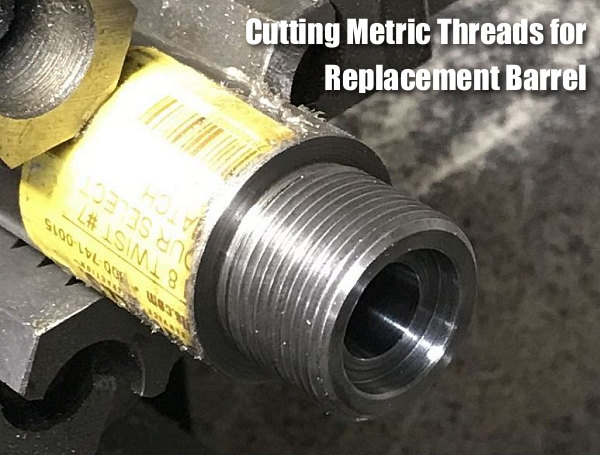
Howa Actions Require Metric Barrel Threads
It’s easy to thread a barrel for a Howa Action. You just have to cut metric threads — most lathes out there can cut them. I cut the threads below on a manual lathe using change gears. [Editor: John Whidden cuts metric tenon threads with a CNC lathe. “It’s easy,” John tells us, “No issue whatsoever.”]
Savage Arms just won a major award for its innovative straight-pull hunting rifle, the Savage Impulse. This is the only straight-pull centerfire rifle currently produced by a major U.S. manufacturer. Guns & Ammo magazine named Savage’s Impulse the 2021 Rifle of the Year.
“The Savage Impulse pushed Savage rifles to a new level in 2021″, wrote Guns & Ammo editors. “Creating a unique, reliable rifle is never easy, but the Impulse combines the innovative features of other Savage rifles along with Hexlock bolt technology that provided a fast, safe, and accurate shot. This rifle was designed to attract hunters of all types through versatile features and load compatibilities. Each model delivers on their promise of speed and range.”
Beth Shimanski, Savage’s Marketing Director, says the design is a game-changer for hunters: “The speed of Impulse’s straight-pull action has changed the way Americans think about hunting rifles. This design combines everything Savage has learned about accuracy and reliability with innovation that provides marksmen and women with new capabilities with new capabilities.”
Savage’s Impulse series of straight-pull bolt rifles is the first American-designed and crafted straight-pull centerfire rifle. The new Impulse features an innovative Hexlock bolt-locking mechanism with six spherical bearings that move radially outward into a ring in the barrel extension, thereby locking the bolt in place. That barrel extension is held in the receiver assembly by four cross-bolts on the lower front section. Ahead of the barrel extension is a conventional recoil lug and a familiar Savage barrel nut.
Savage Impulse Straight-Pull Rifle — Overview
Savage claims the new system offers the cycling speed of a semi-auto, with the accuracy of a bolt-action. However, based on the videos that Savage has posted, the cycling of the Impulse’s straight-pull bolt does not seem to be as smooth as some European straight-pulls, such as the Blaser R8, Merkel RX Helix, and Strasser RS 14. We’ve tried those Austrian/German rifles and you really can cycle them very smoothly. From the video the Savage Impulse appears to require somewhat more muscle and effort. Watch below. The video will launch at the 15-second mark for a comparison between the Impulse and a conventional Savage bolt-action:
Savage Speed Comparison — Impulse vs. Regular Bolt Action
Savage says: “Conventional bolt-actions require four steps to cycle the bolt. Impulse simplifies the process with a simple back-and-forth motion.”
Advantages of Straight-Pull Cycling System
What is the advantage of a straight-pull system? You should be able to cycle faster, and (ideally) maintain your cheek-weld and target view. Savage says: “The smooth bolt throw allows a shooter to cycle rounds intuitively, without the need for the standard four changes-of-direction common to a conventional bolt’s path-of-travel. Impulse reduces split times and allows a shooter to manipulate the bolt without losing [his] cheek weld. The bolt travels out and back and shooters don’t have to take their eyes off the target.” Sounds good, but if you watch the above videos, it’s not as wonderful as claimed. That said, if one slows down a bit, a straight pull should allow the shooter to maintain his cheek weld.
Savage’s Impulse “will redefine the way you think about straight-pull rifles”, said Al Kasper, President/CEO of Savage Arms. These new Impulse rifles are built for speed — faster bolt cycling while maintaining ones cheek-weld. This increase in speed can help a hunter make effective follow-up shots.
When the bolt is closed, the Hexlock system holds it in place instead of conventional lugs. With the Hexlock, six (6) hardened steel bearings lock the bolt in place inside the receiver’s barrel extension. Savage says “As pressure increases, Hexlock’s hold tightens, ensuring that there can be no rearward movement of the bolt. Once the round has left the barrel, the pressure subsides, and the action can safely open again with the straight pull of the bolt handle.”
Savage Impulse — Hexlock System (Bolt Locks in Barrel Extension)
The cleverly-designed, modular Impulse bolt can be disassembled without tools. And the bolt-handle can be moved to either side easily. NOTE: In this diagram it may appear that the barrel does not have threads on the chamber end. Actually, Impulse barrels DO have threads on that end, which are used by the barrel nut. However, these threads are covered by a barrel extension which is held in the action/receiver by a lower-side four-bolt barrel clamp.
Savage Impulse Models: Predator, Big Game, Hog Hunter
Savage currently offers three Impulse models, all equipped with Savage AccuStock, Accufit, and AccuTrigger. All Impulse actions feature a Picatinny rail on top along with a central safety. Because the bolt handle can be placed on either side, all Impulse rifles are essentially ambidextrous — good for lefties as well as righties. There are both short-action and long-action versions of the Impulse rifle. Seven different chamberings are offered, from .22-250 to .300 Win Magnum.
At the request of our readers, we provide select “Deals of the Week”. Every Sunday afternoon or Monday morning we offer our Best Bargain selections. Here are some of the best deals on firearms, hardware, reloading components, optics, and shooting accessories. Be aware that sale prices are subject to change, and once clearance inventory is sold, it’s gone for good. You snooze you lose.
1. Grizzly — Massive Site-Wide Shooting Products Blow-Out Sale
⏺ Big Blow-out Sale on Stocks, Tools, Safety Gear and more
Grizzly Industrial has long been known as a great resource for shooting-related supplies from barrels to gunsmithing tools. Now through October 31, 2021, Grizzly is running a major reloading, shooting and gunsmithing Blow-Out Sale. Save up to 80% on cleaning supplies, 68% on safety equipment, 30% on shooting gear and more. It took us nearly an hour just to go through all the deals and it’s not hard to fill up your shopping cart with many great bargains. There are also many specialized gunsmithing products on sale, including barrel vises and chamber reamers.
2. LockedLoaded.com — M&P 15-22 Sport .22 LR, $379.99
⏺ Accurate, reliable .22 LR rimfire AR-type rifle at excellent price
We like .22 LR AR-type rifles. With these rimfire “black rifles” you can enjoy NRL22 matches, and also cross-train with low-cost ammo. The popular Smith & Wesson M&P 15-22 Sport is now on sale for just $379.99 at LockedLoaded.com. This rifle has full-size AR15 ergonomics and boasts removable Magpul MBUS front and rear folding sights. With the 10″ M&P Magpul M-LOK handguard, you can easily fit lights, bipods, and other accessories. This is a fun gun at a very attractive price.
3. Natchez — Rimfire & Pistol Ammo Sale, Top USA Brands
⏺ Finally — good deals on a variety of USA-made ammo
Ammo is slowly showing up in stores and online but usually at increased prices. That’s why we were pleased to see a major ammunition sale over at Natchez. You’ll find a wide variety of rimfire and pistol ammo on sale from major U.S. manufacturers including American Eagle, CCI, Federal, and Remington. There are no quantity limits, and some ammo types qualify for FREE shipping (with $250+ order).
⏺ Enjoy extended hunting seasons with Crossbow, this is a fine example
Modern crossbows are accurate and effective. And in many areas, there is a special extended hunting season for bow hunters. A great option is the Wicked Ridge Invader X4 Crossbow Package. The Wicked Ridge Invader X4 Crossbow Package delivers excellent power and accuracy. This advanced crossbow can launch arrows at 360 fps with up to 107 ft/lbs of energy. With 11″ WRX laminated limbs, this bow gives hunters big performance from a compact design that measures just 15″ wide when cocked. Ballistics Guru Bryan Litz recently took a deer with a cross-bow — perhaps you can too.
5. EuroOptic — TriggerTech AR or Rem 700 Triggers, $139-$149
⏺ Popular AR and Rem 700 triggers at big savings
If you have a Remington 700-style bolt action or AR-platform rifle and are looking for a precision trigger, check out these TriggerTech Special Edition Triggers. Featuring TriggerTech’s Frictionless Release Technology™, this drop-in trigger has a true zero-creep break with extremely short over-travel. This trigger is extremely reliable because changing the pull weight does not affect hammer force so you get dependable primer strikes at every pull weight. TriggerTech’s Frictionless Release Technology provides very consistent pulls, shot after shot.
Hearing protection is essential, but so is communicating with those around you. You get vital audio protection plus communication capability with these Walker’s Razor Earmuffs with Free Walkie Talkie. With a 23 dB Noise Reduction Rating (NRR), these Walker’s Razor earmuffs offer a low-profile design and handy sound controls. Along with the muffs, right now you get a BONUS full-featured walkie talkie unit allowing you to communicate via wireless radio. This handy transceiver boasts 22 channels and features Push-to-Talk (PTT) technology.
7. Amazon — Plano 52″ All Weather Rifle/Shotgun Case, $124.32
⏺ Very sturdy, weatherproof, wheeled gun case
Traveling with a shotgun or rifle means having a quality case that protects your valuable firearm. If you’re in need of a new case for your next hunting or match trip check out the 52″ Plano All Weather Rifle/Shotgun Cases. With a 51.5″ internal length, this is long enough for many benchrest, F-Class and PRS rifles. You can also fit two hunting rifles inside (see photo). This all-weather case is strong, tough, and seals out moisture. With a Durashell Plus outer shell, this case is relatively lightweight yet durable. If you need a shorter case check out the 36″ Plano All Weather Rifle/Shotgun Case for $76.90, a very good deal.
8. Amazon — Caldwell Lead Sled 3, $99.99
⏺ Good for hunting rifle Sight-In, now $60 less than other vendors
You need a stable platform for sighting in that hunting or varmint rifle, and then testing loads. For decades folks have used one-piece metal rests for this task. One of the more affordable, yet functional options is the Caldwell Lead Sled 3. This Sled is designed to hold sandbags, making it very stable even with heavy recoiling big game loads in light rifles. The Lead Sled 3 fits hunting-style fore-ends in front and has a shock-absorbing pad in the rear. Nice features include 4″ of front elevation adjustment, a micro rear elevation adjustment, and non-skid feet. The $99.99 sale price is a great deal — this very same Lead Sled 3 costs $159.99 at MidwayUSA. The weight sack shown in photos sells separately for $16.99 on Amazon.
9. Creedmoor Sports — Hi-Lux XTC Service Rifle Scope, $475.00
⏺ Top choice for Service Rifle optic now on sale
Specifically designed for CMP and NRA Service Rifle competition, the Hi-Lux XTC 1-4x34mm Service Rifle Scope boasts sharp, bright lenses and very reliable scope clicks. This optic conforms to all CMP/NRA Service Rifle rules. The Hi-Lux XTC features a front objective parallax control that adjusts from 15 yards to infinity. Having adjustable parallax is critical in minimizing parallax error, making this a good choice for AR platform Service Rifles shooters.
10. Midsouth — Berry’s Tri-Can Ammo Carrier, $21.99
⏺ Very Handy New Product has Three Clear-Top Compartments
The Tri-Can Utility Box Carrier is on sale now at Midsouth. Choose either black containers or tan containers for the same $21.99 price (31% off the previous price). This Berry’s Tri-Can is a handy, versatile organizational tool that simplifies range trips. The tough injection molded plastic base and lids, rubber seal gaskets, and cam-lock latches keep contents safe. The Tri-Can boasts a strong, handy carry handle. The Tri-Can is made up of three translucent-lid containers with three internal compartments. If you need even more capacity, MTM offers a 5-can Ammo Crate system for $35.66.
KEY FEATURES: Ballistics Solver, GPS Tagging, Weather Forecast, Field Notes with Photos
Hunters, here’s a great FREE mobile APP for both Apple and Android systems. The ZEISS Hunting App offers many practical functions: full-featured ballistics calculator, field notes with photo archive, compass function, GPS tagging for documentation of hunting experiences, and a detailed weather forecast service. The Hunting App is offered as a FREE download for Android and iOS (iPhone/iPad) mobile devices.
Three Minute Video Explains Zeiss Hunting App Features:
The Zeiss Hunting App integrates multiple useful features — ballistics solver, compass, GPS tagging, hunt history. The “Field Notes” function can record a wide variety of info — you can save photos, record your shots and hits, log animal sightings during the hunt, and even plot game locations on a map. Zeiss explains: “This allows users to optimally record events, the game population in the hunting territory, and their own hunting experiences.” Shots can be tagged via GPS through the shooter’s and the target’s position, and then displayed on a map. The Field Notes hunt diary shows all entries in chronological order.
Full-Featured Ballistics Solver
The integrated ballistic calculator allows hunters to easily customize the settings to suit their favorite cartridges. You can enter your own data, or choose bullet/cartridge info from a database containing over 7000 ammunition types from a variety of manufacturers. The ballistics solver can be programmed for for current weather conditions (temp/humidity), and the angle (inclination) of the shot.
Weather Functions
The weather tool offers a Five-Day Forecast, and you can choose multiple locations. In addition to the current location, users can also display the weather for their hunting areas of choice. The weather forecast includes temperature, precipitation, wind direction, wind speed, humidity, and air pressure. (Note: For precise ballistics solutions, you must input the ACTUAL conditions at your shooting location).
This video explains how to define a hunting zone and set GPS location tags on the map:
Hunt Log and Photos
The Field Notes function can do many things. You can log all your shots and hits, and you can plot game sightings during the hunt. Events can be augmented with photos and GPS data. With the Field Notes mapping function, you can even locate game populations in the hunting territory. A compass and automatic night mode round off the list of smart features.
“A bullet launched at a higher altitude is able to fly slightly farther (in the thinner air) for every increment of downward movement. Effectively, the bullet behaves as if it has a higher ballistic coefficient.”
It’s hunting season, and a good friend is heading to the high country of Colorado next week to pursue elk. He recently zeroed his rifle in California, at a range just a few hundred feet Above Mean Sea Level (AMSL). He wondered if the higher altitude in Colorado could alter his ballistics. The answer is a definite yes. However the good news is that free ballistics calculators can help you plot reliable drop charts for various shooting locations, high or low.
The question has been posed: “What effect does altitude have on the flight of a bullet?” The simplistic answer is that, at higher altitudes, the air is thinner (lower density), so there is less drag on the bullet. This means that the amount of bullet drop is less at any given flight distance from the muzzle. Since the force of gravity is essentially constant on the earth’s surface (for practical purposes), the bullet’s downward acceleration doesn’t change, but a bullet launched at a higher altitude is able to fly slightly farther (in the thinner air) for every increment of downward movement. Effectively, at higher altitudes, the bullet behaves as if it has a higher ballistic coefficient.
Forum member Milanuk explains that the key factor is not altitude, but rather air pressure. Milanuk writes:
“In basic terms, as your altitude increases, the density of the air the bullet must travel through decreases, thereby reducing the drag on the bullet. Generally, the higher the altitude, the less the bullet will drop. For example, I shoot at a couple ranges here in the Pacific Northwest. Both are at 1000′ AMSL (Above Mean Sea Level) or less. I’ll need about 29-30 MOA to get from 100 yards to 1000 yards with a Berger 155gr VLD at 2960 fps. By contrast, in Raton, NM, located at 6600′ AMSL, I’ll only need about 24-25 MOA to do the same. That’s a significant difference.
Note that it is the barometric pressure that really matters, not simply the nominal altitude. The barometric pressure will indicate the reduced pressure from a higher altitude, but it will also show you the pressure changes as a front moves in, etc. which can play havoc w/ your calculated come-ups. Most altimeters are simply barometers that read in feet instead of inches of mercury.”
As Milanuk states, it is NOT altitude per se, but the LOCAL barometric pressure (sometimes called “station pressure”) that is key. The two atmospheric conditions that most effect bullet flight are air temperature, and barometric pressure. Normally, humidity has a negligible effect. It’s important to remember that the barometric pressure reported on the radio (or internet) may be stated as a sea level equivalency. So in Denver (at 6,000 feet AMSL), if the local pressure is 24″, the radio will report the barometric pressure to be 30″. If you do high altitude shooting at long range, bring along a Kestrel, or remember to mentally correct the radio station’s pressure, by 1″ per 1,000 feet.
Trajectory of Bullet fired at Sea Level
Trajectory of Bullet fired at 20,000 feet
You can do your own experimental calculations using JBM Online Ballistics (free to use). Here is an extreme example, with two printouts (generated with Point Blank software), one showing bullet trajectory at sea level (0′ altitude) and one at 20,000 feet. For demonstration sake, we assigned a low 0.2 BC to the bullet, with a velocity of 3000 fps.
To learn more about all aspects of Exterior Ballistics, Hornady has a useful discussion of External Ballistics including the effects of altitude and temperature. To dig deeper, Sierra Bullets has a comprehensive Exterior Ballistics Resource Page with multiple sections from the Sierra Manual (4th and 5th Editions), including:
Example from Section 3.0: “When a bullet flies through the air, two types of forces act on the bullet to determine its path (trajectory) through the air. The first is gravitational force; the other is aerodynamics. Several kinds of aerodynamic forces act on a bullet: drag, lift, side forces, Magnus force, spin damping force, pitch damping force, and Magnus cross force. The most important of these aerodynamic forces is drag. All the others are very small in comparison when the bullet is spin-stabilized.”
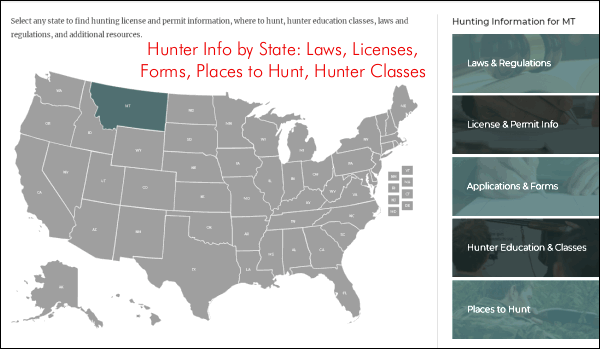
Click Map to launch interactive webpage with info for all 50 states.
Going hunting soon? Need to find out about hunting licenses, deer tags, local regulations, and the best hunting areas? Then visit WheretoHunt.org. This website has an interactive map of the country. Simply click on a state to find the info you need. For all 50 states, the NSSF provides information about hunting licenses and permits, where to hunt, hunter education classes, laws and regulations and more. For each state you’ll also find a link for required applications and license forms. Have a safe and productive hunt this year.
The Three Amigos in New Mexico (L to R): Kelly McMillan, Paul Phillips, Derek Rodgers.
Three years ago nearly to the day, Kelly McMillan, Derek Rogers, and Paul Phillips enjoyed the fellowship and satisfaction of a successful New Mexico Antelope hunt. But sadly, Kelly passed away on June 1, 2021 from rapid, unexpected medical issues. Yesterday, October 7th, 2021, Paul Phillips posted: “Three years ago today. This hunt with Kelly McMillan and Derek Rodgers was a great memory. I miss Kelly.” Yes Paul, scores of us who counted Kelly as a friend and colleague miss him, and think of him often.
This isn’t your typical hunting story, because these weren’t your typical hunters. Derek Rodgers is the reigning F-TR World Champion, and past King of 2 Miles. Paul Phillips is the 2019 King of 2 Miles and a member of the Silver Medal-winning F-TR Team McMillan at the 2018 Nationals. The third hunter, Kelly McMillan, needs no introduction. The past owner of McMillan Fiberglass Stocks, Kelly was a leading figure in the gun industry for decades. He also supported many top rifle shooting teams. This story helps us remember Kelly and all he did for the shooting sports.
In October 2018, these three friends got together for a very successful hunt in New Mexico, Derek’s home turf. All three bagged an impressive Antelope, with Paul Phillips dropping the biggest buck of all. Derek made the longest shot, hitting his buck at an impressive 510 yards, verified by laser rangefinder.
Paul Phillips posted: “Our New Mexico Antelope hunt with Kelly McMillan and Derek Rodgers was a success. To hunt with these two icons was definitely on my bucket list. I shot my buck at 389 yards in an 18-mph wind through a barbed wire fence.” It was a big trophy buck, measuring 84 3/8 inches.
Derek nailed his Antelope at 510 yards with a .308 Win fitted with a suppressor. As dusk approached, despite blustery wind and rain, Kelly dropped the third Antelope with a great 230-yard shot from a broken tree crotch. Paul noted: “All three bucks had their own challenges and funny story. All three hunts required team work with stalking, communication.” The three hunting buddies all had top-quality rifles built with McMillan stocks of course.
For long-range hunting you need to have your drops absolutely “spot-on”. Paul posted: “When you do a 30-45 minute stalk… you need to have all your ballistics perfect or they get away. We were glad that we had a practice day before the hunt to confirm our zeros and verify our ballistics.”
Kelly noted: “Paul Phillips scored this nice 80″+ buck in New Mexico. It was Paul’s first antelope.” The .338 LM rifle featured a Stiller TAC338 action, Bartlein 20″ barrel, McMillan A5 Stock, and Nightforce ATACR scope. In the Facebook video, Paul talks about making the shot, directly into the wind.
Both of Kelly’s Amigos — his hunting partners — were profoundly saddened by his passing. They miss him, as do all of us who knew Kelly.
Derek Rodgers wrote of his friend and hunting partner: “It is difficult to tell you how deeply saddened I feel about the loss of Kelly. What started as a shooting relationship quickly became a close friendship so many years ago. It was a privilege to know Kelly on a personal level and I will never forget his generous, caring nature and the never-ending kindness he had for others. He will forever be missed.”
Paul Phillips posted: “I have no words to express how saddened I am … we lost an icon in the shooting industry. Kelly McMillan was not only a great friend but the most generous and giving man I knew in the industry. There is not enough space to write about everything he did for competitive shooters, military snipers, hunters, and shooting enthusiasts. You were one-of-a-kind Kelly and I will forever remember your friendship and how big an advocate you were for shooting sports. R.I.P. my friend.”
Hunting season is here. Time to organize your gear before heading to deer country. If you don’t have a quality, compact Laser Rangefinder, here’s a great deal. The 7x25mm SIG Sauer Kilo 2200 BDX Rangefinder is now on sale for under $350.00. This is an accurate LRF that ranges deer-sized targets at long distances quickly. The scan mode is fast and very effective. The unit is compact and light — a bonus for hunters.
This SIG LRF sold for over $500.00 when it was introduced. Now you can save 30%, with the Kilo 2200 BDX selling for just $346.99 at Amazon, with Free Shipping. Given its performance, that’s a steal. (With very similar performance, the SIG Kilo 2200 BDX is less than half the price of SIG’s Kilo 2400 BDX, $799.99 on Amazon.) We have tested a variety of LRFs from Bushnell, Leica, Leupold, Sig, Swarovski, and Zeiss. This SIG Kilo 2200 BDX will run with anything in the sub-$500 price range. If you are looking for a small LRF that can fit in a shirt pocket, this Kilo 2200 BDX is a good choice. Glass is good, controls are good, ranging capability is good. Light-Wave DSP Technology enables the Kilo 2200 BDX to range extremely fast. Scan mode refresh rate is an ultra-fast 4 times per second. The unit’s “smart” OLED Lumatic Display automatically runs bright in full sunlight, while dimming down to low levels at dusk and dawn.
And the BDX (Ballistic Data Xchange) capability is a big bonus if you have a compatible SIG Sauer BDX riflescope. This rangefinder can communicate with BDX scopes or phone Apps, providing ballistics solutions. Using Bluetooth, the built-in BDX system sends an illuminated holdover dot to any Bluetooth-enabled SIG Sauer BDX scope. Even with a conventional scope, the SIG Kilo 2200 BDX rangefinder will communicate with a free ballistics App on your mobile device.
SIG Kilo 2200 BDX Verified Buyer Reviews
Read the reviews on Amazon. 87% of verified buyers gave this SIG LRF Five Stars:
Five Stars: “I spent a lot of time agonizing over which rangefinder to purchase, and I’m glad I went with this one. I’ve easily ranged objects out to 1300 yards. Pairing it with the Sig Sauer BDX App and imputing some ballistic and wind data shows me MOA adjustments both in the App and directly in the rangefinder while I’m ranging.” (Review by A. Kirzner, June 2020)
Five Stars: “Amazingly fast and accurate readings. The fact that they pair with Bluetooth to the ballistics App on my phone makes long range shooting much easier.” (Review by Eric A., May 2019)
Five Stars: “Quick to acquire target, easy to use, red reticle works great in low light conditions.” (Review by Brian C., October 2019)
And here is a review of the previous model, the SIG Kilo 2000: “It’s small — palm-sized. If you’re a backcountry shooter and every ounce counts, you can wear this unit around your neck all day long. In my experience and opinion, the Sig Kilo 2000 is an amazing laser rangefinder at a very reasonable price. When it comes to the raw function of a laser rangefinder, to give accurate, repeatable distance measurements within your target range, the Sig Kilo 2000 blows away anything even remotely close to it in its price range.” (Review by Verified Customer, July 2016)
Editor’s Note: This story was first published many seasons ago. In the interceding years, equipment has evolved — actions, optics, front rests and so on. But this rifle remains very competitive in the 600-yard silhouette game, and it remains a wicked weapon for long-range varminting.
The 6-284 may well be the “ultimate” 6mm cartridge, if speed AND accuracy are considered. While it burns a lot more powder than a 6mmBR or 6 Dasher, it also delivers a lot more velocity. Our friend John Southwick, owner of this week’s featured 6-284, can push 107gr SMKs past 3400 fps — velocities no 6BR, 6BRA, or 6 Dasher can touch. He normally dials that back to 3200 fps or so, but that’s still well beyond the limit of a 6 Dasher even a 6mm Creedmoor. John’s gun is more than a speed demon of course — it’s a hyper-accurate match rifle that has claimed many Varmint Silhouette wins. At his club, when John and the Black Borden come out to play, everyone else is usually competing for second place.
Building the Borden Black Beauty
John tells us: “I chose the 6-284 mainly because it appeared in the winning equipment lists of 1K BR matches, and it was becoming very popular with long-range varminters. Skip Talbot had also used a 6-284 to set an IBS 1000-yard record (subsequently lowered in the last decade). Norma and Lapua offered quality 6.5-284 brass, so case-forming would be easy. I wanted a fairly light-recoiling rifle, and after much research I came to the conclusion that a high-BC 6mm bullet driven at 3200+ fps would meet my needs.
I was looking for a very high performance long-range target/bench rifle, primarily to use in 600-yard matches at my local club (Ojai Valley Gun Club), and possibly 1000-yard bench matches, plus occasional varmint hunting. I wanted to have a rifle that was built by a prominent gunsmith. I chose to work with Jim Borden of Borden Rifles for several reasons: his rifles had set world records, his reputation was excellent, and his rifles often showed up in the winning equipment lists of IBS and NBRSA sanctioned shoots. Also I had decided that I wanted a Nesika-actioned gun. I was impressed that Jim had designed one of the Nesika’s key features – Borden Bumps. Likewise, I liked the Bald Eagle front rest, and found out that Jim contributed to its design as well. This gave me confidence that Jim understood every element that goes into precision rifle performance.
Loading for Accuracy
My match load consists of Norma 6.5-284 brass, 51.0 grains of Alliant Reloder 22, Fed 210m primers, and Sierra moly-coated 107gr MKs, seated about .010″ into the lands. This runs about 3250 fps from the 28″ barrel. Case necks are turned to .0133″ wall thickness for a .270″ loaded neck diameter. I use a .268 or .269 bushing, and bump the shoulders back each time. I set the “bump” so that, with firing pin removed, I can just feel the case in the chamber when closing the bolt. My loaded rounds typically show no more than .0015″ runout on a NECO concentricity gauge. I credit the low run-out in large part to the custom inline seating die and shoulder-bump neck-bushing die Jim made for me.
How the 6-284 Shoots
The rifle has fulfilled all my expectations. It is a superbly precise and accurate rifle, as long as I do my part in steering the gun and feeding it consistent, quality ammo. I haven’t done a lot of 100-yard group shooting, just enough to test loads. Typically the rifle easily puts five shots into half-MOA or less at 600 yards. I’ve logged several 3-shot groups between 1.06″ and 2.2″ at 600 yards. I’ve been told that kind of accuracy would be competitive in a 600-yard BR match. But most importantly, I have confidence the gun will hit where I aim. Our Ojai club uses half-size silhouette targets. This gun’s ability to pick off the relatively small steel targets, even in some of the worst conditions imaginable, is nothing short of amazing. At times it seems I’m launching 107gr silhouette-seeking guided missiles.”
Borden 6mm-284 SPEC SHEET
Borden Long-Range Rifle, 16.5 lbs
Nesika ‘K’ Action, 1.70″ diam., Right Bolt, Left Port.
Hart 28″, 1:9″ twist, .920″ at muzzle, cryo’d with .272″ neck diam. and 1.5° throat.
McMillan MBR stock, Borden texture finished, pillar-bedded, with action also glued in.
Nightforce 12-42x NXS,
NP-R2 reticle, 20 MOA ramped scope base, Leupold Mark IV rings.
A Special Brand of Silhouette Shooting
John’s rifle is a purpose-built gun, optimized for one task — hitting little half-size silhouettes at very long distances, at a shooting venue that demands serious wind wizardry. At Ojai, even though matches commence early in the morning, it’s not unusual to have a 10 mph wind blowing left to right at the firing line, no wind at the mid-course flag, and a swirling variable wind at the targets. To make matters worse, the little critters sit on top a ramped berm. When the wind switches to 6 o’clock, it can rise right in front of the target, sending shots high. Despite the often-wicked conditions, John and his Black Borden have excelled at the varmint matches — he’s the “smart-money” bet to win on any given weekend.
John reports: “The rifle has really proven itself at the 600-yard silhouette match at my local club. We shoot ten targets per match, usually three “matches” or relays per day. Targets are half-size NRA Hunter Pistol metallic silhouettes: 1 Ram, 2 Turkeys, 3 Pigs, and 4 Chickens (note, these are larger than the mini-silhouettes in the above photo). The Ram counts one point, Turkey two points, Pig three points and the Chicken counts four points. The Chickens have a “hit zone” roughly .6 MOA at 600 yards–about 3.6″. Trust me, that can be challenging, particularly in shifting winds. Unlike conventional silhouette matches, we shoot F-class fashion from the ground, using bipods or pedestal rests. That’s easier than shooting off your hind legs of course, but our targets are much smaller than standard high-power silhouettes.”
The Black Borden was the rifle to beat at Ojai for many years. John held the record for the most “cleans” (no misses) for the event, and he was the annual Champion for many years, including five years in a row. One year he won the championship in the very last match. John noted: “Thankfully, the gun was humming and I made the right wind calls. I picked up enough points in the final shoot to win the series for the year.” Yes, John’s flat-shooting Borden 6-284 had done its job once again.
Long-Range Silhouette Match Strategy and Techniques
In competition, John says watching the conditions, and minimizing mental mistakes is key: “I keep things pretty basic. Our varmint silhouette matches allow 20 minutes for sighters and 10 shots on target (one per animal). We usually get in three “matches” or relays per event. I try to wait for a favorable condition, then take a few sighters and adjust the scope as needed. If the condition holds steady, I’ll try to run my targets before the wind changes.
At the Ojai range, it is vital to watch the wind flags and heed your spotters’ calls. I’ve seen the wind go from 7mph right to 10mph left from one target to the next. That’s nearly a foot and a half of horizontal change for my gun. If there is a major change, I will try to wait it out. If the shift is small, I may hold off a bit. Scope corrections are a last resort; while you’re dialing, the wind may switch again.”
Technical Report from Jim Borden, Gunsmith
We set up John’s 6-284 as we would for 1000-yard Light Gun competition. We’ve also built some of these rifles in 6MM BR for use in 600-yard competition. For John, we used a Borden/Nesika Model K 1.70″ diameter action as the beginning basis of the rifle. The timing and cocking-piece system for this rifle has the Borden improvements to improve firing pin energy and lock time. The action was pillar-bedded and glued into a McMillan Tooley MBR pattern stock. The stock blank was gel-coated and then epoxy-finished with a texture.
About the Muzzle Brake — We normally blend the brakes into the barrel to make the transition smooth and unseen. John preferred to have the brake larger than the barrel so that it could also be used on future barrels.
9-Twist Barrel — The barrel is a 1:9″-twist Hart HV pattern 28 7/8 inches long. Our 6×284 reamer has a .272″ neck diameter. It is throated with a tight cylindrical section followed by the 1 ½ degree throat. Chambering of the barrel was done utilizing our proven Benchrest chambering techniques. The method of chambering ensures that the body, neck and throat of the chamber align concentrically with the bore and grooves of the barrel. [Editor: With a 6BR or 6 Dasher, we’d definitely recommend an 8-twist barrel to shoot 105-107 grain match bullets. However, with the extra velocity of the 6-284, the 9-twist Hart worked great for John.]
NOTE: Borden Accuracy (BordenRifles.com) now produces its own excellent Borden Custom Actions, which have won National Championships and set World Records. Borden offers precision bolt action receivers for competition, ELR, hunting, varmint, PRS, and other shooting applications.
Situated in the Coastal Mountains behind Ventura, California, the Ojai Valley Gun Club is a beautiful place to shoot. And the Hwy 33 route up to the range offers stunning views.


 Howa 1500 HACT 2-Stage Trigger




 Savage Arms just won a major award for its innovative straight-pull hunting rifle, the


 The question has been posed: “What effect does altitude have on the flight of a bullet?” The simplistic answer is that, at higher altitudes, the air is thinner (lower density), so there is less drag on the bullet. This means that the amount of bullet drop is less at any given flight distance from the muzzle. Since the force of gravity is essentially constant on the earth’s surface (for practical purposes), the bullet’s downward acceleration doesn’t change, but a bullet launched at a higher altitude is able to fly slightly farther (in the thinner air) for every increment of downward movement. Effectively, at higher altitudes, the bullet behaves as if it has a higher ballistic coefficient.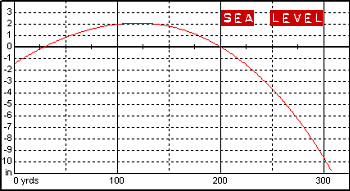





 Building the Borden Black Beauty
 Loading for Accuracy

 Long-Range Silhouette Match Strategy and Techniques
 We set up John’s 6-284 as we would for 1000-yard Light Gun competition. We’ve also built some of these rifles in 6MM BR for use in 600-yard competition. For John, we used a Borden/Nesika Model K 1.70″ diameter action as the beginning basis of the rifle. The timing and cocking-piece system for this rifle has the Borden improvements to improve firing pin energy and lock time. The action was pillar-bedded and glued into a McMillan Tooley MBR pattern stock. The stock blank was gel-coated and then epoxy-finished with a texture.


