California young adults (18 to 20 years) can now own a semi-auto rifle such as this Browning for hunting, self defense, and target shooting. The 9th Circuit struck down a California law as unconstitutional.
Report from Second Amendment Foundation (SAF)
On May 11, 2022, A three-judge panel for the Ninth U.S. Circuit Court of Appeals struck down a California prohibition on sales of semi-automatic rifles to 18- to 20-year-old young adults. The 9th Circuit then remanded the case, Jones v. Bonta, back to the District Court for further proceedings. This ruling is a major victory for firearms rights. The fight against California’s unconstitutional restriction was led by a coalition of Second Amendment advocate groups.
In this legal action, the Second Amendment Foundation (SAF), was joined by the Firearms Policy Coalition, Inc., Firearms Policy Foundation, Calguns Foundation, Poway Weapons and Gear and PWG Range, North County Shooting Center, Inc, Beebe Family Arms and Munitions, and three private citizens, including Matthew Jones for whom the case is named. Download Jones v. Bonta PDF.
The majority opinion was written by Judge Ryan Nelson and joined by Judge Kenneth Lee, both Donald Trump appointees, and in part by Judge Sidney Stein from the Southern District of New York, a Bill Clinton appointee. Judge Stein also dissented in part.
Writing for the majority, Judge Nelson observed, “(T)he Second Amendment protects the right of young adults to keep and bear arms, which includes the right to purchase them. The district court reasoned otherwise and held that the laws did not burden Second Amendment rights at all: that was legal error…(T)he district court erred by applying intermediate scrutiny, rather than strict scrutiny, to the semiautomatic centerfire rifle ban. And even under intermediate scrutiny, this ban likely violates the Second Amendment because it fails the ‘reasonable fit’ test.”
“We are delighted with the opinion,” said SAF founder and Executive Vice President Alan M. Gottlieb. “The court majority rightly recognized that delaying the exercise of a right until age 21 does irreparable harm. It also applied strict scrutiny to the semi-auto ban.”
Gottlieb noted this ruling could have an impact on another case challenging a similar prohibition in Washington State, which is also part of the Ninth Circuit. There, the prohibition was adopted via a citizen initiative in 2018, and was challenged by SAF and the National Rifle Association. ABA Journal related article.
“America would not exist without the heroism of the young adults who fought and died in our revolutionary army,” wrote Judge Ryan Nelson in his majority opinion.
“Today, we reaffirm that our Constitution still protects the right that enabled their sacrifice: the right of young adults to keep and bear arms,” Nelson wrote.
Here is one of Bill Reid’s 6mmBR (6BR) rigs. Like his Sako 6 PPC, this is exceptionally accurate.
AccurateShooter Forum member Bill White (aka “CT10Ring”) is a New Yorker who relocated to Idaho in his senior years. From his Idaho home, Bill enjoys long-range target shooting. But his favorite gun pastime is varmint hunting in nearby states — the Dakotas, Montana, and Wyoming. Every year he loads up his truck and hits the road, often doing a grand circle route, visiting prairie dog havens in multiple states.
Bill has a large rifle collection, most of which see duty in the varmint fields of Montana, North Dakota, South Dakota, and Wyoming. Here are his key “take-aways” for his eight favorite varmint chamberings: .204 Ruger, .223 Rem, .22-250, .22 BR, .22-243, 6 PPC, 6mmBR, and 6-6.5×47 Lapua (aka 6×47).
Eight Great Varmint Cartridge Types — .204, .224, .243 Calibers
.204 Ruger — This delivers great velocity with the little .20-caliber bullets, with mild recoil. The .204 Ruger easily reaches out to 400 yards, but heavier winds do move the tiny bullet around. Tremendous splat factor under 250 yards. I use Sierra 39gr bullets with IMR 8208 XBR in a Sako 75. Even now, .204 Ruger ammo is relatively easy to find.
.223 Remington — Probably the most popular centerfire rifle round in the USA, the .223 Rem offers inexpensive brass, and is a great choice for AR-15 owners. If you run short on ammo, you can find it nearly everywhere. I often bring one AR-15 and one .223 Rem bolt gun on varmint safaris. My Rem 700 5R 1:9″-twist barrel likes 53gr V-Max bullets.
.22 BR — My .22 BR is my first choice for most prairie dog missions. Accuracy is superb with necked-down 6mmBR Lapua brass — quarter-MOA and blazing fast. With the right twist rate, this chambering can shoot anything from 40gr FB bullets to 80gr VLDs. Load development is easy. Below is my .22 BR ammo for another varmint trip. I use 55gr Sierra BlitzKings with Varget in my 1:12″-twist Shilen-barreled rifle. 60gr Bergers are very accurate with a fairly flat trajectory for useful distances.
.22-250 Rem — A classic varmint cartridge, the .22-250 with 50gr V-Maxs delivers spectacular hits. If three P-Dogs happen to be lined up, I’ve witnessed one .22-250 shot take ‘em all out with a triple hit. I currently have five .22-250-chambered rifles: 3 Sako 75s, one Rem 700, and a single shot Nesika that shoots tiny groups. I favor the very deadly Berger 52gr Varmint HP. Making a custom .22-250? With a 1:8″-twist barrel you can use the full weight range of .22-cal bullets, while spinning the lighter bullets fast for “red mist” effect. Remember this cartridge can be a barrel burner. Don’t shoot too many rounds too quickly.
.22-243 Win — This wildcat is even more potent than the .22-250, delivering devastating results on P-Dogs. Run a .243 Win case slowly through a full-length .22-243 die, with plenty of lube to form the brass. I start with Lapua .243 Win brass. There can be some issues necking-down the brass. Watch for donuts forming at the neck-shoulder junction. I bought my .22-243 rifle not sure how it would perform. But now I love shooting it. My .22-243 delivers half-MOA groups with 41.0 grains RL-22 and Hornady 75gr Amax bullets. With those 75-grainers, it’s great in the wind and good to 600 yards easily.
6 PPC — You may consider the 6 PPC a benchrest competition cartridge only, requiring fire-forming. However I have an original Sako 75 single-shot 6 PPC rifle that I load with Sako-headstamp 6 PPC brass (see below) so no fire-forming is required. This Sako 75 came with a test target that measured 0.113″! With my 6 PPC Sako, I found that 58gr V-Maxs, pushed by Vihtavuori N133, are potent out to 300 yards. [Editor’s NOTE: As the Sako brass is no longer available, new 6 PPC shooters will need to fire-form their brass, or try to find Norma 6 PPC brass.]
6mmBR — The 6mmBR Norma (6BR) offers a nearly unbeatable combination of accuracy, efficiency, and tunability. With the 6BR and a fast twist barrel, you can shoot everything from 40gr flat-base bullets to the latest 105-110gr match bullets. I load Lapua brass, Vihtavuori N135, and Hornady 58, 65, and 75gr bullets for my Krieger 1:14″-twist HV barrel. While this cartridge is capable of long-range accuracy, I usually limit my 6BR shots to 350-400 yards.
6-6.5×47 Lapua — I have a nice 6-6.5×47 Lapua varmint rifle, with Surgeon action and Manners stock. I Cerakoted the barreled action and then bedded the action. Shown below is 6-6.5×47 ammo I loaded for testing. Note how I separated different bullets and powder loads into multiple, labeled bags. Hodgdon H4350 is a great choice for this cartridge — 39 grains H4350 with 105gr Amax was the winner here, but 88gr Bergers also shot well. This cartridge has tremendous “critter dismantling” abilities out to 600-700 yards.
Six Tips for Novice Long Range Varmint Hunters
1. Take twice as much ammo you think you may need. The fields could be particularly rich, or, because of wind or other variables, you may have far more misses than expected.
2. When possible, set up with the wind at your back (or, alternatively, directly ahead). This will minimize the effect of cross-winds. Set up a stake with a ribbon to show wind direction.
3. Bring at least two rifles. Ideally one would be a low-recoil rifle with cheaper components for the closer shots. Then bring a rifle with higher-BC bullets for longer shots where wind is a bigger factor.
4. Check the weather before you head out. Prairie dogs like sunshine and calm conditions. If a cloudy, very blustery day is predicted, considering staying in town and cleaning the rifles.
5. Bring plenty of water on a trip. An adult male should be drinking at least 64 ounces of water (or other liquid) every day — more if it’s very hot or you are sweating a lot.
6. Preferably always hunt with a companion. If you do go out solo, have a Garmin inReach SatComm/GPS for emergencies if there is no cell coverage in your location.
Rimfire Varmint Adventure
Can you shoot prairie dogs with a .22 LR Rifle? The answer is yes, if you have an accurate rifle, know your drops, and keep your targets within a reasonable distance (inside 240 yards). While the .17 HMR and .17 WSM are much more potent, flat-shooting, and effective P-dog slayers, a talented marksman CAN get good results with a .22 LR rimfire rifle, as ace PRS shooter and gunsmith Jim See recently proved.
Posting on his Facebook Page on 7/9/2020, Jim wrote: “Took out the .22 LR for some LR prairie poodles, there were not many in this town, but it gave me a chance to get some impressive hits. Norma TAC-22 ammo put the smack down on a first-round hit, called head shots at 189 yards. The body-shot dog was a first-round kill at 240 yards. I had one more head shot with a second round hit at 163. The nice part about using the .22 Long Rifle ammo is the [critters] don’t spook too bad, so a follow-up shot with a correction is usually available to get a better wind hold.” Even unsuppressed, a .22 LR rimfire shot makes much less noise than a centerfire round.
NOTE: The Norma TAC-22 .22 LR ammo used by Jim See offers great bang for the buck. It is quite affordable — a 50rd box is just $4.50 at Palmetto State Armory. Some lots have show outstanding accuracy. These target photos (below) come from Champion Shooters Supply which may have gotten an exceptional lot. This vendor tells us: “We have found this to run very well in Ruger rifles, handguns, and target pistols. These are 5-shot groups at 50 yards with an Anschutz 1913 rifle. This is an incredible value.” Jim says the TAC-22 ammo delivers 1″ groups at 100 yards in his rifle.
Sierra Bullets has introduced a new line of loaded centerfire varmint ammunition, the Prairie Enemy series of cartridges. Sierra currently offers Prairie Enemy ammo for six cartridge types: .204 Ruger, .223 Rem, .224 Valkyrie, .22-250 Rem, .243 Win, and 6.5 Creedmoor. To celebrate this new ammo line, Sierra created a colorful Prairie Enemy P-Dog target. Click the image below to download the PDF target.
We are coming into peak Prairie Dog season. For long shots you’ll definitely want a centerfire. We like the 20 Practical in an AR and a 22 BR/BRA in a bolt-action. That will have you covered out to 700 yards. But for shorter shots on small critters — say inside 150 yards — it makes sense to have an accurate 17 HMR rimfire rig. Today’s 17 HMRs are capable of surprising accuracy, rivaling a good centerfire rig, but with way less recoil and much lower cost per shot. And the 17 HMR offers more than double the velocity of a .22 LR — up to 2650 fps with a 17-grain bullet.
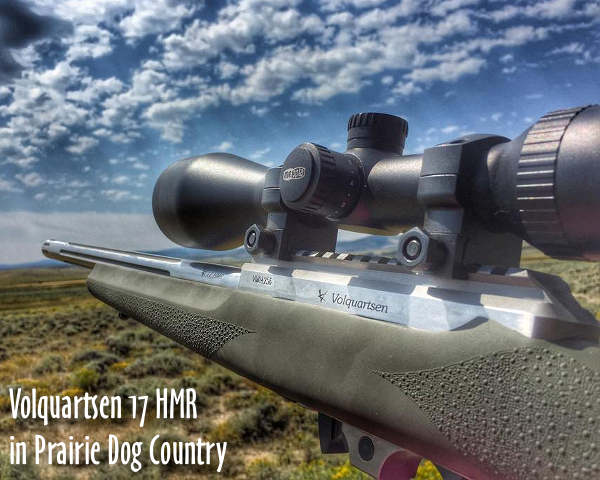
Top Shot former Champion Dustin Ellerman likes his Volquartsens, and we can see why. With one of his favorite 17 HMR rimfire varmint rigs, he’s seen some outstanding accuracy with CCI ammo. A few seasons back, on his Facebook page, Dustin reported: “Prepping for prairie dogs and I’m floored by this cold, sub-half-inch group shot with the Volquartsen Custom 17 HMR at 100 yards.” This thumbhole-stock rifle features a Bowers Group USS suppressor, and 3-12x56mm Meopta Scope. Dustin tried different types of CCI 17 HMR ammo. This small group was shot with CCI A17 ammo.
What’s the effective range of a 17 HMR on prairie dogs? You might be surprised. in 2015, Dustin took another Volquartsen 17 HMR on a Prairie Dog hunt in Wyoming. He was impressed with the rifle (shown below) and the little rimfire cartridge. Dustin says the effective range of the 17 HMR is farther than one might expect: “I made hits out to 300 yards. 200 yards was easy as long as the wind wasn’t too bad.”
Here’s the Volquartsen 17 HMR Dustin used in Wyoming in 2015:
After that 2015 P-Dog expedition, Dustin became a fan of the 17 HMR cartridge: “Never paid it much attention before now because the ammo is five times more expensive than .22 LR and I mostly target shoot. However, for prairie dogs, the 17 HMR is amazing!” Consider this — Hornady’s 17 HMR ammo pushes a 17gr V-Max bullet at 2550 fps, twice as fast as typical .22 LR rounds.
Prairie Dog Adventure with Savage A17
This video shows a successful Prairie Dog hunt. Watch and you’ll see hits out to 160 yards (00:50), proving the effective range of the 17 HMR cartridge. The host is shooting a Savage A17 semi-auto 17 HMR rifle in a Boyds laminated stock.
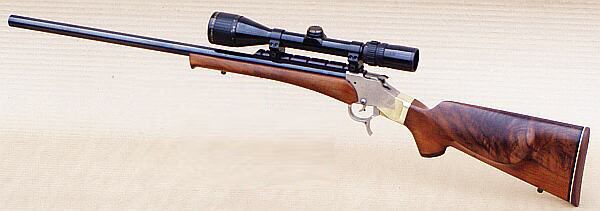
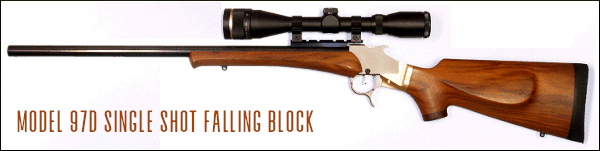
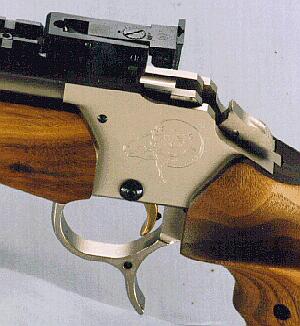
While a 16.5-pound benchrest gun is wonderfully stable on the bench, it’s not what you want in a field rifle. There is much to be said for a slim, light-weight, and easy-handling firearm when it comes to a walking varmint adventure. Eben Brown, who runs E. Arthur Brown Company, has created just such a rifle — the Model 97D Falling Block. When chambered for the 6PPC cartridge it delivered quarter-MOA accuracy in a splendidly portable package that tips the scales at just over six pounds without scope. The Model 97D is fairly unique in its lightweight and compact format — that makes it a great field-carry varmint rig. [Editor’s Note: This is an older article and we use some more recent photos of other model 97D Rifles to better illustrate the design and layout.]
Catalog photo of EABCO Model 97D Falling Block rifle.
Excellent Accuracy Made Easy for Sport Shooters
by Eben Brown, E. Arthur Brown Company
You don’t have to be a benchrest competitor to enjoy shooting one of the most accurate centerfire cartridges in the world, the 6mm PPC. With no complicated brass forming or finicky reloading processes, you can be shooting near half-inch groups right from the start and hone your skills to near quarter-inch groups by your second outing–at least that’s how it worked for me, and I’m NOT a good bench rest shooter! Developed by Louis Palmisano and Ferris Pindell, the 6PPC has won more bench rest accuracy competitions than any other cartridge. Easily made from Lapua .220 Russian brass, the 6mm PPC has a small primer and uniquely small flash hole that is credited for much of its inherent accuracy. The “short, fat” shape and nearly straight body contribute to efficient, consistent powder burning and stable chamber performance (it grips the chamber well during ignition).
The Brown Model 97D — A Slim, Accurate 6-Pound Rifle
The 97D was developed from the EABCO “BF” falling block silhouette pistols that have won world championships and set 500-meter distance records. In operation, the 97D falling block slides perpendicularly and closes the breech with absolutely zero camming leverage. This makes it a perfect test-bed to measure the chamber performance needed for hand-loading most other single-shot rifles accurately. At the reloading bench, I worked up a load with the now fully shaped 6mm PPC brass. I full-length sized the brass, trimmed, and primed each case the same as I would with any other cartridge, and began loading. With the resultant load, I easily shot a 5-shot 1/4″ group, a personal best for me. See target photo at right.
Making 6mm PPC Cartridges
Full-length size, prime, charge with powder, and seat a bullet… sounds like what you do with any other cartridge, doesn’t it? In fact, the only difference with 6mm PPC is that it has to be fired once (fire-formed) to expand to its final shape and size. But even fire-forming shots produce exceptional accuracy. I shot several 3/4″ groups while fire-forming at 100 yards, with my best group at nearly half-inch–so the time spent fire-forming was wonderful! In the photo, the parent .220 Russian case is on the left, while the fire-formed 6PPC case is on the right.
The EABCO 6mm PPC Chamber – 6PPC without Neck-turning!
We dimensioned our 6mm PPC chamber reamer to cut a chamber that fits Lapua 220 Russian brass closely without neck-turning. Naturally we recommend you use the Lapua brass for best results.
[Editor’s Note: We asked Eben if he had tried a 6BR chambering in a model 97D. He explained that, because of the extractor design, the falling block action works better with a smaller rim diameter: “The larger .308 rim width creates some issues. This design works best with cartridges no wider than the 30/30 case, or the 7.62×39 case, from which the 22 Russian case was derived. Cases with .308-sized rims develop more bolt thrust and work best with a different type of extractor than we use in the 97D. I love the 6BR, but I recommend the 6PPC for our 97D.”]
6mm PPC Reloading Data for Model 97D
The following loads were worked up in a Model 97D Rifle with 24″ barrel chambered for 6mm PPC with the chamber neck reamed to .275″ to fit Lapua brass without neck-turning. Lapua 220 Russian brass was full-length sized and fire-formed to 6mm PPC using 65gr V-Max bullets, CCI BR4 primers, and 24.5gr of VV N135 powder. Eben cautions: Load at Your Own Risk — Always start 10% low and work up
The following optimum loads were worked up with Vihtavuori N135, 58gr and 65gr V-Max bullets, and CCI BR4 primers. Please Note: There really is no “standard” for 6mm PPC. It can be finicky. But once you find what works best for you, the cartridge performs superbly. The accuracy will astound you.
Model 97D Specifications
OAL (with 24″ Barrel): 38″
Approx. Weight without Scope: 6-6.5 lbs.
Barrel: 17-26″ Chromoly or Stainless
Stock: Walnut w/Hardwood Grip Cap
Trigger: Tuned 16-24 ounces
This video shows the Loading Technique for Model 97D Rifle
Powder Selection — Choosing the Right Propellant
I’ve found that my maximum single-shot loads reach the same level of performance as bolt gun loads when I use one level slower burning powder type and proper chamber preparation. For example, when the VihtaVuori loading guide shows a maximum with VV N133, my best single shot load ends up being with the slower burning VV N135. Here’s the simplest way to proceed: Use a starting load from the loading guide and increase the powder charge until you detect some resistance to block movement with your thumb. Next, charge a case with that same amount of powder, tap it to settle, and look to see if the case is full to the base of the neck. If it’s not full, step up to the next slower-rated powder and repeat the load development process. There’s a powder burn rate chart for all brands of powder in the front of the current VihtaVuori Loading Guide. When you have the maximum load that will fill the case and still allow the 97D single-shot to open and eject freely after firing, you’re ready to shoot some groups!
Loading for Best Chamber Performance
In the model 97D rifle you can check chamber performance easily. After firing a shot, see if you can press the block downward with only your thumb on the top of the block. If it moves freely, you’ve got good chamber performance.
I use three pressure indicators when developing loads on the Model 97D. First I check the block with my thumb. Then I check to see if the cartridge sticks at all when ejecting. And finally, I check the primer for the excessive flattening that would indicate too much pressure. Generally, the hottest load that still allows the gun to open and eject freely ends up being my most accurate shooting load.
Chamber Preparation
Best chamber performance happens when a cartridge grips the chamber and does not drive backward significantly. When you want something to grip (rather than slip), you want to make sure there is no lubricant on the gripping surfaces. Case forming lube and gun oil are the two lubricants you want to remove. Clean your 6mm PPC cases after sizing (I wipe mine with a paper towel and Windex). Clean your chamber with a chamber sized jag and patch wetted with acetone. (Note: protect your chamber with a thin coat of Clenzoil when you’re not out shooting.)
Conclusions of a Single-Shot Sport Shooter
I love the 6mm PPC! It was easy to hand-load for the cartridge and it was easy to get excellent results. The group shot on this page was with the 65gr bullet and a rifling twist of 1:10. I usually recommend a 1:12 twist and the 58gr bullet because customers have reported superb accuracy (better groups than I can shoot). But the 5-shot ¼” group I shot with this set-up is my personal best ever–so naturally I’m thrilled!
While it’s hard to beat the 6PPC’s accuracy in a Model 97D rifle, my company currently offers the rifle in a variety of chamberings including 17 Hornet, 219 Donaldson Wasp, and 6mm BRM. The 97D Standard features a blued 24″ chrome-moly barrel, French Gray receiver, anodized buttstock transition, 2-ring scope mount and swivel studs.– Eben Brown
About the production Model 97D Rifles: “The 97D is a small frame single shot rifle that’s suitable for big game as well as small game and varmint hunting. It originally evolved from our World Champion long range silhouette pistol action and incorporates the same accurate gun making processes. The 97D action itself is inherently accurate and simple. Onto this we fit an EABCO Accuracy Barrel, precision turned and threaded between centers. Each chamber is individually reamed on-center and individually head spaced. We feel the crown is so critical to accuracy that we leave it until after the gun is finished. Our 11 degree target crowns are cut last and left bright — our trademark finishing touch.”
Available for under $230.00 including front bag, the Caldwell Fire Control front rest is a very good value. It makes the co-axial, joystick design more affordable than ever. We used the Fire Control front rest when testing our Ultimate Varminter 20 Practical AR. Once we removed some sand from the tri-lobe front bag, the rest worked quite well.
Get a Fire Control Rest for $220.99
Right now you can get the Caldwell Fire Control Front Rest for just $220.99, an 18% savings off the regular price. The $220.99 Amazon price is a great deal for guys on a tight budget who want a modern joystick-style front rest (this same Caldwell rest sells for up to $269.99 elsewhere).
With the conversion described in this article, you can put together a system that works pretty darn well, and is more than adequate for many applications, including prairie-dog hunting (from a bench). Put the money saved into a nice custom, hand-lapped barrel or some bullets for your varminter.
Upgrading Fire Control Front Rest with Sinclair Top
While most Fire Control owners are happy with the product, many have wanted to replace the tri-lobe front bag with a more conventional front bag from Protektor or Edgewood. This isn’t as easy as it looks because the width of the Fire Control top is too narrow for most standard 3″-wide front bags. On a “special order” basis, Protektor has crafted some narrower leather front bags that fit pretty well, but some shooters have decided to “upgrade” the entire front assembly.
Forum member Doug M. (aka DrJeckyl), has come up with an elegant solution that allows a Sinclair Int’l Benchrest Rest Top to be fitted to the Fire Control Rest. Doug notes: “The Caldwell Fire Control is a nice rest for the money, but it comes up short in the rest top department. The Sinclair RT-3 [or its replacement, the Gen II B/R top] fits perfect with minor modifications.” Shown below are the main components:
To adapt the Sinclair RT-3 or Gen II B/R top, Doug merely had to drill a couple holes in the RT-3 baseplate, and adapt a spacer to get the height correct: “The Caldwell factory top has a raised mounting portion so a 1/8″ piece of stock will be needed as a spacer to the flat-bottom RT-3. The spacer needs to be cut to the same length as the movable portion on the rest. And you should plan the mounting accordingly so the left thumbscrew clears the vertical height column at full left position (there is a cutaway in the rest under the thumbscrew that allows for easy access to the screw).” We labeled the photo with dimensions, but Doug cautions you should measure your own original plate to insure the drill locations are correct for your unit.
The completed installation, with the RT-3 installed on the Fire Control rest, is shown at the top of this article. Doug says it works very well. To learn more about this conversion, with Doug’s measurements for the hole-spacing and his specs on the fasteners, go to the original thread in our Shooter’s Forum. NOTE: Sinclair no longer sells the RT-3 top, but Sinclair’s $89.99 Gen II B/R top can be converted just as easily. LINK to Fire Control Rest Top Conversion Forum Thread.
Here’s a new product that should benefit hunters and shooters who live in rainy areas (such as Oregon). BONE-DRI, inventor of moisture-absorbing gun cases, has released a new Shotgun & Rifle Case. Engineered with advanced materials to wick moisture, this fabric gun case can provide significant protection from rust and corrosion. NOTE: Even when using this case, whenever possible you should protect exposed metal firearm parts with anti-rust protective coatings such as Eezox or Corrosion-X.
Unlike other gun cases, BONE-DRI cases are engineered with Absorbits™ moisture-removal material, which draws moisture from the firearm. After moisture exposure, this material can be “recharged” by placing it in the sun or drying with a hairdryer on low heat.
Constructed with heavy-duty industrial 800D PVC nylon and mil-spec zippers, BONE-DRI cases are guaranteed for life. Romney Williams, CEO of BONE-DRI’s CEO notes: “Whether traveling to or from the range or the next hunt, the moisture-removing Shotgun & Rifle Case makes it easy to safely transport and protect your valuable shotgun or rifle.”
BONE-DRI Shotgun & Rifle Case Features:
Engineered with Absorbits™ moisture-removing technology to prevent rust
Durable – constructed with heavy-duty industrial 800D PVC nylon
Capacity – holds 1 shotgun or rifle with optics (up to 50″)
Safe – lockable Mil-Spec zipper sliders
Backed by a Lifetime Warranty
Dimensions: 51″ x 10″ x 4″
Weight: 3.4 lbs.
MSRP: $99.99
Along with the new Shotgun & Rifle Case, other BONE-DRI products include: Dual Rifle Case, Big Shuug Shotgun Sleeve, Handgun 2.0 Case, Gun & Ammo Bag, Range & Tool Bag, and Small Electronics Rescue Pouch. You can view these products at BONE-DRI.com.
About BONE-DRI: BONE-DRI is the inventor of moisture-absorbing gun cases engineered with Absorbits™, a patented, advanced material that removes moisture from guns, ammunition, and other valuable hard goods in order to keep them safe, dry, and rust-free. BONE-DRI products are guaranteed for life.
Shooting Industry magazine just released its latest April 2022 edition. You can read the full digital version on the web for free. This April issue contains an interesting article about long-range and PRS/NRL shooting equipment, and the current market for high-end tactical-style rifles and optics.
Shooting Industry’sEquipping Today’s Long-Range Customer article explains that customers in the long-range tactical market are prepared to spend serious bucks, but they demand high-quality gear that will last: “Those shooters who get serious about the [long-range shooting] sport can spend $10,000 or more on a rifle/optic combo. This is before adding accessories like bipods, Kestrel meters and rangefinders. Even an ‘entry level’ setup can set a customer back $2,000 – $3,000. So, while your average shopper might balk at the idea of spending as much on an optic as they do the rifle, things are different with this crowd” because they have done their homework.
“When people decide to step into the sport, they know they’re going to spend money. They don’t want to buy cheap” said A.J. Hoffman of SoDak Sports in South Dakota. Those who try to succeed at long range with low-end components “are likely to end up regretting the decision” — after gaining a better understanding of what it takes to hit targets at 1,000 yards and beyond.
Here are some recommended products featured in the article:
ZEISS LRP S5 318-50 FFP Scope
This new ZEISS LRP S5 318-50 First Focal Plane (FFP) optic offers the widest vertical adjustment range on the market — a full 140 MOA or 40.7 Milrads. We recently reviewed the bigger brother of this 3-18X power optic, the new ZEISS LRP S5 525-56 scope. Our tester said the 5-25x56mm ZEISS S5 offered great, precise turrets and very sharp glass. And the 5X magnification range gives the scope great versatility, from close-range to one mile and beyond.
WOOX Cobra Thumbhole Stock
Shooting Industry magazine states that “The unique ergonomics of the Cobra Thumbhole Precision stock from WOOX reduces felt recoil to help the shooter… while on the firing line.” We like the modern, adjustable design, with laminated wood on the grip and handguard. This provides the advantages of a contemporary tactical stock with the comfortable feel of wood. This WOOX stock features an adjustable comb, and rear underside Pic rail, and a forearm that can mount various accessories.
Vortex Razor HD Gen III 6-36x56mm FFP
Another popular optic for long range tactical shooters is the Vortex Razor HD Gen III 6-36x56mm FFP. This is a very durable optic with an impressive 6X zoom range. The upper 36X power is effective to see small targets at long distances.
Pieter “Piet” Malan is a South African precision rifle shooter and hunter who has created an impressive YouTube Channel with over 300 videos. While Pieter’s Impact Shooting Channel focuses primarily on tactical PRS/NRL type disciplines, his channel also includes dozens of videos of interest to hunters and anyone who handloads rifle cartridges. We particularly like Pieter’s tech review videos which explain important reloading methods and showcase new products.
Here are five Peiter Malan tech videos. Topics include annealing, hydro-forming, case priming, MOA vs. MILs, and how to record video with spotting scopes. As a bonus for you hunters out there, we added Pieter’s recent hunting video, Kudu Hunting Paradise Part 2. After watching that, you’ll probably want to book an African Safari.
Annealing Cartridge Brass with AMP Annealer
With premium cartridge brass for popular match cartridges now approaching $1.20 (or more) per case, you want that new brass to last. But after multiple firings, even the best cartridge brass will start degrading. That’s where annealing comes in. Proper, precision annealing can restore case-neck consistency, reducing ES/SD and improving accuracy. Some top shooters anneal after every firing to keep their brass in top condition. Others will anneal after every 4-6 firings.
Today with the advanced AMP microprocessor-controlled annealing machine, brass cartridge annealing is easier yet more precise than ever. The AMP Annealer provides advanced electrical induction annealing with ultra-precise temperature control set perfectly for your cartridge type and brand of brass. In this video, Pieter shows how to use the AMP Annealer to anneal 6mm Dasher cases and other cartridge types.
Hydro-forming Dasher Brass Using Hammer Method
In this video, Pieter Malan explains the hydro-forming process for Dasher brass and shows how he does the job using the mallet method with hydro-forming dies. He shows that it takes some technique (and multiple hammer blows) to get a good result, with a case that will fit in the chamber.
Fire-forming 6mm Dasher brass can be fairly costly if you factor in barrel life along with the cost of components. If you figure a new 6mm custom barrel, chambered and fitted by a top smith, could cost $650.00 and may only be good for 1300 rounds (in competition), barrel cost per shot is $0.50 (fifty cents). Add the price of a bullet, powder, and primer, and you are approaching $1.00 per round. Given those numbers, it makes sense to hydro-form your 6mm Dasher brass. In the USA, DJ’s Brass will hydro-form and then anneal your cases for $0.60 per case. That’s not much more than the barrel cost per shot alone for fire-forming.
MOA (Minute of Angle) vs MRAD (Milliradians)
This is a good basic introduction to the two types of angular measurements used in modern optics. Benchrest and F-Class shooters tend to favor Minute of Angle (MOA) scopes. One MOA is 1.047″ at 1000 yards. Scopes may be calibrated with 1/4 MOA or 1/8 MOA click values. Tactical and military shooters tend to prefer the Milliradian (Mil or Milrad) system, normally with 1/10 Mil click values. A Milliradian is an SI-derived angular measurement — one thousandth of a radian (0.001 Radian). At 100 yards, a 0.1 Mil click is 0.36″, while a full Mil is 3.6 inches. And practically speaking, 1 Mil at 100 meters is equal to 10 centimeters. MORE INFO: MOA and Mils Explained.
Primal Rights CPS — World’s Most Expensive Priming Tool
Seating primers can be a “dark art”. Many top shooters prefer to seat “by feel” using a hand tool. Others prefer lever-equipped, bench-mounted tools that offer higher work-flow rates and less strain on the hands.
There are many bench-mounted priming options — Forster has a tool, as does RCBS, and Lee. At the top of the heap is the $600 Primal Rights Competition Primer Seater (CPS). This may be the most precise bench priming tool ever created. It is certainly the most expensive at $600.00. But the CPS delivers something special — superb, repeatable depth control, along with the ability to prime up to 1000 cases per hour. For some reloaders, that precision + productivity will justify the high price. In this video Pieter reviews his Primal Rights Competition Primer Seater.
How to Record Video Through Your Spotting Scope
There are many things viewed through a spotting scope that you might want to record for posterity — a successful hunting shot on a game animal, or steel targets being hit in a PRS match. In addition, after a match, it can be useful to study the wind conditions and mirage that occurred during a match. This can help improve your wind reading skills as you watch what unfolded.
In this video, Pieter shows how to mount a smartphone to the eyepiece of a spotting scope with a plastic adapter. This allows you to record, for posterity, what the scope is “seeing”. In addition, this allows the viewer to see the scope’s magnified image conveniently without having to strain into the eyepiece and focus on a very small exit pupil.
Springtime is turkey hunting season throughout the USA. The official spring wild turkey hunting season is set regionally by each state. In a few states, turkey season has already commenced, while most other states open their turkey seasons in early April, with the spring seasons running for 3-5 weeks. CLICK HERE to read Outdoor Life Magazine’s 2022 Turkey Hunting Forecast for spring 2022.
GetZoneHunting.com has a vast video library for hunters, with hundreds of helpful videos on all types of hunting. In time for spring turkey season, GetZoneHunting offers a big collection of turkey hunting videos: At the Ranch – Turkey. On that page you’ll find 13 turkey hunting “how-to” videos. Here are links to five GetZone Turkey Hunting videos with valuable information from skilled, experienced hunters.
At the Ranch Turkey Hunting Videos
At the Ranch – Turkey offers solid advice for turkey hunters. These five videos will help you better understand turkey behavior and have success on your hunt. Click any photo to watch the particular video on the GetZone website. (Work Warning — When each GetZone video opens, it may immediately launch an annoying commercial with loud AUDIO!). There are eight more turkey hunting videos on GetZone’s Turkey Hunting HQ Page.
At the Ranch: Shot Placement for Turkeys — CLICK PHOTO to Watch Video
At the Ranch: Turkey Hunting Essentials — CLICK PHOTO to Watch Video
At the Ranch: The Difference Between a Jake and a Tom — CLICK PHOTO to Watch Video
At the Ranch: Early vs. Late Spring Turkey Hunt — CLICK PHOTO to Watch Video
At the Ranch: How to Plan a Turkey Hunt — CLICK PHOTO to Watch Video
Free Printable Turkey Target from AccurateShooter.com
As a special bonus for our readers, here is a free, printable Turkey Target, so you can practice for your turkey hunting adventure, This special Turkey Bullseye Target was created by our friend and Forum member Pascal (aka “DesertFrog”). CLICK HERE for FREE Turkey Target.


 In this legal action, the Second Amendment Foundation (SAF), was joined by the Firearms Policy Coalition, Inc., Firearms Policy Foundation, Calguns Foundation, Poway Weapons and Gear and PWG Range, North County Shooting Center, Inc, Beebe Family Arms and Munitions, and three private citizens, including Matthew Jones for whom the case is named. Download Jones v. Bonta PDF.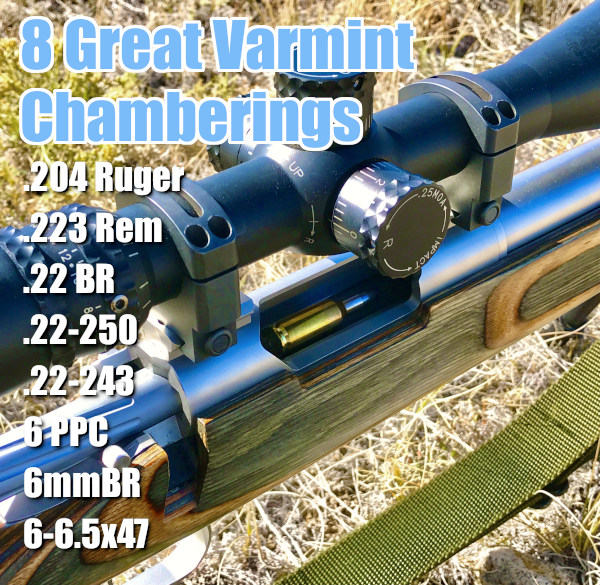



 Rimfire Varmint Adventure



 The Brown Model 97D — A Slim, Accurate 6-Pound Rifle
 Making 6mm PPC Cartridges
 The EABCO 6mm PPC Chamber
 The following optimum loads were worked up with Vihtavuori N135, 58gr and 65gr V-Max bullets, and CCI BR4 primers. Please Note: There really is no “standard” for 6mm PPC. It can be finicky. But once you find what works best for you, the cartridge performs superbly. The accuracy will astound you.
 Loading for Best Chamber Performance