A new discipline has proven very successful. The NRL Precision Hunter Challenge features a multi-distance, walk-around shooting course similar in some ways to PRS/NRL, but limitations on weight and cost of equipment make this more affordable and more practical. The new discipline is catching on — the 2022 NRL Precision Hunter Challenge match, held June 24-26, 2022, in Price, Utah, drew nearly 150 competitors. Hornady was the title sponsor of the event.
Shooters from all over the country competed in 20 challenging stages. The course of fire consisted of 160 rounds with hiking between stages at the North Springs Shooting Complex. The Precision Hunter Challenge featured target distances from 200-850 yards, and angled shots between 0-10°. At the North Springs Shooting Complex, there were natural terrain obstacles and tree stands. Competitors had to navigate the terrain to establish their shooting positions — very much the opposite of a benchrest match!
“The NRL HUNTER Series is designed to help educate new and seasoned hunters about their skills, gear, and personal limitations. The Hornady Precision Hunter Challenge did just that!” said Travis Ishida, President of the NRL. “With a well-designed course of fire that was both challenging and fun, this match encompassed everything we are looking for. With over 50% new faces at this match the NRL HUNTER Series is growing faster than we ever imagined” he added. Verl Dallin, Match Director, added: “With the help of the staff and ROs, the Hornady Precision Hunter Match turned out simply fantastic”.
This video contains highlights from the 2021 Hornady Precision Hunter Challenge:
Here are the 2022 Hornady Precision Hunter Challenge division and class winners:
Factory – Kevin Wilkey
Open Light – Morgun King
Open Heavy – Serge Ducourneau
Team -Tyler Payne & Scott Peterson
Top Young Gun – Marshall Lewis
Top Lady – Katalin Burjan
CLICK HERE for complete 2022 Precision Hunting Challenge Match results on Practiscore.com. The next major NRL Hunter event is the 2022 COMPEXPO Hunter Challenge taking place July 20-22, 2022, at the Cameo Shooting and Education Complex, in Palisade, Colorado.
A varmint shooter’s target is not conveniently placed at a fixed, known distance as it is for a benchrester. The varminter must repeatedly make corrections for bullet drop as he moves from closer targets to more distant targets and back again. Click HERE to read an interesting Varmint Forum discussion regarding the best method to adjust for elevation. Some shooters advocate using the scope’s elevation adjustments. Other varminters prefer to hold-over, perhaps with the assistance of vertical markers on their reticles. Still others combine both methods–holding off to a given yardage, then cranking elevation after that.
Majority View — Click Your Scope
“I zero at 100 yards — I mean really zero as in check the ballistics at 200 and 300 and adjust zero accordingly — and then set the scope zero. For each of my groundhog guns I have a click chart taped into the inside of the lid of the ammo box. Then use the knobs. That’s why they’re there. With a good scope they’re a whole lot more accurate than hold-over, with or without hash marks. This all assumes you have a good range finder and use it properly. If not, and you’re holding over you’re really just spraying and praying. Try twisting them knobs and you’ll most likely find that a 500- or 600- or 700-yard groundhog is a whole lot easier than some people think.” — Gunamonth
“I have my elevation knob calibrated in 100-yard increments out to 550. Range-find the critter, move elevation knob up…dead critter. The problem with hold-over is that it is so imprecise. It’s not repeatable because you are holding over for elevation and for wind also. Every time you change targets 50 yards, it seems as if you are starting over. As soon as I got completely away from the hold over method (I used to zero for 200), my hit ratios went way up.” — K. Candler
“When I first started p-dog shooting, I attempted to use the hold-over method with a 200-yard zero with my 6mm Rem. Any dog much past 325-350 yards was fairly safe. I started using a comeups table for all three of my p-dog rifles (.223 Rems and 6mm Rem). 450-yard hits with the .223s are fairly routine and a 650-yard dog better beware of the 6mm nowadays. An added benefit (one I didn’t think of beforehand) with the comeups table (elevation only), is that when the wind is blowing, it takes half of the variables out of the equation. I can concentrate on wind, and not have to worry about elevation. It makes things much more simple.” — Mike (Linefinder).
“I dial for elevation and hold for wind. Also use a mil-dot reticle to make the windage holds easier. For windage corrections, I watch for the bullet strike measure the distance it was “off” with the mil-dot reticle, then hold that much more the other way. Very fast once you get used to it.” — PepeLP
Minority View — Hold-Over is Better
“I try to not touch my knobs once I’m zeroed at 200 meters. Most of my varmint scopes have duplex reticles and I use the bottom post to put me on at 300 meters versus turning knobs. The reason I try to leave my knobs alone is that I have gone one complete revolution up or down [too far] many times and have missed the varmint. This has happened more than once and that is why I try not to change my knobs if at all possible.” — Chino69
“I have been using the hold over method and it works for me most of the time but the 450 yards and over shots get kinda hard. I moved to a 300 yard zero this year and it’s working well. I do want to get into the click-up method though; it seems to be more fool-proof.” — 500YardHog
Compromise View — Use Both Methods
“I use both [methods] as well — hold over out to 250, and click up past that.” — Jack (Wolf)
“I use the target knobs and crank-in elevation. I also use a rangefinder and know how far away they are before I crank in the clicks. I have a scope with drop dots from Premier Recticle and like it. No cranking [knobs] out to 600.” –Vmthtr
One of the most popular features of our Shooters’ Forum is the ongoing “Pride and Joy” thread. Since 2009, Forum members have posted photos and descriptions of their most prized firearms. Here are some of our favorite “Pride and Joy” rifles recently showcased in our Forum. Do you have a gun you’d like to see featured there? Register for the Forum and you can add your favorite gun to the list. The photo above shows multiple wood-stocked Palma rifles belonging to Forum member SParker.
We hope these “pride and joy” rifles may provide inspiration for our readers, whetting their appetite for their next competition, varminting, or hunting rifle project.
22 BR Savage Varminter — Accuracy on a Budget
This 22 BR Savage, with upgrades from Sharpshooter Supply, is the “pride and joy” of Forum member Maynard. Note the heavy-contour custom barrel with brake. That 22 BR cartridge is a very effective choice for varmint work, as the ground hog in the photo proves. The 22 BR and 22 Dasher are capable of outstanding accuracy with a large variety of bullets and powders. A 22 Dasher can rival the ballistics of a 6mmBR out to 500+ yards, but with reduced recoil.
Daughter’s First Rifle — Built by Dad
Above is a nice field rifle built up by a father for his daughter. Forum member FrankZ explains: “This is my favorite rifle and it will become my daughter’s first centerfire. The action is from the first rifle I purchased with my own money 21 years ago (700VSS).” The rifle now sports a 24″ Brux barrel chambered in 6mm Creedmoor, with aftermarket PT&G Bolt and DBM metal.
6BR Ackley Improved from Alex Wheeler
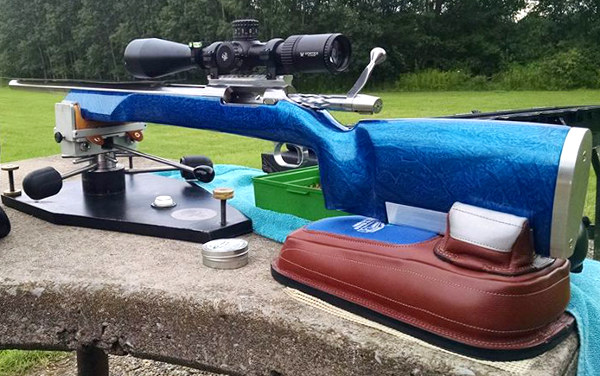
Here is a 6BR Ackley Improved (6BRA) built by Alex Wheeler. This blue marble-painted beauty features a BAT “B” action timed by Alex, fitted with Jewell trigger, and Borden trigger guard. The barrel is a Hawk Hill HV contour finished at 28 inches. The stock is a Deep Creek Tracker with 4″ forearm and rudder system (the toe of the stock adjusts for angle, allowing better tracking). This scope is a Vortex 15-60x52mm Golden Eagle riding in Burris Signature Zee rings.
F-Open Rifle with Borden Action + McMillan Kestros ZR Stock
This state-of-the-art .284 Shehane F-Open rifle belongs to Forum member Willow. This has a McMillan Kestros ZR stock fitted with a RAD (spring-loaded buttpad) system with custom spring. Other components are: Borden BRMXD LBRP DLC-coated action, Bartlein 32″, 4 groove, 1:8.5″-twist 400MOD steel barrel, and TriggerTech Diamond trigger. On top is a March HM 10-60x56mm scope in March Gen 3 rings. Below is a video by Editor F-Class John, showing the features of the Kestros ZR stock.
6BRX in the Country
Forum member Grimstod posted this nice 6BRX in a scenic setting: “Bill Goad at Premier Accuracy crated this fantastic 6BRX. It shoots better then I do.” The rifle features a single-feed Alpin action, with Hart 26″ 1:8″-twist barrel, chambered for the 6BRX (6mmBR wildcat) with .269 neck. Grimstod currently runs 95gr Berger VLDs in Lapua brass. On top is a Leupold 40x45mm scope on a Picatinny rail that Grimstod machined himself. The stock is an HS Precision painted by Premier Accuracy.
6mm Dasher for Benchrest Silhouette Matches
Here’s a gorgeous green 6mm Dasher. Forum Member Gunnermhr states: “This is my new 12-lb Dasher for the 1000 Yard Benchrest silhouette matches. My good friend at CRS Custom Rifle Stocks in Aaronsburg, PA made and painted the stock. It’s similar to a Tooley MBR with a few modifications. It still supported on a 3″ forearm and is full length. Hard to imagine it still makes weight with a wood stock and a 36 power Leopold. Crossed the scale at 11.7lbs. The rifle features a BAT “B” Action. The paint is Candy Apple Green, the forearm has a white base-coat, center section is gray base coat and the buttstock is black base coat, all covered with five coats of clear. It’s the new pride of the fleet as it shoots as good as it looks. This gun hammers with 105gr Berger Hybrids.”
Two Dashers and a Rimfire for Fun
Courtesy Forum member Dan H., here are two red-stocked Dashers plus an Anschutz 54.30 (Benchrest Stock) to make it a trio. Dan says: “The Anschutz provides good practice in trigger-pulling. It’s amazing what you can learn from a rifle that is as sensitive as this one.”
1917 Enfield Upgraded with Hand-Carved Figured Maple Stock
This impressive rifle features an “antique” 1917 Enfield action chambered for the .338 Win Magnum cartridge. The lovely Maple stock was hand-carved by Forum member Spitfire_ER. He tells us: “I found this piece of wood as a return at a lumber yard about 7-8 years ago. I asked the guy in the yard about it and he said it had been returned because it had too much figure for the job the customer was working on. First thing I thought was, ‘That would make a nice stock’.”
New 6PPC with Borden Action, Lederer Barrel, Loker Tuner
Here’s a modern, low-profile, short-range Benchrest rifle, finished proudly in bright red. Forum Member JimmyMac posted: “Picked up my new 6 PPC today. This red rig features a Borden B action (Jewell trigger) fitted with a Lederer 1:14″-twist barrel with a Loker tuner. The barrel action rides in a Roy Hunter stock. On top is a Nightforce 42x44mm Competition scope in BAT rings. The rifle was smithed by Dave Bruno.”
by Sierra Bullets Ballistic Technician Paul Box This cartridge was introduced by Winchester in 1935 in their model 54 rifle. A year later, it was added as a standard cartridge in the model 70. What might not be common knowledge to some reloaders is that the prototype for the Swift was developed in 1934-35 by Grosvenor Wotkyns by necking down the 250 Savage case, but in the end, Winchester chose the 6mm Lee Navy case for the foundation for this cartridge.
This cartridge was far ahead of its time and for that reason it received a lot of bad press. We’ve all read the horror stories through the years. Many of those stories were just simply repeated from previous articles even the wording was just slightly different. So how bad was the Swift? Let’s take a deeper look.
Some of the early Swifts had soft barrel steel and some of the rare ones even had barrels that were .223 in bore size. This stemmed from the fact that the .22 Hornets prior to the end of World War II were .223 in bore size and some of these barrels were chambered in the Swift. It was rumored that the Swift peaked in pressure far too quick. I’ll bet they did with a turkey extra full choke barrel.
Burn rates of powders were limited at that time as well, so the Swift was limited in its true ability due to that. It was almost like building a funny car for drag racing when only kerosene was available.
One of the longest lasting black eyes was that it shot barrels out so fast. If you get the barrel branding iron hot and fail to clean it often this can happen. Common sense will go a long ways here. Keep the barrel as cool as you can and properly clean it every fifteen rounds or less will go a long way to improving accuracy life of a Swift.
So what is the real truth about this cartridge? I’m glad you ask. I’ve been shooting the .220 Swift for over 43 years now. It is one of the best varmint cartridges I’ve ever owned. It is not hard to load for, it doesn’t suddenly peak in pressure and it isn’t the barrel burner that you’ve heard. Hodgdon powders once reported a Remington 40-X with over 3,000 rounds of full power loads averaged .344” for five, 5-shot groups. My findings have been the same. It isn’t as hard on barrels as it has been made out to be.
I’ve also read that down loading it slightly will help in barrel life. This is true, but if you buy a thoroughbred you want him to run. Barrels are threaded on the end for a reason. If you have enough fun to shoot out a Swift barrel, just rebarrel it.
The bottom line is enjoy the .220 Swift for what it was meant to be. The popularity of the Swift has slipped in the last twenty years and few factory rifles are now available in this caliber. There is no reason for this and I know the Swift will always have a strong and loyal following.
Ever find yourself sitting in an airport, bored out of your gourd? Well here’s how to make good use of your time — listen to a gun-centric Podcast. There are a number of interesting Podcasts for shooters and firearms fans. A Podcast is like an old-fashioned radio show, but delivered over the internet. You can listen “live” or save the Podcast file for later review. That’s great when you’re on an airplane and don’t have a web connection. Download some Podcasts to your smartphone before you get to the airport and then you can play them back during your flight.
The NRA Blog reports that podcasts are more popular than ever: “The Great Podcast Renaissance is upon us! It’s easier now than ever for anyone and everyone to make their own podcast, which is why the number of podcasts and variety of show topics have greatly increased.”
1. It’s Federal Season Podcasts
Ammo and components supplier Federal offers an excellent series of informative podcasts. These Federal podcasts cover a wide range of topics and shooting disciplines. This year Federal is celebrating its 100th year in business. Podcast Episode No. 36 covers Federa’s Centennial Celebration
In this latest Federal Season podcast, guest host Tom Sega discusses Federal’s first 100 years with Federal President Jason Vanderbrink and V.P. of Marketing Jason Nash. The podcase covers Federal’s foundation, pivotal moments in company history, and the iconic products that have propelled Federal to become a world-leading ammunition manufacturer.
In a second Federal Season podcast, ace shooter Julie Golob provides a fascinating history of the firearms industry. Julie served with the U.S. Army before embarking on her professional shooting career.:
2. The Firearms Radio Network
With more than a dozen different podcasts, the Firearms Radio Network (FRN) offers a large range of audio programming. Whether you’re a tactical shooter, or a handgunner, or a hunter, you’ll find something of interest. This network also offers a regular podcast dedicated to hand-loading. Here are some of our favorite FRN podcasts:
3. Tom Gresham’s GunTalk Podcasts
Tom Gresham’s GunTalk is the leading radio talk show about firearms, shooting, and gun rights. It is available as a live radio broadcast as well as recorded podcasts. Each week Tom host notable guests from the firearms industry and shooting sports. Along with the primary Gun Talk podcast there is a Gun Talk Nation Podcast and Gun Talk Hunt podcasts. All are accessisble from the Gun Talk Podcast Home Page.
4. Hunt Talk Radio
Randy Newberg’s Hunt Talk Radio covers hunting politics, access to public lands, and conservation topics. Expert hunters and guides join Randy each week, sharing their field skills and stalking tips.
Keith Glasscock is an outstanding competitive shooter, who has finished second at the F-Class National Championships (F-Open) multiple times. Keith is also a skilled wind coach who runs the popular Winning in the Wind YouTube Channel. Along with his interest in mid-range and long-range F-Class competition, Keith also enjoys game hunting and varmint adventures.
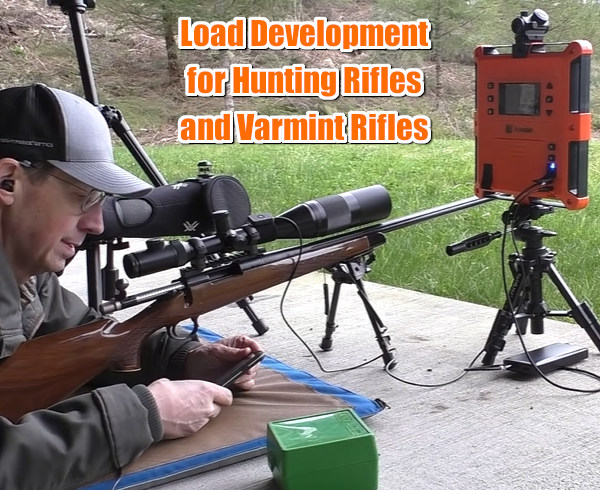
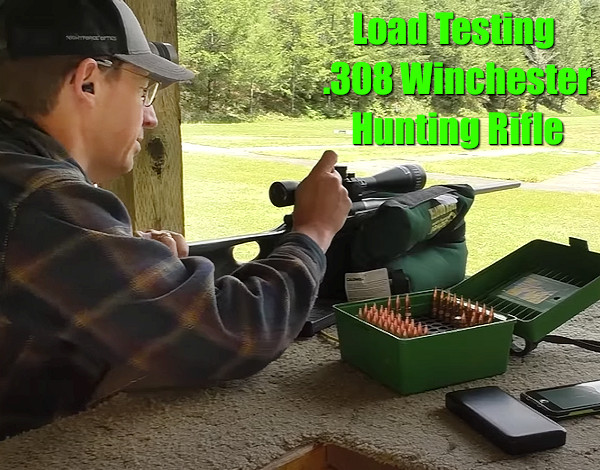
Developing accurate hand-loaded ammo for hunting and varmint rifles involves procedures that may be a bit different than load testing for a match rifle. You want to be efficient, and use the types of brass and bullets you’ll be using on the hunts. In two recent videos, Keith shows how he developed good, accurate loads for a .223 Rem varmint rifle and a .308 Win hunting rifle.
.223 Rem Load Development — Powder Charge and Seating Depth
In the first video, Keith covers the load development process for a Remington 700 bolt-action varmint rifle chambered in .223 Remington. Keith starts by full-length sizing the brass. Then he experimented with powder charge weights, and came up with a promising load of 24.7 grains of Alliant AR Comp with Hornady 50gr A-Max bullets.
Next Keith experimented with seating depths (see 5:30-6:100) and found that accuracy improved as he changed OAL length in .005 increments. Keith ended up with 2.270″ with a 3-shot group in the twos! This video shows the importance of testing your bullet choice at various seating depths. Keith shoots this rig prone off bipod, which is similar to the bipod shooting he does in the varmint fields. Keith explains key factors to consider when optimizing the .223 Rem cartridge in a varmint rig. Velocity readings are made with a LabRadar unit.
Load Development for .308 Win Hunting Rifle
In a second video, Keith shows the process for load development with a .308 Winchester hunting rifle. Here Keith uses a large X-type sandbag for a front support. Again, he was shooting a Remington 700 bolt-action rifle, this time with Barnes TSX solid copper bullets, PPU Brass, Federal 210m primers, and AR Comp powder. Keith said the Barnes bullets were excellent — he commented that these bullets were “match quality in terms of precision”. Keith achieved some very small three-shot groups with AR Comp and the TSX projectiles. Keith did note that point-of-impact shifted up significantly with increases in charge weight (see 6:20-7:10). With thinner-contour hunting barrels, this is not unexpected. But POI change should be observed carefully during load development, as you may need to adjust your zero after completing testing.
Headed out for a varmint trip this summer, but don’t have the time (or the right tools) to load all your own ammo? Well don’t worry, we’ve found online ammunition vendors that carry a big selection of popular varmint cartridge types, from .17 caliber up to the popular 6mm varmint cartridges. OutdoorLimited.com offers a wide selection of rifle ammo types, including some hard-to-find types such as 22 Nosler and .221 Fireball. In addition, MidwayUSA has good small-caliber ammo available, including .204 Ruger, .223 Rem, and 22-250. MidwayUSA is a good place to start.
Shown below are some of the small-caliber varmint ammo types currently in stock at OutdoorLimited.com. NOTE: If you order any of this factory-loaded ammunition, you can save $10 on an order of $250 or more with CODE “10off250″.
Large Caliber Ammunition Available Also
Outdoor Limited has a big selection of larger-caliber ammunition for hunting rifles as well. You’ll find popular ammo types such as .270 Win and .308 Win, as well as big calibers such as the .338 Lapua Magnum. However, the ammo page is somewhat frustrating, as it shows some ammo varieties that are NOT in stock. You must click the photo for each ammo type to see if it is available.
Every shooter should have a good rimfire rifle, both for fun shooting and for training. The .22 LR is very affordable to shoot, and the more potent .17 HMR and .22 WMR rounds also are great for small varmints out to 200 yards or so. Among the rimfire rifle makers, the Czech manufacturer CZ (Česká Zbrojovka) has been a world leader for many decades. In today’s Video round-up we feature a variety of CZ rimfire rifles including the the all-new CZ 457, the versatile CZ 455 VPT, and the classic CZ 452. We also include one semi-auto, the CZ 512 in .22 Winchester Magnum Rimfire (WMR).
CZ 455 Varmint Precision Trainer in Manners Stock
Rimfire cross-training allows PRS competitors to build their skill sets without breaking the bank (or burning out barrels). One great .22 LR option for cross-training is offered by CZ, the Czech arms-maker. The TFBTV video below spotlights the CZ 455 Varmint Precision Trainer (VPT), a smooth-running .22 LR bolt action. This factory rifle was designed specifically as a training tool for precision long-range competition. It boasts a Manners composite stock and 20.5 or 24-inch heavy barrel. The 0.866″-diameter tube is threaded and suppressor-ready. The model 455 VPT is mag-fed and comes with a crisp trigger that adjusts to two pounds. Street price is around $860. That’s pricey for a rimfire — but you’re getting a premium Manners stock that would cost $534 by itself.
Field Testing the CZ 455 Varmint Precision Trainer
New Generation CZ 457 with Upgrades
The CZ 457 may be the most modular precision rimfire on the market. You can swap barrels and magazines easily. The interchangeable barrel feature is by far the best feature of the CZ 457. Want to shoot .22 WMR for varmint hunts then transition to a .22 LR for precision shooting? No problem — five minutes and four screws are all you need. The CZ 457 is also an excellent value — it’s WAY better than a 10/22 but a fraction of the cost of high-end custom rimfire rigs. In the second video below, the CZ 457 goes head to head
In this video, Josh of Pursuit of Accuracy drives nails at 100 yards with his CZ 457:
And here Josh comparison-tests his Lilja-barreled CZ 457 head-to-head with the much more expensive Vudoo V22. The results may surprise you.
CZ 457 MTR Varmint — Product Showcase and Review
We really like the relatively new CZ 457 Varmint MTR .22 LR rifle. Along with other CZ 457 models, the MTR (“Match Target Rifle) Varmint features a completely new action that runs very smoothly with shorter bolt throw. The new 457s also have an American-style, push-to-fire safety. The new-generation actions have been trimmed back nearly one-inch in length, and slab-sided to reduce the footprint and weight of the actions. CZ ditched the 90º bolt rotation of the past in favor of 60º rotation. This change provides more room between bolt handle and scope for easier cycling of rounds. It also allows for the use of scopes with larger ocular bell diameters and lower ring heights.
The well-designed MTR stock has good ergonomics and nice stippling on the grip and fore-end. We were pleased to note that, with the 457 series, CZ is once again offering steel magazines that are interchangeable with older 452/455 magazines.
Here our friends at Area 419 offer a side-by-side comparison between a $2300+ rifle with Vudoo V-22 action in Manners stock and the $752.00 CZ 457. On a bang-for-the-buck basis, the CZ wins hands down. However, the Vudoo V-22 does offer centerfire-style action cycle, which helps with training. It also can run Rem 700-compatible triggers.
CZ 452 — Classic Bolt-Action Rimfire Rifle
The CZ 452 is an affordable classic. It is ultra-reliable, easy to clean and maintain, and you’ll find very good examples on the used market for under $400. This is an excellent first rifle for a young family member. In this video, The TFB TV team tests a CZ 452-2E fitted with a suppressor. As the 452 series is being replaced, if you want to buy a new 2019 CZ 452, you’ll need to spend big bucks on the Grand Finale model: “Produced in limited quantity, the 452 Grand Finale (MSRP $1189.00) is a last hurrah to the venerable CZ 452. Built using the last 452 actions ever produced, on the original manual barrelling equipment and at the Brno workshop, the Grand Finale [features] hand-engraved scroll-work on the action, barrel, bottom metal and scope rings. The upgraded American walnut is trimmed with an ebony fore-end and grip cap.”
Semi-Auto CZ — Model 512 American in .22 Magnum Rimfire
The folks at Varminter.com are avid varmint hunters, who test varmint rigs in the real world, seeing how they perform in the varmint fields. Varminter.com was quite impressed with the CZ Model 512 American semi-auto .22 WMR (Winchester Magnum Rimfire) rifle. The testers found the Model 512 to be accurate, extremely reliable, and fun to shoot. Watch the video to field tests conducted in California. This self-loading rifle performed ultra-effective on California ground squirrels. Erik Mayer, Varminter.com’s publisher says: “The 22 Magnum (.22 WMR) is beginning to see a resurgence of sorts, as the rimfire ammunition becomes more readily available. Because of this, rifles like the CZ Model 512 have also begun to see a rise in interest again”. CLICK HERE for FULL REPORT with accuracy findings for multiple ammo types.
One of our favorite cartridges for small varmints is the 17 HMR. Yes, the newer 17 WSM rimfire has better ballistics, but 17 HMR ammunition is considerably less expensive, and you have a much larger selection of rifles and pre-chambered aftermarket barrels. And out to 150 yards or so the 17 HMR is great on ground squirrels and prairie dogs.
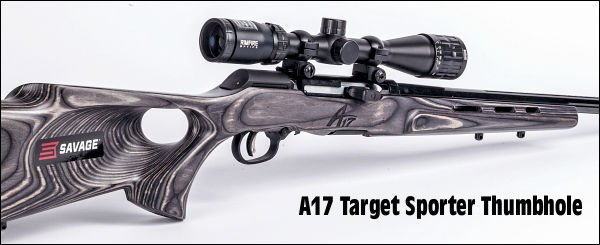
If you are looking for a 17 HMR varmint rifle, one rig you should definitely consider is the Savage A17. Now that this model is offered with laminated stock options, you can get a fine little 17 HMR rifle for about $475.00. We do prefer the laminated stock A17s (both standard and thumbhole models) over the basic polymer-stocked version, priced at $440.00.
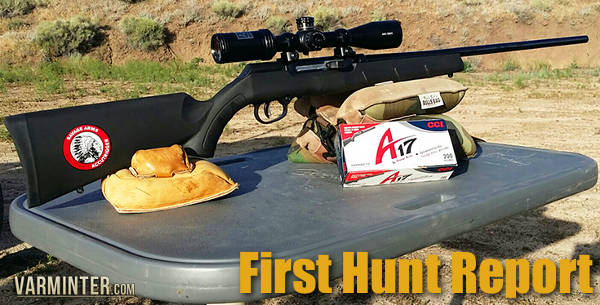
How does an A17 shoot? That question was answered a couple seasons back by Varminter.com in a First Hunt Report. Accurate and affordable, the Savage A17 is also the first .17 HMR to feature a delayed blow-back action. Eric Mayer, Editor of Varminter.com, put the semi-auto Savage A17 through its paces.
Mayer wanted to see how the new Savage would perform, accuracy-wise, and he also wanted to see how the A17 fared in the field. Mayer achieved one-MOA accuracy with the Savage A17 using the latest CCI-brand ammo, and he demonstrated the A17 is wickedly effective on ground squirrels. Below we’ve provided highlights from Varminter.com’s Savage A17 First Hunt Report.
“I [collected] as many versions of the currently available .17 HMR ammunition as I could get my hands on. I had already picked-up and tested the new CCI A17 ammunition, so I filled up my ammo safe with other CCI ammunition, as well as Hornady and Winchester, including the lead free 15.5 grain NTX versions, also from Hornady and Winchester. After spending some time at the bench, I saw that this rifle shot the CCI A17 ammunition best, with most groups hovering right around 1″ to 1.20″ at one hundred yards, and some of the other ammo choices in the 1.25″ to 1.50″ range. This was with a warm barrel and in-between cleanings during the break-in process.”
Mayer found the A17 was easy to maintain: “I was very impressed by the ease of pulling the rifle apart for cleaning out in the field. Even with the scope mounted, I was able to quickly and easily remove the parts needed to give me complete access to the barrel through the breach, so cleaning was a breeze.”
A17 Reliability Lessons — Seat Those Rotary Magazines Correctly Folks
Some early A17 purchasers have noted occasional failures to feed. We believe this is because the magazine was not fully seated (and locked in place) in the firearm. The experience of Varminter.com’s Editor seems to confirm this. Mayer reports “As I began to shoot the rifle, I experienced what a few others have reported, with the magazine falling out while shooting. I quickly realized that I was not snapping the magazine into place every time. I found that popping in the magazine while the bolt was pulled, or locked back, resolved the issue. I did have a few failures to feed, but only on some of the older ammunition I was shooting, namely the first year Hornady ammo and the lead free ammo (which is about 3-4 years old). The newer ammo did not have any issues and functioned well, even while shooting some 10-round ‘mag-dumps’. The trigger is on the heavy side.”
A17 Reliability Shown in Video
The Savage A17 went through a very thorough manufacturer’s testing process before it was released to the market. In fact Savage put over 500,000 test rounds through A17 prototypes. When AccurateShooter.com tested the A17 at Media Day — it worked flawlessly, so long as you make sure the magazine is fully seated. We had zero issues, making us think that reported issues may be related to “driver error”; specifically not seating the magazine properly. Watch AccurateShooter.com video with rapid fire sequence.
This week’s featured firearm belongs to John “SnakeEye” Seibel, founder of the VarmintsForFun website. In recent years, John has become a “true believer” in the little 20-Caliber cartridges. He says this light-recoiling 20 PPC, Rampro-actioned pistol is perfect for a quick shot on a critter, taken from the front seat of his truck. John tells us: “A long-range pistol is an ideal truck gun in my opinion. It stows in a small area and doesn’t take up the room a rifle does. Just keep ear protection near by at all times! I’ve taken varmints as far as 400+ yards with this 20 PPC pistol, so why would you need a rifle?”
Perspectives on Pistols for the Varmint Hunter
by John Seibel
I decided to try my hand at shooting varmints with a pistol one day when I grew tired of wrestling a rifle around in the truck for a quick shot. Many times when traveling around on the farm you’ll spy a groundhog or fox that usually isn’t more than 200 yards away. A single-shot pistol like the Thompson Contender could fit the bill. With its compact length, around 20 inches, a long-barrel pistol can lay on the truck’s passenger seat for easy access. I usually keep my two leather brick-style sandbags laying beside the console and seat. I have a box made from hard rubber that I lay across the top of the door. I then lay the two bags on top. This makes a nice platform to rest the pistol’s forearm. I like to use a forearm that is at least two inches wide. That lets the gun lay steady—almost like you are shooting from a bench rest. For the shooting hand, I prefer a pistol grip with finger grooves and a slight overhang or flare for the web of your hand.
As for optics, I tried long-eye-relief pistol scopes but they lacked the magnification you need for long-range target shooting or varminting. Those pistol scopes have really long eye-relief because they are designed to work with the pistol held at arm’s length. When shooting at the bench or from a truck that’s not what you want. By the time you find the target and get your eye in the exact location, the varmint has moved on or died of old age! After much fiddling around with pistol-type scopes, I finally decided to use rifle scopes on my long-range pistols. The minimum I use is a 4.5-14×40. Eye relief on a Leupold 4.5-14x40mm is about 3.5 inches at 4.5 power. Field of view is better with rifle scopes too and it’s easier to acquire your target. For this type of shooting a light-recoiling caliber is essential or you will have scope-eye bad! I currently have three long-range pistols and use them to shoot 17M4, 20 PPC, 22 BR, and .223 Rem. The featured gun may be the most accurate of my pistols, and your editor thinks it’s the most handsome of the three.
The Rampro Pistol Project — Working with John Illum
A couple of years ago I called John Illum of Rampro about building the ultimate long-range pistol. It just so happens that John was a big time long-range pistol shooter. I told him that I wanted a gun that didn’t recoil badly and wouldn’t torque when fired. As I am a quadriplegic, with no grip in my hands, the gun had to handle well under recoil so I didn’t drop it. Recoil had to be straight back–no twisting.
Well Illum listened to me and came up with a gun that performs just the way I wanted. Illum suggested a rear grip stock of his own design. It has a 2.25″ wide forearm and a rear grip with a slight palm swell that fits your hand perfectly. Another nice feature is the finger grips. It has an extended overhang or “beavertail” that fits comfortably in the web of your hand. Of course it had to be walnut! I chose Rampro’s STP small action with a PPC bolt. His bolt uses a Sako-type extractor. The action is a single-shot. Being right-handed, I chose a right bolt, left port configuration. This works really well in a pistol. You can load with your left hand and see the round laying in the action–that’s what you want in a pistol without a safety.
Gun Specifications John Illum’s Rampro actions are chrome-moly steel. Commonly you’d see them blued, but I had him put a brushed nickel finish on the action and rings. From a few feet away it looks like stainless. The trigger is Illum’s own design set at 8 ounces, and there’s no creep that I can detect. The action has Remington barrel threads and will accept Remington type triggers. One neat thing is that the action was milled with an integral recoil lug (much like the current Surgeon Action). And the bolt is milled all in one piece–no soldered-on handles. My only gripe with this bolt handle is that it could be a tad longer, but it still is manageable for a single-shot. You’ll also note how slick and streamlined the scope rings are. Illum made those as well. His rings mount to the action via two screws from the inside of the ring, a very elegant set-up for sure. (I currently have a 6.5-20x40mm Nikon scope on this gun. If I had to do this project over again the only thing I would change would be installing a 30mm scope because I like ‘em!).
The barrel is a PacNor Super-Match heavy taper with flutes milled by John Illum, who did all the gunsmithing on this pistol. Twist rate is 1 in 12 inches, with an 11° crown, polished to a mirror finish. The barrel was bead-blasted on the exterior to cut glare. I had Illum cut a 20 PPC minimum-spec chamber, with a .237″ neck. That way I don’t have to turn necks on the Lapua Brass (220 Russian necked down to .204). This is a varmint gun–there’s no need for turned necks. [Editor’s Note: Rampro is no longer in business. However, John tells us “I haven’t had any problems with the action so far. If I did, most competent gunsmiths could fix them easily.”]
Handgun Handling Tips
If you want to shoot a long-range pistol but have never have shot this kind of gun before, try to find a mentor — someone with a gun like this who can school you a bit in the correct technique. The first thing you notice is that you have no comb or cheek piece to help align your head and neck. And getting used to the optics takes some practice. Most people fit a pistol-type (long eye-relief) scope, but these can be awkward to use, and somewhat frustrating at first — the field of view is very restricted. Move your head very slightly and you can lose the sight picture completely. You can solve that problem by using a standard rifle scope, but that will put your head very close to the eye-piece — just three to four inches. With that arrangement, if you don’t hold the gun correctly … POW instant scope-eye!
Now once you get the hang of shooting a long-range pistol you will find it can be just as accurate as a rifle. But there is a trick to shooting them. Shooting a long-range pistol is a whole new world — you need to hold it just right. If you don’t let the gun roll back a little (i.e. if you grip too hard) you will get vertical stringing. I hold my hand against the back of the grip to guide the gun but let it almost free recoil. Looking at how compact the pistol is, you might think “Hey, this would make an ideal ‘walking-around’ varminter.” Well, that’s not really the case. For real precision shooting a solid benchrest type set-up is a must. You can attach a bipod to a long-range pistol, but you would need a flat surface. A fence-post top would work pretty well without a bipod if you carry a small light bag. Overall though, this type of pistol works best as a sandbag gun. For a walking-around gun, you’d be happier with a rifle I think.
Load Development and Accuracy
When I built this gun, Hornady had just released the 32gr V-Max (see footnote), a good match for my barrel’s 1:12″ twist. I choose the 20 PPC because of the very good Lapua brass (220 Russian parent case). I figured teaming Lapua brass with the little .204 bullet would offer excellent accuracy combined with very low recoil. My expectations were fulfilled. The brass proved to be excellent and the PacNor loved the little V-Max pills.
I tried quite a few different loads and most powders that I tried worked very well. These included: H322, Benchmark, AA 2460, and Reloader 7. Amazingly, with just 14″ of barrel, all of these powders delivered impressive velocities–ranging from 3914 to 4074 fps. I settled on 48 Harrell’s clicks of Accurate Arms (AA) 2460, which drives the 32gr V-Maxs to 3995 fps.
With AA 2460 the gun will shoot in the low 3s at 100 yards consistently — as long as I steer the gun right, which takes some practice. I think groups in the low 0.3″ range is excellent for a non-benchrest factory bullet. Despite having no buttstock to grab, recoil on my 20 PPC pistol is very minimal — it just rocks back into your hand. The main problem is to keep the scope from smacking you, since I used a rifle scope with short eye-relief. Muzzle flash and noise are tolerable but DO NOT shoot one of these without good ear protection. Your ears are very close to the muzzle.
I also have a 20 PPC rifle built on a BAT action with a Richard’s #008 laminated stock cut down in size. That gun’s 1:9″-twist Lilja barrel lets me shoot the Berger 50gr LTB bullets. In the wind, these perform quite a bit better than the 32s. My two favorite loads for the 50 grainers are: a) 26.0gr VV N135, CCI 450 primers, 3615 fps; and b) 27.3gr Hodgdon Varget, CCI 450s, 3595 fps. The BAT 20 PPC also shoots really well with the 40gr V-Max, pushed by N135 and Fed 205M primers.
Pistol Action Legal Issues
One important thing to remember if you build a pistol is to make sure the receiver came from the factory as a pistol and was titled as a pistol. Rifle actions are illegal to use as a pistol. Yes, that’s a nonsensical law, but it’s still on the books. You can use factory pistol actions such as the XP 100.
If you want a new custom action such as a BAT (my favorite), you can order it as a pistol action and when you get it, register it as a pistol. Note, in some states there may be additional fees, waiting periods, or restrictions for pistol actions (as opposed to rifle actions). Check your local laws before ordering the action.
Future Trends in Varmint Hunting — Plenty of Twenties
I think these sub-caliber rounds, both 20s and the 17s, are the future of recreational varminting, at least out to medium distances. The Twenties offer low recoil, excellent accuracy, and components keep getting better and better. The bullet-makers are finally making high-quality bullets in appropriate weights. Compared to something like a 22-250, I’ve noticed that my 20 PPC rifle has a lot less noise, a plus when you want to be quiet around other people and varmints.
The flat trajectory is another big advantage in the field. With the 20 PPC, zeroed at 100 yards, I can pretty much hold dead center and get hits out to 300 yards or so without touching the scope to add elevation. [Editor: The same is true with the 20 Practical cartridge, basically a .223 Rem necked down to .20 Caliber. It has proven very accurate and easy to tune.]
The 20-Caliber cartridges we have now, in particular the 20 PPC and 20 BR, are very well-refined. You don’t have to do a lot of tuning or tinkering to have a very accurate, effective varmint-slayer. In fact, if I could dream up a signature “20 VFF” (Varmints For Fun) cartridge it would basically be the 20 PPC. In truth, nearly any of the popular 17- or 20-Caliber cartridges will perform well if you start with top-quality brass. The sub-calibers have less recoil and burn less powder, and there are very good components for most varmint and target-shooting applications. To me it seems that these small calibers work so well because of good components, low recoil, and efficient cartridge designs (particularly in the VarTarg and PPC cases).
WARNING: For your own safety, ALWAYS reduce all starting charges by 10% and work up carefully! Ambient temperature changes, powder lot variations, and differences in barrel friction can result in significantly increased pressures.
20 PPC LOAD MAP
Bullet GR
Maker
Powder
Charge
Primer
Case
Velocity fps
Barrel Twist
Comments
32
Hornady V-Max
H322
27.6
Rem 7½
Lapua
4000
Lilja 1:12
WarrenB Form Load
32
Hornady V-Max
AA 2460
29.5
Rem 7½
Lapua
3995
PacNor 1:12
SnakeEye Pistol Load
32
Hornady V-Max
H4198
25.1
CCI BR4
Lapua
4222
PacNor 1:12
A. Boyechko Load
39
Sierra BlitzKing
H322
26.0
Rem 7½
Lapua
3700
Lilja 1:12
WarrenB Load
39
Sierra BlitzKing
VV N540
28.8
CCI BR4
SAKO
4064
PacNor 1:12
D.Moore, Low 2s
40
Hornady V-Max
VV N135
27.8
Fed 205m
Lapua
3950
Lilja 1:9
SnakeEye Load
50
Berger LTB
VV N135
26.0
CCI 450
Lapua
3615
Lilja 1:9
SnakeEye Load
50
Berger LTB
Varget
27.3
CCI 450
Lapua
3595
Lilja 1:9
SnakeEye Load
Footnote: When first manufactured, the small Hornady 20-Caliber V-Max bullet was actually 33 grains, not 32 grains as sold currently. I still have some of the 33-grainers. I’ve observed no functional difference between the 33s and the current 32-grainers.


 A varmint shooter’s target is not conveniently placed at a fixed, known distance as it is for a benchrester. The varminter must repeatedly make corrections for bullet drop as he moves from closer targets to more distant targets and back again.
 Minority View — Hold-Over is Better




 This cartridge was introduced by Winchester in 1935 in their model 54 rifle. A year later, it was added as a standard cartridge in the model 70. What might not be common knowledge to some reloaders is that the prototype for the Swift was developed in 1934-35 by Grosvenor Wotkyns by necking down the 250 Savage case, but in the end, Winchester chose the 6mm Lee Navy case for the foundation for this cartridge.









 Large Caliber Ammunition Available Also

 Rimfire cross-training allows PRS competitors to build their skill sets without breaking the bank (or burning out barrels). One great .22 LR option for cross-training is offered by CZ, the Czech arms-maker. The TFBTV video below spotlights the



 John Illum’s Rampro actions are chrome-moly steel. Commonly you’d see them blued, but I had him put a brushed nickel finish on the action and rings. From a few feet away it looks like stainless. The trigger is Illum’s own design set at 8 ounces, and there’s no creep that I can detect. The action has Remington barrel threads and will accept Remington type triggers. One neat thing is that the action was milled with an integral recoil lug (much like the current Surgeon Action). And the bolt is milled all in one piece–no soldered-on handles. My only gripe with this bolt handle is that it could be a tad longer, but it still is manageable for a single-shot. You’ll also note how slick and streamlined the scope rings are. Illum made those as well. His rings mount to the action via two screws from the inside of the ring, a very elegant set-up for sure. (I currently have a 6.5-20x40mm Nikon scope on this gun. If I had to do this project over again the only thing I would change would be installing a 30mm scope because I like ‘em!).
 Handgun Handling Tips
 Load Development and Accuracy
 Pistol Action Legal Issues
 I think these sub-caliber rounds, both 20s and the 17s, are the future of recreational varminting, at least out to medium distances. The Twenties offer low recoil, excellent accuracy, and components keep getting better and better. The bullet-makers are finally making high-quality bullets in appropriate weights. Compared to something like a 22-250, I’ve noticed that my 20 PPC rifle has a lot less noise, a plus when you want to be quiet around other people and varmints.


