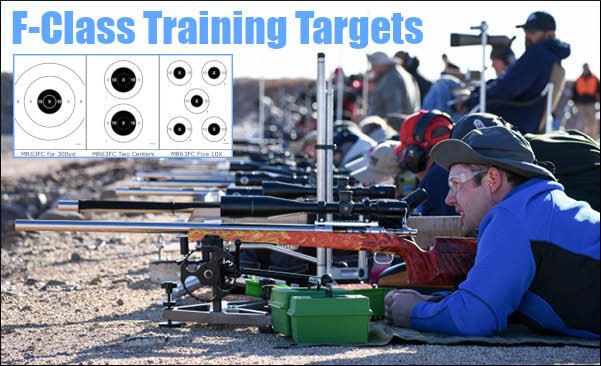
Download FREE F-Class Training Targets for 300 Yards
Ben Avery Match Photo by Sherri Jo Gallagher.
The 2026 F-Class National Championships run October 25 through November 1, 2026 at the Ben Avery Range outside Phoenix, Arizona. SEE F-Class Nationals 2026 INFO Page. With inflation and the high price of gasoline we know some F-Class shooters can’t make it to Nationals this year. For them, and other folks who are getting started in the sport, here are some special targets that let you train at your home range, even if it does not have target bays at 600 and 1000 yards. These special 300-yard Target Centers let you duplicate the exact MOA size of the official longer range F-Class targets, but at closer range.
F-Class Nationals
• F-Class Mid-Range Nationals: October 25–28, 2026 (Ben Avery)
• F-Class Long Range Nationals: October 29 – November 1, 2026 (Ben Avery)

Here is the sleek, carbon-stocked .308 Win rifle Bryan Litz used to win both the 2015 Mid-Range AND
Long-Range F-TR Championship at the Ben Avery Range in Phoenix, Arizona.
These reduced-size target centers were created by Forum member SleepyGator, an F-Class competitor who needed practice targets he could use at 300 yards. There is an official reduced-distanced standard for 300-yard F-Class matches. This utilizes the NRA No. MR-63FC – F-Class Target Center which is pasted over the MR-63 target. It provides a 1.42″ X-Ring, 2.85″ 10-Ring, and 5.85″ Nine-Ring. (The dimensions of F-Class targets are found in the NRA F-Class Highpower Rules, Sec. 4, part 4.1-4.7, pages 13-14 — link below.)

CLICK HERE to Download F-Class 300-yard Target Centers (.Zip archive with three targets)
To duplicate the 300-yard target, SleepyGator has prepared a printable version of the MR-63FC Target Center, along with a pair of training targets with two bulls and five bulls. The two-bull and five-bull targets mirror the scoring rings on the MR-63FC, but they display only the innermost three rings and two rings respectively. All three targets are Adobe Acrobat (PDF) files that can be easily printed. You may need to adjust the scale (sizing) on your printer to get the dimensions exactly correct. As noted above, when printed, the 10-Ring on all three targets should measure 2.85″. This should provide some handy practice targets you can use between matches. Thanks to SleepyGator for providing these targets. You can download all three as a .Zip archive. After downloading the .Zip file, just click on the .Zip archive to extract the individual targets.


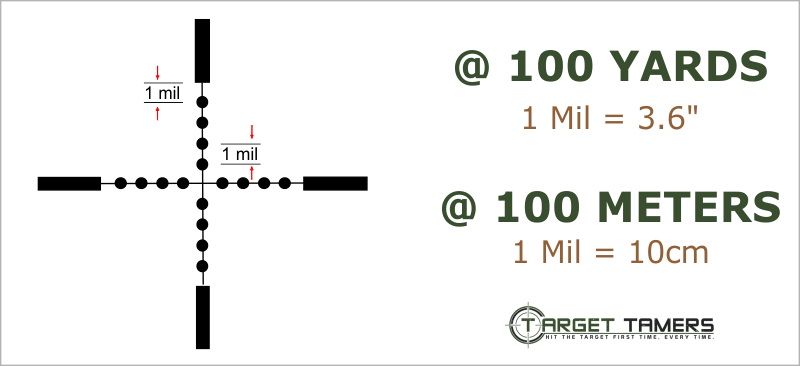
 In this NSSF Video, Ryan Cleckner, a former Sniper Instructor for the 1st Ranger Battalion, defines the term “MilliRadian” (Milrad) and explains how you can use a mildot-type scope to range the distance to your target. It’s pretty simple, once you understand the angular subtension for the reticle stadia dots/lines. Cleckner also explains how you can use the milrad-based reticle markings in your scope for elevation hold-overs and windage hold-offs.