Eurooptic vortex burris nightforce sale


teslong borescope digital camera barrel monitor


As an Amazon Associate, this site earns a commission from Amazon sales.


October 21st, 2026

Smith & Wesson Acquires Savage Arms — $160 Million Deal

smith wesson s&w own acquires merger savage arms rifle manufacturer

smith wesson s&w own acquires merger savage arms rifle manufacturerSmith & Wesson Brands, Inc. (“Smith & Wesson”, Nasdaq SWBI), a U.S.-based leader in firearm manufacturing and design, today announced that it has acquired Savage Arms (“Savage”) by merger from an indirect subsidiary of JDH Capital I, L.P. (“JDH”). The price of the acquisition is listed at $160,000,000 in stock value and cash.

The transaction combines two iconic American firearm manufacturers with leading capabilities across distinct segments of the firearms market. Savage’s strength in hunting and bolt-action rifles is highly complementary to Smith & Wesson’s leadership position in handguns and growing presence across other long gun categories, creating a broader product portfolio.

Savage has been producing firearms for more than 130 years and is one of the world’s largest manufacturers of hunting, competition and target shooting centerfire and rimfire rifles and shotguns.

According to Shooting Times: “The combined company [S&W plus Savage Arma] will immediately rank as the largest commercial firearms manufacturer in the United States, with a full-line product offering spanning handguns, revolvers, rifles, shotguns, and suppressors. Savage brings roughly $160 million annual net sales and a dedicated, skilled workforce of approximately 500 to the Smith & Wesson family, strengthening the combined company’s position at a moment when consumer demand for American-made firearms across every category remains strong.”

Mark Smith, President and Chief Executive Officer of Smith & Wesson, commented, “The acquisition of Savage is a transformative step for Smith & Wesson and an important milestone in our strategy to be the undisputed market leader in the firearm industry. Savage’s brand heritage, culture, and longstanding reputation for performance and innovation align closely with our own, and the business meaningfully expands our presence in the hunting category. By bringing these two companies together, we have created a broader, stronger platform with significant opportunities to better serve our customers, accelerate innovation, realize operating efficiencies and drive long-term value for our stockholders.”
smith wesson s&w own acquires merger savage arms rifle manufacturer

Michael Fertitta, Managing Director of JDH, commented, “Savage has a storied history spanning more than 132 years, and we are incredibly proud of the business and brand the Savage team has built. Smith & Wesson is a natural partner for Savage given the complementary strengths of the two companies and their shared commitment to quality, innovation and serving the firearms community. We are excited about the potential of the combined business and look forward to participating in its continued success as a significant Smith & Wesson stockholder.”

Transaction and Company Details

• Acquisition Date: October 21, 2026
• Deal Value: $160 million in cash and stock
• Previous Owner: JDH Capital I, L.P. (which becomes a Smith & Wesson stockholder)
• Savage Headquarters: Westfield, Massachusetts
• Savage Workforce: Approximately 500 employees
• Annual Net Sales (Savage): Roughly $160 million

Strategic Impact

• Product Complementarity: Merges Smith & Wesson’s handgun leadership with Savage’s footprint in bolt-action and hunting rifles.
• Market Scale: Creates one of the largest combined commercial U.S. firearm manufacturers, spanning handguns, revolvers, centerfire/rimfire rifles, shotguns, and suppressors.

Permalink - Articles, Gunsmithing, News No Comments »
October 21st, 2026

Top Barrel-Makers Explain the Best Way to Clean Your Barrels

Shooting Sports Lohman Barrel

Ask 10 shooters about barrel cleaning and you’ll get 10 different opinions. This reflects that fact that different fouling problems demand different solutions. For example, solvents that work well for copper may not be the best for hard carbon (and vice-versa). To come up with the right solution, first you must understand the nature of the fouling in your barrel.

CLICK HERE to read Full Match Barrel Care Article »

Chip Lohman, former Editor of Shooting Sports USA Magazine, has authored an excellent article on barrel maintenance and cleaning. Chip’s article, Let the BARREL Tell You — Match Barrel Care, is in the Shooting Sports USA digital archives. In this article, Chip shares the knowledge of a dozen experts including respected barrel-makers Frank Green (Bartlein Barrels), John Krieger (Krieger Barrels), Dan Lilja (Lilja Barrels), and Tim North (Broughton Barrels).

John Krieger Interview with AccurateShooter at SHOT Show:

The debate about the proper care of a match barrel is a hot one, spiked with folklore and old wives’ tales, Lohman said. He and his staff set out to set the record straight: “We tried to interject some science into the discussion of cleaning a match barrel,” he explained. In his article, Lohman writes:

Why worry about a little barrel fouling when the throat is subjected to a brutal 5,600° F volcano at 55,000 PSI? To investigate these and other questions about taking care of a match barrel, we spoke with a dozen experts and share their knowledge in this first of a series of articles.

After listening to folks who shoot, build barrels or manufacture cleaning solvents for a living, we concluded that even the experts each have their own unique recommendations on how to care for a match barrel. But they all agree on one thing — the gun will tell you what it likes best. Because the life expectancy of a match barrel is about 1,500 to 2,500 rounds, the objectives of cleaning one should include: preserve accuracy, slow the erosion, and remove fouling — all without damaging the gun. This article doesn’t claim that one cleaning method is better than the next. Rather, we set out to interject a little science into the discussion and to share some lessons learned from experts in the field.

For more Shooting Sports USA articles, visit www.ssusa.org.

Permalink - Articles, - Videos, Tech Tip No Comments »
October 21st, 2026

Vertical Flyer Issues? Check Your Firing Pin and Ignition System

USAMU Handloading vertical dispersion ignition rimfire accuracy firing pin
Top to bottom: Remington firing pin assembly with ISS, Tubb SpeedLock alloy-composite system without ISS (current versions have dual, opposite-wound springs), and Remington short action firing pin assembly without ISS.

The U.S. Army Marksmanship Unit regularly publishes technical articles on the USAMU Facebook page. One informative USAMU article covered mechanical issues and related ignition irregularities that can cause vertical fliers even with good ammunition in an otherwise excellent rifle. We highly recommend you read this article, which offers some important tech tips.

USAMU handloading hump day

Vertical Dispersion: Mechanical/Ignition Issues?

Poor or inconsistent ignition has long been known to be one of the “usual suspects” when one encounters vertical fliers that just shouldn’t be there. By having a sense of some of the basic principles involved, and a few basic areas to check, the shooter may avoid colsiderable frustration, not to mention time, expensive loading components and barrel wear.

USAMU Handloading vertical dispersion ignition rimfire accuracy firing pinIs your well-built rifle of high-quality components plagued with vertical fliers across more than 1-3 handload combinations? Consider the bedding, crown and scope/sight mounts. Are they correct? If so, then you might check for ignition issues before boldly undertaking an extensive, expensive, and quite possibly fruitless quest for the “magic handload”.

SEEING IS BELIEVING: While the author had been aware for many years that poor ignition should be considered and ruled out when dealing with vertical fliers in an otherwise-excellent rifle, actually seeing the problem and its almost instantaneous cure really drove the lesson home.

He was working with a “dot” rifle – a .22 LR match rifle that really stacked bullets into little piles at 50 yards and beyond. With one lot of ELEY Tenex, it produced consistent “bughole” groups at 50, but with another, selected lot of Tenex, similar groups were regularly ruined by single, vertical fliers that did not appear in other rifles. Rather than spending days burning up expensive, select ammunition looking for “magic lots”, he contacted a well-respected rimfire gunsmith and explained the situation.

Without so much as batting an eye, the highly-experienced ‘smith tore into the rifle’s action, and quickly found the cause(s) of the problem. He discovered a demonstrably weak firing pin spring, plus a chip out of the face of the firing pin where it contacted the cartridge rim.

After replacing and tuning the offending parts, the rifle immediately began shooting tiny, bughole groups with the previously “unacceptable” lot of Tenex. Centerfire rifles can also benefit from ensuring positive, consistent ignition. A wise riflesmith is literally worth his weight in gold!

So, what are some issues we as shooters can inspect in our rifles to help determine if ignition woes could be part of our problem? At the club level, ask yourself if that “experienced” Remington, Winchester 70, or even Springfield-based match bolt gun you’re using is still running its’ original 40-80 year-old factory striker spring? If so, a new replacement is cheap insurance against current or future problems. (And BTW, it might be best to stick to the normal, factory-spec spring weight. A super-powerful spring can cause vertical, just as a weak one one can.) Along with that, a routine check for proper firing-pin protrusion is a quick preventive measure that can rule out potential issues.

Other areas to consider are the centering and consistency of the firing pin’s operation in the bolt. Admittedly, with the increasing use of precision-machined custom actions, this is becoming less an issue every day. Below is the firing pin assembly from a custom BAT action:

USAMU Handloading vertical dispersion ignition rimfire accuracy firing pin

However, particularly with factory actions, a very quick and easy check is to remove the bolt, let the firing pin go forward, and look at the firing pin tip through the firing pin hole. Is the tip off-center in the hole, and possibly striking it as it moves forward? Is the hole out-of-round or burred from being struck repeatedly? If so, a trip to the riflesmith is likely in order.

Similarly, machining issues in the bolt/firing pin system can lead to rough and erratic firing pin movement, in which the firing pin drags against an internal surface of the bolt. In high-quality rifles these issues are relatively rare, but not unheard-of, and it takes mere minutes to rule them out. It may be worthwhile to remove the cocking piece/firing pin/spring assembly and look for any unusual gouges, dings, peening, burrs or signs of abnormal wear.

This task is especially easy with Winchester 70s, Springfields, and the similar Mauser 98s, involving little more than the push of a button and unscrewing the cocking piece assembly. This is just one of the many reasons these tried-and-true actions have earned such a loyal following in the field, among hunters who must maintain their rifles away from a shop.

USAMU Handloading vertical dispersion ignition rimfire accuracy firing pin

Particularly with older rifles, watch for and remove excess grease (or even Cosmoline!) from both the firing pin assembly and inside the bolt. This can help improve firing pin speed and consistency. Other bolt-action designs may need a take-down tool or other measures.

As part of this inspection, AFTER ENSURING THE RIFLE IS UNLOADED, slowly cock the rifle, dry-fire, and repeat several times. Listen carefully near the action for inconsistency in the sounds it generates. Does the striker falling make the same sound each time? Do you hear or feel grinding upon operation? If so, where?

Be sure to check the operation of the cocking piece (bolt shroud), firing pin within the bolt shroud, the cocking piece cam and the rear of the bolt body where the cocking piece cam operates. As with our examination for abnormal wear marks discussed above, look for marks indicating roughness or a possible need for light polishing. Then, clean and lightly grease the bearing surfaces while you’re at it.

Remington 700 bolt shroud and cocking cam
Rem 700 bolt cocking cam

These are relatively easy checks that shooters can undertake to perform a preliminary inspection on their own. Other mechanical issues can also cause ignition issues, chiefly centered around the action of the trigger, sear and sear spring. If these are suspected, a trip to an experienced, qualified riflesmith for diagnosis is recommended. We hope you find this information helpful! Join us again next week, and in the meantime, enjoy the shooting sports safely!

Permalink - Articles, Gear Review, Gunsmithing No Comments »
October 21st, 2026

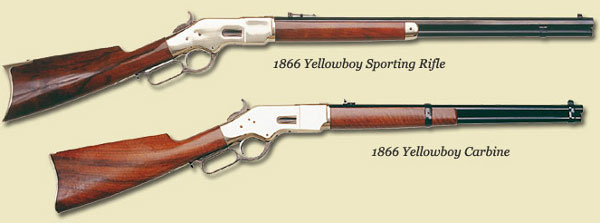
Models 1866 and 1873 Lever-Action Rifles — American Classics

Uberti 1866 1873 Winchester lever gun

While devotees of this site are hard-core accuracy addicts, who normally shoot tiny groups with sophisticated Benchrest and Varmint rifles, we should not overlook the pure fun of shooting a classic iron sights lever-action rifle at reactive targets. Lever guns are fun to shoot, easy to transport, AND they require a lot less maintenance than your modern black rifle.

Drilling a tight 1/4-MOA group is very satisfying. But for simple, basic shooting fun, it’s hard to beat a slicked-up, “race-ready”, Winchester-clone lever gun. In fact, this Editor’s favorite rifle for “fun shooting” is my 20″ Uberti Model 1866 “Yellowboy” Lever gun. Shooting low-recoil .38 Special rounds at steel targets from a standing position offers old-fashioned shooting satisfaction. When I invite a new shooter to the range, I usually bring the 1866 Yellowboy, and let the newbie shoot steel at 50 yards. New shooters (of all ages) love the look and feel of the rifle, and the low recoil. The typical response is: “Wow, that was fun!”.

My rifle features a slicked-up action and lightened trigger. After a “CodyMatic” action job by cowboy gunsmith Cody Conagher, my Yellowboy’s lever can be cycled with just one finger. Trigger pull is about a pound and a half. The high-gloss, blued octagonal barrel is very accurate and the mirror-finish bore cleans up easily.

Uberti Winchester 1866 Yellowboy

Based on the Model 1866 Winchester, Uberti’s Yellowboy, and its Model 1873 “older brother”, feature a toggle-link action that is extremely smooth. The toggle action design also keeps the linkages separate from the chamber so the gun runs extremely clean. After firing 100 rounds or more, all you need to do is wipe off the bolt and breech-face with some solvent and run a bore-snake down the bore a few times. To be honest, the Yellowboy is more fun to shoot at steel than my AR Carbine. And maintenance-wise, for every five minutes I spend cleaning the 1866, I’ll spend an hour detail-stripping and cleaning the AR. The shooting-to-cleaning ratio favors the lever gun by orders of magnitude.

Uberti Winchester 1866 Yellowboy

These Italian-made Winchester clones are very handsome, with nicely figured wood under a durable clearcoat. You can polish the brass receiver to keep it shiny, or leave it alone to develop an authentic, dulled patina. Uberti’s Model 1873 features a steel receiver with gorgeous color case-hardening.

Uberti Winchester 1873

After the fun factor, what’s the best thing about Uberti lever guns? Resale value. I can sell my 1866 for quite a bit more than I paid for it. Over the past decade, the price of Italian-made Uberti lever guns has been steadily rising. This means that older rifles fetch a premium on the used market.

Permalink - Videos, Gear Review, Hunting/Varminting No Comments »