This coming Saturday, September 27th, is National Hunting and Fishing Day, held each year on the fourth Saturday of September. To help the avid hunters among our readers, here are Twenty Tips that can help ensure a safe and successful hunt. These tips have been compiled from our AccurateShooter Hunting Forum, with help from Hunting Editor Colton Reid (who has already been out hunting this month). Some items are preparatory — such as working with maps, sighting in the rifle, and improving physical fitness. We also talk about equipment — having the right gear, from proper boots to a GPS for multi-day hunts.
Of course there are entire volumes written on hunting, but these 20 Tips can benefit all hunters. Follow these suggestions and you should have a safer hunting experience with greater likelihood of success. If you liked these pointers, you’ll find two dozen more helpful hints on the NSSF Website.
Preparations Before The Hunt
1. Map Your Hunt and Notify Others — Before your hunt, make a plan and notify friends and family members about WHERE you are going and your intended return date and time. Print out a Google Satellite map and locate landmarks and trailheads. Mark where you plan to park your vehicle and give a copy of this map to friend and/or family members. A hunter may injure himself by falling off a rock, or tumbling in a creek-bed. After that kind of injury the hunter may be confused or unable to walk. If you get stranded in the wilderness, you want trusted persons to know where you are. So, before you leave on a trip, provide a map to a friend or family member. Show them where you will leave your vehicle, and where you expect to be every day of your hunting adventure.
2. Licenses and Permits — Make sure you have a valid hunting licenses and all the necessary tags. Begin this process with ample time before your intended hunt(s). The NSSF adds: “If you are crossing state or national borders, find out about any special considerations you must take care of. Border crossings can mean knowing about firearm transport laws or Chronic Wasting Disease-related regulations.”
3. Work on Your Fitness — On a multi-day hunt you may be trekking many miles. You need to be in good shape. If you are out of shape you may be putting yourself in a precarious situation, particularly if you underestimate the terrain difficulty. As the NSSF says: “Not being able to handle the conditions lessens your chances of success, can turn a great experience into an agonizing one and can endanger your health.”
4. Do Your Homework — Study the area you will be hunting. Talk to other hunters. Look at satellite photos. Get a real sense of the walking and terrain challenges. For a multi-day hunt, MAKE a PLAN. The NSSF states: “Eliminate surprises. Learn as much about where you will be staying, the area you will be hunting, what the weather might be like and what you need to bring[.]”
5. Rifle and Ammo — Make sure your rifle is sighted-in and your ammo is tested. Sight-in your rifle with the ammo you plan to use on your hunt. CLICK HERE for 4-Shot Sight-in Method. After sighting-in from the bench, confirm your zero by shooting from typical hunting positions (kneeling and with forearm supported on a rock or post).
6. Shooting Positions — Practice the shooting positions you will use in the field. Practice sitting, kneeling, and prone positions. You should also practice with shooting sticks, using your day pack as a rest, and with a bipod. Try to have a rock-steady rest before taking your shot.
7. Back-Up Irons — If possible, select a rifle with back-up iron sights. While modern scopes are very durable, they can and do fail (glass can crack). If you’ve invested a lot of time and money in your hunt, back-up iron sights can keep you in the game even if your riflescope fails.
8. Communications and GPS — Bring a GPS if you are in a wilderness area far from civilization. It’s a good idea to bring a cell phone, but you may not have coverage if you’re quite a distance from populated areas. A smart-phone also doubles as a digital camera to record your trophies. For navigation and safety, consider getting Garmin inReach Explorer+. This high-tech handheld unit features interactive SOS, connecting you to the GEOS 24/7 search-and-rescue monitoring center. They also allow you to send and receive text messages, no matter where you are, via advanced inReach satellite technology. Yes you can communicate even if you are miles from the nearest cell tower.
9. Select Good Gear — Make sure you have GOOD BOOTS that are comfortable — you’ll spend a lot of time on your feet. You may want a pack with harness for your rifle so you have both hands free. On a multi-day trip, make sure you can carry enough water, and that you will stay warm enough at night. Good practices for backpacking apply to multi-day hunts.
10. Make a Gear Checklist — Create a complete checklist of the gear and supplies you need. That includes arms, ammunition, rangefinder, binoculars, proper clothing (including spare clothes), hunting accessories, sleeping gear (on multi-day hunts), toiletries, medications. Don’t forget a good first aid kit — lots of bad things can happen during any wilderness trip. You can cut a hand, break an ankle or worse.
During The Hunt
11. Have a Plan — know where you plan to go and when. Try to be where you want in the early morning and early evening hours when deer are likely most active.
12. Take Your Time — If you spot a deer and get too excited and don’t take your time you may spook him. Go slow and glass. If possible, wait for the animals to bed down and relax. Then work out the best way to approach your prey. Remember, “You get so few opportunities, don’t screw it up!”
13. Glass More, Walk Less — Let your eyes do the walking — get good binoculars and use them. With their heightened senses of smell and hearing, deer/elk are able to spot you way better than you can spot them. If you are walking around a lot, chances are you are getting spotted by your prey.
14. Riflescopes Are Not Binoculars — Never use a riflescope as a substitute for binoculars. The temptation to do so is real, but when one does this, one is by definition pointing the muzzle of the gun at unknown targets. We like binoculars with built-in rangefinders. When glassing at long range, try supporting your binoculars on your pack.
15. Be Sure of Your Target before Shooting — Every year during whitetail season, farmers are forced to spray-paint their cattle or risk having them “harvested” by hunters who don’t bother confirming the species in their sights. Hunters with “buck fever” can make mistakes. When in doubt, don’t shoot.
16. Know When to Unload — When finished hunting, unload your firearm before returning to camp. You should also unload your gun before attempting to climb a steep bank or travel across slippery ground.
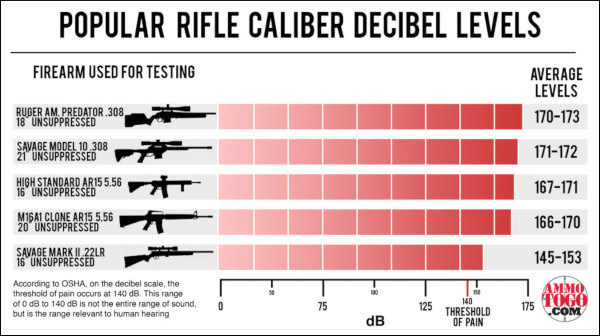
17. Bring Hearing Protection — While pursuing and stalking your prey you’ll want full sensory use of your ears. But when you’re finally ready to take the shot, slip in hearing protection. A shot from a large-caliber hunting rifle can exceed 170 decibels. Unprotected exposure to noise from a SINGLE 170+ dB shot can cause permanent hearing damage. (Source: ASHA.org). If you make a follow-up shot, you double that noise hazard. Therefore a hunter with a non-suppressed rifle should have hearing protection available.
You can keep a pair of easy-to-use quick-insert ear plugs on a cord around your neck. Or, get a lightweight neck band with earbuds, such as the Sellstrom Band, Peltor Band, or 3M Safety Band, all with a good 25 dB or better Noise Reduction Rating. You can keep these lightweight bands around your neck for quick deployment before you shoot.
“Once a hunter is successful, the REAL work begins.” — Colton Reid
18. Harvesting the Animal — When dressing your animal, be careful with the meat. You’ll want very sharp knives. Some hunters prefer knives with replaceable, razor-sharp blades. Don’t rush the task. Make sure you don’t get moisture or dirt on meat. The three spoilers of meat are heat, moisture, and dirt.
19. Pace Yourself When Packing Out — If you DO succeed, and bring down a big buck, will you be able to dress the animal and carry out the meat? Always be prepared to hike out with extra weight. If you are successful, make sure not to waste the meat you worked so hard for. Choose a pack that can help you carry a heavy load. Remember, this is not an insignificant challenge — you may be carrying 60 to 100 extra pounds in addition to your other gear. Again, take your time. Rest as needed. Don’t hurt yourself.
20. Remember to Enjoy the Experience — Our Hunting Editor, Colton Reid, offers this sage advice to all hunters, but particularly to novices: “Have fun, and appreciate your hunt, whether you bag a buck or not. It is a privilege to experience the wilderness and to get away from the city. Enjoy it while you’re out there. And keep your spirits up. You may get tired, but remember that ‘comes with the territory’. At the end of the day, yes you may be exhausted. And you may want to quit and go home. But stay positive, stay focused. Be patient, the experience is worth it.”
CLICK HERE for Hunter Training/Mentoring Programs State-by-State.
Visit WhereToHunt.org
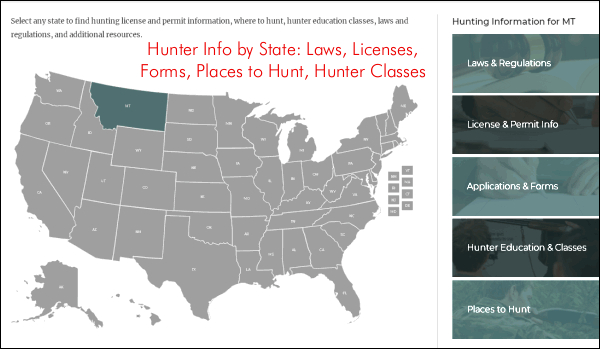
There’s a great online resource for hunters that will help you find game locations in your state and ensure you have all the proper permits and game tags. WheretoHunt.org features an interactive map of the country. For all 50 states, the NSSF has compiled information about hunting license and permits, where to hunt, hunter education classes, laws and regulations and more. For each state you’ll also find a link for required applications and license forms.
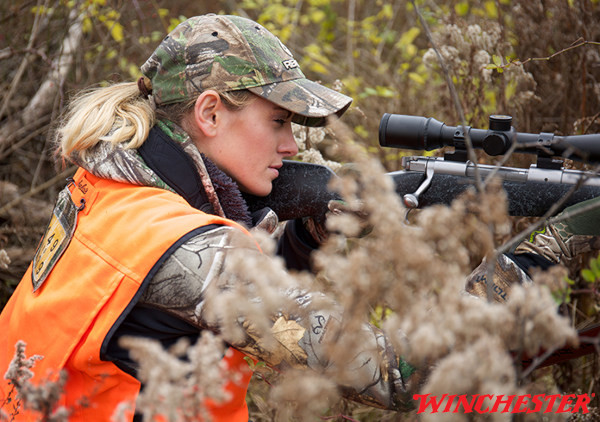
Deer hunting season is underway now across the country. If you plan a hunt in the days or weeks ahead, here are three important tips to follow if you want to successfully harvest a deer this fall. These tips come from an article by noted huntress Nikki Boxler for the Winchester Blog. CLICK HERE to read full article from Internet Archive.
Mistake #1: Not Sighting-In Your Gun with the Ammunition You Plan to Hunt With
You want to make sure you test the actual ammo you will use in your deer rifle. Make sure you are sighted-in properly with THAT ammo. Nikki says: “I always make it a point to shoot a few days before the season opens with the exact ammo and equipment that I will use while in the woods. Nothing gives me more confidence then knowing those last shots are hitting their target[.]”
Mistake #2: Rushing the SHOT — Focusing on Taking the Shot, Rather Than on MAKING the Shot
Being in the right place at the right time is essential to getting a shot on a deer. If you can’t MAKE the shot, being in the right place at the right time doesn’t matter. I have been guilty of this. A buck walks in and the conditions are perfect. He’s not far, but instead of taking my time I rush the entire shot and the results are not as I desired.
Mistake #3: Sticking to the Same Tactics Day in and Day Out
Throughout the course of the season, deer switch up their tactics. So, why wouldn’t we? When I was younger all of my hunting setups always looked the same — I’d have a ladder stand on the edge of a field. This was my comfort zone. I always stuck to it until recent years. I’ve now made it a point to step out of my comfort zone and explore new areas. This has definitely paid off with the percentage of deer I harvest.
Hunting season is coming soon around the country. If you want to get hunting tips from experts, here is a great audio “infotainment” resource. Leupold offers podcasts, 40-75 minutes in length, on a variety of topics of interest to hunters and precision shooters. A podcast is like a radio show that is available 24/7, at your convenience. When you want to “tune in”, via your home computer or mobile devices, just visit the Leupold Podcast Page.
Oregon-based optics-maker Leupold & Stevens (“Leupold) offers the “Core Insider” podcast series. These podcasts deliver hunting advice and recount successful hunting trips — such as Caribou hunting in Alaska. Other Leupold podcasts provide optics info, industry intel, and tech tips. Leupold’s Core Insider podcasts can also be accessed directly from Leupold.com. From the Leupold Podcast Home Page, you can stream the podcasts live or download for later listening.
You can also stream these podcasts via iTunes, and Spotify.
The Leupold Core Insider Podcasts cover a wide variety of shooting and hunting topics. Recent Episode 90 provides useful tips for novice hunters. The informative Episode 55 explains how Binoculars and Rangefinders function. Episode 36 explains how to prepare game meat from a successful hunt. There are now 96 Leupold Podcasts available online for FREE.
Episode 90: Randy Newberg’s Tips for New Hunters. Click to launch Leupold Ep. 90 Podcast Page:
Episode 55, How Binoculars and Rangefinders Work. Click to launch Leupold Ep. 55 Podcast Page:
Episode 36, The Art of Wild Game Cooking. Click to launch Leupold Ep. 36 Podcast Page:
There are now ninety-six (96) Leupold Core Insider Podcasts. Here are ten of our favorite episodes. Click links below to access:
At the request of our readers, we provide select “Deals of the Week”. Every Sunday afternoon or Monday morning we offer our Best Bargain selections. Here are some of the best deals on firearms, hardware, reloading components, optics, and shooting accessories. Be aware that sale prices are subject to change, and once clearance inventory is sold, it’s gone for good. You snooze you lose.
NOTE: All listed products are for sale to persons 18 years of age or older. No products are intended for use by minors.
1. Midsouth — Major Reloading Tools Sale
⏺️ » Big savings on wide range of reloading tools and products
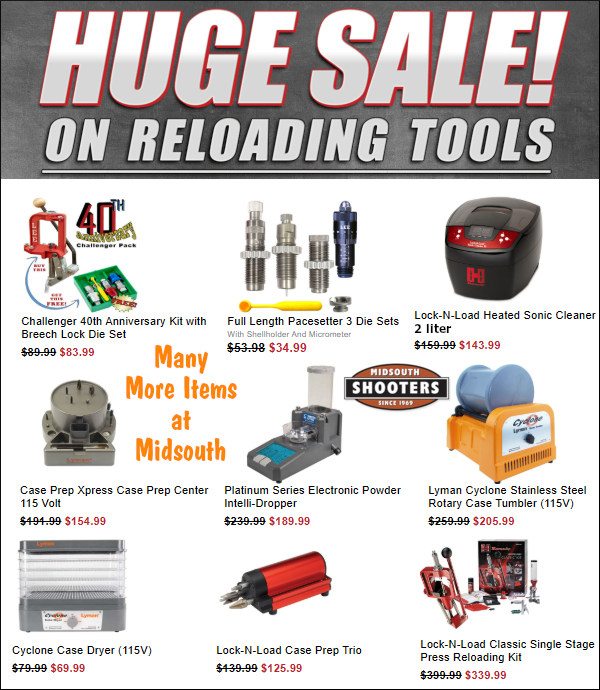
Midsouth is running one of its biggest tool sales of the year. You’ll find major discounts on reloading presses, powder dispensers, case prep machines, tumblers, scales, dies and more. If you need reloading equipment, head over to Midsouth this week. One of the more amazing bargains is a Lee Challenger Press with a full die set all for just $83.99 total. Another great deal is the Frankford Arsenal Intelli-Dropper powder scale/dispenser for just $189.99.
2. MidwayUSA — Vortex Scopes 40-55% Off
⏺️ » Major savings on good scopes for hunting or PRS/NRL
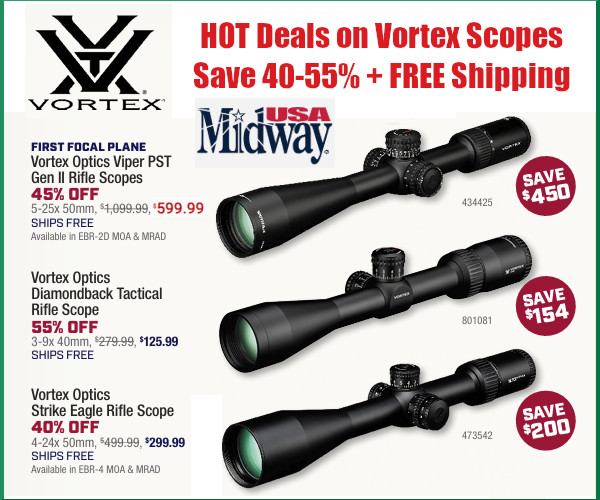
MidwayUSA has great discounts currently on popular Vortex scopes for hunting, PRS/NRL, and target shooting. You can save 40-55% with these special promotions. For example the FFP 5-25x50mm Viper PST Gen II scope is now just $599.99, a $500 (45%) discount off the regular $1099.99 price. This is a good choice for PRS/NRL competition. Or get the Vortex Diamondback 3-9x40mm Diamondback Tactical Scope for just $125.99, a 55% savings. NOTE: Many Vortex scopes currently qualify for FREE Shipping.
3. Sportsman’s Warehouse — Savage Rifle Sale, from $329.37
⏺️ » Great deals on rifles just in time for hunting season
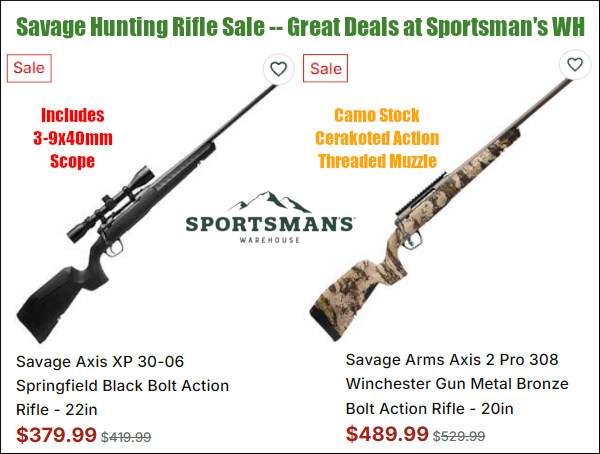
Among the offerings in the Sportsman’s Warehouse Savage Sale are a Savage Axis XP .30-06 Springfield complete with scope for just $379.99 — an incredible deal. Or get the .223 Rem Axis XP for just $329.77. If you want a nice camo stock, consider the Savage Axis 2 Pro in .308 Win, now $489.99 on sale. Many other chamberings are offered for both the Axis XP and Axis 2 Pro rifles. NOTE: You can also get FREE Shipping on orders over $49.00.
4. EuroOptic — Leica Rangefinder/Binoculars Sale, Up to $300 Off
⏺️ » Outstanding compact rangefinders and advance rangefinder binoculars
Leica makes some of the very best laser rangefinders and binoculars with integrated rangefinders. We’ve tested Leica’s rangefinder binoculars and were very impressed. These were able to range a deer-sized object at very long distances, and the optic quality was superb. Right now EuroOptic is running a major sale on Leica LRFs and Rangefinder binocs. You can save $100 on a CRF-PRO Laser Rangefinder, and many hundreds on high-end GeoVid Pro combo LRF binoculars.
5. Midsouth — Lyman Gen 6 Powder Scale/Dispenser, $199.99
⏺️ » Good advanced powder scale/dispenser at great price
Here’s a good, modern powder scale/dispenser at a HUGE discount. The Lyman Gen 6 Compact Powder Dispenser System is now $54 Off at Midsouth. That’s $125 less than a Hornady scale/dispenser. This Lyman unit is accurate to +/- 0.1 grains and can use any type of smokeless powder. It has a fast warm-up, anti-static/anti-drift technology, with sophisticated electronic shielding to resist interference from other electronic devices. This unit comes with calibration weight, powder tray, and cleaning brush.
⏺️ » Save $125 on good spotting scope for hunting or competition
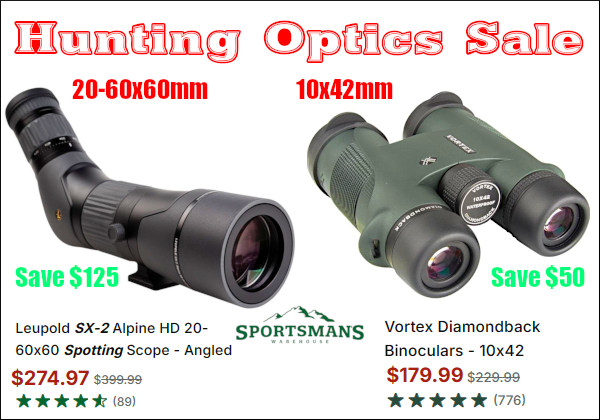
Leupold SX-2 Alpine HD (High Definition) spotting scopes provide exceptionally clear glass and high light transmission, along with a great Leupold warranty. Right now you can save $125 on the Leupold SX-2 Alpine HD 10-60x60mm spotter, on sale for just $274.97. And check out the Vortex Diamondback 10x42mm Full Size Binoculars for just $179.99 — a $50 savings. For just $455 combined, these two optics give a hunter all he needs to spot deer/elk in the field.
7. Amazon — Revasri 1000-Yard Rangefinder, $41.99
⏺️ » Very low price, but many good features
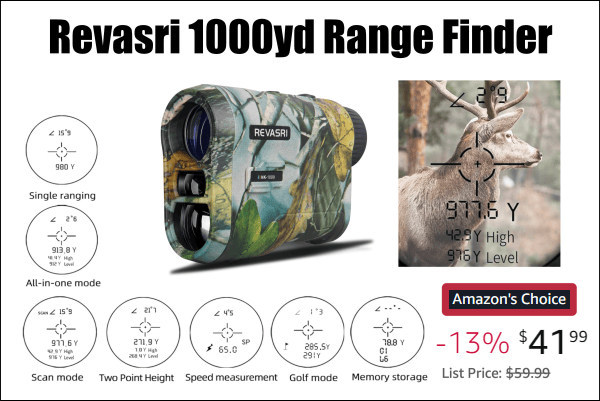
If you need a basic laser rangefinder and don’t want to spend a lot of money, consider the Revasri 1000yd Rangfinder (#ad) now just $41.99 on Amazon. This laser rangefinder for hunters has 7 functions: ranging mode, all-in-one mode, scanning mode, speed measurement mode, two points height measurement mode, golf distance compensation mode and storage mode. This rangefinder has a convenient memory function which will open the mode you used before shutting down.
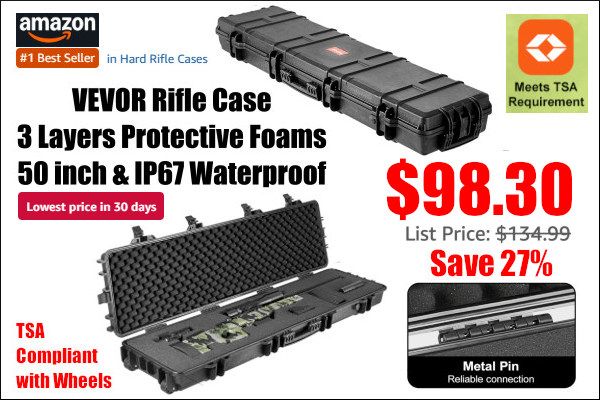
8. Amazon — VEVOR 50″ Rifle TSA-Compliant Hard Case, $98.30
⏺️ » Good waterproof hard case with wheels — great value
Protecting your firearms requires a good, tough transport case. The VEVOR 50″ Rifle Case (#ad) features three layers of protective foam, solid locking points, wheels, and a IP67 waterproof case. This VEVOR gun case meets TSA gun case requirements, making it a good choice for rifle owners who travel by air. At just $98.30 (27% off) this is a great deal — much cheaper than other wheeled rifle cases of similar size.
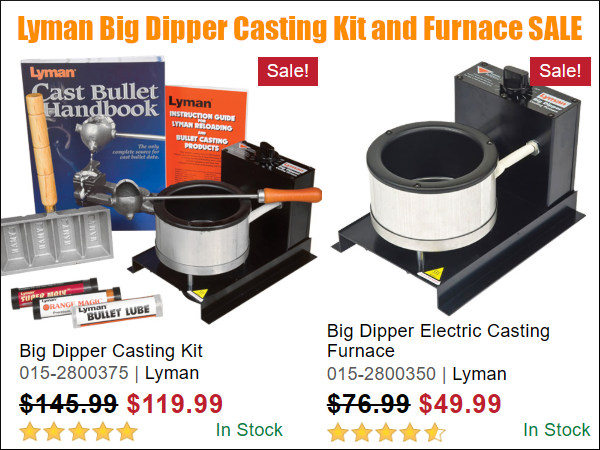
9. Midsouth — Lyman Bullet Casting Systems, $49.99 and $119.99
⏺️ » Save 35% on Bullet Casting Systems
Many shooters who use muzzle-loaders for hunting (because they have extended seasons), craft their own lead bullets. Bullet casting can be fun and rewarding, but you need a good melting and pouring system. Right now Midsouth has Lyman Bullet Casting products on sale. Get the complete Big Dipper Casting Kit with Casting Furnace, Casting Dipper, Ingot Mould, Bullet Lubes, and instruction booklets for $119.99. Or your can get the Big Dipper Casting Furnace by itself for just $49.99, a 35% discount.
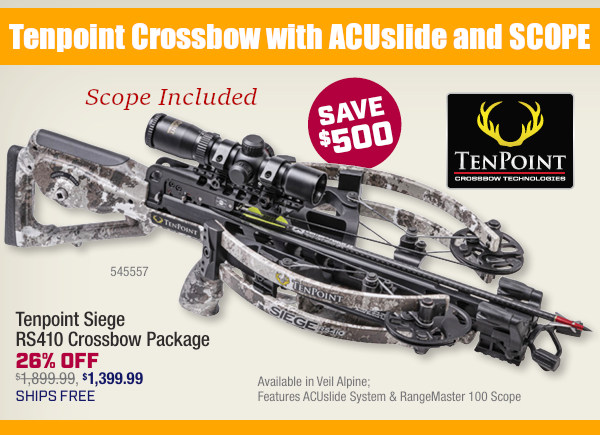
10. MidwayUSA — TenPoint Siege Crossbow with Scope, 26% Off
⏺️ » Very sophisticated hunting crossbow with scope
In many states, there are special hunting seasons for bow-hunters. This may give you a better chance for success IF you have an accurate crossbow with plenty of power. This impressive American-made TenPoint Siege RS410 Pro Crossbow can deliver an impressive 149 ft-lbs. of energy, using an ACUslide cocking system. This crossbow includes a RangeMaster 100 scope with lighted aiming points for precision. Right now this state-of-the-art crossbow is $1399.99, a $500 savings.
As an Amazon affiliate, this site can earn revenues through sales commissions.
Click Map to launch interactive webpage with info for all 50 states.
Going hunting soon? Need to find out about hunting licenses, deer tags, local regulations, and the best hunting areas? Then visit WheretoHunt.org. This website has an interactive map of the country. Simply click on a state to find the info you need.
For all 50 states, the NSSF provides information about hunting licenses and permits, where to hunt, hunter education classes, laws and regulations and more. For each state you’ll also find a link for required applications and license forms. Have a safe and productive hunt this year.
Hunting season is coming soon. For hunters that means many hours may be spent searching for animals through spotting scopes and binoculars — “glassing” for game. And when the hunter does find a good buck or doe, he’ll need to know the animal’s precise distance, so that demands a good laser rangefinder. Being carried in the field, the scopes on hunting rifles need to be tough and durable, and every hunting scope should have excellent low-light performance. And when the hunter finally takes his shot, his scope better be properly zeroed. Today’s Saturday showcase spotlights Hunting Optics. We offer eight great videos that help you select the right riflescope, spotting scope, rangefinder, and binoculars for your next hunt.
Here’s a good video by an avid hunter who treks in remote, mountainous zones. The host has learned what works… and what’s worth the weight to carry: “I’ve found that the combination of 10×42 binoculars and a 27–60x80mm spotting scope is the sweet spot for mountain hunting. This pairing balances weight with reach, allowing me to keep moving but also reach out and see well-hidden animals. In some cases, I will make use of an 18×56 binocular, but this is reserved for non-backpack hunts. With 25 years of mountain hunting experience, I can whole-heartedly recommend my preferred binocular pair as a fantastic and versatile set-up for northern mountain hunts at the very least.”
Ultimate Spotter Test — 19 Spotting Scopes Reviewed
The producers of this remarkable 19-product spotting scope comparison state: “If you are looking at choosing the best spotting scope for hunting… you are in the right place! We tested these 19 spotting scopes to find the best compact spotting scope, best 65mm spotting scope, and best 85mm spotting scope out there. We also wanted to find the best values on the market, and I think we definitely did that. While we certainly couldn’t test them ALL, we were able to put together this incredible lineup of some of the best spotting scopes out there to help you find what is going to work for your specific needs.”
First Focal Plane vs. Second Focal Plane Scopes
For the last century, Second Focal Plane (SFP) scopes have been most common on hunting rifles. Now there are an increasing number of First Focal Plane (FFP) optics favored by hunters. The main reason is that the reticle mark values (in Mils or MOA) are constant relative to the target size at all magnification levels. That is handy for hold-offs and hold-overs. On the other hand, a SFP scope maintains a constant reticle size and line thickness at all zoom values. For most hunting shots, taken inside 300 yards, that really should be fine. Many hunters feel they can spot their prey more easily without a busy reticle that obscures small details at higher magnification. This video explains the pros and cons of both reticle types. The final decision is up to you — much will depend on the terrain you hunt and the distances you shoot.
The Complete Optics Selection for For Deer Hunting
In this video, Vortex optics techs explain the optics package deer hunters will want to take into the field. Along with a good medium-power zoom riflescope, you’ll want binoculars and (probably) a spotting scope. You’ll also want a Laser Rangefinder (LRF) or laser-equipped binoculars. As the team points out, the LRF is not just to range your prey right before you take a shot. A top-quality LRF can range a reflective object as far as 1500 yards away. That helps you decide whether you want to hike a mile to reach that buck you see way out on the next ridge.
MOA vs. MIL — What You Need to Know
These days, scope manufacturers offer a wide selection of both MIL (Milliradian) and MOA (Minute-of-Angle) based optics. We do think that MOA is still predominant in the lighter-weight, lower-cost (sub-$500) scopes marketed for hunters. There are pros and cons for both angular measurement systems. One MIL is 3.6″ at 100 yards, while one MOA is 1.047″ at 100 yards. If you grew up thinking in inches, a 1/4-MOA click-value hunting scope might work best. If you shoot PRS or have other MIL scopes you may prefer a MIL-value optic for your hunting rifle. Both choices will do the job.
Comparison of Eight Laser Rangefinders
The Backfire team purchased eight rangefinders and tested them in the field. Most of the products are under $500. This is a good review if you are looking for a compact LRF at a moderate price. Looking at performance for the price, for the hunting market, the reviewers favored the Leupold RX-1600 and the waterproof Vortex Ranger 1800. COMMENTARY: If you can afford it, we recommend that serious hunters consider top-end laser rangefinder-equipped binoculars such as the ZEISS Victory RF and Leica Geovid.
How to Zero Your Hunting Rifle Efficiently
Last but not least, here’s a great video from Vortex that shows you how to quickly and efficiently sight-in and zero your hunting rifle before heading out into the field. This video explains a simple procedure that lets you get a solid zero in just three shots. Of course you probably want to fire a few more rounds to confirm your zero before you head off to your hunting grounds, but this will let you get on-target with a minimum amount of time and ammo expended. This helpful video has over 3 million views on YouTube!
Fouling Shots and Cold Bore Condition
If you recently cleaned your rifle, you may want to fire two or three fouling shots before you start this procedure. But keep in mind that you want to duplicate the typical cold bore conditions that you’ll experience during the hunt. If you set your zero after three fouling shots, then make sure the bore is in a similar condition when you actually go out hunting.
Hunting season is coming soon in many parts of the nation. If you’re thinking about what bullets to use for your annual game hunt, you’ll find some VERY valuable information here. Federal has created an award-winning Bullet Breakdown Video (below) that demonstrates how various hunting bullets perform in ballistic gelatin. This and other videos are found on Federal Premium Ammunition’s YouTube Channel. The Bullet Breakdown Video features four bullet types used in Federal Ammo: Nosler Ballistic Tip; Sierra GameKing; Trophy Bonded Tip; and Barnes Triple-Shock X-Bullet.
NOTE: You may want to lower the video sound level before playback.
Federal’s high-resolution, slow-motion videography helps demonstrate which loads are the best for specific uses. The ultra-slo-mo footage provides a detailed view of each bullet penetrating ballistic gelatin blocks. These blocks closely mimic animal tissue and clearly display performance characteristics.
“The Bullet Breakdown Video is a great tool for hunters trying to decide on ammunition type,” said Federal’s Jason Nash. “Properly preparing for the hunt is crucial-and not all bullets are made the same. The bullet is the one link between hunter and game and can be the difference between success and failure. This video helps show hunters how different bullet construction affects terminal performance[.]” For more info, visit www.FederalPremium.com.
September 27, 2025 is National Hunting & Fishing Day. The annual celebration takes place on the the fourth Saturday of September every year. National, regional, state and local organizations will run thousands of “open house” hunting- and fishing-related events around the country. Events will include Fishing Derbys, Hunting Expos, Wing-shooting tournaments, and much more.
Hunting Safety Checklist
A good hunt begins with preparation. And during the hunt, safety is a key priority. To help hunters, the National Shooting Sports Foundation (NSSF) has created a Safety Checklist for hunters. This Hunting Safety Checklist, produced as part of the NSSF’s “Hunt S.A.F.E.” campaign, helps hunters follow good, safe practices in the field and at home.
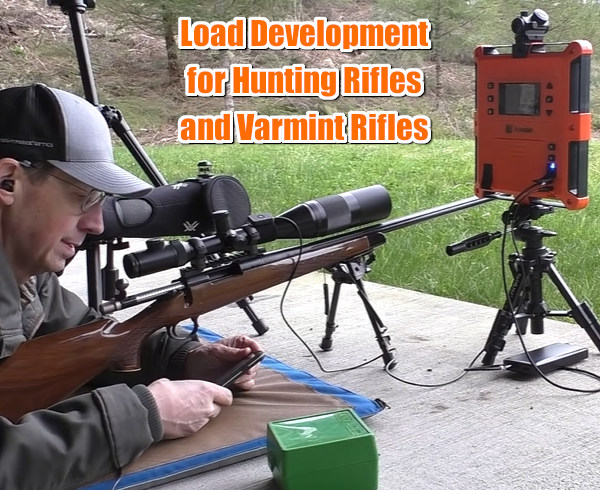
Hunting season kicks off this month in many parts of the USA. If you have a new hunting rifle or need to develop a load for your rig with a new choice of bullets and/or powder, this article can help. Ace shooter Keith Glasscock explains how to develop a good load for a hunting rifle or varmint rifle.
Keith is an outstanding competitive shooter, who has finished second at the F-Class National Championships (F-Open) multiple times. Keith is also a skilled wind coach who runs the popular Winning in the Wind YouTube Channel. Along with his interest in mid-range and long-range F-Class competition, Keith also enjoys game hunting and varmint adventures.
Developing accurate hand-loaded ammo for hunting and varmint rifles involves procedures that may be a bit different than load testing for a match rifle. You want to be efficient, and use the types of brass and bullets you’ll be using on the hunts. In two recent videos, Keith shows how he developed good, accurate loads for a .223 Rem varmint rifle and a .308 Win hunting rifle.
.223 Rem Load Development — Powder Charge and Seating Depth
In the first video, Keith covers the load development process for a Remington 700 bolt-action varmint rifle chambered in .223 Remington. Keith starts by full-length sizing the brass. Then he experimented with powder charge weights, and came up with a promising load of 24.7 grains of Alliant AR Comp with Hornady 50gr A-Max bullets.
Next Keith experimented with seating depths (see 5:30-6:100) and found that accuracy improved as he changed OAL length in .005 increments. Keith ended up with 2.270″ with a 3-shot group in the twos! This video shows the importance of testing your bullet choice at various seating depths. Keith shoots this rig prone off bipod, which is similar to the bipod shooting he does in the varmint fields. Keith explains key factors to consider when optimizing the .223 Rem cartridge in a varmint rig. Velocity readings are made with a LabRadar unit.
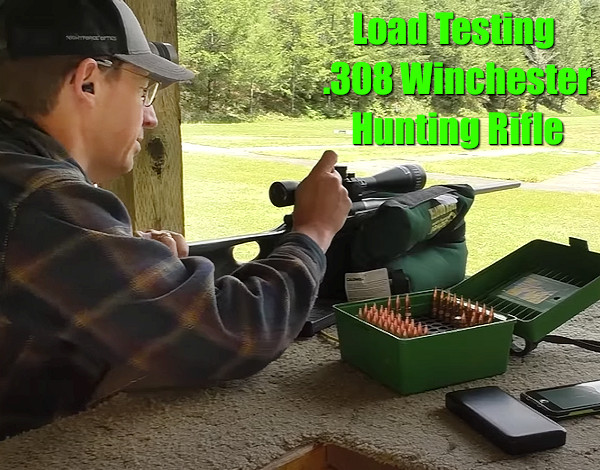
Load Development for .308 Win Hunting Rifle
In a second video, Keith shows the process for load development with a .308 Winchester hunting rifle. Here Keith uses a large X-type sandbag for a front support. Again, he was shooting a Remington 700 bolt-action rifle, this time with Barnes TSX solid copper bullets, PPU Brass, Federal 210m primers, and AR Comp powder. Keith said the Barnes bullets were excellent — he commented that these bullets were “match quality in terms of precision”. Keith achieved some very small three-shot groups with AR Comp and the TSX projectiles. Keith did note that point-of-impact shifted up significantly with increases in charge weight (see 6:20-7:10). With thinner-contour hunting barrels, this is not unexpected. But POI change should be observed carefully during load development, as you may need to adjust your zero after completing testing.
With hunting season coming up soon, we know that many readers will be out in the field — with a set of binoculars. On most game hunts, you’ll speed a lot more time glassing with binocs than looking through your riflescope. With wide field of view and extended low-light capability, a good set of binoculars will be your most important game-finder. And with premium LRF binoculars, such as the ZEISS Victory series, one tool serves both for spotting and laser ranging.
“Without the stabilization of your binoculars [provided by] a tripod … you will be missing a majority of the game you are glassing for.” — Outdoorsmans.com
In this article, Vortex Optics’ Mark Boardman, an experienced hunter, explains the benefits of using a tripod with high-magnification binoculars. Everybody knows that powerful spotting scopes work best when mounted to a stable tripod or otherwise secured to a steady mount. Yet when most folks use binoculars, they never even think of using a tripod, despite the fact that tripod adapters are available for many premium binoculars.
Outdoorsmans Tripod Adapters Outdoorsmans.com sells tripod adapters for various kinds of binoculars. These really work: “Mounting your binoculars to a quality tripod is a must for the serious western hunter. Without the stabilization of your binoculars [by] mounting them to a tripod … you will be missing a majority of the game you are glassing for.”
A serious hunter should learn how to glass with tripod support, using methods outlined here. With binoculars offering more that 8X magnification, you can really benefit from a steady mount. You’ll be amazed at the difference the tripod will make.












 Federal’s high-resolution, slow-motion videography helps demonstrate which loads are the best for specific uses. The ultra-slo-mo footage provides a detailed view of each bullet penetrating ballistic gelatin blocks. These blocks closely mimic animal tissue and clearly display performance characteristics.





 Outdoorsmans Tripod Adapters


