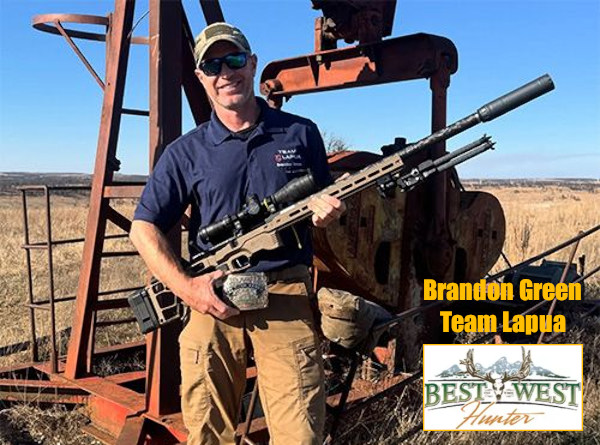
Brandon Green, a multi-time long-range and service rifle national champion, recently won the Open Heavy division at the 2026 Best of the West Hunter match. Held March 6–8, 2026 in Bartlesville, Oklahoma, the Best of the West Hunter competition had 20 simulated hunting stages with targets ranging from 200 yards to over 900 yards, with average target distance around 400 yards. The range was within a large horseshoe bend of Buck creek, giving a 360∘ course of fire over terrain with rolling, rocky bluffs, tall-grass hills, wooded draws, open valleys, and creek bottoms. On the range competitors engaged life‑size AR500 steel animal targets including wolf, bighorn sheep, moose, bear, whitetail deer, hog, coyote, mountain lion, bobcat, turkey, elk, antelope, mule deer, otter, raccoon, rock chuck, squirrel, lynx, prairie dog, and jackrabbit. Round count was 80-160, depending on a first round impact or second round impact.
Green, who has already secured three NRL Hunter match wins this season, credited both the match design and his equipment for the successful outing: “I find the NRL game has its unique challenges along with really fun courses of fire. Having confidence in your equipment and ammunition gives you the ability to focus on the task at hand and that’s the key to having a strong performance. My .260 Remington AI platform loaded with Berger 144 grain Long Range Hybrid Target bullets, Lapua cases, powered with Vihtavuori N160 has been one of the most consistent combinations I’ve ever seen. I’m very thankful these helped secure the Best of the West Hunter Championship.”
Key Details of the 2026 Best of the West Hunter Match
Winner: Brandon Green (Team Lapua).
Location: Bartlesville, Oklahoma, known for challenging, rugged terrain.
Format: 20 stages, 80-160 rounds, including hunting scenarios with simulated wildlife targets (e.g., elk, mule deer, bear). Match focuseson skill-building and practical hunting scenarios.
Rules: NRL Hunter regulations, requiring chamber flags and adhering to safety protocols.
Divisions: Open Heavy, Skills, Team, and Young Guns.
Best of West Match Elements Featured in This Video
About Lapua
Lapua produces high-quality small caliber cartridges and components for civilian and professional use. Lapua is imported by Capstone Precision Group, exclusive U.S. distributor for Berger, Lapua, Vihtavuori, and SK-Rimfire products. For more information, visit Lapua.com.
It’s officially spring now (with vernal Equinox on 3/20/2026). Here are some important tips for a spring varmint hunting adventure. When you’re on a varmint expedition in the Western states you can bet, sooner or later, you’ll encounter serious winds. Here’s some advice on how to minimize the effects of cross-winds on your shooting, and easily improve your percentage of hits. In essence, you want to use your ability to change shooting positions and angles to put the wind behind you.
A benchrest or High Power shooter must operate from a designated shooting position. He must stay put and deal with the wind as it moves across the course, from whatever direction it blows.
Put the Wind at Your Back
By contrast, a varmint hunter can move around and choose the spot that provides the most favorable wind direction. In most cases you’ll get the best results by moving your shooting position so the wind is at your back. This will minimize horizontal wind drift. Once you’re in position, use wind flags to direct your fire in line with the prevailing winds. A varminter who calls himself “Catshooter” explains:
The String of Death
I remember the first time I was on a dog town in the Conata Basin, in the Badlands area of southwestern South Dakota. Along with two other guys, I drove out for 21 days of shooting, and I never saw wind like that before. If all four tires of our vehicle were on the ground, the weather man said these were “mild wind conditions”.
After the first four or five days, we got smart. We would park the truck on the up-wind side of the town so the wind was at our back. Then we took a piece of string on a 3-foot stick, and set it in front of the shooters, and let the string point at the mounds that we were going to shoot.
For the rest of the trip, we didn’t have to deal with wind drift at all. We just shot the dogs that the string pointed to. We started calling our simple wind pointer the “String of Death”.
We were hitting dogs at distances that I would not repeat here (with benchrest grade rifles). After the first time out, I always took a wind rig like that.
Benefits of Swivel Benches
In a large varmint field, you’ll want to orient your shooting position to put the wind at your back if possible. If you have a rotating bench such as this, you can further adjust your shooting orientation to work with the wind, not against it. You may also want to position simple flags (posts with colored tape) downrange to alert you to wind changes you may not notice from your shooting positions. If you can’t get a “wind at back” orientation, the next best set-up is with the wind coming straight at you — that also minimizes the wind drift on your shots.
On its cable TV broadcast, Shooting USA will feature The Ultimate Hunter Rifle Challenge today 3/18/26. The Ultimate Hunter Rifle Challenge is a new shooting sport designed to appeal to the millions of hunters in the country who want to test their skills with equipment they likely already own. Today’s broadcast features the first Ultimate Hunter Invitational event. This match tests hunter skills with accuracy, position building, and time management for cash prizes totaling over $20,000.
Shooting USA SHOW TIMES: This Shooting USA Episode airs Wednesday, March 18, 2026 at 9:00 PM Eastern and Pacific; 8:00 PM Central on the Outdoor Channel. If you miss the regular broadcast, you can stream the show online at any time on Vimeo for $0.99 per episode.
To learn about other Ultimate Hunter field competitons, visit Ultimate-Hunter.com.
Springtime is turkey hunting season throughout the USA. The official spring wild turkey hunting season is set regionally by each state. In a few states, turkey season has already commenced, while most other states open their turkey seasons in early April, with the spring seasons running for 3-5 weeks. CLICK HERE to read Outdoor Life Magazine’s Turkey Hunting Resource page. This includes articles on How to Hunt Turkeys, Best Turkey Calls, Turkey Hunting Camo Gear, and Recommended Turkey Loads.
Sportsman’s Warehouse has an online page about Spring Turkey Hunting. This has features on recommended shotguns, clothing & footwear, decoys & calls, blinds & chairs, and even turkey cooking. CLICK HERE for the Sportsman’s Warehouse Turkey Hunting Page.
And Sportsman’s Warehouse has an excellent, detailed “how to” article, the Beginner’s Guide to Turkey Hunting. That feature includes the Outdoor Dan video featured above.
Saturday Showcase Spring Turkey Hunting Videos
With over 2 million views, this Canada-in-the-Rough video shows effective turkey scouting, calling, and shooting. This action-packed turkey hunting compilation features 30 turkey kill shots with shotguns.
Get Zone — At the Ranch Turkey Hunting Videos
GetZoneHunting.com has a vast video library for hunters, with hundreds of helpful videos on all types of hunting. In time for spring turkey season, GetZoneHunting offers a big collection of turkey hunting videos: At the Ranch – Turkey. On that page you’ll find 13 turkey hunting “how-to” videos. Here are links to five GetZone Turkey Hunting videos with valuable information from skilled, experienced hunters. Click each of the photos below to watch those five videos on theGetZone site.
At the Ranch – Turkey offers solid advice for turkey hunters. These five videos will help you better understand turkey behavior and have success on your hunt. Click any photo to watch the particular video on the GetZone website. (Work Warning — When each GetZone video opens, it may immediately launch an annoying commercial with loud AUDIO!). There are eight more turkey hunting videos on GetZone’s Turkey Hunting HQ Page.
At the Ranch: Shot Placement for Turkeys — CLICK to Watch Video
At the Ranch: Turkey Hunting Essentials — CLICK PHOTO to Watch Video on GetZone.com
At the Ranch: The Differences Between a Jake and a Tom — CLICK PHOTO to Watch Video on GetZone.com
At the Ranch: Early vs. Late Spring Turkey Hunt — CLICK PHOTO to Watch Video on GetZone.com
At the Ranch: How to Plan a Turkey Hunt — CLICK PHOTO to Watch Video on GetZone.com
Free Printable Turkey Target from AccurateShooter.com
As a special bonus for our readers, here is a free, printable Turkey Target, so you can practice for your turkey hunting adventure, This special Turkey Bullseye Target was created by our friend and Forum member Pascal (aka “DesertFrog”). CLICK HERE for FREE Turkey Target.
There’s a nice article in the Western Powders Blog that any varminter will enjoy. In this hare-raising tale, gunwriter Jim Waddell explains how he used a self-loading Savage A17 rifle to take care of a serious jack rabbit problem on a rancho in California. “[My friends] purchased a huge amount of acreage that had some existing alfalfa fields and [surrounding sagebrush]. Sagebrush is home to jack rabbits. Lots of jack rabbits. The previous owner of this property didn’t do any varmint or predator control[.] The ink wasn’t dry on the escrow papers before [my friends] started asking for help shooting rabbits. A problem in taking these critters is it has to be done at night when they come out to feed as they lay low in the bush during the daylight hours.”
Savage A17 Comes to the Rescue
Initially Waddell and some friends took on the jack rabbit hordes using Ruger 10/22s and a .44 Magnum Marlin lever gun. Neither option was ideal. The .44 Magnum just couldn’t keep up the desired shooting pace (it took too long to reload) ant the .22 LRs were too anemic. So Waddell decided to give the more potent 17 HMR a try. He acquired a Savage A17 and went back for a second bunny-busting session. He came away convinced that the 17 HMR cartridge in the semi-auto Savage works great for small varmint control.
NOTE: This is in an older internet archive so it may take a minute or so to load.
Waddell writes: “I wanted more than a .22 after seeing the problems my pals had with their [10/22] bullets not anchoring the rabbits. Armed with my new Savage A17 it was time to head back to the alfalfa fields. This time my hunting partner was Dan, my son-in-law from Seattle. We hunted for four nights. Each night was either raining, windy or both. My question about whether or not rabbits would be out in the weather was answered immediately. They were everywhere. As miserable as the weather was, we got all the shooting we wanted and that Savage rifle was up to the task. We got so many rabbits it was impossible to count.” CLICK HERE for the full account of Waddell’s jack rabbit adventures on the California rancho. It’s worth a read. Here is a sample:
Wabbits, Wabbits Everywhere — Even Running Right at You
I couldn’t believe my eyes when I saw a sea of rabbits as far as the lights would shine and when the light beams hit the bunnies, they became confused and as often as not, would run right at the lights so a good percentage of our shots were literally in spitting distance. It was also a new experience shooting at targets that are running TOWARD you. Most of us who’ve done much hunting for game or varmints have experienced moving targets but how many of those targets are coming at you?
Sources for Best Deals on 17 HMR Ammunition
With 17 HMR ammunition it definitely pays to shop around. This spring (March 2026) we’ve found a 50-count box of 17 HMR ammo as low as $10.10 and as high as $19.99. A typical price currently is about $13.99-$16.99, as you’ll see at Midsouth. You can check multiple vendors’ 17 HMR ammo prices at once on the AmmoSeek.com and BulkCheapAmmo.com websites. Here are some of the best deals we found on 3/10/2026 on BulkCheapammo.com starting at $10.10 per 50-rd box:
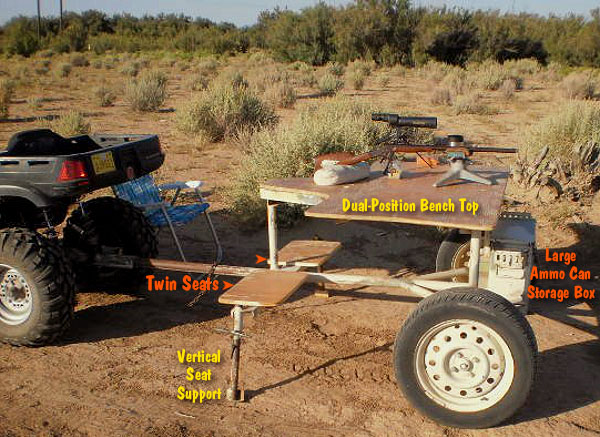
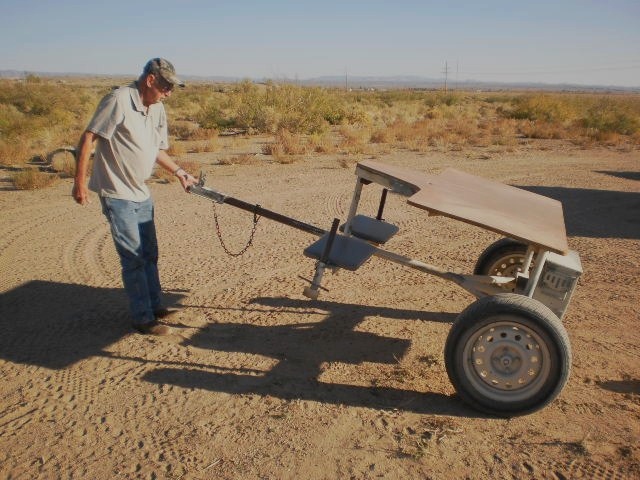
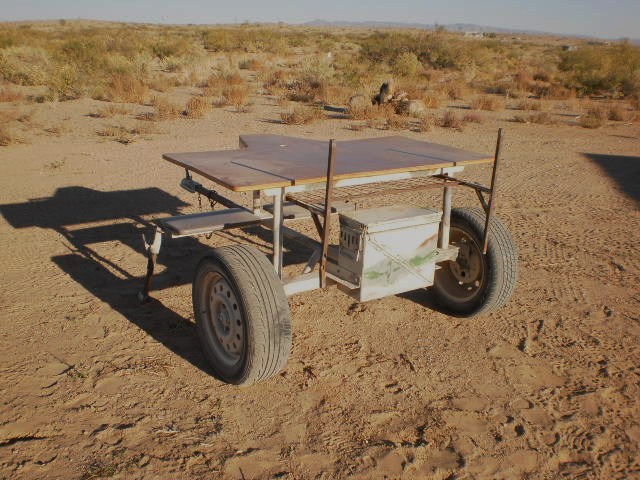
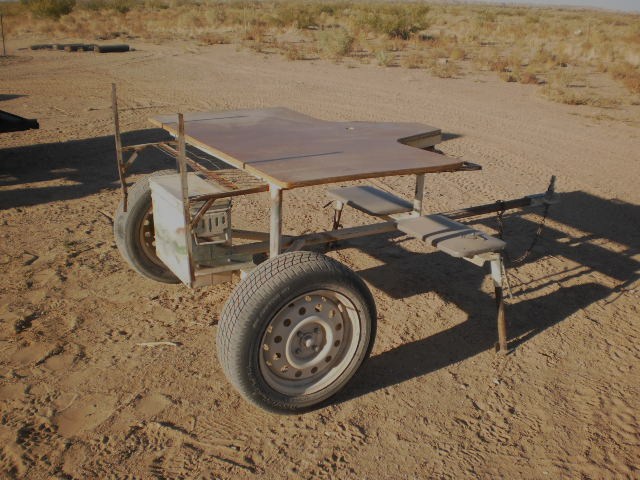
AccurateShooter Forum member John H. of New Mexico (aka “Skratch”) has created an impressive mobile shooting bench that he can haul with his ATV. This trailer-mounted, movable bench is built on a central tubular spine that also serves as the tongue for the trailer, which attaches to a standard hitch. The bench offers two (2) shooting positions so it works for both left-handed and right-handed shooters.
Up front, for storage, a surplus .50-Cal ammo can is secured to the trailer frame. The V-shaped middle section of the wood benchtop looks to be reinforced with a metal stiffener frame on the underside. The front section of the bench is supported by twin tubular uprights attached to the box-section axle housing. The two wooden bench-style seats (on left and right) ride on a cross-tube. At the ends of that cross-tube are adjustable legs for additional support.
Great Rig for New Mexico Varmint Hunting
There are plenty of great varmint hunting areas in Skratch’s home state of New Mexico — you’ll find some huge prairie dog fields there. But to get the best results on a varmint-hunting field session, you need a solid shooting station that can be easily hauled to new locations as needed. It looks like John (aka “Scratch”) has come up with an outstanding “War Wagon” for his New Mexico varmint safaris.
Click on image frames to see full-size photos
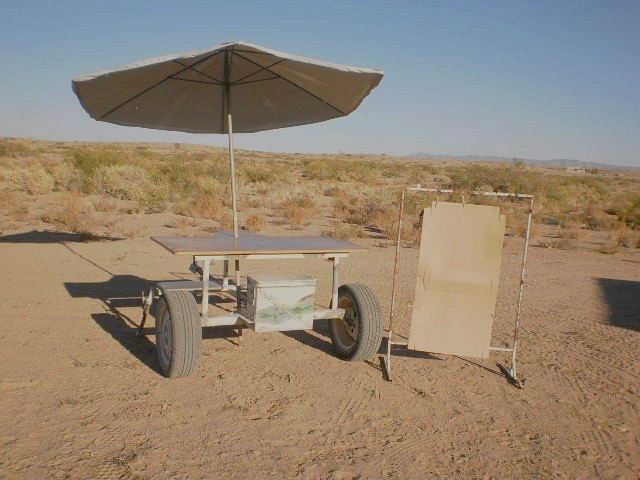
Some readers wanted to know how John’s War Wagon is positioned in the field and if it is ever detached from John’s ATV. John answers: “We do unhook the 4-wheeler for target-checking unless we have an extra along which is usually the case. That way we can level the table front to rear. We have an umbrella from a patio table to provide shade on extra warm days.”
War Wagon Construction Details
John told us: “My brother-in-law and I built this mobile bench a few years ago. The axle, wheels and tire are a tag axle from a small Chevy car, obtained from a salvage yard for about $35-$40 a decade ago. The tubular frame is drill stem, while the bench-top and seats are 3/4′” plywood. Under the plywood we fitted rails so we can slide our target stand under the benchtop for secure travel. The total cost for everything (including storage box) was about $250-$300.”
We set the bench and seat heights so that, with adults, the rifle sets straight level to the shoulder. For the smaller ‘younguns’ we just use a sofa pillow to raise them up. (Yes, adjustable seat heights would be great.) The ammo box holds our rifle rest, sand bags, spotting scope, and miscellaneous gear. Options are a couple of lawn chairs, and a cooler of brew (for after the shooting is done).
Can you hit an egg at 600+ yards? We mean hit it reliably — not just by luck. To do that you’ll need good shooting skills and a very accurate rifle. How accurate? Well, a chicken egg is, on average, 2 1/4 inches (57 mm) long and 1 3/4 inches (44.5 mm) in diameter. That means to hit an egg (on demand) at 600 yards, you’ll need a rifle capable of 1/3-MOA accuracy (or better). Forum member DukeDuke has such a gun, and he demonstrated its egg-busting prowess in this short video. DukeDuke’s rifle is chambered in 6BRX (a 30° 6BR Improved) and it’s loaded with DTAC 115gr bullets pushed by Alliant Reloder 17. In the video, the eggs are placed on top of poles set 616 yards from the firing line.
See Egg Hit at 38 second mark…
As you can see in the video, that’s a heck of a nice shooting range where DukeDuke scrambled those eggs at 616 yards. The range is situated just outside of Lake Jackson, Texas. As for the gun… the action is a Rem 700 SA BDL, blueprinted and bedded in a Rem/HS Precision PSS stock. The 31″ barrel is 1:8″-twist Broughton. The “P3″ on the barrel stands for Porter’s Precision Products, Lake Jackson, TX. The rifle was built by Kenneth Porter. The load was 33.5 grains of RL-17 at 2950 fps, with 115gr DTAC bullets touching the lands. Cartridge OAL is 2.400″.
The 6mm BRX was developed by Bob Crone. Retaining the 30° shoulder of the parent 6mmBR case, the BRX has a little less capacity than a 6mm Dasher. Bob told us that his original design for the 6mm BRX always had a .100″ longer head space than a 6mmBR Norma and that he never deviated from that. But after Bob developed the first 6mm BRX, Bill Shehane made a 6mm BRX version that had a .120″ longer head space, and thus some confusion started. In truth, the original 6mm BRX always was (and still is) a chambering with a head space .100″ longer than a 6mm BR Norma.
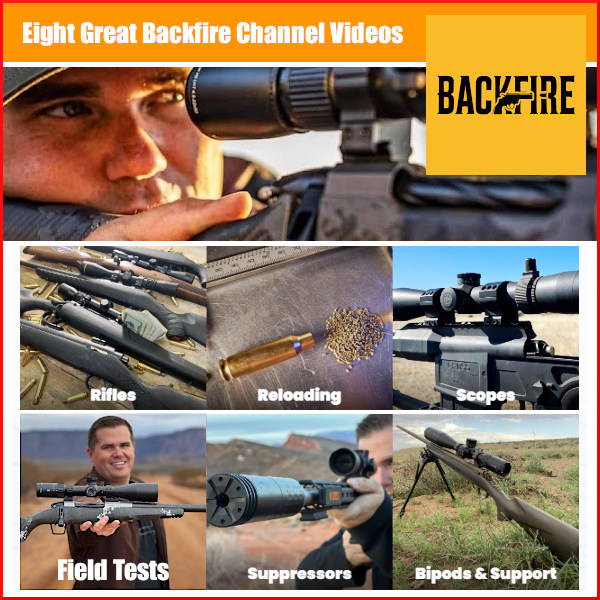
With today’s Saturday video showcase we feature eight videos from the Popular Backfire YouTube Channel. The host of the BackFire channel, Jim Harmer, also has a good website, Backfire.tv with written reviews. If you’re shopping for a hunting rifle we recommend you read the recent (12/1/2025) Best Hunting Rifles article. Without further ado, here are eight noteworthy videos from the BackFire Channel.
Five Powder Dispenser Comparison Test (All Units Purchased)
If you are in the market for a sub-$500 electronic powder dispenser, definitely watch this review. This Backfire comparison test is notable because the tester spent his own money to purchase all five powder dispensers being reviewed. That means Backfire could tell the full truth, both good and bad, about the machines. In fact, Backfire bought TWO ChargeMaster Lites because one failed (See 14:12 time-mark). The reviewer liked the RCBS ChargeMaster Supreme, but his top choice overall was the Hornady Auto Charge Pro. He favored the overall design, and really liked the way the dispensing speeds could be easily set faster or slower. Here are highlights from the video review:
00:08 Speed Test
03:09 Accuracy Test
07:57 Frankford Arsenal Intellidropper
09:08 Lyman Gen 6
10:44 RCBS Chargemaster Supreme
12:03 Hornady Auto Charge Pro
14:12 RCBS Chargemaster Lite
14:41 Conclusions
Best Rifle Scope Under $500 (2.2 Million Views)
This is a very comprehensive test of ten scopes under $500 MSRP. Unlike many reviews, the tester actually purchased all the tested scopes with his own money to provide a fair, unbiased review. The ten scopes all have approximately 4-14X magnification, common for a hunting/general purpose field scope. The reviewer ranked the $349 Vortex Diamondback Tactical FFP as the Best Overall scope. The reviewer’s first choice for a Target/Competition scope was the $299 Arken 4-16×50 model. The $175 Burris Fullfield E1 Hunting model was named the best “Lightweight, Capped Scope”.
The Backfire team purchased eight rangefinders and tested them in the field. Most of the products are under $500. This is a good review if you are looking for a compact LRF at a moderate price. Looking at performance for the price, for the hunting market, the reviewers favored the Leupold RX-1600 and the waterproof Vortex Ranger 1800. COMMENTARY: If you can afford it, we recommend that serious hunters consider top-end laser rangefinder-equipped binoculars such as the ZEISS Victory RF and Leica Geovid.
Affordable Hunting Rifles under $750.00 (1.3 million views)
Here’s another good Backfire Channel video for hunters looking for a new rig. With hunting season starting soon, this video can save you time and help you get the most bang for your buck. The Backfire team review eight affordable under-$750 rifles: Bergara B-14, Howa 1500 Hogue, Kimber Hunter, Remington 700, Ruger American, Savage 110 Switchback, Tikka T3X Superlite, and Weatherby Vanguard. The Backfire reviewers tested all 8 rifles for function and accuracy (4-shot groups). These 8 rifles were chose for review based on input from Backfire channel viewers.
Accuracy Secrets of a Champion — Interview with Erik Cortina
Our friend Erik Cortina is one of America’s top F-Class marksmen, and he has also achieved notable results in some long-range tactical matches. In this video Erik explains some of the factors that help in load development, wind reading, and achieving long range accuracy. If you shoot F-Class or even just compete in local matches, this video is worth watching. Erik’s Cortina Precision company produces high-quality tuners, tuner brakes, dies and other high quality products.
How to Set Up a Rifle for 1000 Yards
Here’s good video for novice ELR and Long range shooters. The video covers initial zeroing and then working with ballistics at 600-1000 yards. The tester explains the importance of a very stable platform and optics with adequate vertical adjustment and proper parallax control. The featured rifle is a 6.5 Creedmoor Bergara Premier Competition in a dark, gray PMA chassis (this is not the tan rifle in cover shot). Note: Bergara also offers a barreled action that you can put into a different chassis of your choice. The scope is an Athlon Helos BTR Gen2 4-20x50mm. A Garmin Xero C1 radar chrono was used to confirm velocity.
Low-Cost vs. High-Cost Rifles — How They Compare (2 Videos)
Here are two interesting videos that compare the features and performance of rifles at various cost points. The first video compares two rifles with a 10X (1000%) price difference — $350 vs. $3500. Some quite inexpensive rifles can perform very well, if you get lucky with the factory barrel. At the high end of the spectrum you can (hopefully) expect a smoother action, better trigger, more sophisticated stock, and (hopefully) more shot-to-shot consistency. Still a big investment doesn’t always guarantee vastly improved performance. For a deer hunter, a $500 rifle with a modestly-priced scope can probably do the job. If you want to hit prairie dogs at 500 yards and beyond, you’ll need an accurate cartridge and a very good (preferably custom) barrel for consistent hits.
At the request of our readers, we provide select “Deals of the Week”. Every Sunday afternoon or Monday morning we offer our Best Bargain selections. Here are some of the best deals on firearms, hardware, reloading components, optics, and shooting accessories. Be aware that sale prices are subject to change, and once clearance inventory is sold, it’s gone for good. You snooze you lose.
NOTE: All listed products are for sale to persons 18 years of age or older. No products are intended for use by minors.
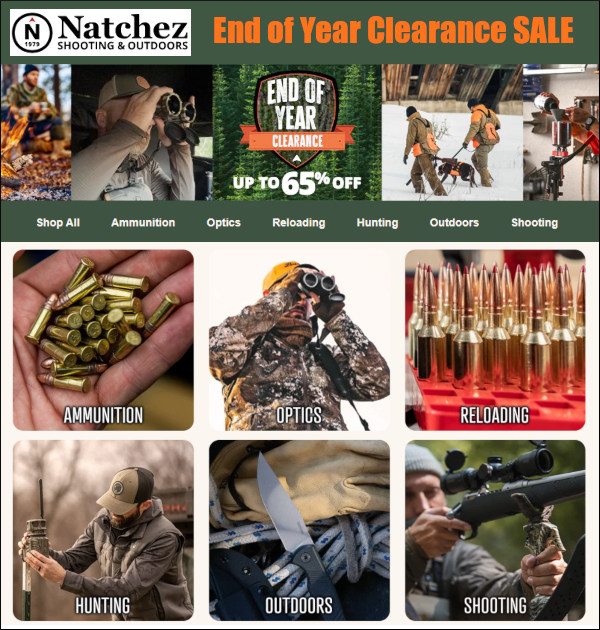
Natchez — End of Year Clearance Sale
⏺️ » Great savings on ammo, outdoor gear, optics and more
Right now Natchez in running a massive End of Year Clearance Sale with significant discounts on over 1000 products. On sale are optics, ammunition, reloading components (brass, bullets, powder, primers), gun accessories, hunting gear, and much more. With these end-of-year discounts, this is a great opportunity to save big bucks in the final week of 2025.
EuroOptic — End of Year Vortex Sale with 15% Off Code
⏺️ » Save 15% on Vortex scopes, binoculars, spotters, red dots
EuroOptic is running a major Vortex 15% Off Sale this week. You can save 15% on competition scopes, hunting optics, tactical optics, spotting scopes, binoculars, laser rangefinders, and red dot optics. NOTE: This sale may expire very soon so you should grab these bargains while you can. During check-out use Code VTX15 to save 15% (some exclusions).
As an Amazon affiliate, this site can earn revenues through sales commissions.
It’s almost Christmas. In parts of Europe hunting season continues well into winter. To celebrate the hunting lifestyle, we’re reprising a story from Europe that showcases the beauty of nature that can be experienced on a hunting trip.
If you need a break from your hum-drum day at the office, how about taking a virtual vacation to Norway, where you can explore the scenic mountains in the Fjord region?
Forum member Kenneth Skorpen (aka “Sal”) has created a cool video of a deer-hunting trip he took in Norway. He didn’t bag a buck on this trip, but the walk in the Fjordland mountains took Kenneth through some spectacular scenery. (At the 11:25 time mark you’ll see an amazing sunset over the Fjord.) Kenneth did encounter a doe that had fallen down the mountain, and apparently broken its neck (14:35 time mark). The terrain is very steep, and Kenneth observed that: “I feel fortunate to be able to do this, but I also feel very tired in my legs. Did you know that the hares around here have shorter left legs due to the steep hills?”
More Hunting/Shooting Videos from Norway
You can watch more interesting hunting and shooting videos from Norway on Kenneth Skorpen’s Streken Vertebrae YouTube Channel. Here are some links:
And here is another Skorpen video showcasing beautiful Norwegian landscapes. This was filmed during a February rifle testing session with targets at 1100 and 1400 meters. You’ll see some stunning snow-capped scenery here, starting at the 4:30 time mark.



 A benchrest or High Power shooter must operate from a designated shooting position. He must stay put and deal with the wind as it moves across the course, from whatever direction it blows.
 Benefits of Swivel Benches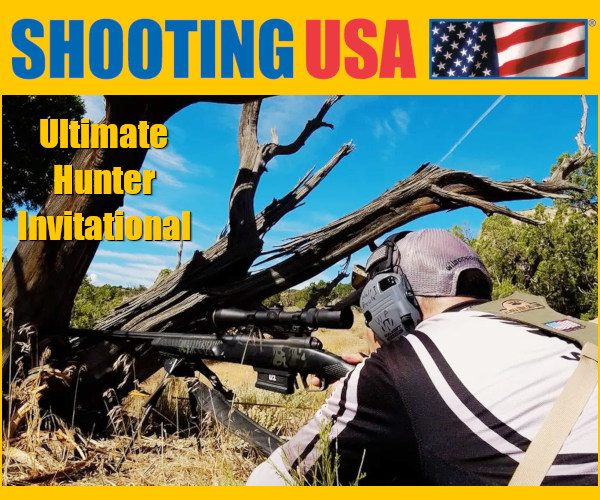



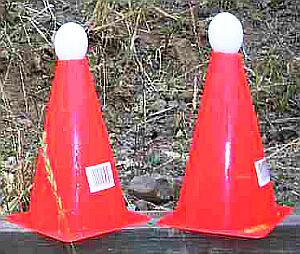 Can you hit an egg at 600+ yards? We mean hit it reliably — not just by luck. To do that you’ll need good shooting skills and a very accurate rifle. How accurate? Well, a chicken egg is, on average, 2 1/4 inches (57 mm) long and 1 3/4 inches (44.5 mm) in diameter. That means to hit an egg (on demand) at 600 yards, you’ll need a rifle capable of 1/3-MOA accuracy (or better). Forum member DukeDuke has such a gun, and he demonstrated its egg-busting prowess in this short video. DukeDuke’s rifle is chambered in 6BRX (a 30° 6BR Improved) and it’s loaded with DTAC 115gr bullets pushed by Alliant Reloder 17. In the video, the eggs are placed on top of poles set 616 yards from the firing line.
 As you can see in the video, that’s a heck of a nice shooting range where DukeDuke scrambled those eggs at 616 yards. The range is situated just outside of Lake Jackson, Texas. As for the gun… the action is a Rem 700 SA BDL, blueprinted and bedded in a Rem/HS Precision PSS stock. The 31″ barrel is 1:8″-twist Broughton. The “P3″ on the barrel stands for Porter’s Precision Products, Lake Jackson, TX. The rifle was built by Kenneth Porter. The load was 33.5 grains of RL-17 at 2950 fps, with 115gr DTAC bullets touching the lands. Cartridge OAL is 2.400″.









 If you need a break from your hum-drum day at the office, how about taking a virtual vacation to Norway, where you can explore the scenic mountains in the Fjord region?


