You have probably never seen a handgun like this before. This ain’t no compact pistol that’s for sure. The new Model 48 Nosler Custom Handgun (NCH), designed for handgun hunting/varminting and long-range silhouette duties, features a rifle-size bolt action, combined with a 15″ barrel. The billet aluminum stock takes AR-type pistol grips. The fore-end is long enough to work well on a front rest. We like the rakish lines of Nosler’s new Model 48 but the $2495.00 MSRP is not inexpensive.
Still, the compact size (21″ OAL) and relatively light weight (5.4 lbs.) make this an interesting option for hunters and varminters who venture far afield.
Early production versions have been well-reviewed: “Over the last 40 years, I have shot every conceivable configuration of single-shot handguns including high-end custom rigs. The new Nosler handgun will keep up with the very best of them. In my experience, I have found this handgun to be extremely accurate, well-designed, and user-friendly. The Nosler handgun will be most welcome with handgun hunters, target and steel shooters, or anyone looking to add an exciting dimension to their shooting experience.” — Mark Hampton
The new Nosler Model 48 handgun is offered in a variety of versatile chamberings: 22 Nosler, 24 Nosler, 6mm Creedmoor, 6.5 Creedmoor, 7mm-08 Rem, and .308 Winchester. CLICK HERE for a discussion of M48 NCH options in our Shooters’ Forum.
Nosler Custom Handgun Model 48 Features
1. Shilen Barrel — The M48 NCH features a free-floated Shilen 416R stainless heavy-contour barrel threaded at the muzzle, and supplied with a thread protector. Standard barrel length is 15″ with other lengths between 12″-18″ available on request. Barrel fluting is also available for an additional charge.
2. Aluminum Stock — The CNC-milled billet 6061-T6 aluminum stock will take any grip that fits an AR15. We suggest adding a grip with a broad flat base to provide more stability.
3. Size and Weight — The M48 NCH is 21″ long with 15″ barrel (no brake) and weighs 5.4 pounds — quite a bit lighter than typical hunting rifles.
4. Cerakote Finish — The M48 NCH barreled action and stock both feature Cerakote® finishes. The barreled action and stock are coated separately, allowing for a wide variety of color combinations.
5. Muzzle Brake Option — A Harrell’s Precision Tactical 4-Port Brake (shown below) is available as an extra-cost addition.
Summer’s here, so many folks will head to the hinterlands on prairie dog safaris. On a good P-Dog adventure, you may shoot hundreds of rounds over a long weekend. So you’ll need plenty of ammo. With these ammo volume requirements, you probably won’t have time to load to benchrest standards, and you may not have the budget for match-grade bullets. To save time you may throw (rather than weigh) your charges, or even load on a progressive press. This all raises the question of ammo accuracy — how good is “good enough”? A Sierra Bullets expert answers that question here — explaining how to efficiently load ammo for varmint work.
Ammunition Accuracy Requirements 101 — Varmint Ammo
This story based on article by Sierra Bullets Chief Ballistician Tommy Todd
I load and shoot ammunition for a living. In my duties here at Sierra I constantly test bullet accuracy for our production needs. Because of this, I shoot a variety of different calibers and cartridges on a daily basis and a large demand of this shooting is keeping the guns and loads tuned for optimum accuracy. I have a very narrow window of tolerances to maintain in order to provide our customers (you) with the most accurate bullets on the market.
I have learned many tricks and techniques over the years to tuning a load, prepping brass, and cleaning barrels to keep a gun shooting. I often utilize the things I have learned and take them to extreme levels when competing in a shooting event. I also often ignore most of these things (other than safety) and simplify the process if the shooting I will be doing does not warrant.
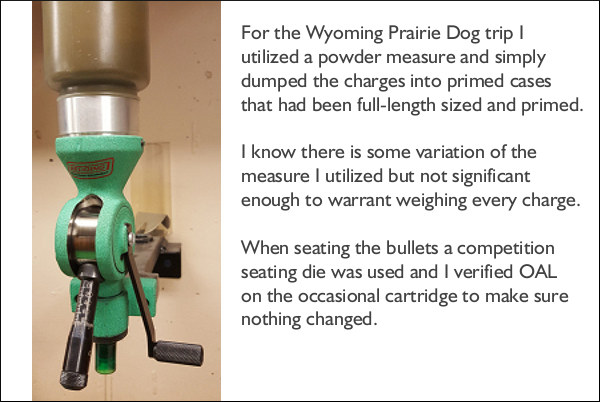
Recently I went on a prairie dog shoot in Wyoming with some good friends. The targets cooperated as did the weather with the exception of some challenging winds we experienced. We had a great time and make a lot of hits on those small rodents. When loading for the 223 Remington rifles and the TC Contender, I cut a few corners in the ammunition-loading process due to both time constraints and accuracy needed. When shooting at a prairie dog a miss is simply that, but when shooting at say the X-ring at 1000-yard competition, a poorly-placed shot [harms your] placing in the match. Because of this, I can afford to miss an occasional shot at a varmint due to ammunition capability without worry but will not allow the same tolerances in my match ammo. For the Wyoming trip I utilized a powder measure and simply dumped the charges into primed cases that had been full-length sized and primed.
I had measured enough for length to know that while there was some variance all were under maximum length. I know there is some variation of the measure I utilized but not significant enough to warrant weighing every charge. When seating the bullets a competition seating die was used and I verified OAL on the occasional cartridge to make sure nothing changed.
The ammo produced shot under one inch at 200 yards in one of the guns I planned on taking on to Wyoming with me. [Editor: That was for TEN Shots — see below.] I knew I had loaded ammunition that was quite suitable for the task at hand which was evidenced by the number of hits I was able to make at fairly long range.
NOTE: The author, Tommy Todd, explains that, when loading ammo for F-Class matches, he uses more exacting methods. He weighs every charge and seats his bullets carefully with an arbor press. Todd adapts his methodology for his particular application. The lesson here is to load to the level of precision demanded by your discipline. READ Full Story HERE.
Need a new optic for your varmint rig or hunting rifle? Right now you can score some very sweet deals on Vortex riflescopes. With these Vortex Values, you can save hundreds on a Vortex Viper HS ($399.99) or Vortex Diamondback ($149.99). The 6-24x50mm HS is a good choice for a varmint rig, while the smaller 3.5-19x40mm Diamondback suits a general-purpose hunting rifle.
Vortex 6-24x50mm HS LR for $399.99
The Vortex Viper HS features side-focus parallax, low-dispersion glass, and a BDC Reticle (shown at right) that has hold-over marks. That can be useful in the varmint fields. (Do your own testing to find the distance settings of the hold-overs with your cartridge and velocity.) The Viper has a 30mm main tube and weighs 21.4 ounces without rings. Max elevation and windage travel are both 42 MOA — plenty for typical varmint applications. At 6X power, the 100-yard Field of View is 17.8 feet.
This Viper HS scope comes with the full Vortex VIP lifetime warranty. MidwayUSA’s $399.99 price is a very good deal. The manufacturer’s suggested retail price (MSRP) is $699.00.
Here is a review of the 6-24x50mm Vortex Viper HS LR model. This is NOT the same as the basic Viper HS, but it shares many features.
Vortex 3.5-10x50mm Diamondback for $149.99
Vortex Diamondback under $150
This Vortex Diamondback has a good 3.5-10 magnification range, well-suited for general field use on a hunting rifle. The 50mm front objective is big enough to give good low-light performance. This scope features a V-Plex reticle which is simple and easy to use. This scope has a 1″-diameter tube and weighs 16.2 ounces without rings. The 100-yard Field of View, at 3.5 power, is 35.8 feet. Eye relief is ample: 3.3 to 3.6 inches.
This 3.5-10x50mm Diamondback is protected by the full Vortex VIP lifetime warranty. Right now this versatile scope is just $149.99 at Cabelas.com. Yes, that’s a terrific deal — this Vortex optic typical sells for $250.00 or more.
Utah Monument photo by DOI. Inset graphic from Ammoland.com, DOI source.
U.S. Secretary of the Interior Ryan Zinke has announced the newly-appointed members of the Hunting and Shooting Sports Conservation Council (HSSCC). The Council, established on January 9, 2018, is intended to provide the Secretary of the Interior and the Secretary of Agriculture with advice regarding the establishment and implementation of existing and proposed policies and authorities with regard to wildlife and habitat conservation. The Advisory Council will meet at least twice a year.
The Council will also examine ways to benefit wildlife resources; encourage partnership among the public, the sporting conservation organizations, state, tribal, territorial, and federal government; and benefit recreational hunting and recreational shooting sports.
“We have assembled here some of the best conservationists in America,” Secretary Zinke said. “Over a century ago, Teddy Roosevelt established the American conservation ethic — best science, best practices, greatest good, longest term. These sportsmen carry on the American conservation ethic in the modern day. Bringing these experts together will be key to ensuring the American tradition of hunting and shooting, as well as the conservation benefits of these practices, carries on.”
Secretary Ryan Zinke (left) believes we can learn important conservation lessons from President Theodore Roosevelt (right), an avid hunter.
“America’s hunters and recreational shooters have a champion in Secretary Ryan Zinke,” said Chris W. Cox, executive director of the NRA’s Institute for Legislative Action. “Zinke is fighting for our sportsmen and women to have greater access to our public lands. I am pleased to work with the Trump Administration’s new Hunting and Shooting Sports Conservation Council to make it easier for Americans to enjoy our public lands.”
“Comprised of national leaders throughout the hunting and recreational shooting communities, the HSSCC is widely regarded as one of the most effective and productive federal advisory committees across the federal government,” said Lawrence Keane, NSSF Senior V.P. and General Counsel.
“What an exciting time for our hunting and shooting sports! This Shooting Sports Council is yet another way Secretary Zinke and staff is making the expansion of our great American heritage a priority,” said Smith & Wesson Pro Shooter Julie Golob.
“President Trump and Sec Zinke continue to make major positive structural changes to America’s land and wildlife conservation systems,” said Sportsmen for Fish and Wildlife Founder Don Peay. “This new Council, made up of the most accomplished hunter/conservationists in North America, will assist in revitalizing conservation of our nation’s natural treasures for generations!”
“I am very pleased and honored to be appointed to this Council by Secretary Zinke,” said Rocky Mountain Elk Foundation Chief Conservation Officer Blake Henning. “I look forward to representing the interests of big game and big game hunters as this Council does important work.”
“I am honored to be asked by Secretary Zinke to serve on the federal advisory council,” said Bob Model, Chairman of the Boone and Crockett Club. “Sportsmen and women are vital stakeholders in federal land management.”
Members of the Hunting and Shooting Sports Conservation Council are listed below
MEMBER NAME
ORGANIZATION
Mike Budzik
Retired Chief of the Ohio Department of Natural Resources
Chris Cox
Executive Director of the NRA’s Institute for Legislative Action (NRA-ILA)
Jeff Crane
President of Congressional Sportsmen’s Foundation (CSF)
John Devney
Vice President of U.S. Policy for Delta Waterfowl
Dan Forester
Vice President and Chief Conservation Officer, Archery Trade Association
Ward “Trig” French
Chairman of the Hunter’s Leadership Forum
Julie Golob
World and National Shooting Champion, Team Smith & Wesson
John Green
CEO of Crossroads Strategies and Board Member of the Congressional Sportsmen’s Foundation
Dale Hall
CEO of Ducks Unlimited and former Director of the USFWS
Blake Henning
Chief Conservation Officer for the Rocky Mountain Elk Foundation
Graham Hill
Principal and Founding Partner, Ice Miller Strategies LLC. NRA Board of Directors member
Larry Keane
Senior V.P. for Governmental and Public Affairs, Asst. Sec. and General Counsel for National Shooting Sports Foundation (NSSF); General Counsel, Sporting Arms and Ammunition Manufacturers Institutes (SAAMI)
Bob Model
Former President of the Boone & Crockett Club; President/CEO of Mule Deer Foundation; previous Deputy Director of Utah’s Div. of Wildlife Resources
Collin O’Mara
President and CEO of the National Wildlife Federation
Donald Peay
Founder and Former CEO of Sportsmen for Fish and Wildlife (SFW)
Eva Shockey
Co-Host of Jim Shockey’s Hunting Adventures on Outdoor Channel
David Spady
President of the Liberty and Property Rights Coalition
For this chart, HowMuch.net analyzed data from the NSSF’s 2017 Firearms and Ammunition Industry Economic Impact Report to estimate gun industry output and jobs in each state.
The firearms industry is an important element of our nation’s economy. Manufacturing products for shooting, hunting, and LEO/military applications employs hundreds of thousands of workers and contributes billions of dollars to America’s GNP. The mainstream media demonizes firearms and attempts to ridicule gun-owners, but the fact remains that guns and ammo are an important part of American culture and a key element of our economy.
Guns America recently published an article showing the economic impact of the firearms industry on a state-by-state basis. This features a “money map” of the USA created by HowMuch.net based on data from the National Shooting Sports Foundation. The number one state is Texas, with $3.83 Billion of economic impact and 23,070 jobs. That may not surprise you, as many quality companies such as Shilen are based in the Lone Star state. However, you may be surprised by the number two state, California, given that jurisdiction’s liberal legislature, and anti-gun policies. But there are still plenty of guns, shooting accessories, and ammo produced in California, generating $3.64 Billion in firearms industry economic activity and over 20,000 jobs. Given that job number, perhaps California’s politicians should think twice before they enact more misguided anti-gun laws.
Weatherby is relocating from California to Wyoming, citing California’s high corporate taxes and hostile business regulations.
Here are Top Ten States, ranked in order:
1. Texas: $3.83B and 23,070 jobs
2. California: $3.64B and 20,610 jobs
3. Minnesota: $2.43B and 11,650 jobs
4. Florida: $2.39B and 14,850 jobs
5. Illinois: $2.18B and 10,681 jobs
6. North Carolina: $1.98B and 11,427 jobs
7. Pennsylvania: $1.94B and 12,436 jobs
8. Massachusetts: $1.86B and 7,116 jobs
9. New York: $1.84B and 8020 jobs
10. Ohio: $1.61B and 11,772 jobs
Ranking third overall is Michigan with $2.43 Billion in economic activity, followed by Florida close behind in fourth place with $2.39 Billion. The NSSF’s data reveals some surprising trends, notes Guns America: “While pro-gun states like Texas ($8.83B) boast a large firearms industry that employs thousands of people, states with stricter firearms regulations like California ($3.64B), Minnesota ($2.43B), Illinois ($2.18B), and Massachusetts ($1.86B) also incorporate relatively large gun industries.”
Looking at that list, it is noteworthy that, along with California, another anti-gun state, New York, has made the Top Ten. New York’s Governor Andrew Cuomo has attacked the firearms industry and the NRA, and the N.Y. State Department of Financial Services has pressured Banks and Insurance companies to stop doing business with gun industry firms. One wonders if Governor Cuomo and his minions have considered the full consequences of their anti-gun activism. Guns America observes: “it is notable that gun makers can survive at all in states like New York, California, and Massachusetts. Attacking firearm makers and sellers is one of the most common anti-gun tactics, but some companies still manage to scrape by despite increasing regulations and public hostility.”
Though it has moved much of its production to Alabama, Remington retains production facilities in New York state. The Remington enterprise was founded in 1816 by Eliphalet Remington in Ilion, New York, as E. Remington and Sons. Remington is America’s oldest gun maker and is still the largest U.S. producer of shotguns and rifles.
Report based on Press Release from U.S. Department of Interior
Continuing his efforts to increase access to public lands, U.S. Secretary of the Interior Ryan Zinke has proposed opening more than 248,000 acres to new or expanded hunting and fishing opportunities at 30 National Wildlife Refuges.
Opportunities include places like Hackmatack National Wildlife Refuge in Illinois and Wisconsin, and deer hunting in Philadelphia at John Heinz National Wildlife Refuge being proposed for the first time. The proposal also outlines expanded hunting and fishing opportunities at 136 national wildlife refuges. If finalized, this would bring the number of units of the National Wildlife Refuge System where the public may hunt to 377, and the number where fishing would be permitted to 312.
“As stewards of our public lands, Interior is committed to opening access wherever possible for hunting and fishing so that more families have the opportunity to pass down this American heritage,” Zinke said. “These 30 refuges will provide incredible opportunities for American sportsmen and women across the country to access the land and connect with wildlife.”
The U.S. Fish and Wildlife Service’s (USFWS) proposal would open more new acres to hunting and fishing than in the past and takes steps to simplify regulations to more closely match state hunting and fishing regulations. The changes would be implemented in time for the upcoming 2018-2019 hunting seasons.
Hunting, fishing and other outdoor activities contributed more than $156 billion in economic activity in communities across the United States in 2016 according to the USFWS’s National Survey of Fishing, Hunting and Wildlife-Associated Recreation, published every five years. More than 101 million Americans pursue wildlife-related recreation — such as hunting, fishing and birding. The Refuge System is an unparalleled network of 566 national wildlife refuges and 38 wetland management districts. There is a national wildlife refuge within an hour’s drive of most major metropolitan areas.
“Ensuring public lands are open for multiple uses supports local economies and provides important opportunities for recreation. Further, this proposal means that families and individuals across our nation will be better able to participate in our nation’s tradition of hunting and fishing. We appreciate Secretary Zinke and the Interior Department for advancing this priority, and we will continue to work to improve access to public lands for our sportsmen,” said Senator John Hoeven.
“Hunters, anglers and shooting sports enthusiasts play a crucial role in funding the management and conservation of North America’s wildlife,” said USFWS Principal Deputy Director Greg Sheehan. “We are providing sportsmen and women with more access to our national wildlife refuges and streamlining regulations to more closely align with our state partners. And that’s good news for our customers.”
The Tikka T3 rifle is very popular with hunters around the globe — for good reason. These rifles offer smooth-running actions, easy sub-MOA accuracy with good ammo, crisp triggers, and ultra-reliable detachable box magazines. The Tupperware stocks aren’t super-rigid, but they are comfortable and easy to handle. If you are looking for a hunting rifle, the Tikka T3 is a smart choice, offering good performance for the price (which starts at less than $580.00 for the T3 Lite version). The T3 series is offered in a wide selection of chamberings, from .204 Ruger up to the large magnums.
Here are two good Tikka T3 video reviews, the first from New Zealand, the second from Scotland. Both reviewers are experienced hunters who explain why the T3 is well-suited for hunting applications. In the first video, Mitch of BushBrothersNZ reviews a T3 with polymer stock and stainless barrel chambered for the .270 Win. Mitch focuses on the T3’s controls and functions, with particular attention to the operation of trigger, safety, and bolt.
In this second video, David, a hunter and wilderness skills teacher from Scotland, demonstrates the features (and remarkable accuracy) of a factory Tikka T3, chambered in .223 Remington. With David’s handloads, this rifle has grouped just over an inch at 250 yards, as shown near the end of the video.
David uses his rifle primarily for fox-hunting (often done at night). He employs a variable-power scope with an illuminated reticle to target his night-time prey. David offers many tips for predator hunters. He prefers an extra-high Harris bipod. With the bipod’s legs fully extended, he can assume a comfortable and solid sitting position. The rifle is supported on his shoulder and on the bipod, leaving both of his hands free. Being able to support the rifle without gripping it is a major advantage, David explains. This frees his hands to search for animals with binoculars or scan distances with his rangefinder.
Kirstie Pike of Próis Hunting Apparel for Women created Mossberg’s wild game cookbook. Kirstie walks you through everything you need to know with 10 easy-to-follow recipes that even non-expert guy cooks can handle. Kirstie is not only passionate about her hunting, but also her cooking, “There is nothing like harvesting your own game and creating fabulous food that is healthy and organic. I love to create recipes that are not only flavorful, but also easy enough for any night of the week.”
The Wild Game Gourmet Cookbook includes:
— Ten easy-to-follow recipes
— In-depth preparation detail for each recipe
— High resolution photos to accompany each recipe
— Suggestions on altering recipes to suit the game you have on hand
— Tips on meat storage, general food preparation, and more…
SIG Sauer and Applied Ballistics showed off impressive new electro-optical technology at the NRA Show in Dallas. Bryan Litz says “SIG Sauer’s Ballistics Data Exchange (BDX) is game changer. Imagine lazing a long range target, and having your exact fire solution (hold-over) automatically projected into your scope based on your ballistic profile.”
BDX takes target range info from a SIG Sauer Laser Rangefinder, calculates a ballistic solution using Applied Ballistics software, then displays the hold-over info directly in the optic (via a wireless BlueTooth connection). Just dial and shoot. Put the calculated BDX dot on the target and shoot. This ground-breaking BDX technology enables key ballistic hold-over information to be exchanged wirelessly among BDX-enabled Electro-Optics products.
You can buy this as a package with scope and LRF, starting at just $700.00 for scope and rangefinder. To our surprise, these scopes have a normal form factor. They look completely “normal”, with no clunky receiver boxes or extra turrets. BDX riflescopes aren’t bulky or heavy even though they include built-in electronics, level, and inclination detection.
“Rangefinding riflescopes of the past have had two major shortcomings: they are either big, boxy and heavy, or extremely expensive. The … BDX system packs advanced ballistics technology into a simple platform that looks just like the rangefinder and riflescope [hunters use] today. It is extremely simple to use. Range a target, put the digital ballistic holdover dot on target, pull the trigger — just connect the dot.” — Andy York, President, SIG Sauer Electro-Optics.
SIG Sauer’s Ballistics Data Exchange (BDX) is an integrated system of devices that talk seamlessly to each other, sharing data. Applied Ballistics says this system be expanded in the months ahead. “This system will be comprised of scopes, rangefinders, binoculars, and more. BDX will even be able to ‘talk’ to Kestrels and Garmins as well as SIG Sauer smart-scopes. This is only the start, over the next year you will see increasing levels of tech becoming available.”
How BDX (Ballistics Data Exchange) Functions — Software and Hardware
How does BDX work? First download the SIG BDX App for Android or iOS. Then pair the KILO BDX rangefinder and SIERRA3BDX riflescope, and set up a basic ballistic profile. Once you are in the field, range your target as you normally would, and the KILO BDX rangefinder will utilize onboard Applied Ballistics Ultralight™ to instantly send your dope to the scope via Bluetooth. Using your basic ballistic profile, the ballistic solution is calculated for your target and will instantly illuminate on the BDX-R1 Digital Ballistic Reticle with windage and elevation holds in the SIERRA3BDX riflescope. A blue LED on the riflescope power selector indicates that the BDX system is paired, and when the reticle has received new ballistic holdover and windage data from the rangefinder.
Looking for some interesting reading material? How about ten-and-a-half years of Shooting Industry Magazine? One hundred twenty-five issues of this popular magazine are available online in Shooting Industry’s digital archives. The latest May 2018 issue was just released. CLICK HERE to read the latest issue, which is available for FREE online (along with all back issues for the past ten years). NOTE: If you have any trouble with the Chrome browser, access the archives with this link using a different browser, such as Firefox: https://shootingindustry.com/digital-version/
Get Free Digital Magazines, 2008-2018
You can access, for free, ten years of Shooting Industry back issues, plus all the recent 2018 issues. CLICK HERE for the full index of all Shooting Industry back issues for the past decade (2008-2018). The newest issues are at the top, and you can scroll down all the way to 2008. Here are some highlights:
In the September 2017 issue there is an informative article on varmint and predator hunting. This talks about popular equipment for both coyote hunting and prairie-dog safaris.
And in the January, February, and March 2018 issues you’ll find Shooting Industry New Product Showcases. These monthly, multi-page articles highlight dozens of new rifles and shooting products introduced in recent months.
The March 2018 issue also has an interesting article on long gun sales trends. As you might expect, there is an over-supply of AR-platform rifles, which has led to deep discounting by some manufacturers. One vendor lamented: “That [MSR] market is flat-lining… the bottom has really dropped out of the market”. Shotguns remain the top home defense choice. In the bolt-action rifle market, 6.5 Creedmoor rigs are hot sellers, with sales of both competition and hunting rifles in this chambering. For the general hunting market, .30 Cals remain popular: .308 Win, .30-06, and big .300-class magnums.


 Still, the compact size (21″ OAL) and relatively light weight (5.4 lbs.) make this an interesting option for hunters and varminters who venture far afield.




 The Vortex Viper HS features side-focus parallax, low-dispersion glass, and a BDC Reticle (shown at right) that has hold-over marks. That can be useful in the varmint fields. (Do your own testing to find the distance settings of the hold-overs with your cartridge and velocity.) The Viper has a 30mm main tube and weighs 21.4 ounces without rings. Max elevation and windage travel are both 42 MOA — plenty for typical varmint applications. At 6X power, the 100-yard Field of View is 17.8 feet.

 Vortex Diamondback under $150


