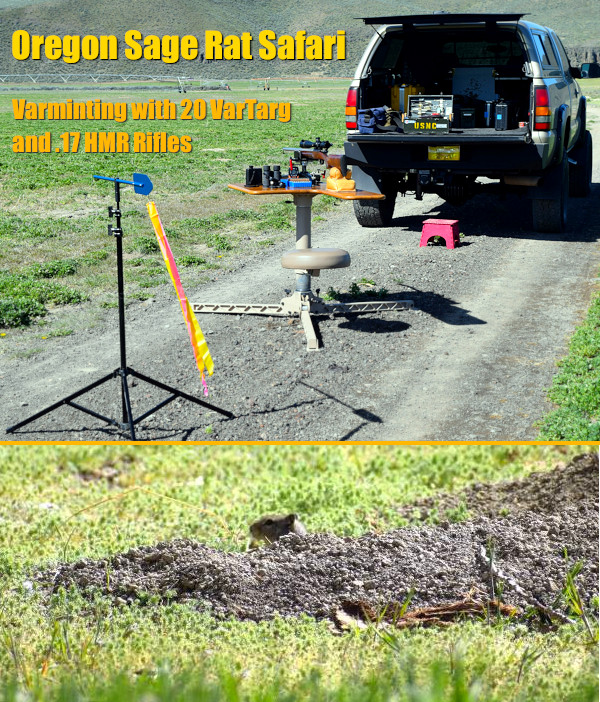
Our AccurateShooter.com Forum has an active section for hunting and varminting. One of the notable varminting threads in recent weeks was an account of a varmint hunt in Eastern Oregon. Forum member “Rick in Oregon” spent a week this past April nailing small varmints — known as “Sage Rats”, aka Belding ground squirrels (Urocitellus beldingi). Rick did most of his shooting with his handsome Cooper M38 rifle chambered for the 20 VarTarg wildcat, which is basically a .221 Fireball case necked down to .20 caliber. Here is Rick’s report on his successful Sage Rat Safari.
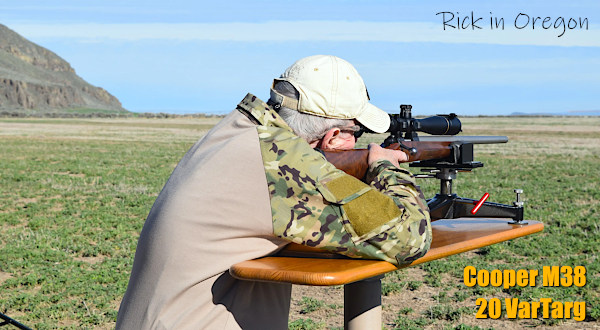
Forum member Rick in Oregon with his 20 VarTarg Cooper M38 rifle.
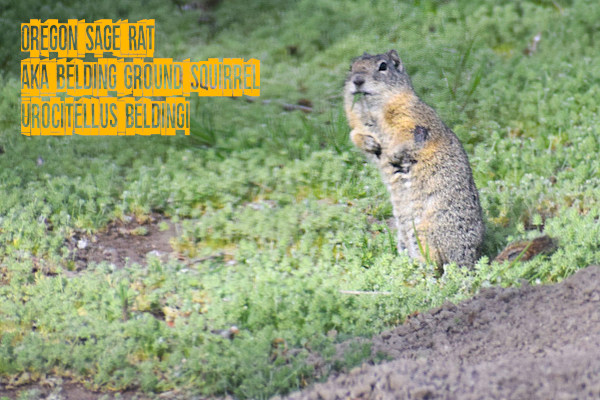
We just returned from a week-long sage rat shoot in the Orygun outback. Decent weather this time, no blowing snow, just plenty of sunshine and our buddy “Skippy the Flying Squirrel” to enhance our shooting enjoyment. Our rancher host refuses to use poison, so he welcomes us with the ability to hook our trailers to power and water, and a nice place to park them while we rid him of his sage rat problem. A true win-win situation for all. Out of respect for the rancher, we did not drive out into the fields. Instead we parked on the perimeter two-tracks, placed our portable benches, set up our windflags, then had at it.
For shooting these small critters, you need accurate rifles that shoot less than 0.5 MOA. The sage rats are small and they may be partially concealed inside their relatively flat mounds. I took my custom M700 .204 Match 1:11-twist rifle, but there were no long range opportunities to justify burning over 25 grains of powder, as no elevated positions were available to take advantage of it. Shooting from the flat terrain gets much mirage, making any hits past 350 yards virtually impossible, so my 20 VarTarg got the most action out to 350 yards. Then inside of 200 yards I used my Anschutz 1715D HB in .17 HMR which did a very fine job of rat launching.
Rick is a definite 20 VarTarg devotee: “For years I thought my .223 AI was the ideal Prairie Dog cartridge. It may well be, but for sage rats, the 20 VarTarg has few equals when efficiency and performance is considered. This makes 15 years of 20 VT sage rat medicine for me, and I do not see any changes on the horizon. It also works quite well on rockchucks!”
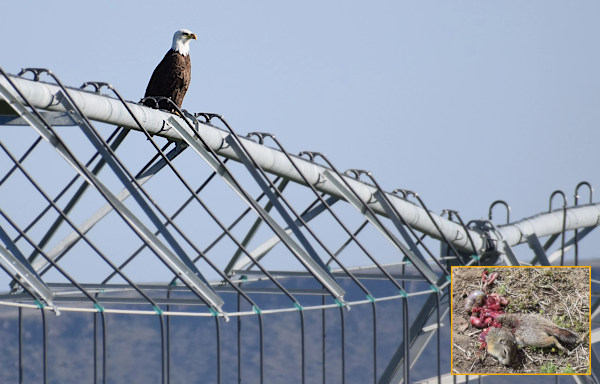
As usual when the “Eastern Oregon Raptor Feeding Society” shows up, so do the raptors. In fact bald eagles, golden eagles, hawks, and ravens all feast on the generous sage rat meals we provide. The terminal effects of the .20-Cal 32-grain bullets can’t be overstated. It sure makes it easy for the birds to do their thing. CLICK HERE for dead critter “blood and guts” close-up photo.
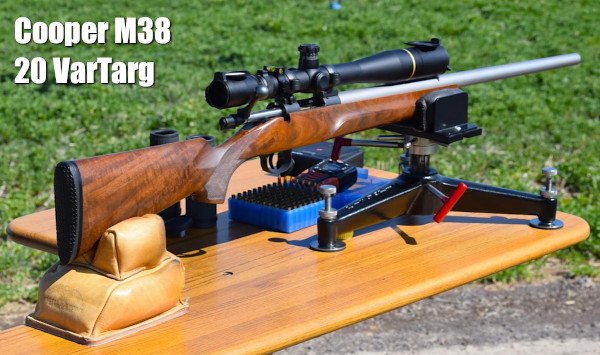
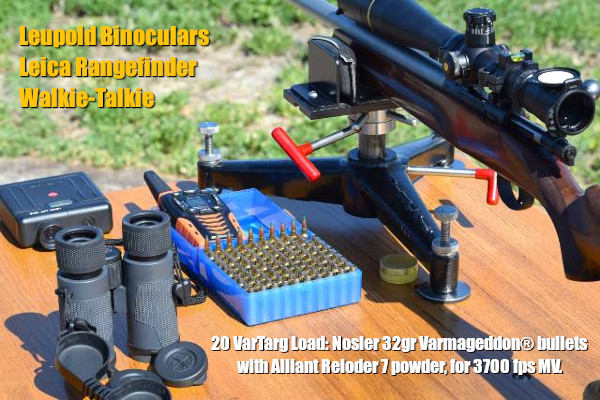
Above is Rick’s Cooper M38 chambered for the 20 VarTarg wildcat on his rotating field bench. Rick tells us: “My Cooper M38 VR 20 VarTarg is basically a stock offering from Cooper Firearms of Montana with a Jard 10 oz. trigger added. The barrel is a 1:12-twist 24″ Wilson chambered by Cooper. The bedding was perfect so I have not touched it in that regard.”
Rick’s load with Nosler 32gr Varmageddon bullets runs 3680 FPS — wicked fast. He loads Alliant Reloder 7 in Lapua or Nosler brass with Rem 7½ primers. Rick says this rig is VERY accurate, delivering groups in the sub-quarter-MOA range.
The scope is a Leupold VX3 6.5-20x40mm LR, with Varmint Hunter Reticle, factory-installed M1 elevation turret, EGW scope level, carried in Leupold rings. Rick notes: “My come-up chart in the scope’s ocular cover was developed using Sierra Infinity ballistics software based on my actual load. The chart has proven to be deadly spot-on at all suitable ranges I encounter the rats and rockchucks.”
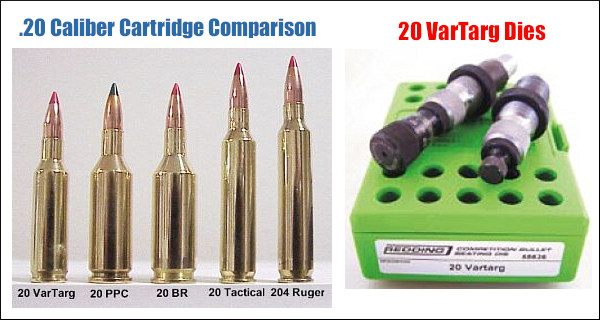
EDITOR: The 20 VarTarg cartridge is based on the .221 Fireball case, necked down to .204 and slightly modified for extra capacity. This very efficient cartridge offers low recoil and great accuracy. It’s one of our first choices for ground squirrels and P-dogs out to 300 yards.
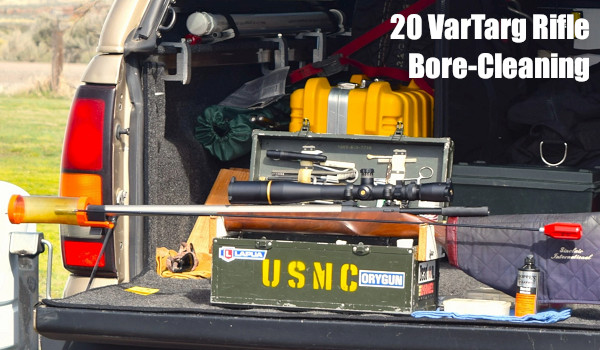
Tailgate Cleaning Set-Up — Brush That Barrel Back at Camp
Rick notes: “When the winds get up, cleaning in the field is problematic, blowing patches about, so cleaning back at camp on the tailgate is the hot setup.”
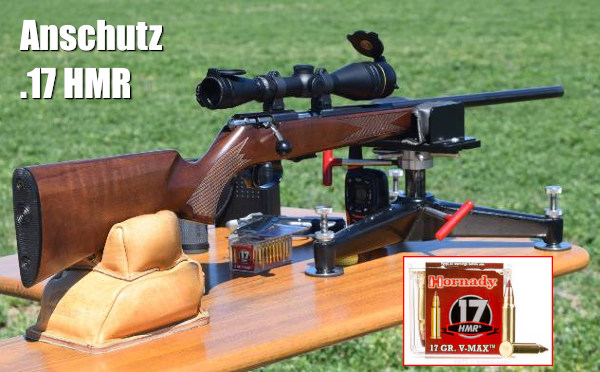
Anschutz 1715D HB in .17 HMR
For shots inside 200 yards, the .17 HMR works well. Rick notes: “The little ones were out, so inside of 200 yards, my Anschutz .17 HMR was the perfect medicine for that work. It really thumps those guys [doing] a very fine job of rat-launching.”
The .17 Hornady Magnum Rimfire (HMR) The .17 Hornady Magnum Rimfire (HMR) was introduced in 2002 by Hornady as a high-velocity, rimfire cartridge derived from the .22 Magnum case necked down to .17-caliber. The .17 HMR gained popularity among varmint hunters and target shooters for its good accuracy and hitting power out to 200 yards or more — all with low recoil and relatively low cost (compared to centerfire ammo).
Most .17 HMR ammo runs 17-grain or 20-grain hollow-point or plastic-tipped bullets at speeds around 2375-2550 FPS (lower for 20-grainers). Though lightweight, these small projectiles do deliver a powerful impact on small game while maintaining low recoil. Compared to the .22 LR, the .17 HMR offers superior ballistic performance, with flatter trajectories and higher energy at extended distances. It’s good for shooting prairie dogs, ground squirrels, sage rats, and other small critters.
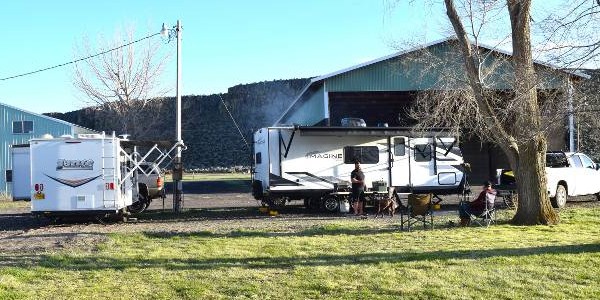
During his sage rat safari in Oregon, Rick stayed in his trailer (see above). Rick noted that one critter “was frolicking about my trailer, so he made a good subject for a 300mm telephoto lens, shot out my dinette window. I can never get that close to them when in the field.”
The .17 Hornady Magnum Rimfire (HMR) was introduced in 2002 by Hornady as a high-velocity, rimfire cartridge derived from the .22 Magnum case necked down to .17-caliber. Designed for precision and flat trajectory, the .17 HMR gained popularity among varmint hunters and target shooters for its good accuracy and hitting power out to 200 yards or more. Standard .17 HMR ammo typically fires a 17-grain V-MAX or TNT hollow point bullet at speeds around 2550 FPS, offering explosive impact on small game while maintaining low recoil.
Compared to other rimfire cartridges like the .22 LR or .22 WMR, the .17 HMR offers superior ballistic performance, including flatter trajectories and higher energy at extended distances. It’s good for shooting prairie dogs, ground squirrels, rabbits, and even coyotes under the right conditions. While not as powerful as some centerfire varmint rounds, its blend of affordability, velocity, and accuracy makes the .17 HMR an outstanding choice for precision-minded rimfire shooters. Popular manufacturers like CCI, Hornady, Winchester, and Federal produce a wide variety of loadings, from polymer-tipped hunting rounds to jacketed hollow points, making it easy to tailor your ammo choice to your specific shooting needs.
.17 HMR Ammo DEALS — CCI, Hornady, Remington, Winchester
Things to Know about .17 HMR Ammunition
Bullet Type & Weight: The standard bullet weight for .17 HMR is 17 grains, with options up to 20 grains for improved wind resistance and penetration. Polymer-tipped bullets expand rapidly on impact, while jacketed hollow points (JHP) offer deeper penetration.
Which is more powerful, .22 Mag or .17 HMR? While the .22 WMR (Magnum) may offer slightly more raw energy, .17 HMR delivers superior velocity and flatter trajectory, giving it better accuracy at long distances. For precision shooting, .17 HMR generally has the edge.
How does .17 HMR ammo compare to other rimfire cartridges? Compared to .22 LR or .22 WMR, .17 HMR shoots flatter, faster (typically 2500+ fps), and with greater accuracy at extended distances. It’s a top choice for rimfire shooters who demand high performance beyond 100 yards.
What is the effective range of .17 HMR? Good .17 HMR ammo is highly accurate up to 150–200 yards for small game and varmints. Some experienced shooters can push it beyond 200 yards with the right optics and wind conditions.
What is the best barrel length for .17 HMR rifles? A barrel length between 20–22 inches is optimal for .17 HMR, balancing velocity, maneuverability, and accuracy. Shorter barrels are lighter but may lose some velocity, while longer barrels offer slightly better ballistics at the cost of weight.
Is the .17 HMR good for beginners? Yes .17 HMR has low recoil, flat trajectory, and simple handling for new shooters. It’s an easy-shooting round that offers good performance with low recoil.
The 6mmBR Norma cartridge has spawned many great variants in multiple calibers: 6mm Dasher, 6BRA, 22 BR, 22 Dasher, 30 BR and others. This article is about a handsome 22 BR Rem-action varmint rig.
Richard Franklin (who operated Richard’s Custom Rifles prior to his retirement), has built scores of varmint rifles, in many different calibers. One of Richard’s all-time favorite varmint rifles is a 1:14″-twist, 22 BR built on his Model 11 stock in laminated Black Walnut and fiddleback maple. Richard says the rifle is versatile and deadly accurate out to 400 yards. Richard uses a Leupold 8.5-25x50mm LRT with varmint reticle.
Richard’s 22 BR Varmint Rifle with Lilja Barrel
Richard tells us: “[Shown above] is my light walking varminter. It’s built on a blue-printed Stainless Steel Remington 700 short action and chambered as a no-turn 22 BR for Lapua brass. The bolt handle is a Dave Kiff replacement and I’ve fitted a Jewel BR trigger with bottom safety. The barrel is a Lilja, 1:14″ #6 contour with a muzzle diameter of .750″. I shoot the 40gr V-Max bullets in the rifle at 4000 FPS. It’s tough on hogs if you don’t try them too far. 400 yards is about the max with it.
Accuracy is outstanding and with Roy, Mike, my grandson and myself shooting this rifle I don’t believe it has missed more than three hogs out of over 100 we shot at one summer. This rifle is carried in a ceiling rack in the truck where it’s handy and is used by the first person that grabs it when a hog is sighted if we are moving between setups. The Varmint reticle on the Leupold (shown below) is nice for quick hold-overs as you change distances.”
At right is a another Franklin Model 11 stock in Birdseye maple. That photo shows the details of the thumbhole stock.
Editor’s Note: We have shot a 1:8″-twist 22 BR in varmint matches and it was very accurate with 80gr bullets. It actually shot flatter out to 500 yards than our 6mmBR running 105-grainers. If we were to build a new long-range, bolt-action varmint rifle it would probably be a 22 BRA, essentially a 22 BR with 40° shoulder. That gives you a very stable cartridge with a bit more capacity. The 22 BRA retains a longer neck compared to the 22 Dasher, which is also an excellent cartridge — versatile and accurate.
22 BR Rivals 22-250 Performance
With bullets in the 40gr to 60gr weight range, the 22 BR gives up very little in velocity to a 22-250, despite burning quite a bit less powder (30-32 grains for the 22 BR vs. 35-38 grains for the 22-250). With a match-quality chamber, the 22 BR will probably have an edge in accuracy over a 22-250, and you should experience longer barrel life. Here are some recommended 22 BR loads for 40-60gr bullets:
Barnes Bullets has started a new Barnes Bullet Points podcast running on YouTube. Hosted by Barnes Bullets’ Marketing Mgr. Dale Evans, this podcast offers a behind-the-scenes look into the design and production of Barnes Bullets products along with use of Barnes Bullets in hunting and shooting sports.
The Barnes Bullet Points podcast will cover a variety of topics, blending technical and educational segments with real-world adventures and conversations with hunters and competitors. You can subscribe to the Barnes Bullets YouTube channel, follow on Spotify or Apple Podcasts. New podcasts will be released weekly. The first two podcasts are live now.
Episode 1: The History of Barnes
Barnes Podcast Number 1, The History of Barnes, was released last week. On the podcast, Evans is joined by Andrew Sparks and Gregg Sloan. The three men discuss Barnes Bullets’ origins, where it is today and what lies ahead. Together, they introduce both Barnes Bullets as a company and explain the Podcast goals.
Episode 2: Deep Dive into the Bullets
Podcast Episode 2 features Barnes bullet families. Listeners will learn more about the design features and performance of popular Barnes bullets. In this 75-minute podcast, Dale Evans is joined by Gregg Sloan and Mitchell Kukson. The three men discuss the features of Barnes TSX, TTSX, and LRX bullets. The podcast discusses how to select the optimal bullet type (for various scenarios), and the experts explain the performance you can expect to see from each. Watch this full 55-minute Podcast below:
“The Barnes Bullet Points podcast is a great resource for our loyal fans and end users to learn more about the brand, the products we offer and the people that help develop them”, said Evans.
This custom war wagon hauls varmint hunters around the Longmeadow Game Resort in Colorado.
Will you be heading to the varmint fields this summer? Proper planning is key to a safe, satisfying, and productive varmint holiday. Of course you’ll be busy reloading, but you should make a check-list of all the gear and supplies you need. Bring a variety of rifles if possible — you’ll need to switch off as one barrel gets hot, and the chambering that works best for your close shots may not be ideal for those longer shots out past 400 yards. Here are some tips from our Forum members that can help you shoot more effectively, and avoid problems on your varmint hunt. Here’s one key tip: at your shooting station, put a strip of surveyor’s tape on a tall stake to show the wind direction. Then shoot in the direction the wind blows. This will minimize the effect of cross-winds.
Varmint Safari Planning, Equipment, and Shooting Advice
From PatchHound: “The gear you bring will make or break a trip out to Prairie Dog land. A lot has to do with where you going and how far you are from [civilization]. For starters, bring lots of water. It will be hot in Wyoming in a few more weeks but it don’t hurt to bring warm clothes in case it snows. It’s best to wear leather boots unless you’re real good at dodging cactus while walking around. Good sunscreen [and a wide-brimmed hat] will save the day too. [What you need to bring] really depends on whether you’re shooting on some friendly ranch or 100 miles in the middle of [a wilderness area]. Good survival gear is a good thing to have for the latter!”
This photo is from a Dan Eigen TV Show video featuring a P-Dog hunt.
From Stoner25mkiv: “I’d suggest an adjustable bipod if you are going to do any walking. A laser rangefinder is a huge asset. Have a fanny pack or backpack for extra ammo, water, bore-snake, etc. when you go on your walkabouts. We also take a couple pivoting benches, heavy movers’ pad/blanket, sandbags (Uncle Bud’s Bulls Bag) for shooting from near the vehicle. Boonie hat for blocking the sun, sun glasses, sunscreen. High leather boots.
Anyway, on to the rifles…consider bringing a 17 HMR, .223 Ackley bolt gun, .223 Ackley AR, and a 243 WSSM. Some years the 17 HMR isn’t removed from its case. We had a couple windless days and the 17 was lots of fun. I’d walk into the dogtown and then lay down and wait. After five minutes or so I’d have dogs within easy rimfire range, and out to as far as I’d care to stretch the rimfire. 275 yards was about it.”
From CTShooter: “The .204 [Ruger] is a laser beam and good to 400 yards easy. Forget the rimfire! Do you have a portable bench that pivots? Bring bipod, binocs. Bring a LOT of water. I have a milspec sniper shooter’s mat/drag bag with shoulder straps. It is good to carry everything when you want to wander off and shoot prone with bipod. Here’s a view through my 6BR in ND.”
From RJinTexas: “In most of the locations that we’ll be shooting we’ll usually set up a minimum of 200 yards from the edge of a major dog town. We’ll start by working over the close-in dogs and shooting our way out, some of these towns may run in excess of 500/600 yards deep. I believe that a rimfire will put you at a distinct disadvantage. The only rimfire that will somewhat work is the 17 HMR and you can reload for your 204s for close to the cost of HMR ammo and you’ll be less apt to be under-gunned. Your 204 will work well out to 300/400 yards unless the wind is blowing hard. We classify a 10-mph crosswind as a very calm day and what makes it a little more challenging is that it is usually also gusting.”
From Wes (P1ZombieKiller): “[For my first PD trip] there are so many things I was not ready for. The one thing that I did bring (that no one told me about) was a canopy. I’m glad I did. Even though the weather was [near perfect], I know that sun can humble you real fast. With my pop-up canopy, I could shoot all day without getting killed by the sun. You had to tie the canopy down real well or the wind would blow it across the pasture.
We sat on shooting benches that pivot 360°, and are fast and easy to set up. Most all shots were 175-250 yards. I just felt comfortable at that range. It was more fun for me to be able to film the hits, and the camcorder I was using just did not get good video past 350 yards. The digital zoom distorted the image too much. I knew I would only get this one chance to film my first P-dog outing, and I wanted to get it on film for [posterity].”
Bring Multiple Rifles on Your Varmint Adventures
On our P-Dog adventures, we like to have multiple rifles — a .17 HMR for close work, then maybe a .20 Practical AR for 150-250 yards, then a larger caliber such as 6BRA, 6 Dasher or 6XC for those long shots. The classic 22-250 is also a wickedly effective varmint cartridge.
.20 Practical (20-223 Rem) AR-Platform Varminter
Here is a .20 Practical built by Robert Whitley. Whitley’s Ultimate Prairie Dog Rifle (PDR) features a 24″ Bartlein 11-twist cut-rifled barrel, DPMS side-charging upper, and a Jewell trigger. It is chambered in 20 Practical, a cartridge popularized by Warren “Fireball” Brookman.
This .20 Practical cartridge is simply the .223 Remington necked down to .204. You can use your existing .223 Rem brass — no special case-forming required! The 20 Practical is accurate, flat-shooting, and has almost no recoil. The advantage over the standard .223 Remington is that, grain for grain, the bullets have a higher BC and travel at a higher velocity for more dramatic effect on a small varmint. The ultra-low recoil allows you to easily see your hits, even without a muzzle brake. The 20 Practical, launching 40-grainers at about 3750 fps, shoots flatter than a .223 Rem with 55gr hollowpoints.
.17 HMR Savage A17 Varmint Rifle
We also like to have a Rimfire for the closer shots, inside 150 yards. The .17 HMR or .17 WSM are good choices. With a rimfire you save on ammo costs and you don’t waste precious centerfire barrel life.
This video shows a successful Prairie Dog hunt with a .17 HMR. Watch and you’ll see hits out to 160 yards (00:50), proving the effective range of the .17 HMR cartridge. The host is shooting a Savage A17 semi-auto .17 HMR rifle in a Boyds laminated stock.
In years past, one of our favorite features on the NRA Blog was the Friday Feast Recipe of the Week. In the past, the NRA Blog offered up a new delicious food recipe each Friday. Sadly the Friday Feast has not been updated for quite some time, but you can still see dozens of past Friday Feast recipes with this link:
Today’s featured Friday Feast combines two things we love — Italian pasta and Elk meat. Article author Emily Rupertus shares our passion for pasta: “I love pasta. I can’t get enough of it! So when I came across this Classic Elk Lasagna, I couldn’t resist sharing with you! You have to try this perfect twist on a classic comfort food.” After assembling your Lasagna in a big cast-iron skillet and covering with tin-foil, bake the Elk Lasagna in a 400° oven for 30 minutes. Then remove the foil, add more cheese and continue to bake uncovered for ten more minutes.
Ingredients
1/2 Package of Lasagna Noodles
1 lb Ground Elk Meat (you can substitute ground venison or antelope)
1 Medium Sweet Onion (chopped)
2 Cloves Garlic (chopped)
2 tablespoons Olive Oil
3 Cups Tomato Sauce
32 oz. Ricotta Cheese
1 Cup Parmesan Cheese
1 8 oz. Fresh Mozzarella Cheese (sliced)
2 eggs
To help celebrate Father’s Day, Savage Arms offers a $50 Rebate for its AXIS, AXIS II, AXIS 2, and AXIS 2 Pro rifles. You can SAVE $50.00 on Savage AXIS and AXIS 2 purchases made between 6/1/2025 through 6/30/2025. So, starting today, there are 16 more days to take advantage of this promotion. DEADLINE for mail-in or online submission is 7/31/2025. To redeem online visit SavageRebate.com.
Savage AXIS, AXIS II, and AXIS 2 rifles are reliable, budget-priced rigs for hunting/varminting. These rifles are currently offered in a variety of configurations, starting at $479.00 MSRP for the scoped AXIS XP. Both right-hand and left-hand actions are offered, with both polymer and wood stocks in a variety of colors, including many camo options. NOTE: The XP models include a mounted and boresighted 3-9x40mm optic. These scope-fitted AXIS XPs represent very affordable, ready-to go solutions for hunters.
Savage currently offers newly redesigned AXIS XP, AXIS 2, AXIS 2 Pro, AXIS 2 XP, and AXIS 2 XP Pro model rifles. The AXIS 2 PRO models are available with great Savage camo patterns and Cerakote finishes. The AXIS XP, AXIS 2 XP, and AXIS 2 XP Pro models come with a mounted 3-9x40mm scope. CLICK HERE to see current Savage AXIS rifles.
Planning a Prairie Dog hunting adventure this summer? Consider bringing a .17 HMR rimfire rifle. Of course, for long shots you’ll definitely want a centerfire. We like the 20 Practical in an AR and a 22 BR/BRA in a bolt-action. That will have you covered out to 700 yards. But for shorter shots on small critters — say inside 150 yards — it makes sense to have an accurate .17 HMR rimfire rig. Today’s 17 HMRs are capable of surprising accuracy, rivaling a good centerfire rig, but with less recoil and much lower cost per shot. And the .17 HMR offers more than double the velocity of a .22 LR — up to 2650 fps with a 17-grain bullet.
Top Shot former Champion Dustin Ellerman likes his Volquartsens, and we can see why. With one of his favorite .17 HMR rimfire varmint rigs, he’s seen some outstanding accuracy with CCI ammo. A few seasons back, on his Facebook page, Dustin reported: “Prepping for prairie dogs and I’m floored by this cold, sub-half-inch group shot with the Volquartsen Custom .17 HMR at 100 yards.” This thumbhole-stock rifle features a Bowers Group USS suppressor, and 3-12x56mm Meopta Scope. Dustin tried different types of CCI .17 HMR ammo. This small group was shot with CCI A17 ammo.
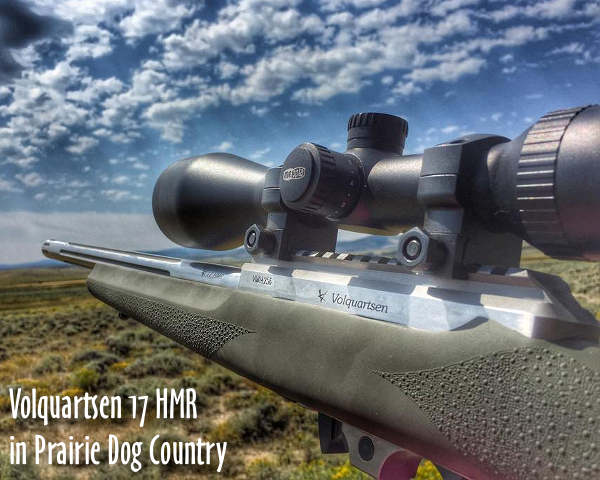
What’s the effective range of a .17 HMR on prairie dogs? You might be surprised. in 2015, Dustin took another Volquartsen .17 HMR on a Prairie Dog hunt in Wyoming. He was impressed with the rifle (shown below) and the little rimfire cartridge. Dustin says the effective range of the .17 HMR is farther than one might expect: “I made hits out to 300 yards. 200 yards was easy as long as the wind wasn’t too bad.”
Here’s the Volquartsen .17 HMR Dustin used in Wyoming in 2015:
After that 2015 P-Dog expedition, Dustin became a fan of the .17 HMR cartridge: “Never paid it much attention before now because the ammo is five times more expensive than .22 LR and I mostly target shoot. However, for prairie dogs, the .17 HMR is amazing!” Consider this — Hornady’s .17 HMR ammo pushes a 17gr V-Max bullet at 2550 fps, twice as fast as typical .22 LR rounds.
Prairie Dog Adventure with Savage A17
This video shows a successful Prairie Dog hunt. Watch and you’ll see hits out to 160 yards (00:50), proving the effective range of the .17 HMR cartridge. The host is shooting a Savage A17 semi-auto .17 HMR rifle in a Boyds laminated stock.
.17 HMR and .22 WMR Options Enhance Ruger Precision Rimfire for Varmint Work
Many readers may not know this, but the Ruger Precision Rimfire rifle is available in three rimfire chamberings: .22 LR, .17 HMR, and .22 WMR. While .22 LR ammo is considerably cheaper, .17 HMR and .22 WMR shoot flatter and deliver MUCH more energy. These .17 HMR and .22 WMR chamberings are way more suitable for varminting. In fact we think this .17 HMR transforms the Ruger Precision Rimfire into a very good “carry-around” varmint rifle. We really like the .17 HMR — it’s our favorite rimfire cartridge for small varmints out to 160 yards.
Both cartridge types, .17 HMR and .22 WMR, also offer higher velocities, less wind drift, and flatter trajectory than the .22 LR. This is a benefit when cross-training. You can shoot at more distant targets with considerably less elevation dialed in your scope. And the windage corrections will be less extreme.
Ruger says: “Faster, flatter and with high-performing bullets, .17 HMR and .22 WMR cartridges expand the capabilities of the Ruger Precision Rimfire platform. Like its .22 LR predecessor, these new magnum offerings maintain the same ergonomics, trigger and manual of arms as the larger centerfire Ruger Precision Rifle.”
Here’s an excellent video review of the .17 HMR Ruger Precision Rimfire rifle by YouTuber 22 Plinkster. The reviewer was impressed with the rifle’s accuracy with 17gr ammo.
Both Ruger Precision Rimfire rifles feature 18″ hammer-forged barrels threaded for muzzle devices, including the Ruger® Silent-SR®. The 15″ free-float handguard with Magpul M-LOK slots provides generous scope clearance and easy mounting of M-LOK-compatible rails and accessories.
Like its .22 LR version, the magnum Ruger Precision Rimfire models featured an adjustable bolt throw (that can emulate a centerfire action if desired), along with trigger that adjusts from 2.25 to 5 pounds. The .17 HMR and .22 WMR models ship with a 0 MOA Picatinny rail and one, 15-round BX-15 Magnum magazine or one, 9-round JMX-1 rotary magazine. The BX-15 Magnum mag works very well with the .17 HMR and .22 WMR chamberings.
The standard finish for the .17 HMR and .22 WMR Ruger Precision Rimfire rifles is Black hard-coat anodized. But there is also a Burnt Bronze Cerakote Special Edition available through Iron Valley Distributor.
State and regional fish and wildlife representatives from across the country recently visited SIG SAUER, Inc. headquarters and the SIG SAUER Academy in New Hampshire. These groups came to see the firearm manufacturing process. This would help them understand how guns and ammo excise taxes fund a sizable portion of modern conservation agency jobs, research, habitat projects, equipment, and technology.
Gun Industry Funds Wildlife Conservation
One of the most significant funding sources for conservation derives from firearm, ammunition, fishing and archery equipment manufacturers through the Wildlife and Sport Fish Restoration program. Nearly $1.1 billion in funding is generated annually.
Participants toured the manufacturing facility, seeing every step of the manufacturing process – they even tested the firearms at SIG SAUER Academy. This collaborative event was made possible through the Partner With A Payer Initiative, which connects state and federal agency staff to the manufacturers whose products generate excise taxes, enabling vital conservation work throughout the USA.
Major partners of this tour include the U.S. Fish and Wildlife Service (USFWS), NSSF — The Firearm Industry Trade Association, and Council to Advance Hunting and the Shooting Sports (CAHSS). The event was featured as part of the annual National R3 Symposium that focuses on the the recruitment, retention, and reactivation of target shooters and hunters. That in turn helps the represented agencies increase conservation funding via excise taxes.


The .17 Hornady Magnum Rimfire (HMR) was introduced in 2002 by Hornady as a high-velocity, rimfire cartridge derived from the .22 Magnum case necked down to .17-caliber. The .17 HMR gained popularity among varmint hunters and target shooters for its good accuracy and hitting power out to 200 yards or more — all with low recoil and relatively low cost (compared to centerfire ammo).





 The 6mmBR Norma cartridge has spawned many great variants in multiple calibers: 6mm Dasher, 6BRA, 22 BR, 22 Dasher, 30 BR and others. This article is about a handsome 22 BR Rem-action varmint rig.
 Accuracy is outstanding and with Roy, Mike, my grandson and myself shooting this rifle I don’t believe it has missed more than three hogs out of over 100 we shot at one summer. This rifle is carried in a ceiling rack in the truck where it’s handy and is used by the first person that grabs it when a hog is sighted if we are moving between setups. The Varmint reticle on the Leupold (shown below) is nice for quick hold-overs as you change distances.”



 From Wes (P1ZombieKiller): “[For my first PD trip] there are so many things I was not ready for. The one thing that I did bring (that no one told me about) was a canopy. I’m glad I did. Even though the weather was [near perfect], I know that sun can humble you real fast. With my pop-up canopy, I could shoot all day without getting killed by the sun. You had to tie the canopy down real well or the wind would blow it across the pasture.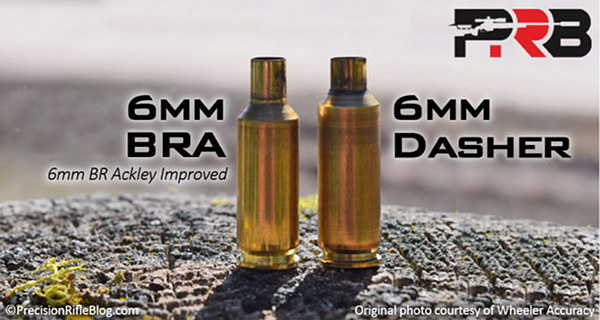



 .17 HMR and .22 WMR Options Enhance


