Beretta, makers of fine shotguns, rifles, and pistols, also owns Finnish rifle-maker SAKO. In this article, which first appeared in the Beretta Blog, hunting guide Mia Anstine writes about her visit to the Sako factory and her live-fire shooting test to secure her hunting permit. CLICK HERE for full story.
Visting the SAKO Factory in Finland, by Mia Anstine
What a joy to wake up in Finland and prepare for a tour of Sako. I enjoyed a European breakfast with a view of downtown Helsinki. Shortly I joined the hosts and writer’s group, and we boarded the bus for a ride to Riihimaki, to the manufacturing facility.
Sako built its original manufacturing facility during World War I. To this day they still utilize the original buildings but have also grown over the years to include larger production areas and updated equipment.
Video shows Sako Rifle-Making and Hunting in Finland’s Backcountry (worth watching):
Beretta Holding’s acquisition of the Sako company brought additional opportunity for growth. The company added state-of-the-art machinery which has aided in increased production. However, they’ve still maintained their signature quality-built products by keeping the human element integrated throughout the production line.
After a quick tour of the Sako facility, we headed to the shooting range. We shot a number or Sako and Tikka rifles, but first, we sighted in our hunting rifles in preparation for a brown bear and moose hunt. I would be hunting with a Sako model 85 Hunter chambered in 9.3 mm. (Editor: For fans of this big 0.366 caliber, Sako offers both 9.3x62mm and 9.3x66mm Sako chamberings).
Hunters Must Pass Marksmanship Tests
To hunt bear in Finland, you must first pass a hunting test as well as shooting test. The timed, live-fire event [requires] five rounds in the kill zone of a brown bear at 100 meters. Of course, the ever-courteous Finns had ladies go first, so I felt more than a bit of pressure, and I know I shot a bit faster than necessary. Regardless, I cycled rounds and passed with ease.
Next, we headed to a different bay at the shooting range where we experienced the hunting test from days of old. In this test, we shot from standing position at a moose target. First, we shot three rounds in the kill zone, from 100 meters, and then three at the moose target as it raced by, from right-to-left and left-to-right, at 20 kilometers per hour. While this test is no longer required, it was a pleasure to try our hands at it.
Recommended Books about Hunting
There’s no shortage of good hunting-related reading material. Here are some of the best books written about hunting. You can find all these titles on Amazon.com. Many are offered in eBook format as well as printed versions. Click on the link(s) below to preview a sample from each book.
For decades, shooters have depended on Brownells to provide tools, parts and accessories for nearly all kinds of modern sporting and hunting firearms. Starting this month, gun owners can now purchase rifles, shotguns, and pistols from Brownells, which has opened a web-based, gun sales division. The company’s entry into selling firearms online makes Brownells a true, one-stop-shop for gun owners and shooting sports enthusiasts.
“We’ve been a gun company from the beginning,” said Pete Brownell, CEO of Brownells. “For 77 years, we’ve serviced all corners of the firearms market – new shooters to gunsmiths. This is just one example of many upcoming programs we’ll be launching to serve every portion of the gun industry.”
Brownells’ new Firearms Sales Center features more than 3,500 production firearms from over 30 popular gun manufacturers, including Remington, Ruger, Browning, CZ-USA, Smith & Wesson, Sig Sauer, Beretta, Benelli, Glock and more.
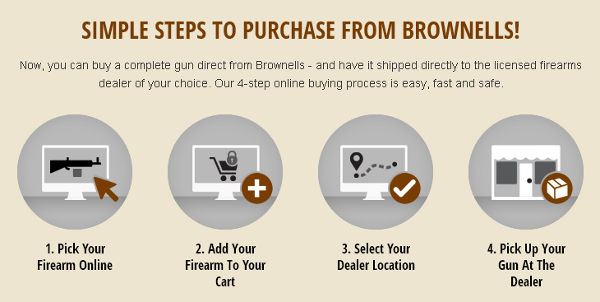
Customers can order guns online using the simple, step-by-step instructions. The quickest, easiest method for completing an online gun purchase will be to choose a Brownells Featured Dealer from the online list of FFL dealers who have already agreed to perform transfers on guns bought from Brownells.
News Tip from EdLongrange. We welcome reader submissions.
The folks at Sierra Bullets asked a few staff bulletsmiths a classic question about guns: “If you could own only one firearm which one would you choose?” There were many interesting answers including a “cheater” response — the drilling — which is really two guns in one. The most-often mentioned chambering was the venerable .30-06. Respondents cited its versatility, hunting prowess, and ready availability of ammo. The popular .308 Winchester, as expected, got mentions as did its cousins the .243 Win and 7mm-08. There were quite a few votes for classic lever guns, as well as 12-gauge shotguns. Two bulletsmiths cited the .22 LR, and we can certainly see the logic in that answer. The little rimfire cartridge is versatile, quiet, and inexpensive.
We ask our readers the same question — if you could only have one long gun, what type of firearm would it be? List the gun type and chambering in the comments section.
If You Could Have Just One Long-Gun — ANSWERS:
Media Relations Manager Carroll Pilant answered: “I would NEVER own only one gun. If I HAD to pick one, it would be a drilling in 12 gauge over .30-06.”
Ballistic Technician Rich Machholz answered: “The early tang safety Ruger M77s pretty much have all you could want in a bolt gun, but I do like the Winchester lever guns and the combination guns, particularly the drillings. Since I have the first two, I’m going for a Doug Turnbull 1886 or a side by side 20 gauge over .223 drilling.”
Ballistic Technician Philip Mahin answered: “More than likely it would have to be a bolt action .30-06. The reliability is legendary on a wide range of game animals and factory ammunition has still been available at my local stores even in these tough times.”
Ballistic Technician Duane Siercks answered: “If I had to boil it all down to one gun, it would probably be a .30-06. I have a Remington 700C (custom shop gun) that has worked very well for anything and everything I have ever wanted to do with it.”
Ballistic Technician Paul Box answered: “A .22 Rimfire.”
Chief Ballistician Tommy Todd answered: “Remington 700 in .308 Winchester.”
VP – Sales & Marketing Matt Reams answered: “A light weight Kimber in 25-06.”
Production Toolsetter Brad Vansell answered: “Savage weather warrior 7mm-08 is my rifle of choice.”
Production Toolsetter Dan Mahnken answered: “The .308 Winchester rifle — [based on the] wide range of bullets made and the wide range of things that one can hunt with it.”
Process Engineer David Palm answered: “Savage action 243 Winchester.”
Ballistic Technician Gary Prisendorf answered: “Probably a .22 LR. It may not be the best choice, but you could use it for about anything if you really had to.”
Production Manager Chris Hatfield answered: “Beretta A300 Outlander 12 gauge.”
Team USA Olympian and ISSF World Cup Winner SFC Michael McPhail is one of the world’s best smallbore rifle shooters. He is also an avid hunter, who enjoys harvesting game with centerfire rifles. In this excellent short video from the USAMU, McPhail shows how competition shooting positions can be adapted for hunters. McPhail shows how well-established positions can provide a more stable platform for hunters in the field. That can help ensure a successful hunt. McPhail demonstrates three positions: kneeling, supported prone, and sitting in a tree-stand.
Watch SFC McPhail Demonstrate Positions for Hunters (Good Video):
McPhail first demonstrates the kneeling position. Michael notes: “I like kneeling. It’s a little bit of an under-utilized position, but it’s almost as stable as prone. It allows you get up off the ground a little bit higher to [compensate for] vegetation. For kneeling start by taking your non-dominant foot and put that towards the target, while at the same time dropping down to a knee on the dominant leg. At the same time … wrap the sling around wrist and fore-arm, lean slightly into the target and take the shot.”
McPhail shows a nice “field expedient” use of your backpack. He shows how the basic prone position can be adapted, using the pack as a front rifle support. McPhail recommends pulling your dominant (strongside) leg forward, bent at the knee. According to Michael, this takes pressure off the abdomen, helps minimizes heart beat effects, and helps with breathing.
Last but not least, McPhail shows some clever treestand tricks. McPhail recommends a position with your weakside leg pulled up and firmly braced on the front rail of the treestand. You can then rest your support arm on your leg. (That would be the left arm for a right-handed shooter). This provides a rock-solid position when shooting from a stand. The second half of the video shows how this works.
Are you looking for a .22 LR Rimfire rifle that has the look and feel of a centerfire rig? Then check out the CZ 455 rimfire rifle featuring a black-finished, laminated wood stock. This gun, dubbed the Varmint Tacticool Suppressor Ready by CZ-USA, features a 5-round detachable magazine and adjustable trigger. It comes with a short 16.5″ barrel with threaded muzzle for easy installation of a “can” (suppressor or sound moderator).
The original CZ-455 Varmint Tacticool was built as an affordable tactical trainer with the ergonomics and stock profile of a full-size centerfire tactical rig. The Tacticool’s stock looks similar to the Manners Composites stock on CZ’s 455 Varmint Precision Trainer, but the wood-stocked ‘Tacticool’ version is much less expensive. The CZ 455 with Manners stock retails at $940.00 MSRP while the latest suppressor-ready ‘Tacticool’ model lists for $549.00 MSRP. The $391.00 you save will buy a lot of ammo (or a scope).
We like the looks of the CZ-455 ‘Tacticool’, and the stock has some nice features. The butt-hook stock has ambidextrous palm swells on the grip and a raised comb to provide a comfortable cheek weld for shooting with a scope. The fore-end features a wide, beavertail swell for greater stability on a front sandbag. There are two (2) sling swivel studs so you can attach both a sling and a bipod.
Twin-Barrel CZ-455: Shoot .22 LR and 17 HMR with Same Rifle
CZ also offers a versitile twin-caliber CZ-455. The CZ-455 American Combo comes from the factory with two (2) fitted barrels, one in .22 LR and the other in 17 HMR. This effectively gives you two rifles for not much more than the cost of a .22 LR rig. And the 17 HMR cartridge really extends your effective range on varmint hunts.
Switching barrels is easy — simply remove the two action screws to release the barreled action then loosen two set screws that retain the barrel. No need to worry about headspace — the barrels are pre-fit and drop-in. The video below shows how the barrel exchange system works.
John Nosler lived 97 years, passing in 2010. During his long lifetime, John was an iconic figure in the shooting world. Considered a true pioneer in bullet and ammunition design, Nosler developed the famous Partition bullet in the 1940s. Born on April 4, 1913 in Brawley, California, John built his business from scratch. He founded his bullet company in 1948, and was considered to be one of the great innovators whose designs literally created the premium bullet category and influenced ammunition manufacturers worldwide.
Moose-Hunt Inspires Partition Bullet Design
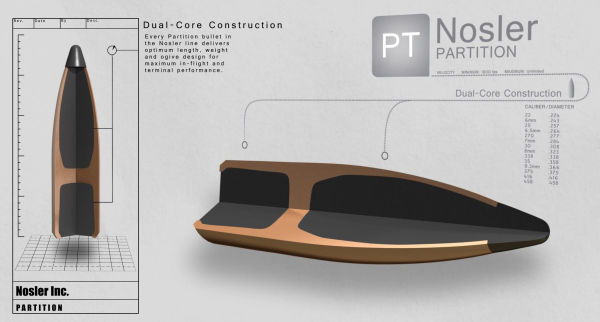
While hunting in Canada, John experienced a bullet failure on the hide of a mud-caked bull moose. He then began developing a revolutionary new projectile, which he called the “Partition”, because of the barrier that separated the bullet into two sections. One year later, John and a friend traveled back to British Columbia with his new Partition bullets, which were designed to provide deep penetration and expansion. The men bagged two moose with two shots, and the rest is history.
In recognition of his contribution to the shooting sports industry, John was the unanimous choice for the inaugural 2007 NRA Golden Bullseye Pioneer Award. The award was the highlight of a long and fruitful career. Even though he officially retired in 1988 when his son and daughter-in-law, Bob and Joan Nosler purchased the company, John still managed to come to the office on a daily basis until his health declined.
Today, John’s son Bob Nosler still presides over the company as president and CEO of Nosler, Inc., based in Bend, Oregon. Along with bullets, the company now produces cartridge brass, loaded ammunition, and hunting rifles.
To learn more about John Nosler and his bullet designs, get your hands on Going Ballistic, a “Professional Memoir” told by John Nosler to outdoor writer Gary Lewis. CLICK HERE to hear a short John Nosler audio clip or to order the book from the author.
John Nosler remained an avid hunter and shooter even late in life. Gary Lewis recalled that, at age 92, John Nosler attended the opening of a new shooting range outside Bend, Oregon. Even in his nineties, Nosler managed to drill two shots inside nine inches at 1000 yards. John Nosler leaves a legacy that will benefit hunters and shooters’ nationwide. The John A. Nosler Endowment of The NRA Foundation, sponsors the NRA’s Basic Rifle Training Program which instructs novices in safe rifle handling.
The Savage A17 in 17 HMR was American Hunter’s 2016 Rifle of the Year. We weren’t surprised. This little rimfire was the first auto-loader engineered from scratch to handle the pressure of the 17 HMR safely and reliably. The A17 also proved to be very accurate and tons of fun to shoot.
If you like the A17’s award-winning delayed-blowback technology, but prefer to shoot a .22 WMR (Winchester Magnum Rimfire) cartridge, you’re in luck. Savage just announced the A22 Magnum, a new rifle that uses an A17-type action (with innovative interrupter lug), to shoot the .22 WMR cartridge.
The A22 Magnum is chambered for .22 WMR and features the same delayed-blowback auto-loading action as the original A17. The A22 Magnum feature a strong steel receiver, chromed bolt, 10-round rotary magazine, and adjustable Savage AccuTrigger. The A22 employs a thread-in headspace system like Savage’s centerfire rifles. This makes it easier to swap in a match-grade barrel down the line. The A22 also comes with two-piece bases for scope mounts
Part No.
Description
Barrel
Weight
MSRP
47400
A22 Magnum semi-automatic, .22 WMR
21″ Barrel
5.5 lbs.
$473.00
Advantages of .22 WMR over 17 HMR
We like both rimfire cartridges, but we understand why some shooters may prefer the older .22 WMR over the newer, speedier 17 HMR. Here are some of the advantages of the .22 Winchester Magnum Rimfire (WMR):
1. .22 Caliber bores are easier to clean than .17 caliber bores. Good .22-Cal cleaning rods are less flexy than .17-cal rods and a greater range of jags and brushes are offered for the larger caliber.
2. The .22 WMR makes a bigger hole — this makes your groups easier to see at longer range, and the bigger hole can give you a scoring edge in rimfire competitions.
3. The .22 WMR offers a wider choice of ammo manufacturers and bullet types. If a hunter desires a heavier, non-fragmenting bullet, the .22 WMR may be a better choice.
It’s about darn time … that somebody offered vibration damping in a laser rangefinder (LRF). This “anti-shake” technology has been available in binoculars for years, but now it’s finally available for a laser rangefinder — thanks to Nikon. Nikon’s new MONARCH 7i VR Laser Rangefinder is the world’s first LRF with automated vibration compensation. Nikon’s VR (Vibration Reduction) technology reduces the effect of external vibrations caused by shaking and hand movements. The system steadies the image seen through the 6X viewfinder, while simultaneously aligning/steadying the irradiated laser beam for faster, more precise ranging.
“Vibrations of the image in the viewfinder caused by hand movement (sinusoidal waves) are reduced to approximately one-fifth (or less) based on Nikon’s measurement standards. With the push of a button you’ve just made the world stand still for a fast, precise distance measurement.”
Nikon says its VR technology will “reduce optical vibrations by nearly 80%“. The VR system stabilizes the viewed image AND simultaneously aligns the image with the activated laser beam. This delivers a “rock-solid” view of your target for faster, more precise ranging. Hunters will find that the target mark on the rangefinder remains much more stable, so you can range more quickly and efficiently. Watch this video to see how VR technology works:
Comment: VR technology IS a big deal for the hunter in the field. Bottom line — this anti-shake technology will let hunters range faster and range distant targets more reliably. The difference when ranging small game at long ranges is quite noticeable. Right now Nikon is the only company offering VR technology in rangefinders, but we expect other LRF-makers to follow suit. Surprisingly, the MONARCH 7i VR Laser Rangefinder is quite affordable. MSRP is $399.95.
Instant-On VR Functionality
The VR Function begins immediately when the laser rangefinder is on, meaning there is no extra time spent trying to toggle between settings. Holding down the ranging button allows the user to continuously scan for 8 seconds. A fast measurement is received (in approximately half a second), regardless of the distance, thanks to Nikon’s Hyper Read technology. The MONARCH 7i VR has an effective measurement range of 8-1000 yards and displays measurements in .1-yard increments. In addition, the Nikon’s ID (Incline/Decline) Technology compensates for uphill or downhill shooting angles by providing the true horizontal distance for your ballistics solver.
The MONARCH 7i VR represents a major step in hunting technology by helping alleviate the difficulty of keeping the rangefinder steady enough to range distant objects. This issue is partially due to the compact size of most laser rangefinders, which makes it challenging to brace it against a solid object, such as a tree or the edge of a deer stand. The rangefinder’s small size, combined with a strong wind, unbalanced position, physical exertion or just plain-old “buck fever” can make it virtually impossible to hold the target mark of the rangefinder on target and keep it still long enough to get a distance reading. VR changes all that, and we commend Nikon for making this technology available to sportsmen.
The Savage A17 earned honors as American Hunter’s 2016 Rifle of the Year. And now this popular auto-loading 17 HMR is even better. Savage Arms has released two new “Target Sporter” versions with heavier barrels and beefier, laminated wood stocks. We particularly like the new Thumbhole version, shown below. MSRP is $631.00 but ‘street price’ will be much lower.
These new models feature 22″ button-rifled heavy barrels for improved accuracy and Boyds’ gray wood laminate stocks for improved ergonomics. As with all A17s, the new wood-stocked Target Sporter models feature a case-hardened receiver, chromed bolt with large charging handle, 10-round rotary magazine, and user-adjustable AccuTrigger.
Features & Benefits
• First reliable semi-automatic rimfire specifically designed from for 17 HMR
• Delayed-blowback action for safe, reliable cycling
• Hard chrome bolt with oversized bolt handle
• Case-hardened receiver and 22-inch button-rifled barrel
• 10-round rotary magazine
The A17 platform is the first delayed-blowback, semi-auto rimfire designed espressly for the 17 HMR cartridge. The unique delayed-blowback action allows safe, reliable semi-auto cycling with normal 17 HMR loads. We tested the original A17 and it proved accurate and reliable (so long as you made sure the magazine is completely seated). In fact, the A17 we tested flawlessly powered through multiple magazines in rapid-fire. Savage has modified the magazine well slightly to enhance reliability (see below). Now it’s easier the get the mag seated — the key to 100% reliable cycling.
How the A17 Works Using Interrupter Lug
For the A17 series of auto-loaders, Savage engineers invented a new delayed-blowback action that employs an interrupter lug to hold the bolt closed for a few milliseconds. Savage engineers scrapped the standard straight-blowback approach, which ejects spent casings via overpressure during firing. In its place, they opted for an interrupter lug that locks the bolt until peak cartridge pressure has passed. The timing system prevents the bolt from opening prematurely, effectively putting an end to ruptured cases. By doubling as a firing pin block, it also prevents out-of-battery firing with an open action.




 In recognition of his contribution to the shooting sports industry, John was the unanimous choice for the inaugural 2007 NRA Golden Bullseye Pioneer Award. The award was the highlight of a long and fruitful career. Even though he officially retired in 1988 when his son and daughter-in-law, Bob and Joan Nosler purchased the company, John still managed to come to the office on a daily basis until his health declined.
 To learn more about John Nosler and his bullet designs, get your hands on Going Ballistic, a “Professional Memoir” told by John Nosler to outdoor writer Gary Lewis.

 1. .22 Caliber bores are easier to clean than .17 caliber bores. Good .22-Cal cleaning rods are less flexy than .17-cal rods and a greater range of jags and brushes are offered for the larger caliber.


