Here’s something you don’t see every day — a bolt-action, repeating, double rifle. This amazing twin-barreled bolt-gun has a closing mechanism that locks two separate bolt bodies into the chambers of the right and left barrels. Yes there are two firing pins, two ejectors, two extractors, and two triggers. We’re not sure how one jumbo camming system closes two bolts, but there might be a geared center shaft rotating both right and left bolt bodies at the same time (but in opposite directions). Perhaps one of our gunsmith readers can explain how this system works.
This Rifle Has TWO Barrels and TWO Bolts
Just $78,000 at “Half-off Pricing”
This unique firearm, chambered in .416 Remington, was sold a few years back on Gunbroker.com for $78,000. That astronomical sum is just half the original cost, according to the seller. Crafted by Fuchs, this double rifle has 22″ barrels and weighs 11.5 pounds. Deep-chiseled, full-coverage engraving decorates the receiver. So, if you have a cool $78 grand to burn you can acquire a very rare firearm — we doubt if you’ll find another one of these anytime soon.
National Hunting and Fishing Day (NHF Day) takes place on Saturday, September 26, 2015. The annual celebration serves as a reminder that conservation succeeds because of leadership and funding from hunters, shooters and anglers. National, regional, state and local organizations will run thousands of “open house” hunting- and fishing-related events around the country. Events will include Fishing Derbys, Hunting Expos, Wing-shooting tournaments, and much more. Over four million Americans will participate. For information on NHF Day, visit www.nhfday.org. To find NHF Day events in your state, click the links below.
Hunting season is right around the corner. That means its time to inspect all your hunting gear, including your scope set-up. A proper scope installation involves more than just tensioning a set of rings — you need to consider the proper eye relief and head position.
In this NSSF video, Ryan Cleckner shows how to set up a scope on a hunting or tactical rifle. Ryan, a former U.S. Army Sniper Instructor, notes that many hunters spend a small fortune on equipment, but fail to set up their rifle to use the optics optimally. Cleckner likens this to someone who owns an expensive sports car, but never adjusts the seat or the mirrors.
Ryan notes that you want your head and neck to be able to rest naturally on the stock, without straining. You head should rest comfortably on the stock. If you have to consciously lift your head off the stock to see through the scope, then your set-up isn’t correct. Likewise, You shouldn’t have to push your head forward or pull it back to see a clear image through the scope. If you need to strain forward or pull back to get correct eye relief, then the scope’s fore/aft position in the rings needs to be altered. Watch the full video for more tips.
Tips on Mounting Your Scope and Adjusting Your Comb Height:
1. Normally, you want your scope mounted as low as possible, while allowing sufficient clearance for the front objective. (NOTE: Benchrest shooters may prefer a high mount for a variety of reasons.)
2. Once the scope height is set, you need to get your head to the correct level. This may require adding an accessory cheekpad, or raising the comb height if your rifle has an adjustable cheekpiece.
3. Start with the rifle in the position you use most often (standing, kneeling, or prone). If you shoot mostly prone, you need to get down on the ground. Close your eyes, and let you head rest naturally on the stock. Then open your eyes, and see if you are too low or too high. You may need to use a cheekpad to get your head higher on the stock.
4. If your scope has a flat on the bottom of the turret housing, this will help you level your scope. Just find a flat piece of metal that slides easily between the bottom of the scope and the rail. Slide that metal piece under the scope and then tilt it up so the flat on the bottom of the scope aligns parallel with the flats on the rail. Watch the video at 8:40 to see how this is done.
Video find by EdLongrange. We welcome reader submissions.
This is one of the finest shooting videos we’ve ever seen. Set in the scenic Fjordland of northern Norway, this high-quality 15-minute video is part Nat Geo travelog, part ballistics lesson, part gear review. We wish we had the opportunity to join Ulf Lindroth and Thomas Haugland on their remarkable shooting adventure. This video was originally created for Great Britain’s Fieldsports TV Channel.
This is an outstanding video, recommended for anyone interested in long-range hunting.
Long range shooters Lindroth and Haugland traveled to the Arctic Circle to field test a new .338 LM Blaser R8 (in GRS stock) fitted with a Zeiss Victory V8 4.8-35x60mm scope. (Ammo is Norma-brand .338 Lapua Magnum). The video shows how they confirm the ballistics of the Norma factory ammo in the Blaser R8 rifle system.
Ulf and Thomas initially test out the system confirming drop at multiple yardages, and then use the rifle for practical accuracy. Ulf says: “If you know your hunting will demand a long shot, and you want to push the limit but still be sure to make the first-shot kill… If you want to do an ethical hunt, if you want to push that limit, you have to do [this kind of testing].”
Ulf Lindroth (above) observed: “We shot [at 808 meters] observed the misses, clicked our way into the target, and now we have the true drop at that distance… in this air pressure, in this temperature. From there we can start working to find our TRUE trajectory. And when we have THAT… we can get serious about some target shooting.”
Top Shot Champion Dustin Ellermann has been busy up in Wyoming slaying varmints. On his Facebook Page, Dustin wrote: “I’ve been helping some ranchers out with their prairie dog infestation in Wyoming. The 17 HMR Volquartsen Custom is amazing! The Meopta Sports Optics R1r is super nice as well. Can you guess how many prairie dogs I eliminated in two days?” (Facebook users post guesses HERE.)
Dustin says the effective range of the 17 HMR is farther than one might expect: “I made hits out to 300 yards. 200 yards was easy as long as the wind wasn’t too bad.”
Dustin was very impressed with the 17 HMR cartridge: “Never paid it much attention before now because the ammo is five times more expensive than .22 LR and I mostly target shoot. However, for prairie dogs, the 17 HMR is amazing!” Dustin is now a fan of the speedy rimfire round. Consider this — Hornady’s 17 HMR ammo pushes a 17gr V-Max bullet at 2550 fps, twice as fast as typical .22 LR rounds.
Forum member XmarksSpot has been shooting a wicked fast varmint cartridge that has broken the 5000-fps barrier using Berger 30gr varmint bullets. That’s some serious velocity! The parent case is a 6mmBR, which is then improved and necked down to .224 caliber. XmarksSpot reports:
Some people think 5000+ fps is mythical. Well just thought I’d let you guys know that I got 5239 fps a couple weeks ago shooting 30-grainers with my 224 McDonald, a wildcat cartridge based on an improved 6BR case necked down to 224. (This case is very similar to a 22 Dasher.) The bullet used is the 30gr Berger. (The 40s run fast too — about 4800 fps.) The rig is a Rem 700 with a 30″ Hart barrel. Below is the case before and after forming. As you can see it has a 40° shoulder and far more case capacity than a 22 BR (a 22 Dasher case holds about 41.0 grains H20). My most accurate loads are with 50-52gr bullets, with bugholes the norm at 4200 fps. The 40gr bullets will do 4800+ fps.
This 224 McDonald wildcat was originally developed by Charles McDonald. He has been developing and chambering custom cartridges for years. Editor’s Note: Many folks may not be aware of the little .224-caliber 30gr Berger varmint bullet, Berger item # 22301. This bullet is not on Berger’s current production list but some vendors may still have “old stock” inventory. The little 30-grainer has an 0.119 G1 BC and will work in 1:15″ or faster twist barrels. For more info, visit BergerBullets.com.
Howa now offers “Mini Action” rifles with actions that are nearly an inch shorter than typical “short actions”. With the Mini Action, the chamber and bolt are 12% shorter than regular short actions with shorter bolt throw for faster reloads. Weight is also reduced with a shorter bolt. The Howa Mini Action rifles come with ten-round, synthetic detachable box magazine and a reasonably light HACT 2-stage trigger. This makes for a nice, compact (and very shootable) varmint package. Nice enough, in fact, that we are looking seriously at the Mini-Action Howa as a donor for a .221 Fireball varmint gun project. We like the idea of a shorter action with a compact 10-round mag.
Howa Mini Action rifles chambered in .223 Rem are available now with 20″ lightweight, 22″ standard and 20″ heavy barrel options. Other chamberings, including the .204 Ruger, will be available soon. Synthetic stocks designed to fit this new Mini Action configuration are offered in black, OD green, and Kryptek Highlander camo colors.
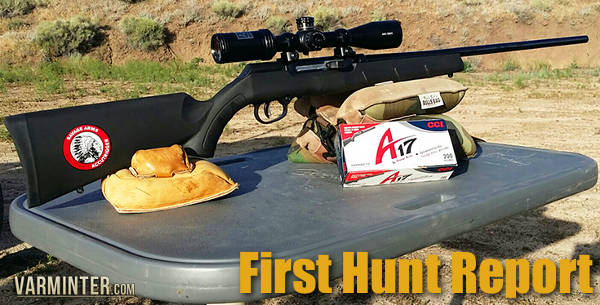
Varminter.com recently released a First Hunt Report on the new Savage A17 rifle. Savage’s new semi-auto .17 HMR has caused quite a stir. Accurate and affordable, the Savage A17 is also the first .17 HMR to feature a delayed blow-back action. We think the A17 may be the most important new rimfire rifle of 2015, so we were pleased to see that Eric Mayer, Editor of Varminter.com, put the new semi-auto Savage through its paces.
Mayer wanted to see how the new Savage would perform, accuracy-wise, and he also wanted to see how the A17 fared in the field. Mayer achieved one-MOA accuracy with the Savage A17 using the latest CCI-brand ammo, and he demonstrated the A17 is wickedly effective on ground squirrels. Here are some highlights from Varminter.com’s Savage A17 First Hunt Report:
The 17 Winchester Super Magnum Rimfire (aka Win Super Mag or WSM) is the fastest, most potent modern rimfire round you can buy. This cartridge, which uses a modified nail gun casing, drives 20gr bullets at 3000 fps. The 17 WSM offers superior ballistics to all .22 rimfires, and is a clear step ahead of the 17 HMR. That makes this round a potential “game-changer” in the varmint fields. To guage the capabilities of the 17 WSM, Varminter.com tested the cartridge in the new Ruger 77/17 bolt-action rifle. Click HERE for Varminter.com Ruger 77/17, 17 WSM Review.
17 WSM shoots faster than the 17 HMR, so the 20gr bullets don’t drift as much in the wind:
Varminter.com reports: “The much-anticipated Ruger 77/17 chambered in the 17 Winchester Super Magnum (17WSM) has been released. Our Review Editor, William Chambers, put it through a full range test with all four currently-available ammunition loads. Afterwards, he took it on a short groundhog hunt[.] We put a lot of rounds through the guns we test, at targets, through chronographs and out in the field. This report includes all currently available 17 WSM ammunition and a sneak peek of the really nice Nikon Prostaff 5 riflescope.” READ REVIEW.
The Tikka T3 rifle is very popular with hunters around the globe — for good reason. These rifles offer smooth-running actions, easy sub-MOA accuracy with good ammo, crisp triggers, and ultra-reliable detachable box magazines. The Tupperware stocks aren’t super-rigid, but they are comfortable and easy to handle. If you are looking for a hunting rifle, the Tikka T3 is a smart choice, offering good performance for the price (which starts at less than $580.00 for the T3 Lite version). The T3 series is offered in a wide selection of chamberings, from .204 Ruger up to the large magnums.
Here are two good Tikka T3 video reviews, the first from New Zealand, the second from Scotland. Both reviewers are experienced hunters who explain why the T3 is well-suited for hunting applications. In the first video, Mitch of BushBrothersNZ reviews a T3 with polymer stock and stainless barrel chambered for the .270 Win. Mitch focuses on the T3’s controls and functions, with particular attention to the operation of trigger, safety, and bolt.


 Here’s something you don’t see every day — a bolt-action, repeating, double rifle. This amazing twin-barreled bolt-gun has a closing mechanism that locks two separate bolt bodies into the chambers of the right and left barrels. Yes there are two firing pins, two ejectors, two extractors, and two triggers. We’re not sure how one jumbo camming system closes two bolts, but there might be a geared center shaft rotating both right and left bolt bodies at the same time (but in opposite directions). Perhaps one of our gunsmith readers can explain how this system works.


 In this NSSF video, Ryan Cleckner shows how to set up a scope on a hunting or tactical rifle. Ryan, a former U.S. Army Sniper Instructor, notes that many hunters spend a small fortune on equipment, but fail to set up their rifle to use the optics optimally. Cleckner likens this to someone who owns an expensive sports car, but never adjusts the seat or the mirrors.


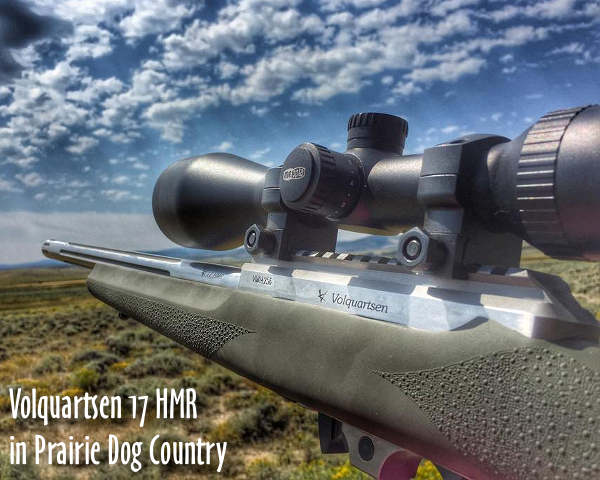
 Top Shot Champion Dustin Ellermann has been busy up in Wyoming slaying varmints. On his