|
|
March 11th, 2014
If you like sweet-shooting .17 HMR rimfire rifles, and appreciate fine German engineering, then you’ll love the Anschutz model 1727. Rarely seen on American shores, this is the only varmint rifle in the world using the super-fast, straight-pull Fortner action. Developed for Olympic Biathlon competitions, the Fortner action can be cycled in the blink of an eye. Just pull back the side-lever with your forefinger and then snick the bolt back with your thumb. This slick-cycling action has been used for many years in biathlon rifles, but the model 1727 is the first example of a Fortner varminter.
Our friend Steven Boelter, author of the Rifleman’s Guide to Rimfire Ammunition, has been able to test the Anschutz model 1727 extensively, both from the bench and in the field. Steven has published an outstanding online review of the model 1727, lavishly illustrated with great photos that show all the details of this unique firearm. We strongly recommend you visit Boelter’s Rimfire Research & Development Website (RRDVegas.com) and read his Anschutz 1727 Review.
Click Photo to Read Anschutz 1727 Review by Steven Boelter

After bench-testing the model 1727 for accuracy, and then using it on a ground squirrel safari, Boelter came away hugely impressed with this unique .17 HMR rifle:
The 1727 is truly a masterpiece; there really is no other way to look at it. I can’t think of any other rimfire action which remotely comes close in design or function, and executed at this level of precision.
The 1727 combines the accuracy of a single-shot match rifle, provides the convenience of a four-shot repeater, and cycles with nearly the speed of a semi-auto without fear of a dreaded case failure or “Ka-boom”. There’s really nothing else to say about the rifle. With virtually no short-comings in design or function, superb field performance and overall accuracy, it’s to be considered a 10 out of 10.
The only downside, Boelter explains, is the price: “The rifle alone has a suggested retail price of $3,500. When you add a nice set of Talley rings and bases along with a sharp Leupold scope, you’re approaching $5,000 USD. It’s completely out of reach for the majority of varmint hunters, and that is a shame.”

Anschutz 1727 Video Review from Australia. Amazing 50-yd accuracy at 12:00 time-mark.
Story tip by Boyd Allen. We welcome reader submissions.
March 7th, 2014
Are you looking to save money on a factory varmint or hunting rifle? Well Thompson/Center Arms (T/C) is currently offering a $75.00 rebate with the purchase of any new T/C Venture™ rifle. The mail-in rebate program will be available to consumers who purchase a T/C Venture rifle from January 25, 2014 through April 30, 2014 in the United States or Canada.
Consumers can choose from 16 different calibers ranging from the .204 Ruger to the big .338 Winchester Magnum. Made in America and backed by Thompson/Center’s lifetime warranty, the T/C Venture provides consumers with an affordable, value-packed hunting rifle.

Click HERE for Rebate Coupon
Lifetime Warranty, One MOA Group Size Guarantee
T/C Venture rifles come with a One Minute of Angle (MOA) accuracy guarantee, plus a full lifetime factory warranty. T/C Venture bolt-action rifles features a precision barrel with 5R rifling, a user-adjustable trigger, fat bolt design with 60-degree lift, composite stock featuring traction grip panels, QD sling swivel studs, and a single stack 3+1 detachable nylon magazine. Various models are offered, including the popular T/C Venture Predator with Realtree Camo finish.

March 2nd, 2014
Jere’s something new for you AR fans — an AR15 with laminated wood furniture. At SHOT Show 2014, Windham Weaponry introduced the VEX (Varmint Exterminator) Wood Stock line of rifles. Windham calls its first VEX model the “Pepper”, for the gray/black tones of the laminated stock. This should work better on the bags than conventional ARs. Up front, the handguard is wider on the underside (with a flared profile similar to the beavertail fore-ends on Cooper rifles). The buttstock has a dropped section at the rear for riding a sandbag. The $1480.00 VEX rifle features a 20″, 1:8″-twist fluted stainless barrel. Designed for scoped use, the A4-type flattop upper comes with optics riser blocks. There’s a Pic rail up front if you want to add a front iron sight.
Click to zoom photo


CLICK HERE to Download PDF Version of this Spec Sheet.

February 17th, 2014
Gene F. (aka “TenRing” in our Forum), provides this basic intro to Groundhog matches, East-Coast style.
 Groundhog Matches Are Growing in Popularity Groundhog Matches Are Growing in Popularity
Though Groundhog matches are very popular in many parts of the country, particularly on the east coast, I’ve found that many otherwise knowledgeable “gun guys” don’t know much about this form of competition. A few weeks ago, I ordered custom bullets from a small Midwest bullet-maker. He asked what type of competition the bullets would be used for, and I told him “groundhog shoots”. He had not heard of these. It occurs to me that perhaps many others are unfamiliar with this discipline.
Groundhog matches have grown rapidly in popularity. There are numerous clubs hosting them in Pennsylvania, Maryland, and Delaware, as well as other venues. They are usually open to the public. Most Eastern clubs have five to twenty cement benches, and overhead roofs. At this time, there is no central source for match schedules. If you’re interested in going to a groundhog match, post a query in the AccurateShooter Forum Competition Section, and you should get some info on nearby opportunities.

How Matches Are Run — Course of Fire and Scoring
Unlike NRA High Power Matches, there is no nationwide set of standard rules for Groundhog matches. Each club has their own rules, but the basics are pretty similar from club to club. Paper groundhog targets are set at multiple distances. There are normally three yardages in the match. Some clubs place targets at 100, 200, and 300 yards. Other clubs set them at 200, 300, or 400 yards. At my club in Shippensburg, PA, our targets are placed at 200, 300 and 500 meters.
The goal is to score the highest total. The paper targets have concentric scoring rings. The smallest ring is normally worth ten points while the large ring is worth five points. The course of fire varies among the various clubs. Most clubs allow unlimited sighters and five shots on the record target in a given time period. Only those five shots on the scoring rings are counted, so that with three yardages, a perfect score would be 150 points. Tie breakers may be determined by total number of dead center or “X” strikes; or, by smallest group at the farthest distance.

Types of Rifles Used at Groundhog Matches
The same benchrest rigs found at IBS and NBRSA matches can be utilized (though these will typically be put in a ‘custom’ class). Though equipment classes vary from club to club, it is common to separate the hardware into four or five classes. Typical firearm classes can include: factory rifle; deer hunter; light varmint custom (usually a limit of 17 lbs.with scope); and heavy varmint custom (weight unlimited). Some clubs allow barrel tuners, others do not. Scope selection is usually unlimited; however, some restrict hunter class rifle scopes to 20 power. Factory rifles usually cannot be altered in any way.
Good, Simple Fun Shooting — Why Groundhog Shoots Are Popular
Forum member Danny Reever explains the appeal of groundhog matches: “We don’t have a governing organization, or have to pay $50 a year membership just to compete in matches. Sure the rules vary from club to club, but you adapt. If you don’t like one club’s rules, you just don’t shoot there. It’s no big deal.
There are no National records, or Hall of Fame points — just individual range records. If you want to shoot in BIG matches (with big prizes), there is the Hickory Ground Hog Shoot among others. If competition isn’t your bag, many clubs offer mid-week fun matches that you can shoot just for fun. You shoot the same targets but with a more relaxed atmosphere with no time limits.
The best part is you don’t have to shoot perfect at every yardage. You always have a chance because in this sport it really isn’t over until the last shot is fired. Typically ALL the entry money goes to the host club, with much of the cash returned back to the shooters via prizes. Junior shooters often shoot for free, or at a reduced rate. The low entry cost also encourages young guys to get involved who don’t have $4000 custom rifles or the money to buy them.
There isn’t a sea of wind flags to shoot over or to put up and take down. If the range has a couple of flags so much the better, but after all it is a varmint match. No pits to spot shots and slow things down either. If you can’t see your hits through your rifle scope or spotting scope well you are in the same boat as everybody else. That’s what makes it interesting/ sometimes frustrating!
February 1st, 2014
 For many years, the Varmint Hunters Association (VHA) has produced an excellent print periodical, The Varmint Hunter Magazine. Along with hunting stories, the magazine features articles about precision reloading and methods for accurizing rifles. The Varmint Hunter Magazine is available by subscription, and you can also purchase back issues through the VHA Online Store. For many years, the Varmint Hunters Association (VHA) has produced an excellent print periodical, The Varmint Hunter Magazine. Along with hunting stories, the magazine features articles about precision reloading and methods for accurizing rifles. The Varmint Hunter Magazine is available by subscription, and you can also purchase back issues through the VHA Online Store.
Right now the VHA is offering two FREE digital editions of The Varmint Hunter Magazine. Can’t beat that price. Click the links below to view (or download) the latest Winter 2014 Edition (Issue #89) and/or the previous Fall 2013 Edition (Issue #88). These digital eZines can be read on your computer or by most mobile devices. But since these are complete magazines, it make take a minute or two to download the full PDF files (be patient).

VHA Magazine tip by EdLongrange. We welcome reader submissions.
January 18th, 2014

CZ USA had many new (and updated) products on display at SHOT Show 2014. A new camo version of the CZ 455 Varmint Precision Trainer (VPT) caught our eye. This is one of the best options for Rimfire Tactical Competitions, and well as cross-training with low-cost rimfire ammo. Chambered in .22 LR, the Varmint Precision Trainer was designed to provide the same look and feel as a full-size tactical rifle while allowing for more economical training. The high-quality Manners Composite T4 stock wears a new camouflage paint scheme this year. The rifle features an .866-diameter heavy barrel that should offer good accuracy. MSRP is $940.00.

The black-stocked rifle below the camo VPT is another interesting rimfire from CZ. New for 2014, this CZ 455 Tacticool Suppressor-Ready sports a 16.5″ varmint-contour barrel with 1/2×28 threads for the “can”. This allows easy installation of your suppressor, while allowing a short overall package. For varmint hunters who want a quiet, stealthy rifle, this model fills the bill. NOTE: CZ does NOT provide the suppressor. That must be purchased separately and an ATF tax stamp must be obtained. Check the laws in your jurisdiction to determine whether suppressor ownership is legal where you live.

3-Gun Competitors will be impressed with CZ’s new scattergun, the 712 Practical. Priced at an affordable $699.00 (MSRP), this semi-auto shotgun, designed specifically for 3-Gun competition, features 10-round capacity (counting a shell in the chamber). The 6-position, adjustable buttstock offers various lengths of pull from 11.25 to 15 inches. The ATI fluted magazine extension provides 9+1 rounds of firepower and extends just past the 22″ barrel to help protect the muzzle. The new 712 Practical comes complete with 5 choke tubes — all for a price that undercuts some comparable 3-Gun shotguns by hundreds.

January 16th, 2014

Tab Gear Pollok Mats shown above with Tab Gear Bag below.
 Here is a cool product we saw at SHOT Show, the TAB Pollok Shooting Mat. This 72″x30″ mat rolls up into a compact package about 8″ long and 4.5″ in diameter. Once rolled, the mat is secured with either Snap Buckles or D-rings (buyer’s choice). The bottom of the mat has a waterproof, urethane coating. You can stuff the mat inside your pack or strap it to webbing. For comfort, there’s a 12″-wide section of closed-cell foam in the area contacted by elbows. Loops are provided so the mat can be staked down in high winds. This is a good product for hunters or varmint shooters who need to take prone shots on the ground. The mat is light and easy to stow in a day-pack. The D-ring version is $65.00, while the buckled version is $72.50. Order through the Tab Gear Webstore. For more information visit TabGear.com. Here is a cool product we saw at SHOT Show, the TAB Pollok Shooting Mat. This 72″x30″ mat rolls up into a compact package about 8″ long and 4.5″ in diameter. Once rolled, the mat is secured with either Snap Buckles or D-rings (buyer’s choice). The bottom of the mat has a waterproof, urethane coating. You can stuff the mat inside your pack or strap it to webbing. For comfort, there’s a 12″-wide section of closed-cell foam in the area contacted by elbows. Loops are provided so the mat can be staked down in high winds. This is a good product for hunters or varmint shooters who need to take prone shots on the ground. The mat is light and easy to stow in a day-pack. The D-ring version is $65.00, while the buckled version is $72.50. Order through the Tab Gear Webstore. For more information visit TabGear.com.
Size is 72″ x 30″
Rolled up size approximately 4″ x 8″
Made from 1000 Denier Cordura Nylon
Webbing is all 1″ Milspec
Padded Elbow Rest Area
Stake-down loops on each corner
Watch Video Demo with Tab Gear Roll-up Shooting Mat


January 5th, 2014

For 2014, Legacy Sports will offer Howa rifles with Kryptek Highlander, Typhon, and Raid camo patterns. You can purchase the basic rifle equipped with hydro-dipped, camo-pattern Hogue Overmolded stocks. Or, alternatively, you can get a fully-camouflaged package rifle with Nikko Stirling Gameking riflescope. With the package rifle, the Kryptek camo coating covers the barreled action, stock, scope, rings, and one-piece base.
 The basic rifles are fitted with either blued or stainless #2 contour barreled actions, with stocks dipped in one of three Kryptek patterns. You can also order Package camo guns with a Nikko Stirling Gameking 3.5-10×44 Illuminated riflescope. In addition, the Howa/Kryptek series is also available in a Ranchland lightweight configuration with blued #1 contour barrels. The basic rifles are fitted with either blued or stainless #2 contour barreled actions, with stocks dipped in one of three Kryptek patterns. You can also order Package camo guns with a Nikko Stirling Gameking 3.5-10×44 Illuminated riflescope. In addition, the Howa/Kryptek series is also available in a Ranchland lightweight configuration with blued #1 contour barrels.
A heavy-barrel option will be offered with bipod and a 5-round detachable magazine. These rifles are available in three short action calibers with heavy (#6) contour barrels, and come with Nikko Stirling Gameking 4-16×44 riflescopes. These Heavy Barrel Howa/Kryptek rifles come complete with scope, scope rings. and one-piece base.
December 20th, 2013
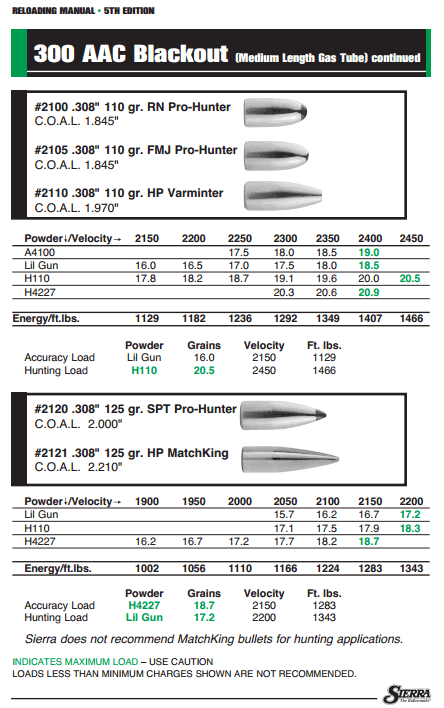
The 300 AAC Blackout (300 BLK, or 7.62x35mm) was created by Advanced Armament Corp. and Remington in order to provide the military with a way to shoot .30-caliber bullets from the M4 carbines with only a barrel change. It has since become popular with AR shooters for a wide range of uses including hunting and home defense. With the increased popularity of this cartridge, folks have been looking for reliable 300 BLK load information. Now, thanks to Sierra Bullets, we have some good load data for the 300 AAC Blackout. Sierra has released a FREE 6-page Load Guide for this cartridge, as part of the Sierra Reloading Manual (5th Edition).
CLICK HERE for Sierra 300 AAC Blackout Load DATA (PDF Format).
Here is ONE of SIX Pages in the Sierra Load Sheet for 300 AAC Blackout

About the 300 AAC Blackout (300 BLK)
The 300 AAC Blackout cartridge shares case-head dimensions and body taper with the .223 Remington. Not only does this allow for compatibility with existing magazines and bolts, but it allows reloaders to form their own brass from cut-down 5.56×45 mm or .223 Rem cases. You can also form 300 Blackout cases by necking-up .221 Fireball brass. Take Note: Lapua has started producing .221 Fireball brass — this should be available in the USA by early April.

The 300 AAC Blackout is a similar concept to previous wildcats, such as the 30-221 and 300 Fireball, as well as the proprietary 300 Whisper®, except that 300 BLK was the first to be a SAAMI-approved cartridge and any company is free to make firearms or ammunition.
300 AAC Blackout is also finding use with hunters, who may not have been able to legally hunt with .223 in their state, and who prefer .30 caliber bullets for medium-sized game. It provides similar effectiveness to the 7.62×39 or the slightly more powerful .30-30 cartridges except works in the more up-to-date AR-platform rifles. Effective hunting range is about 150 yards. Some innovators, such as Dave Whitford, have also experimented with the 300 BLK for Across-the-Course competition. READ Whitford story in Rifleman’s Journal..
December 13th, 2013
For many guys, a 17 HMR is their “go-to” rifle for squirrels and small varmints. The 17 HMR is a great little cartridge — speedy and accurate. However, in recent months, 17 HMR ammo has been hard to find. Take heart guys, we’ve learned that site sponsors Graf & Sons and Powder Valley Inc. both have Hornady 17gr 17 HMR ammo in stock right now. This ammo is loaded with plastic-tipped 17gr V-Max bullets. Traveling at roughly 2570 fps (from a 22″ barrel), this little 17-grainer is ultra-effective on pesky ground squirrels and other small critters. On our squirrel hunts, the 17gr V-Max did the job out to 200 yards, no problem. Grafs.com sells the 17gr Hornady 17 HMR ammo for $12.99 per box of 50 (item HRN83170). That price includes shipping (after a single $6.95 handling charge). Powder Valley currently offers Hornady’s 17gr V-Max 17 HMR ammo for $11.30 per box of 50 (item HOR83170, shipping extra).

If you want to learn more about the 17 HMR cartridge, read our Gun of the Week Article on the subject. This two-gun shoot-out compares the performance of a Volquartsen 17 HMR semi-auto and a Ruger 77/17 bolt-action. Glen Robinson, the owner of both rifles, has done some serious comparison testing with both rifles, trying out a half-dozen varieties of 17 HMR ammo. The overall results may surprise you. The semi-auto outshot the bolt gun by a significant margin, with all types of ammo tested.

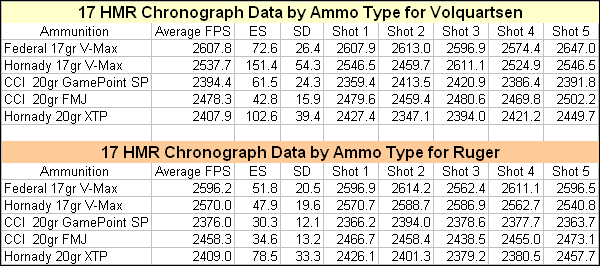
Comparing the Qualities of the Two 17 HMR Rifles
By Glen Robinson
While the Volquartsen proved to be the more accurate of my pair of 17 HMRs, I still enjoy owning both rifles. Each gun has its strong points and weak points.
 Ruger Strong Points: From any angle, the Ruger 77/17 is a nice-looking rifle with classic lines. I like the gray-finish stainless barrel — it goes well with the gray laminated stock. With the addition of the aftermarket sear, the trigger is crisp and the bolt function is smooth. The action is strong and dependable. The conventional “open rear” action allows you to clean “normally” with a bore guide, cleaning rod, and patches/brushes. I feel I can do a better job of cleaning with the Ruger than with the boresnake on the Volquartsen. Ergonomically, the Ruger is easier to get down on because the stock is lower. Ruger Strong Points: From any angle, the Ruger 77/17 is a nice-looking rifle with classic lines. I like the gray-finish stainless barrel — it goes well with the gray laminated stock. With the addition of the aftermarket sear, the trigger is crisp and the bolt function is smooth. The action is strong and dependable. The conventional “open rear” action allows you to clean “normally” with a bore guide, cleaning rod, and patches/brushes. I feel I can do a better job of cleaning with the Ruger than with the boresnake on the Volquartsen. Ergonomically, the Ruger is easier to get down on because the stock is lower.
Ruger Weak Points: Accuracy is somewhat disappointing. The best 100-yard group the Ruger has shot was about 0.82″ and the gun averages well over 1.25″ for 5 shots. In fairness, I haven’t done anything exotic in terms of bedding the action/barrel, and I would expect that an aftermarket barrel, perhaps combined with a barrel pre-load (up-pressure) pad, could improve the accuracy.
Volquartsen Strong Points: The Volquartsen is a well-made, accurate, dependable rifle. The gun cycles very reliably and requires very little maintenance. To clean it, just pull a boresnake through the bore. The gun exhibits very nice machining, and the VX-5000 stock rides steady on a front sand-bag, even though it’s only about 1.75″ wide. Even without any tweaking the trigger is very good, and the pull weight is fine for varminting.
Volquartsen Weak Points: The VX-5000 stock is not ideal for bench work — the comb is a bit too high, though I like the feel of the vertical grip. This stock profile is really more suited for silhouette shooting, but this stock seemed to be the best option offered by Volquartsen that could be used for both paper-punching and varminting. The receiver design limits your options for barrel cleaning.

Conclusion — The Volquartsen Takes the Prize
Having shot both rifles extensively, if I had to pick one gun, it would be the Volquartsen. The Volquartsen is much more accurate and it offers much faster follow-up shots. For varminting the Volquartsen would be superior, no question about it. I’m happy I bought the Volquartsen and the VX-5000 stock. It is a fun, versatile gun that lives up to the accuracy claims.
Read Full Article HERE.
|


