TrackingPoint, creator of the Precision Guided Firearm (PGF) system, has released a new “smart rifle”, the XS4 .338 Lapua Magnum. The XS4 boasts TrackingPoint’s revolutionary TTX (Tag Track Xact) technology — a system that automates aiming and ballistic correction once you have “tagged” the target with a laser beam. Along with the exotic computerized targeting system, the new XS4 features top-flight conventional components: Surgeon XL action, 27″ Krieger barrel, and McMillan A5 hunting stock. Full rifle weight including laser/digital/optical scope, two batteries, loaded magazine, muzzle brake, and bipod, is 22.5 pounds.
Like TrackingPoint’s XS1, the new XS4 has a maximum TTX range of 1,200 yards, the longest effective range offered by the company. The rifle’s 27-inch, Krieger cut-barrel is fitted in a traditional-style, adjustable McMillan A5 stock. It also features TrackingPoint’s highest-power zoom optic, offering 6x to 35X magnification. “Our customers have been asking for the power of our 338 Lapua Magnum smart rifles in the form factor of our popular XS3 hunting model,” said John Lupher, Chief Technology Officer for TrackingPoint. Pre-orders for the XS4 are now being accepted. The rifle will be demonstrated at the 2014 NSSF SHOT Show and other trade shows in 2014. To learn more about the XS4 Precision Guided Firearm, visit Tracking-Point.com.
If you are considering purchasing a sound moderator (aka “suppressor” or “can”) for one or more of your rifles, a video from Surefire explains the many benefits of modern suppressors. Sound moderators not only reduce the audible sound coming from a firearm, but they also reduce flash signature, dust signature, and recoil.
In the video below, Surefire highlights the features and benefits of its line of quick-attach suppressors. These are crafted from special alloys that are “stronger at 1000° F than stainless steel is cold.” While the video focuses on the use of suppressors by military and police personnel, these devices are also beneficial for hunters and competitive tactical shooters.
Noise Reduction
A shot from a .308 Win rifle can be as loud as 167 db to the shooter. Notably, the noise level can be just as great to someone positioned one meter away (Source: 1999 Finish Suppressor Trials). What’s worse is that popular muzzle brakes can INCREASE shooters’ noise exposure by 5 to 10 db. The noise level at which hearing damage can occur is about 140 db. A quality modern suppressor can reduce .308 Win rifle shot noise levels to 130 db or less.
Flash Signature Reduction
For a varminter, a quality suppressor can reduce the visible muzzle flash from a rifle by 90% or more. That’s important when hunting at night. The bright flash can both spook game and temporarily degrade the hunters’ night vision. Using a suppressor can help the shooter maintain his night-adapted vision.
Recoil Reduction
Recoil reduction is a real benefit. In 1992, Finland’s National Board of Labor Protection tested a variety of suppressors on both bolt-action hunting rifles and select-fire military rifles. The study concluded that recoil reduction was significant: “Suppressors reduced recoil energy by 20 to 30 percent, or about as must as muzzle brakes, making powerful bolt-action hunting rifles considerably less painful to shoot (especially repeated shots in training).”
Dust Signature
When firing prone, a rifle with a muzzle brake kicks up a large cloud of dust. (Watch video at 3:00). In a military situation, this dust signature can reveal the shooter’s position — with potentially disastrous consequences. For a tactical competitor, the dust may prevent recognition of a hit while impeding a rapid second-shot. For the varminter, the dust cloud is a nuisance that may prevent him from seeing his hits, while sending critters scurrying back into cover.
Message to Politicians — Suppressors Will Save Tax Dollars
Here is an interesting finding from the 1992 Finland Suppressor Project: “The unit price of a mass-produced suppressor may be reduced to $50 to $70 (1992 prices). [This low cost] will make cost-effectiveness of the suppressor far better than that of any shooting range [sound-proofing]… and, actually, also better than the cost-effectiveness of hearing protection, especially when several persons are present while just one of them is shooting at a time.” Too bad most politicians can’t seem to understand these points. They still view suppressors as evil tools employed by gangsters, rather than proven safety devices that will reduce noise pollution.
Is the “price of noise” something we really need to consider from a public policy standpoint? Absolutely. In 2004 the Veterans Administration paid out $633.8 million in compensation to 378,982 vets whose main disability is hearing loss. Only a small fraction of those vets saw combat; most damaged their hearing during weapons training activities.
Nesika is back. Now part of the Freedom Group, Nesika has introduced new ‘custom shop’ Sporter, Long Range, and Tactical rifles. All three rifles feature composite stocks (with aluminum bedding blocks), Douglas barrels, and Timney triggers. Nesika provides a 5-shot, One MOA accuracy guarantee for all three rifles. These are all fairly expensive for factory rifles but Nesika claims they are built “one at a time, by hand” in the Nesika Custom Shop. The Sporter runs $3499.00, the Long Range is $3999.00, and the Tactical is a daunting $4499.00. You can buy a very nice true custom for that money.
The green Tactical model has an adjustable cheekpiece and spacer-adjustable buttplate. The Tactical comes with a matte black CeraKote finish, a built-in +15 MOA scope rail, and an AAC Blackout muzzle brake/suppressor adapter on the barrel. The Nesika Tactical is offered in .300 Win Mag (26″ barrel) and .338 Lapua Magnum (28″ barrel), with a 5-round DBM provided.
The Long Range Rifle has Nesika’s stainless, open-top Hunter action, with a CeraKote-finished chrome-moly bolt. The Timney trigger breaks at three pounds. Leupold QRW bases come standard, as does a SS
Oberndorf-style hinged floor plate.
The Sporter features a Nesika stainless tactical action. A wide variety of regular and magnum chamberings are offered, and barrels are 24″ or 26″ depending on chambering. Like the Long Range Rifle, the Sporter offers Leupold QRW bases. The rifle weighs eight pounds without optics — a reasonable weight for a hunting rifle. It looks nicely built, but will it harvest white-tails any better than a $450.00 Savage? Maybe not.
When we first ran this video a couple years back, readers were amazed at the off-hand, rapid-fire shooting skills of this young, German hunter, armed with a Sauer 202 rifle.
Check out this video of a young German hunter, Franz Albrecht Öttingen-Spielberg. Shooting off-hand with a Sauer 202 bolt action, he makes multiple kills on wild boar running at full speed. Half way through the video, a pack of boar crosses right to left, running fast. You need slow motion to see all Franz’s hits as he engages one animal after another. He doesn’t hit with every shot, but a quick count shows that nearly half his shots, fired rapid-fire from a standing position, were solid takedowns. Notice how Franz “leads” his prey, moving the muzzle from right to left along the animals’ path.
Slow-Mo Video Reveals Knock-Down Power of 7mm Rem Magnum
Near the beginning of the video, slow-motion footage reveals bullet trace, and the bullet’s impact on a running boar. The shot takes the boar right at the top of the shoulder and the animal goes down in a heap. This is impressive shooting. The video shows what is possible with a skilled marksmen, a powerful cartridge (7mm Rem Magnum), and an accurate, smooth-cycling bolt gun.
Today is Thanksgiving. After partaking in the traditional Turkey Day feast, we know many of our readers will find time during the holiday to head to the range. A Thanksgiving Day shoot is a fun excursion, and a great way for young and old family members to share time together. For all you T-Day marksmen, we offer a special turkey target. This was created by our friend and Forum member Pascal (aka “DesertFrog”).
We’ve packaged the turkey target along with five (5) other varmint/animal-themed targets for your shooting pleasure. These are all offered in .pdf (Adobe Acrobat) format for easy printing.
Program Promotes Family Hunting Opportunities
Speaking of turkeys and families going shooting together, we’d like to give a plug for the “Families Afield” program. A joint effort of the Nat’l Shooting Sports Foundation (NSSF), U.S. Sportsmen’s Alliance (USSA), and National Wild Turkey Federation (NWTF), the “Families Afield” program works to expand the opportunities for young hunters with adult mentors. The goal of the program is to increase the number of young people getting involved in hunting. For every 100 adult hunters today, only 69 youth hunters are coming up to take their place. “Families Afield” works to reverse that trend. Several states that were restrictive to youth hunting have signed into law “Families Afield” legislation. These new laws make it possible for young hunters and their families to enjoy hunting traditions together. CLICK HERE to learn more.
Roy Bertalotto is an author, precision shooter, varmint hunter and part-time gunsmith. On his website, RVBPrecision.com, you’ll find many interesting feature stories, including “how-to” articles. One project that caught our eye was Roy’s clever rotating-top shooting bench. Simple to build from low-cost components, Roy’s bench design features a raised center section that traverses on rollers. This allows you to move your rifle through a wide arc without having to move your front rest or rear sand bag. Roy’s bench can be built for a fraction of the cost of the big, heavy carousel-style varmint benches. This would make a nice, winter project for anyone handy with simple tools. For a set of plans and list of materials, send email to Robert: RVB100 [at] comcast.net.
This picture shows a conventional front pedestal rest used with a benchrest type rifle. As you can see, the top swivels, allowing a tremendous sweep of the varmint fields.
The swiveling top moves on metal rollers. These roller devices are available from Trend Lines, or Woodworkers warehouse. Two are required at the front of the movable top.
Below is a close-up of the pivot point.
A conventional folding table leg (from Woodworkers Warehouse) is used in the front. In the rear, Roy’s table uses a single leg fabricated from tubing and aluminum angle iron. This creates a tripod. The three-legged design provides more room for the shooter, and is easier to set up on uneven ground.
Weatherby now offers a sub-MOA accuracy assurance on many of its rifles. As shown below, the VANGUARD® Series 2 RC (Range Certified) Varmint rifle comes with a SUB-MOA guarantee as well as a factory-shot target signed by company President Ed Weatherby himself. Other Weatherby “RC” Rifles, such as the new Mark V Ultra Lightweight RC, offer the same guaranteed performance. All RC rifles are guaranteed to shoot SUB-MOA (a three-shot group of .99-inch or less) with specified Weatherby factory or premium ammunition.
Range Certified rifles are tested at Weatherby’s modern indoor range. Range technicians mount premium optics, bore-sight, and test fire each rifle to determine the most accurate load using the Oehler Research 83 Ballistic Imaging System. After testing, the rifle is cleaned and packed (minus optics) with the target signed by Ed Weatherby. Each rifle sports a special RC engraved floorplate.
If you really want to learn about long-range hunting, listen to a pro, a man like Nathan Foster who has spent a life-time in the field. Nathan has just released a new book: The Practical Guide to Long Range Hunting Cartridges. You can trust what Nathan says. He has spent decades in the wild, harvesting over 7500 head of game. Nathan’s richly-illustrated, 415-page resource guides you through the process of choosing the best cartridge and projectile(s) for your hunts. The book begins by explaining the key principles of of long-range hunting. Then Nathan examines the pros and cons of various cartridges so that the reader can select the best cartridge and projectile to get the job done.
Nathan is truly a hunting expert. Nathan has spent thousands of hours in the field and he knows the subject cold. Unlike some outdoor writers, Nathan doesn’t pull punches — he tells the unvarnished truth about what works and what doesn’t. Here’s what Nathan says about his new book:
After many months of writing, it is now done, 415 pages of research, each bullet repeat-tested in the field, my research scrutinized by veterinarian surgeons [and] industry peers. It was truly an immense undertaking.
For several years, I have received two types of email. The first question is which is the right rifle for me? The second question is which is the right cartridge? My first book dealt with the accurate rifle. This second book deals with long range hunting cartridge selection. I firmly believe that there has been a huge gap in education regarding optimal long range hunting cartridge performance. In many instances, both hunters and bullet manufacturers do not understand what’s required to achieve goals. Many times, the wrong tools are used for long range hunting. This book seeks to remedy these problems.
In the Practical Guide to Long Range Hunting Cartridges, I start with the fundamentals of game killing — but from the perspective of the long range hunter (also encountering close range shots). This section is not politically correct in any way, as after the study of anatomy, I explore worst case scenarios in as much depth as ideal shot placement.
The second section of the book is a study of projectile design. I wanted to get right down to the finer details of the long range hunting bullet in this section, exploring manufacturers, manufacturing techniques, and ways in which the end user can perform preliminary testing as well as bullet modifications.
The third section explains how to select a long range hunting cartridge. The system I have used here is based on a selection method I developed over the years to help clients worldwide. This method takes individual circumstances into consideration rather than a one size fits all approach. It is a system that relies on plain common sense based on research.
The fourth section of the book is the cartridge section. Cartridge information is presented in a set format with Pro/Con summary tables. In many instances I have included my own load notes. I have also included notes regarding how to approach close range shots with each of our long range cartridges.
Book Buyer Comment: “Nathan has ‘hit it out of the park’ with his 2nd book, The Practical Guide to Long Range Hunting Cartridges! This is definitely the ‘go-to’ manual for decision-making for hunters around the world. Where else can you fine such a wealth of information on bullet selection for a particular cartridge based on the weight of the animal you intend to pursue. This allows the hunter to make an educated decision on the best cartridge for a particular game species or to load that round, up or down, to cover a variety of game species in their location.” — Jim Moseley, North Carolina, USA
About the Author: New Zealander Nathan Foster lives and breathes what he teaches. An expert in the field of terminal ballistics, Nathan has taken over 7500 head of game, and has field-tested a vast number of cartridges and projectiles. Nathan’s first book, The Practical Guide to Long Range Hunting Rifles, is widely recognized as one of the best books ever published on the subject. The new book goes into greater detail on specific cartridges. Nathan’s website includes an outstanding online cartridge knowledge base with over 60 detailed cartridge profiles. CLICK HERE for Cartridge INFO.
Nathan runs Terminal Ballistics Research, a small company in Taranaki, New Zealand, that conducts cartridge and projectile performance research. Nathan also operates a long-range shooting school. Nathan is also the creator of MatchGrade Bedding Products.
Kirby Allen of Allen Precision Shooting, www.apsrifles.com, has developed a .30-caliber jumbo-sized magnum he calls the 300 Raptor. The 300 Raptor (center in photo) is based on Allen’s 338 Excalibur parent case (far right in photo), necked down to 30 cal with shoulder moved forward to increase case capacity. Allen states: “This is the largest capacity and performance .30 caliber magnum on the market that can be used in a conventional sized receiver.”
Shoot 200s at 3600 fps
Performance of Allen’s new 300 Raptor is impressive. Allen claims that “200gr Accubonds can be driven to nearly 3600 fps, 230gr Berger Hybrids to 3350 fps, and the 240gr SMK to right at 3300 fps. These loads offered case life in excess of 6-7 firings per case and many of my test cases have over 8 firings on each case so they are not an overly hot load showing the potential of this big .30 caliber.”
To showcase the new cartridge, Allen built up a prototype rifle with a McMillan A5 stock, Raptor LRSS Action with extended tenon, and a Jewell trigger. The first 300 Raptor Rifle is currently on its second barrel, a new 30″, 3-groove 1:9″-twist Lilja in a custom APS “Raptor Contour”. This distinctive dual-fluted contour runs full-diameter almost to the end of the stock, and then steps down and tapers to the muzzle, where a beefy Medium 3-port ‘Painkiller’ Allen Precision brake is fitted.
Story tip by EdLongrange. We welcome reader submissions.
As a member of the World Champion Team USA F/TR squad, Paul Phillips regularly competes (and wins) at 1000 yards. Paul is also a long-range hunter. Here’s his story about developing his ultimate long-range hunting rifle. Chambered for the .338 Lapua Magnum, this rig is accurate out to 1800 yards.
The Long-Range ChallengeBy Paul Phillips
Being an avid big game rifle hunter, my goal was to build the most accurate long-range hunting rifle possible that would still be light enough to carry. My thought was to use the same type of high-quality components as what I used on my US F/TR Team Rifle, except in a bigger caliber — a caliber that would have plenty of knock-down power at very long ranges. After extensive research, including both ballistic data analysis, as well as discussion with top gunsmiths and champion long-range shooters, I chose the .338 Lapua Magnum. My past experience from being a member of a USMC Scout Sniper Platoon and a shooting member of two World Champion U.S. F-Class F/TR teams, I knew that this rifle was more than capable of performing the task. After establishing that the rifle had half-MOA accuracy at 600 yards, we wanted to see how far the rifle could maintain sub-MOA accuracy, to see what the cartridge and rifle could achieve. Could this gun shoot sub-MOA at a mile? That was our challenge.
Rifle Components and Gunsmithing
My rifle was built on a Stiller Tac-338 single-shot action. It has a 30″, 1:10″-twist Brux barrel, a McMillan A-5 stock with Magnum fill, a Sinclair Bipod, and a Remington X-Mark trigger set at two pounds. The rifle wears a Nightforce NXS 8-32x56mm scope in Nightforce rings on a +40 MOA rail. I chose David Tooley to install the barrel, custom brake, apply a Cerakote dark earth finish and bed the stock. After speaking with Mr. Tooley in great length, I chose his no-neck-turn match .338 Lapua chamber specifically designed for the 300 grain Berger Bullet. This rifle weighs 17 pounds and, with the muzzle brake, it recoils like a standard .308 Winchester.
Load Development and Accuracy Testing
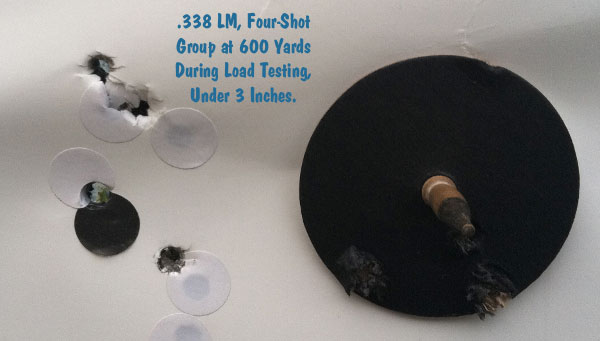
I used the 600-yard range at the Midland County Sportsman’s Club. If I was going to have any chance of hitting small targets at a mile, I would need to find a load that could produce half-minute (0.5 MOA) or better accuracy. I found an accurate load that gave me consistent half-minute groups that chronographed at 2825 FPS. My load consisted of Lapua brass, Federal 215M Primer, Alliant Reloder 25, and Berger 300gr Hybrid OTM bullet. With the Berger 300-grainer’s listed 0.419 G7 BC, this load would be good enough to reach 1880 yards before going subsonic. This load’s calculated energy at one mile is 960 ft/pounds. This is similar to a .44 magnum pistol round at point-blank range.
With my +40 MOA scope rail, my 100-yard zero ended up with the elevation at the bottom of the tube and the windage just 2 MOA left of center. This left a full 65 Minutes of Elevation — enough to get out to 1800 yards. This gave me the capability to aim and shoot from 100 yards to 1800 yards with a projectile that is still supersonic at 1800.
Hitting a 10″ Balloon at One Mile
For a one-mile target, I chose a balloon inflated to 10″ in diameter. The balloon would be a challenging, reactive target that would show up well on video. I teamed up with a fellow long-range shooter, John Droelle and friend Justin Fargo to attempt this feat. Using my known 600-yard Zero, my ballistics program showed my come-up for 1783 yards to be 53 MOA. After two sighters that measured 4 inches apart, I adjusted up one minute from my spotter shot and nailed my 10″ balloon at one mile. This video was recorded with my iPhone attached to my 25-power Kowa spotting scope, so it may seem a lot closer than it really is. Below is a video of the shot. Needless to say I achieved my goal and was very excited.
Watch Hit on 10″-Diameter Balloon at One Mile with .338 Lapua Magnum
After my balloon shot, I let my friend Justin Fargo, a novice shooter, try his skills. Justin told me that he had never shot past 100 yards using a common deer rifle. Surprisingly, Justin not only kept all his shots under 1 MOA, he hit the 9-inch white circle in the middle of the target. This bullet hole measured only 4.3 inches from the center of where he was aiming. Truly amazing! The target below shows Justin’s shots at one mile. Note that All the hits are located within the 24-inch black circle.
What I Learned — With the Right Equipment, Even a Novice Can Make Hits at a Mile
The above results demonstrate that even a novice shooter with a high-quality, custom rifle and match-grade ammo can make extreme long range shots with great accuracy. It is very important to understand the ballistics of the bullet and the effect of wind drift to make precision, first-shot hits on your target. It is also important that you know your target, backstop and beyond when making these shots. To date, I have shot approximately 40 shots at a mile in calm conditions while averaging 3-shot groups between ½ to 1 MOA (1 MOA is about 18.5″ at that distance). My next experiment is to see how well these bullets perform traveling at subsonic speeds out to 1.5 – 2 miles. Stay tuned!
Special thanks to the following people that helped out with this project: Geoff Esterline, David Tooley, Dick Davis, John Droelle, Ray Gross and Bryan Litz.
Editor’s Comment: The point of this article is to show the kind of accuracy a precision rifle system can achieve, consistently, at extreme long range. Though this rifle will do duty as a hunting arm, Phillips is not advocating that a .338 LM be used to harvest animals at the full limit of its supersonic range. Because winds are hard to predict at extreme long range in a hunting situation, Phillips cautions that the practical distance at which he would shoot game with a rig like this is much, much shorter.


 Flash Signature Reduction


 If you really want to learn about long-range hunting, listen to a pro, a man like Nathan Foster who has spent a life-time in the field. Nathan has just released a new book:
  For several years, I have received two types of email. The first question is which is the right rifle for me? The second question is which is the right cartridge? My first book dealt with the accurate rifle. This second book deals with long range hunting cartridge selection. I firmly believe that there has been a huge gap in education regarding optimal long range hunting cartridge performance. In many instances, both hunters and bullet manufacturers do not understand what’s required to achieve goals. Many times, the wrong tools are used for long range hunting. This book seeks to remedy these problems.
 About the Author: New Zealander Nathan Foster lives and breathes what he teaches. An expert in the field of terminal ballistics, Nathan has taken over 7500 head of game, and has field-tested a vast number of cartridges and projectiles. Nathan’s first book,
  Kirby Allen of Allen Precision Shooting,