Earlier this month we ran a story on the new Sauer 101 rifle. It turns out the Sauer 101 will be distributed in the U.S. by Blaser USA. Here’s more good news for hunters — we’ve learned that Blaser will be bringing another new German hunting rifle to the USA — the Mauser M 12. You’ll find specs and photos of the M 12 below. This is a rifle with a great heritage, superb build quality, plus some innovative features.
Both the Mauser M 12 and Sauer 101 rifles should be available at retailers in late April. To learn more, visit these websites: www.Mauser-m12.com and www.Sauer-101.com. For additional information on the Blaser line of products visit www.Blaser-USA.com.
Mauser M 12 Specifications
Bolt Features: 6-lug bolt, 60° bolt lift, bolt lugs engage directly in barrel, side bolt release, bolt can be disassembled without tools.
Extraction: Dual, spring loaded-ejectors for positive extraction.
Some times nice guys do finish first. Our buddy Vu Pham, co-founder of the NorCal Practical Precision Rifle Club (NCPPRC) took top honors in the NCPPRC monthly tactical long range match on the 1000 yard range at the Sacramento Valley Shooting Center. Shooting his .260 Remington in a McMillan A5 stock, built by Spartan Rifles, topped with a Bushnell 4-30x50mm from CS Tactical, Vu beat a competitive field on a breezy day that saw the top 6 shooters separated by only 15 points. The Course of Fire had 27 of the 50 rounds shot from 800 to 1000 yards, where the fast-switching winds at 1000 yards were the deciding factor in the outcome. Vu tells us: “This LR Match win has eluded me for seven years now with these guys. I’ve been in the top five quite a few times, but never took home the win. Our matches are so close these days that it usually comes down to one or two bad trigger presses or ‘blown’ wind calls to separate the Top 10 shooters.”
NCPPRC long range tactical matches are held the first Sunday of each month, and are open to anyone 18 or older. No membership in any organization is required. Registration is at Range 12 of the Sacramento Valley Shooting Center from 07:30 to 08:30 in the morning. Cost is $25. To learn more about the match visit the NCPPRC Long Range Match webpage.
New Bushnell 4.5-30x50mm Tactical Scope
Vu Pham was running an all-new Bushnell front focal plane 4.5-30x50mm XRS scope with an amazing 6.7 times zoom range. This 34mm-tube scope features Bushnell’s G2 DMR Reticle. For a scope offering 30X magnification, is it compact at 14″ OAL (only 3/4″ longer than the HDMR). The elevation turret provides 10 mils per revolution with a zero stop. The scope sells for $2149.00 at CS Tactical.
Vu liked the new Bushnell scope and, obviously, it performed well for him. Vu tells us: “I believe this optic just hit the market… and is still pretty new. After having a few days behind the Bushnell XRS 4.5-30, I believe this optic will be a very viable option for the tactical precision rifle game. One of my favorite features of this scope is the mil-based G2DMR reticle. It makes holding over (and holding for windage) fast and easy. I will be doing a full test and evaluation in the next week or two after I get more time behind the optic.” Mike Cecil with CS Tactical provided the scope for this T&E.” Mike notes: “This is not the 4-30 tactical that’s listed as an XRS in the Bushnell online catalog — that’s a 30mm in the 6500 series line. This 34mm-tube XRS is a whole new animal!”
If you want to see the latest and greatest shooting hardware from the other side of the Atlantic, log on to Targetshooter.co.uk, and check out the recently-released April 2013 digital edition of Target Shooter Magazine. Now offered in an easy-to-read scrolling format, the April edition is a gear-head’s delight, with dozens of large photos showing new hardware on display at the IWA Outdoor Classics trade show. You’ll find full IWA show coverage, including coverage of some very exotic rifles and components that have yet to make it across the Atlantic. Target Shooter’s “man on the scene” at the IWA show was our friend Vince Bottomley, and he came away very impressed with many of the new products he saw on display.
Vince notes that the IWA show had more than 1200 exhibitors. That’s a big presence, even compared to the 1600 exhibitors at SHOT Show. IWA also had many of the larger European exhibitors who don’t exhibit in Vegas. Interestingly, Vince noted that “aluminum stocks are becoming the ‘industry standard’ — particularly for competition and tactical rifles. Thanks to… CNC machinery, these stocks are generally reasonably priced (often less than the fiberglass equivalent) and require little or no gunsmithing[.] In most cases, they also look superb, especially when anodized or Ceracoated. Even major manufacturers are offering aluminum-stocked rifles — check out Blaser, Steyr, Haenel, Zastava and of course Unique Alpine, Accuracy International, and Desert Tactical Arms.” There were also many interesting bipods, actions, and optics on display.
In addition to the IWA report by Vince Bottomley, the April edition of Target Shooter has a field test by Chris Parkin of the Savage Model 25 Lightweight Varminter, chambered in 17 Hornet. With a comfortable thumbhole stock, Savage’s Model 25 performed well and was ultra-silent as fitted with a suppressor. The April issue also spotlights a carbon-fiber-stocked beauty — the Ataman M2 Benchrest Air Rifle. This is the second of a two-part report by Carl Boswell.
Fire-forming improved cases can be time-consuming and expensive. Now with just a mallet, a Hornady hydro-forming die kit, and a little H20, you can form Dasher and other improved cartridge cases easily and safely. And you won’t consume costly bullets, powder, and primers, or use up precious barrel life.
Three or Four Whacks Produces a 95%-Formed Case
With a Hornady hydro-forming die, water pressure does the job of blowing out the shoulders of your improved case. The process is relatively simple. Place a spent primer in the bottom of a new piece of brass. Fill the case with water, and then slip it into a special Hornady shell-holder with no hole in the middle. Then you run the case up into the forming die. Now comes the fun part. You gently insert a plunger (hydraulic ram) from the top, and give it three or four stiff whacks with a mallet (or better yet, a dead-blow hammer). Remove the plunger and you have a 95% formed case, ready to load.
Forum member Walter Queen (aka Queen_Stick) acquired a Hornady Hydraulic forming die kit through our Forum Classifieds. He used this to form 6mm Dasher cases. Walter tested to see how many mallet blows would be required to form his dasher cases. Using a regular mallet, four or five blows was the magic number (with a Dead-blow hammer, one can often do the job with three strong whacks). Shown below are test cases with 1, 2, 3, 4, 5 and 10 (X) mallet strikes. Walter explained: “It helps to use a consistent yet aggressive swing with the mallet. I did a little test to show what’s happening to the case with each swing. The numbers on the cases refer to the number of swings with the mallet. The last case, with the ‘X’ on it, I actually hit it 10 times. The extra effort made no difference; anything beyond 5 swings is likely a waste of time!”
What’s the “happy face” case with the split shoulder? Well, as a test, Walter tried one older, work-hardened piece of brass. This split its shoulder on the third strike. Walter concluded: “You MUST have new brass, or freshly annealed brass. The ‘smiley case’ shows a split neck. For that case, on the third swing of the mallet the piston slammed down into the die and bottomed out [and] the water shot out of the split in the neck.”
Read More on RiflemansJournal.com
You can learn more about the hydro-forming process in a detailed article on German Salazar’s Rifleman’s Journal website. There, you’ll find more photos, and Walter provides helpful tips on how to hydro-form cases most efficiently (and with the least spilled H20). One tip is to “fill the cases with a syringe of some sort.”
Hornady supplies a shell holder made specifically for the hydro die; there’s no hole in the bottom of it. Just insert a spent primer into the primer pocket and you’re ready to go. The spent primer combined with the solid shell holder, keeps the water from seeping out of the primer pocket. The primer pushes out a little bit during this process, but it’s impossible for it to come out because of the way the shell holder is designed. The shell holder has a grove which allows the case to slide out of the shell holder even when the primer protrudes a bit.
How to Order Hydro-Forming Die Kits
Hydro-forming die kits, which include forming die, plunger, and special shell-holder can be ordered through the Hornady Custom Shop. Hornady can create a forming die kit for most popular cartridges, if you provide a die print or some full-formed sample cases. To order, contact Ben Syring at Hornady: 800-338-3220 (ext. 261) or bsyring [at] hornady.com. If you have an oddball wildcat, send Ben the specs for your chamber and three (3) pieces of fire-formed brass.
Next month, the Lone Star State hosts the 2013 NRA Annual Meetings & Exhibits. From May 2-5, an estimated 550 companies will display their latest products across 445,000 square feet of space in Houston’s George R. Brown Convention Center. There will be scores of new guns and firearms accessories on display.
Here are some of the New Products that will be on display at the NRA Meetings in Houston:
BARRETT: MRAD multi-caliber rifle (.338 LM, .300 WM, .308 Win). BENELLI USA: New M2 Field shotgun variants. BERETTA: New competition over/under shotguns, the 692 Sporting and XT, and DT11. BERGARA USA: New line of “semi-custom” hunting and tactical rifles. BROWNING: New AB3 A-Bolt with new bolt, action, trigger. BUSHMASTER: 308 Hunter, Predator, Varminter rifles now have Magpul stocks. CROSMAN: New AR-style air rifle (MSR77 NP), and MK-177 tactical pump pellet rifle. CZ: New 455 rimfire bolt-actions –Tacticool, SST Varmint, and Varmint Thumbhole. FNH USA: New FN SC 1 over/under target shotgun with 30″ barrel. GAMO: New “Bull Whispers”, bull-barrel air rifles with NS-52 dampener to lower noise. MOSSBERG: New pump-action shotguns wiht Harmonic Damper Technology to reduce perceived recoil. NOSLER CUSTOM: New Model 48 Outfitter Rifle with custom action and hand-lapped ss barrel. REMINGTON: New Model 783, low-priced bolt-action rifle with adjustable ‘Crossfire’ trigger. RUGER: New 6-lb, compact American Rifle models in .243 and 7mm-08. SAVAGE: New B-Mag 17 WSM rifle, chambered for the new .17 Win Super Mag rimfire cartridge. SMITH & WESSON: New M&P 10 flat-top .308 Win AR-platform rifle with factory camo finish. STEYR: Mannlicher Pro African rifle with new soft-finish composite stock that is quiet in bush. THOMPSON/CENTER: New Venture Compact, with shorter barrel and composite stock with LOP spacers. WEATHERBY: Upgraded Back Country Vanguard S2 rifle with Cerakote Tactical Grey metalwork. WINCHESTER: “Ultimate Shadow” m70 bolt-action hunting rifles in stocks with rubberized surfaces.
The latest Forster Products Catalog is now available. If you haven’t received a copy yet, you can download a digital PDF version, or submit a request for a print catalog.
Report from Jim Jewell: “Having read through the New Forster Catalog, I am pleased to report that it is as great a pictorial guide to important concepts and techniques for precision reloading as you are likely to find. It is best of all free!”
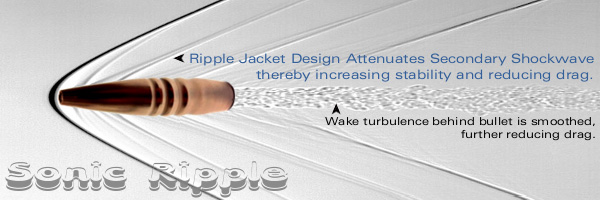
At the end of this year, Berger Bullets plans to introduce a new projectile that may truly be the most revolutionary bullet design since the advent of jacketed spitzers in the late 19th Century. Berger’s new bullet is unlike anything we have ever seen before. It features concentric curved ridges, or “ripples”, on the bearing surface. Tests show that this new projectile, dubbed the “Sonic Ripple Bullet”, has signficantly less drag than conventional bullets (no matter what their ogive configuration). In addition, the Sonic Ripple design provides increased stability at all velocities (allowing barrels with slower twist rates for a given bullet weight).
So, what does all this mean in practical terms? Well, compared to conventional bullets (of similar weight/size), the Sonic Ripple Bullet will shoot a flatter trajectory, buck the wind better, retain energy longer, and remain stable for a much longer distance. That’s big news for competitive shooters, tactical shooters, and long-range hunters.
The Science of the Sonic Ripple Bullet Design
Bryan Litz, Ballistician for Berger Bullets, explains: “This radical leap forward in bullet design was made possible by advanced, new bullet-making technologies. The unusual bullet appearance is only part of the revolutionary ‘Sonic Ripple’ system. The curvilinear waves or ripples in the bullet jacket are designed to create a specific resonance when fired from a specially ‘tuned’ barrel system. The result is an optimization of the sonic wavefront created by the bullet as it travels through its trajectory. This wavefront optimization simultaneously reduces bullet drag while increasing bullet stability.”
In essence, the supersonic shock-wave is smoothed out, dramatically reducing secondary wave fronts. This is all good, as Bryan explains: “If all the internal ballistic requirements are met, the Sonic Ripple bullet exits the muzzle with a harmonically-stabilized launch dynamic. As a further benefit of the ripple design, tests show that the concentric ripples also enhance boundary layer airflow attachment on the bullet. This, in turn, dramatically reduces wake turbulence and attendant drag.”
The reduction of wake turbulence (combined with wavefront optimization) represents a “major breakthrough” which should increase projectile BC by at least 0.14 (on G7 scale), according to Bryan. But, we wondered, might the increased surface area associated with the ripples slow the bullet down in flight? Actually, no. Bryan explained: “Eddies in the boundary layer around the ripples actually lower skin friction drag which more than compensates for increased surface area, resulting in a net friction drag loss at all velocities — both supersonic and transonic.”
Sonic Ripple Bullets Available by the End of 2013
When will we see Sonic Ripple Bullets on dealers’ shelves? Maybe this year. Berger’s marketing department told us: “The Sonic Ripple technology is currently under development and is expected to mature enough for commercial application by late fall, 2013.”
Are you tired of messing with cleaning rods, bore guides, stinky solvents, and messy JB patches? Can’t wait hours for bore-foam products to work? Well now there’s a new solution ideal for all pistol, shotgun, and rifle shooters. With the new Bore-O-Matic cleaning machine, you can clean your barrels in seconds. Remove copper, powder fouling, and even hard carbon in one ultra-fast operation. The Bore-O-Matic uses a self-deploying snake fitted with a bronze brush to instantly rout out all types of fouling. A powerful 0.5 horsepower electric motor spins the brush at 200 rpm as it snakes its way through your bore, eating away fouling, and leaving a “squeaky clean” interior finish in its wake.
The Bore-O-Matic is easy to use. Simply squirt your favorite solvent* in the barrel, fire up the motor, and let the Bore-O-Matic power its way down your barrel. In seconds you’ll have a perfectly clean bore. Since the Bore-O-Matic’s flexible drive shaft is plastic-coated, no harm can be done.
Bore-O-Matic inventor Tom Bugiardo says that the Bore-O-Matic is perfectly safe for your fine match barrels. “We’ve seen how top competitors brush their barrels like crazy, and frankly, we’re just doing the same thing, but with a motor to minimize the labor.” Additionally, Bugiardo says that the bronze brushes used on the Bore-O-Matic can’t possibly harm your bore. “We all know that bronze is softer than steel so there’s absolutely no risk”. Some potential buyers were worried about the rapidly-spinning bore brushes rounding off the edges of lands or damaging the crown. “Horse-pucky” says Bugiardo, “We’ve researched this extensively on internet gun forums, so we’re 100% confident that running a powered bronze brush at 200 rpm down your barrel can’t harm a thing. Trust us.”
Because the Bore-O-Matic spins as it runs down the bore, gyroscopic forces self-center the cleaning brush. So, no cumbersome (and expensive) bore guides are needed. “Just feed that puppy right down the barrel, and say ‘goodbye’ to barrel fouling forever”, says the inventor.
Along with the $189.99 benchtop Bore-O-Matic unit, a smaller $99.99 hand unit is available. When working in tight spaces, or when cleaning at the range, the battery-powered Bore-O-Matic “Hand-Jobber” is ideal. The Bore-O-Matic handheld unit conveniently fits in a range box and runs off long-lasting, rechargeable Lithium-Ion batteries.
With the compact Bore-O-Matic “Hand-Jobber” you can also easily dip the attached cleaning brush in a tub of JB or Iosso bore cream. Bugiardo tells customers: “Slather that JB on your brush and run ‘er right in the muzzle if you want a mirror finish in your bore. Remember, nothing says ‘pride of ownership’ better than a bore that shines like a spit-polished diamond!”
Currently the Bore-O-Matic is available only from Bugiardo’s company, TB Plumbing Supplies, in Lizella, Georgia (no website yet). Bugiardo expects the product will soon catch on with shooters nationwide and it will be carried by major retailers and online webstores.
*With its high-speed rotary brush, the Bore-O-Matic is so efficient that you don’t need expensive, specialty solvents. Bugiardo uses a simple solution of Windex, Ammonia, Drano Gel, and baking soda. “Makes my barrels shine, inside and out”, Bugiardo says.
Berger Bullets has released its “new and improved” Ballistics Calculator on the Berger Bullets website. Much work, and several weeks of testing, went into Berger’s new web-based ballistics calculator. But Berger is pleased to announce that the handy Balllistics Calculator is now up and running! CLICK HERE for Calculator.
How to Use Berger’s Ballistic Calculator
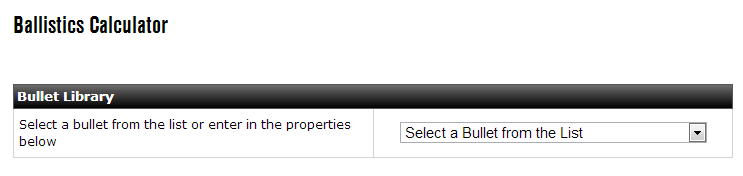
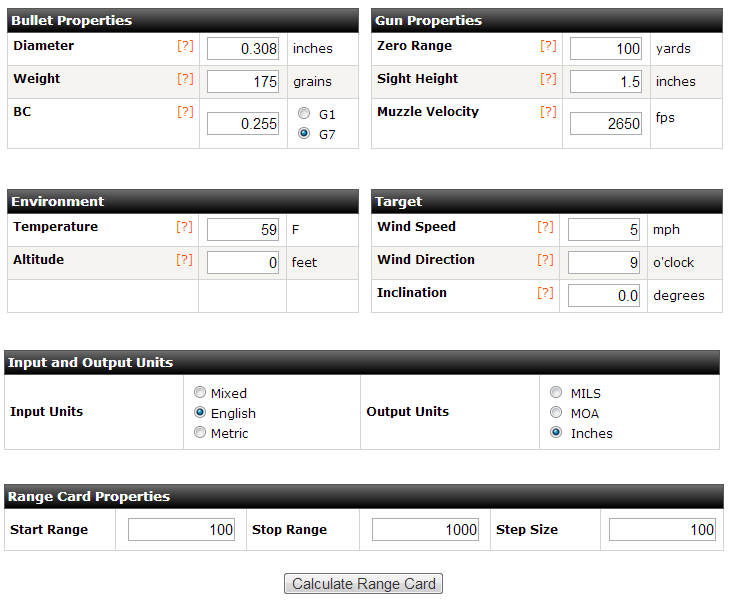
On the top of Berger’s home-page you’ll find a link that says “Ballistics”, with a drop-down menu for Berger’s Twist Rate Calculator and Ballistics Calculator. When using the Ballistics Calculator, the first element you’ll see is the bullet library. This convenient tool automatically fills in the bullet properties fields with the correct information when you select a bullet from the list.
Below, you will see the bullet properties fields are filled in with the 30 Cal 175gr VLD Berger Target Bullet information. You would then manually change the Gun Properties, Environment, Target, and the rest of the fields to correspond with the conditions you will be shooting under. After you have filled in all the variables properly, click “Calculate Range Card” to generate a ballistic solution showing your load’s trajectory, with come-up values at various distances.
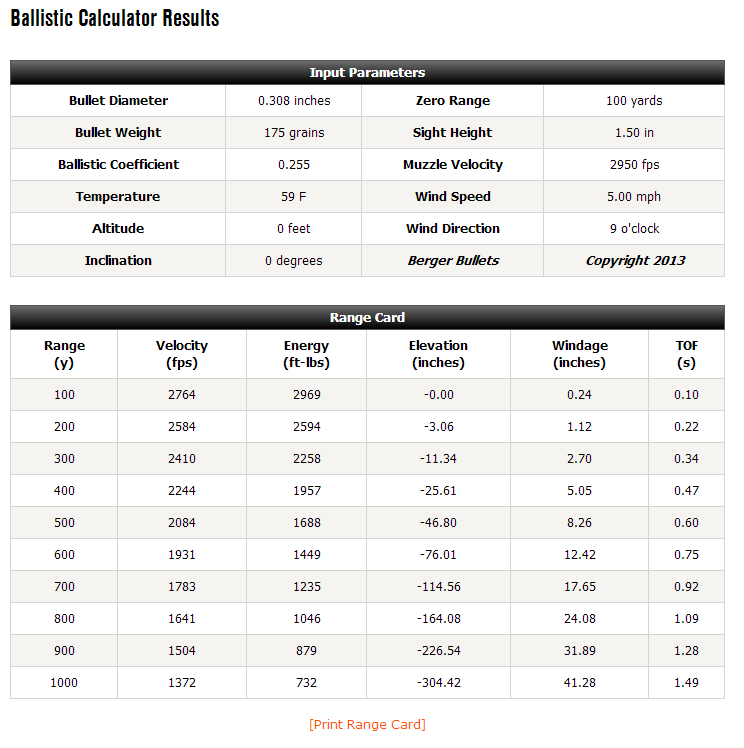
Once the Calculator Results are given, you can print them out and take them with you to the range or on your hunt. Here is an example of the calculated results:
If you have questions about the Ballistics Calculator CLICK this link or use the contact info below. Berger also plans to release a mobile version of the Ballistics Calculator in the near future. This should work well on smart-phones and tablets, so watch for it!
Berger Bullets
Marketing and Shooter Services
Phone: 714-447-5422 (option 2)
M-F 8am to 4:30pm pst
Story tip from EdLongrange. We welcome reader submissions.
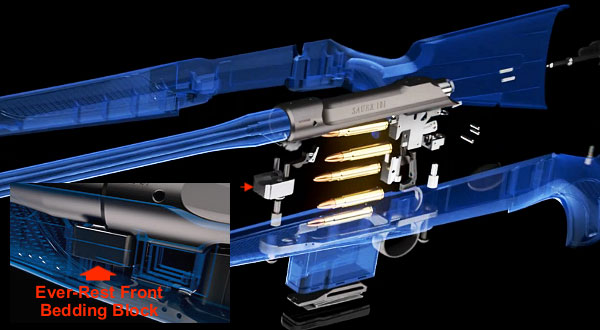
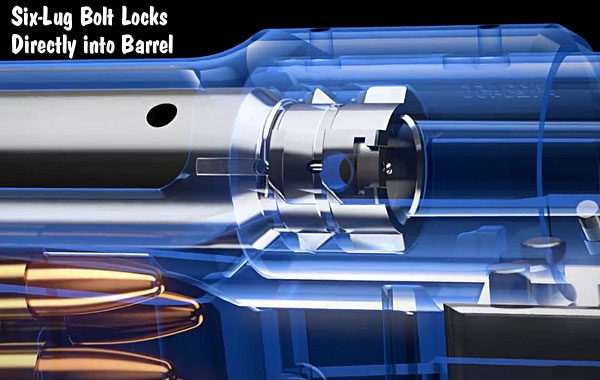
J.P. Sauer & Sohn has released an all-new hunting rifle, the Sauer 101. This new rifle features a six-lug bolt that locks directly into the barrel, along with a new, sophisticated safety system that positively blocks the firing pin. The Sauer 101 also has a patented “Ever-Rest” bedding system featuring a metal block surrounding the front action screw. The Sauer 101 comes with either a black synthetic stock (“Classic XT”), or a quality walnut stock (“Classic”). MSRP has not been revealed, but the Sauer 101 is designed to fall in the “mid-class price range”, making it much more affordable than the Sauer 202. CLICK HERE to visit Sauer 101 dedicated website.
Sauer 101 Features
Smooth-running bolt with 60° lift
6-lug bolt locks directly into the barrel
Dual ejectors provide reliable 90° extraction
Safety system directly blocks firing pin
Crisp 2-lb trigger pull
22″ barrel for standard calibers
24″ barrel for Magnums
Adjustable open sights optional
Sauer 101 Technical Features Video (with Amazing Computer-Generated 3D Animations)
Sauer has provided some fantastic 3D-style cutaway animations that show the features of the new rifle. You can see 3D “exploded” renderings of all the gun’s components. As well, the animation shows the function of the safety system, the six-lug bolt, and the dual-ejector system. Watch this video!
Barrel Attachment Technology
Sauer boasts that the barrel is heat-pressed into the receiver, with the bolt locking up directly into the barrel. That may sound good, but in reality, this engineering solution makes it extremely difficult to fit a new after-market barrel to the gun. We talked with two highly-respected custom gunsmiths. Both agreed that it would be “very difficult to find a smith who would tackle the task of re-barreling this gun (starting with a barrel blank).” One smith observed that “machining the lug recesses directly into the barrel is not a procedure that 95% of gunsmiths are capable of doing.” So, when your Sauer 101 barrel wears out (or if you want to change calibers), presumably you have to send the gun back to the factory.
Chamberings Offered
Standard calibers: 22-250 Rem. .243 Win, 6.5×55, .270 Win, 7×64, .308 Win, .30-06, 8x57IS, 9.3×62
Magnum calibers: 7mm Rem Mag, 300 Win Mag, .338 Win Mag
Sauer 101 Intro Video (1 Minute)
Sauer 101 Pros:
1. The safety system looks very robust and sophisticated. The Sauer 101 features an integral firing pin block that allows firing only after the bolt has been fully locked into battery. That’s smart engineering.
2. Crisp, two-pound trigger pull is very nice for a factory rifle. Sauer claims trigger has “zero creep”.
3. Sauer 101 Accepts Remington 700 long action scope base mounts.
4. Stock is ambidextrous — good for both righties and lefties.
Sauer 101 Cons:
1. The pressed-in “Heat-Lock” barrel attachment system is not “gunsmith friendly”. And, because the lug recesses are inside the barrel, it will be difficult to fit after-market barrels. The machining required is much different than simply drilling a chamber as is done with “pre-fit” threaded barrels.
2. The sling swivel stud is positioned on the front of the Schnabel fore-end. To fit a Harris bipod, the owner will have to add a stud further back, or make an adapter for the forward-facing swivel stud.
3. No factory muzzle brake option.
4. No factory rail option for mounting scope rings.
5. No provision for adjusting length of pull (fixed at 14.4 inches).


 Earlier this month we ran a story on the new Sauer 101 rifle. It turns out the Sauer 101 will be distributed in the U.S. by Blaser USA. Here’s more good news for hunters — we’ve learned that Blaser will be bringing another new German hunting rifle to the USA — the Mauser M 12. You’ll find specs and photos of the M 12 below. This is a rifle with a great heritage, superb build quality, plus some innovative features.


 Next month, the Lone Star State hosts the
 The latest Forster Products Catalog is now available. If you haven’t received a copy yet, you can download a digital PDF version, or submit a request for a print catalog.
 The Science of the Sonic Ripple Bullet Design


 If you have questions about the Ballistics Calculator