Secure Firearm Products (SFP) has introduced a new Spring Tester that measures the “pull weight” of a wide variety of springs used in handguns and rifles. With this new Spring Tester you can measure recoil springs, mainsprings, firing pin springs, and much more. The SFP Spring Tester comes with a digital scale. The complete Spring Tester kit (Model # 11490-SR-D) retails for $40.99.
The Spring Tester, which comes complete with a compact digital pull-weight scale, is simple to use. Just insert the spring on bolt, insert that assembly in the red tool housing, then attach the coupler and scale. Pull until proper compression length* is achieved, and record your reading. Note: the Spring Tester Tool is marked with a line at 1.625″ which is the Mil-Spec compression length of a 1911 recoil spring. The SFP Spring Tester currently ships with an adapter that lets you test small springs such as mainsprings, firing pin springs or other small springs used in pistols, rifles or revolvers.
*NOTE: The appropriate compression length varies with the spring and the application. You may need to get this compression length specification from the manufacturer.
SFP Spring Tester Demo Video
Why do you need a spring tester? SFP’s David Surgi explains: “It’s important to be able to sort and organize all of them properly and know that when a spring needs replacing, that you are putting in the right one with the proper tension.” Dan Kidder of Sportsman’s Warehouse concurs: “The Spring Tester from SFP gave me the ability to take a drawer full of recoil, main springs, firing pin springs and others, and easily identify their tension. I no longer have to try to label springs or worry about them getting in the wrong spot.”
Nikon has introduced an all-new line-up of affordable riflescopes for hunters and varmint shooters. The new Nikon ProStaff 5 Series of scopes feature four times zoom range and a bright new optical system. With their fully multi-coated lenses, ProStaff 5 riflescopes provide up to 95% light transmission. That’s great for hunters working at dawn and dusk. (Some ProStaff 5s also have illuminated reticles). All ProStaff 5 scope models are waterproof, fogproof, and shockproof.
The ProStaff 5 line-up of scopes ranges from 2.5-10X to 4.5-18X with a variety of reticle options including NikoPlex, BDC, Fine Crosshair with dot, and Mil-Dot. Some ProStaff 5 scopes have an illuminated reticle with five intensity levels of red or green. A rheostat dimmer is located on the side focus knob for easy adjustment. All ProStaff 5 scopes now offer spring-loaded, instant zero-reset turrets. This makes your return-to-zero fast and foolproof in the field. (To set your zero, just sight-in as usual, then lift the spring-loaded adjustment knob, rotate to “zero,” and re-engage.)
ProStaff 5 series scopes were designed with a constant (and generous) four inches of eye relief. If you’ve ever had to move your head back and forth as you changed magnification levels, you know that constant eye relief is a big deal with very real practical benefits in the field. The new ProStaff 5 scopes also feature a quick-focus eyepiece, to allow any shooter to easily bring the reticle into focus.
Nikon ProStaff 5 Scopes
Part # Model Reticle MSRP
6735 2.5-10×40 Nikoplex $269.95
6736 2.5-10×40 BDC $279.95
6737 2.5-10×40 (silver) BDC $289.95
6738 2.5-10×50 Nikoplex $369.95
6739 2.5-10×50 BDC $379.95
6740 3.5-14×40 SF Nikoplex $349.95
6741 3.5-14×40 SF BDC $359.95
6742 3.5-14×40 SF (silver) BDC $369.95
6743 3.5-14×40 SF Mildot $359.95
6744 3.5-14×50 SF Nikoplex $449.95
Part # Model Reticle MSRP
6745 3.5-14×50 SF BDC $459.95
6750 3.5-14×50 SF Illuminated Nikoplex $569.95
6751 3.5-14×50 SF Illuminated BDC $579.95
6746 4.5-18×40 SF Nikoplex $449.95
6747 4.5-18×40 SF BDC $459.95
6748 4.5-18×40 SF Mildot $459.95
6749 4.5-18×40 SF Fine Crosshair with Dot $459.95
6752 4.5-18×40 SF Illuminated BDC $579.95
6753 4.5-18×40 SF Illuminated Nikoplex $569.95
Canadian Fred Harvey of Star Shooter Precision recently posted photos of an interesting metal-stocked F-TR rifle, fitted with a Star Shooter CF-SS Bipod with carbon-fiber legs. This handsome .308 Winchester rifle features a Barnard S action, 30″ Krieger barrel (1:11.25″ twist), and aluminum stock/chassis from Dolphin Gun Company in the UK.
The all-up weight of this rig, including the Star Shooter bipod and mounting rail is 17 pounds, 15 ounces. (F-TR weight limit is 8.25 kgs, approx. 18.15 pounds). Gunsmith was Ian Robertson.
Dolphin Gun Company Aluminum F-TR/Tactical Rifle Stock
Dolphin’s modular, CNC-crafted F-TR/Tactical stocks are fully adjustable. Fore-ends are interchangeable and the pistol grip even adjusts for length of pull. Dolphin offers single shot and repeater inlets for Rem 700-style actions, Barnard S & SM actions, RPA Quadlite actions, plus BAT VR and Savage actions. Three types of fore-ends are available: short tactical style, long F-TR style, and a wide F-Open style. Repeater versions accept AI magazines. Dolphin claims the repeaters “feed faultlessly with any action fitted”. The aluminum Dolphin F-TR/Tactical stock comes with an adjustable buttplate fitted with Morgan Recoil pad. The bag-rider height also adjusts. These stocks sell for £630 (about $960 USD) with either Dura-coat or hard-anodized finish. A variety of anodizing colors are offered.
If you do home gunsmithing or swap barrels frequently, you need a good barrel vise. PMA Tool is now carrying a quality 6061 Aluminum barrel vise, with spring-loaded clamps and a durable, baked-on powdercoat finish.
PMA’s Pat Reagin tells us: “These Deluxe Barrel Vises are made by our friend Bob ‘The Viper’ Pastor. Bob’s barrel vises feature hardened bolts and nuts along with fully-captured return springs. The return springs prevent the top of the vise from flopping around, making inserting and removing barrels from the vise much quicker and easier.” This feature, along with the non-slip powdercoat finish, protects your barrels from scratches and, importantly, protects the crown of the muzzle. Pat says: “You will not find a higher quality barrel vise with these features anywhere.” Price for the Pastor barrel vise, machined from 6061 Aluminum, is $60.95. CLICK HERE to order.
Product tip by EdLongrange. We welcome reader submissions.
Mirage shields really do help you hit your targets more reliably. Novice shooters may wonder “Why does that guy have a venetian blind attached to his barrel?” Here’s why. As the barrel gets hot, the heat from the barrel rises up, cooking and distorting the air directly in front of the scope’s front lens. In essense, the rifle creates its own nasty visual mirage, right in the worst possible place. You can have a $4000.00 custom rifle and a $2500.00 scope but if the air in front of your scope is distorted, it can literally move your apparent point of aim on the target relative to your cross-hairs, causing you to miss the shot.
As our friend Boyd Allen observed: “Varminters should use mirage shields. Think about it. You’ve invested thousands of dollars in a fancy varmint rifle and quality scope. You may have spent hundreds of dollars traveling to the varmint fields and spent dozens of hours loading up your ammo. Without a mirage shield on your barrel, once that barrel gets hot, you WILL get mirage effects that can make you miss a shot.”
So, we’ve established you need a mirage shield to shoot your best when the barrel gets hot. You can make your own shield from a scrap blind, or purchase a ready-made plastic or aluminum shield. Sinclair Int’l offers 2″-wide, white mirage shields in 18″ (#06-7200) or 24″ (#06-7300) lengths for $4.95. Shotmaster 10X offers a variety of Patterned Mirage Shields, starting at $6.00. These include a Patriotic theme and even Tiger Stripes:
Camo Mirage Shields for Tactical Shooters and Hunters
Though tactical shooters should use mirage shields for long-distance, slow-fire stages, for the most part, tactical shooters don’t bother. One reason is that mirage shields CAN detach if you’re crawling around in the bush. However, for many tactical shooting situations, a mirage shield IS both practical and recommended. And now, for the first time, tactical shooters can get mirage shields in camo patterns to match their rifles. These camo shields should also be popular with varminters and long-range hunters.
At the request of AccurateShooter.com, Shotmaster 10X created a line of camo-pattern mirage shields (see above). Made of 2″-wide aluminum strips, these are available in 18″, 20″, and 24″ lengths. The camo-pattern shields come complete with Velcro attachments, and start at $8.50 for the 18″ length. The 20″ models are $9.50, while 24″ shields are $11.00.
Traditions™ Performance Firearms is bringing out a complete line of dummy training cartridges. These will meet SAAMI specs for dimensions, and the dummies are weighted so they handle just like the real thing. Training cartridges will be offered for all firearms types: Rifle, Pistol, and Shotgun. Forty different rifle cartridge types — everything from .17 Rem to 50 BMG — will be for sale later this year. Yes there is .22LR, but unfortunately, the 6PPC, 6mmBR, 6XC, 6.5-284, and .284 Win are not yet in the line-up.
Traditions™ Training Cartridges are the only training cartridges available that meet all SAAMI (Sporting Arms and Ammunition Manufactures Institute) specifications for dummy ammunition. The Training Cartridges are weighted like real ammunition so they have the same feel when practicing. These training cartridges are intended for function testing, dry-firing, malfunction drills, and teaching demonstrations.
Traditions™ precision Training Cartridges have durable brass cases and rims so they won’t degrade like plastic dummies. Precision-assembled, these are available in over 60 chamberings and shotgun gauges. For most of the common rifle calibers, these training cartridges cost about $10 for a pack of two (2) dummy rounds. For more information or to view Traditions™ complete line of products, go to TraditionsFirearms.com, or call 1-860-388-4656.
Traditions Training Cartridge Types for Rifles
.17 Rem
.204 Ruger
.22LR
.22 Hornet
.222 Rem
.223 Rem
22-250 Rem
.223 WSSM
6mm Rem
.243 Winchester
.243 WSSM
.257 Roberts
.25 WSSM
.25-06 Rem
.260 Rem
6.5×55 Swedish
6.8 Rem SPC
.270 Winchester
270 WSM
7mm-08
7mm WSM
7mm Rem Mag
7×57 Mauser
.303 British
.30 Carbine
.30-30 Winchester
7.62×39
.308 Winchester
300 WSM
.30-06 Spr
.300 Rem UM
300 Win Mag
8×57 Mauser
.338 Rem UM
.338 Winchester Mag
35 Whelen
.375 H&H
.458 Win Magnum
.45-70
50 BMG
BAT .50 BMG — Now That’s an Action!, by GAS
A while back, I stopped into Bruno Shooters Supply for a jug of powder and looked into the display case where the new actions are kept. Amid the usual array of BAT Machine, Stolle and other actions, there was something unlike any action I’d seen before — all I can call it is the BIG BAT. I wasn’t too surprised at the weight (a beefy 13.7 lbs.), but until you lift it it’s hard to appreciate how solid, chunky, hefty, massive (pick your favorite adjective) this thing really is. The action is a 2.5″-diameter, 12″-long BAT for the .50 BMG cartridge. It is simply the biggest, slickest custom action on the planet. In order to give you some sense of scale, I photographed the action alongside a conventional BAT action for short-range Benchrest shooting and I put a .220 Russian case and a .30-06 case into the picture. I’ve handled and fired other .50 BMG actions/rifles before, but this BAT puts them all to shame, as far as fit and finish go.
The action is actually quite conventional in design and execution. The bolt is fluted and has two front lugs with a conventional, although super-sized, firing pin assembly. Any Remington-style trigger will mount by way of a normal trigger hanger, allowing for simplified maintenance or replacement in the field. The loading port is 5.5″ long and the barrel threads are 1.5″ x 16 tpi — nothing about this beast is small! There is a conventional rocker-type bolt release on the left side of the receiver body and a recoil lug is built into the bottom of the receiver. In reality, the action is very similar to any other BAT except for the size and it adheres to all of BAT’s high standards for quality of design, manufacture, fit, finish and just plain good looks. Slide that bolt back and it feels as tight as a small Benchrest action!
Given the BIG BAT’s $3,285.00 sticker price (2011 pricing), not many of us will ever have the opportunity to own or shoot one of these beauties (I certainly won’t). However, it is nice to know they exist and can be bought and enjoyed in many places.
Mark your calendars for May 3-5, 2013. Those are the dates for the NRA Annual Meetings and Exhibits, to be held this year in Houston, Texas.
As ever, there will be plenty to see and do at the NRA National Meetings/Exhibits. There will be seminars, celebrity appearances, and priceless collections of firearms. Virtually all the major gunmakers in the country should have their latest products on display. In fact, there will be over 550 exhibitors whose displays will cover 400,000 square feet of exhibit hall space. In addition to fireams, you can see knives, wildlife art, shooting accessories, hunting gear, ATVs, and much more. You’ll even find an airgun range on site where you can shoot air rifles provided by Pyramyd Air.
Photo from Previous NRA Annual Meeting and Exhibits.
CZ has introduced a new version of the CZ-455 rimfire rifle featuring a black-finished, laminated wood stock. This new gun, dubbed the Varmint Tacticool by CZ-USA, features a 5-round detachable magazine and adjustable trigger. The new CZ-455 Varmint Tacticool was built as a affordable tactical trainer with the ergonomics and “feel” of a full-size centerfire tactical rig. The Tacticool’s stock looks similar to the Manners Composites stock on CZ’s 455 Varmint Precision Trainer, but the wood-stocked ‘Tacticool’ version is much less expensive. The CZ 455 with Manners stock retails at $899.00 MSRP while the new ‘Tacticool’ model lists for just $522.00 MSRP. The $377.00 you save will buy a lot of ammo (or a scope).
We like the looks of the CZ-455 ‘Tacticool’, and the stock has some nice features. The butt-hook stock has ambidextrous palm swells on the grip and a raised comb to provide a comfortable cheek weld for shooting with a scope. The fore-end features a wide, beavertail swell for greater stability on a front sandbag. There are two (2) sling swivel studs so you can attach both a sling and a bipod.
If you have a rifle chambered in .260 Remington, you may be wondering if the Lapua .260 Brass is worth the money compared to domestic-made brass. Well, the answer is “yes” if you demand consistent weight and dimensional uniformity (including neckwall thickness).
Mike Harpster of Dead Center Sports took the time to weigh and measure Lapua .260 Rem brass. His test show this brass to be extremely uniform. Weight variance was less than one (1) grain in a 20-case sample. And case neckwall thickness was very consistent.
Report by Mike Harpster: Lapua .260 Rem Brass Test Results (with Comparisons)
I pulled twenty (20) pieces randomly from one Lapua box to do some measurements. I weighed them on my Mettler-Toledo digital lab scale and here are the individual weights of each case. Remarkably, the Lapua brass had less than one grain total weight variance among all 20 cases!
While checking the Lapua brass I remembered I had just received some Winchester brand .308 brass, so I thought it would be interesting to do a comparison between the two brands. I again pulled 20 cases at random from a bag of 50 and repeated the same measurements. The results are shown in the right half of the table below.
Weight Variance Lapua .260 Rem Brass vs. Winchester .308 Brass
LAPUA .260 Rem Brass
Winchester .308 Win Brass
Average: 172.20 grains
ES: 0.94 grains
SD: 0.259
Average: 158.49 grains
ES: 2.64 grains
SD: 0.678
Lapua Brass Further Inspection
With sample Lapua .260 Rem cases, I also measured the neck wall thickness in four places with calipers, not the most accurate method but I feel confident that the thickness did not vary more than .001″ over the 20 cases (.0145-.0155). The inside diameter of the neck measured .260 which would give .004 of neck tension out of the box. I visually checked the flash holes and I did not find any flakes of brass or burrs inside, the holes were round and centered.
Winchester Brass Further Inspection
The flash holes on the majority of the Winchester brass were not round or centered and they had large burrs inside. The neck wall thickness was pretty consistent, varying only .0015″ (.0125″ – .014″). As you can see in the photo (right) many of the Winchester cases were badly dented while the Lapua brass showed very few minor dents. The annealing on the necks of the Lapua brass was clearly evident while the Winchester showed no signs of being annealed. [Editor’s note: Winchester tumble-polishes its brass before shipping — so you would not notice annealing coloration if annealing had been done.]
I have never done these measurements on any other brass so I don’t know how they compare, but I am very impressed with the overall quality of the Lapua .260 brass. If they prove to hold up to the repeated firings I get from my Lapua 6BR brass I believe .260 shooters wil be very happy.
Mike Harpster — Dead Center Sports
105 Sunrise Drive
Spring Mills, PA 16875
phone: 814-571-4655 www.deadcentersports.com


 Secure Firearm Products (SFP) has introduced a new Spring Tester that measures the “pull weight” of a wide variety of springs used in handguns and rifles. With this new Spring Tester you can measure recoil springs, mainsprings, firing pin springs, and much more. The SFP Spring Tester comes with a digital scale. The complete Spring Tester kit (Model # 11490-SR-D) retails for $40.99.


 Canadian Fred Harvey of


 If you do home gunsmithing or swap barrels frequently, you need a good barrel vise.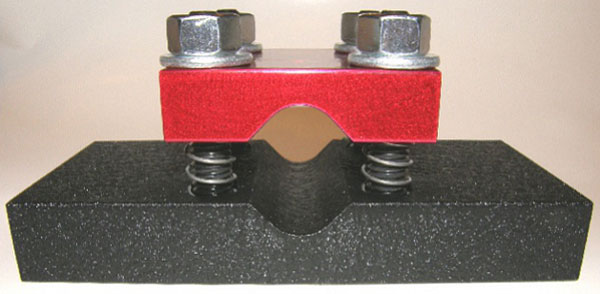
 Mirage shields really do help you hit your targets more reliably. Novice shooters may wonder “Why does that guy have a venetian blind attached to his barrel?” Here’s why. As the barrel gets hot, the heat from the barrel rises up, cooking and distorting the air directly in front of the scope’s front lens. In essense, the rifle creates its own nasty visual mirage, right in the worst possible place. You can have a $4000.00 custom rifle and a $2500.00 scope but if the air in front of your scope is distorted, it can literally move your apparent point of aim on the target relative to your cross-hairs, causing you to miss the shot.


 Traditions™ Training Cartridges are the only training cartridges available that meet all SAAMI (Sporting Arms and Ammunition Manufactures Institute) specifications for dummy ammunition. The Training Cartridges are weighted like real ammunition so they have the same feel when practicing. These training cartridges are intended for function testing, dry-firing, malfunction drills, and teaching demonstrations.


 Mark your calendars for May 3-5, 2013. Those are the dates for the


 If you have a rifle chambered in .260 Remington, you may be wondering if the Lapua .260 Brass is worth the money compared to domestic-made brass. Well, the answer is “yes” if you demand consistent weight and dimensional uniformity (including neckwall thickness).
 Average: 172.20 grains
 Average: 158.49 grains
 Lapua Brass Further Inspection


