Stan Ware of SGR Custom Rifles, is one of the finest gunsmiths with whom we’ve worked. He’s also a talented shooter and an innovative wildcatter who’s not afraid to think “outside the box”. Stan competes in both Hunter Benchrest (HBR) and Varmint for Score (VFS) disciplines. In his quest to build the ultimate Hunter Benchrest cartridge, Stan created the radical “Wolfpup” wildcat, based on a 6mmBR parent case. Noting the dominance of 30 BRs in VFS matches, Stan wondered if a stretched 30 BR could work in HBR competition. The challenge was case capacity. Under HBR rules the cartridge must hold at least 45.0 grains of water, equal to the capacity of the classic 30/30 case.
To get the requisite HBR case capacity, Stan figured he needed to boost the volume of a 30 BR case significantly, so he would have to move the shoulder forward — a lot. He did this by running a 30 BR reamer deeper and deeper, test-firing brass along the way. After three reamer passes, he ended up with the capacity he needed (the Wolfpup holds 45.3 grains of water). But then he looked at the finished product — a case with almost no neck, and he wondered “how could this possibly work?”.
From Trashbin to Winner’s Circle
Ware’s prototype Wolfpup ended up so short-necked, so unlike any “normal” cartridge, that Stan figured it was “dead on arrival”. Stan told us: “I said ‘this ain’t going to work’ and I threw the brass in the trash can. Honest. But later I thought I better shoot it and see what it does.” There was one problem — Stan didn’t have a seating die. He noticed the short neck provided a bit of tension after fire-forming, so he literally seated some bullets, BIB 118s and 125s, with his fingers. For powder he used H4198 and started with 35 grains, one grain more than a 30 BR load. Stan then did a pressure work-up: “I actually went up to 41.0 grains and didn’t have a sticky bolt. I ended up at 37.9 grains of Hodgdon 4198 — that gave 3150 fps, where the sweet spot is.” (Later testing revealed a second accuracy node at about 3020 fps, using 36.4 grains of H4198).
Stan’s radical short-necked Wolfpup shot great from the get-go. Once he found the right velocity node, the gun shot in the ones and zeros with both 7-ogive and 10-ogive bullets, both 118s and 125s. The Wolfpup proved easy to tune — it’s not finicky at all. And it’s a winner. Stan began shooting the Wolfpup in 2006 in both VFS and HBR matches and the ‘Pup’ started winning matches right away. In 2007, Stan won the Wisconsin State VFS Championship shooting the Wolfpup. Most recently, in June 2010 at a Webster City, Iowa VFS match, Stan won the Grand Agg and posted high X-Count for the match, while placing first at 100 yards and second at 200 yards. How’s that for a cartridge that almost ended up in the trash bin?
Does Stan deserve an award for “most innovative benchrest cartridge design”? Stan chuckles at that notion: “I’m not a hero, not a genius. I really didn’t do anything. The fun part is thinking outside the box — for me anyway. Shooting is an age-old process of experimentation. You never learn it all.”
Why Does It Work?
How can such a radical case design perform so well? “That’s a good question,” Stan admitted. He then explained: “The 30 BR is inherently accurate, so I figured something based on the 30 BR should be accurate too. My personal belief is that the short neck doesn’t hurt you. Plus if the throat in the barrel is straight, the bullet can self-align. If the chamber is good, the bullet will self-center in the throat. In a regular case there’s not much room to do that, so a bullet can start off-center, and you don’t get the same results every time. A bullet in a conventional case is stopped from self-centering by the stiffer neck, particularly in a tight-clearance BR gun.”
Reloading the .30 Wolfpup
Stan’s Wolfpup chamber has a neck dimension of 0.330″. He turns his necks for a 0.327″ loaded round. Bullets are jammed .020″ forward of first contact with the lands. When he closes the bolt it pushes the bullet back in the case — almost a soft seat. Stan notes: “To start with I normally bump the shoulder .0005-.001″ so they go in easy. Just by doing that I get a little neck tension. I also use a bushing. Right now I’m running a .322, but it’s not particularly sensitive. I’ve tried one-thousandths increments up to a .325 bushing and couldn’t tell a lot of difference.”
Currently there are no production sizing dies for the Wolfpup. Stan uses two dies to size his fired brass: “I use a 30 BR bushing full-length die after each firing, but that doesn’t size the bottom half of the case. But I can shoot the brass four or five times with no problems.” After four to five firings Stan hits the bottom of the brass with a modified 6mmBR body die. Stan hogged out the top half of the body die so it doesn’t contact the top of the brass. For bullet seating, Stan uses a Wilson 30 BR seater die into which he ran the chamber reamer. This gives perfect case fit during seating operations.
If You Want a Wolfpup Rifle
Stan has received a number of requests to chamber Wolfpups for Hunter Benchrest shooters, and he will be building some for next season. Stan charges $300.00 for chambering, crowning, and headspacing a barrel. He also sells Wilson micrometer-top seater dies, customized for the Wolfpup, for about $110.00. If there is sufficient demand, he may start producing “one-pass” full-length sizing dies for the cartridge. Stan can also build complete benchrest, hunting, and long-range rifles in your choice of calibers. Visit SGRCustomRifles.com, or call (507) 274-5649.
About the Illustrated Gunstock
You’ll notice Stan’s stock contains scenes from Vietnam and a quotation. Here’s the story. A Vietnam combat veteran, Stan served “in-country” with the Army’s 509th Non-Divisional Combat Unit (out of Fort Riley) from 1965-1966. Shortly before he left Vietnam, Stan went to a shop to have a souvenir lighter engraved. He asked the vendor for an appropriate inscription. The shop’s metal-worker engraved: “War is a tragedy. It takes mans’ best to do mans’ worst.” That message, along with the combat scenes, were hand-painted on Stan’s rifle by his wife Susan, a talented artist. She spent more than 20 hours painting the rifle stock.
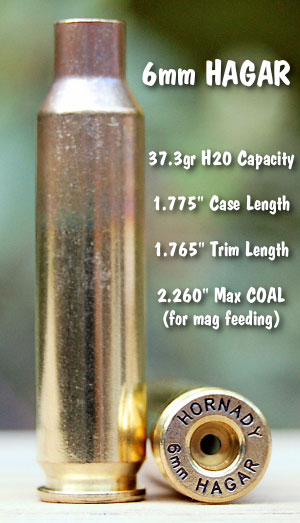
Here’s good news for AR shooters looking for a 6mm option. 6mm HAGAR brass is now available from Hornady, and it looks like this brass is quite good. Those of you who follow the National Matches at Camp Perry know that Carl Bernosky won multiple National High Power Championships shooting the 6mm HAGAR cartridge from an AR Platform rifle. The 6mm HAGAR was derived from the 30 Remington cartridge, and it has the same case head diameter as the 6.8 SPC, also a 30 Remington derivative.
The 30°-shoulder 6mm HAGAR is just about the longest 6mm cartridge that can be loaded in a two-column AR15 magazine and still feed reliably. The advantage of the 6mm HAGAR is that it offers enough “boiler room” to drive 6mm bullets to impressive velocities, yet it can still fit and function well in AR mags. But note, if you are restrained to a mag-length COAL, you can pretty much rule out using 95-108 grain bullets, because they would have to be seated too deep in the HAGAR case. That actually means that the “advantage” of the 6mm HAGAR’s case capacity is lost to some degree — at least when using long, heavy bullets. On the other hand, when loaded with shorter varmint and hunting bullets, such as Hornady’s 75gr V-Max, you can load to 2.260″ mag length and use nearly all of the HAGAR’s case capacity.
For this reason, we think the 6mm HAGAR may ultimately prove more popular with varminters than with the High Power crowd (at least those who do not want to modify their mags to allow heavy 6mm bullets to be seated longer.) If you’re using shorter bullets, you can fill up the HAGAR case and drive 60-75 grain projectiles at serious velocities.
6mm HAGAR Basics
The 6mm HAGAR uses a 6.8 SPC AR-15 bolt and 6.8 SPC magazines and a conventional upper receiver, barrel extension, and bolt carrier assembly. Typically this cartridge has been used for varminting, hunting, and High Power competition. We think the 6mm HAGAR should be a kick-ass cartridge for varminters shooting ARs with shorter varmint bullets.
On the other hand, because the 1.775″-long HAGAR case takes up so much space in an AR magazine, the 100-108gr bullets aren’t well-suited for mag-fed 6mm HAGAR applications (unless the mags are modified). These same 100-108 grainers DO work well in single-load situations provided the chamber is properly throated for such bullets.
NOTE: Some High Power shooters have slotted AR mags to allow loading of long bullets up to 2.340″ max, i.e. beyond normal mag length. See modified magazine at right.
Hornady’s 6mm HAGAR Brass Is Shipping Now
Until recently, 6mm HAGAR brass was hard to obtain. Cases could be formed from 30 Rem brass, but this was a tedious, time-consuming process. Now, however, quality 6mm HAGAR brass is available from Hornady. An initial run of 150,000 pieces of 6mm HAGAR brass was produced. Vendors who got some of the first run of HAGAR brass include AR-X Enterprises LLC (Robert Whitley) and Creedmoor Sports.
Robert Whitley reports: “We’ve received our first shipment of factory 6mm HAGAR brass from Hornady. This Hornady 6mm HAGAR brass is hard at the base but well annealed at the neck. The brass has a small primer pocket and a small flash hole. All of these features enable the brass to hold pressures well and to remain serviceable and usable for multiple re-loadings. Internal H20 capacity of the brass case is right around 37.0 – 37.5 grains of water weight. With its larger case capacity the 6mm HAGAR can accurately push the bigger 105gr to 108gr bullets in the range of 2800 fps (when these bullets are seated long and single-loaded, not mag-fed). However, because of its rather long case length (1.775″) relative to max mag-fed cartridge OAL of 2.260″, the 6mm HAGAR may work best with the smaller and lighter 6mm bullets (75gr and under).” [Editor: Do the math … 2.260″ minus 1.775″ leaves only 0.485″ clearance for a bullet to extend beyond the case mouth.]
Loading Long Bullets to Mag-Limited 2.260″ COAL Is Neither Practical Nor Wise:*
6mm HAGAR Brass, Dies, Mags and Complete Uppers Offered
Along with 6mm HAGAR brass (at $84.00 per hundred), ARX Enterprises has 6mm HAGAR dies, and magazines. ARX Enterprises is also building complete match and varmint AR-platform uppers chambered for the 6mm HAGAR. You can find out about all these products on Robert Whitley’s 6mm HAGAR web page. To order 6mm HAGAR uppers, die sets, brass, magazines and related products contact:
AR-X Enterprises, LLC (Attn: Robert Whitley)
199 North Broad Street
Doylestown, PA 18901
(215) 348-8789
e-mail: rcw3 [at] erols.com
*Left = 75gr Hornady V-Max at 2.260″ OAL (bullet diameter at mouth of case is .243″.)
Left Center = Berger 100gr BT at 2.260″ OAL (bullet diameter at mouth of case is only .225″.)
Right Center = Sierra 107gr MatchKing at 2.260″ OAL (bullet diameter at mouth of case is only .222″.)
Right = Hornady 105gr A-Max at 2.260″ OAL (bullet diameter at mouth of case is only .225″.)
Sierra Bullets has just announced a new .375-caliber, 350 grain HPBT bullet — the latest in Sierra’s MatchKing line of projectile. Designed for custom long-range applications, this 350-grainer is the largest MatchKing Sierra produces, and it offers a jaw-dropping 0.805 G1 BC (at 2,200+ fps).
With that impressively high BC, the new .375-caliber MatchKing should “buck the wind” very well at long range. The new bullet features an 11-caliber ogive, and 9-degree boat tail. Sierra says the overall shape is “forgiving” to tune and should work well at a variety of seating depths. These bullets will be available in 50-count boxes (stock #9350T), or bulk boxes of 500 bullets (stock #9350).
Redding is releasing a dedicated small-case powder measure with a charge weight range of 1 to 25 grains. This specialized Model 10X powder measure should work well for small varmint cartridges such as the .221 Fireball, .20 Vartarg, and the 17 Hornet. The powder cavity and micrometer settings put the charge for a 17 Hornet right in the middle of the powder measure’s capacity — the most accurate part of its range. That’s good news for small rifle cartridge reloaders.
In addition, 17 Fireball and 17 Hornet shooters will be pleased to not that Redding has introduced a 17-caliber drop tube adapter that fits the small-diameter necks of these compact varmint cartridges. With this 17-cal adapter (Redding part #03817), you can throw charges directly into 17-caliber cartridge brass, without the need for separate small-neck funnels.
Features of New Redding 10x Powder Measure:
• Micrometer-controlled powder metering chamber
• Hemispherical Cup for smoother operation
• Cast iron and hard chrome construction
• Positive metering chamber lock
• Adjustable powder baffle
The 17 Hornet is based on the venerable rimmed .22 Hornet case. However, the case is not just necked-down from .22 caliber. The case designers reduced body taper, moved the shoulder, and changed the shoulder angle to 25°. This effectively modernized the old .22 Hornet case, improving efficiency while retaining the max OAL, so that the 17 Hornet can work in any action big enough for the .22 Hornet. Hornady’s “Superformance” 17 Hornet loaded ammo is designed to push a 20gr bullet at an impressive 3650 fps.
Imagine a “smart scope” that can range your target AND calculate windage correction. Such technology may appear in riflescopes fairly soon. The Israeli Government’s Soreq Nuclear Research Center has received a U.S. patent for a new laser-based technology that can gauge wind vectors as well as target distance, using a laser rangefinder coupled to a rifle-scope. The Israeli system is called LIDAR, an acronym for Laser Identification Detection And Ranging. This new technology could, potentially, be a major boon for long-range shooters, both military and civilian. Ironically LIDAR was first developed for environmental monitoring (not for use with weapons). A LIDAR system was used for 3-D mapping and modeling of wind-driven plumes from the Israel Electric Company’s Rabin power plant.
Credit The Firearm Blog for breaking this story on the new Israeli LIDAR technology for sniper scopes. Below you’ll find the LIDAR Patent Application Abstract, which has a good summary of how LIDAR reads the wind.
The new Israeli LIDAR unit gauges wind speed by detecting fluctations in laser signals sent out from the integrated scope/LRF, reflected back from the target, and then received by photodiodes in the scope/LRF. Other scopes have used built-in LRFs to measure distance-to-target, but Israel’s patented LIDAR goes one step further, using the laser to gauge BOTH target distance AND wind vectors (i.e. velocity + direction). This information is entered automatically into software. The software then calculates a ballistic solution compensating for distance, wind angle, and wind velocity. If it really works, LIDAR represents a remarkable technological achievement. The Israelis claim LIDAR works for targets at distances of 500m or greater. Why won’t it work at closer ranges? Presumably the wind-induced laser fluctuations are too small to register at closer distances.
Current Integrated LaserScopes for Hunters While the Israeli LIDAR system may seem like science fiction, it’s not that far removed from the lastest commercial optics. Engineers on both sides of the Atlantic have already integrated laser rangefinders (LRFs) into rifle-mounted “consumer” optics. Just this year, Burris introduced an affordable “consumer” scope, the Eliminator, that ranges the distance to target and then displays the ballistically correct aiming point on the vertical crosshair. The amount of hold-over is automatically calculated with reference to ballistics formulas. At right is a view through the Burris Eliminator; the illuminated dot shows the calculated aiming point.
While such technology can help a shooter compensate for bullet drop, windage compensation is another matter. A shooter must still gauge crosswind angle and velocity, and then hold left or right accordingly. If the LIDAR system can perform this task reliably, that is a major advancement.
DARPA “One Shot” System to Have Wind-Reading Capability
Meanwhile, in the United States, the Defense Advanced Research Projects Agency (DARPA) is proceeding forward with a One-Shot Sniper System, another “Super-Scope” that will have day/night capability, and calculate both elevation AND windage correction automatically. Prototypes have already been tested, demonstrating that a laser beam can be used to “measure the average down-range crosswind profile”. The wind data is combined with readings of temperature, humidity, and target range to provide a very sophisticated ballistic solution. DARPA’s Spec for the One Shot program calls for a 12-42X Direct View Optic (DVO), a Riflescope Display Assembly (RDA), and an Integrated Spotting Scope (ISS) with rangefinder that ranges to 2 km, and provides “crosswind measurements”. The system will be “menu-selectable” for .308 Win, .338 Lapua, and .300 Win Mag. DARPA has budgeted big bucks for the One Shot system. The ISS, by itself, is expected to cost $85,000 per unit (for the first 15 units).
These systems will never replace the utility of an experienced shooter who possesses the skills of wind reading, but it is a real boon for less experienced shooters. In terms of military utility, it is a game changer. I’ve seen and used a prototype of the One Shot, and it does perform as advertised. — SFC Emil Praslick III, USAMU Coach
Can Wind-Reading Systems Work in the Real World?
From what we can tell, the LIDAR system, and America’s competing One Shot System, are both designed to measure crosswind speed and angle AT THE TARGET primarily. But as any experienced long-range shooter knows, wind is rarely constant along the entire path of the bullet. There can be a 10 mph left wind near the firing point, a 5 mph tailwind in mid-trajectory, and a 20 mph right wind 1000 yards away. Importantly, wind close to the shooter has more effect on the bullet’s path than wind far downrange — that’s a matter of simple geometry. Therefore, any wind-reading system could provide incorrect solutions if it is not able to read and calculate different wind vectors along the full bullet flight path. Presumably LIDAR and One Shot systems will attempt some kind of crosswind averaging, but that will be a very challenging task, without multiple wind sensors downrange.
Tikkashooters.com is now importing ergonomic field and tactical stocks crafted by GRS Rifle Stocks of Norway. These “Stratabond” Laminate wood stocks come in many colors — all with a gorgeous oiled finish. The GRS stocks come in three styles, plus a biathalon model, with an F-Class and Safari model to come. All styles are all drop-in inletted for most popular actions — not just Tikkas! GRS stocks feature Speedlock push-button adjustment for recoil pad position and comb height. All stocks come with a one-inch thick Limbsaver recoil pad.
Shown above is the Sporter/Varmint model, which comes in six colors. This design has a butt hook and the 6° grip angle for more comfortable hand positioning. As with other GRS stocks, the Sporter/Varmint model features quick, no-tools adjustability using a Speedlock system. Inlets are offered for Howa (SA, LA), Rem 700 (SA, LA), Sako (models 75, 85, L-579), and Tikka (models 55, 65, 595, 695, all T3 versions, including T3 RH, T3 LH, Varmint, Tactical).
Next, shown above, is the GRS Adjustable Hunting model which comes in four colors: Black, Brown, Green Mountain Camo, and Royal Jacaranda. The fore-end is comfortable when shooting without a rest and the grip angle is canted 6° to provide a more ergonomic hold. Inlets are offered for Howa 1500 (SA, LA), Rem 700 (SA, LA), Sako (models 75, 85, L-579), and Tikka (models 55, 65, 595, 695, all T3 versions, including T3 RH, T3 LH, Varmint, Tactical).
Last, but not least, is the GRS Long-Range Model, offered in six colors. This design is inspired by military sniper-type rifles. This stock is similar to the sporter/varmint model, but has a more pronounced butt hook with an integrated monopod with quick release and micro adjustment. The longer fore-end provides a better bipod platform and aids in balancing long, heavy barrels. Inlets are offered for Rem 700 (SA, LA, left/right), Rem 40X (single shot), Sako 75 (IV, V), Tikka T3 (Std, Varmint, Tactical).
Save $100 with Introductory Pricing This Month
For more information visit the GRS Stocks page on the TikkaShooters.com webstore. NOTE: Introductory pricing is available through May 31, 2012. The GRS Hunter and Sporter/Varmint stocks are currently priced at $697.00 fully inletted, including adjustable hardware. The Long-Range Model is currently priced at $897.00 fully inletted with adjustable hardware. Unless the intro pricing deal is extended, expect prices to increase $100.00 per model starting June 1, 2012.
Jerry Hurt set a pending new IBS 600-yard Light Gun Score Aggregate Record of 198 this weekend at the MSSA range in Memphis, Tennessee. If certified, this would beat the previous LG Record of 197 set by Sam Hall in 2011. The 198 score Four-Target Agg was well-centered with a 2.256″ Group Agg. One shot on Jerry’s third target appears to have just clipped the line for the 10. (See Target 3 Close-up Photo).
Forum member Tim Claunch reports: “Mr. Jerry Hurt had an exceptional Light Gun match and indeed scored a 198. I drew next bench to Jerry and was there watching him. You won’t find a nicer gentleman in our sport — congratulations Jerry Hurt!”. Match conditions were very good with partly sunny skies and 75° early temps with a light SW Tailwind.
Jerry was shooting a 16.86-lb, 6mm Dasher with a BAT two-lug Action and Shehane MBR stock in Obeche wood laminate. The 1.25″-straight contour 5C Broughton barrel is chambered with a 0.267″ neck for neck-turned brass with 0.265″ loaded necks. This barrel was purchased about a year ago, but only had about 150 rounds on it when Jerry shot the 198 score. Measuring 27.5″ long, this Broughton has proven exceptionally fast. Jerry’s chronographed velocities are significantly faster than other Dasher shooters — too fast to print. Let’s just say Jerry is running a very high speed node.
Berger 105gr Hybrids .030″ Off Lands
Jerry’s load consisted of Berger 105gr Hybrid bullets, seated 0.030″ off the lands and pushed by 33.0 grains of “Long-Range Match” pull-down (surplus) powder. This powder, which is very similar to Reloder 15, has produced some great results recently. Ron Boyd used it in his Dasher to shoot a 1.462″ 1000-yard group last month.
Notably, Jerry shot his Berger 105 hybrids “right out of the box… with no sorting, no pointing.” Jerry did tell us that: “this is a new lot of 105 Hybrids… obviously they are very, very good.”
Jerry praised his equipment. Along with his very fast Broughton barrel, Jerry gave credit to his Shehane MBR. “It’s a looker, that’s for sure. Because the 1.25″ straight barrel is heavy, I haven’t added weight to the stock but it still tracks really well.” Jerry also said that his Sure Feed Vertical Ammo Caddy helps him get rounds downrange quickly: “These work really well with the 6BR, Dasher, BRX. And I also have a second Sure Feed for my .300 Ackley 1000-yard gun. These are custom-made by Tim Sellars in Texas. They are set up for a particular cartridge type, and Tim customizes the Caddy to fit the height of your rifle on the rest. You want the bottom round in the stack — the one you grab — to be real close to the loading port.”
Sure Feed Ammo Caddies
Tim Sellars – Sure Feed
4704 Redondo Street
North Richland Hills, TX 76180
Phone: (682) 240-7690 (cell)
eMail: sel248 [at] aol.com
F-Classer Kenny Adams was spotted at the recent Tennessee NRA Regional using the new patent-pending PD Products LLC On-Time Cartridge Caddy. This $95.00 gadget is the creation of ace pistolsmith and “casual” High Power competitor, Paul Liebenberg of Pistol Dynamics. The On-Time Caddy combines 25 cartridge slots with a countdown timer so the shooter can keep track of time while accessing his ammo. No one knows if the new Caddy had anything to do with Kenny’s one-point win over Danny Biggs at the Tennessee match, but Paul figures it has to be worth at least one point per match, so the inventor is shamelessly taking credit for Kenny’s win.
The PD On-Time Cartridge Caddy is entirely CNC-machined from aluminum and acrylic (clear or colored) and is available for all cartridges commonly used by High Power and F-Class shooters. The angled-face integrated timer lets you manage time and handle ammo without shifting from the shooting position.
The PD Cartridge Caddy is not a one-size-fits-all product. With its smaller rim diameter, the.223 Rem requires a dedicated tray. However certain trays can hold multiple cartridge types (with common case diameters). For example the .308 Caddy also works with .243 Win, 6.5X47 Lapua, .260 Rem. There is a special tray designed for the 6mmBR, 30BR, and Dasher. And there is tray for the larger-diameter 7mm WSM and RSAUM. The top photo above shows Kenny with 7mm RSAUM rounds in his PD Caddy.
PD Cartridge Caddies are available now at an introductory price of $95.00. To order, send email to info@pistoldynamics.com, or call Pistol Dynamics at 321-733-1266. There is a lifetime guarantee on the machined part and a one-year warrantee on the timer.
PMA Action Cleaning Tool Kit Review by Danny Reever
I’ve been playing with the PMA Action Cleaning Tool Kit for about a month now. Previously, I used one of the old style (round knob) Sinclair action-cleaning tools with cylindrical cotton rolls. With the Sinclair tool, I was pretty satisfied that I was getting my actions reasonably clean. But, as I explain below, I think the newer PMA Action Cleaning Tool Kit is easier to use, and possibly achieves better results.
PMA Tool Kit Extensively Tested with Many Action Types
PMA tried a variety of options before finalizing the PMA Action Cleaning Tool Kit. PMA explains that several shooters did a lot of testing “with various sizes of die-cut foam, patches, felts and cotton rolls with various bolt action types (BAT two- and three-Lug, Kelblys, Halls, Remingtons, Winchesters and Savages). [Testers all agreed] that the foam disc is far superior to felts and cotton rolls [and] we decided to include two different sizes of foam discs.”
The PMA Action-Cleaning Tool uses round foam discs in two included sizes: 1″ diameter and 1.25″ diameter. Both size discs can be used alone, or with a 3″ patch wrapped around them. The handles of the tools are CNC-machined blue-anodized aluminum with a silicone sleeve for grip. The PMA tool handles are a bit longer than those of my old Sinclair action-cleaning tool. I like the added handle length, and I find the design of the handle easier to use compared to the old-style round knobs.
The PMA tools are quality items. They are an improvement over my older Sinclair action-cleaning set-up. But do the PMA tools they actually clean the action better or easier than the old style cotton rolls? Well, based on my experience, the answer is a definite “maybe”.
Comparison Testing — Cotton Rolls vs. PMA Foam Discs (with and without patches)
Starting with the old-style cotton roll system, I cleaned my actions to a level I considered “clean” in the past. I then tried the included PMA foam discs. I found that, for my Remington-style actions, the larger 1.25″-diameter disc seemed to work better than the smaller 1″-diameter disc. Wrapping the larger disc with a 3″ patch definitely brought out more crud from my previously cleaned actions than the old style cotton rolls. Well, you might ask, what if you wrap the old-style cotton roll with a patch? Yes that will remove more crud too, but perhaps not as much as the PMA system. Moreover you would have to buy both cotton rolls AND 3″ patches. Not many places sell the cotton rolls.
Is it worth plunking down the $45.95 for the complete PMA system? Well, if you want to upgrade to a quality-made tool with better handles the answer is yes. Is getting that last bit of crud out of your action every time you clean it that important to you? You have to decide that for yourself. From my own perspective, I was due for an upgrade so the answer was easy. I like the PMA system, especially the new improved handles. Also, with the PMA system I don’t have to fool around with a tiny Allen screw to secure the cotton rolls — that was annoying. So my final take on the PMA Action Cleaning Tool Kit is that it is a good product with some real advantages over other action-cleaning systems.
PMA Tool charges $45.95 for the complete Action Cleaning Tool Kit that includes a chamber cleaning handle and cotton swab. PMA offers the lug recess action cleaning tool by itself with four foam cleaning discs and five 3″ patches. Cleaning discs are also available separately in your choice of 1″- and 1.25″-diameter in a five pack.
Tomorrow, May 19, you can try out the electronic targets used in the Olympics at the Peacemaker National Training Center in Gerrardstown, WV. The event is a part of the NRA’s effort to increase awareness of Electronic Target Systems and their use for recreational shooting. Provided by ShotResponse (a dealer for the Swiss SIUS AG company), the electronic targets instantly record and score every shot fired down-range. The new NRA Portable Box Target provides a 4′ x 4′ scoring zone (with multiple target options) and remote display at the shooter’s location. The wireless version works out to 1,000 yards without a signal repeater.
Next Target Demo in Williamsport, PA
The next demonstration of the SIUS electronic targets will be September 8, 2012 at the Original Pennsylvania 1000 Yard Benchrest Club, in Williamsport, PA. CLICK HERE to learn more about the Williamsport event this fall. If your club is interested in hosting an electronic target event in the future, contact NRA Range Services at (877) NRA-RANGE or email range@nrahq.org.
About the Equipment
The SIUS Portable Bullet Sensor (PBS) is a Portable Single Lane RF (wireless) automatic electronic precision target scoring system. SIUS PBS employs Acoustical Projectile Locating (detection). Accuracy is 1 – 2mm at the target center and 5 – 7mm at outer scoring zones. Any small arms firearms from .22-caliber to .308 caliber can be used with the system. It works with both subsonic and supersonic projectiles. The ShotResponse NRA Box targets with multiple target “skins”, including standard bullseye targets along with deer and boar hunting targets. There are 12 different Target Facings with Firing Exercise Software plus the Rifle Grouping/Zeroing Exercise.
The PBS system consists of a collapsible Precision Target with an RF (wireless) Battery Pack, a Target carrying/shipping case and a Shooter’s RF Wireless Control Unit/Monitor with Keypad, Battery Pack, Carrying/Shipping Case and a Laptop computer for downloading and printing of firing data. This portable system employs technology developed by SIUS, the official supplier of electronic targets for the Olympic Games and ISSF competition. CLICK HERE for SIUS video.
The video below shows a variety of SIUS/ShotResponse indoor and outdoor electronic targets in use. There are systems for airguns and pistols as well as rimfire and centerfire rifles.


 Stan Ware of SGR Custom Rifles, is one of the finest gunsmiths with whom we’ve worked. He’s also a talented shooter and an innovative wildcatter who’s not afraid to think “outside the box”. Stan competes in both Hunter Benchrest (HBR) and Varmint for Score (VFS) disciplines. In his quest to build the ultimate Hunter Benchrest cartridge, Stan created the radical “Wolfpup” wildcat, based on a 6mmBR parent case. Noting the dominance of 30 BRs in VFS matches, Stan wondered if a stretched 30 BR could work in HBR competition. The challenge was case capacity. Under HBR rules the cartridge must hold at least 45.0 grains of water, equal to the capacity of the classic 30/30 case.

 From Trashbin to Winner’s Circle

 Why Does It Work?

 Here’s good news for AR shooters looking for a 6mm option. 6mm HAGAR brass is now available from Hornady, and it looks like this brass is quite good. Those of you who follow the National Matches at Camp Perry know that Carl Bernosky won multiple National High Power Championships shooting the 6mm HAGAR cartridge from an AR Platform rifle. The 6mm HAGAR was derived from the 30 Remington cartridge, and it has the same case head diameter as the 6.8 SPC, also a 30 Remington derivative.

 6mm HAGAR Basics

 Sierra Bullets has just announced a new .375-caliber, 350 grain HPBT bullet — the latest in Sierra’s MatchKing line of projectile. Designed for custom long-range applications, this 350-grainer is the largest MatchKing Sierra produces, and it offers a jaw-dropping 0.805 G1 BC (at 2,200+ fps).

 Redding is releasing a dedicated small-case powder measure with a charge weight range of 1 to 25 grains. This specialized Model 10X powder measure should work well for small varmint cartridges such as the .221 Fireball, .20 Vartarg, and the 17 Hornet. The powder cavity and micrometer settings put the charge for a 17 Hornet right in the middle of the powder measure’s capacity — the most accurate part of its range. That’s good news for small rifle cartridge reloaders.

 Imagine a “smart scope” that can range your target AND calculate windage correction. Such technology may appear in riflescopes fairly soon. The Israeli Government’s
 While the Israeli LIDAR system may seem like science fiction, it’s not that far removed from the lastest commercial optics. Engineers on both sides of the Atlantic have already integrated laser rangefinders (LRFs) into rifle-mounted “consumer” optics. Just this year, Burris introduced an affordable “consumer” scope, the


 Jerry Hurt set a pending new IBS 600-yard Light Gun Score Aggregate Record of 198 this weekend at the MSSA range in Memphis, Tennessee. If certified, this would beat the previous LG Record of 197 set by Sam Hall in 2011. The 198 score Four-Target Agg was well-centered with a 2.256″ Group Agg. One shot on Jerry’s third target appears to have just clipped the line for the 10. (See


 Berger 105gr Hybrids .030″ Off Lands

 The PD On-Time Cartridge Caddy is entirely CNC-machined from aluminum and acrylic (clear or colored) and is available for all cartridges commonly used by High Power and F-Class shooters. The angled-face integrated timer lets you manage time and handle ammo without shifting from the shooting position.


 Tomorrow, May 19, you can try out the electronic targets used in the Olympics at the


