James Mock spotted some impressive new benchrest stocks at the recent Super Shoot. James told us: “Your readers may be interested in pictures of some striking stocks I saw at the Super Shoot. The purple one on the left belongs to Greg King. It is an HV with BAT action that has been coated and features a maple/carbon fiber laminated stock by Terry Leonard. Terry stained it purple (under the epoxy) at the request of Greg. The tuner was made by Sid Goodling.”
Terry Leonard can be reached at (423) 323-9327. Terry told us that a stock like this (tinted or natural wood colors) would typically run $1250.00 to $1300.00.
James Mock also spotted a handsome Walnut composite stock made by Roy Hunter. James writes: “The rifle on the right belongs to Sid Goodling (that’s Sid holding it), and it also features a BAT action. The rifle is a Light Varmint with a composite stock made from Balsa, English Walnut, and Carbon Fiber. The creator of this beautiful stock is Roy Hunter. Sid told me that a custom stock like this from Roy would cost about $1150.00. This is in line with other wooden composite stocks.” NOTE: The barrel on Sid’s gun is 21.5″. It may appear short because Roy Hunter builds his stocks “about 2″ longer than standard” according to Goodling. For more information on this rifle, contact Sid Goodling at www.GoodlingRifles.com.
Stock-Maker Roy Hunter Learned to Work Wood as a Master Furniture Craftsman
Although Terry Leonard is well-known to the BR community, Roy Hunter is a newcomer to the stock-making trade. But make no mistake — Roy is a highly-skilled craftsman who knows how to create both functional and beautiful stocks. This man knows his wood — Roy is an experienced furniture-maker who specializes in classic furniture of the 1700s and 1800s. Roy Hunter can be reached by phone at: (410) 259-7944.
Last fall we announced that Leatherwood/Hi-Lux Optics would be adding an 8X Unertl-type scope to its William Malcolm Series of externally-adjusting riflescopes. Well, the wait is finally over folks. The Hi-Lux Malcolm 8X USMC-Sniper Scope is now in stock and on sale at Creedmoor Sports for $549.00. This should prove quite popular with Vintage Sniper Rifle Match competitors. The new USMC repro scope duplicates the original windage and elevation controls on the 50s/60s-era USMC scope — but the new Hi-Lux offers modern multi-coated lenses.
Scopes of this design, with micrometer click external adjustment, were once favored by long range shooters. The Marine Corps utilized this style of externally-adjusting scope on sniper rifles during WWII, Korea, and the early stages of the Vietnam conflict. Today, a mint-condition, original USMC-marked scope can sell for as much as $5,000. And with the current interest in vintage sniper rifles, just a working standard model Unertl scope in good condition can still bring $2,000 or more.
With its $549.00 price at Creedmoor Sports, the Hi-Lux USMC-Sniper repro scope is far more affordable than a serviceable original. Like all Leatherwood/Hi-Lux Optics, the Wm. Malcolm USMC-Sniper model comes backed with a limited lifetime warranty. Each 8X USMC-Sniper repro scopes will be serial numbered — as were the original USMC models. Leatherwood/Hi-Lux also sells a variety of long-tube, external-adjusting scopes that are quite popular with BPCR shooters and vintage rifle fans.
In 2009, to raise money for its defense budget, the Korean Defense Ministry announced plans to sell 87,000 M1 Garands to American collectors. Initially, it looked like there was a “green light” for the return of these historic arms, which were originally provided to South Korea by the American government. The rifles’ return was widely anticipated by American military rifle match shooters and gun collectors.
However, in March of 2010, the State Department blocked importation of the South Korean M1 Garands based on the expressed fear that the rifles would fall into the wrong hands. According to FoxNews.com, a State Department spokesman said that: “The transfer of such a large number of weapons … could potentially be exploited by individuals seeking firearms for illicit purposes.”
State Department Apparently Will No Longer Block Return of South Korean Garands
It looks like the State Department may have reversed itself. In response to pressure from Senator Jon Tester of Montana, the State Department now says that it will allow South Korea to return the rifles, once a qualified importer is selected. Sen. Tester’s office asserts that “the rifles will be sold in the U.S. through the Civilian Marksmanship Program” (CMP), which has sold many thousands of other surplus M1 Garands.
Sen. Tester declared: “From World War II to Korea and Vietnam, M1 Garand rifles played a crucial role in history. These American-made firearms will always be valued as collector’s items, and law-abiding Americans have the right to keep them under our Constitution’s Second Amendment. I’m glad the State Department listened to my concerns and those of America’s gun collectors.”
CMP States It Will NOT Sell Commercially Imported Garands
Senator Tester’s office has said the CMP will sell the Korean Garands. However, if the South Korean Garands are imported commercially, and NOT simply returned to the U.S. Army, it appears that these rifles would not be able to be sold or distributed by the CMP. Orest Michaels, CMP Chief Operating Officer, explained that the CMP would not re-sell commercially imported rifles:
“The CMP is not a firearms importer and we would not have any involvement of any kind in anything that may happen with these Korean rifles and carbines if they were ‘sold’ to an importer. The only way any rifle or carbine from any country can find its way to the CMP is if the country returns ‘loaned’ rifles back to the U.S. Army — at no cost to the U.S.[.] When that happens, the CMP ‘may’ possibly receive some of those rifles. Korea does not plan on returning (repatriating) any rifles to the U.S. Army, but plans to ‘sell’ these rifles to an importer. According to the recent news and rumors, the U.S. State Dept. has agreed to allow Korea to sell the rifles, even though the U.S. Army claimed the rifles and carbines should be returned to the U.S. Army at no cost. CMP will not have any involvement in this.” Michaels added: “There is no need to wait for the Korean Garands to make a purchase. CMP has plenty of M1 Garands for sale now.”
We commend the State Department for reversing its misguided policy blocking return of these historic arms. We wonder if this reversal can be attributed in large part to Tester’s efforts in Washington. After the State Department blocked the rifle’s sale in 2010, Tester drafted legislation blocking Executive-branch interference with importation of American-made guns that were originally provided to a foreign government. Tester, Chairman of the Congressional Sportsmen’s Caucus, also led efforts in the U.S. Senate to block U.S. funding to promote the United Nations Arms Trade Treaty.
Scientists at the Oak Ridge National Laboratory (ORNL) have developed a system that uses lasers and fiber optics to measure very small changes (deflections) in a rifle barrel. These deflections are recorded with laser sensors, and then algorithms are used to compute the resultant changes in bullet trajectory. Using computer-calculated trajectories, the digital sighting system’s “virtual” reticle automatically adjusts to compensate for barrel deflection, as well as changing environmental conditions. The microprocessor-controlled digital reticle can adjust to 1/1000th of a Minute of Angle (MOA). That makes it far more precise than any conventional riflescope reticle.
ORNL Barrel Sensor with Compensating Reticle
Shown below is a laboratory prototype of Oak Ridge National Laboratory’s Reticle Compensating Rifle Barrel Reference Sensor. This system precisely measures the deflection of the barrel relative to the sight and then electronically makes the necessary corrections. The system was developed by a team led by Oak Ridge National Laboratory’s Slobodan Rajic, shown in the photo.
The Reticle Compensating Rifle Barrel Reference Sensor takes the guesswork out of shooting by shifting the burden of knowing the relative position between the barrel and the weapon sight axes from the shooter to an electronic sensor. The system precisely measures the deflection of the barrel relative to the sight and then electronically realigns the moving reticle, or crosshairs, with the true position of the barrel, or bore axis.
“When a weapon is sighted in, the aim point and bullet point of impact coincide,” Rajic said. “However, in the field, anything that comes into contact with the barrel can cause perturbation of the barrel and induce errors.”
With modern high-caliber rifles boasting ranges of up to two miles, even very small barrel disruptions can cause a shooter to miss by a wide margin. That makes this technology indispensable from a marksman’s perspective, Rajic said.
From a technological standpoint, the approach is straightforward. ORNL starts with fluted barrels (the flutes play a key role). With the ORNL technology, glass optical fibers are placed into the flutes. The sensor system contains a laser diode that sends a signal beam into the optical fibers parallel to the bore axis of the barrel.
“The optical fibers are designed to split the laser beam twice, sending one beam along the top of the rifle barrel and another light beam along the side of the barrel,” Rajic said. “Thus, we can measure both the vertical and horizontal barrel deflection.”
Through a combination of algorithms, optics and additional sensor inputs, the system can take into account distance and other factors affecting the bullet trajectory. Ultimately, the whole optical/laser/digital system provides the shooter with crosshairs that automatically adjust for conditions in real time.
A Compensating Reticle with 1/1000 MOA Precision
Skeptics of electronic sighting systems have complained that the resolution of a digital rifle-sight is too crude to allow precise aiming. There simply aren’t enough pixels on a viewscreen to allow ultra-precise aiming at long-range targets, shooters have said. In fairness, the existing commercially-available digital rifle sighting systems HAVE been crude — with a lo-rez screens like you might find in a portable GPS.
Well you can forget all that. ORCL has achieved a break-through in digital sighting. The bar has been raised — by an order of magnitude. The resolution of ORNL’s digital, sensor-informed Compensating Reticle is 125 times better than that of traditional target reticles, which can normally be adjusted by one-eighth Minute of Angle (MOA) (at best). Now get this — the ORNL sensor can sense angular displacement and shift the reticle by 1/1,000th of a minute of angle. While this system is expensive, and designed (at this point) for the military, this technology could eventually benefit sport shooters. A decade from now, we would not be surprised if long-range civilian shooters commonly use electronically-enhanced optics, with digital reticles that automatically compensate for bullet drop (and maybe even windage).
ORNL scientists are also working on technology that could yield much more precise and accurate plots of bullet trajectories. We will no longer have to rely on “guesstimated” data inputs, and certain assumptions about bullet drag factors. Rajic and colleagues are developing a laser-based, bullet tracking system that would record plot the bullet’s actual flight path while the bullet is in the air. In other words, this tracking system would be able to plot the bullet’s true trajectory from muzzle to target. That is much differerent than current ballistic “solvers” which merely draw a predicted arc based on muzzle velocity, wind and temp inputs, and a reference BC value.
Oak Ridge National Laboratory is a multi-program science and technology laboratory managed for the U.S. Department of Energy by UT-Battelle, LLC. Over 3000 scientists and engineers at ORNL conduct basic and applied research and development to create scientific knowledge and new technology in key areas of science, energy, the environment, and national security.
Gary Elesio of Competition Machine has come up with a new product for smallbore shooters. Gary has a new H1 Tubegun Chassis for the Hall custom rimfire action, a very high-quality, single-shot action that can be fitted with a Jewell trigger. The new H1 Chassis, like other Elesio tubegun kits, features a fully-adjustable skeleton-style stock, and a tubular forearm. The forearm can be rotated so a sling-shooter can “dial in” the best angle for his hand-stop. We think this new H1 action should be popular with rimfire prone and position shooters who are looking for an affordable, all-American alternative to expensive European match rifles. Below is a “sneak peek” at Elesio’s new H1. This shows the H1 receiver housing fitted with a Picatinny-style rail. MSRP for the H1 has yet to be announced.
About the Hall Action
The $1075.00 Hall action is a high-quality, custom-crafted design built to benchrest standards. The action is 1 3/8″ diameter by 7 ” long and is made of 416 stainless steel, with heat-treated, tool steel locking lugs. The action features an Anschutz-type feed ramp, and it comes with a trigger housing which uses 40X Remington-type triggers (Jewell Remington triggers will work). The Hall action is currently available with either right or left port, but only right bolt.
Product Tip from EdLongrange. We welcome reader submissions.
Stan Ware of SGR Custom Rifles, is one of the finest gunsmiths with whom we’ve worked. He’s also a talented shooter and an innovative wildcatter who’s not afraid to think “outside the box”. Stan competes in both Hunter Benchrest (HBR) and Varmint for Score (VFS) disciplines. In his quest to build the ultimate Hunter Benchrest cartridge, Stan created the radical “Wolfpup” wildcat, based on a 6mmBR parent case. Noting the dominance of 30 BRs in VFS matches, Stan wondered if a stretched 30 BR could work in HBR competition. The challenge was case capacity. Under HBR rules the cartridge must hold at least 45.0 grains of water, equal to the capacity of the classic 30/30 case.
To get the requisite HBR case capacity, Stan figured he needed to boost the volume of a 30 BR case significantly, so he would have to move the shoulder forward — a lot. He did this by running a 30 BR reamer deeper and deeper, test-firing brass along the way. After three reamer passes, he ended up with the capacity he needed (the Wolfpup holds 45.3 grains of water). But then he looked at the finished product — a case with almost no neck, and he wondered “how could this possibly work?”.
From Trashbin to Winner’s Circle
Ware’s prototype Wolfpup ended up so short-necked, so unlike any “normal” cartridge, that Stan figured it was “dead on arrival”. Stan told us: “I said ‘this ain’t going to work’ and I threw the brass in the trash can. Honest. But later I thought I better shoot it and see what it does.” There was one problem — Stan didn’t have a seating die. He noticed the short neck provided a bit of tension after fire-forming, so he literally seated some bullets, BIB 118s and 125s, with his fingers. For powder he used H4198 and started with 35 grains, one grain more than a 30 BR load. Stan then did a pressure work-up: “I actually went up to 41.0 grains and didn’t have a sticky bolt. I ended up at 37.9 grains of Hodgdon 4198 — that gave 3150 fps, where the sweet spot is.” (Later testing revealed a second accuracy node at about 3020 fps, using 36.4 grains of H4198).
Stan’s radical short-necked Wolfpup shot great from the get-go. Once he found the right velocity node, the gun shot in the ones and zeros with both 7-ogive and 10-ogive bullets, both 118s and 125s. The Wolfpup proved easy to tune — it’s not finicky at all. And it’s a winner. Stan began shooting the Wolfpup in 2006 in both VFS and HBR matches and the ‘Pup’ started winning matches right away. In 2007, Stan won the Wisconsin State VFS Championship shooting the Wolfpup. Most recently, in June 2010 at a Webster City, Iowa VFS match, Stan won the Grand Agg and posted high X-Count for the match, while placing first at 100 yards and second at 200 yards. How’s that for a cartridge that almost ended up in the trash bin?
Does Stan deserve an award for “most innovative benchrest cartridge design”? Stan chuckles at that notion: “I’m not a hero, not a genius. I really didn’t do anything. The fun part is thinking outside the box — for me anyway. Shooting is an age-old process of experimentation. You never learn it all.”
Why Does It Work?
How can such a radical case design perform so well? “That’s a good question,” Stan admitted. He then explained: “The 30 BR is inherently accurate, so I figured something based on the 30 BR should be accurate too. My personal belief is that the short neck doesn’t hurt you. Plus if the throat in the barrel is straight, the bullet can self-align. If the chamber is good, the bullet will self-center in the throat. In a regular case there’s not much room to do that, so a bullet can start off-center, and you don’t get the same results every time. A bullet in a conventional case is stopped from self-centering by the stiffer neck, particularly in a tight-clearance BR gun.”
Reloading the .30 Wolfpup
Stan’s Wolfpup chamber has a neck dimension of 0.330″. He turns his necks for a 0.327″ loaded round. Bullets are jammed .020″ forward of first contact with the lands. When he closes the bolt it pushes the bullet back in the case — almost a soft seat. Stan notes: “To start with I normally bump the shoulder .0005-.001″ so they go in easy. Just by doing that I get a little neck tension. I also use a bushing. Right now I’m running a .322, but it’s not particularly sensitive. I’ve tried one-thousandths increments up to a .325 bushing and couldn’t tell a lot of difference.”
Currently there are no production sizing dies for the Wolfpup. Stan uses two dies to size his fired brass: “I use a 30 BR bushing full-length die after each firing, but that doesn’t size the bottom half of the case. But I can shoot the brass four or five times with no problems.” After four to five firings Stan hits the bottom of the brass with a modified 6mmBR body die. Stan hogged out the top half of the body die so it doesn’t contact the top of the brass. For bullet seating, Stan uses a Wilson 30 BR seater die into which he ran the chamber reamer. This gives perfect case fit during seating operations.
If You Want a Wolfpup Rifle
Stan has received a number of requests to chamber Wolfpups for Hunter Benchrest shooters, and he will be building some for next season. Stan charges $300.00 for chambering, crowning, and headspacing a barrel. He also sells Wilson micrometer-top seater dies, customized for the Wolfpup, for about $110.00. If there is sufficient demand, he may start producing “one-pass” full-length sizing dies for the cartridge. Stan can also build complete benchrest, hunting, and long-range rifles in your choice of calibers. Visit SGRCustomRifles.com, or call (507) 274-5649.
About the Illustrated Gunstock
You’ll notice Stan’s stock contains scenes from Vietnam and a quotation. Here’s the story. A Vietnam combat veteran, Stan served “in-country” with the Army’s 509th Non-Divisional Combat Unit (out of Fort Riley) from 1965-1966. Shortly before he left Vietnam, Stan went to a shop to have a souvenir lighter engraved. He asked the vendor for an appropriate inscription. The shop’s metal-worker engraved: “War is a tragedy. It takes mans’ best to do mans’ worst.” That message, along with the combat scenes, were hand-painted on Stan’s rifle by his wife Susan, a talented artist. She spent more than 20 hours painting the rifle stock.
Here’s good news for AR shooters looking for a 6mm option. 6mm HAGAR brass is now available from Hornady, and it looks like this brass is quite good. Those of you who follow the National Matches at Camp Perry know that Carl Bernosky won multiple National High Power Championships shooting the 6mm HAGAR cartridge from an AR Platform rifle. The 6mm HAGAR was derived from the 30 Remington cartridge, and it has the same case head diameter as the 6.8 SPC, also a 30 Remington derivative.
The 30°-shoulder 6mm HAGAR is just about the longest 6mm cartridge that can be loaded in a two-column AR15 magazine and still feed reliably. The advantage of the 6mm HAGAR is that it offers enough “boiler room” to drive 6mm bullets to impressive velocities, yet it can still fit and function well in AR mags. But note, if you are restrained to a mag-length COAL, you can pretty much rule out using 95-108 grain bullets, because they would have to be seated too deep in the HAGAR case. That actually means that the “advantage” of the 6mm HAGAR’s case capacity is lost to some degree — at least when using long, heavy bullets. On the other hand, when loaded with shorter varmint and hunting bullets, such as Hornady’s 75gr V-Max, you can load to 2.260″ mag length and use nearly all of the HAGAR’s case capacity.
For this reason, we think the 6mm HAGAR may ultimately prove more popular with varminters than with the High Power crowd (at least those who do not want to modify their mags to allow heavy 6mm bullets to be seated longer.) If you’re using shorter bullets, you can fill up the HAGAR case and drive 60-75 grain projectiles at serious velocities.
6mm HAGAR Basics
The 6mm HAGAR uses a 6.8 SPC AR-15 bolt and 6.8 SPC magazines and a conventional upper receiver, barrel extension, and bolt carrier assembly. Typically this cartridge has been used for varminting, hunting, and High Power competition. We think the 6mm HAGAR should be a kick-ass cartridge for varminters shooting ARs with shorter varmint bullets.
On the other hand, because the 1.775″-long HAGAR case takes up so much space in an AR magazine, the 100-108gr bullets aren’t well-suited for mag-fed 6mm HAGAR applications (unless the mags are modified). These same 100-108 grainers DO work well in single-load situations provided the chamber is properly throated for such bullets.
NOTE: Some High Power shooters have slotted AR mags to allow loading of long bullets up to 2.340″ max, i.e. beyond normal mag length. See modified magazine at right.
Hornady’s 6mm HAGAR Brass Is Shipping Now
Until recently, 6mm HAGAR brass was hard to obtain. Cases could be formed from 30 Rem brass, but this was a tedious, time-consuming process. Now, however, quality 6mm HAGAR brass is available from Hornady. An initial run of 150,000 pieces of 6mm HAGAR brass was produced. Vendors who got some of the first run of HAGAR brass include AR-X Enterprises LLC (Robert Whitley) and Creedmoor Sports.
Robert Whitley reports: “We’ve received our first shipment of factory 6mm HAGAR brass from Hornady. This Hornady 6mm HAGAR brass is hard at the base but well annealed at the neck. The brass has a small primer pocket and a small flash hole. All of these features enable the brass to hold pressures well and to remain serviceable and usable for multiple re-loadings. Internal H20 capacity of the brass case is right around 37.0 – 37.5 grains of water weight. With its larger case capacity the 6mm HAGAR can accurately push the bigger 105gr to 108gr bullets in the range of 2800 fps (when these bullets are seated long and single-loaded, not mag-fed). However, because of its rather long case length (1.775″) relative to max mag-fed cartridge OAL of 2.260″, the 6mm HAGAR may work best with the smaller and lighter 6mm bullets (75gr and under).” [Editor: Do the math … 2.260″ minus 1.775″ leaves only 0.485″ clearance for a bullet to extend beyond the case mouth.]
Loading Long Bullets to Mag-Limited 2.260″ COAL Is Neither Practical Nor Wise:*
6mm HAGAR Brass, Dies, Mags and Complete Uppers Offered
Along with 6mm HAGAR brass (at $84.00 per hundred), ARX Enterprises has 6mm HAGAR dies, and magazines. ARX Enterprises is also building complete match and varmint AR-platform uppers chambered for the 6mm HAGAR. You can find out about all these products on Robert Whitley’s 6mm HAGAR web page. To order 6mm HAGAR uppers, die sets, brass, magazines and related products contact:
AR-X Enterprises, LLC (Attn: Robert Whitley)
199 North Broad Street
Doylestown, PA 18901
(215) 348-8789
e-mail: rcw3 [at] erols.com
*Left = 75gr Hornady V-Max at 2.260″ OAL (bullet diameter at mouth of case is .243″.)
Left Center = Berger 100gr BT at 2.260″ OAL (bullet diameter at mouth of case is only .225″.)
Right Center = Sierra 107gr MatchKing at 2.260″ OAL (bullet diameter at mouth of case is only .222″.)
Right = Hornady 105gr A-Max at 2.260″ OAL (bullet diameter at mouth of case is only .225″.)
Sierra Bullets has just announced a new .375-caliber, 350 grain HPBT bullet — the latest in Sierra’s MatchKing line of projectile. Designed for custom long-range applications, this 350-grainer is the largest MatchKing Sierra produces, and it offers a jaw-dropping 0.805 G1 BC (at 2,200+ fps).
With that impressively high BC, the new .375-caliber MatchKing should “buck the wind” very well at long range. The new bullet features an 11-caliber ogive, and 9-degree boat tail. Sierra says the overall shape is “forgiving” to tune and should work well at a variety of seating depths. These bullets will be available in 50-count boxes (stock #9350T), or bulk boxes of 500 bullets (stock #9350).
Redding is releasing a dedicated small-case powder measure with a charge weight range of 1 to 25 grains. This specialized Model 10X powder measure should work well for small varmint cartridges such as the .221 Fireball, .20 Vartarg, and the 17 Hornet. The powder cavity and micrometer settings put the charge for a 17 Hornet right in the middle of the powder measure’s capacity — the most accurate part of its range. That’s good news for small rifle cartridge reloaders.
In addition, 17 Fireball and 17 Hornet shooters will be pleased to not that Redding has introduced a 17-caliber drop tube adapter that fits the small-diameter necks of these compact varmint cartridges. With this 17-cal adapter (Redding part #03817), you can throw charges directly into 17-caliber cartridge brass, without the need for separate small-neck funnels.
Features of New Redding 10x Powder Measure:
• Micrometer-controlled powder metering chamber
• Hemispherical Cup for smoother operation
• Cast iron and hard chrome construction
• Positive metering chamber lock
• Adjustable powder baffle
The 17 Hornet is based on the venerable rimmed .22 Hornet case. However, the case is not just necked-down from .22 caliber. The case designers reduced body taper, moved the shoulder, and changed the shoulder angle to 25°. This effectively modernized the old .22 Hornet case, improving efficiency while retaining the max OAL, so that the 17 Hornet can work in any action big enough for the .22 Hornet. Hornady’s “Superformance” 17 Hornet loaded ammo is designed to push a 20gr bullet at an impressive 3650 fps.
Imagine a “smart scope” that can range your target AND calculate windage correction. Such technology may appear in riflescopes fairly soon. The Israeli Government’s Soreq Nuclear Research Center has received a U.S. patent for a new laser-based technology that can gauge wind vectors as well as target distance, using a laser rangefinder coupled to a rifle-scope. The Israeli system is called LIDAR, an acronym for Laser Identification Detection And Ranging. This new technology could, potentially, be a major boon for long-range shooters, both military and civilian. Ironically LIDAR was first developed for environmental monitoring (not for use with weapons). A LIDAR system was used for 3-D mapping and modeling of wind-driven plumes from the Israel Electric Company’s Rabin power plant.
Credit The Firearm Blog for breaking this story on the new Israeli LIDAR technology for sniper scopes. Below you’ll find the LIDAR Patent Application Abstract, which has a good summary of how LIDAR reads the wind.
The new Israeli LIDAR unit gauges wind speed by detecting fluctations in laser signals sent out from the integrated scope/LRF, reflected back from the target, and then received by photodiodes in the scope/LRF. Other scopes have used built-in LRFs to measure distance-to-target, but Israel’s patented LIDAR goes one step further, using the laser to gauge BOTH target distance AND wind vectors (i.e. velocity + direction). This information is entered automatically into software. The software then calculates a ballistic solution compensating for distance, wind angle, and wind velocity. If it really works, LIDAR represents a remarkable technological achievement. The Israelis claim LIDAR works for targets at distances of 500m or greater. Why won’t it work at closer ranges? Presumably the wind-induced laser fluctuations are too small to register at closer distances.
Current Integrated LaserScopes for Hunters While the Israeli LIDAR system may seem like science fiction, it’s not that far removed from the lastest commercial optics. Engineers on both sides of the Atlantic have already integrated laser rangefinders (LRFs) into rifle-mounted “consumer” optics. Just this year, Burris introduced an affordable “consumer” scope, the Eliminator, that ranges the distance to target and then displays the ballistically correct aiming point on the vertical crosshair. The amount of hold-over is automatically calculated with reference to ballistics formulas. At right is a view through the Burris Eliminator; the illuminated dot shows the calculated aiming point.
While such technology can help a shooter compensate for bullet drop, windage compensation is another matter. A shooter must still gauge crosswind angle and velocity, and then hold left or right accordingly. If the LIDAR system can perform this task reliably, that is a major advancement.
DARPA “One Shot” System to Have Wind-Reading Capability
Meanwhile, in the United States, the Defense Advanced Research Projects Agency (DARPA) is proceeding forward with a One-Shot Sniper System, another “Super-Scope” that will have day/night capability, and calculate both elevation AND windage correction automatically. Prototypes have already been tested, demonstrating that a laser beam can be used to “measure the average down-range crosswind profile”. The wind data is combined with readings of temperature, humidity, and target range to provide a very sophisticated ballistic solution. DARPA’s Spec for the One Shot program calls for a 12-42X Direct View Optic (DVO), a Riflescope Display Assembly (RDA), and an Integrated Spotting Scope (ISS) with rangefinder that ranges to 2 km, and provides “crosswind measurements”. The system will be “menu-selectable” for .308 Win, .338 Lapua, and .300 Win Mag. DARPA has budgeted big bucks for the One Shot system. The ISS, by itself, is expected to cost $85,000 per unit (for the first 15 units).
These systems will never replace the utility of an experienced shooter who possesses the skills of wind reading, but it is a real boon for less experienced shooters. In terms of military utility, it is a game changer. I’ve seen and used a prototype of the One Shot, and it does perform as advertised. — SFC Emil Praslick III, USAMU Coach
Can Wind-Reading Systems Work in the Real World?
From what we can tell, the LIDAR system, and America’s competing One Shot System, are both designed to measure crosswind speed and angle AT THE TARGET primarily. But as any experienced long-range shooter knows, wind is rarely constant along the entire path of the bullet. There can be a 10 mph left wind near the firing point, a 5 mph tailwind in mid-trajectory, and a 20 mph right wind 1000 yards away. Importantly, wind close to the shooter has more effect on the bullet’s path than wind far downrange — that’s a matter of simple geometry. Therefore, any wind-reading system could provide incorrect solutions if it is not able to read and calculate different wind vectors along the full bullet flight path. Presumably LIDAR and One Shot systems will attempt some kind of crosswind averaging, but that will be a very challenging task, without multiple wind sensors downrange.


 The Reticle Compensating Rifle Barrel Reference Sensor takes the guesswork out of shooting by shifting the burden of knowing the relative position between the barrel and the weapon sight axes from the shooter to an electronic sensor. The system precisely measures the deflection of the barrel relative to the sight and then electronically realigns the moving reticle, or crosshairs, with the true position of the barrel, or bore axis.

 Stan Ware of
 From Trashbin to Winner’s Circle
 Why Does It Work?
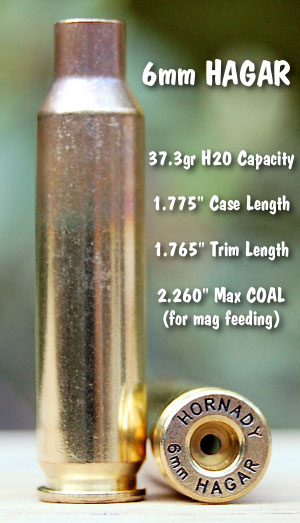 Here’s good news for AR shooters looking for a 6mm option. 6mm HAGAR brass is now available from Hornady, and it looks like this brass is quite good. Those of you who follow the National Matches at Camp Perry know that Carl Bernosky won multiple National High Power Championships shooting the 6mm HAGAR cartridge from an AR Platform rifle. The 6mm HAGAR was derived from the 30 Remington cartridge, and it has the same case head diameter as the 6.8 SPC, also a 30 Remington derivative.
 6mm HAGAR Basics
 Sierra Bullets has just announced a new .375-caliber, 350 grain HPBT bullet — the latest in Sierra’s MatchKing line of projectile. Designed for custom long-range applications, this 350-grainer is the largest MatchKing Sierra produces, and it offers a jaw-dropping 0.805 G1 BC (at 2,200+ fps).
 Redding is releasing a dedicated small-case powder measure with a charge weight range of 1 to 25 grains. This specialized Model 10X powder measure should work well for small varmint cartridges such as the .221 Fireball, .20 Vartarg, and the 17 Hornet. The powder cavity and micrometer settings put the charge for a 17 Hornet right in the middle of the powder measure’s capacity — the most accurate part of its range. That’s good news for small rifle cartridge reloaders.
 Imagine a “smart scope” that can range your target AND calculate windage correction. Such technology may appear in riflescopes fairly soon. The Israeli Government’s
  While the Israeli LIDAR system may seem like science fiction, it’s not that far removed from the lastest commercial optics. Engineers on both sides of the Atlantic have already integrated laser rangefinders (LRFs) into rifle-mounted “consumer” optics. Just this year, Burris introduced an affordable “consumer” scope, the


