Leatherwood/Hi-Lux Optics has added an 8X USMC-SNIPER Unertl-type scope to its William Malcolm Series of vintage-style, externally-adjusting riflescopes. Scopes of this design, with micrometer click external adjustment, were once favored by long range shooters. Today, a mint-condition, original USMC-marked scope can sell for as much as $5,000. And with the current interest in vintage sniper rifles, just a working standard model Unertl scope in good condition can still bring $2,000 or more.
Leatherwood/Hi-Lux already markets a variety of long-tube, external-adjusting scopes that are quite popular with BPCR shooters and vintage rifle fans. The new USMC repro scope, priced at $549.00, duplicates the original windage and elevation controls on the 50s/60s-era USMC scope. But the new Hi-Lux offers modern multi-coated lenses. Hi-Lux claims this scope offers the “brightest and sharpest optics ever in a riflescope of this design”. That’s quite a boast — the “real deal” Unertls were pretty darn good.
The 8X USMC repro scopes are marked with the “Wm. Malcolm” name over the USMC-SNIPER model designation, and each will be serial numbered — as were the original USMC models. The Marine Corps utilized this style of externally-adjusting scope on sniper rifles during WWII, Korea, and the early stages of the Vietnam conflict.
With its $549.00 MSRP, the Hilux USMC-SNIPER repro scope is far more affordable than a serviceable original. Like all Leatherwood/Hi-Lux Optics, the Wm. Malcolm USMC-SNIPER model comes backed with a limited lifetime warranty. If this scope proves to be of decent quality, we expect it will become popular for the growing Vintage Sniper Rifle discipline, which allows reproduction optics.
by Robert Whitley
I recently received some of the new Berger 6mm 105gr Hybrid Match Bullets for testing. There is much interest in these new 6mm Hybrids, so I thought I’d share my initial observations. A couple of things are very striking about these new bullets:
1. They appear to be very long, sleek and aerodynamic, while they still maintain a good bearing surface length (full-diameter shank). I like bullets with a sufficient bearing surface length because I find that it makes for bullets that are easier to shoot and tune. I also feel a good bearing surface length makes for a bullet that has a better potential for consistent performance over bullets with a short bearing surface.
2. The published ballistic coefficient (BC) numbers on these bullets are quite high. They have a stated G1 BC of .547 and a G7 BC of .278. Looking at the bullets themselves it’s easy to see why these BC numbers are so high. The front end of the projectile is quite long and similar to what you see on long-range VLDs, but the transition to the bearing surface has a blended appearance (the Hybrid part) vs. the sharp transition you typically see with most VLDs and secant ogive bullets. The 105gr Hybrid bullets also have a long boat-tail.
3. The new Berger 105gr Hybrid bullets measure right around 1.261″ OAL. By comparison, the many other 105gr to 108gr bullets I’ve measured all seem to run in the range of 1.210″ to 1.225″ OAL. The Berger 105gr Hybrid bullets are thus a fair bit longer than the others, which is why a true 1:8″ or faster twist is recommended for them. The bearing surface diameter of the new Hybrids was dead on at 0.243″. So these bullets are neither “fat” nor “skinny”.
4. The tips on these bullets are quite uniform, with the meplats closed up nicely. The Hybrids have nice small tips similar those on the Berger 108s (reasonably tight in diameter). While I sometimes like to point my match bullets, I like to shoot bullets that are ready to go “out of the box”, and these are just that. I’m hoping they will perform very well without meplat trimming or pointing.
Berger’s 6mm 105gr Hybrids Slated to Go on Sale in Late October
Berger has done its own in-house testing on these bullets and found them to be accurate and appropriate for release for additional testing by shooters out in the field. Unless this additional field testing reveals something that no one anticipated (which I doubt), I suspect these new projectiles will be one of Berger’s most popular bullet offerings. The planned official release date for the new 6mm, 105gr Hybrids has been tentatively set for mid- to late-October of 2011. So, barring some last minute changes, these 105s should be on dealers’ shelves before Thanksgiving.
This past weekend we reported that the NBRSA approved the use of the Gonzales cartridge feeder in registered benchrest matches. This device, supported by an arm attached to the front rest, holds 6PPC cartridges close to the loading port on the left side of the action. Using a remote (red) cable activated by the left hand, the cartridge feeder drops one cartridge at a time directly into the action. Now, thanks to Rick Pollock of Benchrest.ca, we can show you close-up photos of the device, so you can see how it is positioned and supported. Note that the Gonzales device does not touch the gun.
Watch Video to See Speed-Feeder in Action
The cases are gravity-fed, but the shooter has positive control over feeding. A cable with a push-button control runs from the magazine down to the rear foot of the pedestal rest. You just push the button to drop one cartridge from the magazine. Watch the video below to see how it works:
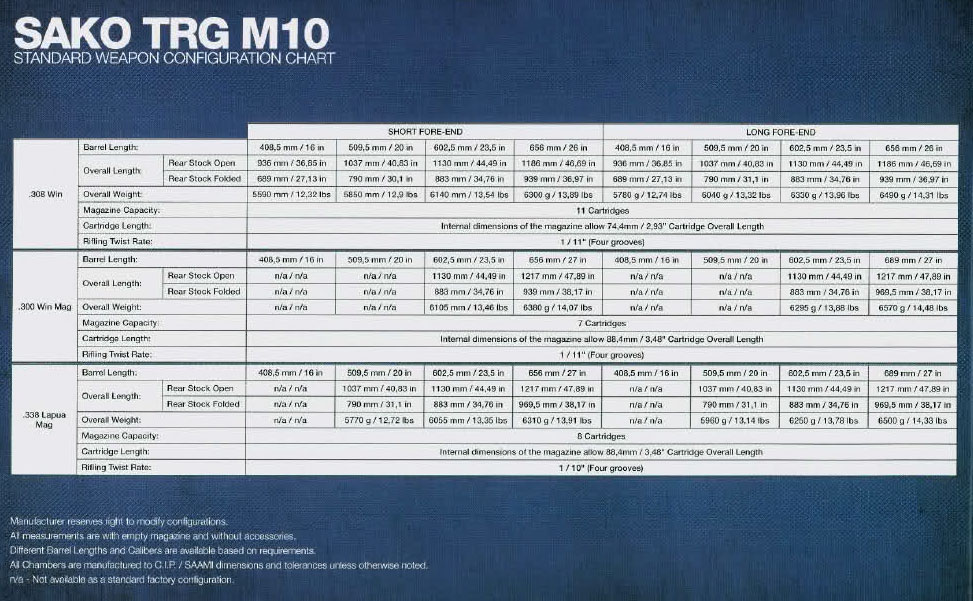
Last week, at the DSEi trade show in London, UK, Sako unveiled an all-new tactical rifle, designed from the ground up as a modular system, which can be user-configured in the field to shoot multiple calibers. By changing bolts and barrels, Sako’s new TRG M10 can be switched from a 7.62×51 NATO round to the .300 Win Mag, or the even larger .338 Lapua Magnum. With the capability of the TRG M10 to shoot both standard and magnum cartridges, Sako now has a product that can compete with other multi-caliber sniper rifles such as the Barrett MRAD, released last year. CLICK HERE for TRG M10 Spec Sheet.
Sako Breaks TRG Mold with New M10
The TRG M10 represents quite a departure from Sako’s current TRG models which use a composite shell over a metal chassis which holds the barreled action. There is no outer shell or “skin” on the TRG M10. The action bolts into a rigid, exposed metal chassis to which a rail-equipped metal forearm/handguard is attached. Bipods can mount directly to a bottom Picatinny-style rail or to a metal block clamped to the rail on the underside of the forearm (See Photos).
TRG M10 Previewed in London CLICK HERE to view more photos of the new TRG M10. These images, taken at DSEi in London, show the rifle both fully assembled as well as pulled apart into its major sections: action/barrel, folding stock, forearm, bolt assemblies, magazines. As the TRG M10 is designed to shoot multiple calibers, it employs two different bolt assemblies to fit both standard and magnum cases (of course this requires a barrel interchange as well).
For Military and Law Enforcement Only — for Now
Currently, the TRG M10 is marketed for “military and law enforcement only.” It will be interesting to see if Sako eventually decides to sell the TRG M10 to American civilian shooters. If Sako changes its mind about the civilian market, we would not be surprised if an announcement to that effect would be made at SHOT Show 2012 (to be held Las Vegas, NV, January 17-20, 2012). The TRG M10 system will next be displayed at the Milipol trade show in Paris, France on October 18-21, 2011.
There is an extensive discussion of the new Sako TRG M10 on the Snipers’ Hide Forum. Overall, the initial reaction of ‘Hide members has been positive. Quite a few of those who commented on the rifle stated they would purchase a TRG M10 if it was offered to civilians. Hopefully Beretta, Sako’s parent company, will recognize that popular demand for the TRG M10 would be sufficient to justify its release to the civilian market. Only time will tell….
Get ready for a major new technology that could change the benchrest game. Carlos (Carlito) Gonzales, a benchrest shooter (and Professor of Engineering) from Argentina, has perfected a horizontal, external “floating” cartridge loader that can reliably feed PPC cartridges as fast as you can work the bolt.
We have received a report that Gonzales’s fast-feeding device has been approved by the NBRSA for use in benchrest matches. Pascal Fischbach told us: “I had an email September 17th from Gene Bukys, [stating] that the board of directors of the NBRSA approved the use of the ‘[Gonzales] manual cartridge feeder’ for use in NBRSA competitions.” [Editor’s note: We don’t yet know if the device is approved for all NBRSA benchrest matches, or just short-range matches.] Pascal added: “The device was presented at the delegates meeting of the WBC11 in France and approved for use during the World Championships. The next step for Carlito will be to market it. He is also willing to license the concept, plans, and methods to a machinist capable of manufacturing it in the USA.” See Discussion Thread.
External Horizontal Cartridge-Feeder
The Gonzales loading device is an open-ended, covered metal tray situated on the left side of the action (but it does not touch the gun — it is supported by an arm attached to the front rest). This feeds into the left-side loading port. The cases are gravity-fed, but the shooter has positive control over feeding. A cable with a push-button control runs from the magazine down to the rear foot of the pedestal rest. You just push the button to drop one cartridge from the magazine. We don’t know exactly how the cartridge is released in the magazine itself, but in the video below you can see how the push-button works.
You push the button as soon as a spent cartridge ejects (watch Carlito’s left hand in the video above). It is a clever set-up that works very, very fast. The video shows Carlos running five cartridges through his action in just 9 seconds (time marker 00:31 – 00:40). That’s fast! On a repeat viewing focus on Carlito’s left hand to see how he works the push-button cartridge dispensing control.
Credit to Pascale Fischbach for sourcing this story and video link.
The gyro-stabilized two-wheeled Segway was supposed to revolutionize personal transportation. That may never happen (mall cops excepted), but remote-controlled Segways just might revolutionize the way military and police personnel train for urban engagements.
Robotic Segway “Smart Targets” for Live-Fire Training
An Australian company, Marathon Robotics, has created wheeled robot targets — remote-controlled Segways fitted with target silhouettes. The Segway Robots can move and respond like humans, ducking into doorways, or dispersing at the sound of gunfire. This provides challenging, ultra-realistic training for military and police sharp-shooters. This is not just science fiction. Australian Special Forces units already train in a mock urban center populated with Marathon’s rolling robots. And the U.S. Marine Corps has hired Marathon to create a similar robot-equipped, live-fire training venue.
Marathon combined computer gaming technology with armored, remote-controlled Segways to create the ultimate 21st century moving target. The lower halves of the Segways are armor-plated, so the expensive electronic innards don’t get damaged by an errant shot. On top is mounted a replica human torso. The torso section can be clothed to distinguish “civilians” from military targets, or to distinguish terrorists from hostages.
Marathon’s sophisticated software can control multiple Segway Robots at the same time. A group of Segways can be programmed to mimic a squad on patrol, or a group of terrorists holding hostages. The control software allows autonomous or “intelligent” behavior by the Segway Robots. For example, the Segways can disperse automatically at the sound of a gunshot, and the Segways can be trained to seek cover in hallways or behind objects. Importantly, the Segway Robots are capable of human-like movement — they can stop quickly, turn 360° and retreat slowly, or accelerate to a human running pace. Marathon’s Segway Robots are equipped with laser range finders so they can avoid running into obstacles, including people on the move. The “Segbots” lean forward slightly as they walk forward, like people do.
To really understand how the Robotic Smart Targets work, watch this amazing video:
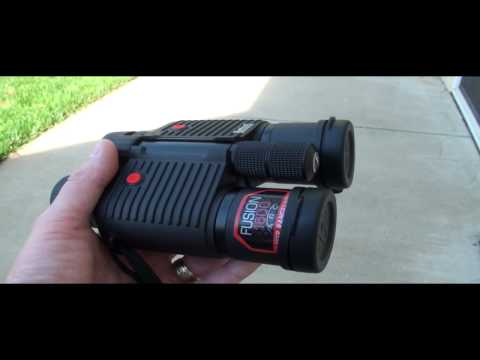
Bushnell recently released its new Fusion 1600 ARC range-finding binoculars. With a “low street price” under $799.00, Bushnell’s 1600 ARC binoculars are less than one third the price of Leica Geovids (10×42, $2399.00) or Zeiss Victory RF Binoculars (10×45, $2,799.00).
That huge price advantage makes the Fusion very tempting — but can Bushnell’s 1600 ARC binos perform as advertised?
Forum Member Reviews Fusion 1600 ARC
Forum Member Stan (aka BigBamBoom) acquired the Fusion 1600 ARC RF binoculars and has posted a video review. Stan was favorably impressed with the quality of the glass and the exterior ruggedness of the unit. He was able to range very large objects (water-tower, trees) beyond 1200 yards. He also praised the speed of the unit, saying it ranged faster than his Leica CRF 1200. Consider however, that the very small CRF1200 is harder to aim precisely, simply because it is so small and light and held in a vertical orientation. Most people can aim the larger, heavier LRFs with more steadiness using a normal two-handed horizontal grip. In the real world, if you can hold the LRF more steady, you can get a true range on a small object more quickly.
Don’t Expect to Range a WhiteTail at 1600 yards
We also caution that, in our Laser rangefinder comparison tests, we learned that there is BIG difference between ranging a water tower, and ranging a deer-sized animal. We found that some units that could range a water tower at 1300+ yards could NOT reliably range an actual deer (stuffed by taxidermist) at 700 yards. Note that Bushnell lists three different effective ranging distances for the Fusion 1600, and Bushnell claims only 500-yard effectiveness on deer-sized objects. This is fairly consistent with our LRF comparison tests:
It can be fun to range buildings at a mile, but for the hunter, that may not have much practical utility. You want to be able to range deer-sized game at all practical distances. For the tactical shooter, you need a narrowly focused beam (with minimal beam divergence) that can range a gong or metallic silhouette reliably at 1000 yards. If an LRF can’t do that, it may not be all that useful, even if it the sales price is attractive. Fusion 1600 ARC Features
The 10×42 roof prism binoculars feature built-in battery life indicator, twist-up eye pieces, and multi-coated optics with RainGuard. The Fusion 1600 is fully waterproof and submersible, meeting IPX7 “waterproof” specification. As Stan observed, the Fusion 1600 has good glass, and the red readouts are easy to see. Bushnell employs Vivid Display Technology™ (with four display brightness settings) to enhance display readability in all lighting conditions.
The built-in laser rangefinder features ARC (Angle Range Compensating) technology, which calculates the angle to the target (-90 to +90 degrees). ARC also and gives the hold-over range for the rifle shooter, and true horizontal distance for bow hunters. We like the fact that you can choose between Inches and MOA for holdover. There is a brush mode for measuring distances in heavy cover and a bullseye mode for ranging in open areas. The brush mode can filter out false returns from closer objects. This IS a useful feature that actually does work.
The Fusion 1600 ARC laser rangefinder binoculars come with battery, neck-strap, and carrying case. MSRP is $899.00. It pays to shop around as we’ve seen advertised prices from $789.00 to $899.00. For more info, visit www.bushnell.com or call 800-423-3537 for consumer inquiries.
Federal Ammunition has released a new type of small rifle match primer optimized for AR15s and similar semi-automatic rifles. The new Gold Medal® AR Match Primers, designated GM205MAR, have harder primer cups than the popular Federal 205M match primers. The harder cup is designed to perform better in semi-automatic actions that use free-floating firing pins. A Federal spokesman said that Federal’s “normal” 205M primers were not ideal for use in firearms, such as ARs, with free floating firing pins. Hence Federal designed the new GM205MAR primers. These are available now from major vendors such as Midsouth Shooters Supply, which offers the new GM205MAR primers for $35.22 per thousand.
Other AR-Friendly Primers
For quite some time, CCI has offered its #41 milspec small rifle primer for use in ARs. A CCI #41 primer is a ‘magnum’ strength primer, equivalent to the CCI 450 Small Magnum rifle primer. However, the #41 primer is made with a bigger gap between the tip of the anvil and the bottom of the cup, creating a slightly less sensitive primer. The #41 primer also has a thicker bottom on the cup than the CCI 400 primer.
The folks at the NRA Museum have created a new 304-page, photo-illustrated history of firearms. With over 1500 photographs, this new book covers all types of firearms, from small handguns to large rifles. Illustrated are deringers, flintlocks, revolvers, semi-autos, machine guns, muzzle loaders, long rifles — and much more. Researched by the NRA’s historians, The Illustrated History of Firearms is a worthy addition to any gun aficionado’s library. You can pre-order the book now from Amazon.com for just $19.79 (list price is $29.99.) The NRA Museum will be releasing two companion volumes, also available through Amazon: Guns of the Wild West, and Guns of World War II.
Timney Triggers has introduced a new drop-in trigger for the Savage Axis/Edge line of rifles. The new Timney Axis/Edge trigger (Model 633) is CNC machined from solid steel and then case-hardened. The Model 633 Axis/Edge trigger fully adjustable for pull weight, sear engagement (creep) and over-travel. The trigger’s pull weight can be adjusted from 1.5 to 4 pounds, an ideal range for a hunting rifle. Midsouth Shooters Supply has the Model 633 trigger in stock now.
The Timney Axis/Edge trigger retails for $104.95 for the standard blued version and is also available nickel-plated for $114.95. Each trigger is hand-assembled, calibrated, and tested before shipping. Timney offers a lifetime warranty on all of their products. Triggers are Made in the USA.
Story tip by EdLongrange. We welcome reader submissions.


 Sako Breaks TRG Mold with New M10


 Marathon combined computer gaming technology with armored, remote-controlled Segways to create the ultimate 21st century moving target. The lower halves of the Segways are armor-plated, so the expensive electronic innards don’t get damaged by an errant shot. On top is mounted a replica human torso. The torso section can be clothed to distinguish “civilians” from military targets, or to distinguish terrorists from hostages.


 Bushnell recently released its new