Successful long-range shooting demands very uniform ammo. Weighing charges carefully can make shot velocities more uniform within a shot string. Uniformity of velocities is good, because lower ES translates to less vertical dispersion of the shots at long range. Many competitive shooters today try to load charges that are consistent within one-tenth of a grain. Some exacting reloaders, in the relentless pursuit of perfection, go even further — they try to maintain charge weight uniformity down to the equivalent of just one or two kernels of powder.
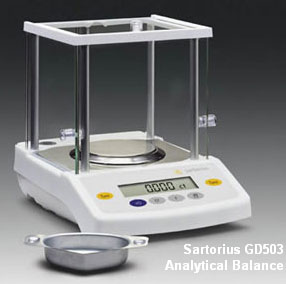
To weigh charges with this kind of precision, you need a very high-quality scale. Even the $400.00-grade balances (such as the Acculab VIC-123), struggle to maintain single-kernel precision with their conventional strain-gauge load cell technology. But there is a new class of electronic lab scales which employ magnetic force restoration technology. These force restoration balances can reliably (and repeatably) weigh a single grain of powder. In normal use, lab-grade force restoration scales also deliver a stable reading more quickly than strain-gauge type scales. This is a boon for reloaders who like to trickle the final few kernels of a load. But the enhanced speed and precision of force restoration (magnetic) scales come with a stiff price — these technological marvels cost $900.00 and up. That could buy a custom action, or three new barrels.
Trickling Kernel by Kernel with GD503 and Omega Trickler
Do the advanced force restoration scales perform as advertised? Can they reliably recognize a single kernel of powder quickly enough to make trickling practical? Well, thanks to Forum member A.J. (aka AJ), we have a video that answers those questions. Using a Sartorius GD503 Class II force restoration balance with an Omega two-speed powder trickler, A.J. demonstrates how he can weigh charges that are consistent within a single kernel’s weight, i.e. 20-25 thousandths of a grain.
When you watch the video, note how (at 3:45 time mark) the RCBS electronic scale reads 41.7 grains, when in fact the correct charge weight was 41.830 grains, as measured by the GB503. That’s a one-tenth grain (four kernel) error right there. You will also see that the Omega Trickler from Dandy Products really can drop one kernel at a time. It takes some careful adjusting of the drop tube to achieve this sensitivity, but the Omega really is up to the task.
A.J. recently acquired his Sartorius GD503 digital scale from Balances.com. Retail price is $899.99. A.J. reports: “I have to say the [GD503] is one awesome unit. I was loading my 260 with 42 grains of H4350. The GD503 is accurate to .005 (5 thousandths) of a grain. My Acculab was supposed to be accurate to .020 of a grain but couldn’t do that on a good day. This new scale can actually weigh an individual kernel of H4350, it weighs right at .025 per kernel. I weighed a small screw about 20 times throughout one day and every time I got the same exact reading. My load for my 260 now has a SD in the single digits and an ES of 10 fps is not uncommon for 5-shot groups.”
Having seen an actual reduction in his velocity ES and SD, A.J. is sold on his $900.00 GD503: “This thing is amazingly accurate. It repeats every time. The weight does not keep changing or growing like my Acculab VIC 123 or my RCBS Chargemaster. My loads have never been so accurate. Now I don’t have to wait for a Prometheus as I have something better for a fraction of the cost.”
If you’re interested in the Sartorius GD503, below is a video from Balances.com that explains the features of the GD503 and shows how to set up and operate the unit to achieve the best results.
Strain-Gauge Scale vs. Force Restoration Scale — Responsiveness Test
This final video also shows the difference in performance between a strain gauge scale and magnetic force restoration scale (GD503). In the video, both scales are tasked with measuring tiny grains of salt, which are much smaller than extruded powder kernels. You can see that the GD503 responds more quickly when a few grains of salt are added.
Eric Stecker of Berger Bullets just revealed some details on Berger’s new 6mm 105gr Hybrid bullet. This projectile is now in the final stage of testing. Here are comparative ballistics for the new 6mm Hybrid vs. Berger’s popular 105gr VLD bullet:
6mm 105 gr Hybrid Target
Original 6mm 105 gr VLD (Now is Berger’s hunting version)
Averaged G1 BC = 0.547 G7 BC = 0.278
Averaged G1 BC = 0.532 G7 BC = 0.272
Longer Bullet Requires 1:8″ Twist
The new 105gr Hybrid Target is slightly longer than the original 105-grainer so a true 1:8″ is strongly recommended. The new bullet is made with the thicker Target jacket to withstand match shooting conditions. The Hybrid ogive is designed to be less sensitive to seating depth and has been working well in other calibers and sizes. This bullet can take all the 6mm cases can dish out and it has a BC equal to our own 6mm 115 gr VLD.
Eric Stecker tells us: “The moment we knew that we had to modify the 6mm 105gr VLD Target with a larger meplat, the need for this bullet was born. We’ve been working on it ever since. Bryan Litz has done an exceptional job with this design. I am very eager to see how they do in many rifles since I regard the 105gr class of bullets as key in Berger’s line. Between the 68gr, the 80gr and the 105gr (among other weights) we have been especially blessed with our 6mm offerings.” Eric is quite right — all those bullets shoot exceptionally well and the 105gr VLD holds many records. If the new 105gr Hybrid can come close to the accuracy of the 105gr VLD, it should be very successful.
Swarovski has released a new binocular product with built-in laser rangefinder, and angle compensation. Designed on the popular “open-bridge” EL binocular body, the EL Range comes in two configurations: 8x42mm and 10x42mm. Weighing just 910grams (32 ounces), both versions are lighter than other premium rangefinding binocs. The shape and size (6.5″L x 4.6″W) of the EL Range are basically the same as the non-laser EL Binocular — all the additional electronics are housed in two small belly extensions, one on each side (see photo). These curved extensions fit comfortably into your palms, so the the EL’s good ergonomics have been maintained.
Max Range is 1375 meters (1504 yards)
The EL Range is rated to 1375m or 1504 yards — that’s comparable with the latest Leica LRFs. Swarovski claims that its ranging laser can measure with an accuracy of +/- 1m over the entire measurement range (30–1375m). Ranging options (reticle brightness, angle compensation etc.) are controlled by a small button under the bridge. This can easily be accessed by your thumb while glassing. You don’t have to remove the EL away from you head to find or operate the digital controls. The EL Range is comfortable in the hand, and it is noticeably easier to hold the EL Range steady on a small target than the ultra-compact, pocket-sized rangefinders.
With the Swaro EL Range, you get great glass along with a very accurate laser. The transmission in both binocular halves is 91%. They are equipped with a 61° wide-angle eyepiece which supports a field of view of 137m (8×42) or 110m (10×42). The large eye relief offers four positions, to which the eyecup can be adjusted individually. This means that even spectacle wearers can enjoy the full benefit, with a crystal-clear vision and great comfort. Diopter compensation is an ample -7/+5. Interpupillary distance is 2.2 – 2.9 inches (that’s enough to fit all adults). The exit pupil on the 8X version is 5.3mm, while on the 10X version it is 4.2mm, still plenty big.
Swaro-Aim Angle Compensation Aids Hunters
The newest “SWARO-AIM” technology features an integrated gradometer to show the precise and correct shooting distance and angle. Designed with electronic readout of yards and meters, brightness levels and angle compensation, the display offers 5 individually adjustable brightness levels on an easy-to-read LCD screen with a simple and intuitive menu operation.
Release Date and Price: MSRP on the EL Range laser-equipped binoculars is $3077.00 for the 8×42, and $3188.00 for the 10×42. We expect “street price” to settle around $2770.00 for the 8X and $2870.00 for the 10X. That’s quite a bit more than the 8×42 Leica Geovid Rangefinder binocular, which retails for $2349.00 (street price). On the other hand, Swarovski’s standard (no laser) EL 8.5×42 Swarovision binocular costs about $2350.00 (street price), so that means you’ll pay about $420.00 more for the ranging capability. For someone who can afford the standard (non-laser) EL binoculars, it probably makes sense to spend a few hundred more for the EL Range. Vendors expect to receive the Swarovski EL Range in late October, but Swarovski tells us that “quantities will be very limited before the end of the year”.
Having completed successful field testing, Berger is releasing two new .30-caliber Hybrid bullets, the 185gr Hybrid (part #30424) and the new 200gr Hybrid (part # 30427). The Hybrid design, developed by Bryan Litz, combines both secant-ogive and tangent-ogive shapes. This keeps drag low while making the bullet easier to tune than typical VLD style bullets. Both these new Hybrid bullets have demonstrated excellent accuracy along with outstanding long-range ballistics. The BC on the 200-grainer is extremely high, with a G1 value of 0.624 and a G7 value of 0.320. The new 185gr and 200gr Hybrids should be arriving on store shelves very soon.
Berger 185gr and 200gr .308 Hybrid Specifications
Consumer Field Testing of new 6mm 105gr Hybrid, and Heavy 30s
Berger has commenced testing of its new 30 cal 215 and 230 gr Hybrid bullets, and Bergers new 6mm 105gr Hybrid. Berger tells us that: “If the tests results are positive, these bullets should be available to order in the middle of October, 2011.”
Berger is soliciting qualified AccurateShooter.com Forum members to help with the testing of the latest hybrids — the jumbo 30s and the new 6mm 105-grainer. You must have an appropriate rifle and be willing to report your results in a timely, coherent manner. In return, if selected, you’ll get a free bullets for testing — one 100-ct box per test. If you wish to participate in the testing process, click the links below to read Berger’s testing announcements in our Forum.
The Tuff 1 Grip Cover is a simple new accessory that may benefit tubegun shooters, AR owners, and pistol enthusiasts. Tuff 1 Grip Covers are made from a proprietary, grippy rubberized material that can stretch up to 200%. This elasticity allows the covers to easily fit all revolvers, semi-autos, and rifle or shotgun pistol grips. As you’d expect, Tuff 1 grip covers give you a more secure hold. Importantly, the material also helps absorb recoil (though not as much as Hogue grips). When fitted over a standard, hard-plastic AR grip, the Tuff 1 sleeve definitely provides a more comfortable, “high-traction” feel in the hand. On semi-auto pistols, Tuff 1 grip covers give a secure hold without the rough feel you get with stick-on skateboard tape.
Boa or Bad-Ass
Three surface patterns and four colors (Black, Olive Drab, Desert Tan, Hot Pink) are offered. We prefer the raised button “Boa Snake” pattern, but there is also a grid pattern with raised lines, and a skull pattern, for those “bad-ass” types. The $16.95 MSRP is the same for all colors and surface patterns. You can order from major vendors or directly from the Tuff 1 Online Store.
The one-size-fits-all Tuff 1 grip covers are easy to install. Simply roll the rubberized grip up like a sock, place it on the grip, then unroll it. (Watch installation video below). The Tuff 1 covers can be just as easily removed without harming the rubber.
Useful Product — But Consider Other Options
If you sweat a lot or shoot in wet climates, Tuff 1 grip covers provide a simple, low-cost upgrade. A Tuff 1 grip sleeve does markedly enhance the standard plastic AR15 pistol grip, which is hard, and slippery when wet. But then, for not much more money, you can select among a half-dozen or more aftermarket AR grips which will probably fit your hand better AND provide more cushioning.
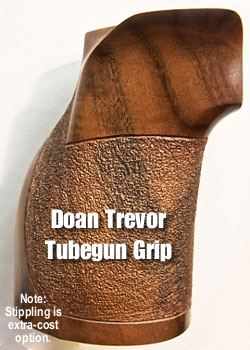
For wood-handled wheelguns, we like the Tuff 1 covers in Boa or ‘Double-Cross’ pattern. The Tuff 1 grip sleeves provide better “traction” and cushion the hand a bit without changing grip geometry or making the grip overly thick in your hand. For a tubegun, we prefer the feel and ergonomics of a wood grip, such as those crafted by Doan Trevor (photo at right). These cost $75.00 from DoanTrevor.com or CompetitionShootingStuff.com. For $175.00, Doan also offers fully customized stippled grips, fitted to the shooter’s hand, and finished in satin or gloss.
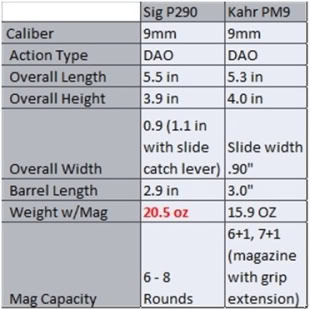
Small, light-weight carry pistols and revolvers are the hottest selling handguns on the market right now. Ruger’s .380 ACP and 9mm carry guns have been hugely successful, generating revenues that have helped push Ruger’s stock price up 500% since 2009. Now Sig-Sauer is getting on the bandwagon. We had a chance to look at Sig’s new-for-2011, P290 compact 9mm carry pistol. Overall, our reaction was generally favorable. The P290’s fit and finish are excellent — as you’d expect from Sig. Keltec’s PF-9 compact 9mm seems downright junky by comparison to the Sig P290. And the machining and fit of the slide and barrel on the Sig seem superior to the hot-selling Ruger LC9. In a nutshell, here’s how the new Sig P290 stacks up to the competition — it is better crafted and more reliable than the Keltec PF-9, it is more reliable than the Ruger LC9 (which has had recall issues), and, with its optional integrated laser, it is a more complete package than the Kahr CM9 and PM9.
However, the P290 is not without its flaws. We wish the grip was a little longer — and other reviewers agree. Also the trigger pull, listed at “9.0 lbs. average”, is just too heavy in our opinion. We know that Double-Action-Only (DAO) carry pistols like this need high pull weights to satisfy the lawyers, but the P290 pull weight is extreme. Most people will have trouble getting best accuracy out of the gun because of the heavy trigger, which one tester measured at 12.5 pounds.
Rich Grassi, Tactical Wire: “According to factory specifications, the trigger is supposed to average 9 pounds. The guns [we tested were] 1st Edition models and could have been underachievers. While some participants thought the triggers were a bit extreme, I found them manageable. The sample that arrived at headquarters on my return is an overachiever; my Timney scale ran out of weights at 10 pounds. Getting my old Brownells trigger pull gauge, I was able to get an average of around 12 ½ pounds(!) before bending the trigger hook! This is 12 ½ pounds to fire a gun that weighs just over a pound. You hold it still through a trigger stroke. I’ll watch.”
Paul Scarlata, PoliceMag: “The trigger pull was rather heavy with a definite staging about halfway through the stroke, although I assumed this would smooth out with use. My other concern was that the attenuated grip left the little finger of my shooting hand dangling in the air. Because of its short grip, frame recoil control was not what one would have hoped for and I actually found the pistol more comfortable to fire with an unsupported grip. [Sig informed me] that future plans call for the P290 to come with a spare eight-round magazine with a sleeve that approximates the external contour of the grip. Such magazines will provide a full, three-finger grip without compromising concealability[.]”
CONCLUSION: The Sig P290 is a well-designed, nicely-made pistol in the super-small 9mm carry pistol category. However, for this writer, I wouldn’t want to carry the gun unless the trigger pull could be reduced to a reasonable weight for a DAO application (the trigger pull on the Kahr PM9 is much better). I would also wait until the optional magazine with grip extension is available. In the meantime, when the situation calls for a very small, light carry gun, I’ll stick with my older S&W model 638 revolver. We do suspect that, despite its shortcomings, the P290 will attract many buyers based on Sig Sauer’s reputation for quality. But the P290 costs more than most other small, polymer-framed 9mms, and price may be the deciding factor for many buyers.
Weaver Optics has just released two new illuminated, first focal plane (FFP) tactical optics, plus a line of accessories. The new scopes, a 3-15x50mm Long-Range Scope (part #800363) and a 1-5x24mm Intermediate-Range Scope (part #800364) were designed and built to survive rough handling. Made from aircraft-grade aluminum, they feature 10 illumination settings, fully multi-coated lenses and a one-piece, 30mm Argon purged tube. Weaver claims both scopes are waterproof, shockproof, and fogproof (at least on the inside). “We take our tactical optics very seriously,” said Marketing Manager Tom Knudtson. “Our optics experts have done a lot of work on these reticles, glass and overall scope design to meet the needs of law enforcement professionals, military officers and other precision shooters.”
AR-friendly Optics Accessories
To accompany the two new tactical scopes, Weaver has released four new accessories, designed to fit AR-type flat-top rifles. We like the new 30mm SPR optics mount that can be fixed in place without tools.
Full-length AR-15 Flat Top Riser Rail with +20 MOA of built-in elevation (part #99675).
Picatinny Riser Set Small (elevates optics to optimal height, part #99658).
Weaver SPR (Special Purpose Rifle) 30mm Optics Mount with hand knobs for no-tool installation.
AR15 Fixed Back-Up Iron Sight with both “Precision” and CQB apertures.
Modular Driven Technology (MDT) has created a new 6061-T6 aluminum chassis for Rem 700 actions (and Rem 700 clones). MDT’s new TAC21 chassis has four (4) main components: action housing, lower unit (with trigger guard and mag well), forearm, and a quick-detach buttstock adapter that mates with the action housing. The main section has a +20 MOA milspec Picatinny rail on top. The action is seated on a V-Block style base inside the action housing. The short action TAC 21 chassis employs AICS-style magazines for .223 Rem or .308 Win-sized cartridges. The fore-end/handguard allows for free-floating barrels up to 1.350″ diameter. The chassis is built to accept any AR15/M16 stock and pistol grip.
Purchase from Sinclair Starting at $849.99
Currently Sinclair Int’l is the exclusive USA distributor of MDT’s TAC21 chassis. Sinclair’s price for the short-action version (right-hand or left-hand) is $849.99, while the long-action version will be $942.99. At present, only short action-versions are in stock, but MDT will be making long-action versions soon, and Sinclair is taking pre-orders. NOTE: these prices do NOT include buttstock, barrel, action, trigger, or optics. For more information, visit www.mdttac.com.
TAC21 Performs Well for Varmint Hunting
Al Voth from the Coyote School Blog did a field test of a .204 Ruger rifle built with the TAC21 chassis and conventional wood buttstock. Voth was able to assemble the rifle in 40 minutes with the MDT chassis kit and “everything fit perfectly.” CLICK HERE to Read Coyote School TAC21 Review.
Charter Arms has apparently revived its 40 S&W Rimless Revolver, first announced in 2009. Charter Arms claims its 40 S&W Revolver is the “world’s first .40 caliber Rimless Revolver”.
Built on the same stainless steel frame as the .44 Special Pit Bull wheelgun, the new 5-shot .40 S&W Pit Bull Revolver weighs 20 ounces, and measures 6.75″ overall with a 2.3 inch barrel. The gun has a fixed frame rear sight and a ramped front sight with a standard hammer. A DAO hammer is available upon request. Rubber grips are standard.
Dual Coil Spring Extractor Design Eliminates Need for Moonclips
The Charter Arms .40 S&W Revolver features a rimless cartridge extractor assembly. A dual coil spring assembly is located in the extractor to allow the insertion and retention of a .40 caliber cartridge in each chamber of the revolvers’ cylinder. What sets the new Charter Arms apart from previous revolvers chambered for rimless cartridges is the built-in coil spring that grabs the cartridges’ extractor groove. This enables the gun to work without moon clips used in other revolver designs.
.40 S&W Revolver Makes Sense as Back-Up for .40 S&W Duty Pistol
Why do we need a revolver that shoots .40 S&W when there are perfectly good options for .38 Special, .357 Magnum and other popular rimmed cartridges? According to Charter Arms President Nick Ecker, the firearms industry has had a “long felt need” for a revolver that fires .40 S&W rimless ammo. Ecker explains: “The Pit Bull is the ideal revolver for law enforcement officers to use as their back up, because they can now carry a revolver that utilizes the same ammo as their sidearm. It gives them the first revolver that shoots their [.40 S&W] ammo without utilizing moon clips.” It is not clear whether the new .40-Cal Pit Bull can shoot the hotter 10mm rimless ammo as well. We note that the barrel of the gun is marked “Pit Bull 40 S&W”.
COMMENT: We hope Charter Arms applies its rimless extractor design to a 9mm Parabellum version. A 9mm revolver that works reliably without moon clips should be very popular. In a lightweight wheelgun, the 9mm (with its lesser recoil) would be more controllable than the .40 S&W round. The .40 S&W has a stout kick even in a full-size, all-metal duty pistol. 9mm ammo is also much more affordable than 40 S&W ammunition. We note that when Charter Arms first announced its “Rimless Revolvers” two years ago, it claimed it would also release a .45 ACP version and “90-120 days after the .45 ACP will come the 9mm”. Charter Arms has not revealed whether it still plans to bring out either a .45 ACP or 9mm Rimless Revolver. In 2009, Charter Arms listed these prices: 9mm $399.00, .40 $449.00, .45 ACP $449.00.
Hindsight: Smith & Wesson 9mm Model 547
Historically, the new .40 Cal Pit Bull is not the first revolver from a major manufacturer to chamber rimless cartridges without moon clips. In the 1980s Smith & Wesson marketed a model 547 9mm revolver that used a spring-loaded detent in the cylinder for case retention. Basically a modified model 13 with 3″ barrel, the model 547 is no longer in production.
Alliant Powder has introduced a new Black Powder substitute, Black MZ™. This product is designed to work with all types of black powder firearms. We’re told this stuff is “on the trucks” — supplies are being shipped to vendors nationwide this month.
Why do we need another Black Powder substitute? Alliant claims this new propellant withstands moisture and significantly reduces the frequency (and difficulty) of bore cleaning: “Black MZ helps maximize shooting performance by resisting moisture and adverse weather conditions. Hunters can stay loaded in the field for days, only needing to insert a primer to get into the action. Black MZ won’t clump or corrode the barrel”.
Alliant designed Black MZ to deliver dependable ignition, lower barrel pressure and higher velocities. Alliant claims that “The clean-burning ignition of Black MZ is virtually non-corrosive, [and] greatly diminishes fouling”. Alliant adds that “wedged slugs, grimy barrels, stuck seater dies, and dwindling accuracy are greatly reduced by Black MZ.” Hopefully that’s not marketing hype. If, as claimed, Black MZ really does foul less than other BP substitutes, it should allow more shots between cleaning sessions. That would be a boon for BP shooters.
Black MZ’s enhanced performance derives from its high moisture tolerance and non-corrosive ignition. “We’re excited about what Black MZ can do for muzzleloader hunters and black powder cartridges. It helps take the hassle out of muzzleloading”, said Alliant’s Brand Director Rick Stoeckel. To learn more about Black MZ, or view load data, please visit www.AlliantPowder.com. Product designation: BLACKmz, 1 lb. bottle, Alliant Part No. 150524.
Story Tip by EdLongrange. We welcome reader submissions.


 Successful long-range shooting demands very uniform ammo. Weighing charges carefully can make shot velocities more uniform within a shot string. Uniformity of velocities is good, because lower ES translates to less vertical dispersion of the shots at long range. Many competitive shooters today try to load charges that are consistent within one-tenth of a grain. Some exacting reloaders, in the relentless pursuit of perfection, go even further — they try to maintain charge weight uniformity down to the equivalent of just one or two kernels of powder.
 Longer Bullet Requires 1:8″ Twist
 Swarovski has released a new binocular product with built-in laser rangefinder, and angle compensation. Designed on the popular “open-bridge” EL binocular body, the


 Having completed successful field testing, Berger is releasing two new .30-caliber Hybrid bullets, the 185gr Hybrid (part #30424) and the new 200gr Hybrid (part # 30427). The Hybrid design, developed by Bryan Litz, combines both secant-ogive and tangent-ogive shapes. This keeps drag low while making the bullet easier to tune than typical VLD style bullets. Both these new Hybrid bullets have demonstrated excellent accuracy along with outstanding long-range ballistics. The BC on the 200-grainer is extremely high, with a G1 value of 0.624 and a G7 value of 0.320. The new 185gr and 200gr Hybrids should be arriving on store shelves very soon.


 Useful Product — But Consider Other Options


 SIG P290 Online Reviews
 CONCLUSION: The Sig P290 is a well-designed, nicely-made pistol in the super-small 9mm carry pistol category. However, for this writer, I wouldn’t want to carry the gun unless the trigger pull could be reduced to a reasonable weight for a DAO application (the trigger pull on the Kahr PM9 is much better). I would also wait until the optional magazine with grip extension is available. In the meantime, when the situation calls for a very small, light carry gun, I’ll stick with my older S&W model 638 revolver. We do suspect that, despite its shortcomings, the P290 will attract many buyers based on Sig Sauer’s reputation for quality. But the P290 costs more than most other small, polymer-framed 9mms, and price may be the deciding factor for many buyers.


