The U.S. Border Patrol Agency has been ordered to “give up its guns”, starting this summer. In a surprise directive issued this morning, the Department of Homeland Security (DHS), parent agency of the Border Patrol, announced that up to one-half of U.S. Border Patrol Agents will be required to turn in their firearms, starting August 1, 2011. The current issue sidearm of the Border Patrol is the HK P2000 LEM in .40 SW, but Agents many also carry rifles and shotguns. Duty Weapons will be replaced by non-lethal dye markers, similar to paintball guns.
Agents to Be Disarmed in Border Areas Speaking at a Washington, DC press conference, Homeland Security Director Janet Napolitano stated that stripping the Border Patrol of lethal weapons reflects the “long-stated objective of this Adminstration to value human life over all other lesser considerations.” Napolitano stressed that the Border Patrol would not be required to give up all its firearms. The Patrol would still maintain pistols, rifles, and shotguns in “secure lock-ups” removed from the “immediate border area”.
The goal of the policy shift, Napolitano stated, is to eliminate the risk of accidental or unintentional injury to “wayward travelers and undocumented citizens”. Napolitano denied that confiscation of Border Patrol Agents’ firearms was a response to “trigger-happy men in green”. Napolitano stated: “I have the greatest faith in our men and women in the Border force”, adding that “we are now giving those Agents viable non-lethal technologies with which they can carry out their duties”.
Firearms Replaced by Non-Lethal Alien Immigrant Marker System (NLAIM)
The technologies cited by Director Napolitano include the new Non-Lethal Alien Immigrant Marker (NLAIM) which will be provided to Border Patrol agents on the “front line”, i.e. those who actively patrol the southern border. The NLAIM is a pneumatic device that propels small, liquid-filled marker balls at effective ranges up to 50 feet. Once released, the liquid inside the balls leaves a highly-visible, long-lasting dye mark on anything it contacts. In addition, the dye marker solution is activated by body heat so it literally “glows in the dark” when viewed through night-vision optics.
Is NLAIM Technology Really Something New? Critics of NLAIM technology claim that NLAIM devices are merely over-priced versions of recreational paintball guns, many of which sell for under $200.00. NLAIMs, which will be provided in both pistol and carbine configurations, cost nearly $2700.00 each, not including transport modules. A total of 10,000 NLAIMs will be delivered to the Border Patrol under a no-bid DHS contract valued at $26.8 million dollars. Some of that cost will be offset by revenues earned from the recycling of current Border Patrol firearms which will be decommissioned, melted down, and sold for scrap.
Chief Border Patrol Agent Randall Sikes (Del Rio Sector) defended the switch from conventional firearms to NLAIMs. Sikes stated that: “Hey, these aren’t just run-of-the-mill paintball guns — I mean these babies are state-of-the-art. Plus you can’t buy our day/night ammo balls in any paintball store. You think glow in the dark capability comes easy? The NLAIM is a sophisticated law enforcement tool, not a toy.”
Sikes also said that the NLAIM lets an Agent respond more effectively than ever before to a border incident. “Look, with a real gun, I mean you can either point it, or shoot it, and we don’t want the latter. The border-crossers we face know we won’t shoot them, so they just run away. At least now we can color-tag them and the choppers can chase ‘em down. We get the job done and no one gets hurt. Plus the NLAIMs are a hoot to shoot. It’s a win-win.”
The United States Border Patrol is a federal law enforcement agency within U.S. Customs and Border Protection (CBP), a component of the Department of Homeland Security (DHS). Currently, the U.S. Border Patrol employs over 20,200 agents, who are specifically responsible for patrolling the 6,000 miles of Mexican and Canadian international land borders. Agents are assigned primarily to the Mexico–United States border. There are 20 Border Patrol sectors, each headed by a Sector Chief Patrol Agent. Currently, U.S. Customs and Border Protection has more sworn law enforcement officers than any other agency in the U.S. Federal government.
The Editors of AccurateShooter.com and a pantheon of legendary shooters have collaborated on a new book, Voodoo Accuracy, destined to become the definitive print resource for precision shooting. This new 666-page, full-color treatise compiles the wisdom of today’s greatest Hall of Fame and National Champion shooters. With the Voodoo knowledge of the world’s ‘top guns’ in your grasp, you can and will shoot more accurately no matter what your discipline.
Why do Voodoo? Sure you can spend hours, days, months, heck even a lifetime measuring stuff with calipers and trickling individual powder kernels, but you’re not going to win the big matches without access to the closely-guarded Voodoo secrets of the world’s master marksmen. Remember, there are more things in heaven and earth, Horatio, than are dreamt of in your reloading manuals!
For the first time ever, Voodoo Accuracy reveals the hidden shooting secrets of the greatest trigger-pullers of all time. Now you too can shoot like a legend! Find out how to win matches without ever practicing! Apply Voodoo reloading techniques with startling results! Voodoo Accuracy contains chapters on all major forms of competitive shooting, from 25m air rifle benchrest to ultra-long range tactical competitions. Whatever your sport — point-blank benchrest, High Power, F-class, Silhouette, Palma, Multi-Gun, Biathlon, 1000-yard Benchrest — you’ll find invaluable Voodoo insights that will transform your shooting abilities overnight. We guarantee it!
Voodoo Accuracy Chapter Highlights:
● Extreme Wind Calling — How to dope a hurricane.
● Barrel Break-In — Sure-fire 50-step, 1000-round method.
● Ogive Talkin’ — More incomprehensible Ballistology by Bryan Litz.
● Point-Blank Pointers — Feng Shui and the placement of Wind Flags.
● Why Weigh Charges? — How to throw perfect charges blind-folded.
● Powder Blending Basics — Have a BLAST with the Mix-Master method.
● For FTR, Size Matters — Six-foot-wide, servo-adjusting bipods by Danny Biggs.
● Hall of Fame Headgear — The effect of dorky hats on Group Size, by Tony Boyer.
● Barrel Tuning — Voodoo Methods demonstrated (results guaranteed non-repeatable).
● Tactical Gearfinder — Be the first on your block with the latest, overpriced Tacticool accessories.
● .30-06 — THE solution to everything, including the economy and Global Warming, by G. Salazar.
● Voodoo Annealing — How to anneal by instinct (worrying about time and temperature is for sissies).
Here’s a sample from our chapter on the Joys of Abrasives: “We all learned as kids that shiny is good. Well it is. And more shiny is even better. Why settle for a bore that has anything less than a mirror finish? Just do a quick high-pressure bead-blast down your bore, followed by few thousand strokes with JB, and your bore will be perfectly slick and shiny. And you won’t have to waste any more time with those annoying lands and grooves that trap carbon and copper. They’re gone for good! Polish your bore to a mirror finish for the ultimate in barrel cleanliness.”
Order Your Own Copy of Voodoo Accuracy Voodoo Accuracy comes in a handsome, large-format hardback edition for $49.99. There is also a special, limited-run letterbox edition signed by Hall of Famers so legendary we can’t even mention their names here. The letterbox edition, limited to 250 copies, will cost $299.99. Think that’s too much? Well who can put a price on perfection? We guarantee that if you buy Voodoo Accuracy you’ll win early and often, feeding your self-esteem while reducing your shooting rivals to whimpering, broken shells of their former selves. Remember, as Charlie Sheen said, it’s all about “Winning”! If you want to run with the Big Dogs, and strut your stuff on top of the podium, order your copy of Voodoo Accuracy today!
Hornady is rolling out a series of new Boat-Tail Hollowpoint (BTHP) match bullets. These are all-new non-tipped bullets, not merely modified A-Max designs. There will be a 105gr 6mm, a 140gr 6.5mm, a 162gr 7mm, three new .30 Cal bullets (178, 208, 225 grains), a 285gr .338-cal bullet, and a monster 450gr .416-caliber projectile. These BTHP bullets feature Hornady’s new AMP (Advanced Manufacturing Process) jackets, which Hornady claims are “the most consistently concentric bullet jackets available”.
All Bullets Except the 6mm and 6.5mm Can Be Purchased Now
Unfortunately, the 6mm and 6.5mm bullets have not reached dealers’ shelves yet, as far as we can tell. However, the .30-caliber match bullets, the 162gr 7mm, and the new .338 and .416 bullets, are in stock now either at Grafs.com or Sinclair International. Our price check revealed that, for those new Hornady Match bullets currently carried by both vendors, Grafs.com has the lower price by a couple dollars per box. Grafs.com also offers free shipping (after a flat-rate handling charge). The prices in the chart below are for Grafs.com, except where only Sinclair Int’l has inventory in stock.
High BC and Improved Concentricity — But Will They Shoot?
Hornady boasts some pretty high G1 BCs for most of these new match bullets. In addition, Hornady claims the new bullets have superior concentricity because their AMP jackets exhibit “near zero wall-thickness variation”. We’re anxious to try some of the new AMP-jacketed bullets to see if these bullets really are exceptionally accurate, or whether Hornady’s marketing claims are mere hype. Watch the video below to learn more about these new bullets.
Disclosure: Hornady does not advertise with AccurateShooter.com and does not contribute to this site as a sponsor. Story sourced by Edlongrange.
Applied Balllistics LLC, run by Bryan Litz, has just released new .308 Winchester Tactical Ammunition. This new ammo employs a brand-new 175gr “Tactical OTM” bullet from Berger Bullets. This new projectile is unique in that it was designed to “fly right” even at transonic and subsonic speeds. The new 175gr bullets are loaded to magazine length (2.800″) in new Lapua brass, so the ammo will fit all popular detachable box magazines in tactical bolt guns and gas guns. Bryan recommends a 1:13″ (or faster) twist barrel.
New Tactical Ammo Has Individually-Weighed Charges and Low ES
Unlike most “factory ammo”, Bryan’s new Tactical Ammo features individually weighed charges. That’s right — the charge for each and every round is weighed before it goes in the case. As a result, the new ammo typically delivers Muzzle Velocity (MV) Standard Deviation (SD) under 10 FPS (for 10 shots). That’s a low number, on a par with quality handloads. Bryan has shot this ammo at 1000 yards through a LaRue OBR AR10-type rifle. The ammo shot under one MOA at 1000 yards. Another benefit of the weighed charges is that this allows the use of high-quality extruded (stick) powders. The stick powders are known to deliver great accuracy while being consistent through a wide temperature range.
Berger’s NEW .30 Caliber 175gr Tactical OTM Bullet
This bullet was designed by Berger Ballistician Bryan Litz specifically to optimize performance of the M118LR class of ammunition. The design objectives were to maximize BC while staying within the 2.800” COAL for magazine feeding, and the requirement for the bullet to remain stable through transonic speeds. All of these design objectives were achieved, according to Bryan. The bullet has a length-tolerant tangent ogive shape, so it is less sensitive to seating depth than secant-ogive bullets.
The BC of this bullet is 7% higher than the 175 grain Sierra MatchKing currently used in most M118LR ammunition, and 2% higher than the Hornady 178 grain option. The average G1 BC of the Berger 175gr Tactical bullet is 0.510 from 3000 to 1500 fps. The G7 BC is 0.259, and is a more accurate representation of this bullets performance over a wide range of speeds. (CLICK HERE to read about G1 vs. G7 BC.)
The Berger 175gr Tactical OTM bullet requires a minimum twist rate of 1:13″ to be stable from the muzzle. Transonic stability was verified from a 20″-barreled LaRue OBR with a 1:11.25″ twist.
Early Tests Show Bullet Shoots Great — Report by Robert Whitley
Robert Whitley got a box of early-run 175gr Tactical bullets. He says they shoot great in his own handloads: “I just received some of the new Berger .30 cal 175gr Tactical OTM (Open Tip Match) bullets. Wow — what great bullets for the .308 Winchester! I did some range testing and these things really shoot! As you can see below, I had a 5-shot group around 0.2″ and, then, shooting prone, I produced a 20-shot group that just tore out the X-Ring.” (NOTE: these targets were shot with Robert’s handloads, not the Applied Ballistics pre-loaded ammo.)
While the words “Open Tip Match” might lead one to believe it has a large open tip, this BTHP bullet actually has a small meplat. Robert suspects that, for this bullet’s potential tactical and military applications, it was felt the words “hollow point” should be avoided in favor of “open tip”.
Bullets Are Positioned Optimally When Loaded at 2.800″ Mag Length
These bullets were also made to be loaded at magazine feeding length in the .308 Winchester (2.800″ OAL). Robert reports: “When loaded at a 2.800″ OAL length, the bullets sit perfectly in the neck of the .308 Winchester, with the full bearing surface of the bullet up in the neck of the case, and the junction of the boat tail and bearing surface of the bullet just forward of the junction of the neck and shoulder of the case.”
If you are going to shoot these bullets and expect them to be supersonic the whole way, a 1:13″ or faster twist is recommended, and if you are going to run them at velocities where they might be subsonic/transonic, Bryan confirmed they’ll work in 1:11.25″ twist barrels. Robert notes that his company, AR-X Enterprises, carries 1:11.25″ twist Bartlein .30 Cal barrels as a regularly-stocked item in both the M24/M40/Rem Tactical contour and the Remington Heavy Varmint/Sendero contour.
Whitley concludes “This is a great offering by Berger Bullets”. While the bullets can be purchased through Berger or Berger’s dealers, the new Applied Ballistics’ loaded ammo should be ordered through Bryan’s website. The price is $40 (plus shipping) for 20 rounds.
CLICK HERE to order through the Applied Ballistics secure shopping cart.
Disclosure: Applied Ballistics LLC advertises Bryan Litz’s Ballisitics Book on this site.
Horus ATrag Ballistics software is now embedded in Kestrel 4500 NV Pocket Weather Trackers, eliminating the need for a PDA. Since the ballistics software is built into the Kestrel unit, environmental data automatically flows from the Kestrel side to the ATrag solver for accurate and instant ballistics solutions. You don’t have to punch in wind speed, temp, or air pressure — that’s all done automatically. The 4500 NV Weather Tracker is IP67 waterproof and MIL-STD-810F rugged. MSRP for the Kestrel with Horus Ballistics is $619.00 (non-Bluetooth).
Features of Horus ATrag
By integrating ATrag capabilities, you can now go to the field with just one device for weather AND Ballistics, eliminating the need to carry a separate PDA or smartphone. Along with a ballistics solver, ATrag includes an extensive gun list, customizable targets, and truing capability. Truing takes your factual data and models an accurate outcome of bullet drop, rather than a predictive one.
The new unit allows users to load and customize multiple guns and rounds from the extensive proprietary Horus database. You can create up to six targets, each customized for location, distance, direction, declination and winds. The Kestrel meter will meter wind velocity and direction, and, using its built-in digital compass, it will give the bearing to the targets. Once these parameters are set, the Kestrel meter takes over — tracking the current met data and automatically updating the firing solution. The Horus ATrag software even compensates for coriolis and spin drift at extreme long range.
When you switch out of Ballistics mode, you still have all the capabilities of a 4500 NV unit which can measure: speed and direction, temperature, humidity, heat stress, barometric pressure, altitude, density altitude, crosswind and more.
For 2011, Champion® Traps and Targets offers new 3D and printed targets. For fans of reactive targets, Champion now sells bright “Radiation Green” versions of its single and triple varmint spinner targets. These auto-resetting targets wobble or spin on impact to indicate positive hits. The targets are made from a self-healing DuraSeal polymer than can take hundreds of hits. (The smaller the bullet, the longer the target life.) The new day-glo green color really is eye-catching, even at long range. That’s because flourescent or “dayglo” colors not only absorb and convert light energy of the dominant wavelength, but also the wavelengths of ultraviolet rays and other colors lower in the visible spectrum. As a result, your eye perceives a far more intense color. More INFO.
In addition to reactive targets, Champion offers a wide selection of printed targets, including 100 and 200-yard benchrest targets. New for 2011 are “X-Ray” animal targets and Insect Targets. The X-Ray targets display the bone structure and heart/lung position of game animals. These will surely be popular with hunters, as will a new line of “Critter” targets with 5 different realistic animals in a 10-pack. Precision shooters looking for a change from standard bullseye-targets should have fun with the new Bug and Fly Precision Targets. We like shooting the Fly Paper target at 50 yards with our rimfire rifles. CLICK HERE to view the new X-Ray Animal Targets, Critter Targets, and Precision Insect targets.
Manners Composite Stocks has released its new MCS-T4 trainer stock for CZ 452 and 455 actions. This should work well for guys who cross-train with a .22LR or who compete in the popular Tactical Rimfire matches now offered by many clubs. The MCS-T4 duplicates the feel, heft, and ergonomics of a full-size tactical stock, making it easy to transition from your centerfire rifle to your smallbore trainer.
Tom Manners reports: “This is the second .22LR trainer stock we have developed. The design goal is the same as the first stock we built for the SakoQuad. This project was started for the guys that wanted a full-size rimfire training rifle that had the same size and feel as their full-size service gun. The goal was to have a gun that had the same balance, feel, and as close to same ergonomics as a full-size Remington 700. That lets you train effectively with inexpensive .22LR ammo.”
Tom added: “We designed the MCS-T4 so the CZ 452/455 bolt handle and trigger are in the same location as your full-size service rifle”. Manners can also deliver the MCS-T4 with an extra-heavy fill to bring the weight of the complete gun up to about 13 lbs — about the same as a centerfire bolt gun with a medium-contour barrel. With the MCS-T4, a shooter can put together an affordable rimfire cross-trainer without having to spend big bucks on a 40X action or 40X clone. The new Manners MCS-T4 CZ Trainer Stock lists for $475.00 plus shipping. For more info, visit MannersStocks.com or call (816) 283-3334.
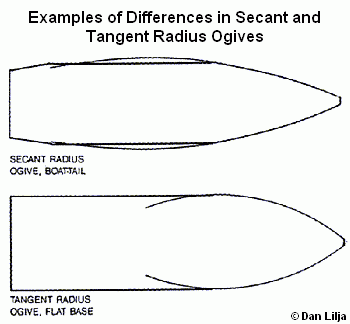
In discussions of ballistics, you’ll see references to “tangent” and “secant” bullet shapes. We know that, for many readers, these terms can be confusing. To add to the confusion, bullet makers don’t always identify their projectiles as secant or tangent designs. This article provides a basic explanation of tangent and secant designs, to help you understand the characteristics of both bullet shapes.
Tangent Ogive vs. Secant Ogive vs. Hybrid
Most match bullets produced today use a tangent ogive profile, but the modern VLD-style bullets employ a secant profile. To further complicate matters, the latest generation of “Hybrid” projectiles from Berger Bullets feature a blended secant + tangent profile to combine the best qualities of both nose shapes. The secant section provides reduced drag, while the tangent section makes the bullet easier to tune, i.e. less sensitive to seating depth position.
Berger Bullets ballistician Bryan Litz explains tangent and secant bullet ogive designs in a glossary section of his Applied Ballistics website, which we reprint below. Bryan then explains how tangent and secant profiles can be combined in a “hybrid” design.
How Bullet Ogive Curves are Defined
While the term “ogive” is often used to describe the particular point on the bullet where the curve reaches full bullet diameter, in fact the “ogive” properly refers to the entire curve of the bullet from the tip to the full-diameter straight section — the shank. Understanding then, that the ogive is a curve, how is that curve described?
LITZ: The ogive of a bullet is usually characterized by the length of its radius. This radius is often given in calibers instead of inches. For example, an 8 ogive 6mm bullet has an ogive that is a segment of a circular arc with a radius of 8*.243 = 1.952”. A .30-caliber bullet with an 8 ogive will be proportionally the same as the 8 ogive 6mm bullet, but the actual radius will be 2.464” for the .30 caliber bullet.
For a given nose length, if an ogive is perfectly tangent, it will have a very specific radius. Any radius longer than that will cause the ogive to be secant. Secant ogives can range from very mild (short radius) to very aggressive (long radius). The drag of a secant ogive is minimized when its radius is twice as long as a tangent ogive radius. In other words, if a tangent ogive has an 8 caliber radius, then the longest practical secant ogive radius is 16 calibers long for a given nose length.”
Secant Ogive vs. Tangent Ogive
Ogive metrics, and Rt/R
LITZ: There is a number that’s used to quantify how secant an ogive is. The metric is known as the Rt/R ratio and it’s the ratio of the tangent ogive radius to the actual ogive radius for a given bullet. In the above example, the 16 caliber ogive would have an Rt/R ratio of 0.5. The number 0.5 is therefore the lowest practical value for the Rt/R ratio, and represents the minimum drag ogive for a given length. An ogive that’s perfectly tangent will have an Rt/R ratio of 1.0. Most ogives are in between an Rt/R of 1.0 and 0.5. The dimensioned drawings at the end of my Applied Ballistics book provide the bullets ogive radius in calibers, as well as the Rt/R ratio. In short, the Rt/R ratio is simply a measure of how secant an ogive is. 1.0 is not secant at all, 0.5 is as secant as it gets.
Hybrid Bullet Design — Best of Both Worlds?
Bryan Litz has been developing a number of modern “Hybrid” design bullets for Berger. The objective of Bryan’s design work has been to achieve a very low drag design that is also “not finicky”. Normal (non-hybrid) secant designs, such as the Berger 105gr VLD, deliver very impressive BC values, but the bullets can be sensitive to seating depth. Montana’s Tom Mousel has set world records with the Berger 105gr VLD in his 6mm Dasher, but he tells us “seating depth is critical to the best accuracy”. Tom says a change of .005″ in seating depth “can cause the group size to increase substantially”. In an effort to produce more forgiving high-BC bullets, Bryan Litz has developed a hybrid tangent/secant bullet shape. This is explained in the illustration below.
The IWA & OutdoorClassics trade show is underway right now in Nuremberg, Germany. The show, which opened its doors on Friday, March 11, concludes Monday, March 14th in the Nuremberg Exhibition Center. After SHOT Show in America, this is the second largest gun/hunting/outdoor sports trade fair in the world. In 2010, 1,141 exhibitors from 55 nations presented their products and services to 32,214 trade visitors from more than 102 countries. Nearly 60% of visitors come from countries other than Germany, making IWA & OutdoorClassics a truly multinational industry gathering.
You can watch videos from the 2011 IWA show using this player. You can also access videos from previous years. To enlarge the videos to full screen, click the little icon with arrows at four corners.
You can read more about the IWA show in the IWA NEWS Daily. These digital journals, produced each show-day in PDF format, contain interesting articles and showcase many new products at the show. It’s worth scanning the IWA NEWS just to check out the latest advertisements from European manufacturers. You’ll find some cool products we otherwise never see on this side of the Atlantic.
Forum Member Tom Sziler(aka Tomekeuro85) produces very nice CNC-milled aluminum loading and sorting blocks that can be customized with your name or catridge designation. These start at just $15 for a 50-bullet sorting tray or 25-round range block. The original 50-round loading blocks cost $25 for most cartridges (smaller than .338 Lapua), $28 for .338 Lapua, and $30 for big stuff like the 50 BMG.
This bullet sorting tray is useful if you sort by base to ogive length or bullet weight.
Trays Are Made to Precise Tolerances and Fitted with Rubber Pads
All trays and blocks have rubber pads on the bottom for grip. Holes are all milled deep, to precise tolerances to prevent rattling, but rounds still fit with sufficient clearance. Clearance is provided on the bottom of each hole to avoid potential primer contact and to make room for debris. You want something customized? No problem. Tom says: “Custom variations of any of these items are available. Just let me know what you’re looking for.”
These blocks are definitely high-quality. Forum member PGG reports: “You can count on top notch work and materials guys. I bought a boat load of them for Christmas gifts [and] they were a huge hit. Super items, super service, great value.” Forum member WoolenMammoth agrees: “[I] ordered a few blocks recently and they far exceeded my expectation. Really nice work at an absurdly competitive price.” For more info, or to place an order, view this Shooters’ Forum Thread, or email Tom.Sziler[at]gmail.com.


 The U.S. Border Patrol Agency has been ordered to “give up its guns”, starting this summer. In a surprise directive issued this morning, the Department of Homeland Security (DHS), parent agency of the Border Patrol, announced that up to one-half of U.S. Border Patrol Agents will be required to turn in their firearms, starting August 1, 2011. The current issue sidearm of the Border Patrol is the HK P2000 LEM in .40 SW, but Agents many also carry rifles and shotguns. Duty Weapons will be replaced by non-lethal dye markers, similar to paintball guns.
 Speaking at a Washington, DC press conference, Homeland Security Director Janet Napolitano stated that stripping the Border Patrol of lethal weapons reflects the “long-stated objective of this Adminstration to value human life over all other lesser considerations.” Napolitano stressed that the Border Patrol would not be required to give up all its firearms. The Patrol would still maintain pistols, rifles, and shotguns in “secure lock-ups” removed from the “immediate border area”.

 Critics of NLAIM technology claim that NLAIM devices are merely over-priced versions of recreational paintball guns, many of which sell for under $200.00. NLAIMs, which will be provided in both pistol and carbine configurations, cost nearly $2700.00 each, not including transport modules. A total of 10,000 NLAIMs will be delivered to the Border Patrol under a no-bid DHS contract valued at $26.8 million dollars. Some of that cost will be offset by revenues earned from the recycling of current Border Patrol firearms which will be decommissioned, melted down, and sold for scrap.
 The Editors of AccurateShooter.com and a pantheon of legendary shooters have collaborated on a new book, Voodoo Accuracy, destined to become the definitive print resource for precision shooting. This new 666-page, full-color treatise compiles the wisdom of today’s greatest Hall of Fame and National Champion shooters. With the Voodoo knowledge of the world’s ‘top guns’ in your grasp, you can and will shoot more accurately no matter what your discipline.
 Order Your Own Copy of Voodoo Accuracy


 Horus ATrag Ballistics software is now embedded in Kestrel 4500 NV Pocket Weather Trackers, eliminating the need for a PDA. Since the ballistics software is built into the Kestrel unit, environmental data automatically flows from the Kestrel side to the ATrag solver for accurate and instant ballistics solutions. You don’t have to punch in wind speed, temp, or air pressure — that’s all done automatically. The 4500 NV Weather Tracker is IP67 waterproof and MIL-STD-810F rugged. MSRP for the Kestrel with Horus Ballistics is $619.00 (non-Bluetooth).
 For 2011,



 The


 These blocks are definitely high-quality. Forum member PGG reports: “You can count on top notch work and materials guys. I bought a boat load of them for Christmas gifts [and] they were a huge hit. Super items, super service, great value.” Forum member WoolenMammoth agrees: “[I] ordered a few blocks recently and they far exceeded my expectation. Really nice work at an absurdly competitive price.” For more info, or to place an order, view this


